

Enhancing health care equity with Indigenous populations: evidence-based strategies from an ethnographic study
Open accessThe DOI matches its Crossref record; 96 of the 97 references it cites were found in a registry or an index.
Abstract
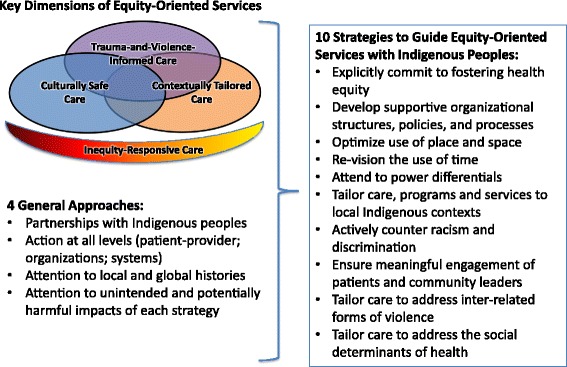
BACKGROUND: Structural violence shapes the health of Indigenous peoples globally, and is deeply embedded in history, individual and institutional racism, and inequitable social policies and practices. Many Indigenous communities have flourished, however, the impact of colonialism continues to have profound health effects for Indigenous peoples in Canada and internationally. Despite increasing evidence of health status inequities affecting Indigenous populations, health services often fail to address health and social inequities as routine aspects of health care delivery. In this paper, we discuss an evidence-based framework and specific strategies for promoting health care equity for Indigenous populations. METHODS: Using an ethnographic design and mixed methods, this study was conducted at two Urban Aboriginal Health Centres located in two inner cities in Canada, which serve a combined patient population of 5,500. Data collection included in-depth interviews with a total of 114 patients and staff (n = 73 patients; n = 41 staff), and over 900 h of participant observation focused on staff members' interactions and patterns of relating with patients. RESULTS: Four key dimensions of equity-oriented health services are foundational to supporting the health and well-being of Indigenous peoples: inequity-responsive care, culturally safe care, trauma- and violence-informed care, and contextually tailored care. Partnerships with Indigenous leaders, agencies, and communities are required to operationalize and tailor these key dimensions to local contexts. We discuss 10 strategies that intersect to optimize effectiveness of health care services for Indigenous peoples, and provide examples of how they can be implemented in a variety of health care settings. CONCLUSIONS: While the key dimensions of equity-oriented care and 10 strategies may be most optimally operationalized in the context of interdisciplinary teamwork, they also serve as health equity guidelines for organizations and providers working in various settings, including individual primary care practices. These strategies provide a basis for organizational-level interventions to promote the provision of more equitable, responsive, and respectful PHC services for Indigenous populations. Given the similarities in colonizing processes and Indigenous peoples' experiences of such processes in many countries, these strategies have international applicability.
Overview
The claims and statistics of this paper haven’t been checked yet.
Free: it reads the open-access text and checks the first 5 claims that cite a source we can check. Create a free account to check every claim.
Integrity signals
Registry
Cites
Statistics
Figures
Verification
Claims the paper makes
The claims and statistics of this paper haven’t been checked yet.
Free: it reads the open-access text and checks the first 5 claims that cite a source we can check. Create a free account to check every claim.
Claims other papers make about this one
Each is checked against this paper’s own text: does it say what the citing paper says it does?
The source backs part of the claim, not all of it — or backs it for a different population, condition or comparison.
In the citing paper
“The current structure continues to cultivate mistrust among Indigenous Peoples with regards to existing healthcare services, and this is especially prevalent for developmental disabilities such as autism (5).”
From Informing care pathways and policies for children and youth with Indigenous perspectives to advance Canada's National Autism Strategy (2022) · cites this paper as [5]
Experimental — accuracy not yet measuredThe source backs part of the claim, not all of it — or backs it for a different population, condition or comparison.
In the citing paper
“This historical, and current, context and events have had detrimental effects on Indigenous people's perceptions and trust of Canadian systems and supports and thus lead to negative health outcomes (5).”
From Informing care pathways and policies for children and youth with Indigenous perspectives to advance Canada's National Autism Strategy (2022) · cites this paper as [5]
Experimental — accuracy not yet measured
Self-check
Percentages, sums and reported differences re-computed from the paper’s own numbers.
The self-check needs the paper’s full text.
Citations
Cites
8 Decolonizing Methodologies: Research and Indigenous Peoples
Tuhiwai Smith, L. (2024) · Foundational Concepts of Decolonial and Southern Epistemologies · doi:10.21832/9781800418868-012 · Cited by 9,810
Canadian Institute for Health Information.
Lalonde, A. (1994) · PubMed · Cited by 4,739
Red Skin, White Masks: Rejecting the Colonial Politics of Recognition
Coulthard, G. S., & Alfred, T. (2014) · doi:10.5749/minnesota/9780816679645.001.0001 · Cited by 4,011
Coulthard, G. S., & Alfred, T. (2010) · University of Minnesota Press eBooks · doi:10.5749/9781452942421 · Cited by 3,963
(2009) · Cited by 2,537
Reclaiming Indigenous Voice and Vision
(2007) · University of British Columbia Press eBooks · doi:10.59962/9780774853170 · Cited by 1,439
Adverse childhood experiences and the risk of premature mortality
Brown, D. W., Anda, R. F., Tiemeier, H., Felitti, V. J., Edwards, V. J., Croft, J. B., & Giles, W. H. (2009) · American Journal of Preventive Medicine · doi:10.1016/j.amepre.2009.06.021 · Cited by 1,369
United Nations Declaration on the Rights of Indigenous Peoples
(2007) · International Journal of Cultural Property · doi:10.1017/s0940739107070270 · Cited by 1,334
Red Skin, White Masks: Rejecting the Colonial Politics of Recognition
Hallenbeck, J., Krebs, M., Hunt, S., Goonewardena, K., Kipfer, S. A., Pasternak, S., & Coulthard, G. S. (2016) · The AAG Review of Books · doi:10.1080/2325548x.2016.1146013 · Cited by 966
The Embodiment of Inequity: Health Disparities in Aboriginal Canada
Adelson, N. (2005) · Canadian Journal of Public Health · doi:10.1007/bf03403702 · Cited by 877
Thorne, S. (2016) · Routledge eBooks · doi:10.4324/9781315545196 · Cited by 849
Elliott, D. E., Bjelajac, P., Fallot, R. D., Markoff, L. S., & Reed, B. G. (2005) · Journal of Community Psychology · doi:10.1002/jcop.20063 · Cited by 834
Kirmayer, L. J., Gone, J. P., & Moses, J. (2014) · Transcultural Psychiatry · doi:10.1177/1363461514536358 · Cited by 652
Decolonizing Methodologies: Research and Indigenous People
Austin, S. (2001) · Journal of Health Psychology · doi:10.1177/135910530100600310 · Cited by 641
The Colour of Democracy: Racism in Canadian Society
Henry, F., Tator, C., Mattis, W., & Rees, T. (2009) · Cited by 622
(2007) · TSpace (University of Toronto) · Cited by 558
A Life Course Perspective on How Racism May Be Related to Health Inequities
Gee, G. C., Walsemann, K. M., & Brondolo, E. (2012) · American Journal of Public Health · doi:10.2105/ajph.2012.300666 · Cited by 547
Shannon, K., Kerr, T., Allinott, S., Chettiar, J., Shoveller, J., & Tyndall, M. W. (2008) · Social Science & Medicine · doi:10.1016/j.socscimed.2007.11.008 · Cited by 489
Dovidio, J. F., Penner, L. A., Albrecht, T. L., Norton, W. E., Gaertner, S. L., & Shelton, J. N. (2008) · Social Science & Medicine · doi:10.1016/j.socscimed.2008.03.019 · Cited by 455
Sawyer, P. J., Major, B., Casad, B. J., Townsend, S. S. M., & Mendes, W. B. (2012) · American Journal of Public Health · doi:10.2105/ajph.2011.300620 · Cited by 431
Dovidio, J. F., & Fiske, S. T. (2012) · American Journal of Public Health · doi:10.2105/ajph.2011.300601 · Cited by 350
Battiste, M. (2008) · Handbook of Critical and Indigenous Methodologies · doi:10.4135/9781483385686.n25 · Cited by 327
Rethinking Indigenous Education: Culturalism, Colonialism, and the Politics of Knowing
McConaghy, C. (2000) · Cited by 307
Closing the health equity gap: evidence-based strategies for primary health care organizations
Browne, A. J., Varcoe, C. M., Wong, S. T., Smye, V. L., Lavoie, J., Littlejohn, D., Tu, D., Godwin, O., Krause, M., Khan, K. B., et al. (2012) · International Journal for Equity in Health · doi:10.1186/1475-9276-11-59 · Cited by 302
Self-citationSpaces of care in the city: the place of a community drop-in centre
Conradson, D. (2003) · Social & Cultural Geography · doi:10.1080/1464936032000137939 · Cited by 272
Anderson, J., Perry, J., Blue, C., Browne, A., Henderson, A., Khan, K. B., Kirkham, S. R., Lynam, J., Semeniuk, P., & Smye, V. (2003) · Advances in Nursing Science · doi:10.1097/00012272-200307000-00005 · Cited by 259
Self-citationHedtke, K. A., Ruggiero, K. J., Fitzgerald, M. M., Zinzow, H. M., Saunders, B. E., Resnick, H. S., & Kilpatrick, D. G. (2008) · Journal of Consulting and Clinical Psychology · doi:10.1037/0022-006x.76.4.633 · Cited by 246
Tang, S. Y., & Browne, A. J. (2008) · Ethnicity & Health · doi:10.1080/13557850701830307 · Cited by 232
Self-citationAccess to Primary Care From the Perspective of Aboriginal Patients at an Urban Emergency Department
Browne, A. J., Smye, V. L., Rodney, P., Tang, S. Y., Mussell, B., & O'Neil, J. (2011) · Qualitative Health Research · doi:10.1177/1049732310385824 · Cited by 219
Self-citationReimagining Global Health: An Introduction
(2019) · University of California Press eBooks · doi:10.1525/9780520954632 · Cited by 206
State of the World’s Indigenous Peoples
(2019) · State of the world's indigenous peoples · doi:10.18356/532f27ac-en · Cited by 201
Women's health and use of crack cocaine in context: Structural and ‘everyday’ violence
Bungay, V., Johnson, J. L., Varcoe, C., & Boyd, S. C. (2010) · International Journal of Drug Policy · doi:10.1016/j.drugpo.2009.12.008 · Cited by 185
Self-citationClinical encounters between nurses and First Nations women in a Western Canadian hospital
Browne, A. J. (2007) · Social Science & Medicine · doi:10.1016/j.socscimed.2007.02.006 · Cited by 185
Self-citationThe impact of stressors on second generation Indian residential school survivors
Bombay, A., Matheson, K., & Anisman, H. (2011) · Transcultural Psychiatry · doi:10.1177/1363461511410240 · Cited by 184
Determinants of Indigenous Peoples’ Health in Canada: Beyond the Social
Tait Neufeld, H. (2017) · Canadian Studies in Population · doi:10.25336/p6mc71 · Cited by 182
Cultural Safety in Aotearoa New Zealand
(2015) · Cambridge University Press eBooks · doi:10.1017/9781009716482 · Cited by 181
Haskell, L., & Randall, M. (2009) · SSRN Electronic Journal · doi:10.3138/ijih.v5i3.28988 · Cited by 177
Chronic Pain in Women Survivors of Intimate Partner Violence
Wuest, J., Merritt-Gray, M., Ford-Gilboe, M., Lent, B., Varcoe, C., & Campbell, J. C. (2008) · The Journal of Pain · doi:10.1016/j.jpain.2008.06.009 · Cited by 175 · cited 1×
“Such training is essential to integrate understandings of the long-term impact of trauma into practices and policies, and to avoid inadvertently creating an invalidating environment [61, 90, 116].”
BackgroundSelf-citationWhen the Other is Me: Native Resistance Discourse, 1850-1990
LaRocque, E. (2010) · Cited by 164
Patient race and physicians' decisions to prescribe opioids for chronic low back pain
Burgess, D. J., Crowley-Matoka, M., Phelan, S., Dovidio, J. F., Kerns, R., Roth, C., Saha, S., & van Ryn, M. (2008) · Social Science & Medicine · doi:10.1016/j.socscimed.2008.09.009 · Cited by 163
Mitrou, F., Cooke, M., Lawrence, D., Povah, D., Mobilia, E., Guimond, E., & Zubrick, S. R. (2014) · BMC Public Health · doi:10.1186/1471-2458-14-201 · Cited by 154
Brownridge, D. A. (2008) · Journal of Family Violence · doi:10.1007/s10896-008-9160-0 · Cited by 151
Smye, V., Browne, A. J., Varcoe, C., & Josewski, V. (2011) · Harm Reduction Journal · doi:10.1186/1477-7517-8-17 · Cited by 138
Self-citationAboriginal Homelessness in Canada: A Literature Review
Patrick, C. (2014) · York University Digital Library (York University) · Cited by 132
The burden of history: colonialism and the frontier myth in a rural Canadian community
(1999) · Choice Reviews Online · doi:10.5860/choice.37-2344 · Cited by 129
Historicizing historical trauma theory: Troubling the trans-generational transmission paradigm
Maxwell, K. (2014) · Transcultural Psychiatry · doi:10.1177/1363461514531317 · Cited by 125 · cited 4×
“We share these concerns and endorse the call for using a decolonizing lens when discussing trauma in relation to Indigenous peoples [62].”
BackgroundInfluentialBrown, S. M., Baker, C. N., & Wilcox, P. (2012) · Psychological Trauma: Theory, Research, Practice, and Policy · doi:10.1037/a0025269 · Cited by 125
Addressing inequities in access to quality health care for indigenous people
Peiris, D., Brown, A., & Cass, A. (2008) · Canadian Medical Association Journal · doi:10.1503/cmaj.081445 · Cited by 120
Indigenous in the City: Contemporary Identities and Cultural Innovation
(2013) · University of British Columbia Press eBooks · doi:10.59962/9780774824668 · Cited by 117
A Systematic Review of Trauma-Focused Interventions for Domestic Violence Survivors
Warshaw, C., Sullivan, C. M., & Rivera, E. A. (2013) · PsycEXTRA Dataset · doi:10.1037/e566602013-001 · Cited by 115
Health Outcomes by Closeness of Sexual Abuse Perpetrator: A Test of Betrayal Trauma Theory
Edwards, V. J., Freyd, J. J., Dube, S. R., Anda, R. F., & Felitti, V. J. (2012) · Journal of Aggression, Maltreatment & Trauma · doi:10.1080/10926771.2012.648100 · Cited by 101
Weiner, S. G., Griggs, C. A., Mitchell, P. M., Langlois, B. K., Friedman, F. D., Moore, R., Lin, S. C., Nelson, K. P., & Feldman, J. A. (2013) · Annals of Emergency Medicine · doi:10.1016/j.annemergmed.2013.05.025 · Cited by 96
The Burden of History: Colonialism and the Frontier Myth in a Rural Canadian Community
Waiser, B., & Furniss, E. (2000) · The Western Historical Quarterly · doi:10.2307/969995 · Cited by 93
Chronic pain among homeless persons: characteristics, treatment, and barriers to management
Hwang, S. W., Wilkins, E., Chambers, C., Estrabillo, E., Berends, J., & MacDonald, A. (2011) · BMC Family Practice · doi:10.1186/1471-2296-12-73 · Cited by 92
Timely Deaths: Medicalizing the Deaths of Aboriginal People in Police Custody
Razack, S. H. (2013) · Law, Culture and the Humanities · doi:10.1177/1743872111407022 · Cited by 90
Women's health in Canada: critical perspectives on theory and policy
(2008) · Choice Reviews Online · doi:10.5860/choice.45-2647 · Cited by 90
Fiske, J., & Browne, A. J. (2006) · Policy Sciences · doi:10.1007/s11077-006-9013-8 · Cited by 89
Self-citationHarms and benefits: Collecting ethnicity data in a clinical context
Varcoe, C., Browne, A. J., Wong, S. T., & Smye, V. L. (2009) · Social Science & Medicine · doi:10.1016/j.socscimed.2009.02.034 · Cited by 87
Self-citationS. McCall-Hosenfeld, J., Winter, M., Heeren, T., & Liebschutz, J. M. (2014) · Journal of Psychosomatic Research · doi:10.1016/j.jpsychores.2014.07.011 · Cited by 86
Wuest, J., Ford-Gilboe, M., Merritt-Gray, M., Varcoe, C., Lent, B., Wilk, P., & Campbell, J. (2009) · Pain Medicine · doi:10.1111/j.1526-4637.2009.00624.x · Cited by 82
Self-citationDenison, J., Varcoe, C., & Browne, A. J. (2014) · Journal of Advanced Nursing · doi:10.1111/jan.12271 · Cited by 81
Self-citationAboriginal urbanization and rights in Canada: Examining implications for health
Senese, L. C., & Wilson, K. (2013) · Social Science & Medicine · doi:10.1016/j.socscimed.2013.02.016 · Cited by 76
Varcoe, C., Brown, H., Calam, B., Harvey, T., & Tallio, M. (2013) · BMC Pregnancy and Childbirth · doi:10.1186/1471-2393-13-26 · Cited by 71
Self-citationIndigenous in the city: contemporary identities and cultural innovation
(2013) · Choice Reviews Online · doi:10.5860/choice.51-2378 · Cited by 70
Baba, J. T., Brolan, C. E., & Hill, P. S. (2014) · International Journal for Equity in Health · doi:10.1186/1475-9276-13-56 · Cited by 67
Anaya, S. J. (2015) · bepress Legal Repository · Cited by 61
Avoidable mortality among First Nations adults in Canada: A cohort analysis.
Park, J., Tjepkema, M., Goedhuis, N., & Pennock, J. (2015) · PubMed · Cited by 58
‘Underclassism’ and access to healthcare in urban centres
Tang, S. Y., Browne, A. J., Mussell, B., Smye, V. L., & Rodney, P. (2015) · Sociology of Health & Illness · doi:10.1111/1467-9566.12236 · Cited by 58
Self-citationWendt, D. C., & Gone, J. P. (2012) · Health & Place · doi:10.1016/j.healthplace.2012.06.004 · Cited by 58
Aboriginal and treaty rights in Canada: essays on law, equity, and respect for difference
(1997) · Choice Reviews Online · doi:10.5860/choice.35-1076 · Cited by 57
Brownridge, D. A. (2008) · Violence Against Women · doi:10.1177/1077801208320368 · Cited by 54
Varcoe, C., Bottorff, J. L., Carey, J., Sullivan, D., & Williams, W. (2010) · Canadian Journal of Public Health · doi:10.1007/bf03404363 · Cited by 52
Self-citationNathoo, T., Poole, N., Bryans, M., Dechief, L., Hardeman, S., Marcellus, L., Poag, E., & Taylor, M. (2020) · First Peoples Child & Family Review An Interdisciplinary Journal Honouring the Voices Perspectives and Knowledges of First Peoples · doi:10.7202/1071409ar · Cited by 51
Evaluation of a Health Care Provider Training Program to Identify and Help Partner Violence Victims
Hamberger, L. K., Guse, C. E., Boerger, J., Minsky, D., Pape, D., & Folsom, C. (2004) · Journal of Family Violence · doi:10.1023/b:jofv.0000011578.37769.c4 · Cited by 47
Varcoe, C., & Dick, S. (2013) · International Journal of Indigenous Health · doi:10.18357/ijih41200812314 · Cited by 45
Self-citationStructural Violence, Oppression, and the Place-Based Marginality of Homelessness
Taylor, S. (2013) · Canadian social work review · Cited by 44
Walker, R., Cromarty, H., Linkewich, B., Semple, D., & Pierre-Hansen, N. S. (2013) · International Journal of Indigenous Health · doi:10.18357/ijih61201012346 · Cited by 39
Development of Health Equity Indicators in Primary Health Care Organizations Using a Modified Delphi
Wong, S. T., Browne, A. J., Varcoe, C., Lavoie, J., Fridkin, A., Smye, V., Godwin, O., & Tu, D. (2014) · PLoS ONE · doi:10.1371/journal.pone.0114563 · Cited by 39
Self-citationFirestone, M., Smylie, J., Maracle, S., Spiller, M., & O'Campo, P. (2014) · BMJ Open · doi:10.1136/bmjopen-2014-004978 · Cited by 38
The association between intimate partner violence, alcohol and depression in family practice
Gilchrist, G., Hegarty, K., Chondros, P., Herrman, H., & Gunn, J. (2010) · BMC Family Practice · doi:10.1186/1471-2296-11-72 · Cited by 38
LAVOIE, J., BOULTON, A., & DWYER, J. (2010) · Public Administration · doi:10.1111/j.1467-9299.2009.01784.x · Cited by 37
Self-citationFrom the design to implementation: the case of the Health Care Integration Councils (CIRA) in Chile
Arteaga, O., Fuentes, A., Toro, O., & Alarcón, A. (2012) · International Journal for Equity in Health · doi:10.1186/1475-9276-11-s1-a2 · Cited by 35
Pedagogy as Influencing Nursing Students' Essentialized Understanding of Culture
Gregory, D., Harrowing, J., Lee, B. A., Doolittle, L., & O'Sullivan, P. (2010) · International Journal of Nursing Education Scholarship · doi:10.2202/1548-923x.2025 · Cited by 35
Enhancing measurement of primary health care indicators using an equity lens: An ethnographic study
Wong, S. T., Browne, A. J., Varcoe, C., Lavoie, J., Smye, V., Godwin, O., Littlejohn, D., & Tu, D. (2011) · International Journal for Equity in Health · doi:10.1186/1475-9276-10-38 · Cited by 35
Self-citationTo Repair the World: Paul Farmer Speaks to the Next Generation
Farmer, P. E. (2019) · University of California Press eBooks · doi:10.1525/9780520955431 · Cited by 34
Stout, M. D. (2012) · PubMed · Cited by 32
An Exploration of the Connection between Child Sexual Abuse and Gambling in Aboriginal Communities
Dion, J., Collin‐Vézina, D., Sablonnière-Griffin, M. D. L., Philippe-Labbé, M.-P., & Giffard, T. (2009) · International Journal of Mental Health and Addiction · doi:10.1007/s11469-009-9234-0 · Cited by 31
(2012) · TSpace (University of Toronto) · Cited by 28
Self-citationAddressing health inequities through indigenous involvement in health-policy discourses.
Fridkin, A. (2012) · PubMed · Cited by 26
Self-citationBrowne, A. J., Varcoe, C. M., Wong, S. T., Smye, V. L., & Khan, K. B. (2014) · Ethnicity & Health · doi:10.1080/13557858.2013.814766 · Cited by 20 · cited 1×
“We have argued elsewhere that it is important for health care organizations to develop strategies for fostering health equity in ways that will result in overall improvements in care [6, 42, 44].”
BackgroundSelf-citationLegally invisible: stewardship for Aboriginal and Torres Strait Islander health
Howse, G., & Dwyer, J. (2015) · Australian and New Zealand Journal of Public Health · doi:10.1111/1753-6405.12358 · Cited by 14
Yli-Kauhaluoma, S. (2016) · UTUPub (University of Turku) · Cited by 13
Fiske, J. (2009) · University of British Columbia Press eBooks · doi:10.59962/9780774815253-009 · Cited by 13
Indigenous people's health and health-care equity: seven years later.
Gregory, D., & Harrowing, J. (2012) · PubMed · Cited by 9
Stout, M. D. (2012) · PubMed · Cited by 9
Maschinot, B., & Cohen, J. (2012) · Cited by 7
Discourse / Discours - Indigenous People's Health and Health-Care Equity: Seven Years Later
Gregory, D., & Harrowing, J. (2012) · Canadian Journal of Nursing Research · Cited by 1
Research works printed but not linked: 30
- The Chief Public Health Officer. The Chief Public Health Officer's report on the state of public health in Canada Growing up well - Priorities for a healthy future 2009 Ottawa, ON Public Health Agency of Canada 2009
- World Health Organization Closing the health equity gap: Policy options and opportunities for action 2013 Geneva, Switzerland World Health Organization
- World Health Organization The World Health Report 2008 - Primary health care (Now more than ever) 2008 Geneva, Switzerland World Health Organization
- World Health Organization Monitoring health inequality: An essential step for achieving health equity 2014 Geneva, Switzerland World Health Organization
- Canadian Institute for Health Information Disparities in primary health care experiences among Canadians with ambulatory care sensitive conditions 2012 Ottawa, ON Canadian Institute for Health Information
- Parliament of Canada A report on missing and murdered Indigenous women in Canada 2014 Ottawa, ON Parliament of Canada
- Allan B Smylie J First peoples, second class treatment: The role of racism in the health and well-being of Indigenous peoples in Canada 2015 The Wellesley Institute Toronto, ON
- United Nations Department of Economic and Social Affairs State of the world’s Indigenous peoples 2009 New York, NY United Nations Department of Economic and Social Affairs Division for Social Policy and Development
- Reading J Halseth R Pathways to improving well-being for Indigenous peoples: How living conditions decide health 2013 Prince George, BC National Collaborating Centre for Aboriginal Health
- Office of the Provincial Health Officer The health and wellbeing of the Aboriginal population: Interim update. Provincial Health Officer's Special Report 2012 Victoria, BC BC Ministry of Health Planning Office of the Provincial Health Officer
- Public Health Agency of Canada Population-specific HIV/AIDS status report: Women 2012 Ottawa, ON Public Health Agency of Canada
- Public Health Agency of Canada Population-specific HIV/AIDS status report: Aboriginal peoples 2010 Ottawa, ON Public Health Agency of Canada
- Barton R Missing Aboriginal women: Ottawa ignored draft report’s inquiry recommendation: Calls for inquiry grow after RCMP reveals 1,200 Aboriginal women murdered or missing over 30 years CBC News 2014 Ottawa, ON CBC News
- Police RCM Missing and murdered Aboriginal women: A national operational overview 2014 Ottawa, ON Royal Canadian Mounted Policy
- The Special Committee on Violence Against Indigenous Women Invisible women: A call to action. A report on missing and murdered Indigenous women in Canada 2014 Ottawa, ON Speaker of the House of Commons
- News CBC Winnipeg ER death a failure ‘at all levels’, inquest told 2013
- Poole N Essentials of trauma-informed care 2012 Ottawa, ON The Canadian Network of Substance Abuse and Allied Professionals
- Dion SM Knowledge exchange workshop: Successful approaches for the prevention of Aboriginal family violence 2009 Gatineau, QC Public Health Agency of Canada
- Dion Stout M Spirit beads, resilience and residential school Visions: BC’s Mental Health Addict J 2008 5 1 11
- LaRocque ED Violence in Aboriginal communities. Reprinted from the book “The path to healing” with permission from the Royal Commissions on Aboriginal Peoples 1994 Ottawa, ON Health Canada
- Battiste M Reclaiming Indigenous voice and vision 2000 Vancouver, BC University of British Columbia Press
- Ramsden I Cultural safety and nursing education in Aotearoa and Te Waipounamu. Doctoral dissertation 2002 Wellington, New Zealand University of Wellington
- Indigenous Physicians Association of Canada The Royal College of Physicians and Surgeons of Canada. Cultural safety in practice: A curriculum for family medicine residents and physicians 2009 Winnipeg & Ottawa IPAC-RCPSC Family Medicine Curriculum Development Working Group
- Indigenous Physicians Association of Canada The Royal College of Physicians and Surgeons of Canada. Promoting culturally safe care for First Nations, Inuit and Métis patients: A core curriculum for residents and physicians 2009 Winnipeg & Ottawa IPAC-RCPSC Family Medicine Curriculum Development Working Group
- Aboriginal Nurses Association of Canada Cultural competence and cultural safety in First Nations, Inuit and Métis Nursing Education: An integrated review of the literature. Making it happen: Strengthening First Nation, Inuit and Métis health human resources 2009 Ottawa, ON Aboriginal Nurses Association of Canada
- Varcoe C Browne AJ MacDonald-Jenkins J Luctkar-Flude M Interpersonal violence assessment Physical examination and health assessment by C Jarvis 2014 2 Toronto, ON Elsevier 120 137
- Boyer Y Moving Aboriginal health forward: Discarding Canada’s legal barriers 2014 Saskatoon, SK Purish Publishing Limited
- Canada S Aboriginal demographics from the 2011 National Household Survey: Government of Canada 2013 Research and Statistics Branch Aboriginal Affairs and Northen Development Planning
- Ministry of Aboriginal Relations and Reconciliation Off-reserve Aboriginal action plan provincial coordination team 2012-13 year-end report 2013 Victoria, BC Government of British Columbia
- Stats BC Aboriginal population in British Columbia: A study of selected indicators for off-reserve and urban Aboriginal and non-Aboriginal populations 2011 Victoria, BC BC Stats
Cited by
Implementing Anti-Racism Interventions in Healthcare Settings: A Scoping Review
Hassen, N., Lofters, A., Michael, S., Mall, A., Pinto, A. D., & Rackal, J. (2021) · International Journal of Environmental Research and Public Health · doi:10.3390/ijerph18062993 · Cited by 286
Pain in persons who are marginalized by social conditions
Craig, K. D., Holmes, C., Hudspith, M., Moor, G., Moosa-Mitha, M., Varcoe, C., & Wallace, B. (2020) · Pain · doi:10.1097/j.pain.0000000000001719 · Cited by 203
Self-citationFORD‐GILBOE, M., WATHEN, C. N., VARCOE, C., HERBERT, C., JACKSON, B. E., LAVOIE, J. G., PAULY, B. (., PERRIN, N. A., SMYE, V., WALLACE, B., et al. (2018) · The Milbank Quarterly · doi:10.1111/1468-0009.12349 · Cited by 201
Self-citationTrauma informed interventions: A systematic review
Han, H., Miller, H., Nkimbeng, M. J., Budhathoki, C. B., Mikhael, T., Rivers, E., Gray, J., TRIMBLE, K., Chow, S., & Wilson, P. (2021) · PLoS ONE · doi:10.1371/journal.pone.0252747 · Cited by 193
Nguyen, N. H., Subhan, F. B., Williams, K., & Chan, C. B. (2020) · Healthcare · doi:10.3390/healthcare8020112 · Cited by 173
“Practices include developing and delivering culturally sensitive healthcare services by: hiring Indigenous HCPs, or non-Indigenous staff who are motivated to work in Indigenous communities [25,58], developing anti-racism policies, and providing cross-cultural training [86].”
Background
Metadata
- Authors
- Browne, A. J., Varcoe, C., Lavoie, J., Smye, V., Wong, S. T., Krause, M., Tu, D., Godwin, O., Khan, K., & Fridkin, A.
- Affiliations
- University of British Columbia (CA)
- Ontario Tech University (CA)
- Soonats’ooneh Community Health Centre (CA)
- Provincial Health Services Authority (CA)
- Corresponding author
- Browne, Annette J.
- Venue
- BMC Health Services Research
- Published
- 2016-10-04
- Volume
- 16
- Issue
- 1
- Pages
- 544-544
- ISSN
- 1472-6963 (ISSN-L)
- PMC
- PMC5050637
- OpenAlex
- W2528586959
- Cited by
- 358
- References
- 96
- Citations by year
- 2026: 37 · 2025: 36 · 2024: 34 · 2023: 41 · 2022: 49 · 2021: 52 · 2020: 43 · 2019: 28 · 2018: 27 · 2017: 7
- FWCI
- 27.27
- Type
- journal article
- Language
- en
- Open access
- gold
- doi.org
- Licence
- cc-by
- Locations
- BMC Health Services Research (publishedVersion, cc-by)
- Europe PMC (PubMed Central) (publishedVersion, cc-by)
- PubMed Central (publishedVersion, cc-by)
- PubMed (publishedVersion)
- cIRcle (University of British Columbia) (submittedVersion, cc-by)
- Mspace (University of Manitoba) (submittedVersion)
- Open Collections
- Funders
- Canadian Institutes of Health Research (173182)
- Topics
- Social Sciences › Health › Indigenous Health, Education, and Rights
- Health Sciences › Medicine › Public Health, Environmental and Occupational Health › Cultural Competency in Health Care
- Social Sciences › Anthropology › Indigenous Cultures and History
- Keywords
- health care equity, indigenous peoples, structural violence, racism, colonialism, culturally safe care, Indigenous community partnerships, primary care, patient-provider relationship, health disparities
- MeSH terms
- Health Equity, Exposure to Violence, Anthropology, Cultural, Canada, Culture, Health Services, Indigenous, Humans, Indians, North American, Primary Health Care, Professional-Patient Relations, Violence, Organizational Policy, Trust, Healthcare Disparities, Racism
About these checks
Registry, retraction, Cites and statistics results are computed, not judged, with one exception: a printed reference that no index lists is read once by a model before it counts as a citation error. Claims are extracted by a model and kept only when their quote appears verbatim in the text; each cited source is then checked, with a model’s help, for whether it says what the claim relies on. Those verdicts can be wrong — read the claim’s quote and the cited source before relying on one.
Statistics and arithmetic are recomputed, not judged.
Confidence bands are shown only for fields calibrated on our annotated test set. None is calibrated yet, so no band is shown.
What counts as a claim ›How we measure confidence ›How we check this ›
Are you an author, or do you see a problem with this page? Request a review
Data sources
Bibliographic data: Semantic Scholar, OpenAlex, Crossref.
Contains information from the Semantic Scholar Academic Graph Datasets, made available under the ODC Attribution License (ODC-BY 1.0).
Semantic Scholar’s data is described in: Kinney, R., et al. (2023). The Semantic Scholar Open Data Platform. arXiv:2301.10140.
