

Role of mHealth applications for improving antenatal and postnatal care in low and middle income countries: a systematic review
Open accessThe DOI matches its Crossref record; 37 of the 39 references it cites were found in a registry or an index.
Abstract
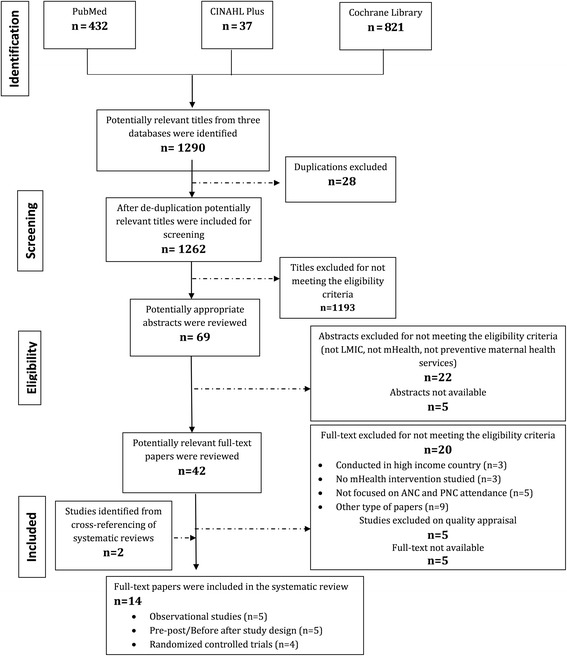
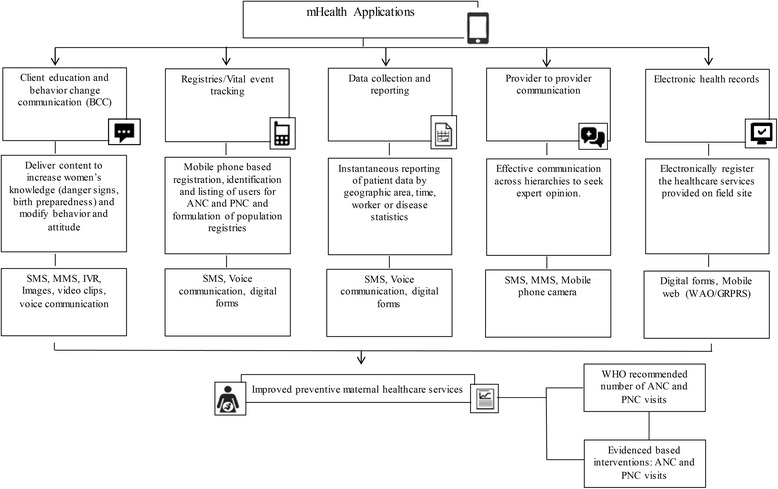
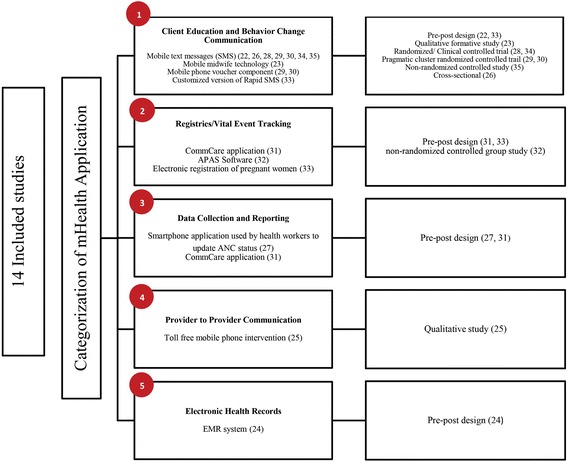
BACKGROUND: From 1990 to 2015, the number of maternal deaths globally has dropped by 43%. Despite this, progress in attaining MDG 5 is not remarkable in LMICs. Only 52% of pregnant women in LMICs obtain WHO recommended minimum of four antenatal consultations and the coverage of postnatal care is relatively poor. In recent years, the increased cellphone penetration has brought the potential for mHealth to improve preventive maternal healthcare services. The objective of this review is to assess the effectiveness of mHealth solutions on a range of maternal health outcomes by categorizing the interventions according to the types of mHealth applications. METHODS: Three international online electronic databases were searched between January 1, 2000 and January 25, 2016 to identify studies exploring the role of mHealth solutions in improving preventive maternal healthcare services. Of 1262 titles screened after duplication, 69 potentially relevant abstracts were obtained. Out of 69 abstracts, 42 abstracts were shortlisted. Full text of 42 articles was reviewed using data extraction sheet. A total of 14 full text studies were included in the final analysis. RESULTS: The 14 final studies were categorized in to five mHealth applications defined in the conceptual framework. Based on our analysis, the most reported use of mHealth was for client education and behavior change communication, such as SMS and voice reminders [n = 9, 65%]. The categorization provided the understanding that much work have been done on client education and behavior change communication. Most of the studies showed that mHealth interventions have proven to be effective to improve antenatal care and postnatal care services, especially those that are aimed at changing behavior of pregnant women and women in postnatal period. However, little evidence exists on other type of mHealth applications. CONCLUSION: This review suggests that mHealth solutions targeted at pregnant women and women in postnatal period can improve preventive maternal healthcare services. However, there is a need to conduct more controlled-trials and quasi-experimental studies to strengthen the literature in this research area. The review recommends that mHealth researchers, sponsors, and publishers should prioritize the transparent reporting of interventions to allow effective interpretation of extracted data.
Overview
The claims and statistics of this paper haven’t been checked yet.
Free: it reads the open-access text and checks the first 5 claims that cite a source we can check. Create a free account to check every claim.
Integrity signals
Registry
Cites
Statistics
Figures
Verification
Claims the paper makes
The claims and statistics of this paper haven’t been checked yet.
Free: it reads the open-access text and checks the first 5 claims that cite a source we can check. Create a free account to check every claim.
Claims other papers make about this one
Each is checked against this paper’s own text: does it say what the citing paper says it does?
The source backs part of the claim, not all of it — or backs it for a different population, condition or comparison.
In the citing paper
“This is a clear indication that mobile messaging may be the communication of choice for most users instead of other means of mHealth communication.”
From mHealth communication to strengthen postnatal care in rural areas: a systematic review (2019) · cites this paper as [14]
Experimental — accuracy not yet measuredThe source backs part of the claim, not all of it — or backs it for a different population, condition or comparison.
In the citing paper
“These findings are in line with other studies that demonstrate that mHealth communication reduces physical barriers to accessibility [14, 49, 54] and avails health services at reduced costs [57].”
From mHealth communication to strengthen postnatal care in rural areas: a systematic review (2019) · cites this paper as [14]
Experimental — accuracy not yet measured
Self-check
Percentages, sums and reported differences re-computed from the paper’s own numbers.
The self-check needs the paper’s full text.
Citations
Cites
(2014) · Medical Entomology and Zoology · Cited by 17,633
Cochrane Handbook for Systematic Reviews of Interventions Version 5.0.1. The Cochrane Collaboration
Higgins, J. P. T., Green, S. R., & Higgins, J. P. T. (2008) · Cited by 7,259
Eysenbach, G., & CONSORT-EHEALTH Group (2011) · Journal of Medical Internet Research · doi:10.2196/jmir.1923 · Cited by 1,863
Contraception for adolescents in low and middle income countries: needs, barriers, and access
Chandra-Mouli, V., McCarraher, D. R., Phillips, S. J., Williamson, N. E., & Hainsworth, G. (2014) · Reproductive Health · doi:10.1186/1742-4755-11-1 · Cited by 687
Suzuki, E., Mathers, C. D., Moller, A., Alkema, L., Say, L., Gemmill, A., Mills, S. L., Chou, D., & Hogan, D. R. (2014) · Cited by 680
Labrique, A. B., Vasudevan, L., Kochi, E., Fabricant, R., & Mehl, G. (2013) · Global Health: Science and Practice · doi:10.9745/ghsp-d-13-00031 · Cited by 601 · cited 2×
“Labrique and colleagues identified 12 mHealth applications to respond to various health issues [17].”
BackgroundFinlayson, K., & Downe, S. (2013) · PLoS Medicine · doi:10.1371/journal.pmed.1001373 · Cited by 472
Lee, S. H., Nurmatov, U. B., Nwaru, B. I., Mukherjee, M., Grant, L., & Pagliari, C. (2016) · Journal of Global Health · doi:10.7189/jogh.06.010401 · Cited by 456
Høyer, B. B., Ramlau-Hansen, C. H., Pedersen, H. S., Góralczyk, K., Chumak, L., Jönsson, B. A., Bonde, J. P., & Toft, G. (2015) · BMC Public Health · doi:10.1186/s12889-015-1465-3 · Cited by 441
Ng, S.-K., Cameron, C. M., Hills, A. P., McClure, R. J., & Scuffham, P. A. (2014) · BMC Pregnancy and Childbirth · doi:10.1186/1471-2393-14-314 · Cited by 391
Tamrat, T., & Kachnowski, S. (2012) · Maternal and Child Health Journal · doi:10.1007/s10995-011-0836-3 · Cited by 312
Mobile phones improve antenatal care attendance in Zanzibar: a cluster randomized controlled trial
Lund, S., Nielsen, B. B., Hemed, M., Boas, I. M., Said, A., Said, K., Makungu, M. H., & Rasch, V. (2014) · BMC Pregnancy and Childbirth · doi:10.1186/1471-2393-14-29 · Cited by 301 · cited 1×
“All studies used text message (SMS) appointment reminders and antenatal education for pregnant women and two also provided the women with mobile phone voucher component to contact their health worker, if needed [29, 30].”
BackgroundMrisho, M., Obrist, B., Schellenberg, J. A., Haws, R. A., Mushi, A. K., Mshinda, H., Tanner, M., & Schellenberg, D. (2009) · BMC Pregnancy and Childbirth · doi:10.1186/1471-2393-9-10 · Cited by 299 · cited 1×
“However, it is suggested that women should have at least one or more postnatal visits within 2 days of delivery [7, 8].”
BackgroundPsychometric properties of the Swedish childbirth self-efficacy inventory (Swe-CBSEI)
Carlsson, I.-M., Ziegert, K., & Nissen, E. (2014) · BMC Pregnancy and Childbirth · doi:10.1186/1471-2393-14-1 · Cited by 295
(2012) · PubMed Central · doi:10.11604/pamj.2012.13.31.1864 · Cited by 259
Lund, S., Hemed, M., Nielsen, B., Said, A., Said, K., Makungu, M., & Rasch, V (2012) · BJOG: An International Journal of Obstetrics & Gynaecology · doi:10.1111/j.1471-0528.2012.03413.x · Cited by 228 · cited 1×
“All studies used text message (SMS) appointment reminders and antenatal education for pregnant women and two also provided the women with mobile phone voucher component to contact their health worker, if needed [29, 30].”
BackgroundLanglois, É. V., Miszkurka, M., Zunzunegui, M. V., Ghaffar, A., Ziegler, D., & Karp, I. (2015) · Bulletin of the World Health Organization · doi:10.2471/blt.14.140996 · Cited by 227 · cited 2×
“However, it is suggested that women should have at least one or more postnatal visits within 2 days of delivery [7, 8].”
BackgroundWatterson, J. L., Walsh, J., & Madeka, I. (2015) · BioMed Research International · doi:10.1155/2015/153402 · Cited by 183 · cited 3×
“Description of included studies and quality appraisal (DOCX 21 kb) Abbreviations ANC: Antenatal care; ART: Antiretroviral Therapy; CHWs: Community Health Workers; EmONC: Emergency Obstetric and Neonatal Care; EMR: Electronic Medical Records; FGDs: Focus Group Discussions; HIC: High Income Countries; ICT: Information a…”
BackgroundInfluentialImprovement of maternal health services through the use of mobile phones
Noordam, A. C., Kuepper, B. M., Stekelenburg, J., & Milen, A. (2011) · Tropical Medicine & International Health · doi:10.1111/j.1365-3156.2011.02747.x · Cited by 174
Antenatal and postnatal care service utilization in southern Ethiopia: a population-based study.
Regassa, N. (2011) · PubMed Central · Cited by 174
Das, J. K., Kumar, R., Salam, R. A., Lassi, Z. S., & Bhutta, Z. A. (2014) · Reproductive Health · doi:10.1186/1742-4755-11-s2-s4 · Cited by 173
Application of smart phone in "Better Border Healthcare Program": A module for mother and child care
Kaewkungwal, J., Singhasivanon, P., Khamsiriwatchara, A., Sawang, S., Meankaew, P., & Wechsart, A. (2010) · BMC Medical Informatics and Decision Making · doi:10.1186/1472-6947-10-69 · Cited by 126 · cited 3×
“The other observed categories were mHealth as a Data collection and reporting, mainly to ensure data recording and completeness [27, 31]; as a provider to provider communication platform, to access support from care providers [25]; and as an electronic health record system to ensure availability of health information…”
BackgroundComfort, A. B., Peterson, L. A., & Hatt, L. E. (2013) · PubMed Central · Cited by 125
Chanlekha, H., Kawazoe, A., & Collier, N. (2010) · BMC Medical Informatics and Decision Making · doi:10.1186/1472-6947-10-1 · Cited by 109
McNabb, M., Chukwu, E., Ojo, O., Shekhar, N., Gill, C. J., Salami, H., & Jega, F. (2015) · PLOS ONE · doi:10.1371/journal.pone.0123940 · Cited by 107 · cited 4×
“The other observed categories were mHealth as a Data collection and reporting, mainly to ensure data recording and completeness [27, 31]; as a provider to provider communication platform, to access support from care providers [25]; and as an electronic health record system to ensure availability of health information…”
BackgroundInfluentialHaskew, J., Rø, G., Saito, K., Turner, K., Odhiambo, G., Wamae, A., Sharif, S. K., & Sugishita, T. (2015) · International Journal of Medical Informatics · doi:10.1016/j.ijmedinf.2015.01.005 · Cited by 87 · cited 3×
“The other observed categories were mHealth as a Data collection and reporting, mainly to ensure data recording and completeness [27, 31]; as a provider to provider communication platform, to access support from care providers [25]; and as an electronic health record system to ensure availability of health information…”
BackgroundLau, Y. K., Cassidy, T., Hacking, D., Brittain, K., Haricharan, H. J., & Heap, M. (2014) · BMC Pregnancy and Childbirth · doi:10.1186/1471-2393-14-284 · Cited by 79
Mushamiri, I., Luo, C., Iiams-Hauser, C., & Ben Amor, Y. (2015) · BMC Public Health · doi:10.1186/s12889-015-1358-5 · Cited by 76
Intergenerational impacts of maternal mortality: Qualitative findings from rural Malawi
Bazile, J., Rigodon, J., Berman, L., Boulanger, V. M., Maistrellis, E., Kausiwa, P., & Yamin, A. E. (2015) · Reproductive Health · doi:10.1186/1742-4755-12-s1-s1 · Cited by 75
Mayo‐Wilson, L. J., Omoni, A. O., Akerele, A., Ibrahim, Y., & Ekanem, E. E. (2015) · International Journal of Medical Informatics · doi:10.1016/j.ijmedinf.2015.01.016 · Cited by 66 · cited 2×
“Only few studies evaluated the impact of mHealth interventions on postnatal care services [26, 32, 35].”
BackgroundImpact of Mobile Telephone on Maternal Health Service Care: A Case of Njoro Division
Fedha, T. (2014) · Open Journal of Preventive Medicine · doi:10.4236/ojpm.2014.45044 · Cited by 61 · cited 1×
“[34] In Zanzibar, a pragmatic cluster randomized controlled trial was conducted in primary health facilities.”
BackgroundA study to assess the feasibility of Text Messaging Service in delivering
Datta, S. S. (2014) · Australasian Medical Journal · doi:10.4066/amj.2014.1916 · Cited by 53 · cited 1×
“Five studies examined ANC services before and after implementation of mHealth applications for improved patient electronic records, data collection and reporting, vital event tracking and automated appointment reminders; these studies similarly found a statistically significant improvement in on-time ANC attendance, d…”
BackgroundLearning the ABCs of pregnancy and newborn care through mobile technology
Entsieh, A. A., Emmelin, M., & Pettersson, K. O. (2015) · Global Health Action · doi:10.3402/gha.v8.29340 · Cited by 51 · cited 1×
“Two qualitative studies conducted in LMICs evaluated the impact mobile midwife technology and toll free mobile phone communication on quality of ANC and health advice; women in both studies verbalized that ANC visits have improved after the introduction of mobile technology and SBAs have become competent in managing c…”
BackgroundHuq, N. L., Azmi, A. J., Quaiyum, M., & Hossain, S. (2014) · Reproductive Health · doi:10.1186/1742-4755-11-52 · Cited by 46 · cited 3×
“The other observed categories were mHealth as a Data collection and reporting, mainly to ensure data recording and completeness [27, 31]; as a provider to provider communication platform, to access support from care providers [25]; and as an electronic health record system to ensure availability of health information…”
BackgroundNurmatov, U. B., Lee, S. H., Nwaru, B. I., Mukherjee, M., Grant, L., & Pagliari, C. (2014) · Journal of Global Health · doi:10.7189/jogh.04.010407 · Cited by 46
Kvist, L. J., & Persson, E. K. (2009) · BMC Pregnancy and Childbirth · doi:10.1186/1471-2393-9-35 · Cited by 38
Role of reminder by text message in enhancing postnatal clinic attendance
Adanikin, A. I., Awoleke, J. O., & Adeyiolu, A. (2014) · International Journal of Gynecology & Obstetrics · doi:10.1016/j.ijgo.2014.02.009 · Cited by 33 · cited 1×
“Only few studies evaluated the impact of mHealth interventions on postnatal care services [26, 32, 35].”
Background
Research works printed but not linked: 3
- PHilbriCk WC. mHealth MNCH: State of the Evidence Trends, gaps, stakeholder needs, and opportunities for future research on the use of mobile technology to improve maternal, newborn, and child health 2013 Washington UN Foundation
- Feroz A, Perveen S, Aftab W. Role of mHealth solutions in improving antenatal and postnatal care attendance in low and middle income countries: a systematic review. 2016. PROSPERO 2016:CRD42016035503 Available from http://www.crd.york.ac.uk/PROSPERO/display_record.asp?ID=CRD42016035503 PMC5678803 29115992
- World Bank Country and lending groups 2016
Cited by
What is the clinical value of mHealth for patients?
Rowland, S. P., Fitzgerald, J. E., Holme, T., Powell, J., & McGregor, A. (2020) · npj Digital Medicine · doi:10.1038/s41746-019-0206-x · Cited by 454
Osei, E., & Mashamba-Thompson, T. P. (2021) · Heliyon · doi:10.1016/j.heliyon.2021.e06639 · Cited by 166
Badawy, S. M., Cronin, R. M., Hankins, J. S., Crosby, L. E., DeBaun, M. R., Thompson, A. A., & Shah, N. (2018) · Journal of Medical Internet Research · doi:10.2196/10940 · Cited by 170
“In addition, many studies have discussed improvement in self-management using eHealth in low- and middle-income countries [42-49].”
BackgroundOnline Antenatal Care During the COVID-19 Pandemic: Opportunities and Challenges
Wu, H., Sun, W., Huang, X., Yu, S., Wang, H., Bi, X., Sheng, J., Chen, S., Akinwunmi, B. O., Zhang, C. J. P., et al. (2020) · Journal of Medical Internet Research · doi:10.2196/19916 · Cited by 134
“Online antenatal care programs can take various forms: online courses to deliver pregnancy-related information, mobile phone apps to motivate healthy behaviors during pregnancy, and mobile health (mHealth) apps to provide mental consultations [8,9].”
Feroz, A. S., Ali, N. A., Khoja, A. A., Asad, A., & Saleem, S. (2021) · Reproductive Health · doi:10.1186/s12978-020-01059-7 · Cited by 137
“Many LMICs have attained a substantial level of cell phone penetration (over 90%) in recent years [4, 5].”
BackgroundSelf-citation
Metadata
- Authors
- Feroz, A., Perveen, S., & Aftab, W.
- Affiliations
- Aga Khan University (PK)
- Corresponding author
- Feroz, Anam
- Venue
- BMC Health Services Research
- Published
- 2017-11-07
- Volume
- 17
- Issue
- 1
- Pages
- 704-704
- ISSN
- 1472-6963 (ISSN-L)
- PMC
- PMC5678803
- OpenAlex
- W2767579371
- Cited by
- 210
- References
- 39
- Citations by year
- 2026: 15 · 2025: 22 · 2024: 26 · 2023: 28 · 2022: 33 · 2021: 36 · 2020: 24 · 2019: 17 · 2018: 8 · 2017: 1
- FWCI
- 2.41
- Type
- journal article
- Language
- en
- Open access
- gold
- doi.org
- Licence
- cc-by
- Locations
- BMC Health Services Research (publishedVersion, cc-by)
- Europe PMC (PubMed Central) (publishedVersion, cc-by)
- PubMed Central (publishedVersion, cc-by)
- PubMed (publishedVersion)
- DOAJ (DOAJ: Directory of Open Access Journals) (submittedVersion, cc-by-sa)
- Topics
- Health Sciences › Health Professions › General Health Professions › Mobile Health and mHealth Applications
- Physical Sciences › Computer Science › Information Systems › ICT in Developing Communities
- Health Sciences › Medicine › Pediatrics, Perinatology and Child Health › Global Maternal and Child Health
- Keywords
- mobile health, prenatal care, postpartum care, maternal health, low- and middle-income countries, SMS reminders, behavior change communication, client education, pregnant women, maternal outcomes, intervention reporting quality
- MeSH terms
- Developing Countries, Female, Humans, Income, Male, Maternal Health Services, Postnatal Care, Pregnancy, Prenatal Care, Telemedicine, Cell Phone, Quality Improvement
About these checks
Registry, retraction, Cites and statistics results are computed, not judged, with one exception: a printed reference that no index lists is read once by a model before it counts as a citation error. Claims are extracted by a model and kept only when their quote appears verbatim in the text; each cited source is then checked, with a model’s help, for whether it says what the claim relies on. Those verdicts can be wrong — read the claim’s quote and the cited source before relying on one.
Statistics and arithmetic are recomputed, not judged.
Confidence bands are shown only for fields calibrated on our annotated test set. None is calibrated yet, so no band is shown.
What counts as a claim ›How we measure confidence ›How we check this ›
Are you an author, or do you see a problem with this page? Request a review
Data sources
Bibliographic data: Semantic Scholar, OpenAlex, Crossref.
Contains information from the Semantic Scholar Academic Graph Datasets, made available under the ODC Attribution License (ODC-BY 1.0).
Semantic Scholar’s data is described in: Kinney, R., et al. (2023). The Semantic Scholar Open Data Platform. arXiv:2301.10140.
