

A tailored intervention to promote uptake of retinal screening among young adults with type 2 diabetes - an intervention mapping approach
Open accessThe DOI matches its Crossref record; 85 of the 87 references it cites were found in a registry or an index, and 2 are not checked yet; none of the 73 sources its claims cite is checked for support yet.
Abstract
BACKGROUND: Young adults (18-39 years) with type 2 diabetes are at risk of early development and rapid progression of diabetic retinopathy, a leading cause of vision loss and blindness in working-age adults. Retinal screening is key to the early detection of diabetic retinopathy, with risk of vision loss significantly reduced by timely treatment thereafter. Despite this, retinal screening rates are low among this at-risk group. The objective of this study was to develop a theoretically-grounded, evidence-based retinal screening promotion leaflet, tailored to young adults with type 2 diabetes. METHODS: Utilising the six steps of Intervention Mapping, our multidisciplinary planning team conducted a mixed-methods needs assessment (Step 1); identified modifiable behavioural determinants of screening behaviour and constructed a matrix of change objectives (Step 2); designed, reviewed and debriefed leaflet content with stakeholders (Steps 3 and 4); and developed program implementation and evaluation plans (Steps 5 and 6). RESULTS: Step 1 included in-depth qualitative interviews (N = 10) and an online survey that recruited a nationally-representative sample (N = 227), both informed by literature review. The needs assessment highlighted the crucial roles of knowledge (about diabetic retinopathy and screening), perception of personal risk, awareness of the approval of significant others and engagement with healthcare team, on retinal screening intentions and uptake. In Step 2, we selected five modifiable behavioural determinants to be targeted: knowledge, attitudes, normative beliefs, intention, and behavioural skills. In Steps 3 and 4, the "Who is looking after your eyes?" leaflet was developed, containing persuasive messages targeting each determinant and utilising engaging, cohort-appropriate imagery. In Steps 5 and 6, we planned Statewide implementation and designed a randomised controlled trial to evaluate the leaflet. CONCLUSIONS: This research provides an example of a systematic, evidence-based approach to the development of a simple health intervention designed to promote uptake of screening in accordance with national guidelines. The methods and findings illustrate how Intervention Mapping can be employed to develop tailored retinal screening promotion materials for specific priority populations. This paper has implications for future program planners and is intended to assist those wishing to use Intervention Mapping to create similar theoretically-driven, tailored resources.
Checked 2026-11-25 · 2 references not checked yet
Overview
CoChat Summary
TL;DR
This paper reports the Intervention Mapping-based development of a tailored leaflet, “Who is looking after your eyes?”, to promote retinal screening among young adults (18–39 years) with type 2 diabetes. A mixed-methods needs assessment identified modifiable determinants that informed the leaflet, which was pre-tested and planned for statewide implementation and randomised controlled trial evaluation.
Key findings
- The needs assessment included in-depth qualitative interviews with 10 young adults with type 2 diabetes (50% women, aged 29–37 years; 50% had not previously attended retinal screening) and an online survey; the full text reports 129 participants completed the full survey (2% of the eligible population; 60% women, average age 34 ± 5 years, 74% had previously screened), while the abstract reports the survey recruited a nationally representative sample of N = 227.
- Compared with non-screeners, previous screeners had significantly higher knowledge (e.g., “all people with diabetes are at risk of DR”: 93% vs 79%, p = .004; initiate eye examinations “at diabetes diagnosis”: 45% vs 15%, p = .004; screen “at least every 2 years”: 19% vs 0%, p = .003), more positive attitudes (e.g., reassuring: 4.63 vs 3.94, p < .001; important: 4.89 vs 4.06, p < .001), stronger normative approval (family/close friends would approve: 6.82 vs 5.94, p = .008), higher intention (plan to attend: 6.76 vs 4.26, p < .001), and greater behavioural skills confidence (e.g., remember to have an eye check: 4.36 vs 2.68, p < .001; find time: 4.55 vs 2.74, p < .001).
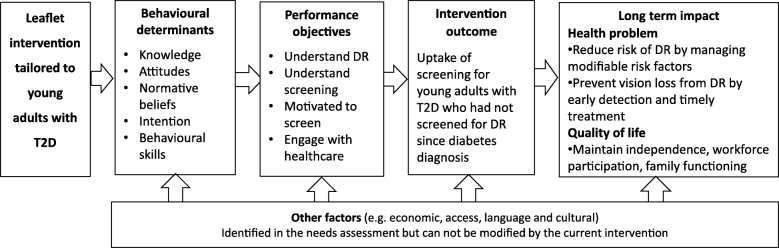
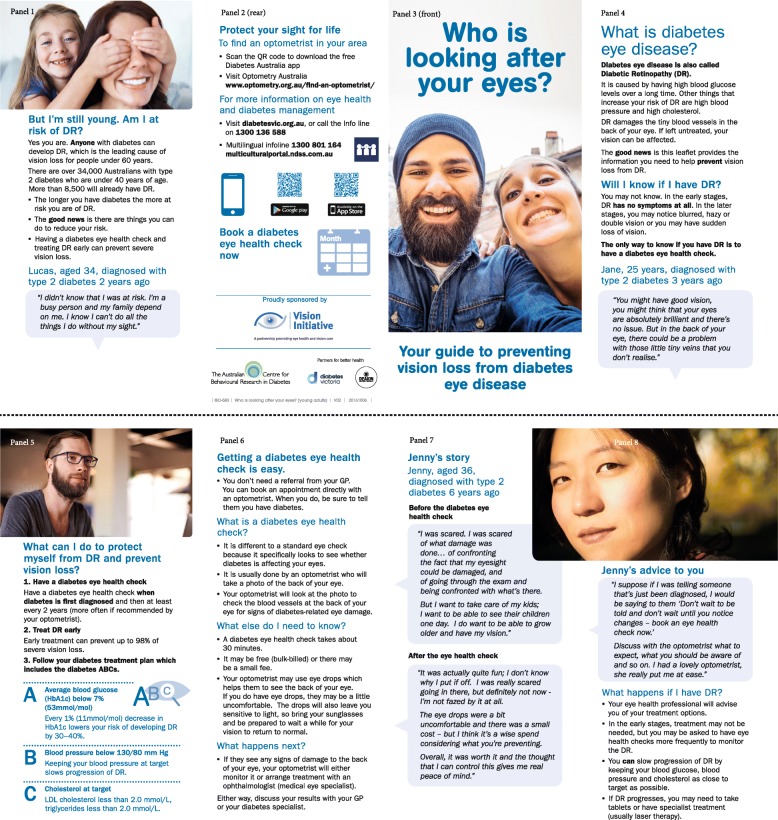
- Five modifiable behavioural determinants were selected for targeting: knowledge, attitudes, normative beliefs, intention, and behavioural skills. The resulting 8-panel leaflet drew on more than 60 persuasive messages; readability assessment gave a median consensus grade of 6, median reading ease of 75.6 (“fairly easy”), and a Suitability Assessment of Materials score of 75% (“superior”).
- Evaluation was planned as a two-arm, wait-list randomised controlled trial with screening uptake as the primary outcome and change in modifiable behavioural determinant constructs as secondary outcomes; the trial is registered (ACTRN12614001110673), is now complete, and a manuscript is in preparation.
Methods
- The study applied the six steps of Intervention Mapping: a mixed-methods needs assessment (literature review, qualitative interviews, national online survey), identification of modifiable determinants and a matrix of change objectives, leaflet design and pre-testing with stakeholders and patient/public involvement members, and planning for implementation and evaluation.
- Qualitative interviews were semi-structured, conducted by telephone, audio-recorded, transcribed verbatim, and content-analysed using an a priori coding framework; 20% of transcripts were double-coded with 99% inter-rater reliability.
- The online survey was hosted on Qualtrics, invited N = 5354 NDSS registrants, comprised 54 items based on the Information-Motivation-Behavioural Skills model and Theory of Planned Behaviour, and used univariate analyses (chi-square and independent-samples t-tests, two-sided, p < .01).
Limitations
- The authors state that recruitment was challenging: only 10 young adults participated in the qualitative study and only 2% of the eligible population completed the quantitative online study; they note this may limit generalisability, though the national survey response rate was larger than any other conducted to date with this priority population.
- The authors state the study was limited to one priority population (young adults with type 2 diabetes), and that contextual elements such as intervention level, delivery medium, and format were externally prescribed, meaning the intervention could not address external factors such as cultural diversity, low socioeconomic status, or limited English proficiency.
- Evident from the text: the abstract reports N = 227 for the online survey while the results report 129 completed full surveys, a discrepancy the authors do not reconcile; the paper also does not report effectiveness outcomes from the completed RCT, which is described as a manuscript in preparation.
Model-written summary. Check it against the paper before relying on it.
Integrity signals
Registry
Cites
Statistics
Figures
Verification
Claims the paper makes
0 Valid · 2 Not valid · 37 Not checked · 65 Own results and interpretations
A result the paper reports from its own data — it cites no other source for it, so there is none to check. The quote shows it is in the paper.
In the paper
“No differences were observed between groups on how pleasant or comfortable the eye check was perceived to be, although scores were lower for all participants compared to other attitude items.”
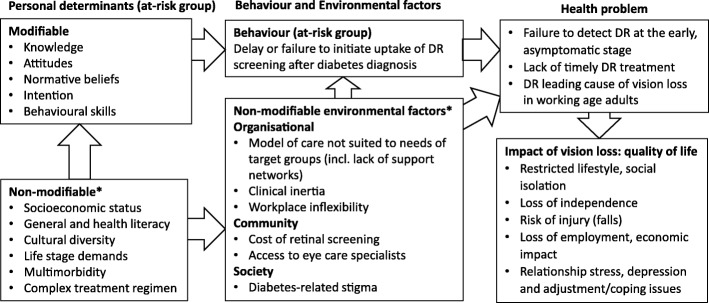
§ A tailored intervention to promote uptake of retinal screening among young adults with type 2 diabetes - an intervention mapping approach > Method and results > Logic model of the problem
plain- Asserted: passes — The authors put it forward as true.
- Checkable: passes — It can be checked against evidence.
- Load-bearing: unclear — It is unclear whether the paper’s conclusions depend on it.
- Based: passes — The paper gives a reason why it holds.
None of the sources cited for this claim have been checked yet.
In the paper
“The findings highlighted that many of the clinical and psychosocial barriers to diabetes self-management faced by young adults with T2D more broadly [18, 20, 40, 41, 75–78], also apply to retinal screening.”
§ A tailored intervention to promote uptake of retinal screening among young adults with type 2 diabetes - an intervention mapping approach > Discussion
What the sources say
- Not checked yetcites [18] Savage S Dabkowski S Dunning T The education and information needs of young adults with type 2 diabetes: a qualitative study J Nurs Healthcare Chronic Illn 2009 1 4 321 330 10.1111/j.1752-9824.2009.01035.x source
- Not checked yetcites [20] Browne JL Scibilia R Speight J The needs, concerns, and characteristics of younger Australian adults with type 2 diabetes Diabet Med 2013 30 5 620 626 10.1111/dme.12078 23181664 source
- Not checked yetcites [40] Browne JL Nefs G Pouwer F Speight J Depression, anxiety and self-care behaviours of young adults with type 2 diabetes: results from the international diabetes management and impact for long-term empowerment and success (MILES) study Diabet Med 2014 32 1 133 140 10.1111/dme.12566 25131861 source
- Not checked yetcites [41] Hessler DM Fisher L Mullan JT Glasgow RE Masharani U Patient age: a neglected factor when considering disease management in adults with type 2 diabetes Patient Educ Couns 2011 85 2 154 159 10.1016/j.pec.2010.10.030 21112720 PMC3196056 source
- Not checked yetcites [75] Waitzfelder B Pihoker C Klingensmith G Case D Anderson A Bell RA Adherence to guidelines for youths with diabetes mellitus Pediatrics 2011 128 3 531 538 21859914 PMC3164090 source
- Not checked yetcites [76] Auslander WF Sterzing PR Zayas LE White NH Psychosocial resources and barriers to self-management in African American adolescents with type 2 diabetes: a qualitative analysis Diabetes Educator 2010 36 4 613 622 10.1177/0145721710369706 20479133 source
- Not checked yetcites [77] Brouwer AM Salamon KS Olson KA Fox MM Yelich-Koth SL Fleischman KM Adolescents and type 2 diabetes mellitus: a qualitative analysis of the experience of social support Clin Pediatr (Phila) 2012 51 12 1130 1139 10.1177/0009922812460914 23034947 source
- Not checked yetcites [78] Sillars BA Davis WA Kamber N Davis TME The epidemiology and characteristics of type 2 diabetes in urban, community-based young people Intern Med J 2010 40 12 850 854 10.1111/j.1445-5994.2010.02372.x 21199223 source
plainstates an association- Asserted: passes — The authors put it forward as true.
- Checkable: passes — It can be checked against evidence.
- Load-bearing: passes — The paper’s conclusions depend on it.
- Based: passes — The paper gives a reason why it holds.
A result the paper reports from its own data — it cites no other source for it, so there is none to check. The quote shows it is in the paper.
In the paper
“Compared to their non-screening counterparts, those who had previously screened reported greater concern and worry at the prospect of not screening.”
§ A tailored intervention to promote uptake of retinal screening among young adults with type 2 diabetes - an intervention mapping approach > Method and results > Logic model of the problem
plainstates an association- Asserted: passes — The authors put it forward as true.
- Checkable: passes — It can be checked against evidence.
- Load-bearing: unclear — It is unclear whether the paper’s conclusions depend on it.
- Based: passes — The paper gives a reason why it holds.
A result the paper states — it cites no source for it, so there is none to check. The quote shows it is in the paper.
In the paper
“Although moderately high levels of distress in the priority population mean that it is important to avoid direct ‘fear appeal’ messages”
§ A tailored intervention to promote uptake of retinal screening among young adults with type 2 diabetes - an intervention mapping approach > Method and results > Logic model of the problem
plain- Asserted: passes — The authors put it forward as true.
- Checkable: passes — It can be checked against evidence.
- Load-bearing: passes — The paper’s conclusions depend on it.
- Based: passes — The paper gives a reason why it holds.
A result the paper reports from its own data — it cites no other source for it, so there is none to check. The quote shows it is in the paper.
In the paper
“Perceived barriers to and facilitators of screening (which are modifiable and within the scope of the current intervention) include:”
§ A tailored intervention to promote uptake of retinal screening among young adults with type 2 diabetes - an intervention mapping approach > Method and results > Logic model of the problem
plain- Asserted: passes — The authors put it forward as true.
- Checkable: passes — It can be checked against evidence.
- Load-bearing: passes — The paper’s conclusions depend on it.
- Based: passes — The paper gives a reason why it holds.
42 more claims
Create a free account to see all 104 claims and to verify the 70 references still open.
- The quote only partly states this claim. 2
- It may state two separate claims as one. 38
- Probably not a substantial claim. 30
Claims other papers make about this one
Each is checked against this paper’s own text: does it say what the citing paper says it does?
In the citing paper
“Using a co-design approach, our multidisciplinary project team developed an evidence-based and theoretically-grounded screening promotion leaflet, targeting factors previously identified as impacting screening behaviour among young adults with T2D [12, 18, 19].”
From Effect of a tailored leaflet to promote diabetic retinopathy screening among young adults with type 2 diabetes: a randomised controlled trial (2020) · cites this paper as [18]
Self-check
Percentages, sums and reported differences re-computed from the paper’s own numbers.
Each contradiction between two passages listed here was confirmed by an independent check.
Rated minor: it would not touch a result — a value no result rests on, a p-value that stays on the same side of the significance level, or a conflict that is clerical, resolved elsewhere in the paper, or outside its own findings.
In the paper
§ A tailored intervention to promote uptake of retinal screening among young adults with type 2 diabetes - an intervention mapping approach > Method and results > Logic model of the problem
“No differences were observed between groups on how pleasant or comfortable the eye check was perceived to be, although scores were lower for all participants compared to other attitude items.”
§ A tailored intervention to promote uptake of retinal screening among young adults with type 2 diabetes - an intervention mapping approach > Method and results > Logic model of the problem
“| ...(not) ‘unpleasant’ | 3.71 (0.94) | 3.86 (1.07) | .500 | | ...reassuring | 3.94 (0.96) | 4.63 (0.61) | <.001 | | ...important | 4.06 (1.06) | 4.89 (0.35) | <.001 | | ...empowering | 3.10 (1.19) | 3.73 (0.97) | .004 | | ...comfortable | 3.26 (1.15) | 3.68 (1.10) | .073 |”
Rated minor: it would not touch a result — a value no result rests on, a p-value that stays on the same side of the significance level, or a conflict that is clerical, resolved elsewhere in the paper, or outside its own findings.
In the paper
§ A tailored intervention to promote uptake of retinal screening among young adults with type 2 diabetes - an intervention mapping approach > Method and results > Logic model of the problem
“Given the large number of analyses, a conservative p < 0.01 was considered statistically significant.”
§ A tailored intervention to promote uptake of retinal screening among young adults with type 2 diabetes - an intervention mapping approach > Method and results > Logic model of the problem
“statistical significance p < 0.05”
Citations
Cites
Developing and evaluating complex interventions: the new Medical Research Council guidance
Craig, P., Dieppe, P., Macintyre, S., Michie, S., Nazareth, I., & Petticrew, M. (2008) · BMJ · doi:10.1136/bmj.a1655 · Cited by 10,995
Hoffmann, T. C., Glasziou, P. P., Boutron, I., Milne, R., Perera, R., Moher, D., Altman, D. G., Barbour, V., Macdonald, H., Johnston, M., et al. (2014) · BMJ · doi:10.1136/bmj.g1687 · Cited by 10,548
Social Influence: Compliance and Conformity
Cialdini, R. B., & Goldstein, N. J. (2004) · Annual Review of Psychology · doi:10.1146/annurev.psych.55.090902.142015 · Cited by 6,077 · cited 1×
“Use of quotes: in recognition of the subtle aspects of social influence, where an individual’s’ beliefs are influenced by those accepted and encouraged by the majority [63], quotes from similar others to be used to reinforce key persuasive messages.”
BackgroundCane, J., O’Connor, D., & Michie, S. (2012) · Implementation Science · doi:10.1186/1748-5908-7-37 · Cited by 4,888 · cited 1×
“Transcripts were subjected to content analysis (by AJL), with each participant utterance coded for behavioural determinants (using an a priori coding framework informed by the literature [48]), and again as either ‘facilitator’ or ‘barrier’ dependent upon the context.”
MethodPredicting and Changing Behavior
Fishbein, M., & Ajzen, I. (2011) · doi:10.4324/9780203838020 · Cited by 2,807
A taxonomy of behavior change techniques used in interventions
Abraham, C., & Michie, S. (2008) · Health Psychology · doi:10.1037/0278-6133.27.3.379 · Cited by 2,525 · cited 1×
“techniques (or change strategies) [65, 66] grouped into six broad change mechanisms designed to ‘boost motivation and prompt action’ ([65], p.”
BackgroundSelf-citationPlanning health promotion programs an intervention mapping approach
Bartholomew, L. K., Parcel, G. S., Kok, G., & Gottlieb, N. (2006) · Research Publications (Maastricht University) · Cited by 2,321
Planning Health Promotion Programs: An Intervention Mapping Approach
Hicking-Woodison, L. (2017) · Nursing Standard · doi:10.7748/ns.32.6.33.s38 · Cited by 1,841
Teaching Patients with Low Literacy Skills
Doak, C. C., Doak, L. G., & Root, J. H. (1996) · American Journal of Nursing · doi:10.1097/00000446-199612000-00022 · Cited by 1,432
Teaching patients with low literacy skills
(2001) · PsycEXTRA Dataset · doi:10.1037/e518822004-001 · Cited by 1,229
Research works printed but not linked: 2
- Fishbein M Ajzen I Predicting and changing behaviour: the reasoned action approach 2010 New York Psychology Press
- Scott B Readability formulas: free readability tools to check for reading levels, reading assessment and reading grade levels 2016
Cited by
The Handbook of Behavior Change
(2020) · Cambridge University Press eBooks · doi:10.1017/9781108677318 · Cited by 407
Changing Behavior Using the Theory of Planned Behavior
Ajzen, I., & Schmidt, P. (2020) · The Handbook of Behavior Change · doi:10.1017/9781108677318.002 · Cited by 266
Changing Behavior Using the Model of Action Phases
Keller, L., Gollwitzer, P. M., & Sheeran, P. (2020) · The Handbook of Behavior Change · doi:10.1017/9781108677318.006 · Cited by 147
Changing Behavior Using Social Cognitive Theory
Łuszczyńska, A., & Schwarzer, R. (2020) · Cambridge University Press eBooks · doi:10.1017/9781108677318.003 · Cited by 105
Changing Behavior Using the Health Action Process Approach
Schwarzer, R., & Hamilton, K. (2020) · The Handbook of Behavior Change · doi:10.1017/9781108677318.007 · Cited by 102
Changing Behavior Using Ecological Models
Salmon, J., Hesketh, K. D., Arundell, L., Downing, K. L., & Biddle, S. (2020) · Cambridge University Press eBooks · doi:10.1017/9781108677318.017 · Cited by 90
Changing Behavior Using Self-Determination Theory
Hagger, M. S., Hankonen, N. E., Chatzisarantis, N. L. D., & Ryan, R. M. (2020) · Cambridge University Press eBooks · doi:10.1017/9781108677318.008 · Cited by 87
Gardner, B., Rebar, A. L., & Lally, P. J. (2020) · Cambridge University Press eBooks · doi:10.1017/9781108677318.041 · Cited by 82
Warner, L. M., & French, D. (2020) · Cambridge University Press eBooks · doi:10.1017/9781108677318.032 · Cited by 79
Conceptual tensions and practical trade-offs in tailoring implementation interventions
McHugh, S., Riordan, F., Curran, G. M., Lewis, C. C., Wolfenden, L., Presseau, J., Lengnick‐Hall, R., & Powell, B. J. (2022) · Frontiers in Health Services · doi:10.3389/frhs.2022.974095 · Cited by 69
Changing Behavior: A Theory- and Evidence-Based Approach
Hagger, M. S., Cameron, L. D., Hamilton, K., Hankonen, N. E., & Lintunen, T. (2020) · Cambridge University Press eBooks · doi:10.1017/9781108677318.001 · Cited by 63
Changing Behavior Using Habit Theory
Orbell, S., & Verplanken, B. (2020) · Cambridge University Press eBooks · doi:10.1017/9781108677318.013 · Cited by 66
Attitudes and Persuasive Communication Interventions
Hamilton, K., & Johnson, B. T. (2020) · Cambridge University Press eBooks · doi:10.1017/9781108677318.031 · Cited by 61
Ophthalmic Screening Patterns Among Youths With Diabetes Enrolled in a Large US Managed Care Network
Wang, S. Y., Andrews, C. A., Gardner, T. W., Wood, M., Singer, K., & Stein, J. D. (2017) · JAMA Ophthalmology · doi:10.1001/jamaophthalmol.2017.0089 · Cited by 56
Diabetic Retinopathy Screening: A Systematic Review of Qualitative Literature
Egunsola, O., Dowsett, L. E., Diaz, R. L., Brent, M. H., Rac, V. E., & Clement, F. M. (2021) · Canadian Journal of Diabetes · doi:10.1016/j.jcjd.2021.01.014 · Cited by 52
Changing Behavior Using Integrated Theories
Hagger, M. S., & Hamilton, K. (2020) · Cambridge University Press eBooks · doi:10.1017/9781108677318.015 · Cited by 51
Planning and Implementation Intention Interventions
Rhodes, R. E., Grant, S. J., & de Bruijn, G. (2020) · Cambridge University Press eBooks · doi:10.1017/9781108677318.039 · Cited by 49
Tarrant, M., Haslam, C., Carter, M., Calitri, R., & Haslam, S. A. (2020) · Cambridge University Press eBooks · doi:10.1017/9781108677318.044 · Cited by 43
Developing Behavior Change Interventions
Hankonen, N. E., & Hardeman, W. (2020) · Cambridge University Press eBooks · doi:10.1017/9781108677318.021 · Cited by 38
Changing Behavior Using the Health Belief Model and Protection Motivation Theory
Orbell, S., Zahid, H., & Henderson, C. J. (2020) · Cambridge University Press eBooks · doi:10.1017/9781108677318.004 · Cited by 40
Changing Behavior Using the Transtheoretical Model
DiClemente, C. C., & Graydon, M. M. (2020) · Cambridge University Press eBooks · doi:10.1017/9781108677318.010 · Cited by 38
Patibandla, R. S. M. L., Rao, B. T., & Murty, M. R. (2024) · Advances in healthcare information systems and administration book series · doi:10.4018/979-8-3693-3661-8.ch007 · Cited by 38
A Review of Advancements and Evidence Gaps in Diabetic Retinopathy Screening Models
Pearce, E., & Sivaprasad, S. (2020) · Clinical ophthalmology · doi:10.2147/opth.s267521 · Cited by 37
Changing Behavior Using the Reflective-Impulsive Model
Deutsch, R., & Strack, F. (2020) · Cambridge University Press eBooks · doi:10.1017/9781108677318.012 · Cited by 37
Changing Behavior Using the Common-Sense Model of Self-Regulation
Cameron, L. D., Fleszar‐Pavlović, S. E., & Khachikian, T. (2020) · Cambridge University Press eBooks · doi:10.1017/9781108677318.005 · Cited by 32
Design, Implementation, and Evaluation of Behavior Change Interventions: A Ten-Task Guide
Abraham, C., & Denford, S. (2020) · Cambridge University Press eBooks · doi:10.1017/9781108677318.019 · Cited by 36
Self-citationChanging Behavior by Changing Environments
Marteau, T. M., Fletcher, P. C., Hollands, G. J., & Munafo, M. R. (2020) · Cambridge University Press eBooks · doi:10.1017/9781108677318.014 · Cited by 35
Rothman, A. J., Klein, W. M. P., & Sheeran, P. (2020) · Cambridge University Press eBooks · doi:10.1017/9781108677318.020 · Cited by 30
McHugh, S., Riordan, F., Kerins, C., Curran, G. M., Lewis, C. C., Presseau, J., Wolfenden, L., & Powell, B. J. (2023) · HRB Open Research · doi:10.12688/hrbopenres.13675.1 · Cited by 31
Gneezy, U., Kajackaite, A., & Meier, S. (2020) · Cambridge University Press eBooks · doi:10.1017/9781108677318.036 · Cited by 28
Dyadic Behavior Change Interventions
Scholz, U., Berli, C., Lüscher, J., & Knoll, N. (2020) · Cambridge University Press eBooks · doi:10.1017/9781108677318.043 · Cited by 29
Engagement of Stakeholders in the Design, Evaluation, and Implementation of Complex Interventions
Hudson, J. L., Moon, Z., Hughes, L. D., & Moss-Morris, R. E. (2020) · Cambridge University Press eBooks · doi:10.1017/9781108677318.024 · Cited by 29
Imagery, Visualization, and Mental Simulation Interventions
Hagger, M. S., & Conroy, D. (2020) · Cambridge University Press eBooks · doi:10.1017/9781108677318.033 · Cited by 25
Changing Behavior Using Social Identity Processes
Reynolds, K. J., Branscombe, N. R., Subašić, E., & Willis, L. (2020) · Cambridge University Press eBooks · doi:10.1017/9781108677318.016 · Cited by 24
Ruiter, R. A. C., Crutzen, R., de Leeuw, E., & Kok, G. (2020) · Cambridge University Press eBooks · doi:10.1017/9781108677318.018 · Cited by 22
Thomas, R., Cheung, W., Rafferty, J., Luzio, S. D., Akbari, A., & Owens, D. R. (2021) · Diabetic Medicine · doi:10.1111/dme.14536 · Cited by 19
Lake, A. J., Hateley-Browne, J. L., Rees, G., & Speight, J. (2020) · BMC Ophthalmology · doi:10.1186/s12886-020-1311-y · Cited by 18
Self-citationWebb, T. L., & de Bruin, M. (2020) · Cambridge University Press eBooks · doi:10.1017/9781108677318.037 · Cited by 17
Evans, T. S., Hawkes, R. E., Keyworth, C., Newson, L., Radley, D., Hill, A. J., Matu, J., & Ells, L. J. (2022) · British Journal of Diabetes · doi:10.15277/bjd.2022.341 · Cited by 17
Critical and Qualitative Approaches to Behavior Change
Chamberlain, K., & Lyons, A. C. (2020) · Cambridge University Press eBooks · doi:10.1017/9781108677318.030 · Cited by 16
Riordan, F., Curran, G. M., Pallin, N., Albers, B., Clack, L., Morrissey, E., Curran, G. M., Lewis, C. C., Powell, B. J., Presseau, J., et al. (2022) · HRB Open Research · doi:10.12688/hrbopenres.13507.1 · Cited by 16
The Science of Behavior Change: The Road Ahead
Hagger, M. S., Cameron, L. D., Hamilton, K., Hankonen, N. E., & Lintunen, T. (2020) · Cambridge University Press eBooks · doi:10.1017/9781108677318.046 · Cited by 16
Autonomy-Supportive Interventions
Reeve, J., & Cheon, S. H. (2020) · Cambridge University Press eBooks · doi:10.1017/9781108677318.035 · Cited by 15
Motivational Interviewing Interventions
Berman, A. H., Beckman, M., & Lindqvist, H. (2020) · Cambridge University Press eBooks · doi:10.1017/9781108677318.045 · Cited by 14
Changing Behavior Using Control Theory
Mansell, W. (2020) · Cambridge University Press eBooks · doi:10.1017/9781108677318.009 · Cited by 13
Implementation Science and Translation in Behavior Change
Łuszczyńska, A., Łobczowska, K., & Horodyska, K. (2020) · Cambridge University Press eBooks · doi:10.1017/9781108677318.023 · Cited by 13
Recent advances in thermogels for the management of diabetic ocular complications
Ong, N. W. X., Sim, B., Chang, J. J., Wong, J. H. M., Loh, X. J., & Goh, R. Z. R. (2023) · RSC Applied Polymers · doi:10.1039/d3lp00136a · Cited by 14
Maximizing User Engagement with Behavior Change Interventions
Yardley, L., Morrison, L. G., Müller, I., & Bradbury, K. J. (2020) · Cambridge University Press eBooks · doi:10.1017/9781108677318.025 · Cited by 13
de Ridder, D. T. D., Gillebaart, M., & Friese, M. (2020) · Cambridge University Press eBooks · doi:10.1017/9781108677318.040 · Cited by 11
Pranata, S., Wu, S. V., Wang, T.-J. T., Liang, S., Chuang, Y., Lu, K., & Khoiriyah, K. (2022) · Nurse Media Journal of Nursing · doi:10.14710/nmjn.v12i1.44336 · Cited by 11
Ballios, B. G., Park, T., Chaudhary, V., Hurley, B. R., Kosar, S., Sheidow, T., Cruess, A. F., Brent, M. H., Glazier, R. H., & Wong, D. T. (2020) · Canadian Journal of Ophthalmology · doi:10.1016/j.jcjo.2020.10.018 · Cited by 11
Evaluation of Behavior Change Interventions
Matthews, L., & Simpson, S. A. (2020) · Cambridge University Press eBooks · doi:10.1017/9781108677318.022 · Cited by 10
Economic and Behavioral Economic Approaches to Behavior Change
Brown, P. M., Cameron, L. D., Wilkinson, M., & Taylor, D. (2020) · Cambridge University Press eBooks · doi:10.1017/9781108677318.042 · Cited by 10
Lake, A. J., Rees, G., & Speight, J. (2018) · Current Diabetes Reports · doi:10.1007/s11892-018-1007-3 · Cited by 9
Self-citationTracey, M., Racine, E., Riordan, F., McHugh, S., & Kearney, P. M. (2019) · HRB Open Research · doi:10.12688/hrbopenres.12926.3 · Cited by 9
Changing Behavior Using Integrative Self-Control Theory
Hofmann, W., Dohle, S., & Diel, K. (2020) · Cambridge University Press eBooks · doi:10.1017/9781108677318.011 · Cited by 8
Epton, T., & Armitage, C. J. (2020) · Cambridge University Press eBooks · doi:10.1017/9781108677318.038 · Cited by 8
Conner, M. T., Williams, D. M., & Rhodes, R. E. (2020) · Cambridge University Press eBooks · doi:10.1017/9781108677318.034 · Cited by 8
Addressing Underserved Populations and Disparities in Behavior Change
Schüz, B., & Hooper, M. W. (2020) · Cambridge University Press eBooks · doi:10.1017/9781108677318.027 · Cited by 8
Effect of an interventional program on diabetic patients’ awareness regarding diabetic retinopathy
Said, H., & Hamed, M. (2021) · The Egyptian Family Medicine Journal/The Egyptian Family Medicine Journal · doi:10.21608/efmj.2021.28699.1026 · Cited by 7
Changing Behavior in the Digital Age
Kavanagh, D. J. (2020) · Cambridge University Press eBooks · doi:10.1017/9781108677318.029 · Cited by 20
Kelly, Y., O’Rourke, N., Hegarty, J. M., Gannon, J., Flynn, R., & Keyes, L. M. (2024) · BMC Health Services Research · doi:10.1186/s12913-024-12075-9 · Cited by 4
Interventions to increase attendance for diabetic retinopathy screening: A cochrane review summary
Whitehead, L. (2018) · International Journal of Nursing Studies · doi:10.1016/j.ijnurstu.2018.10.002 · Cited by 4
Tang, J., Yang, Z., Kee, F., & Congdon, N. G. (2023) · Frontiers in Psychology · doi:10.3389/fpsyg.2023.1101909 · Cited by 4
Pei, X., & Li, Z. (2024) · Journal of Infrastructure Policy and Development · doi:10.24294/jipd.v8i10.6668 · Cited by 3
Behavior Change in Community Contexts
Trickett, E. J., & Paterson, S. E. (2020) · Cambridge University Press eBooks · doi:10.1017/9781108677318.028 · Cited by 2
Using intervention mapping framework to develop knowledge translation program: a scoping review
Jiang, H., Wang, Z., Yang, D., Meng, M., Li, X., & Hao, Y. (2025) · BMC Health Services Research · doi:10.1186/s12913-025-13454-6 · Cited by 2
Cost-Effectiveness Evaluations of Behavior Change Interventions
Wang, T., Downes, M., Byrnes, J., & Scuffham, P. (2020) · Cambridge University Press eBooks · doi:10.1017/9781108677318.026 · Cited by 1
Herbert, T., Malone, M. K., Rhind, N., & Cooper, K. (2025) · JBI Evidence Synthesis · doi:10.11124/jbies-24-00201 · Cited by 1
Anindita, P. D., Siceria, P. D., Benu, I. E., Ragustri, J. N., Lallo, A. K., Gabriel, M., Hendarto, D., & Anugrahsari, S. (2024) · JAMBI MEDICAL JOURNAL "Jurnal Kedokteran dan Kesehatan" · doi:10.22437/jmj.v12i1.20988 · Cited by 1
Hagger, M. S., Cameron, L. D., Hamilton, K., Hankonen, N. E., & Lintunen, T. (2020) · Cambridge University Press eBooks · doi:10.1017/9781108677318.047
Ogunyemi, M. (2024) · Theseus (Ammattikorkeakoulujen)
Finch, T. (2023) · HRB Open Research · doi:10.21956/hrbopenres.14954.r33378
Vandervelde, S., Scheepmans, K., Milisen, K., van Achterberg, M., & de Casterlé, B. D. (2019) · Lirias (KU Leuven)
Prevención de retinopatía como complicación de la diabetes mellitus tipo 2: revisión integrativa
Calderón, I. V. A., Espinal, J. I. M., & Guarín, K. D. M. (2023) · Repositorio Digital de la Fundación Universitaria de Ciencias de la Salud (FUCSALUD)
Följsamhet till ögonbottenscreening vid diabetes : En litteraturöversikt
Magnusson, L., & Roos, R. (2021) · DiVA (Linnaeus University)
Alomari, A. M. A., Alananzeh, I. M., Bulushi, A. A., Idris, Z., Hassan, N. P., Yousef, K. M., Omari, A. Y. M. A., Alrefai, F., & Kwok, C. (2026) · Health Science Reports · doi:10.1002/hsr2.71569
Lake, A. J., Bo, A., & Hadjiconstantinou, M. (2021) · Current Diabetes Reports · doi:10.1007/s11892-021-01432-1 · Cited by 6
Self-citationBehaviour change in diabetes: behavioural science advancements to support the use of theory
McSharry, J., Byrne, M., Casey, B., Dinneen, S. F., Fredrix, M., Hynes, L., Lake, A. J., & Morrissey, E. (2020) · Diabetic Medicine · doi:10.1111/dme.14198 · Cited by 56
Self-citation
Metadata
- Authors
- Lake, A. J., Browne, J. L., Abraham, C., Tumino, D., Hines, C., Rees, G., & Speight, J.
- Affiliations
- Deakin University (AU)
- University of Exeter (GB)
- Vision Australia (AU)
- Diabetes Victoria (AU)
- The University of Melbourne (AU)
- Corresponding author
- Lake, Amelia J.
- Venue
- BMC Health Services Research
- Published
- 2018-05-31
- Volume
- 18
- Issue
- 1
- Pages
- 396-396
- ISSN
- 1472-6963 (ISSN-L)
- PMC
- PMC5984467
- OpenAlex
- W2805909107
- Cited by
- 82
- References
- 85
- Citations by year
- 2026: 1 · 2025: 2 · 2024: 6 · 2023: 5 · 2022: 4 · 2021: 5 · 2020: 53 · 2019: 2 · 2018: 2
- FWCI
- 10.22
- Type
- journal article
- Language
- en
- Open access
- gold
- doi.org
- Licence
- cc-by
- creativecommons.org/licenses/by/4.0/ (tdm)
- Locations
- BMC Health Services Research (publishedVersion, cc-by)
- Europe PMC (PubMed Central) (publishedVersion, other-oa)
- PubMed Central (publishedVersion, cc-by)
- PubMed (publishedVersion)
- DOAJ (DOAJ: Directory of Open Access Journals) (submittedVersion, cc-by-sa)
- Figshare (submittedVersion, cc-by)
- Minerva Access (University of Melbourne) (submittedVersion, cc-by)
- Funders
- Vision 2020 Australia
- Topics
- Health Sciences › Medicine › Endocrinology, Diabetes and Metabolism › Diabetes Management and Education
- Health Sciences › Medicine › Public Health, Environmental and Occupational Health › Health Promotion and Cardiovascular Prevention
- Health Sciences › Medicine › Ophthalmology › Retinal Diseases and Treatments
- Keywords
- retinal screening, diabetic retinopathy, type 2 diabetes, young adults, screening uptake, intervention mapping, needs assessment, behavioural determinants, health behavior change, blindness prevention
- MeSH terms
- Adult, Attitude to Health, Diabetes Mellitus, Type 2, Diabetic Retinopathy, Female, Humans, Male, Mass Screening, Pamphlets, Patient Acceptance of Health Care, Perception, Surveys and Questionnaires, Risk Factors, Vision Disorders, Program Development, Needs Assessment, Early Diagnosis, Young Adult
About these checks
Registry, retraction, Cites and statistics results are computed, not judged, with one exception: a printed reference that no index lists is read once by a model before it counts as a citation error. Claims are extracted by a model and kept only when their quote appears verbatim in the text; each cited source is then checked, with a model’s help, for whether it says what the claim relies on. Those verdicts can be wrong — read the claim’s quote and the cited source before relying on one.
A language model drew the claims from the paper on 2026-11-20, under version 3 of the claim definition (model deepseek-v4.1-flash, prompt extract-v3).
A second model labelled each claim on 2026-11-20 (model jev-1.13-20260917, definition revision gold-guideline-v0.2).
Statistics and arithmetic are recomputed, not judged.
Confidence bands are shown only for fields calibrated on our annotated test set. None is calibrated yet, so no band is shown.
What counts as a claim ›How we measure confidence ›How we check this ›
Are you an author, or do you see a problem with this page? Request a review
Data sources
Bibliographic data: Semantic Scholar, OpenAlex, Crossref.
Contains information from the Semantic Scholar Academic Graph Datasets, made available under the ODC Attribution License (ODC-BY 1.0).
Semantic Scholar’s data is described in: Kinney, R., et al. (2023). The Semantic Scholar Open Data Platform. arXiv:2301.10140.
