

The DOI matches its Crossref record; 92 of the 92 references it cites were found in a registry or an index.
What are the effective elements in patient-centered and multimorbidity care? A scoping review
Open accessAbstract
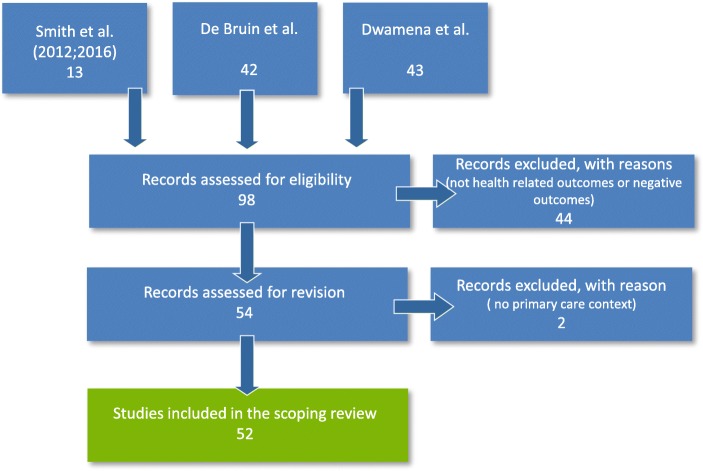
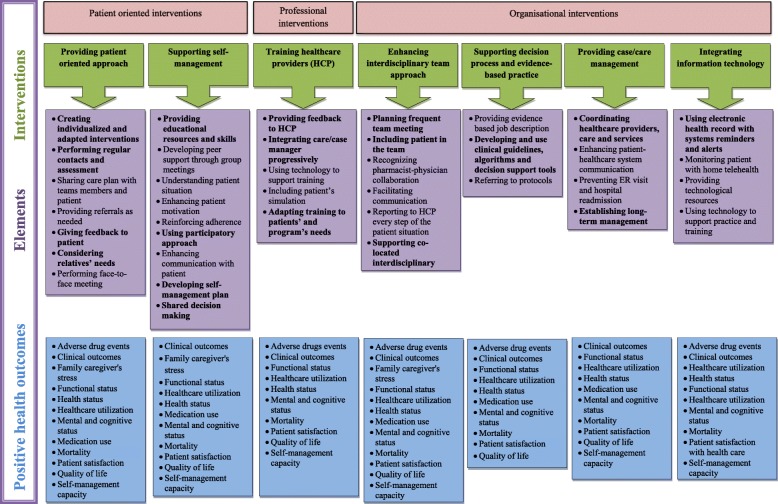
BACKGROUND: Interventions to improve patient-centered care for persons with multimorbidity are in constant growth. To date, the emphasis has been on two separate kinds of interventions, those based on a patient-centered care approach with persons with chronic disease and the other ones created specifically for persons with multimorbidity. Their effectiveness in primary healthcare is well documented. Currently, none of these interventions have synthesized a patient-centered care approach for care for multimorbidity. The objective of this project is to determine the particular elements of patient-centered interventions and interventions for persons with multimorbidity that are associated with positive health-related outcomes for patients. METHOD: A scoping review was conducted as the method supports the rapid mapping of the key concepts underpinning a research area and the main sources and types of evidence available. A five-stage approach was adopted: (1) identifying the research question; (2) identifying relevant studies; (3) selecting studies; (4) charting the data; and (5) collating, summarizing and reporting results. We searched for interventions for persons with multimorbidity or patient-centered care in primary care. Relevant studies were identified in four systematic reviews (Smith et al. (2012;2016), De Bruin et al. (2012), and Dwamena et al. (2012)). Inductive analysis was performed. RESULTS: Four systematic reviews and 98 original studies were reviewed and analysed. Elements of interventions can be grouped into three main types and clustered into seven categories of interventions: 1) Supporting decision process and evidence-based practice; 2) Providing patient-centered approaches; 3) Supporting patient self-management; 4) Providing case/care management; 5) Enhancing interdisciplinary team approach; 6) Developing training for healthcare providers; and 7) Integrating information technology. Providing patient-oriented approaches, self-management support interventions and developing training for healthcare providers were the most frequent categories of interventions with the potential to result in positive impact for patients with chronic diseases. CONCLUSION: This scoping review provides evidence for the adaption of patient-centered interventions for patients with multimorbidity. Findings from this scoping review will inform the development of a toolkit to assist chronic disease prevention and management programs in reorienting patient care.
Overview
The claims and statistics of this paper haven’t been checked yet.
Run the check — free, no account needed. It reads the open-access text and checks the sources it cites.
Integrity signals
Registry
Cites
Statistics
Figures
Verification
Claims the paper makes
The claims and statistics of this paper haven’t been checked yet.
Run the check — free, no account needed. It reads the open-access text and checks the sources it cites.
Claims other papers make about this one
Each is checked against this paper’s own text: does it say what the citing paper says it does?
In the citing paper
“Overall, our findings support the notion of person-centered care, highlighting the increased empowerment of people with mental illness, integrated into their biopsychosocial and cultural context [81,82,83].”
From Therapeutic Adherence of People with Mental Disorders: An Evolutionary Concept Analysis (2023) · cites this paper as [82]
Self-check
Percentages, sums and reported differences re-computed from the paper’s own numbers.
The self-check needs the paper’s full text.
Citations
Cites
Scoping studies: towards a methodological framework
Arksey, H., & O'Malley, L. (2005) · International Journal of Social Research Methodology · doi:10.1080/1364557032000119616 · Cited by 36,742
Lorig, K. R., Sobel, D. S., Stewart, A. L., Brown, B. W., Bandura, A., Ritter, P., Gonzalez, V. M., Laurent, D. D., & Holman, H. R. (1999) · Medical Care · doi:10.1097/00005650-199901000-00003 · Cited by 2,261
Collaborative care for patients with depression and chronic illnesses
Katon, W. J., Lin, E. H. B., Von Korff, M., Ciechanowski, P., Ludman, E. J., Young, B., Peterson, D., Rutter, C. M., McGregor, M., & McCulloch, D. (2010) · New England Journal of Medicine · doi:10.1056/nejmoa1003955 · Cited by 1,697
Transitional Care of Older Adults Hospitalized with Heart Failure: A Randomized, Controlled Trial
Naylor, M. D., Brooten, D. A., Campbell, R. L., Maislin, G., McCauley, K. M., & Schwartz, J. S. (2004) · Journal of the American Geriatrics Society · doi:10.1111/j.1532-5415.2004.52202.x · Cited by 1,365 · cited 2×
“The most important element found was the coordination of healthcare providers, care and services [20, 32, 38, 39, 42, 43, 53, 55, 57, 62, 64, 67, 76].”
BackgroundInterventions for providers to promote a patient-centred approach in clinical consultations
Dwamena, F., Holmes-Rovner, M., Gaulden, C. M., Jorgenson, S., Sadigh, G., Sikorskii, A., Lewin, S., Smith, R. C., Coffey, J., Olomu, A., et al. (2012) · Cochrane Database of Systematic Reviews · doi:10.1002/14651858.cd003267.pub2 · Cited by 1,227
Vogeli, C., Shields, A. E., Lee, T. A., Gibson, T. B., Marder, W. D., Weiss, K. B., & Blumenthal, D. (2007) · Journal of General Internal Medicine · doi:10.1007/s11606-007-0322-1 · Cited by 1,150
Designing Health Care for the Most Common Chronic Condition—Multimorbidity
Tinetti, M. E., Fried, T. R., & Boyd, C. M. (2012) · JAMA · doi:10.1001/jama.2012.5265 · Cited by 1,005
Prevalence of multimorbidity among adults seen in family practice
Fortin, M. (2005) · The Annals of Family Medicine · doi:10.1370/afm.272 · Cited by 987 · cited 1×
“Background Patients with multimorbidity represent a significant portion of the primary healthcare population [1].”
BackgroundSelf-citationSmith, S. M., Wallace, E., O’Dowd, T., & Fortin, M. (2016) · Cochrane Database of Systematic Reviews · doi:10.1002/14651858.cd006560.pub3 · Cited by 921
Self-citationSmith, S. M., Soubhi, H., Fortin, M., Hudon, C., & O'Dowd, T. C. (2012) · BMJ · doi:10.1136/bmj.e5205 · Cited by 744
Self-citation
Research works printed but not linked: 2
- Grimshaw J. A knowledge synthseis chapter. Ottawa: University of Ottawa; 2010. p. 56.
- Procter S, Single A. Home telehealthcare: findings from a pilot study in north-East London. Br J Healthcare Comput Inform Manage. 2006;23(8):10–3.
Cited by
Sorted by citations
Items 201–219 of 219
Bellanger, W., Peurois, M., Connan, L., Navasiolava, N. M., Missud, D., Py, T., & Bègue, C. (2023) · Figshare · doi:10.6084/m9.figshare.23722356
Additional file 4 of Patient-centeredness in the multimorbid elderly: a focus group study
Kanat, M., Schaefer, J., Kivelitz, L., Dirmaier, J., Voigt-Radloff, S., Heimbach, B., & Glattacker, M. (2021) · Figshare · doi:10.6084/m9.figshare.16829077
Dufour, É., Bolduc, J., Leclerc-Loiselle, J., Charette, M., Dufour, I., Roy, D. A., Poirier, A.-A., & Duhoux, A. (2023) · Figshare · doi:10.6084/m9.figshare.24079672
Bellanger, W., Peurois, M., Connan, L., Navasiolava, N. M., Missud, D., Py, T., & Bègue, C. (2023) · Figshare · doi:10.6084/m9.figshare.23722359
van den Bemd, M., Leensen, M. C. J., Cuypers, M., Leusink, G. L., Schalk, B. W. M., & Bischoff, E. W. M. A. (2024) · Figshare · doi:10.6084/m9.figshare.26043682
Outcomes of interprofessional oncology rehabilitation seminars in South Africa
Boright, L. E., Pilusa, S. I., Blaney, T., Breedy, B., Cook, R., Crick, S., Doherty, D., & Galantino, M. L. (2025) · South African Journal of Oncology · doi:10.4102/sajo.v9i0.332
A Patient-Centered Approach to Care
Gans, R. O. B. (2026) · Springer eBooks · doi:10.1007/978-3-031-82232-2_9
Ndateba, I., Havaei, F., Haase, K. R., Hogg, W., Martin‐Misener, R., & Wong, S. T. (2026) · Primary Health Care Research & Development · doi:10.1017/s1463423626100887 · Cited by 1
Embrett, M. G., Martin‐Misener, R., Sampalli, T., Elliott, M. A., & Mehrpooya, S. (2026) · Research Square · doi:10.21203/rs.3.rs-8289805/v1
Hypertension management in São Paulo: insights from a computational simulation approach
Loo, P. S., Silveira, M., Baxter, Y. C., Júnior, Á. A., Drager, L. F., Bortolotto, L. A., Boch, J., & Muñoz, D. C. (2026) · The Lancet Regional Health - Americas · doi:10.1016/j.lana.2026.101449
Multimorbidity research in dementia: it’s time to shift to a person-centred approach
Swain, S., Kantilal, K., Suryadevara, V., & Stirland, L. (2026) · Frontiers in Dementia · doi:10.3389/frdem.2026.1791795
Wang, Y., Wang, Z., Wang, Y., Yu, J., Xia, S., Li, Y., Che, Y., Wang, Y., Li, X., Liu, Y., et al. (2026) · BMC Public Health · doi:10.1186/s12889-026-27383-4
Patient-Centred Care for Multimorbid Patients: A Scoping Review
den Wyngaert, I. V., Vaes, B., Delvaux, N., & Pottelbergh, G. V. (2026) · Journal of Clinical Medicine · doi:10.3390/jcm15103774
Hill, C., Keast, J. M., Dahil, A., & Dambha‐Miller, H. (2026) · Journal of Multimorbidity and Comorbidity · doi:10.1177/26335565261444423
Li, K., Lu, C., & Wang, J. (2026) · Medicine · doi:10.1097/md.0000000000049383
Hughes, S., Hughes, B. M. A., Haroon, S. M., Hathaway, E., Anderson, N. E., McMullan, C., Newnham, M., Taylor, C., Denniston, A. K., Backhouse, S., et al. (2026) · JRSM Open · doi:10.1177/20542704261459717
Humanization interventions in primary health care: an umbrella review
Mellado, A., Escobar, E. T., Jeldres, S. P., Riveros-Jiménez, M. A., & Jiménez, D. S. (2026) · Frontiers in Health Services · doi:10.3389/frhs.2026.1835535
Sagen, Å. M., Eide, G. E., Grimstad, T. B., & Reime, M. H. (2026) · Nursing Reports · doi:10.3390/nursrep16090301
Saifan, A. R., Ayoub, A. Y., Alarabyat, I. A., Saleh, Z. T., Abujaber, D. A., Al‐Yateem, N., Rezq, K. A., Saleem, N. H., Amin, E. M., Alkouri, O. A., et al. (2026) · International Journal of Environmental Research and Public Health · doi:10.3390/ijerph23101243
Metadata
- Authors
- Poitras, M.-E., Maltais, M.-E., Bestard-Denommé, L., Stewart, M., & Fortin, M.
- Affiliations
- Western University (CA)
- Université de Sherbrooke (CA)
- Venue
- BMC Health Services Research
- Published
- 2018-06-14
- Volume
- 18
- Issue
- 1
- Pages
- 446-446
- ISSN
- 1472-6963 (ISSN-L)
- PMC
- PMC6001147
- OpenAlex
- W2807719804
- Cited by
- 219
- References
- 92
- Citations by year
- 2026: 15 · 2025: 13 · 2024: 40 · 2023: 46 · 2022: 40 · 2021: 29 · 2020: 27 · 2019: 8 · 2018: 1
- FWCI
- 12.69
- Type
- journal article
- Language
- en
- Open access
- gold
- doi.org
- Licence
- Locations
- BMC Health Services Research (publishedVersion, cc-by)
- Europe PMC (PubMed Central) (publishedVersion, other-oa)
- PubMed Central (publishedVersion, cc-by)
- PubMed (publishedVersion)
- DOAJ (DOAJ: Directory of Open Access Journals) (submittedVersion)
- Funders
- Institute of Health Services and Policy Research (297943)
- Topics
- Health Sciences › Medicine › Epidemiology › Chronic Disease Management Strategies
- Health Sciences › Medicine › Family Practice › Primary Care and Health Outcomes
- Health Sciences › Health Professions › General Health Professions › Patient-Provider Communication in Healthcare
- Keywords
- multimorbidity, patient-centered care, primary care, chronic disease management, patient self-management, case management, interdisciplinary teams, health professions education, information technology integration, evidence-based practice, health outcomes
- MeSH terms
- Multiple Chronic Conditions, Delivery of Health Care, Humans, Primary Health Care, Patient-Centered Care, Evidence-Based Practice
About these checks
Registry, retraction, Cites and statistics results are computed, not judged, with one exception: a printed reference that no index lists is read once by a model before it counts as a citation error. Claims are extracted by a model and kept only when their quote appears verbatim in the text; each cited source is then checked, with a model’s help, for whether it says what the claim relies on. Those verdicts can be wrong — read the claim’s quote and the cited source before relying on one.
Statistics and arithmetic are recomputed, not judged.
Confidence bands are shown only for fields calibrated on our annotated test set. None is calibrated yet, so no band is shown.
What counts as a claim ›How we measure confidence ›How we check this ›
Are you an author, or do you see a problem with this page? Request a review
