

What makes mental health and substance use services youth friendly? A scoping review of literature
Open accessThe DOI matches its Crossref record; 49 of the 51 references it cites were found in a registry or an index.
Abstract
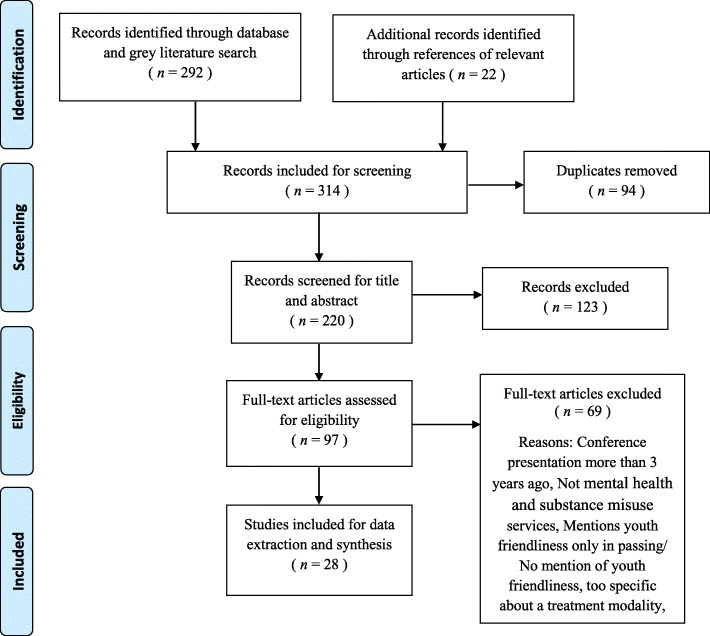
BACKGROUND: There are increasing calls to make mental health and substance use services youth friendly, with hopes of improving service uptake, engagement and satisfaction. However, youth-friendliness in this area has not been clearly defined and there is a lack of information about the characteristics that make such services youth friendly. The purpose of this scoping review was to examine the literature available on youth-friendly mental health and substance use services in order to identify the characteristics, outline the expected impacts, and establish a definition. METHODS: A scoping review of seven databases and grey literature sources was conducted. Twenty-eight documents were retained as relevant to the research questions. Relevant data from these documents was extracted, analyzed and presented to stakeholders, including youth, caregivers and service providers to validate and refine the results. RESULTS: Youth-friendly mental health and substance use services include integrated, inclusive, confidential and safe organization and policy characteristics; bright, comfortable, environment with informational materials; welcoming and genuine service providers with appropriate communication and counselling skills; an accessible location; minimal wait times; and individualized and innovative approaches. All areas in which youth friendliness should be implemented in a mental health and substance use service organization had a core value of youth voice. CONCLUSION: Improving the youth friendliness of mental health and substance use services includes incorporating youth voice in organization, policy, environment, service providers, and treatment services, and has implications for treatment uptake, engagement and satisfaction. Further research is required to determine the impact of youth friendliness in such services.
Overview
The claims and statistics of this paper haven’t been checked yet.
Free: it reads the open-access text and checks the first 5 claims that cite a source we can check. Create a free account to check every claim.
Integrity signals
Registry
Cites
Statistics
Figures
Verification
Claims the paper makes
The claims and statistics of this paper haven’t been checked yet.
Free: it reads the open-access text and checks the first 5 claims that cite a source we can check. Create a free account to check every claim.
Claims other papers make about this one
Each is checked against this paper’s own text: does it say what the citing paper says it does?
The source backs part of the claim, not all of it — or backs it for a different population, condition or comparison.
In the citing paper
“Experts and emerging adults have also indicated that parent, caregiver, and partner involvement should be offered, while simultaneously respecting the emerging adults' autonomy and independence, such as through separate programming (6, 29, 56, 57).”
From Initial insights from a quality improvement initiative to develop an evidence-informed young adult substance use program (2022) · cites this paper as [29]
Experimental — accuracy not yet measured
Self-check
Percentages, sums and reported differences re-computed from the paper’s own numbers.
The self-check needs the paper’s full text.
Citations
Cites
Scoping studies: towards a methodological framework
Arksey, H., & O'Malley, L. (2005) · International Journal of Social Research Methodology · doi:10.1080/1364557032000119616 · Cited by 36,742
Scoping studies: advancing the methodology
Levac, D., Colquhoun, H., & O'Brien, K. K. (2010) · Implementation Science · doi:10.1186/1748-5908-5-69 · Cited by 15,268
Gulliver, A., Griffiths, K. M., & Christensen, H. (2010) · BMC Psychiatry · doi:10.1186/1471-244x-10-113 · Cited by 3,292
Kim-Cohen, J., Caspi, A., Moffitt, T. E., Harrington, H., Milne, B. J., & Poulton, R. (2003) · Archives of General Psychiatry · doi:10.1001/archpsyc.60.7.709 · Cited by 2,025
Wang, P. S., Berglund, P., Olfson, M., Pincus, H. A., Wells, K. B., & Kessler, R. C. (2005) · Archives of General Psychiatry · doi:10.1001/archpsyc.62.6.603 · Cited by 1,325
Morrison, A., Polisena, J., Husereau, D., Moulton, K., Clark, M., Fiander, M., Mierzwinski-Urban, M., Clifford, T., Hutton, B., & Rabb, D. (2012) · International Journal of Technology Assessment in Health Care · doi:10.1017/s0266462312000086 · Cited by 1,257
Stigma and Help Seeking for Mental Health Among College Students
Eisenberg, D., Downs, M. F., Golberstein, E., & Zivin, K. (2009) · Medical Care Research and Review · doi:10.1177/1077558709335173 · Cited by 1,193
The Joanna Briggs Institute reviewers' manual 2015: methodology for JBI scoping reviews
Peters, M. D. J., Godfrey, C. M., McInerney, P. A., Soares, C. B., Khalil, H., & Parker, D. (2015) · Cited by 1,135
Youth-friendly primary-care services: how are we doing and what more needs to be done?
Tylee, A., Haller, D. M., Graham, T., Churchill, R., & Sanci, L. A. (2007) · The Lancet · doi:10.1016/s0140-6736(07)60371-7 · Cited by 622
Costello, E. J., He, J.-P., Sampson, N. A., Kessler, R. C., & Merikangas, K. R. (2014) · Psychiatric Services · doi:10.1176/appi.ps.201100518 · Cited by 441
Research works printed but not linked: 10
- United Nations Department of Economic and Social Affairs Definition of Youth 2013
- Canadian Agency for Drugs and Technology in Health Grey matters: a practical search tool for evidence-based medicine 2015
- Veritas Health Innovation Covidence systematic review software 2017
- Bardash MM. Needs assessment of adolescent outpatient mental health services: factors related to treatment engagement and retention. (Doctoral dissertation, Rutgers The State University of New Jersey)2010.
- Kiselica MS Englar-Carlson M Kiselica MS Englar-Carlson M Horne AM Establishing rapport with boys in individual counseling and psychotherapy Counseling troubled boys: a guidebook for professionals 2008 New York Routledge 49 65
- Paul Hamlyn Foundation, Mental Health Foundation Right Here: how to… provide youth-friendly mental health and wellbeing services 2014
- Pope P Youth-friendly counselling CPJ. 2002 13 1 18 19
- Rhodes J. Using superheroes as treatment metaphors in trauma work: providing male-friendly therapy for adolescent male clients in residential facilities. (Doctoral dissertation, The Chicago School of Professional Psychology)2014.
- Rosen A Howe D The youth health approach to youth mental health [Powerpoint slides] 2005
- Ontario Centre of Excellence for Child and Youth Mental Health Walking the talk: a toolkit for engaging youth in mental health 2016
Cited by
Items 101–139 of 139
What do justice-involved youth want from integrated youth services? A conjoint analysis.
Klymkiw, D. F., Day, D. M., Henderson, J. L., & Hawke, L. D. (2024) · PubMed Central · Cited by 3
Self-citationDinh, A., El‐Den, S., Collins, J. C., Hamilton, B., Janiszewski, C. M. S., Fowler, D., & O’Reilly, C. L. (2025) · Journal of Child and Adolescent Psychopharmacology · doi:10.1089/cap.2024.0140 · Cited by 1
“…outcomes such as increased service uptake and quality of care, in comparison to other non-age-speci fi c models of care (Brimblecombe et al., 2017; Hawke et al., 2019). headspace is Australia ’ s National Youth Mental Health Foundation, founded in 2006 in response to the increasing prevalence…”
Quality of Psychiatric Nursing Care: Perceptions of Nurses and Patients with Mental Illness
Hussien, R. M., Mansoor, K. M. A., & Ahmed, H. A. A. (2023) · The Open Nursing Journal · doi:10.2174/18744346-v17-230823-2022-197 · Cited by 5
Pilarinos, A., Bromberg, D. J., & Karamouzian, M. (2022) · Archives of Pediatrics and Adolescent Medicine · doi:10.1001/jamapediatrics.2022.0474 · Cited by 1
Youths’ Participation in Livestock Agribusiness Entrepreneurship in Nigeria
Adebayo, O. A., Akinola, O. O., Ademiluyi, I. O., Halidu, S. K., Ibrahim, O. A., Ofordu, C. S., Wahab, M. K. A., & Odebunmi, C. A. (2022) · IJEBD (International Journal Of Entrepreneurship And Business Development) · doi:10.29138/ijebd.v5i5.1920 · Cited by 1
Lum, A., Damianidou, D., Bailey, K. A., Cassel, S., Unwin, K., Beck, A. K., Kelly, P. J., Argent, A., Deane, F. P., Langford, S., et al. (2022) · SSRN Electronic Journal · doi:10.2139/ssrn.4121575 · Cited by 1
Participatory Community Asset Mapping for Rural Youth Mental Health in Wellington County, Ontario
Wilson, A. (2021) · QSpace (Queen's University Library)
Kwan, A., Conroy, K., Barron, K., Nandlall, N., Iyer, S. N., Henderson, J. L., & Barbic, S. P. (2022) · Psychiatric Services · doi:10.1176/appi.ps.20220281
Self-citationKilkelly, U., Forde, L., Lambert, S., & Swirak, K. (2023) · Palgrave critical studies in human rights and criminology · doi:10.1007/978-3-031-36652-9_5
Flisher, A. J., Gerein, N., & Ba-Break, M. M. (2023) · Elsevier eBooks · doi:10.1016/b978-0-323-99967-0.00069-7
Kwan, A., Conroy, K., Barron, K., Nandlall, N., Iyer, S. N., Henderson, J. L., & Barbic, S. P. (2023) · doi:10.32920/24521959
Self-citationKwan, A., Conroy, K., Barron, K., Nandlall, N., Iyer, S. N., Henderson, J. L., & Barbic, S. P. (2023) · doi:10.32920/24521959.v1
Self-citationTouati, N., Ruelland, I., del Barrio, L. R., Bouchard, M., Beaulieu, K., & Courcy, I. (2024) · Health Services Insights · doi:10.1177/11786329241232299
Wojciechowski, L., Harms, L., Carter, A., Hoy, J., & Newman, C. E. (2024) · AIDS Care · doi:10.1080/09540121.2024.2445790
“…and psychosocial services and that because of their unique developmental processes, they have specific needs relating to models of care, workforce competencies of service providers, and the physical environment of services (Hawke et al., 2019; McKinlay et al., 2021; Sendero-witz, 1999; WHO, 2019).”
Stead, V. E., Lumb, A. B., Brasch, J. S., & MacKillop, J. M. (2025) · Cambridge University Press eBooks · doi:10.1017/9781009086264.013
Walker, J. S., LaPelusa, B., Klodnick, V. V., Johnson, R. P., Hermsen-Kritz, M., & Blajeski, S. M. (2026) · BMC Psychology · doi:10.1186/s40359-026-05128-7
Does youth-friendly mental health care improve therapeutic engagement and psychosocial outcomes?
Allison, S. C., Bastiampillai, T. J., Kisely, S. R., & Looi, J. C. (2025) · Australasian Psychiatry · doi:10.1177/10398562251351445 · Cited by 1
Doyle, G., Mitchell, S., Hawley, S., Krysiak, K., & Gradinger, F. (2025) · International Journal of Integrated Care · doi:10.5334/ijic.9055 · Cited by 1
Ogresta, J., Kožljan, P., & Stanić, L. (2025) · Journal of social service research · doi:10.1080/01488376.2025.2542272
“While adolescents’ voices have been increasingly acknowledged as vital to shaping youth-centered mental health services (Hawke et al., 2019; Lukoševičiūtė-Barauskienė et al., 2023), they remain underrepresented in research and policy-making, especially in socio-economically disadvantaged and…”
Rethinking youth emergency mental healthcare in the UK: insights from Australian service models
Romeu, D. (2025) · BJPsych Bulletin · doi:10.1192/bjb.2025.10130 · Cited by 1
Wells, M., Kelly, P. J., & Larance, B. (2025) · Drug and Alcohol Dependence · doi:10.1016/j.drugalcdep.2025.112845
Ramirez-Meneses, D., Toyama, M., Vilela-Estrada, A. L., Flores, S., Carbonel, A., Gianella, C., Arenas, L., Priebe, S., & Diez‐Canseco, F. (2025) · Revista Colombiana de Psiquiatría · doi:10.1016/j.rcp.2025.09.001 · Cited by 1
What's it gonna take? Lessons learned for youth-friendly mental health services research
Cheng, C., Siddiqui, H. B., Jacques, A., Kumar, S., Vader, K., Campbell, M., Maisonneuve, S., & Minnery, E. (2025) · Frontiers in Health Services · doi:10.3389/frhs.2025.1623179
Hawke, L. D., Thabane, L., Iyer, S. N., Jaouich, A., Reaume‐Zimmer, P., & Henderson, J. L. (2021) · Figshare · doi:10.6084/m9.figshare.16725888
Self-citationOw, N., Marchand, K., Liu, G., Mallia, E., Mathias, S., Sutherland, J. M., & Barbic, S. P. (2024) · Figshare · doi:10.6084/m9.figshare.26635446
Lum, A., Damianidou, D., Bailey, K. A., Cassel, S., Unwin, K., Beck, A., Kelly, P. J., Argent, A., Deane, F. P., Langford, S., et al. (2023) · Figshare · doi:10.6084/m9.figshare.22914694
Lum, A., Damianidou, D., Bailey, K. A., Cassel, S., Unwin, K., Beck, A., Kelly, P. J., Argent, A., Deane, F. P., Langford, S., et al. (2023) · Figshare · doi:10.6084/m9.figshare.22914697
Rapid realist review of organisational supports for youth peer support workers
Hews‐Girard, J., Halsall, T., Cullen, E., Bellefeuille, A., Daley, M., Evans, C., Sandoval, V., Dunning, A., Lee, J., Carde, B., et al. (2026) · BMJ Open · doi:10.1136/bmjopen-2025-111837
Persson, S. (2026) · Clinical Child Psychology and Psychiatry · doi:10.1177/13591045261431349
“It is recommended that young people actively take part in all stages of how services are delivered (for reviews see Hawke et al., 2019; Svamo et al., 2024), as young people ’ s self-engagement may improve treatment outcomes (Svamo et al., 2024).”
InfluentialEthics and Self-Disclosure: How Social Workers Decide What is Appropriate to Share With Young People
Inkpen, S., & McAuliffe, D. A. (2026) · Australian Social Work · doi:10.1080/0312407x.2025.2597000
Henderson, J. L., Chiodo, D., Quinlan-Davidson, M., Jackson-Best, F., Barbic, S. P., Linklater, R., Nyambi, A., Dahr, Y. E., Dozet, D., Varadi, A.-L., et al. (2026) · BMJ Open · doi:10.1136/bmjopen-2025-109280 · Cited by 2
Self-citationCoronado‐Montoya, S., Varadi, A.-L., Dozet, D., Chiodo, D., & Henderson, J. L. (2026) · doi:10.2196/preprints.99389
Self-citationLostedt, J., Väätäinen, L., Lantta, T., Niemelä, S., & Mishina, K. E. (2026) · Substance Use & Misuse · doi:10.1080/10826084.2026.2670615
“By involving young people in the planning and developing services, help-seeking among young people can be enhanced through youth-friendly social media advertising and clear, youth-oriented service descriptions (Hawke et al., 2019).”
InfluentialMak, J., Custers, A., Regenmortel, T. V., & Mathijssen, J. (2026) · Children and Youth Services Review · doi:10.1016/j.childyouth.2026.109055
Robinson, A., LeBouef, S., Krahl, W., Hokanson, C. D., Mohamud, Z., & O’Brien, J. R. G. (2026) · Journal of Addiction Medicine · doi:10.1097/adm.0000000000001727
Halladay, J. E., Gendy, M. N. S., Little, Hira, V., Taisir, R., Rahman, L., Britton, E. M., Shantz, R. N., Levitt, E. E., Amlung, M. T., et al. (2026) · Substance Use & Misuse · doi:10.1080/10826084.2026.2670633
“…health system transitions and creating developmentally tailored, youth-friendly spaces in adult systems are essential for ensuring early and effective treatment for SUDs and concurrent psychiatric problems (Bergman et al., 2016; Cleverley et al., 2020; Halladay et al., 2023b; Hawke et al., 2019).”
Coronado‐Montoya, S., Varadi, A.-L., Dozet, D., Chiodo, D., & Henderson, J. L. (2026) · Journal of Medical Internet Research · doi:10.2196/99389
Self-citationSheidow, A. J., Drazdowski, T. K., Pasman, E., Wenzel, K. R., Gallardo, K. R., Jurinsky, J., Kelly, L. M., McCart, M. R., Hayes, B. B., Lewis, L. E., et al. (2026) · Emerging Adulthood · doi:10.1177/21676968261493641
Youth Perspectives on Seeking Psychotherapy: A Concurrent Mixed Methods Study.
(2021) · PubMed Central · Cited by 13
Self-citation
Metadata
- Authors
- Hawke, L. D., Mehra, K., Settipani, C., Relihan, J., Darnay, K., Chaim, G., & Henderson, J.
- Affiliations
- Centre for Addiction and Mental Health (CA)
- University of Toronto (CA)
- Corresponding author
- Hawke, Lisa D.
- Venue
- BMC Health Services Research
- Published
- 2019-04-27
- Volume
- 19
- Issue
- 1
- Pages
- 257-257
- ISSN
- 1472-6963 (ISSN-L)
- PMC
- PMC6486969
- OpenAlex
- W2947423864
- Cited by
- 139
- References
- 51
- Citations by year
- 2026: 14 · 2025: 25 · 2024: 24 · 2023: 20 · 2022: 23 · 2021: 20 · 2020: 10 · 2019: 3
- FWCI
- 2.16
- Type
- journal article
- Language
- en
- Open access
- gold
- doi.org
- Licence
- cc-by
- creativecommons.org/licenses/by/4.0/ (tdm)
- Locations
- BMC Health Services Research (publishedVersion, cc-by)
- PubMed Central (publishedVersion, cc-by)
- PubMed (publishedVersion)
- TSpace (University of Toronto) (submittedVersion, cc-by)
- DOAJ (DOAJ: Directory of Open Access Journals) (submittedVersion)
- Funders
- Ontario SPOR Support Unit
- Topics
- Health Sciences › Medicine › Psychiatry and Mental health › Mental Health Treatment and Access
- Health Sciences › Medicine › Pediatrics, Perinatology and Child Health › Adolescent and Pediatric Healthcare
- Social Sciences › Psychology › Clinical Psychology › Psychiatric care and mental health services
- Keywords
- youth-friendly services, child and adolescent mental health services, substance use services, youth voice, service attributes, service environment, treatment uptake, service engagement, service satisfaction, confidentiality, waiting time
- MeSH terms
- Adolescent, Delivery of Health Care, Humans, Mental Health Services, Substance Abuse Treatment Centers, Adolescent Health Services, Substance-Related Disorders
About these checks
Registry, retraction, Cites and statistics results are computed, not judged, with one exception: a printed reference that no index lists is read once by a model before it counts as a citation error. Claims are extracted by a model and kept only when their quote appears verbatim in the text; each cited source is then checked, with a model’s help, for whether it says what the claim relies on. Those verdicts can be wrong — read the claim’s quote and the cited source before relying on one.
Statistics and arithmetic are recomputed, not judged.
Confidence bands are shown only for fields calibrated on our annotated test set. None is calibrated yet, so no band is shown.
What counts as a claim ›How we measure confidence ›How we check this ›
Are you an author, or do you see a problem with this page? Request a review
Data sources
Bibliographic data: Semantic Scholar, OpenAlex, Crossref.
Contains information from the Semantic Scholar Academic Graph Datasets, made available under the ODC Attribution License (ODC-BY 1.0).
Semantic Scholar’s data is described in: Kinney, R., et al. (2023). The Semantic Scholar Open Data Platform. arXiv:2301.10140.
