

A systematic review of the effects of advance care planning facilitators training programs.
Open accessThe DOI matches its Crossref record; 35 of the 35 references it cites were found in a registry or an index; 21 of the 63 sources its claims cite were checked for support.
Abstract
Systematic review evaluating effectiveness of advance care planning training programs for healthcare professionals.
Overview
CoChat Summary
TL;DR
This systematic review found that advance care planning (ACP) facilitator training programs for healthcare professionals generally improved knowledge, attitudes, communication skills, confidence, comfort, and experiences with end-of-life discussions. However, the evidence base was limited by few high-quality RCTs, especially for nurses in non-palliative care hospital settings, and meta-analysis was not possible.
Key findings
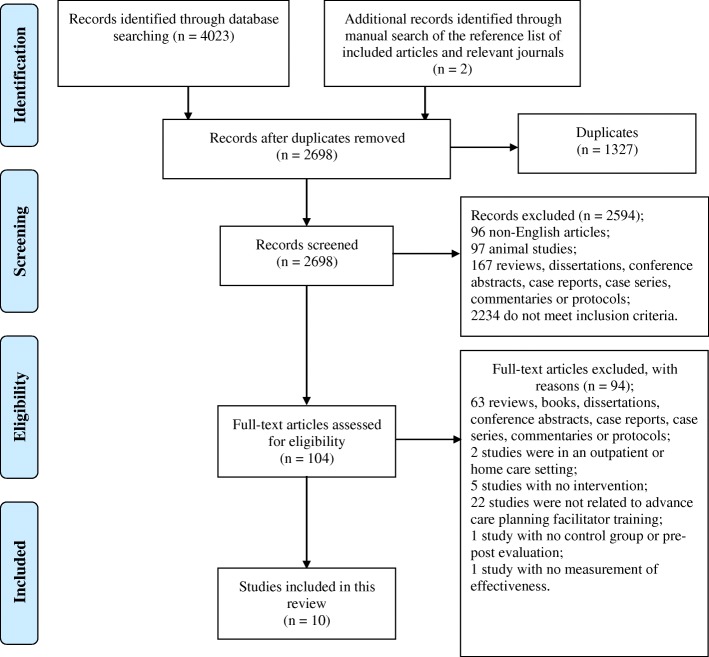
- Ten eligible articles covering 1081 participants were included from 4025 identified articles; sample sizes ranged from 16 to 278, with five studies including more than 100 participants.
- All included intervention studies showed positive results: training significantly increased knowledge, attitudes towards shared decision-making, perceived communication skills, confidence, comfort, and experiences in discussing end-of-life issues; patient advocacy, job satisfaction, and perceived adequacy of training for end-of-life care also improved.
- Quality appraisal using EPHPP rated two studies strong, two moderate, and six weak; only two studies were RCTs, and there was a lack of high-quality RCTs for nurses working in non-palliative care hospital settings.
- Decision aids were rated as acceptable and clinically useful, and 90% of participants in one study evaluated the educational value of a values-based session positively, though that study found no evidence of increased ACP actions after one month.
Methods
- Systematic review with literature search conducted in July 2018 across eight databases: MEDLINE, CINAHL, PubMed, EMBASE, Cochrane Library, JBI EBP, PsycINFO, and Health and Psychosocial Instruments.
- Eligible studies were RCTs, quasi-experimental studies with a control group, or uncontrolled before-and-after studies; participants were healthcare professionals working with adult patients with terminal illness, and outcomes included knowledge, attitudes, self-perceived competence, and frequency of initiating ACP conversations.
- Two reviewers independently screened, extracted data, and appraised quality using the Effective Public Health Practice Project (EPHPP) tool; meta-analysis was not performed because interventions and outcome measurements were too varied.
Limitations
- The paper states that meta-analysis could not be performed because intervention and outcome measurements were highly varied, and that there is a lack of high-quality RCTs evaluating ACP facilitator training for nurses in non-palliative care hospital settings.
- The paper also notes that not many studies measured the effect on frequency of initiating ACP discussions, that some studies used non-validated questionnaires/surveys, that outcome assessors were not blinded in several studies, and that one study had less than 60% participant completion.
- Evident from the text: only ten studies were included, most were rated weak in quality, the review was limited to English-language articles, and it excluded community/home-dwelling patients and neonatal/pediatric populations.
Model-written summary. Check it against the paper before relying on it.
Integrity signals
Registry
Cites
Statistics
Figures
Verification
Claims the paper makes
18 Valid · 1 Not valid · 30 Not checked · 23 Own results and interpretations
The cited sources support only part of this claim — read each source’s verdict below.
In the paper
“facilitated ACP can increase the number of meaningful and valid ADs”
§ A systematic review of the effects of advance care planning facilitators training programs > Background
What the sources say
- Supportedcites [4] in der Schmitten J Lex K Mellert C Rothärmel S Wegscheider K Marckmann G Implementing an advance care planning program in German nursing homes: results of an inter-regionally controlled intervention trial Dtsch Arztebl Int 2014 111 4 50 57 24612497 PMC3950824 source
The Discussion reports a ninefold higher incidence of advance directives in the intervention group and says the new directives were predominantly of high relevance and validity. The Results also report more physician signatures and clear emergency-treatment instructions in the intervention region. This supports the claim for the facilitated ACP program studied in German nursing homes. (LLM, conf=0.94)
- Not checked — no full text of the sourcecites [5] Hammes BJ Rooney BL Gundrum JD A comparative, retrospective, observational study of the prevalence, availability, and specificity of advance care plans in a county that implemented an advance care planning microsystem J Am Geriatr Soc 2010 58 7 1249 1255 10.1111/j.1532-5415.2010.02956.x 20649688 source
- Partly supportedcites [6] Detering KM Hancock AD Reade MC Silvester W The impact of advance care planning on end of life care in elderly patients: randomised controlled trial BMJ. 2010 340 c1345 10.1136/bmj.c1345 20332506 PMC2844949 sourceExperimental — accuracy not yet measured
The Intervention section reports that 70 of 125 patients who received facilitated advance care planning completed an advance care plan, and the Discussion says documentation was completed in most discussions and correctly filed. The paper describes discussions of patients’ goals and wishes, but our copy does not establish that the resulting advance directives were legally valid; that qualifier is unsupported. (LLM, conf=0.84)
plainstates a cause- Asserted: passes — The authors put it forward as true.
- Checkable: passes — It can be checked against evidence.
- Load-bearing: passes — The paper’s conclusions depend on it.
- Based: passes — The paper gives a reason why it holds.
- Supported
The sources with a verdict support this claim; the rest weren’t checked yet, have no full text we could read, or their verdicts aren’t rated yet.
In the paper
“strengthen patient autonomy”
§ A systematic review of the effects of advance care planning facilitators training programs > Background
What the sources say
- Supportedcites [4] in der Schmitten J Lex K Mellert C Rothärmel S Wegscheider K Marckmann G Implementing an advance care planning program in German nursing homes: results of an inter-regionally controlled intervention trial Dtsch Arztebl Int 2014 111 4 50 57 24612497 PMC3950824 source
The Conclusion describes facilitated ACP as helping people develop and articulate their future treatment wishes through an informed-consent process. The Methods add that facilitators help clarify individual preferences, and the paper reports more advance directives with potential relevance to medical decisions. These passages support the hedged claim that facilitated ACP can strengthen patient autonomy; they do not establish autonomy as a separately measured outcome. Page numbers were not supplied in our copy. (LLM, conf=0.87)
- Not checked — no full text of the sourcecites [5] Hammes BJ Rooney BL Gundrum JD A comparative, retrospective, observational study of the prevalence, availability, and specificity of advance care plans in a county that implemented an advance care planning microsystem J Am Geriatr Soc 2010 58 7 1249 1255 10.1111/j.1532-5415.2010.02956.x 20649688 source
- Supportedcites [6] Detering KM Hancock AD Reade MC Silvester W The impact of advance care planning on end of life care in elderly patients: randomised controlled trial BMJ. 2010 340 c1345 10.1136/bmj.c1345 20332506 PMC2844949 source
The Intervention section describes trained facilitators helping patients document their future care choices. The study reports that intervention patients were more likely to participate in end-of-life decisions and to have their wishes known and respected, supporting the claim that facilitated advance care planning can strengthen patient autonomy. (LLM, conf=0.92)
plainstates a cause- Asserted: passes — The authors put it forward as true.
- Checkable: passes — It can be checked against evidence.
- Load-bearing: passes — The paper’s conclusions depend on it.
- Based: passes — The paper gives a reason why it holds.
- Supported
Every source the paper cites for this claim was checked and supports it.
In the paper
“Lum et al. [22] found that 90% of participants evaluated the educational value of the session positively.”
§ A systematic review of the effects of advance care planning facilitators training programs > Results > Effects of interventions
What the sources say
- Supportedcites [22] Lum HD Dukes J Church S Abbott J Youngwerth JM Teaching medical students about “the conversation”: an interactive value-based advance care planning session Am J Hosp Palliat Care 2018 35 2 324 329 10.1177/1049909117696245 28273761 PMC5730505 source
The Results section (‘Students’ Perspectives on ACP Educational Session’) says students rated the session highly useful for learning about advance care planning. It reports that 92% positively rated two learning components, supporting the citing sentence’s rounded ‘90%’ description. (LLM, conf=0.90)
plain- Asserted: passes — The authors put it forward as true.
- Checkable: passes — It can be checked against evidence.
- Load-bearing: unclear — It is unclear whether the paper’s conclusions depend on it.
- Based: passes — The paper gives a reason why it holds.
- Supported
Every source the paper cites for this claim was checked and supports it.
In the paper
“All except Lum et al. [22] reported intervention effect maintained at time of follow up.”
§ A systematic review of the effects of advance care planning facilitators training programs > Results > Outcome measures
What the sources say
- Supportedcites [22] Lum HD Dukes J Church S Abbott J Youngwerth JM Teaching medical students about “the conversation”: an interactive value-based advance care planning session Am J Hosp Palliat Care 2018 35 2 324 329 10.1177/1049909117696245 28273761 PMC5730505 source
The Results section reports no increase in concrete advance care planning actions at the one-month follow-up compared with immediately after the session. The Discussion adds that the surveys could not be linked for a formal pre-to-post comparison. These passages support treating Lum et al. as an exception to studies reporting a maintained intervention effect; this source cannot speak to the other included studies. (LLM, conf=0.86)
plainstates a cause- Asserted: passes — The authors put it forward as true.
- Checkable: passes — It can be checked against evidence.
- Load-bearing: unclear — It is unclear whether the paper’s conclusions depend on it.
- Based: passes — The paper gives a reason why it holds.
- Supported
The sources with a verdict support this claim; the rest weren’t checked yet, have no full text we could read, or their verdicts aren’t rated yet.
In the paper
“improve the quality of care when EOL is near [4–6]”
§ A systematic review of the effects of advance care planning facilitators training programs > Background
What the sources say
- Supportedcites [4] in der Schmitten J Lex K Mellert C Rothärmel S Wegscheider K Marckmann G Implementing an advance care planning program in German nursing homes: results of an inter-regionally controlled intervention trial Dtsch Arztebl Int 2014 111 4 50 57 24612497 PMC3950824 source
The Discussion reports that a controlled ACP study improved both process and outcome quality in nursing homes, and that another ACP program generally honored patients’ documented wishes near the end of life. This supports the qualified claim that facilitated ACP can improve care, although this paper’s own German study assessed procedural outcomes rather than clinical outcomes. (LLM, conf=0.87)
- Not checked — no full text of the sourcecites [5] Hammes BJ Rooney BL Gundrum JD A comparative, retrospective, observational study of the prevalence, availability, and specificity of advance care plans in a county that implemented an advance care planning microsystem J Am Geriatr Soc 2010 58 7 1249 1255 10.1111/j.1532-5415.2010.02956.x 20649688 source
- Supportedcites [6] Detering KM Hancock AD Reade MC Silvester W The impact of advance care planning on end of life care in elderly patients: randomised controlled trial BMJ. 2010 340 c1345 10.1136/bmj.c1345 20332506 PMC2844949 source
The Discussion states that this randomised trial found advance care planning carried out by trained non-medical staff improved end-of-life care by helping ensure patients’ wishes were known and respected. The Intervention section confirms that trained facilitators delivered the planning. (LLM, conf=0.94)
plainstates a cause- Asserted: passes — The authors put it forward as true.
- Checkable: passes — It can be checked against evidence.
- Load-bearing: passes — The paper’s conclusions depend on it.
- Based: passes — The paper gives a reason why it holds.
- Supported
34 more claims · 4 with their cited sources checked
Create a free account to see all 72 claims and every source verdict.
- Probably not a substantial claim. 19
- It may state two separate claims as one. 16
- Borderline: one of the tests for a substantial claim is unclear. 1
- The quote only partly states this claim. 1
Self-check
Percentages, sums and reported differences re-computed from the paper’s own numbers.
Each contradiction between two passages listed here was confirmed by an independent check.
Rated minor: it would not touch a result — a value no result rests on, a p-value that stays on the same side of the significance level, or a conflict that is clerical, resolved elsewhere in the paper, or outside its own findings.
In the paper
§ A systematic review of the effects of advance care planning facilitators training programs > Results > Outcome measures
“Lum et al. [22, 25]”
§ A systematic review of the effects of advance care planning facilitators training programs > Results > Methodological quality
“Smith et al. [25]”
Citations
Cites
Preferred Reporting Items for Systematic Reviews and Meta-Analyses: the PRISMA statement
Moher, D., Liberati, A., Tetzlaff, J., Altman, D. G., & for the PRISMA Group (2009) · BMJ · doi:10.1136/bmj.b2535 · Cited by 83,823
Preferred reporting items for systematic reviews and meta-analyses: the PRISMA Statement.
(2009) · PubMed Central · Cited by 44,859
Preferred reporting items for systematic reviews and meta-analyses: The PRISMA statement
Moher, D., Liberati, A., Tetzlaff, J., Altman, D. G., & the PRISMA Group* (2009) · Annals of Internal Medicine · doi:10.7326/0003-4819-151-4-200908180-00135 · Cited by 37,554
Detering, K. M., Hancock, A. D., Reade, M. C., & Silvester, W. (2010) · BMJ · doi:10.1136/bmj.c1345 · Cited by 2,332
Thomas, B. H., Ciliska, D., Dobbins, M., & Micucci, S. (2004) · Worldviews on Evidence-Based Nursing · doi:10.1111/j.1524-475x.2004.04006.x · Cited by 2,118
The effects of advance care planning on end-of-life care: A systematic review
Brinkman-Stoppelenburg, A., Rietjens, J. A., & van der Heide, A. (2014) · Palliative Medicine · doi:10.1177/0269216314526272 · Cited by 1,480
The changing model of palliative care
Graham, F., & Clark, D. (2008) · Medicine · doi:10.1016/j.mpmed.2007.11.009 · Cited by 743
You, J. J., Downar, J., Fowler, R. A., Lamontagne, F., Ma, I. W. Y., Jayaraman, D., Kryworuchko, J., Strachan, P. H., Ilan, R., Nijjar, A. P., et al. (2015) · JAMA Internal Medicine · doi:10.1001/jamainternmed.2014.7732 · Cited by 422
Lund, S., Richardson, A., & May, C. (2015) · PLOS ONE · doi:10.1371/journal.pone.0116629 · Cited by 325
Johnson, S., Butow, P., Kerridge, I., & Tattersall, M. (2016) · Psycho-Oncology · doi:10.1002/pon.3926 · Cited by 276
Research works printed but not linked: 2
- World Health Organization WHO definition of palliative care 2018
- Park S A study on the degree of death orientation and terminal care performance of nurses 1996 Gwangju Chonnam National University
Cited by
Sullivan, D. R., Iyer, A. S., Enguidanos, S. M., Cox, C. E., Farquhar, M. C., Janssen, D. J. A., Lindell, K. O., Mularski, R. A., Smallwood, N., Turnbull, A. E., et al. (2022) · American Journal of Respiratory and Critical Care Medicine · doi:10.1164/rccm.202207-1262st · Cited by 156
Chen, X., Zhang, Y., Arber, A., Huo, X., Liu, J., Sun, C.-H., Yuan, L., Wang, X., Wang, D., Wu, J.-F., et al. (2022) · BMC Palliative Care · doi:10.1186/s12904-022-00953-0 · Cited by 33
Schichtel, M., MacArtney, J. I., Wee, B., & Boylan, A. R. (2021) · British Journal of General Practice · doi:10.3399/bjgp.2020.0973 · Cited by 39
Yang, Z. Y., Liu, S., Dai, M., & Zhang, H. (2021) · Nurse Education in Practice · doi:10.1016/j.nepr.2021.103183 · Cited by 35
Chan, H. Y. L., Kwok, A. O. L., Yuen, K.-K., Au, D. K.-S., & Yuen, J. K. Y. (2020) · BMC Medical Education · doi:10.1186/s12909-020-02347-3 · Cited by 47
Self-citationAn Interprofessional Approach to Advance Care Planning
Kwak, J., Jamal, A., Jones, B. L., Timmerman, G. M., Hughes, B., & Fry, L. (2021) · American Journal of Hospice and Palliative Medicine® · doi:10.1177/10499091211019316 · Cited by 40
The Role of Effective Communication Skills in Professional Life
Sumaiya, B., Srivastava, S., Jain, V., & Prakash, V. (2022) · World Journal of English Language · doi:10.5430/wjel.v12n3p134 · Cited by 99
Arends, S. A. M., Steenbergen, M., Thodé, M., Francke, A. L., & Jongerden, I. P. (2022) · Patient Education and Counseling · doi:10.1016/j.pec.2022.01.017 · Cited by 54
Patel, M. I., Khateeb, S. I., & Coker, T. R. (2021) · JCO Oncology Practice · doi:10.1200/op.21.00100 · Cited by 35
Implementation of advance care planning amid the COVID ‐19 crisis: A narrative review and synthesis
Hirakawa, Y., Saif‐Ur‐Rahman, K., Aita, K., Nishikawa, M., Arai, H., & Miura, H. (2021) · Geriatrics and gerontology international/Geriatrics & gerontology international · doi:10.1111/ggi.14237 · Cited by 33
Continuing Education Outcomes for Advance Care Planning: A Systematic Review of the Literature
Kinton, W., Saxon, R. L., Plowman, G., Hyde, M. B., & Oprescu, F. (2021) · Journal of Continuing Education in the Health Professions · doi:10.1097/ceh.0000000000000323 · Cited by 35
Laranjeira, C., Dixe, M. D. A., Gueifão, L., Caetano, L., Passadouro, R., & Querido, A. (2021) · Healthcare · doi:10.3390/healthcare9060648 · Cited by 25
Dias, L. M., Frutig, M. D. A., Bezerra, M. R., Barra, W. F., Castro, L., & Rêgo, F. M. P. D. S. (2023) · International Journal of Environmental Research and Public Health · doi:10.3390/ijerph20043239 · Cited by 23
Turnbull, M. L., Yu, C., & Wu, X. I. (2022) · Patient Education and Counseling · doi:10.1016/j.pec.2022.10.007 · Cited by 20
Lin, C., Peng, J., Chen, P., Huang, H., Hsu, S.-H., & Cheng, S. (2020) · International Journal of Environmental Research and Public Health · doi:10.3390/ijerph17217954 · Cited by 22
Smith, K. M., Scerpella, D. L., Guo, A., Hussain, N., Colburn, J. L., Cotter, V. T., Aufill, J., Dy, S. M., & Wolff, J. L. (2022) · Journal of Primary Care & Community Health · doi:10.1177/21501319221137251 · Cited by 22
Hirakawa, Y., Aita, K., Nishikawa, M., Arai, H., & Miura, H. (2021) · Home Healthcare Now · doi:10.1097/nhh.0000000000000945 · Cited by 18
Fortin, G., & Dumont, S. (2021) · Journal of Social Work in End-of-Life & Palliative Care · doi:10.1080/15524256.2021.1897922 · Cited by 21
Lasmarías, C., Subirana‐Casacuberta, M., Mancho, N., & Aradilla‐Herrero, A. (2021) · Journal of Palliative Medicine · doi:10.1089/jpm.2020.0653 · Cited by 15
Voss, H., Vogel, A., Wagemans, A. M. A., Francke, A. L., Metsemakers, J. F. M., Courtens, A. M., & de Veer, A. J. E. (2021) · Intellectual and developmental disabilities · doi:10.1352/1934-9556-59.1.39 · Cited by 17
Interventions to promote readiness for advance care planning: A systematic review and meta-analysis
Tan, M., Tang, S., Feder, S. L., Xiao, J., Huang, C., Cook, A. G., Johnson, C. E., & Ding, J. (2024) · International Journal of Nursing Studies · doi:10.1016/j.ijnurstu.2024.104778 · Cited by 22
DeCamp, M. W., Prager, K. M., Opole, I. O., Deep, N. N., Callister, T. B., Abraham, G. M., Bornstein, S. S., Bruera, E. D., Burnett, J. R., Carney, J. K., et al. (2023) · Annals of Internal Medicine · doi:10.7326/m23-1361 · Cited by 17
Chen, J.-O., Chang, S.-C. S., & Lin, C.-C. (2021) · PLoS ONE · doi:10.1371/journal.pone.0254982 · Cited by 13
Hope pictured in drawings by patients newly diagnosed with advanced cancer
Hammer, K., Højgaard, H. S., Steig, B. Á., Wang, A. G., Bergenholtz, H., & Rosted, E. (2022) · Journal of Clinical Nursing · doi:10.1111/jocn.16274 · Cited by 20
Addressing Advance Care Planning in Patients With COPD
Rose, E. K., & O’Connor, J. (2021) · CHEST Journal · doi:10.1016/j.chest.2021.10.037 · Cited by 12
Detering, K. M., Sinclair, C., Buck, K., Sellars, M., White, B. P., Kelly, H., & Nolte, L. (2021) · BMC Health Services Research · doi:10.1186/s12913-021-06523-z · Cited by 13
van Lummel, E. V. T. J., Savelkoul, C., Stemerdink, E. L. E., Tjan, D. H. T., & van Delden, J. J. M. (2022) · BMC Palliative Care · doi:10.1186/s12904-022-01005-3 · Cited by 13
van Doorne, I., Mokkenstorm, K., Willems, D. L., Buurman, B. M., & van Rijn, M. (2023) · Heliyon · doi:10.1016/j.heliyon.2023.e14772 · Cited by 10
Zhao, Y., Liu, L., Ding, Y., Shan, Y., & Chan, H. Y. L. (2022) · BMC Nursing · doi:10.1186/s12912-022-00815-3 · Cited by 12
Self-citationEnd-of-Life Care Education as Blended Learning Approach for General Practitioners: a Scoping Review
Atreya, S. Y., & Salins, N. S. (2023) · Journal of Cancer Education · doi:10.1007/s13187-023-02358-w · Cited by 14
Using Zoom and Card Game to Conduct Advance Care Planning Classes: An Innovative Practice
Phenwan, T., Peerawong, T., Jarusomboon, W., Sittiwantana, E., Satian, C., & Supanichwatana, S. (2021) · OMEGA - Journal of Death and Dying · doi:10.1177/00302228211032735 · Cited by 14
Kirchner, Ä., Langner, H., Meyer, G., Schnakenberg, R., Silies, K., Hoffmann, F., Köpke, S., Köberlein–Neu, J., & Berg, A. (2022) · Pflege · doi:10.1024/1012-5302/a000897 · Cited by 6
Goto, Y., & Miura, H. (2023) · Healthcare · doi:10.3390/healthcare11091356 · Cited by 13
Xing, B., Liang, G., Zhang, J., Zhang, J., Jiang, Z., & Miao, Q. (2021) · BMC Palliative Care · doi:10.1186/s12904-021-00885-1 · Cited by 12
Chan, H. Y. L., Chan, C. N.-C., Man, C.-W., Chiu, A. D.-W., Liu, F. C.-F., & Leung, E. M.-F. (2022) · International Journal of Environmental Research and Public Health · doi:10.3390/ijerph19020667 · Cited by 10
Self-citationFinkelstein, A., Resnizky, S., Cohen, Y., Garber, R., Kannai, R., Katz, Y., & Avni, O. (2022) · Palliative & Supportive Care · doi:10.1017/s1478951521001942 · Cited by 9
Carrasco, A. J. P., Berlin, P., Betker, L., Riera‐Knorrenschild, J., von Blanckenburg, P., & Seifart, C. (2022) · European Journal of Cancer Care · doi:10.1111/ecc.13756 · Cited by 10
Escher, M., NENDAZ, M. R., Scherer, F., Cullati, S., & Perneger, T. (2020) · Palliative Medicine · doi:10.1177/0269216320963931 · Cited by 8
Advance care planning in patients with respiratory failure
Ribeiro, C. S. M. F., Pamplona, P., & Simonds, A. K. (2024) · European Respiratory Review · doi:10.1183/16000617.0120-2024 · Cited by 14
Hong, S. W., Kim, S., Yun, Y., Jung, H. S., Shim, J. L., & Kim, J. (2021) · International Journal of Environmental Research and Public Health · doi:10.3390/ijerph18031158 · Cited by 8
Psychometric testing of the training needs for advance care planning scale for clinicians and nurses
He, C., Dong, T., Tan, J., Yang, L., Qiu, Y., Zhang, J., Huang, Y., Zhou, A., Wang, X., Huang, Y. W., et al. (2024) · BMC Nursing · doi:10.1186/s12912-024-01952-7 · Cited by 6
Katamreddy, A., Ye, A. M., Vorchheimer, D. A., Hardoon, I., FAILLACE, R. T., & Taub, C. C. (2022) · American Journal of Hospice and Palliative Medicine® · doi:10.1177/10499091221092699 · Cited by 6
Waller, A. E., Chan, S. W., Chan, C. W. H., Chow, M. C. M., Kim, M., Kang, S. J., Oldmeadow, C. J., & Sanson‐Fisher, R. (2020) · Journal of Advanced Nursing · doi:10.1111/jan.14510 · Cited by 5
Self-citationNursing students’ perception: Escape Room use in teaching leadership skills
Rached, C. D. A., da Cruz, E. A. A., da Mota, M. H. C., Paulo, C. D. S. F., Amaral, G. M. P., & Nakajima, D. L. (2024) · Revista Brasileira de Enfermagem · doi:10.1590/0034-7167-2023-0414 · Cited by 13
Naik, B., Ghoshal, A., Damani, A., Singhai, P., Attur, R. P., Salins, N. S., Nayak, A. M., & Nagaraju, S. P. (2024) · The Nephron journals/Nephron journals · doi:10.1159/000541347 · Cited by 7
Naik, B., Damani, A., Ghoshal, A., Nagaraju, S., Singhai, P., Ammunje, S. N., Attur, R., & Salins, N. (2025) · BMC Nephrology · doi:10.1186/s12882-025-04354-2 · Cited by 5
Iida, K., Ishimaru, M., Tsujimura, M., & Wakasugi, A. (2025) · JBI Evidence Synthesis · doi:10.11124/jbies-23-00221 · Cited by 7
Advance care plan discussion among parents of children with cerebral palsy
Khalid, F., Voon, S. I. N., Ong, L. C., Lim, W. K., Li, L., Adnan, A., Ganesan, V. M., Teh, C. M., & Fong, C. Y. (2022) · Developmental Medicine & Child Neurology · doi:10.1111/dmcn.15184 · Cited by 5
Bennett, F. B., & O’Conner-Von, S. (2022) · Journal of Gerontological Nursing · doi:10.3928/00989134-20221003-08 · Cited by 7
Examining the role of card game in promoting death awareness in Thailand
Phenwan, T., Sittiwantana, E., Jarusomboon, W., & Peerawong, T. (2025) · Mortality · doi:10.1080/13576275.2025.2449895 · Cited by 4
Riedel, A., Lehmeyer, S., Linde, A.-C., & Treff, N. (2022) · Springer Reference Pflege, Therapie, Gesundheit · doi:10.1007/978-3-662-58680-8_85 · Cited by 4
Garcia, P., Kim, H. J., Barbour, S., & Cooper, A. S. (2023) · International Journal of Evidence-Based Healthcare · doi:10.1097/xeb.0000000000000373 · Cited by 7
Kaminski, A. (2022) · American Journal of Hospice and Palliative Medicine® · doi:10.1177/10499091221127994 · Cited by 7
Martins, C. S., & Nunes, R. (2023) · BMC Palliative Care · doi:10.1186/s12904-023-01203-7 · Cited by 5
Zhou, Y., Bai, Z., Cheng, L., Zheng, Q., & Li, L. (2023) · Journal of Palliative Care · doi:10.1177/08258597231185679 · Cited by 3
Tan, M., Tang, S., Kan, S., Zhang, H., Wu, B., Ni, Z., Lin, C., & Ding, J. (2025) · BMJ Open · doi:10.1136/bmjopen-2025-099226 · Cited by 4
Yang, Z. Y., Wang, H., Chen, Z., & Wang, A. (2022) · Nurse Education in Practice · doi:10.1016/j.nepr.2022.103484 · Cited by 4
End-of-Life Planning: Normalizing the Process
Masters, J., Wylie, L. E., & Hübner, S. (2021) · Journal of Aging & Social Policy · doi:10.1080/08959420.2021.1926864 · Cited by 5
Nursing facility residents’ cardiopulmonary resuscitation decisions
Myers, A. L., & Matthias, M. S. (2020) · International Journal of Older People Nursing · doi:10.1111/opn.12344 · Cited by 5
Bryant, J., Waller, A. E., Bowman, A., Pickles, R., Hullick, C., Price, E., White, B. P., Willmott, L., Knight, A., Ryall, M., et al. (2022) · BMC Medical Ethics · doi:10.1186/s12910-022-00813-9 · Cited by 3
Choi, J., Son, Y., & Lee, K. (2020) · Journal of Korean Critical Care Nursing · doi:10.34250/jkccn.2020.13.1.27 · Cited by 5
Souza, L. G., Archambault, P. M., Bouba, D. A., Dofara, S. G., Guay-Bélanger, S., Ghio, S. C., Gadio, S., Michaels, L. C., Paquette, J., Izumi, S., et al. (2024) · medRxiv · doi:10.1101/2024.02.05.24302368 · Cited by 2
The affordable care act and do-not-resuscitate orders: Differences by race and ethnicity
Callahan, K., Acharya, Y., & Hollenbeak, C. S. (2023) · Heart & Lung · doi:10.1016/j.hrtlng.2023.01.009 · Cited by 3
Bouba, D. A., Souza, L. G., Dofara, S. G., Guay-Bélanger, S., Gadio, S., Mochcovitch, D. G. V., Paquette, J., Izumi, S., Archambault, P. M., Totten, A. M., et al. (2024) · Journal of CME · doi:10.1080/28338073.2024.2420475 · Cited by 4
Chan, C. W. H., Ng, N. H. Y., Chan, H. Y. L., Choi, K. C., Chow, K. M., Kwan, C. W., Robinson, J., & Tse, M.-K. (2024) · European Journal of Oncology Nursing · doi:10.1016/j.ejon.2024.102760 · Cited by 2
Self-citationDias, L. M., Frutig, M. D. A., Bezerra, M. R., Barra, W. F., Castro, L., & Rêgo, F. M. P. D. S. (2021) · Research Square · doi:10.21203/rs.3.rs-770418/v1 · Cited by 2
Tan, M., Tang, S., Huang, C., Xiao, J., & Ding, J. (2024) · PubMed Central · doi:10.11817/j.issn.1672-7347.2024.230291 · Cited by 3
Baldwin, E. J., Short, A., Wehner, K., Zanter, A., & Coombs, L. A. (2025) · Journal of Hospice and Palliative Nursing · doi:10.1097/njh.0000000000001193 · Cited by 1
Advance care planning in multiple sclerosis: reflections of a palliative care physician
Petersen, L. (2021) · British Journal of Neuroscience Nursing · doi:10.12968/bjnn.2021.17.sup3.s20 · Cited by 1
Goto, Y., & Miura, H. (2024) · Nursing Reports · doi:10.3390/nursrep14020075 · Cited by 1
Ko, H., Hwang, Y. Y., Heo, S., Cho, K., Shin, M., Kim, M. Y., & Kim, J. (2024) · Japan Journal of Nursing Science · doi:10.1111/jjns.12641 · Cited by 2
Souza, L. G., Archambault, P. M., Bouba, D. A., Dofara, S. G., Guay-Bélanger, S., Ghio, S. C., Gadio, S., Michaels, L., Paquette, J., Izumi, S., et al. (2025) · PLoS ONE · doi:10.1371/journal.pone.0298994 · Cited by 4
Qutob, R. A., Alaryni, A. A., Alammari, Y. M., Almaimani, M. K., Alghamdi, A., Alotay, A. A., Alhajery, M. A., Faqihi, F. A., Daghistani, Y., AlHussaini, K. I., et al. (2025) · Healthcare · doi:10.3390/healthcare13070771 · Cited by 3
Gichobi, B., Gitonga, L. K., & Marwa, I. N. (2023) · International Journal of Health Sciences and Research · doi:10.52403/ijhsr.20231004 · Cited by 3
Crous, K., Kanareck, D., Thomas, M. A., Anderson, K., Tully, S., & Wand, A. P. F. (2026) · European Geriatric Medicine · doi:10.1007/s41999-026-01416-y · Cited by 2
Care for the Dying: A Scoping Review of Measures for Clinical Practice With Qualitative Synthesis
Oubaid, N., Kaur, S., Oechsle, K., Ullrich, A., Milke, V., Schieferdecker, A., Kremeike, K., Meesters, S., Herrmann, C., Voltz, R., et al. (2025) · OMEGA - Journal of Death and Dying · doi:10.1177/00302228251322860 · Cited by 2
Li, Y., Li, F., Li, Y., & Zhou, Q. (2025) · BMC Palliative Care · doi:10.1186/s12904-025-01886-0 · Cited by 3
Towards quality indicators in palliative care education: An umbrella review
Carrasco, A. J. P., Näppä, U., Hökkä, M., Pereira, J. L. S., Paal, P., Kaňák, J., Jarašiūnaitė–Fedosejeva, G., Connolly, M., Ellershaw, J., Antoniu, S. A., et al. (2026) · Palliative Care and Social Practice · doi:10.1177/26323524261440959 · Cited by 2
Doan, T., & Brennan, S. (2025) · Nursing Reports · doi:10.3390/nursrep15080270 · Cited by 2
Ludwick, R. E., & Baughman, K. R. (2022) · Journal of Gerontological Nursing · doi:10.3928/00989134-20221003-04 · Cited by 1
Identifying Gaps in Care Quality for Seriously Ill Medicare Advantage Enrollees
Price, R. A., Tolpadi, A. A., Bradley, M. A., DeYoreo, M., Elliott, M. N., Teno, J. M., Brodnitzki, W., Chen, J. X., Gosline, A., & Chan, S. H. (2025) · Journal of Palliative Medicine · doi:10.1177/10966218251381011 · Cited by 2
Ke, X., Zhu, H., Zhang, Y., Yang, L., Shi, S., Zhu, F., & Luo, H. (2022) · BMC Palliative Care · doi:10.1186/s12904-022-01108-x · Cited by 2
Jonathan, S., Pfaff, K., & Cruz, E. (2024) · Canadian Journal of Nursing Research · doi:10.1177/08445621241278922 · Cited by 3
Advance Care Planning in Healthcare Systems: A Literature Review and Call to Action
(2019) · ARC Journal of Nursing and Healthcare · doi:10.20431/2455-4324.0503005 · Cited by 1
Bourjot, M., L’épine, Q., Brocquet, E., Robinet, P., Charpentier, A., Beuscart, J., & Visade, F. (2026) · Journal of Palliative Care · doi:10.1177/08258597261448961 · Cited by 1
Advance Care Planning for Patients With Hematologic Malignancies: A Narrative Review
Seecof, O. M. (2026) · American Journal of Hospice and Palliative Medicine® · doi:10.1177/10499091261416032 · Cited by 1
Building a Comprehensive Advance Care Planning Approach in a Community Health System during COVID-19
(2021) · Health Education and Public Health · doi:10.31488/heph.168
(2020) · doi:10.21203/rs.3.rs-29070/v2 · Cited by 1
Self-citationCOACHING Y LA TRANSFORMACIÓN EN LA GESTIÓN ORGANIZACIONAL DEL SISTEMA DE SALUD
Calcurian, Y. D. C. G., Flores, M., Carrasquel, A., Cumana, K., Evies, A., & Maldonado, J. R. P. (2024) · Enfermería Investiga · doi:10.31243/ei.uta.v9i2.2448.2024
Enhanced Outcomes of Training Home Care Nurses to Lead Advance Care Planning for Older Adults
Chung, H., Jo, M., Choi, J. Y., & Park, M. (2025) · Advances in Nursing Science · doi:10.1097/ans.0000000000000586
Metadata
- Authors
- Chan, C. W. H., Ng, N. H. Y., Chan, H. Y. L., Wong, M. M. H., & Chow, K. M.
- Affiliations
- Chinese University of Hong Kong (HK)
- Corresponding author
- Ng, Nancy Hiu Yim
- Venue
- BMC Health Services Research
- Published
- 2019-06-07
- Volume
- 19
- Issue
- 1
- Pages
- 362-362
- ISSN
- 1472-6963 (ISSN-L)
- PMC
- PMC6555972
- OpenAlex
- W2948775368
- Cited by
- 135
- References
- 35
- Citations by year
- 2026: 22 · 2025: 18 · 2024: 23 · 2023: 14 · 2022: 28 · 2021: 21 · 2020: 7 · 2019: 2
- FWCI
- 2.37
- Type
- journal article
- Language
- en
- Open access
- gold
- doi.org
- Licence
- cc-by
- creativecommons.org/licenses/by/4.0/ (tdm)
- creativecommons.org/licenses/by/4.0/ (vor)
- Locations
- BMC Health Services Research (publishedVersion, cc-by)
- PubMed Central (publishedVersion, cc-by)
- PubMed (publishedVersion)
- DOAJ (DOAJ: Directory of Open Access Journals) (submittedVersion, cc-by-sa)
- Topics
- Health Sciences › Medicine › Public Health, Environmental and Occupational Health › Palliative Care and End-of-Life Issues
- Health Sciences › Medicine › Public Health, Environmental and Occupational Health › Palliative and Oncologic Care
- Health Sciences › Health Professions › General Health Professions › Patient-Provider Communication in Healthcare
- Keywords
- advance care planning, health professions education, end-of-life care, shared decision-making, communication skills, decision aids, role play, terminal illness, patient advocacy, job satisfaction
- MeSH terms
- Decision Making, Health Personnel, Humans, Randomized Controlled Trials as Topic, Advance Directives, Advance Care Planning, Evidence-Based Practice
About these checks
Registry, retraction, Cites and statistics results are computed, not judged, with one exception: a printed reference that no index lists is read once by a model before it counts as a citation error. Claims are extracted by a model and kept only when their quote appears verbatim in the text; each cited source is then checked, with a model’s help, for whether it says what the claim relies on. Those verdicts can be wrong — read the claim’s quote and the cited source before relying on one.
The claim verdicts this report counts are experimental: their accuracy is not yet measured.
A language model drew the claims from the paper on 2026-10-10, under version 3 of the claim definition (model deepseek-v4.1-flash, prompt extract-v3).
A second model labelled each claim on 2026-10-10 (model jev-1.13-20260917, definition revision gold-guideline-v0.2).
Cited sources are checked with a language model’s help (gpt-6-sol).
Statistics and arithmetic are recomputed, not judged.
Confidence bands are shown only for fields calibrated on our annotated test set. None is calibrated yet, so no band is shown.
What counts as a claim ›How we measure confidence ›How we check this ›
Are you an author, or do you see a problem with this page? Request a review
Data sources
Bibliographic data: Semantic Scholar, OpenAlex, Crossref.
Contains information from the Semantic Scholar Academic Graph Datasets, made available under the ODC Attribution License (ODC-BY 1.0).
Semantic Scholar’s data is described in: Kinney, R., et al. (2023). The Semantic Scholar Open Data Platform. arXiv:2301.10140.
