

The DOI matches its Crossref record; 64 of the 66 references it cites were found in a registry or an index.
Digital technology and nursing care: a scoping review on acceptance, effectiveness and efficiency studies of informal and formal care technologies
Open accessAbstract
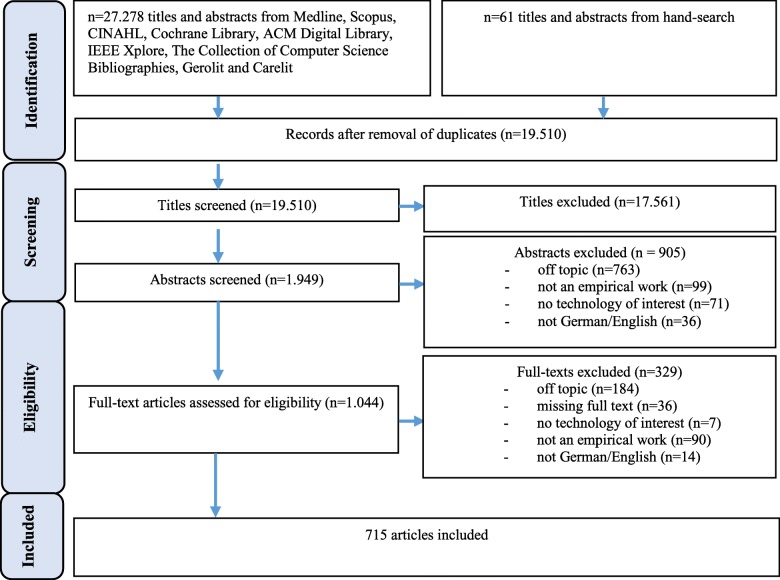
BACKGROUND: The existence, usage and benefits of digital technologies in nursing care are relevant topics in the light of the current discussion on technologies as possible solutions to problems such as the shortage of skilled workers and the increasing demand for long-term care. A lack of good empirical overviews of existing technologies in the present literature prompted us to conduct this review. Its purpose was to map the field of digital technologies for informal and formal care that have already been explored in terms of acceptance, effectiveness and efficiency (AEE), and to show the scope of the used methods, target settings, target groups and fields of support. METHODS: A systematic literature search was conducted using Medline, Scopus, CINAHL, Cochrane Library, ACM Digital Library, IEEE Xplore, the Collection of Computer Science Bibliographies, GeroLit and CareLit. In addition, project websites were manually screened for relevant publications. RESULTS: Seven hundred fifteen papers were included in the review. Effectiveness studies have been most frequently performed for ICT, robots and sensors. Acceptance studies often focussed on ICT, robots and EHR/EMR. Efficiency studies were generally rare. Many studies were found to have a low level of evidence. Experimental designs with small numbers and without control groups were the most common methods used to evaluate acceptance and effectiveness. Study designs with high evidence levels were most commonly found for ICT, robots and e-learning. Technologies evaluated for informal caregivers and children or indicated for formal care at home or in cross-sectoral care were rare. CONCLUSION: We recommend producing high-quality evaluations on existing digital technologies for AEE in real-life settings rather than systematic reviews with low-quality studies. More focus should be placed on research into efficiency. Future research should be devoted to a closer examination of the applied AEE evaluation methods. Policymakers should provide funding to enable large-scale, long-term evaluations of technologies in the practice of care, filling the research gaps for technologies, target settings and target groups identified in this review.
Overview
The claims and statistics of this paper haven’t been checked yet.
Run the check — free, no account needed. It reads the open-access text and checks the sources it cites.
Integrity signals
Registry
Cites
Statistics
Figures
Verification
Claims the paper makes
The claims and statistics of this paper haven’t been checked yet.
Run the check — free, no account needed. It reads the open-access text and checks the sources it cites.
Claims other papers make about this one
Each is checked against this paper’s own text: does it say what the citing paper says it does?
In the citing paper
“This could be explained by the fact that the average participating IC was 14 years younger than their CDOA and thus had more contact with technology in their daily life [40].”
From Perceptions About Technologies That Help Community-Dwelling Older Adults Remain at Home: Qualitative Study (2020) · cites this paper as [40]
Self-check
Percentages, sums and reported differences re-computed from the paper’s own numbers.
The self-check needs the paper’s full text.
Citations
Cites
Scoping studies: towards a methodological framework
Arksey, H., & O'Malley, L. (2005) · International Journal of Social Research Methodology · doi:10.1080/1364557032000119616 · Cited by 36,742
Scoping studies: advancing the methodology
Levac, D., Colquhoun, H., & O'Brien, K. K. (2010) · Implementation Science · doi:10.1186/1748-5908-5-69 · Cited by 15,268
Munn, Z., Peters, M. D. J., Stern, C., Tufanaru, C., McArthur, A., & Aromataris, E. (2018) · BMC Medical Research Methodology · doi:10.1186/s12874-018-0611-x · Cited by 11,385
Guidance for conducting systematic scoping reviews
Peters, M. D. J., Godfrey, C. M., Khalil, H., McInerney, P., Parker, D., & Soares, C. B. (2015) · International Journal of Evidence-Based Healthcare · doi:10.1097/xeb.0000000000000050 · Cited by 7,472
The cochrane database of systematic reviews
Geddes, J. R. (1996) · Journal of Psychosomatic Research · doi:10.1016/s0022-3999(96)90063-x · Cited by 5,988
The Cochrane Database of Systematic Reviews
Handoll, H. H. (2004) · The British Journal of Hand Therapy · doi:10.1177/175899830400900201 · Cited by 1,515
Buntin, M. B., Burke, M. F., Hoaglin, M. C., & Blumenthal, D. (2011) · Health Affairs · doi:10.1377/hlthaff.2011.0178 · Cited by 1,311
Factors influencing acceptance of technology for aging in place: A systematic review
Peek, S. T. M., Wouters, E. J. M., van Hoof, J., Luijkx, K. G., Boeije, H. R., & Vrijhoef, H. J. M. (2014) · International Journal of Medical Informatics · doi:10.1016/j.ijmedinf.2014.01.004 · Cited by 1,206
Effect of Clinical Decision-Support Systems: A Systematic Review
Bright, T. J., Wong, A., Dhurjati, R., Bristow, E., Bastian, L., Coeytaux, R. R., Samsa, G., Hasselblad, V., Williams, J. W., Musty, M. D., et al. (2012) · Annals of Internal Medicine · doi:10.7326/0003-4819-157-1-201207030-00450 · Cited by 1,200
Publication bias in clinical trials due to statistical significance or direction of trial results
Hopewell, S., Loudon, K., Clarke, M. J., Oxman, A. D., & Dickersin, K. (2009) · Cochrane Database of Systematic Reviews · doi:10.1002/14651858.mr000006.pub3 · Cited by 898
Research works printed but not linked: 4
- Isfort M, Rottländer R, Weidner F, Tucman D, Gehlen D, Hylla J. Pflege-Thermometer 2016. In: Eine bundesweite Befragung von Leitungskräften zur Situation der Pflege und Patientenversorgung in der ambulanten Pflege. Köln: Deutsches Institut für angewandte Pflegeforschung e.V. (dip); 2016.
- Domhoff D, El Ali A, Huter K, Krick T, Stratmann TC, Wolf-Ostermann K, Rothgang H. Digitale, automatisierte Analyse von Literaturdatenbanken in Public Health und Pflegewissenschaft - Quantitative Textanalyse großer Ergebnismengen mittels Topc Modelinhg. Eine Darstellung am Beispiel neuer Technologien in der Pflege. In: Boll S, Hein A, Heuten W, Wolf-Ostermann K, editors. Zukunft der Pflege Tagungsband der 1 Clusterkonferenz 2018 "Innovative Technologien für die Pflege". Oldenburg: OFFIS - Institut für Informatik; 2018. p. 190–5.
- Weiss S, Bongartz H, Heuten W, Boll S. Applications Of Immersive VR in Nursing Education –A Review. In: Boll S, Hein A, Heuten W, Wolf-Ostermann K, editors. Zukunft der Pflege Tagungsband der 1 Clusterkonferenz 2018 "Innovative Technologien für die Pflege". Oldenburg: OFFIS - Institut für Informatik; 2018.
- Gross HM, Schroeter C, Mueller S, Volkhardt M, Einhorn E, Bley A, Langner T, Merten M, Huijnen C, Heuvel Hvd et al: Further progress towards a home robot companion for people with mild cognitive impairment. 2012 IEEE International Conference on Systems, Man, and Cybernetics (SMC): 14-17 Oct. 2012 2012; 2012: 637-644.
Cited by
Sorted by citations
Digitalization to achieve sustainable development goals: Steps towards a Smart Green Planet
Mondéjar, M. E., Avtar, R., Díaz, H. L. B., Dubey, R. K., Esteban, J., Gómez‐Morales, A., Hallam, B. J., Mbungu, N. T., Okolo, C. C., Prasad, K. A., et al. (2021) · The Science of The Total Environment · doi:10.1016/j.scitotenv.2021.148539 · Cited by 988
How the nursing profession should adapt for a digital future
Booth, R. G., Strudwick, G., McBride, S. G., O’Connor, S., & López, A. L. S. (2021) · BMJ · doi:10.1136/bmj.n1190 · Cited by 369
Application Scenarios for Artificial Intelligence in Nursing Care: Rapid Review
Seibert, K., Domhoff, D., Bruch, D., Schulte-Althoff, M., Fürstenau, D., Biessmann, F., & Wolf-Ostermann, K. (2021) · Journal of Medical Internet Research · doi:10.2196/26522 · Cited by 314
Self-citationAkinosun, A. S., Polson, R., Diaz-Skeete, Y., Kock, J. H. D., Carragher, L., Leslie, S. J., Grindle, M., & Gorely, T. (2020) · JMIR mhealth and uhealth · doi:10.2196/21061 · Cited by 169
The integration of AI in nursing: addressing current applications, challenges, and future directions
Wei, Q., Pan, S., Liu, X., Hong, M., Nong, C., & Zhang, W. (2025) · Frontiers in Medicine · doi:10.3389/fmed.2025.1545420 · Cited by 143
Metadata
- Authors
- Krick, T., Huter, K., Domhoff, D., Schmidt, A., Rothgang, H., & Wolf-Ostermann, K.
- Affiliations
- University of Bremen (DE)
- Corresponding author
- Krick, Tobias
- Venue
- BMC Health Services Research
- Published
- 2019-06-20
- Volume
- 19
- Issue
- 1
- Pages
- 400-400
- ISSN
- 1472-6963 (ISSN-L)
- PMC
- PMC6585079
- OpenAlex
- W2952147205
- Cited by
- 279
- References
- 66
- Citations by year
- 2026: 28 · 2025: 48 · 2024: 61 · 2023: 40 · 2022: 40 · 2021: 31 · 2020: 28 · 2019: 3
- FWCI
- 7.79
- Type
- journal article
- Language
- en
- Open access
- gold
- doi.org
- Locations
- BMC Health Services Research (publishedVersion, cc-by)
- PubMed Central (publishedVersion, cc-by)
- PubMed (publishedVersion)
- DOAJ (DOAJ: Directory of Open Access Journals) (submittedVersion, cc-by-sa)
- Funders
- Bundesministerium für Bildung und Forschung (16SV7821)
- Topics
- Health Sciences › Medicine › Geriatrics and Gerontology › Technology Use by Older Adults
- Social Sciences › Health › Social Policies and Healthcare Reform
- Health Sciences › Medicine › Public Health, Environmental and Occupational Health › Telemedicine and Telehealth Implementation
- Keywords
- informal care, formal care, care robots, sensors, information and communication technologies, electronic health records, online learning, long-term care, caregiver shortage, assessment methods, research gaps
- MeSH terms
- Humans, Nursing Care, Technology, Nursing Evaluation Research
About these checks
Registry, retraction, Cites and statistics results are computed, not judged, with one exception: a printed reference that no index lists is read once by a model before it counts as a citation error. Claims are extracted by a model and kept only when their quote appears verbatim in the text; each cited source is then checked, with a model’s help, for whether it says what the claim relies on. Those verdicts can be wrong — read the claim’s quote and the cited source before relying on one.
Statistics and arithmetic are recomputed, not judged.
Confidence bands are shown only for fields calibrated on our annotated test set. None is calibrated yet, so no band is shown.
What counts as a claim ›How we measure confidence ›How we check this ›
Are you an author, or do you see a problem with this page? Request a review
