

A mixed methods process evaluation of a person-centred falls prevention program
Open accessThe DOI matches its Crossref record; 43 of the 44 references it cites were found in a registry or an index.
Abstract
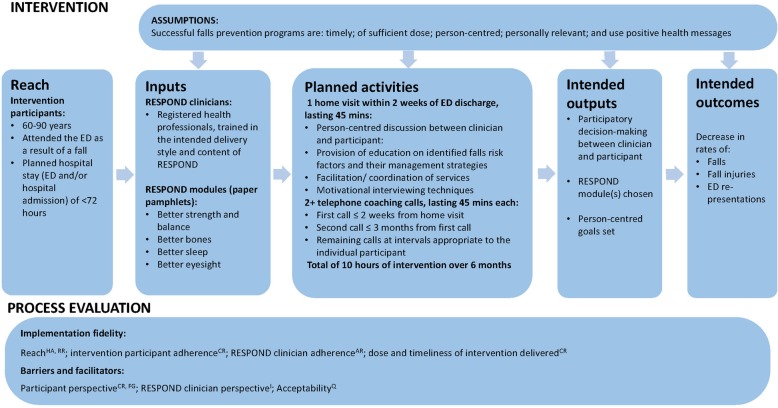
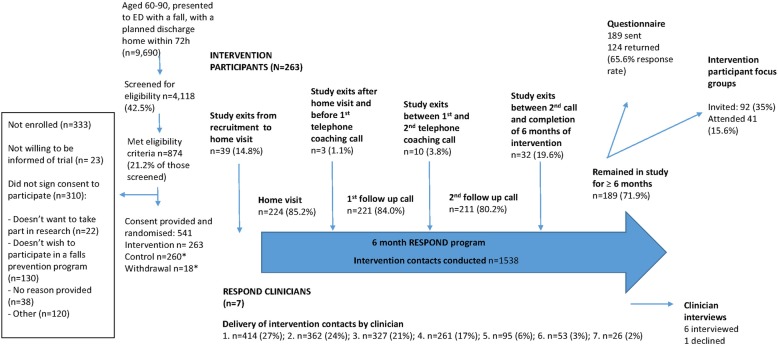
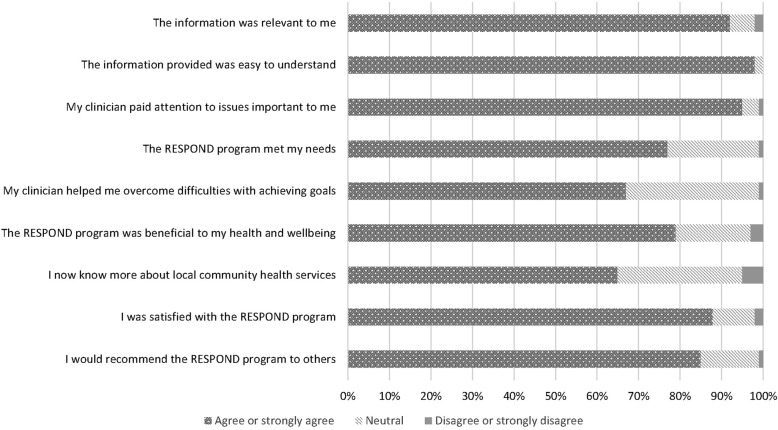
Background: RESPOND is a telephone-based falls prevention program for older people who present to a hospital emergency department (ED) with a fall. A randomised controlled trial (RCT) found RESPOND to be effective at reducing the rate of falls and fractures, compared with usual care, but not fall injuries or hospitalisations. This process evaluation aimed to determine whether RESPOND was implemented as planned, and identify implementation barriers and facilitators. Methods: A mixed-methods evaluation was conducted alongside the RCT. Evaluation participants were the RESPOND intervention group (n = 263) and the clinicians delivering RESPOND (n = 7). Evaluation data were collected from participant recruitment and intervention records, hospital administrative records, audio-recordings of intervention sessions, and participant questionnaires. The Rochester Participatory Decision-Making Scale (RPAD) was used to evaluate person-centredness (score range 0 (worst) - 9 (best)). Process factors were compared with pre-specified criteria to determine implementation fidelity. Six focus groups were held with participants (n = 41), and interviews were conducted with RESPOND clinicians (n = 6). Quantitative data were analysed descriptively and qualitative data thematically. Barriers and facilitators to implementation were mapped to the ‘Capability, Opportunity, Motivation – Behaviour’ (COM-B) behaviour change framework. Results: RESPOND was implemented at a lower dose than the planned 10 h over 6 months, with a median (IQR) of 2.9 h (2.1, 4). The majority (76%) of participants received their first intervention session within 1 month of hospital discharge with a median (IQR) of 18 (12, 30) days. Clinicians delivered the program in a person-centred manner with a median (IQR) RPAD score of 7 (6.5, 7.5) and 87% of questionnaire respondents were satisfied with the program. The reports from participants and clinicians suggested that implementation was facilitated by the use of positive and personally relevant health messages. Complex health and social issues were the main barriers to implementation. Conclusions: RESPOND, which was previously shown to reduce falls and fractures in the main trial analysis, was found to be delivered in a timely and person-centred manner, at a substantially lower dose, using fewer resource than anticipated. Trial registration: This study was registered with the Australian New Zealand Clinical Trials Registry, number ACTRN12614000336684 (27 March 2014).
Overview
The claims and statistics of this paper haven’t been checked yet.
Free: it reads the open-access text and checks the first 5 claims that cite a source we can check. Create a free account to check every claim.
Integrity signals
Registry
Cites
Statistics
Figures
Verification
Claims the paper makes
The claims and statistics of this paper haven’t been checked yet.
Free: it reads the open-access text and checks the first 5 claims that cite a source we can check. Create a free account to check every claim.
Claims other papers make about this one
Each is checked against this paper’s own text: does it say what the citing paper says it does?
The source backs part of the claim, not all of it — or backs it for a different population, condition or comparison.
In the citing paper
“Types of health knowledge included: knowledge of personal health and health conditions [15, 21, 25, 30, 32], suitable PA intervention strategies [15, 22, 26, 28, 30–32], PA guidelines [31, 32], and benefits of PA for their well-being [15, 21, 22, 30, 32].”
From Identifying the factors affecting ‘patient engagement’ in exercise rehabilitation (2022) · cites this paper as [15]
Experimental — accuracy not yet measuredThe source backs part of the claim, not all of it — or backs it for a different population, condition or comparison.
In the citing paper
“whereas affordable facilities resulted in greater adherence levels [15, 31, 34].”
From Identifying the factors affecting ‘patient engagement’ in exercise rehabilitation (2022) · cites this paper as [15]
Experimental — accuracy not yet measuredThe source backs part of the claim, not all of it — or backs it for a different population, condition or comparison.
In the citing paper
“Types of health knowledge included: knowledge of personal health and health conditions [15, 21, 25, 30, 32], suitable PA intervention strategies [15, 22, 26, 28, 30–32], PA guidelines [31, 32], and benefits of PA for their well-being [15, 21, 22, 30, 32].”
From Identifying the factors affecting ‘patient engagement’ in exercise rehabilitation (2022) · cites this paper as [15]
Experimental — accuracy not yet measuredThe source backs part of the claim, not all of it — or backs it for a different population, condition or comparison.
In the citing paper
“A prominent physical opportunity determinant noted in multiple articles was the availability of time for engaging in PA [15, 20, 21, 25, 26, 28, 30, 31, 33].”
From Identifying the factors affecting ‘patient engagement’ in exercise rehabilitation (2022) · cites this paper as [15]
Experimental — accuracy not yet measured
8 more claims about this paper
Create a free account to see every claim other papers make about this one.
Self-check
Percentages, sums and reported differences re-computed from the paper’s own numbers.
The self-check needs the paper’s full text.
Citations
Cites
Using thematic analysis in psychology
Braun, V., & Clarke, V. (2006) · Qualitative Research in Psychology · doi:10.1191/1478088706qp063oa · Cited by 194,414 · cited 1×
“Qualitative data were analysed by the lead researcher using deductive and inductive coding [32].”
MethodMichie, S., van Stralen, M. M., & West, R. (2011) · Implementation Science · doi:10.1186/1748-5908-6-42 · Cited by 13,697
Developing and evaluating complex interventions: the new Medical Research Council guidance
Craig, P., Dieppe, P., Macintyre, S., Michie, S., Nazareth, I., & Petticrew, M. (2008) · BMJ · doi:10.1136/bmj.a1655 · Cited by 10,995 · cited 1×
“This information can guide researchers, clinicians and policy makers to successfully implement similar programs in different settings [10].”
BackgroundAchieving integration in mixed methods designs-principles and practices
Fetters, M. D., Curry, L. A., & Creswell, J. W. (2013) · Health Services Research · doi:10.1111/1475-6773.12117 · Cited by 7,219
Process evaluation of complex interventions: Medical Research Council guidance
Moore, G. F., Audrey, S., Barker, M., Bond, L., Bonell, C., Hardeman, W., Moore, L., O'Cathain, A., Tinati, T., Wight, D., et al. (2015) · BMJ · doi:10.1136/bmj.h1258 · Cited by 6,204
The Mini‐Mental State Examination: A Comprehensive Review
Tombaugh, T. N., & McIntyre, N. J. (1992) · Journal of the American Geriatrics Society · doi:10.1111/j.1532-5415.1992.tb01992.x · Cited by 5,152
Process evaluation in randomised controlled trials of complex interventions
Oakley, A., Strange, V., Bonell, C., Allen, E., & Stephenson, J. (2006) · BMJ · doi:10.1136/bmj.332.7538.413 · Cited by 1,247
Health Message Framing Effects on Attitudes, Intentions, and Behavior: A Meta-analytic Review
Gallagher, K. M., & Updegraff, J. A. (2012) · Annals of Behavioral Medicine · doi:10.1007/s12160-011-9308-7 · Cited by 1,147
Prevention of falls in the elderly trial (PROFET): a randomised controlled trial
Close, J., Ellis, M., Hooper, R., Glucksman, E., Jackson, S., & Swift, C. (1999) · The Lancet · doi:10.1016/s0140-6736(98)06119-4 · Cited by 965
Older Patients in the Emergency Department: A Review
Samaras, N., Chevalley, T., Samaras, D., & Gold, G. (2010) · Annals of Emergency Medicine · doi:10.1016/j.annemergmed.2010.04.015 · Cited by 652
Systematic evaluation of implementation fidelity of complex interventions in health and social care
Hasson, H. (2010) · Implementation Science · doi:10.1186/1748-5908-5-67 · Cited by 417 · cited 1×
“Implementation fidelity is the degree to which an intervention is delivered as intended, and key components of evaluation of implementation fidelity have been variously categorised and defined [22].”
Shaw, F. E., Bond, J., Richardson, D. A., Dawson, P., Steen, I. N., McKeith, I. G., & Kenny, R. A. (2003) · BMJ · doi:10.1136/bmj.326.7380.73 · Cited by 414
Elwyn, G., Dehlendorf, C., Epstein, R. M., Marrin, K., White, J., & Frosch, D. L. (2014) · The Annals of Family Medicine · doi:10.1370/afm.1615 · Cited by 319
Hill, A.-M., McPhail, S. M., Waldron, N., Etherton-Beer, C., Ingram, K., Flicker, L., Bulsara, M., & Haines, T. P. (2015) · The Lancet · doi:10.1016/s0140-6736(14)61945-0 · Cited by 274
Self-citationDavison, J., Bond, J., Dawson, P., Steen, I. N., & Kenny, R. A. (2005) · Age and Ageing · doi:10.1093/ageing/afi053 · Cited by 251
Yardley, L., Donovan-Hall, M., Francis, K., & Todd, C. (2007) · The Journals of Gerontology Series B: Psychological Sciences and Social Sciences · doi:10.1093/geronb/62.2.p119 · Cited by 186
Russell, M. A., Hill, K. D., Blackberry, I., Day, L. M., & Dharmage, S. C. (2008) · Age and Ageing · doi:10.1093/ageing/afn129 · Cited by 170
Self-citationMuramatsu, N., Yin, H., & Hedeker, D. (2010) · Social Science & Medicine · doi:10.1016/j.socscimed.2009.12.005 · Cited by 165
Yarber, L., Brownson, C. A., Jacob, R. R., Baker, E. A., Jones, E., Baumann, C., Deshpande, A. D., Gillespie, K. N., Scharff, D. P., & Brownson, R. C. (2015) · BMC Health Services Research · doi:10.1186/s12913-015-1224-2 · Cited by 162
Hendriks, M. R. C., Bleijlevens, M. H. C., Van Haastregt, J. C. M., Crebolder, H. F. J. M., Diederiks, J. P. M., Evers, S. M. A. A., Mulder, W. J., Kempen, G. I. J. M., Van Rossum, E., Ruijgrok, J. M., et al. (2008) · Journal of the American Geriatrics Society · doi:10.1111/j.1532-5415.2008.01803.x · Cited by 157
Development of the Falls Risk for Older People in the Community (FROP-Com) screening tool
Russell, M. A., Hill, K., Day, L. M., Blackberry, I., Gurrin, L. C., & Dharmage, S. C. (2008) · Age and Ageing · doi:10.1093/ageing/afn196 · Cited by 128
Self-citationSalter, A. E., Khan, K. M., Donaldson, M. G., Davis, J. C., Buchanan, J., Abu‐Laban, R. B., Cook, W. L., Lord, S. R., & McKay, H. A. (2006) · Osteoporosis International · doi:10.1007/s00198-005-0032-7 · Cited by 119
Lightbody, E. (2002) · Age and Ageing · doi:10.1093/ageing/31.3.203 · Cited by 118
Matchar, D. B., Duncan, P. W., Lien, C. T. C., Ong, M. E. H., Lee, M., Gao, F., Sim, R., & Eom, K. Y. (2017) · Archives of Physical Medicine and Rehabilitation · doi:10.1016/j.apmr.2017.01.014 · Cited by 90
Rochester Participatory Decision-Making Scale (RPAD): Reliability and Validity
Shields, C. G. (2005) · The Annals of Family Medicine · doi:10.1370/afm.305 · Cited by 81
Haines, T. P., Day, L., Hill, K., Clemson, L. M., & Finch, C. F. (2014) · Archives of Gerontology and Geriatrics · doi:10.1016/j.archger.2014.03.003 · Cited by 80
Self-citationBarker, A. L., Cameron, P. A., Flicker, L. A., Arendts, G., Brand, C. A., Etherton‐Beer, C., Forbes, A. B., Haines, T. P., Hill, A., Hunter, P. C., et al. (2019) · PLoS Medicine · doi:10.1371/journal.pmed.1002807 · Cited by 74
Self-citationMotivational interviewing for older adults in primary care: A systematic review
Purath, J., Keck, A., & Fitzgerald, C. E. (2014) · Geriatric Nursing · doi:10.1016/j.gerinurse.2014.02.002 · Cited by 65
Social support as a predictor of health status among older adults living alone in Japan
Saito, E., Sagawa, Y., & Kanagawa, K. (2005) · Nursing and Health Sciences · doi:10.1111/j.1442-2018.2005.00220.x · Cited by 63
Russell, M. A., Hill, K. D., Day, L. M., Blackberry, I., Schwartz, J., Giummarra, M. J., Dorevitch, M., Ibrahim, J. E., Dalton, A. C., & Dharmage, S. C. (2010) · Journal of the American Geriatrics Society · doi:10.1111/j.1532-5415.2010.03191.x · Cited by 61
Self-citationArkkukangas, M., Söderlund, A., Eriksson, S., & Johansson, A. (2017) · Journal of Aging and Physical Activity · doi:10.1123/japa.2017-0009 · Cited by 57
Whitehead, C., Wundke, R., Crotty, M., & Finucane, P. (2003) · Australian Health Review · doi:10.1071/ah030088 · Cited by 55
Chu, M. M. L., Fong, K. N. K., Lit, A. C., Rainer, T. H., Cheng, S. W., Au, F. L. Y., Fung, H. K. K., Wong, C., & Tong, H. (2016) · Journal of the American Geriatrics Society · doi:10.1111/jgs.14527 · Cited by 48
Bleijlevens, M. H., Hendriks, M. R., van Haastregt, J. C., van Rossum, E., Kempen, G. I., Diederiks, J. P., Crebolder, H. F., & van Eijk, J. T. (2008) · BMC Public Health · doi:10.1186/1471-2458-8-332 · Cited by 41
Do ED staffs have a role to play in the prevention of repeat falls in elderly patients?
Bloch, F., Jegou, D., Dhainaut, J.-F., Rigaud, A., Coste, J., Lundy, J. E., & Claessens, Y.-É. (2009) · The American Journal of Emergency Medicine · doi:10.1016/j.ajem.2008.02.026 · Cited by 40
Vind, A. B., Andersen, H. E., Pedersen, K. D., Jørgensen, T., & Schwarz, P. (2009) · Journal of the American Geriatrics Society · doi:10.1111/j.1532-5415.2009.02270.x · Cited by 39
Khong, L. A. M., Bulsara, C., Hill, K., & Hill, A. (2016) · Ageing and Society · doi:10.1017/s0144686x16000192 · Cited by 36
Self-citationBarker, A. L., Cameron, P. A., Hill, K., Flicker, L. A., Haines, T. P., Lowthian, J. A., Waldron, N., Arendts, G., Redfern, J., Forbes, A. B., et al. (2014) · Injury Prevention · doi:10.1136/injuryprev-2014-041271 · Cited by 30
Self-citationElmore, J. G., & Kramer, B. S. (2014) · JAMA · doi:10.1001/jama.2014.2494 · Cited by 27
A profile of older emergency department attendees: findings from an Irish study
Fealy, G., Treacy, M. P., Drennan, J., Naughton, C., Butler, M., & Lyons, I. (2011) · Journal of Advanced Nursing · doi:10.1111/j.1365-2648.2011.05800.x · Cited by 25
Harper, K. J., Barton, A., Arendts, G., Edwards, D., Petta, A. C., & Celenza, A. (2017) · Emergency Medicine Australasia · doi:10.1111/1742-6723.12804 · Cited by 23
Self-citationWeb-Site-Based Tailored Advice to Promote Strength and Balance Training: An Experimental Evaluation
Nyman, S. R., & Yardley, L. (2009) · Journal of Aging and Physical Activity · doi:10.1123/japa.17.2.210 · Cited by 16
Self-citationMorris, R. L., Brand, C. A., Hill, K., Ayton, D., Redfern, J., Nyman, S. R., Lowthian, J. A., Hill, A., Etherton‐Beer, C., Flicker, L. A., et al. (2014) · Injury Prevention · doi:10.1136/injuryprev-2014-041453 · Cited by 8
Self-citation
Research works printed but not linked: 5
- Creswell JW, Clark VLP. Designing and conducting mixed methods research: Wiley online library; 2007.
- Rosengren DB. Building motivational interviewing skills: a practitioner workbook: Guilford publications; 2017.
- StataCorp. Stata Statistical Software: Release 14. College Station: StataCorp LP; 2015.
- Australian Bureau of Statistics (ABS). In: ABS, editor. Technical Paper: Socio- Economic Indexes for Areas (SEIFA) 2016, vol. 2033.0.55.001. Australia: Commonwealth of Australia; 2018.
- Morris, R. L., Hill, K. D., Ackerman, I. N., Ayton, D., Arendts, G., Brand, C., Cameron, P., Etherton-Beer, C. D., Flicker, L., Hill, A. -M., Hunter, P., Lowthian, J. A., Morello, R., Nyman, S. R., Redfern, J., Smit, D. V. & Barker, A. L. (2019). A mixed methods process evaluation of a person-centred falls prevention program. BMC HEALTH SERVICES RESEARCH, 19 (1), https://doi.org/10.1186/s12913-019-4614-z. Persistent Link: http://hdl.handle.net/11343/245326 File Description: published version License: CC BY
Cited by
Identifying the factors affecting ‘patient engagement’ in exercise rehabilitation
Teo, J. L., Zheng, Z., & Bird, S. R. (2022) · BMC Sports Science, Medicine and Rehabilitation · doi:10.1186/s13102-022-00407-3 · Cited by 96
“Other sources of motivation included: incentives to exercise such as rewards and positive health outcomes [15, 27, 32, 34], and enjoyment of exercise and physical activity [20, 24, 34].”
BackgroundResultInfluentialSaarijärvi, M., Wallin, L., & Bratt, E. (2020) · European Journal of Cardiovascular Nursing · doi:10.1177/1474515120906561 · Cited by 21
Engagement of older adults in STRIDE 's multifactorial fall injury prevention intervention
McMahon, S., Greene, E. J., Latham, N. K., Peduzzi, P. N., Gill, T. M., Bhasin, S., & Reuben, D. B. (2022) · Journal of the American Geriatrics Society · doi:10.1111/jgs.17983 · Cited by 23
“More than consultation or involvement, results from prior engagement research shows that strategies targeting partnership led to better care processes and services within organizations.(22) Literature addressing older adults' partnership in fall prevention efforts has focused on adherence, a related concept defined va…”
BackgroundDrahota, A., Udell, J. E., MacKenzie, H., & Pugh, M. T. (2024) · Cochrane Database of Systematic Reviews · doi:10.1002/14651858.cd013480.pub2 · Cited by 34
Lim, Y. Y., Ayton, D., Perin, S., Lavale, A., Yassi, N., Buckley, R. F., Barton, C., Bruns, L., Morello, R., Pirotta, S., et al. (2021) · Journal of Alzheimer s Disease · doi:10.3233/jad-210589 · Cited by 18
Self-citation
Metadata
- Authors
- Morris, R. L., Hill, K. D., Ackerman, I. N., Ayton, D., Arendts, G., Brand, C., Cameron, P., Etherton-Beer, C. D., Flicker, L., Hill, A.-M., Hunter, P., Lowthian, J. A., Morello, R., Nyman, S. R., Redfern, J., Smit, D. V., & Barker, A. L.
- Affiliations
- Monash University (AU)
- Curtin University (AU)
- The University of Western Australia (AU)
- The University of Melbourne (AU)
- Alfred Health (AU)
- Bournemouth University (GB)
- The University of Sydney (AU)
- Corresponding author
- Ayton, Darshini
- ORCID
- Venue
- BMC Health Services Research
- Published
- 2019-11-28
- Volume
- 19
- Issue
- 1
- Pages
- 906-906
- ISSN
- 1472-6963 (ISSN-L)
- PMC
- PMC6883679
- OpenAlex
- W2990709975
- Semantic Scholar
- f51bd791ef71f4bf5757fe881dc605b488b73ee3
- Cited by
- 18
- References
- 44
- Citations by year
- 2025: 2 · 2024: 3 · 2023: 2 · 2022: 5 · 2021: 4 · 2020: 2
- FWCI
- 3.75
- Type
- journal article
- Language
- en
- Update notices
- correction (2023-06-27)
- Open access
- gold
- doi.org
- Licence
- cc-by
- creativecommons.org/licenses/by/4.0 (tdm)
- creativecommons.org/licenses/by/4.0 (vor)
- Locations
- BMC Health Services Research (publishedVersion, cc-by)
- PubMed Central (publishedVersion, cc-by)
- Monash University Research Portal (Monash University) (publishedVersion, cc-by)
- PubMed (publishedVersion)
- Bournemouth University Research Online (Bournemouth University) (acceptedVersion)
- Minerva Access (University of Melbourne) (submittedVersion, cc-by)
- UWA Profiles and Research Repository (UWA) (submittedVersion, cc-by)
- DOAJ (DOAJ: Directory of Open Access Journals) (submittedVersion, cc-by-sa)
- Funders
- National Health and Medical Research Council (APP1056802, 1067236, 1052442)
- National Institute for Health Research (CDF-2015-08- 030)
- Research Training Program
- Topics
- Health Sciences › Health Professions › General Health Professions › Health Policy Implementation Science
- Health Sciences › Health Professions › Physical Therapy, Sports Therapy and Rehabilitation › Balance, Gait, and Falls Prevention
- Health Sciences › Medicine › Geriatrics and Gerontology › Pharmaceutical Practices and Patient Outcomes
- Keywords
- fall prevention, older adults, person-centred care, implementation fidelity, implementation barriers and facilitators, telephone-delivered intervention, emergency department, COM-B model, person-centredness, fracture, hospitalization, participant satisfaction, provider satisfaction, health messaging, social determinants of health, process evaluation
- MeSH terms
- Accident Prevention, Accidental Falls, Aged, Aged, 80 and over, Evaluation Studies as Topic, Female, Humans, Male, Telephone, Program Evaluation, Focus Groups, Patient-Centered Care
About these checks
Registry, retraction, Cites and statistics results are computed, not judged, with one exception: a printed reference that no index lists is read once by a model before it counts as a citation error. Claims are extracted by a model and kept only when their quote appears verbatim in the text; each cited source is then checked, with a model’s help, for whether it says what the claim relies on. Those verdicts can be wrong — read the claim’s quote and the cited source before relying on one.
Statistics and arithmetic are recomputed, not judged.
Confidence bands are shown only for fields calibrated on our annotated test set. None is calibrated yet, so no band is shown.
What counts as a claim ›How we measure confidence ›How we check this ›
Are you an author, or do you see a problem with this page? Request a review
Data sources
Bibliographic data: Semantic Scholar, OpenAlex, Crossref.
Contains information from the Semantic Scholar Academic Graph Datasets, made available under the ODC Attribution License (ODC-BY 1.0).
Semantic Scholar’s data is described in: Kinney, R., et al. (2023). The Semantic Scholar Open Data Platform. arXiv:2301.10140.
