

Assessing the psychosocial work environment in the health care setting: translation and psychometric testing of the French and Italian Copenhagen Psychosocial Questionnaires (COPSOQ) in a large sample of health professionals in Switzerland
Open accessThe DOI matches its Crossref record; 46 of the 46 references it cites were found in a registry or an index; none of the 69 sources its claims cite is checked for support yet.
Abstract
Background: Measuring work-related stress in a reliable way is important in the development of appropriate prevention and intervention strategies. Especially in multilingual studies the use of comparable and reliable instruments is crucial. Therefore, the aim of this study was to translate selected scales and single items from the German version of the Copenhagen Psychosocial Questionnaire (COPSOQ) into French and Italian and psychometrically test them in a sample of health professionals. Methods: This study used cross-sectional data from health professionals at 163 randomised selected health organisations in Switzerland. Selected COPSOQ items/scales were backwards- and forwards- translated and cross-culturally adapted from German to French and Italian. Reliability was assessed with Cronbach alpha and intraclass correlation coefficients, construct validity with confirmatory factor analysis (CFA) and structural equation modelling as well as comparative fit index. Results: Responses from 12,754 health professionals were included in the analysis. Of the overall 24 scales, 20 in the German version, 19 in the French version and 17 in the Italian version attained sufficient internal consistency with a threshold of 0.7 for Cronbach’s alpha. Predominantly high factor loadings on scale level are reported (> 0.35), as well as good and satisfactory fit values with RMSEA below 0.1, SRMR below 0.08 and CFI above 0.95. For 10 out of 15 scales, the test for factor invariance revealed a significant difference regarding the psychological constructs of the scales across the language versions. Conclusions: The psychometric properties verify the underlying theoretical model of the COPSOQ questionnaire, which is to some extent comparable across the three language versions. Of the 10 scales with significant factor variance, four showed large differences, implying that revision is needed for better comparability. Potential cultural issues as well as regional differences may have led to the factor variance and the different reliability scores per scale across language versions. One known influencing factor for regional differences is culture, which should be considered in scale development. Moreover, emerging topics such as digitization should be considered in further development of the questionnaire.
Overview
CoChat Summary
TL;DR
This study translated selected COPSOQ scales/items from German into French and Italian and psychometrically tested them in 12,754 Swiss health professionals. It found acceptable reliability and construct validity for many scales, but 10 of 15 scales showed significant factor invariance across language versions, with four requiring revision for comparability.
Key findings
- Reliability was sufficient (Cronbach’s alpha > 0.7) for 20 of 24 German, 19 French, and 17 Italian scales with at least two items; scales including Quantitative demands, Opportunities for development, Scope for breaks and holidays, Feedback, and Demarcation failed in some or all language groups (alpha 0.39–0.68).
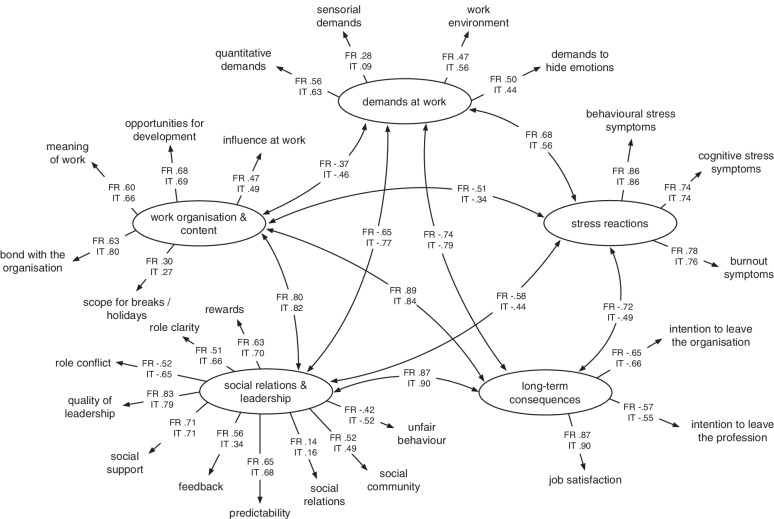
- Confirmatory factor analysis showed predominantly high factor loadings on scale level (> 0.35) and mostly good/satisfactory fit (RMSEA below 0.1, SRMR below 0.08, CFI above 0.95), but Social Support at work did not meet any fit criteria in any language version.
- Factor invariance testing found significant differences across language versions for 10 of 15 scales; four scales had differences > 0.1 in estimates—opportunities for development, influence at work, social support at work, and job satisfaction—implying need for revision.
- The sample included 12,754 health professionals (mean age 41.48 years, SD 12.47; 81% female; 58% nurses; 42.8% acute care), with 10,738 German-speaking (84.2%), 1,788 French-speaking (14.0%), and 228 Italian-speaking (1.8%).
Methods
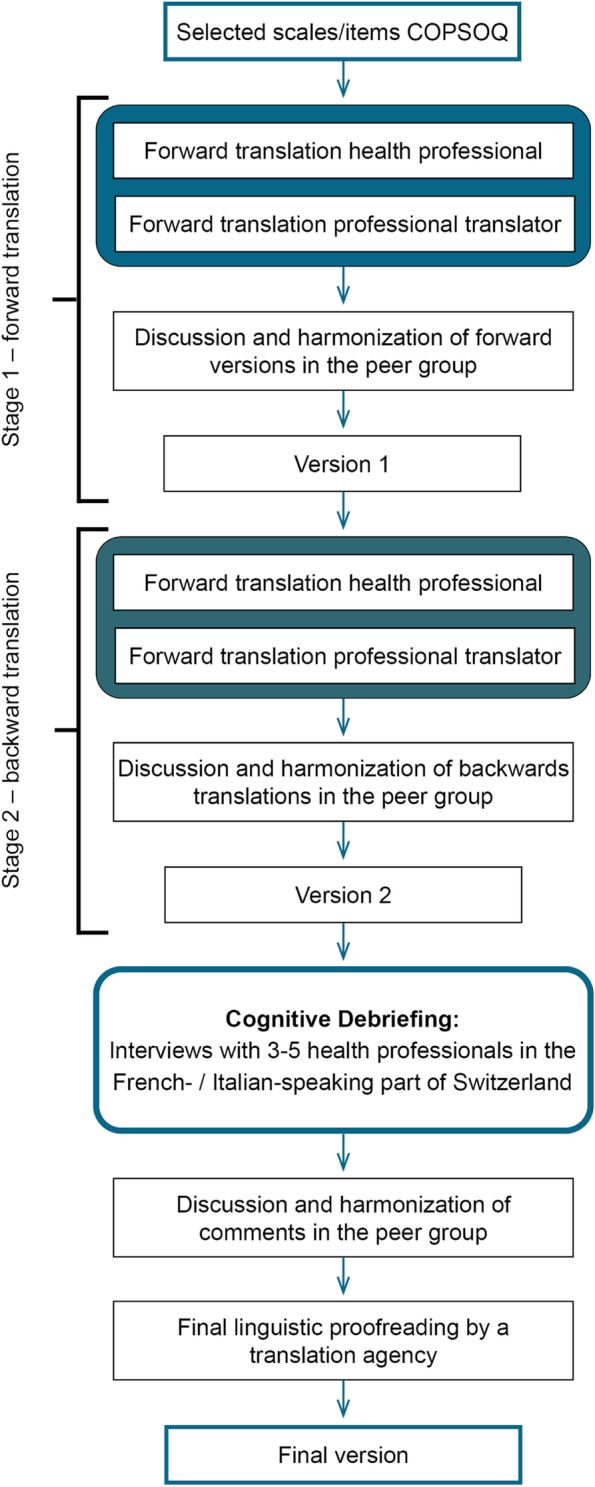
- Two-phase design: selected German COPSOQ scales/items were forward- and backward-translated and cross-culturally adapted into French and Italian, with cognitive debriefing interviews among 5 native French-speaking and 5 native Italian-speaking health professionals; then psychometrically validated.
- Cross-sectional data came from the STRAIN project baseline T0 (September 2017–March 2018) and first measurement T1 (January–May 2019); repeated cases were removed, and 163 health organisations participated (36 hospitals, 86 nursing homes, 41 home care organisations).
- Analysis used Cronbach’s alpha, ICC(3,1), floor/ceiling effects, confirmatory factor analysis, structural equation modelling, and likelihood ratio tests for factor invariance; reliability was calculated for scales with at least two items and construct validity for scales with at least three items, using R version 3.5.1.
Limitations
- Paper-stated: results are limited to the healthcare sector; two-thirds of scales differed significantly across language versions; floor/ceiling effects may indicate limited discrimination; data from two measurement periods may have led to duplicates; several scales had only one or two items and may not sufficiently cover the construct; test-retest reliability was not conducted.
- Evident from the text: the Italian-language sample was much smaller (n = 228, 1.8%) than the German sample (n = 10,738, 84.2%), which may limit the stability and precision of Italian estimates.
- Paper-stated: dimension-level structural equation models did not show satisfactory CFI in either French or Italian (both 0.82), and no imputation procedure for missing values was performed.
Model-written summary. Check it against the paper before relying on it.
Integrity signals
Registry
Cites
Statistics
Figures
Verification
Claims the paper makes
0 Valid · 0 Not valid · 42 Not checked · 61 Own results and interpretations
A result the paper reports from its own data — it cites no other source for it, so there is none to check. The quote shows it is in the paper.
In the paper
“In the German version 20 of the 24 scales with at least two items exceeded the conventional threshold of 0.7 for Cronbach’s alpha, indicating sufficient internal consistency, whereas in the French version 19 and in the Italian version 17 reached the threshold of 0.7 for Cronbach’s alpha.”
§ Assessing the psychosocial work environment in the health care setting: translation and psychometric testing of the French and Italian Copenhagen Psychosocial Questionnaires (COPSOQ) in a large sample of health professionals in Switzerland > Results > Reliability
plain- Asserted: passes — The authors put it forward as true.
- Checkable: passes — It can be checked against evidence.
- Load-bearing: unclear — It is unclear whether the paper’s conclusions depend on it.
- Based: passes — The paper gives a reason why it holds.
A result the paper reports from its own data — it cites no other source for it, so there is none to check. The quote shows it is in the paper.
In the paper
“R-squared showed predominantly satisfactory factor loadings with values higher than 0.40 in all language groups.”
§ Assessing the psychosocial work environment in the health care setting: translation and psychometric testing of the French and Italian Copenhagen Psychosocial Questionnaires (COPSOQ) in a large sample of health professionals in Switzerland > Results > Construct validity on scale level
plain- Asserted: passes — The authors put it forward as true.
- Checkable: passes — It can be checked against evidence.
- Load-bearing: passes — The paper’s conclusions depend on it.
- Based: passes — The paper gives a reason why it holds.
A result the paper reports from its own data — it cites no other source for it, so there is none to check. The quote shows it is in the paper.
In the paper
“The vast majority of scales showed fair (0.40 - 0.59) or good (0.60 – 0.74) scale consistency as measured by ICC.”
§ Assessing the psychosocial work environment in the health care setting: translation and psychometric testing of the French and Italian Copenhagen Psychosocial Questionnaires (COPSOQ) in a large sample of health professionals in Switzerland > Results > Reliability
plain- Asserted: passes — The authors put it forward as true.
- Checkable: passes — It can be checked against evidence.
- Load-bearing: passes — The paper’s conclusions depend on it.
- Based: passes — The paper gives a reason why it holds.
A result the paper reports from its own data — it cites no other source for it, so there is none to check. The quote shows it is in the paper.
In the paper
“The scales “Quantitative demands”, “Opportunities for development”, “Scope for breaks and holidays”, “Feedback”, and “Demarcation”, failed to show desirable levels for Cronbach’s alpha in some or in all language groups, ranging from 0.39 – 0.68.”
§ Assessing the psychosocial work environment in the health care setting: translation and psychometric testing of the French and Italian Copenhagen Psychosocial Questionnaires (COPSOQ) in a large sample of health professionals in Switzerland > Results > Reliability
plain- Asserted: passes — The authors put it forward as true.
- Checkable: passes — It can be checked against evidence.
- Load-bearing: passes — The paper’s conclusions depend on it.
- Based: passes — The paper gives a reason why it holds.
31 more claims
Create a free account to see all 103 claims and to verify the 68 references still open.
- Probably not a substantial claim. 49
- It may state two separate claims as one. 38
- The quote only partly states this claim. 1
Self-check
Percentages, sums and reported differences re-computed from the paper’s own numbers.
Each contradiction between two passages listed here was confirmed by an independent check.
Rated major: it would touch a result — a value a result rests on, reported and recomputed p-values on opposite sides of the significance level, two passages that conflict with no sign which is right, or a cited work retracted before this paper was published.
In the paper
“| Unfair behaviour (1) | 9437 | 14.08 (21.52) | 63.37 | 0.58 | n.a. | n.a. | 1497 | 14.43 (21.82) | 62.86 | 0.73 | n.a. | n.a. | 220 | 15.11 (23.2) | 0.00 | 29.55 | n.a. | n.a. |”
§ Assessing the psychosocial work environment in the health care setting: translation and psychometric testing of the French and Italian Copenhagen Psychosocial Questionnaires (COPSOQ) in a large sample of health professionals in Switzerland > Results > Reliability
Reported 15.11 · recomputed 29.55
Rated minor: it would not touch a result — a value no result rests on, a p-value that stays on the same side of the significance level, or a conflict that is clerical, resolved elsewhere in the paper, or outside its own findings.
In the paper
“| BSS3 | 0.80 | 0.01 | 0.64 | 0.82 | 0.01 | 0.36 | 0.73 | 0.04 | 0.53 |”
§ Assessing the psychosocial work environment in the health care setting: translation and psychometric testing of the French and Italian Copenhagen Psychosocial Questionnaires (COPSOQ) in a large sample of health professionals in Switzerland > Results > Construct validity on scale level
Reported 0.36 · recomputed 0.6724
Rated minor: it would not touch a result — a value no result rests on, a p-value that stays on the same side of the significance level, or a conflict that is clerical, resolved elsewhere in the paper, or outside its own findings.
In the paper
§ Assessing the psychosocial work environment in the health care setting: translation and psychometric testing of the French and Italian Copenhagen Psychosocial Questionnaires (COPSOQ) in a large sample of health professionals in Switzerland > Discussion
“Scope for breaks and holidays (0.39 - 0.43), Feedback (0.62 - 0.65) and Demarcation (0.39 - 0.40)”
§ Assessing the psychosocial work environment in the health care setting: translation and psychometric testing of the French and Italian Copenhagen Psychosocial Questionnaires (COPSOQ) in a large sample of health professionals in Switzerland > Results > Reliability
“| Scope for breaks and holidays (2) | 9871 | 60.75 (20.81) | 1.01 | 4.86 | 0.39 | 0.24 | 1599 | 60.65 (21.91) | 1.44 | 4.82 | 0.43 | 0.26 | 224 | 55.86 (25.11) | 3.57 | 6.25 | 0.48 | 0.32 |”
Rated minor: it would not touch a result — a value no result rests on, a p-value that stays on the same side of the significance level, or a conflict that is clerical, resolved elsewhere in the paper, or outside its own findings.
In the paper
“| BSS4 | 0.80 | 0.00 | 0.64 | 0.89 | 0.01 | 0.54 | 0.83 | 0.03 | 0.69 |”
§ Assessing the psychosocial work environment in the health care setting: translation and psychometric testing of the French and Italian Copenhagen Psychosocial Questionnaires (COPSOQ) in a large sample of health professionals in Switzerland > Results > Construct validity on scale level
Reported 0.54 · recomputed 0.7921
Rated minor: it would not touch a result — a value no result rests on, a p-value that stays on the same side of the significance level, or a conflict that is clerical, resolved elsewhere in the paper, or outside its own findings.
In the paper
“| BSS1 | 0.78 | 0.01 | 0.61 | 0.71 | 0.01 | 0.59 | 0.73 | 0.04 | 0.54 |”
§ Assessing the psychosocial work environment in the health care setting: translation and psychometric testing of the French and Italian Copenhagen Psychosocial Questionnaires (COPSOQ) in a large sample of health professionals in Switzerland > Results > Construct validity on scale level
Reported 0.59 · recomputed 0.5041
2 more findings
Create a free account to see every finding of this check.
Citations
Cites
Hu, L., & Bentler, P. M. (1999) · Structural Equation Modeling A Multidisciplinary Journal · doi:10.1080/10705519909540118 · Cited by 108,788
lavaan : An R Package for Structural Equation Modeling
Rosseel, Y. (2012) · Journal of Statistical Software · doi:10.18637/jss.v048.i02 · Cited by 27,955
Intraclass correlations: Uses in assessing rater reliability.
Shrout, P. E., & Fleiss, J. L. (1979) · Psychological Bulletin · doi:10.1037/0033-2909.86.2.420 · Cited by 24,532
Evaluating Goodness-of-Fit Indexes for Testing Measurement Invariance
Cheung, G. W., & Rensvold, R. B. (2002) · Structural Equation Modeling: A Multidisciplinary Journal · doi:10.1207/s15328007sem0902_5 · Cited by 16,280
Confirmatory factor analysis for applied research
(2007) · Choice Reviews Online · doi:10.5860/choice.44-2769 · Cited by 15,614
Cicchetti, D. V. (1994) · Psychological Assessment · doi:10.1037/1040-3590.6.4.284 · Cited by 9,349
What is coefficient alpha? An examination of theory and applications
Cortina, J. M. (1993) · Journal of Applied Psychology · doi:10.1037/0021-9010.78.1.98 · Cited by 8,810
Reporting Structural Equation Modeling and Confirmatory Factor Analysis Results: A Review
Schreiber, J. B., Nora, A., Stage, F. K., Barlow, E. A., & King, J. (2006) · The Journal of Educational Research · doi:10.3200/joer.99.6.323-338 · Cited by 6,937
Wild, D., Grove, A., Martin, M., Eremenco, S., McElroy, S., Verjee-Lorenz, A., & Erikson, P. (2005) · Value in Health · doi:10.1111/j.1524-4733.2005.04054.x · Cited by 5,521
psych: Procedures for Psychological, Psychometric, and Personality Research
Revelle, W. (2007) · CRAN: Contributed Packages · doi:10.32614/cran.package.psych · Cited by 2,965
The reliability of a two-item scale: Pearson, Cronbach, or spearman-brown?
Eisinga, R., Grotenhuis, M. T., & Pelzer, B. (2013) · International Journal of Public Health · doi:10.1007/s00038-012-0416-3 · Cited by 2,695
Aiken, L. H., Sermeus, W., Van den Heede, K., Sloane, D. M., Busse, R., McKee, M., Bruyneel, L., Rafferty, A. M., Griffiths, P., Moreno-Casbas, M. T., et al. (2012) · BMJ · doi:10.1136/bmj.e1717 · Cited by 2,052
Kristensen, T. S., Hannerz, H., Høgh, A., & Borg, V (2005) · Scandinavian Journal of Work, Environment & Health · doi:10.5271/sjweh.948 · Cited by 1,430
The second version of the Copenhagen Psychosocial Questionnaire
Pejtersen, J. H., Kristensen, T. S., Borg, V., & Bjorner, J. B. (2010) · Scandinavian Journal of Public Health · doi:10.1177/1403494809349858 · Cited by 1,187 · cited 1×
“Floor and ceiling effects were calculated as the proportion of respondents choosing the lowest and highest response options for all items within a scale, adhering to the procedure from comparable studies [23, 38].”
MethodNurses’ reports of working conditions and hospital quality of care in 12 countries in Europe
Aiken, L. H., Sloane, D. M., Bruyneel, L., Van den Heede, K., & Sermeus, W. (2013) · International Journal of Nursing Studies · doi:10.1016/j.ijnurstu.2012.11.009 · Cited by 711
The cost of work-related stress to society: A systematic review
Hassard, J., Teoh, K. R. H., Visockaite, G., Dewe, P., & Cox, T. (2018) · Journal of Occupational Health Psychology · doi:10.1037/ocp0000069 · Cited by 652
The Third Version of the Copenhagen Psychosocial Questionnaire
Burr, H., Berthelsen, H., Moncada, S., Nübling, M., Dupret, E., Demiral, Y., Oudyk, J., Kristensen, T. S., Llorens, C., Navarro, A., et al. (2019) · Safety and Health at Work · doi:10.1016/j.shaw.2019.10.002 · Cited by 519
Self-citationSome Guidelines Concerning the Modeling of Traits and Abilities in Test Construction
Schweizer, K. (2010) · European Journal of Psychological Assessment · doi:10.1027/1015-5759/a000001 · Cited by 448
Estryn-Béhar, M., Van der Heijden, B. I. J. M., Ogińska, H., Camerino, D., Le Nézet, O., Conway, P. M., Fry, C., & Hasselhorn, H.-M. (2007) · Medical Care · doi:10.1097/mlr.0b013e31806728d8 · Cited by 253
Work related stress, burnout, job satisfaction and general health of nurses: A follow‐up study
Khamisa, N., Peltzer, K., Ilic, D., & Oldenburg, B. (2016) · International Journal of Nursing Practice · doi:10.1111/ijn.12455 · Cited by 209
Brunner, B., Igic, I., Keller, A. C., & Wieser, S. (2019) · The European Journal of Health Economics · doi:10.1007/s10198-019-01084-9 · Cited by 173
COPSOQ III in Germany: validation of a standard instrument to measure psychosocial factors at work
Lincke, H.-J., Vomstein, M., Lindner, A., Nolle, I., Häberle, N., Haug, A., & Nübling, M. (2021) · Journal of Occupational Medicine and Toxicology · doi:10.1186/s12995-021-00331-1 · Cited by 135
Self-citationAlpha Inflation? The Impact of Eliminating Scale Items on Cronbach's Alpha
Kopalle, P. K., & Lehmann, D. R. (1997) · Organizational Behavior and Human Decision Processes · doi:10.1006/obhd.1997.2702 · Cited by 127
Reliability of the Copenhagen Psychosocial Questionnaire
Thorsen, S. V., & Bjørner, J. B. (2009) · Scandinavian Journal of Public Health · doi:10.1177/1403494809349859 · Cited by 111
Li, J., Galatsch, M., Siegrist, J., Müller, B. H., & Hasselhorn, H. M. (2011) · International Journal of Nursing Studies · doi:10.1016/j.ijnurstu.2010.09.011 · Cited by 107
Working conditions and intent to leave the profession among nursing staff in Europe
Conway, P. M. (2004) · Cited by 100
Copenhagen Psychosocial Questionnaire - A validation study using the Job Demand-Resources model
Berthelsen, H., Hakanen, J. J., & Westerlund, H. (2018) · PLOS ONE · doi:10.1371/journal.pone.0196450 · Cited by 93
Hasselhorn, H. M., Conway, P. M., Widerszal‐Bazyl, M., Simon, M., Tackenberg, P., Schmidt, S. G., Camerino, D., & Müller, B. H. (2008) · ePrints Soton (University of Southampton) · Cited by 73
Azeem, S. M., & Akhtar, N. (2014) · International Journal of Human Resource Studies · doi:10.5296/ijhrs.v4i2.5667 · Cited by 72
Lee, Y., Dai, Y., Chang, M. Y., Chang, Y., Yao, K. G., & Liu, M. (2017) · Journal of Nursing Scholarship · doi:10.1111/jnu.12301 · Cited by 72
Indicators per Factor in Confirmatory Factor Analysis: More is not Always Better
Koran, J. (2020) · Structural Equation Modeling: A Multidisciplinary Journal · doi:10.1080/10705511.2019.1706527 · Cited by 71
Peter, K. A., Hahn, S., Schols, J. M. G. A., & Halfens, R. J. G. (2020) · Journal of Clinical Nursing · doi:10.1111/jocn.15340 · Cited by 58
Self-citationAssessing the psychosocial work environment—“subjective” versus “objective” measurement
Kompier, M. (2005) · Scandinavian Journal of Work, Environment & Health · doi:10.5271/sjweh.946 · Cited by 55
The Digital Transformation of Healthcare
Belliger, A., & Krieger, D. J. (2018) · Progress in IS · doi:10.1007/978-3-319-73546-7_19 · Cited by 50
Dupret, E., Bocéréan, C., Teherani, M., Feltrin, M., & Pejtersen, J. H. (2012) · Scandinavian Journal of Public Health · doi:10.1177/1403494812453888 · Cited by 50
Effort–Reward Imbalance, Work–Privacy Conflict, and Burnout Among Hospital Employees
Häusler, N., Bopp, M., & Hämmig, O. (2018) · Journal of Occupational & Environmental Medicine · doi:10.1097/jom.0000000000001287 · Cited by 39
Peter, K. A., Schols, J. M. G. A., Halfens, R. J. G., & Hahn, S. (2020) · Nursing Open · doi:10.1002/nop2.469 · Cited by 32
Self-citationRosário, S., Azevedo, L. F., Fonseca, J. A., Nienhaus, A., Nübling, M., & da Costa, J. T. (2017) · Journal of Occupational Medicine and Toxicology · doi:10.1186/s12995-017-0170-9 · Cited by 32
Self-citationZavala-Rojas, D., & Saris, W. E. (2018) · Social Indicators Research · doi:10.1007/s11205-017-1787-x · Cited by 19
Streit, S., Da Costa, B. R., Christensen, S., Tal, K., Tandjung, R., & Jüni, P. (2019) · Swiss Medical Weekly · doi:10.4414/smw.2019.20116 · Cited by 14
Karin, P. (2020) · Research Publications (Maastricht University) · doi:10.26481/dis.20200922kp · Cited by 5
(2006) · PubMed Central
Self-citation(2003)
(2005)
(2017)
(n.d.)
Research works printed but not linked: 10
- Eurofound Working conditions and workers’ health 2019 Luxembourg Publications Office of the European Union
- Eurofound Work-related stress 2005 Dublin Eurofound
- Leka S Jain A Health impact of psychosocial hazards at work: an overview 2010 Geneva World Health Organization
- WHO Global strategy on human resources for health: workforce 2030 2016 Geneva World Health Organization
- Kristensen TS A new tool for assessing psychosocial factors at work: the Copenhagen psychosocial questionnaire 2000 Copenhagen National Institute of Health
- Llorens C Pérez-Franco J Oudyk J Berthelsen H Dupret E Nübling M Agreed guidelines for the use of COPSOQ III 2018
- Nübling M Stößel U Hasselhorn HM Michaelis M Hofmann F Methoden zur Erfassung psychischer Belastungen: Erprobung eines Messinstruments (COPSOQ) 2005 Dortmund Bundesanstalt für Arbeitsschutz und Arbeitsmedizin
- Urbaniak GC Plous S Research randomizer (version 4.0) [computer software] 2013 Pennsylvania Social Psychology Network
- Ivengar S Assessing linguistic equivalence in multilingual surveys Developing countries 1993 175
- Jaccard Ruedin H Widmer M Ausländisches Gesundheitspersonal in der Schweiz 2010 Neuchâtel Schweizerisches Gesundheitsobservatorium
Cited by
Peter, K. A., Voirol, C., Kunz, S., Gurtner, A., Renggli, F., Juvet, T. M., & Golz, C. (2024) · BMC Health Services Research · doi:10.1186/s12913-024-10718-5 · Cited by 97
Self-citationOse, S. O., Lohmann-Lafrenz, S., Bernstrøm, V. H., Berthelsen, H., & Marchand, G. H. (2023) · PLoS ONE · doi:10.1371/journal.pone.0289739 · Cited by 19
Bagnasco, A., Alvaro, R., Lancia, L., Manara, D. F., Rasero, L., Rocco, G., Burgio, A., Nitto, M. D., Zanini, M. P., Zega, M., et al. (2024) · Public Health Nursing · doi:10.1111/phn.13320 · Cited by 16
Caponnetto, V., Nitto, M. D., Cesare, M., Iovino, P., Longobucco, Y., Marcomini, I., Zaghini, F., Alvaro, R., Burgio, A., Cicolini, G., et al. (2025) · Health & Social Care in the Community · doi:10.1155/hsc/6664667 · Cited by 13
Cesare, M., Nitto, M. D., Iovino, P., Caponnetto, V., Longobucco, Y., Marcomini, I., Zaghini, F., Alvaro, R., Burgio, A., Cicolini, G., et al. (2025) · Journal of Clinical Nursing · doi:10.1111/jocn.70007 · Cited by 9
Metadata
- Authors
- Peter, K. A., Golz, C., Bürgin, R. A., Nübling, M., Voirol, C., Zürcher, S. J., & Hahn, S.
- Affiliations
- Bern University of Applied Sciences (CH)
- Freiburger Forschungsstelle für Arbeitswissenschaften GmbH (Germany) (DE)
- HES-SO University of Applied Sciences and Arts Western Switzerland (CH)
- Corresponding author
- Peter, Karin Anne
- ORCID
- Venue
- BMC Health Services Research
- Published
- 2022-05-06
- Volume
- 22
- Issue
- 1
- Pages
- 608-608
- ISSN
- 1472-6963 (ISSN-L)
- PMC
- PMC9074249
- OpenAlex
- W4229069211
- Semantic Scholar
- 1a9ba59e7b72c42db2bf35cae226166b288809ac
- Cited by
- 25
- References
- 46
- Citations by year
- 2026: 9 · 2025: 7 · 2024: 5 · 2023: 4
- FWCI
- 2.65
- Type
- journal article
- Language
- en
- Open access
- gold
- doi.org
- Licence
- cc-by
- creativecommons.org/licenses/by/4.0 (tdm)
- creativecommons.org/licenses/by/4.0 (vor)
- Locations
- BMC Health Services Research (publishedVersion, cc-by)
- PubMed Central (publishedVersion, cc-by)
- PubMed (publishedVersion)
- ARBOR - Bern University of Applied Sciences Repository (submittedVersion, other-oa)
- DOAJ (DOAJ: Directory of Open Access Journals) (submittedVersion)
- ArODES (HES-SO (https://www.hes-so.ch/)) (submittedVersion)
- Funders
- Staatssekretariat für Bildung, Forschung und Innovation
- Berner Fachhochschule
- Topics
- Health Sciences › Medicine › Public Health, Environmental and Occupational Health › Workplace Health and Well-being
- Health Sciences › Medicine › Public Health, Environmental and Occupational Health › Occupational Health and Burnout
- Social Sciences › Psychology › Social Psychology › Stress and Burnout Research
- Keywords
- Copenhagen Psychosocial Questionnaire, psychosocial work environment, occupational stress, healthcare workers, cross-cultural adaptation, French translation, Italian translation, psychometric properties, measurement invariance, construct validity, reliability statistics, healthcare workforce
- MeSH terms
- Cross-Sectional Studies, Delivery of Health Care, Humans, Language, Psychometrics, Surveys and Questionnaires, Switzerland, Reproducibility of Results
About these checks
Registry, retraction, Cites and statistics results are computed, not judged, with one exception: a printed reference that no index lists is read once by a model before it counts as a citation error. Claims are extracted by a model and kept only when their quote appears verbatim in the text; each cited source is then checked, with a model’s help, for whether it says what the claim relies on. Those verdicts can be wrong — read the claim’s quote and the cited source before relying on one.
A language model drew the claims from the paper on 2026-11-24, under version 3 of the claim definition (model deepseek-v4.1-flash, prompt extract-v3).
A second model labelled each claim on 2026-11-24 (model jev-1.13-20260917, definition revision gold-guideline-v0.2).
Statistics and arithmetic are recomputed, not judged.
Confidence bands are shown only for fields calibrated on our annotated test set. None is calibrated yet, so no band is shown.
What counts as a claim ›How we measure confidence ›How we check this ›
Are you an author, or do you see a problem with this page? Request a review
Data sources
Bibliographic data: Semantic Scholar, OpenAlex, Crossref.
Contains information from the Semantic Scholar Academic Graph Datasets, made available under the ODC Attribution License (ODC-BY 1.0).
Semantic Scholar’s data is described in: Kinney, R., et al. (2023). The Semantic Scholar Open Data Platform. arXiv:2301.10140.
