

The DOI matches its Crossref record; 58 of the 58 references it cites were found in a registry or an index.
The use of co-production, co-design and co-creation to mobilise knowledge in the management of health conditions: a systematic review
Open accessAbstract
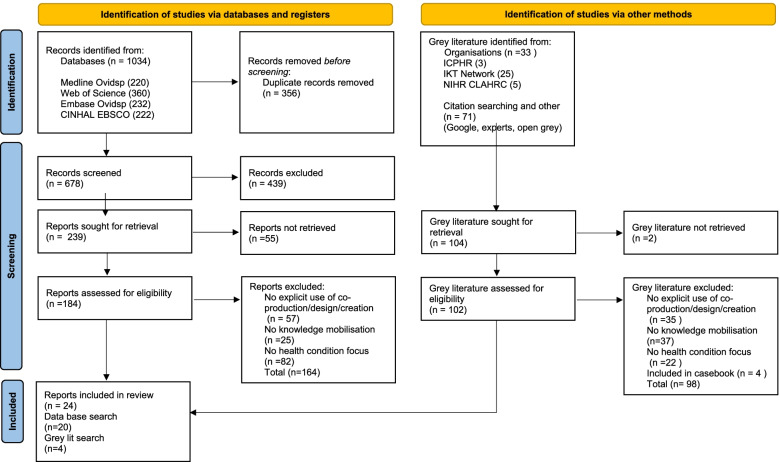
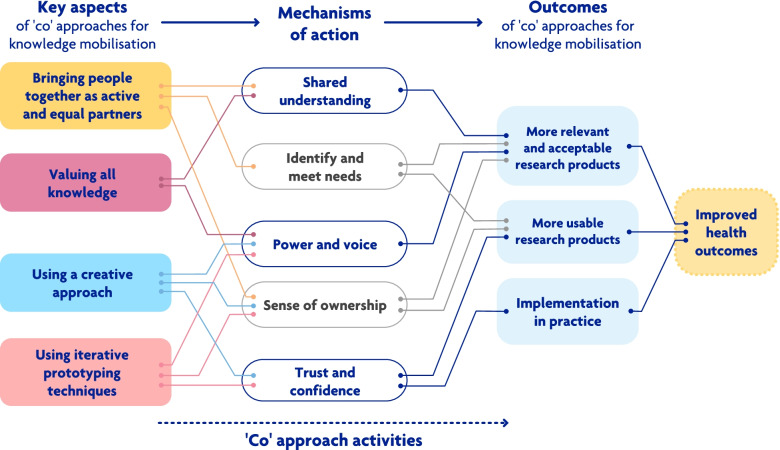
Background: Knowledge mobilisation is a term used in healthcare research to describe the process of generating, sharing and using evidence. ‘Co’approaches, such as co-production, co-design and co-creation, have been proposed as a way of overcoming the knowledge to practice gap. There is a need to understand why researchers choose to adopt these approaches, how they achieve knowledge mobilisation in the management of health conditions, and the extent to which knowledge mobilisation is accomplished. Methods: Studies that explicitly used the terms co-production, co-design or co-creation to mobilise knowledge in the management of health conditions were included. Web of Science, EMBASE via OvidSP, MEDLINE via OvidSP and CINHAL via EBSCO databases were searched up to April 2021. Quality assessment was carried out using the Joanna Briggs Institute qualitative quality assessment checklist. Pluye and Hong’s seven steps for mixed studies reviews were followed. Data were synthesised using thematic synthesis. Results: Twenty four international studies were included. These were qualitative studies, case studies and study protocols. Key aspects of ‘co’approaches were bringing people together as active and equal partners, valuing all types of knowledge, using creative approaches to understand and solve problems, and using iterative prototyping techniques. Authors articulated mechanisms of action that included developing a shared understanding, identifying and meeting needs, giving everyone a voice and sense of ownership, and creating trust and confidence. They believed these mechanisms could produce interventions that were relevant and acceptable to stakeholders, more useable and more likely to be implemented in healthcare. Varied activities were used to promote these mechanisms such as interviews and creative workshops. There appeared to be a lack of robust evaluation of the interventions produced so little evidence in this review that ‘co’approaches improved the management of health conditions. Conclusion: Those using ‘co’approaches believed that they could achieve knowledge mobilisation through a number of mechanisms, but there was no evidence that these led to improved health. The framework of key aspects and mechanisms of ‘co’approaches developed here may help researchers to meet the principles of these approaches. There is a need for robust evaluation to identify whether ‘co’approaches produce improved health outcomes. Trial Registration: PROSPERO CRD42020187463 .
Overview
The claims and statistics of this paper haven’t been checked yet.
Run the check — free, no account needed. It reads the open-access text and checks the sources it cites.
Integrity signals
Registry
Cites
Statistics
Figures
Verification
Claims the paper makes
The claims and statistics of this paper haven’t been checked yet.
Run the check — free, no account needed. It reads the open-access text and checks the sources it cites.
Claims other papers make about this one
Each is checked against this paper’s own text: does it say what the citing paper says it does?
The cited source says what the claim attributes to it.
In the citing paper
“This ongoing collaborative process promotes active, iterative engagement from all stakeholders and aligns with effective knowledge mobilisation practices [47, 62].”
From The Complex and Multifaceted Nature of Social Media: Perspectives From Young Adolescents, Parents and Experts (2026) · cites this paper as [47]
Self-check
Percentages, sums and reported differences re-computed from the paper’s own numbers.
The self-check needs the paper’s full text.
Citations
Cites
The PRISMA 2020 statement: An updated guideline for reporting systematic reviews
Page, M. J., McKenzie, J. E., Bossuyt, P. M., Boutron, I., Hoffmann, T. C., Mulrow, C. D., Shamseer, L., Tetzlaff, J. M., Akl, E. A., Brennan, S. E., et al. (2021) · BMJ · doi:10.1136/bmj.n71 · Cited by 108,283
Preferred Reporting Items for Systematic Reviews and Meta-Analyses: the PRISMA statement
Moher, D., Liberati, A., Tetzlaff, J., Altman, D. G., & for the PRISMA Group (2009) · BMJ · doi:10.1136/bmj.b2535 · Cited by 83,823
Preferred Reporting Items for Systematic Reviews and Meta-Analyses: The PRISMA Statement
Moher, D., Liberati, A., Tetzlaff, J., & Altman, D. G. (2009) · Journal of Clinical Epidemiology · doi:10.1016/j.jclinepi.2009.06.005 · Cited by 19,575
Cochrane Handbook for Systematic Reviews of Interventions
(2019) · doi:10.1002/9781119536604 · Cited by 14,828
Page, M. J., Moher, D., Bossuyt, P. M., Boutron, I., Hoffmann, T. C., Mulrow, C. D., Shamseer, L., Tetzlaff, J. M., Akl, E. A., Brennan, S. E., et al. (2021) · BMJ · doi:10.1136/bmj.n160 · Cited by 13,262
Methods for the thematic synthesis of qualitative research in systematic reviews
Thomas, J., & Harden, A. (2008) · BMC Medical Research Methodology · doi:10.1186/1471-2288-8-45 · Cited by 9,312
Qualitative Research: Consensus methods for medical and health services research
Jones, J., & Hunter, D. (1995) · BMJ · doi:10.1136/bmj.311.7001.376 · Cited by 3,471
Gran, B. C. (2008) · Cited by 2,853
Pluye, P., & Hong, Q. N. (2014) · Annual Review of Public Health · doi:10.1146/annurev-publhealth-032013-182440 · Cited by 1,363 · cited 2×
“BMC Health Services Research (2022) 22:877 Methods This is a mixed studies systematic review, that is, a comprehensive review and synthesis of a wide range of literature of diverse designs [18].”
BackgroundResearch co-design in health: a rapid overview of reviews
Slattery, P., Saeri, A. K., & Bragge, P. (2020) · Health Research Policy and Systems · doi:10.1186/s12961-020-0528-9 · Cited by 1,313
Research works printed but not linked: 6
- Melville-Richards L, Rycroft-Malone J, Burton C, Wilkinson J. Making authentic: exploring boundary objects and bricolage in knowledge mobilisation through National Health Service-university partnerships. Evidence and Policy. 2019;2:1–23.
- NIHR INVOLVE. Guidance on co-producing a research project. 2019.
- Booth A, Sutton A, Papaioanna D. Systematic Approaches to a successful literaure review. London: SAGE Publications Ltd; 2012.
- Kothari A, McCutcheon C, Graham I, editors. How We Work Together: The Integrated Knowledge Translation Casebook. Volume 1. Vol. 1. Ottawa; 2019. Available from: https://ktpathways.ca/resources/how-we-work-together-integrated-knowledge-translation-research-network-casebook
- Wengel Y, McIntosh A, Cockburn-Wootten C. A critical consideration of LEGO SERIOUS PLAY methodology for tourism studies. Tourism Geography. 2019;23(2):1–23.
- Stickdorn M, Sneider J, editors. This Is Service Design Thinking. Basic- Tools- Cases. Amsterdam: BIS Publishers; 2010.
Cited by
Sorted by citations
Peters, S., Guccione, L., Francis, J., Best, S., Tavender, E. J., Curran, J., Davies, K., Rowe, S., Palmer, V. J., & Klaic, M. (2024) · Implementation Science · doi:10.1186/s13012-024-01394-4 · Cited by 135
Messiha, K., Chinapaw, M. J. M., Ket, J. C. F., An, Q., Anand-Kumar, V., Longworth, G. R., CHASTIN, S. F. M., & Altenburg, T. M. (2023) · Journal of Public Health · doi:10.1093/pubmed/fdad046 · Cited by 122
Singh, D. R., Sah, R. K., Simkhada, B., & Darwin, Z. J. (2023) · Global Health Research and Policy · doi:10.1186/s41256-023-00290-6 · Cited by 125
Agnello, D. M., Anand-Kumar, V., An, Q., de Boer, J., Delfmann, L. R., Longworth, G. R., Loisel, Q. E. A., McCaffrey, L., Steiner, A., & CHASTIN, S. F. M. (2025) · BMC Medical Research Methodology · doi:10.1186/s12874-025-02514-4 · Cited by 90
Veldmeijer, L., Terlouw, G., van Os, J., Dijk, O. V., Veer, J. V. ‘., & Boonstra, N. (2023) · JMIR Mental Health · doi:10.2196/46590 · Cited by 89
Metadata
- Authors
- Grindell, C., Coates, E., Croot, L., & O’Cathain, A.
- Affiliations
- University of Sheffield (GB)
- Corresponding author
- Grindell, Cheryl
- Venue
- BMC Health Services Research
- Published
- 2022-07-07
- Volume
- 22
- Issue
- 1
- Pages
- 877-877
- ISSN
- 1472-6963 (ISSN-L)
- PMC
- PMC9264579
- OpenAlex
- W4284704782
- Cited by
- 409
- References
- 58
- Citations by year
- 2026: 151 · 2025: 127 · 2024: 97 · 2023: 29 · 2022: 5
- FWCI
- 12.50
- Type
- journal article
- Language
- en
- Open access
- gold
- doi.org
- Locations
- BMC Health Services Research (publishedVersion, cc-by)
- PubMed Central (publishedVersion, cc-by)
- PubMed (publishedVersion)
- DOAJ (DOAJ: Directory of Open Access Journals) (submittedVersion, cc-by-sa)
- Funders
- Sheffield Hallam University
- University of Sheffield
- Topics
- Health Sciences › Health Professions › General Health Professions › Health Policy Implementation Science
- Health Sciences › Health Professions › General Health Professions › Mental Health and Patient Involvement
- Social Sciences › Business, Management and Accounting › Management of Technology and Innovation › Innovative Approaches in Technology and Social Development
- Keywords
- knowledge mobilization, co-production, co-design, co-creation, knowledge-practice gap, stakeholder engagement, participatory approach, mechanism of action, iterative prototyping, creative workshops, intervention implementation
- MeSH terms
- Delivery of Health Care, Health Services Research, Humans, Trust, Qualitative Research
About these checks
Registry, retraction, Cites and statistics results are computed, not judged, with one exception: a printed reference that no index lists is read once by a model before it counts as a citation error. Claims are extracted by a model and kept only when their quote appears verbatim in the text; each cited source is then checked, with a model’s help, for whether it says what the claim relies on. Those verdicts can be wrong — read the claim’s quote and the cited source before relying on one.
Statistics and arithmetic are recomputed, not judged.
Confidence bands are shown only for fields calibrated on our annotated test set. None is calibrated yet, so no band is shown.
What counts as a claim ›How we measure confidence ›How we check this ›
Are you an author, or do you see a problem with this page? Request a review
