

Nuclear genome sequence of the plastid-lacking cryptomonad Goniomonas avonlea provides insights into the evolution of secondary plastids
Open accessThe DOI matches its Crossref record; 103 of the 103 references it cites were found in a registry or an index.
Abstract
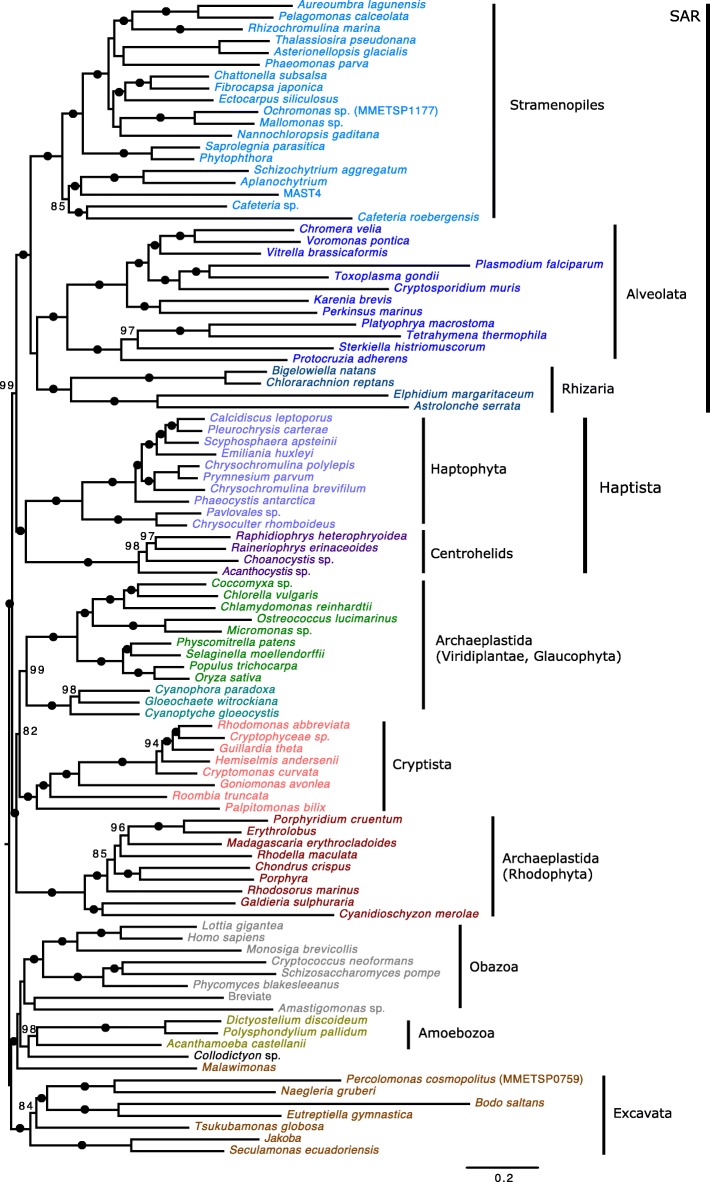
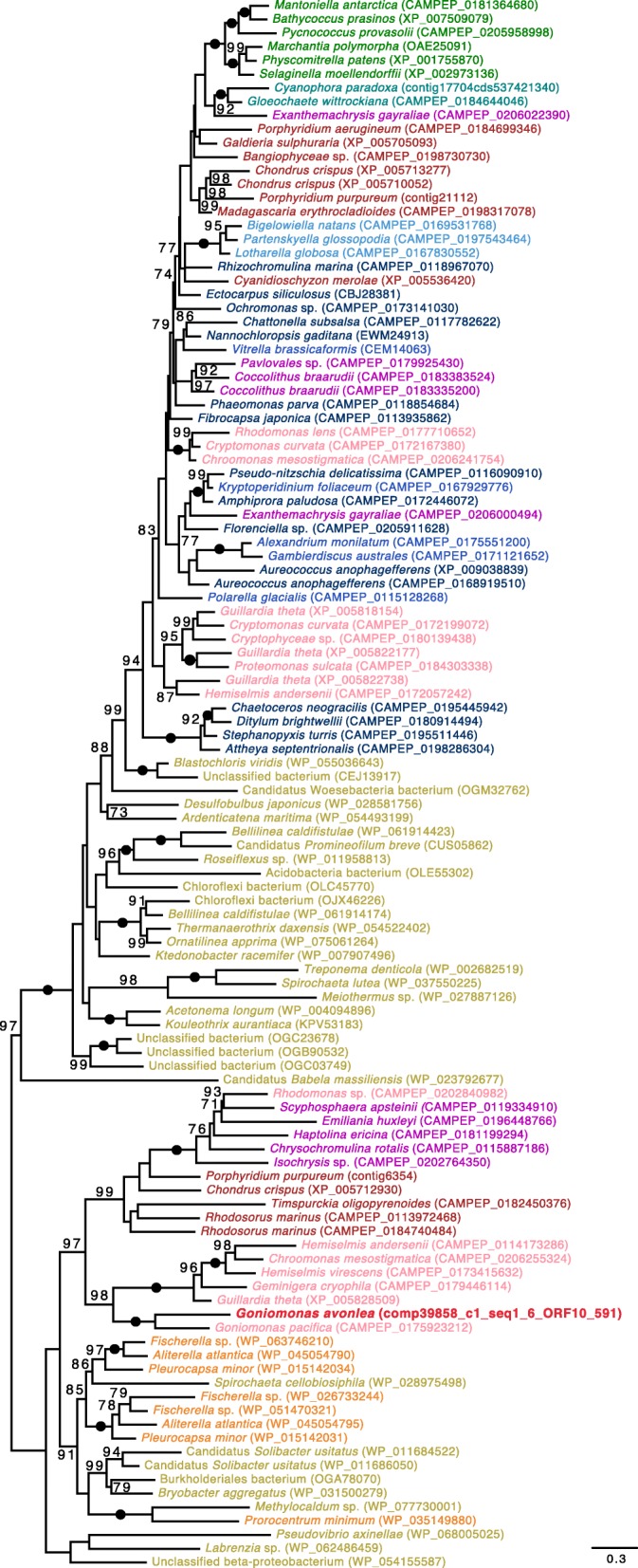
BACKGROUND: The evolution of photosynthesis has been a major driver in eukaryotic diversification. Eukaryotes have acquired plastids (chloroplasts) either directly via the engulfment and integration of a photosynthetic cyanobacterium (primary endosymbiosis) or indirectly by engulfing a photosynthetic eukaryote (secondary or tertiary endosymbiosis). The timing and frequency of secondary endosymbiosis during eukaryotic evolution is currently unclear but may be resolved in part by studying cryptomonads, a group of single-celled eukaryotes comprised of both photosynthetic and non-photosynthetic species. While cryptomonads such as Guillardia theta harbor a red algal-derived plastid of secondary endosymbiotic origin, members of the sister group Goniomonadea lack plastids. Here, we present the genome of Goniomonas avonlea-the first for any goniomonad-to address whether Goniomonadea are ancestrally non-photosynthetic or whether they lost a plastid secondarily. RESULTS: We sequenced the nuclear and mitochondrial genomes of Goniomonas avonlea and carried out a comparative analysis of Go. avonlea, Gu. theta, and other cryptomonads. The Go. avonlea genome assembly is ~ 92 Mbp in size, with 33,470 predicted protein-coding genes. Interestingly, some metabolic pathways (e.g., fatty acid biosynthesis) predicted to occur in the plastid and periplastidal compartment of Gu. theta appear to operate in the cytoplasm of Go. avonlea, suggesting that metabolic redundancies were generated during the course of secondary plastid integration. Other cytosolic pathways found in Go. avonlea are not found in Gu. theta, suggesting secondary loss in Gu. theta and other plastid-bearing cryptomonads. Phylogenetic analyses revealed no evidence for algal endosymbiont-derived genes in the Go. avonlea genome. Phylogenomic analyses point to a specific relationship between Cryptista (to which cryptomonads belong) and Archaeplastida. CONCLUSION: We found no convincing genomic or phylogenomic evidence that Go. avonlea evolved from a secondary red algal plastid-bearing ancestor, consistent with goniomonads being ancestrally non-photosynthetic eukaryotes. The Go. avonlea genome sheds light on the physiology of heterotrophic cryptomonads and serves as an important reference point for studying the metabolic "rewiring" that took place during secondary plastid integration in the ancestor of modern-day Cryptophyceae.
Overview
The claims and statistics of this paper haven’t been checked yet.
Free: it reads the open-access text and checks the first 5 claims that cite a source we can check. Create a free account to check every claim.
Integrity signals
Registry
Cites
Statistics
Figures
Verification
Claims the paper makes
The claims and statistics of this paper haven’t been checked yet.
Free: it reads the open-access text and checks the first 5 claims that cite a source we can check. Create a free account to check every claim.
Claims other papers make about this one
Each is checked against this paper’s own text: does it say what the citing paper says it does?
The cited source says what the claim attributes to it.
In the citing paper
“Consistent with a previous transcriptome-based survey of Goniomonas pacifica (Yabuki et al. 2014), the genomic survey of G. avonlea found no convincing evidence for the previous existence of a red alga-derived plastid in goniomonads, suggesting that the red algal plastid in cryptophytes was established after their divergence from goniomonads (Cenci et al. 2018).”
From Genomic Insights into Plastid Evolution (2020) · cites this paper as Cenci et al. 2018
The cited source says what the claim attributes to it.
In the citing paper
“Intriguingly, Cenci et al. (2018) identified genes in G. avonlea suggesting that it grazes not just on bacteria but eukaryotes as well, including algae and specifically red algae (via the identification of an agarase gene encoding a protein with a signal peptide).”
From Genomic Insights into Plastid Evolution (2020) · cites this paper as Cenci et al. 2018
Self-check
Percentages, sums and reported differences re-computed from the paper’s own numbers.
The self-check needs the paper’s full text.
Citations
Cites
Gapped BLAST and PSI-BLAST: a new generation of protein database search programs
Altschul, S. (1997) · Nucleic Acids Research · doi:10.1093/nar/25.17.3389 · Cited by 73,302
Trimmomatic: a flexible trimmer for Illumina sequence data
Bolger, A. M., Lohse, M., & Usadel, B. (2014) · Bioinformatics · doi:10.1093/bioinformatics/btu170 · Cited by 65,548
Fast gapped-read alignment with Bowtie 2
Langmead, B., & Salzberg, S. L. (2012) · Nature Methods · doi:10.1038/nmeth.1923 · Cited by 56,400
MAFFT Multiple Sequence Alignment Software Version 7: Improvements in Performance and Usability
Katoh, K., & Standley, D. M. (2013) · Molecular Biology and Evolution · doi:10.1093/molbev/mst010 · Cited by 46,209
MUSCLE: multiple sequence alignment with high accuracy and high throughput
Edgar, R. C. (2004) · Nucleic Acids Research · doi:10.1093/nar/gkh340 · Cited by 44,662
IQ-TREE: A Fast and Effective Stochastic Algorithm for Estimating Maximum-Likelihood Phylogenies
Nguyen, L.-T., Schmidt, H. A., von Haeseler, A., & Minh, B. Q. (2015) · Molecular Biology and Evolution · doi:10.1093/molbev/msu300 · Cited by 26,046
Full-length transcriptome assembly from RNA-Seq data without a reference genome
Grabherr, M. G., Haas, B. J., Yassour, M., Levin, J. Z., Thompson, D. A., Amit, I., Adiconis, X., Fan, L., Raychowdhury, R., Zeng, Q., et al. (2011) · Nature Biotechnology · doi:10.1038/nbt.1883 · Cited by 21,039
Hierarchical Grouping to Optimize an Objective Function
Ward, J. H. (1963) · Journal of the American Statistical Association · doi:10.1080/01621459.1963.10500845 · Cited by 20,598
ModelFinder: fast model selection for accurate phylogenetic estimates
Kalyaanamoorthy, S., Minh, B. Q., Wong, T. K. F., von Haeseler, A., & Jermiin, L. S. (2017) · Nature Methods · doi:10.1038/nmeth.4285 · Cited by 18,449
FastTree 2 – Approximately Maximum-Likelihood Trees for Large Alignments
Price, M. N., Dehal, P. S., & Arkin, A. P. (2010) · PLoS ONE · doi:10.1371/journal.pone.0009490 · Cited by 14,894
Cited by
Burki, F., Roger, A. J., Brown, M. W., & Simpson, A. G. B. (2020) · Trends in Ecology & Evolution · doi:10.1016/j.tree.2019.08.008 · Cited by 913
Self-citationGenomic Insights into Plastid Evolution
Sibbald, S. J., & Archibald, J. M. (2020) · Genome Biology and Evolution · doi:10.1093/gbe/evaa096 · Cited by 161
Self-citationStrassert, J. F. H., Jamy, M., Mylnikov, A. P., Tikhonenkov, D. V., & Burki, F. (2019) · Molecular Biology and Evolution · doi:10.1093/molbev/msz012 · Cited by 123
High-resolution metagenomic reconstruction of the freshwater spring bloom
Kavagutti, V., Bulzu, P., Chiriac, M., Salcher, M. M., Mukherjee, I., Shabarova, T., Grujčić, V., Mehrshad, M., Kasalický, V., Andrei, A., et al. (2023) · Microbiome · doi:10.1186/s40168-022-01451-4 · Cited by 74
Division of functional roles for termite gut protists revealed by single-cell transcriptomes
Nishimura, Y., Otagiri, M., Yuki, M., Shimizu, M., Inoue, J.-I., Moriya, S., & Ohkuma, M. (2020) · The ISME Journal · doi:10.1038/s41396-020-0698-z · Cited by 54
Convergent evolution and horizontal gene transfer in Arctic Ocean microalgae
Dorrell, R. G., Kuo, A., Füssy, Z., Richardson, E., Salamov, A. A., Zarevski, N., Freyria, N. J., Ibarbalz, F. M., Jenkins, J. W., Karlusich, J. J. P., et al. (2022) · Life Science Alliance · doi:10.26508/lsa.202201833 · Cited by 50
Self-citationRani, M. R. P., Raj, P. S., Nair, A., Ranjith, S., Rajankutty, K., & Raghu, K. G. (2021) · Chemico-Biological Interactions · doi:10.1016/j.cbi.2021.109755 · Cited by 43
Cryptic and ubiquitous aplastidic cryptophytes are key freshwater flagellated bacterivores
Šimek, K., Mukherjee, I., Szöke‐Nagy, T., Haber, M., Salcher, M. M., & Ghai, R. (2022) · The ISME Journal · doi:10.1038/s41396-022-01326-4 · Cited by 37
Šimek, K., Mukherjee, I., Nedoma, J., de Paula, C. C. P., Jezberová, J., Sirová, D., & Vrba, J. (2021) · Environmental Microbiology · doi:10.1111/1462-2920.15846 · Cited by 35
Evolutionary diversification of the autophagy-related ubiquitin-like conjugation systems
Zhang, S., Yazaki, E., Sakamoto, H., Yamamoto, H., & Mizushima, N. (2022) · Autophagy · doi:10.1080/15548627.2022.2059168 · Cited by 37
Yazaki, E., Yabuki, A., Imaizumi, A., Kume, K., Hashimoto, T., & Inagaki, Y. (2022) · Open Biology · doi:10.1098/rsob.210376 · Cited by 37
Cerón-Romero, M. A., Fonseca, M. M., Martins, L. D. O., Posada, D., & Katz, L. A. (2022) · Genome Biology and Evolution · doi:10.1093/gbe/evac119 · Cited by 27
Genome evolution of a nonparasitic secondary heterotroph, the diatomNitzschia putrida
Kamikawa, R., Mochizuki, T., Sakamoto, M., Tanizawa, Y., Nakayama, T., Onuma, R., Cenci, U., Moog, D., Speak, S. A., Sarkozi, K., et al. (2022) · Science Advances · doi:10.1126/sciadv.abi5075 · Cited by 28
Self-citationPenot-Raquin, M., Dacks, J. B., Read, B. A., & Dorrell, R. G. (2022) · Applied Phycology · doi:10.1080/26388081.2022.2103732 · Cited by 27
Yazaki, E., Kume, K., Shiratori, T., Eglit, Y., Tanifuji, G., Harada, R., Simpson, A. G. B., Ishida, K., Hashimoto, T., & Inagaki, Y. (2020) · Proceedings of the Royal Society B Biological Sciences · doi:10.1098/rspb.2020.1538 · Cited by 25
Current understanding of structure, function and biogenesis of yeast mitochondrial ATP synthase
Artika, I. M. (2019) · Journal of Bioenergetics and Biomembranes · doi:10.1007/s10863-019-09809-4 · Cited by 24
Should I stay or should I go? Retention and loss of components in vestigial endosymbiotic organelles
Maciszewski, K., & Karnkowska, A. (2019) · Current Opinion in Genetics & Development · doi:10.1016/j.gde.2019.07.013 · Cited by 23
Tanifuji, G., Kamikawa, R., Moore, C. E., Mills, T., Onodera, N. T., Kashiyama, Y., Archibald, J. M., Inagaki, Y., & Hashimoto, T. (2020) · Genome Biology and Evolution · doi:10.1093/gbe/evaa001 · Cited by 26
Self-citationScaffolding proteins guide the evolution of algal light harvesting antennas
Rathbone, H. W., Michie, K. A., Landsberg, M. J., Green, B. R., & Curmi, P. M. G. (2021) · Nature Communications · doi:10.1038/s41467-021-22128-w · Cited by 27
An Enigmatic Stramenopile Sheds Light on Early Evolution in Ochrophyta Plastid Organellogenesis
Azuma, T., Pánek, T., Tice, A. K., Kayama, M., Kobayashi, M., Miyashita, H., Suzaki, T., Yabuki, A., Brown, M. W., & Kamikawa, R. (2022) · Molecular Biology and Evolution · doi:10.1093/molbev/msac065 · Cited by 26
Self-citationBarabas, A. J., Aryal, U. K., & Gaskill, B. N. (2019) · Scientific Reports · doi:10.1038/s41598-019-53903-x · Cited by 20
Moog, D., Nozawa, A., Tozawa, Y., & Kamikawa, R. (2020) · Scientific Reports · doi:10.1038/s41598-020-58082-8 · Cited by 21
Self-citationFreire, F. B. S., Bastos, R. L. G., Bret, R. S. C., Cândido-Sobrinho, S. A., Medeiros, D. B., Antunes, W. C., Fernie, A. R., & Daloso, D. M. (2021) · Environmental and Experimental Botany · doi:10.1016/j.envexpbot.2020.104370 · Cited by 22
Chimeric human opsins as optogenetic light sensitisers
Hickey, D. G., Davies, W. I. L., Hughes, S., Rodgers, J., Thavanesan, N., MacLaren, R. E., & Hankins, M. W. (2021) · Journal of Experimental Biology · doi:10.1242/jeb.240580 · Cited by 16
Vestiges of the Bacterial Signal Recognition Particle-Based Protein Targeting in Mitochondria
Pyrih, J., Pánek, T., Durante, I. M., Rašková, V., Cimrhanzlová, K., Kriegová, E., Tsaousis, A. D., Eliáš, M., & Lukeš, J. (2021) · Molecular Biology and Evolution · doi:10.1093/molbev/msab090 · Cited by 18
ER-Phagy and Microbial Infection
Li, J., Gao, E., Xu, C., Wang, H., & Wei, Y. (2021) · Frontiers in Cell and Developmental Biology · doi:10.3389/fcell.2021.771353 · Cited by 18
George, E. E., Barcytė, D., Lax, G., Livingston, S., Tashyreva, D., Husník, F., Lukeš, J., Eliáš, M., & Keeling, P. J. (2023) · Current Biology · doi:10.1016/j.cub.2023.04.010 · Cited by 15
Nishimura, Y., Kume, K., Sonehara, K., Tanifuji, G., Shiratori, T., Ishida, K., Hashimoto, T., Inagaki, Y., & Ohkuma, M. (2020) · Frontiers in Ecology and Evolution · doi:10.3389/fevo.2020.00140 · Cited by 12
Pyrih, J., Žárský, V., Fellows, J. D., Grosche, C., Włoga, D., Striepen, B., Maier, U. G., & Tachezy, J. (2021) · BMC Ecology and Evolution · doi:10.1186/s12862-021-01777-x · Cited by 10
Retracing Storage Polysaccharide Evolution in Stramenopila
Chabi, M., Leleu, M., Fermont, L., Colpaert, M. G., Colleoni, C., Ball, S. G., & Cenci, U. (2021) · Frontiers in Plant Science · doi:10.3389/fpls.2021.629045 · Cited by 11
Self-citationArchibald, J. M. (2020) · Current Biology · doi:10.1016/j.cub.2020.08.101 · Cited by 9
Self-citationRecurrent evolutionary switches of mitochondrial cytochrome c maturation systems in Archaeplastida
Li, H., Akella, S., Engstler, C., Omini, J. J., Rodriguez, M., Obata, T., Carrie, C., Cerutti, H. D., & Mower, J. P. (2024) · Nature Communications · doi:10.1038/s41467-024-45813-y · Cited by 9
A three-genome ultraconserved element phylogeny of Cryptophytes
Greenwold, M. J., Merritt, K., Richardson, T. L., & Dudycha, J. L. (2023) · Protist · doi:10.1016/j.protis.2023.125994 · Cited by 7
Evolution of Photosynthetic Eukaryotes; Current Opinion, Perplexity, and a New Perspective
Maruyama, S., & Kim, E. (2020) · Results and problems in cell differentiation · doi:10.1007/978-3-030-51849-3_12 · Cited by 7
Self-citationLineage-specific expansions of polinton-like viruses in photosynthetic cryptophytes
Bulzu, P., Vieira, H. H., & Ghai, R. (2025) · Microbiome · doi:10.1186/s40168-025-02148-0 · Cited by 6
Temporal and spatial diversity and abundance of cryptophytes in San Diego coastal waters
Rammel, T., Nagarkar, M., & Palenik, B. P. (2024) · Journal of Phycology · doi:10.1111/jpy.13451 · Cited by 5
Morphological and Molecular Phylogenetic Characterization of Three New Marine Goniomonad Species
Phanprasert, Y., Kim, S. Y., Kang, N. S., Jeong, M., Kim, J. I., Shin, W., Lee, W. J., & Kim, E. (2025) · Journal of Eukaryotic Microbiology · doi:10.1111/jeu.70002 · Cited by 4
Self-citationGenome of tiny predator with big appetite
McFadden, G. I. (2018) · BMC Biology · doi:10.1186/s12915-018-0610-8 · Cited by 4
Spermine and thermospermine synthases emerged multiple times during eukaryote evolution
Li, B., Liang, J., Baniasadi, H. R., Phillips, M. A., & Michael, A. J. (2025) · Journal of Biological Chemistry · doi:10.1016/j.jbc.2025.111028 · Cited by 5
Phylogenomic frameworks from deep archaeplastid evolution to embryophyte diversification
Baştürk, M. N., Kunz, C. F., Darienko, T., Pröschold, T., de Vries, J., & Chen, H. (2026) · Current Biology · doi:10.1016/j.cub.2026.03.019 · Cited by 11
Complex Plastids Across the Eukaryotes: An Overview of Inherited and Convergently Evolved Characters
Vanclová, A. M. G. N., & Dorrell, R. G. (2024) · Springer eBooks · doi:10.1007/978-3-031-57446-7_2 · Cited by 10
Cryptic Cryptophytes—Revision of the Genus Goniomonas
Sachs, M., Nitsche, F., & Arndt, H. (2025) · Journal of Eukaryotic Microbiology · doi:10.1111/jeu.70038 · Cited by 3
Microheliella maris possesses the most gene-rich mitochondrial genome in Diaphoretickes
Yazaki, E., Yabuki, A., Nishimura, Y., Shiratori, T., Hashimoto, T., & Inagaki, Y. (2022) · Frontiers in Ecology and Evolution · doi:10.3389/fevo.2022.1030570 · Cited by 4
Algae from Secondary Endosymbiosis
Friedl, T. (2024) · Springer eBooks · doi:10.1007/978-3-662-65712-6_5 · Cited by 3
Prospects for sociogenomics in avian cooperative breeding and parental care
Termignoni‐García, F., Louder, M. I. M., Balakrishnan, C. N., O’Connell, L. A., & Edwards, S. V. (2019) · Current Zoology · doi:10.1093/cz/zoz057 · Cited by 2
Cultivation, genomics, and giant viruses of a ubiquitous and heterotrophic freshwater cryptomonad
Mukherjee, I., Bulzu, P., Boukheloua, R., Asghar, U., Park, H., Vieira, H. H., Chiriac, M., Kasalický, V., Znachor, P., Rychtecký, P., et al. (2025) · The ISME Journal · doi:10.1093/ismejo/wraf271 · Cited by 3
Colour and shape evolution reflect ecological specialisation in PomacentridaePreprint
Jiménez, A. G., Salamin, N., & Gaboriau, T. (2025) · bioRxiv (Cold Spring Harbor Laboratory) · doi:10.1101/2025.08.05.668455 · Cited by 1
真核生物の高次分類体系の改訂―Adl et al. (2019)について―
裕規, 矢., & 島野, 智. (2020) · doi:10.19004/taxa.48.0_71
Phylogenomics invokes the clade housing Cryptista, Archaeplastida, and Microheliella marisPreprint
Yazaki, E., Yabuki, A., Imaizumi, A., Kume, K., Hashimoto, T., & Inagaki, Y. (2021) · bioRxiv (Cold Spring Harbor Laboratory) · doi:10.1101/2021.08.29.458128
Ruiz, A. R., Palka, M. V., Severado, C., Cho, A., Leander, B. S., & Wideman, J. G. (2026) · F1000Research · doi:10.12688/f1000research.171920.1
Franco, A. D. (2019) · theses.fr (ABES) · doi:10.70675/9c8d2b6cz53cfz4351za1cbz83d9c20217f1 · Cited by 1
The evolution of red algal organellar genomes and the origin of red complex plastids
van Beveren, F. (2022) · theses.fr (ABES) · doi:10.70675/1d5ed7dezb138z4504za194z566b690fb2db · Cited by 1
Lack of evidence for the presence of plastids in the evolutionary history of kinetoplastid protists
Butenko, A., & Lukeš, J. (2026) · Folia Parasitologica · doi:10.14411/fp.2026.005
Metadata
- Authors
- Cenci, U., Sibbald, S. J., Curtis, B. A., Kamikawa, R., Eme, L., Moog, D., Henrissat, B., Maréchal, E., Chabi, M., Djemiel, C., Roger, A. J., Kim, E., & Archibald, J. M.
- Affiliations
- Dalhousie University (CA)
- Kyoto University (JP)
- Uppsala University (SE)
- Centre National de la Recherche Scientifique (FR)
- Unité de Glycobiologie Structurale et Fonctionnelle (FR)
- Canadian Institute for Advanced Research (CA)
- American Museum of Natural History (US)
- Corresponding author
- Archibald, John M.
- ORCID
- Venue
- BMC Biology
- Published
- 2018-11-28
- Volume
- 16
- Issue
- 1
- Pages
- 137-137
- ISSN
- 1741-7007 (ISSN-L)
- PMC
- PMC6260743
- OpenAlex
- W2899973058
- Cited by
- 53
- References
- 103
- Citations by year
- 2026: 3 · 2025: 6 · 2024: 4 · 2023: 3 · 2022: 10 · 2021: 10 · 2020: 9 · 2019: 7 · 2018: 1
- FWCI
- 2.40
- Type
- journal article
- Language
- en
- Open access
- gold
- doi.org
- Licence
- cc-by
- creativecommons.org/licenses/by/4.0/ (tdm)
- Locations
- BMC Biology (publishedVersion, cc-by)
- Europe PMC (PubMed Central) (publishedVersion, other-oa)
- PubMed Central (publishedVersion, cc-by)
- PubMed (publishedVersion)
- Uppsala University Publications (Uppsala University) (submittedVersion, other-oa)
- HAL (submittedVersion, cc-by)
- DOAJ (DOAJ: Directory of Open Access Journals) (submittedVersion, cc-by-sa)
- Funders
- Natural Sciences and Engineering Research Council of Canada (05871)
- Simons Foundation (SF-382790)
- Agence Nationale de la Recherche (ANR-10-LABEX-04)
- Topics
- Life Sciences › Agricultural and Biological Sciences › Ecology, Evolution, Behavior and Systematics › Protist diversity and phylogeny
- Life Sciences › Biochemistry, Genetics and Molecular Biology › Molecular Biology › Photosynthetic Processes and Mechanisms
- Life Sciences › Biochemistry, Genetics and Molecular Biology › Genetics › Chromosomal and Genetic Variations
- Keywords
- cryptophytes, secondary endosymbiosis, nuclear genome, mitochondrial genome, Guillardia theta, photosynthetic eukaryotes, fatty acid synthesis, Archaeplastida, phylogenomics
- MeSH terms
- Cell Nucleus, Phylogeny, Tryptophan-tRNA Ligase, Genome, Plastids, Evolution, Molecular, Algal Proteins, Cryptophyta
About these checks
Registry, retraction, Cites and statistics results are computed, not judged, with one exception: a printed reference that no index lists is read once by a model before it counts as a citation error. Claims are extracted by a model and kept only when their quote appears verbatim in the text; each cited source is then checked, with a model’s help, for whether it says what the claim relies on. Those verdicts can be wrong — read the claim’s quote and the cited source before relying on one.
Statistics and arithmetic are recomputed, not judged.
Confidence bands are shown only for fields calibrated on our annotated test set. None is calibrated yet, so no band is shown.
What counts as a claim ›How we measure confidence ›How we check this ›
Are you an author, or do you see a problem with this page? Request a review
Data sources
Bibliographic data: Semantic Scholar, OpenAlex, Crossref.
Contains information from the Semantic Scholar Academic Graph Datasets, made available under the ODC Attribution License (ODC-BY 1.0).
Semantic Scholar’s data is described in: Kinney, R., et al. (2023). The Semantic Scholar Open Data Platform. arXiv:2301.10140.
