

New Phylogenomic Analysis of the Enigmatic Phylum Telonemia Further Resolves the Eukaryote Tree of Life
Open accessPublished version of a preprint
The DOI matches its Crossref record; 62 of the 62 references it cites were found in a registry or an index.
Abstract
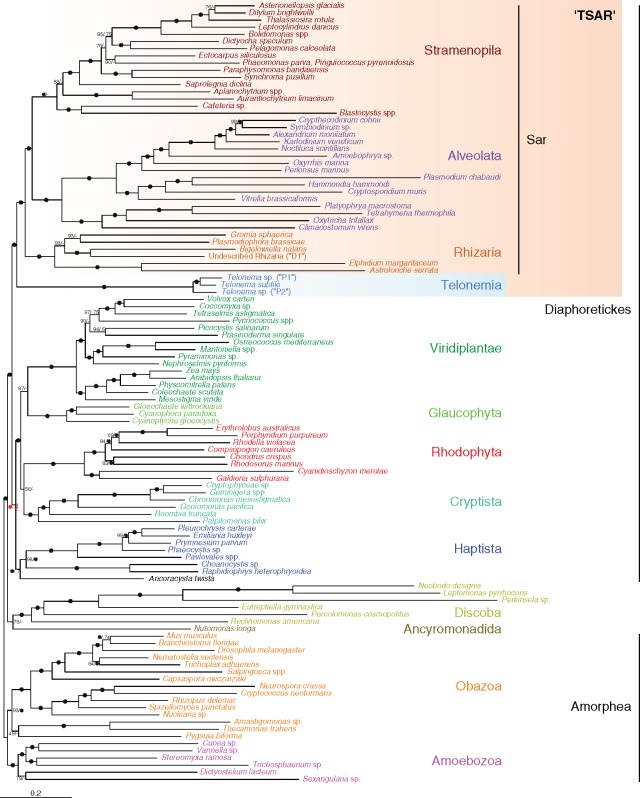
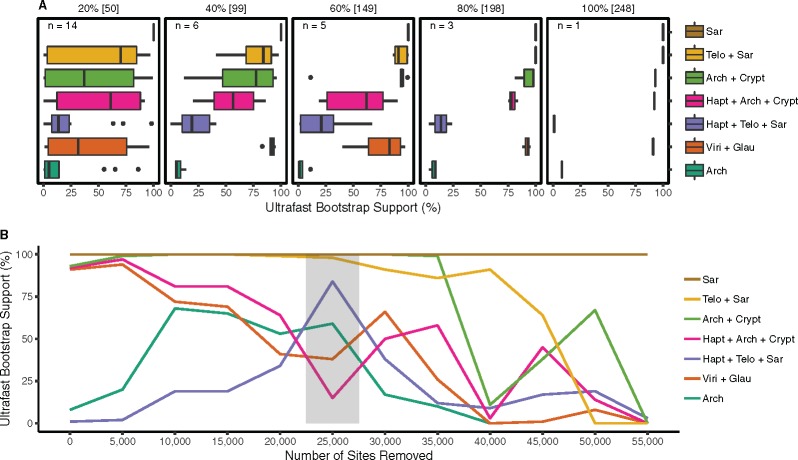
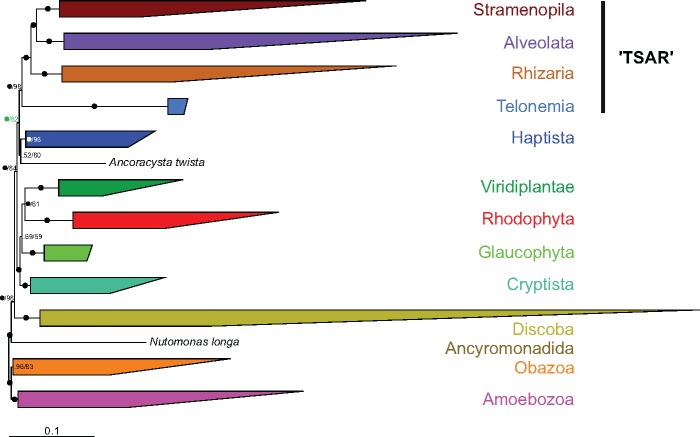
The resolution of the broad-scale tree of eukaryotes is constantly improving, but the evolutionary origin of several major groups remains unknown. Resolving the phylogenetic position of these “orphan” groups is important, especially those that originated early in evolution, because they represent missing evolutionary links between established groups. Telonemia is one such orphan taxon for which little is known. The group is composed of molecularly diverse biflagellated protists, often prevalent although not abundant in aquatic environments. Telonemia has been hypothesized to represent a deeply diverging eukaryotic phylum but no consensus exists as to where it is placed in the tree. Here, we established cultures and report the phylogenomic analyses of three new transcriptome data sets for divergent telonemid lineages. All our phylogenetic reconstructions, based on 248 genes and using site-heterogeneous mixture models, robustly resolve the evolutionary origin of Telonemia as sister to the Sar supergroup. This grouping remains well supported when as few as 60% of the genes are randomly subsampled, thus is not sensitive to the sets of genes used but requires a minimal alignment length to recover enough phylogenetic signal. Telonemia occupies a crucial position in the tree to examine the origin of Sar, one of the most lineage-rich eukaryote supergroups. We propose the moniker “TSAR” to accommodate this new mega-assemblage in the phylogeny of eukaryotes.
Overview
The claims and statistics of this paper haven’t been checked yet.
Free: it reads the open-access text and checks the first 5 claims that cite a source we can check. Create a free account to check every claim.
Integrity signals
Registry
Cites
Statistics
Figures
Verification
Claims the paper makes
The claims and statistics of this paper haven’t been checked yet.
Free: it reads the open-access text and checks the first 5 claims that cite a source we can check. Create a free account to check every claim.
Claims other papers make about this one
Each is checked against this paper’s own text: does it say what the citing paper says it does?
The source backs part of the claim, not all of it — or backs it for a different population, condition or comparison.
In the citing paper
“Recent large-scale phylogenomic studies of nuclear genes place haptophytes and the heterotrophic centrohelids together (Haptista) as sister to the SAR assemblage (stramenopiles, alveolates, and rhizarians), whereas Cryptista (to which cryptophytes belong) branches completely separate in a highly supported relationship with Archaeplastida (e.g., Burki et al. 2016; Strassert et al. 2019).”
From Genomic Insights into Plastid Evolution (2020) · cites this paper as Strassert et al. 2019
Experimental — accuracy not yet measuredThe cited source says what the claim attributes to it.
In the citing paper
“However, given our current understanding of the structure of the eukaryotic tree of life (e.g., Burki et al. 2016; Strassert et al. 2019), the chromalveolate hypothesis is unparsimonious in the sense that it requires extensive plastid loss in numerous, phylogenetically intervening, heterotrophic lineages (fig. 1; see below).”
From Genomic Insights into Plastid Evolution (2020) · cites this paper as Strassert et al. 2019
The cited source says what the claim attributes to it.
In the citing paper
“With phylogenomics, the deep structure of the eukaryotic tree of life has become ever more resolved (e.g., Strassert et al. 2019; Burki et al. 2020; fig. 1), thereby providing a framework for mapping plastid gains and losses across the tree.”
From Genomic Insights into Plastid Evolution (2020) · cites this paper as Strassert et al. 2019
Self-check
Percentages, sums and reported differences re-computed from the paper’s own numbers.
The self-check needs the paper’s full text.
Citations
Cites
Trimmomatic: a flexible trimmer for Illumina sequence data
Bolger, A. M., Lohse, M., & Usadel, B. (2014) · Bioinformatics · doi:10.1093/bioinformatics/btu170 · Cited by 65,548 · cited 2×
“Reads were trimmed with Trimmomatic v. 0.36 (Bolger et al. 2014) using the following parameters: LEADING:5, TRAILING:5, SLIDINGWINDOW:5:16, MINLEN:80.”
MethodInfluentialMAFFT Multiple Sequence Alignment Software Version 7: Improvements in Performance and Usability
Katoh, K., & Standley, D. M. (2013) · Molecular Biology and Evolution · doi:10.1093/molbev/mst010 · Cited by 46,209
RAxML version 8: a tool for phylogenetic analysis and post-analysis of large phylogenies
Stamatakis, A. (2014) · Bioinformatics · doi:10.1093/bioinformatics/btu033 · Cited by 32,291 · cited 2×
“FastTree v. 2.1.10 (Price et al. 2010) employing -lg -gamma plus options for more accurate performances (first round) and RAxML v. 8.2.10 (Stamatakis 2014) employing PROTGAMMALGF and 100 rapid bootstrap searches (second and third round) were used to infer single gene Maximum Likelihood (ML) trees.”
MethodInfluentialIQ-TREE: A Fast and Effective Stochastic Algorithm for Estimating Maximum-Likelihood Phylogenies
Nguyen, L.-T., Schmidt, H. A., von Haeseler, A., & Minh, B. Q. (2015) · Molecular Biology and Evolution · doi:10.1093/molbev/msu300 · Cited by 26,046
FastTree 2 – Approximately Maximum-Likelihood Trees for Large Alignments
Price, M. N., Dehal, P. S., & Arkin, A. P. (2010) · PLoS ONE · doi:10.1371/journal.pone.0009490 · Cited by 14,894 · cited 1×
“10 (Price et al. 2010) employing -lg -gamma plus options for more accurate performances (first round) and RAxML v.”
MethodtrimAl: a tool for automated alignment trimming in large-scale phylogenetic analyses
Capella-Gutiérrez, S., Silla-Martínez, J. M., & Gabaldón, T. (2009) · Bioinformatics · doi:10.1093/bioinformatics/btp348 · Cited by 12,751
Cd-hit: Accelerated for clustering the next-generation sequencing data
Fu, L., Niu, B., Zhu, Z., Wu, S., & Li, W. (2012) · Bioinformatics · doi:10.1093/bioinformatics/bts565 · Cited by 11,175 · cited 1×
“com): 1) Protein sequences for each taxon were clustered with CDHIT (Fu et al. 2012) using an identity threshold of 85%; 2) Homologous copies were retrieved by BLASTP searches using the 263 genes as queries (e-value: 1e-20; coverage cutoff: 0.”
MethodUFBoot2: Improving the Ultrafast Bootstrap Approximation
Hoang, D. T., Chernomor, O., von Haeseler, A., Minh, B. Q., & Vinh, L. S. (2018) · Molecular Biology and Evolution · doi:10.1093/molbev/msx281 · Cited by 10,881 · cited 1×
“Each sub-data set was again used in ML tree reconstruction (LGþC60þFþC4 model) with UFBoot approximation (Hoang et al. 2018).”
MethodHaas, B. J., Papanicolaou, A., Yassour, M., Grabherr, M., Blood, P. D., Bowden, J., Couger, M. B., Eccles, D., Li, B., Lieber, M., et al. (2013) · Nature Protocols · doi:10.1038/nprot.2013.084 · Cited by 8,464
Ultrafast Approximation for Phylogenetic Bootstrap
Minh, B. Q., Nguyen, M. A. T., & von Haeseler, A. (2013) · Molecular Biology and Evolution · doi:10.1093/molbev/mst024 · Cited by 4,844 · cited 1×
“Following the Akaike information criterion and the Bayesian information criterion, the best fitting model was the LGþC60 mixture model (Quang et al. 2008; Minh et al. 2013) with stationary amino acid frequencies optimized from the data set (F) and four discrete gamma (C) categories for rate heterogeneity (LGþC60þFþC4).”
Method
Cited by
Burki, F., Roger, A. J., Brown, M. W., & Simpson, A. G. B. (2020) · Trends in Ecology & Evolution · doi:10.1016/j.tree.2019.08.008 · Cited by 913
“Some or all of thesemay branch with an established group; for example,Ancoracystamay be sister to Haptista [60,62] andmalawimonadsmay be sisters toMetamonada (see above; [68]).”
BackgroundResultInfluentialSelf-citationStrassert, J. F. H., Irisarri, I., Williams, T. A., & Burki, F. (2021) · Nature Communications · doi:10.1038/s41467-021-22044-z · Cited by 298
Self-citationHorizontal Gene Transfer in Eukaryotes: Not if, but How Much?
Van Etten, J., & Bhattacharya, D. (2020) · Trends in Genetics · doi:10.1016/j.tig.2020.08.006 · Cited by 231
“Thus, genome-based studies targeting novel or poorly studied lineages (e.g., Rhodelphis, Hemimastigophora [74,75]), or so-called orphan lineages (e.g., Telonemia, ‘CRuMs’ [76,77]) are valuable.”
EukProt: A database of genome-scale predicted proteins across the diversity of eukaryotes
Richter, D. J., Berney, C., Strassert, J. F. H., Poh, Y.-P., Herman, E. K., Muñoz-Gómez, S. A., Wideman, J. G., Burki, F., & de Vargas, C. (2022) · Peer Community Journal · doi:10.24072/pcjournal.173 · Cited by 230
“…the proposal of new supergroups and the placement of enigmatic lineages in known supergroups (Burki et al., 2012, 2020; Kamikawa et al., 2014; Yabuki et al., 2015; Janou š kovec et al., 2017; Brown et al., 2018; Lax et al., 2018; Strassert et al., 2019; Gawryluk et al., 2019; Tice et al., 2021).”
BackgroundSelf-citationThe lipid metabolism in thraustochytrids
Morabito, C., Bournaud, C., Maës, C., Schuler, M., Aiese Cigliano, R., Dellero, Y., Maréchal, E., Amato, A., & Rébeillé, F. (2019) · Progress in Lipid Research · doi:10.1016/j.plipres.2019.101007 · Cited by 202
“This supergroup assembles Stramenopiles (such as diatoms, thraustochytrids, oomycetes, etc), Alveolates (dinoflagellates, apicomplexans, ciliates, etc) and Rhizaria (foraminifera, radiolarian, etc).”
BackgroundInfluential
Metadata
- Authors
- Strassert, J. F. H., Jamy, M., Mylnikov, A. P., Tikhonenkov, D. V., & Burki, F.
- Affiliations
- Uppsala University (SE)
- Russian Academy of Sciences (RU)
- Corresponding author
- Burki, Fabien
- Venue
- Molecular Biology and Evolution
- Publisher
- Oxford University Press (OUP)
- Published
- 2019-01-22
- Volume
- 36
- Issue
- 4
- Pages
- 757-765
- ISSN
- 0737-4038 (ISSN-L)
- 1537-1719
- PMC
- PMC6844682
- OpenAlex
- W2951426837
- Cited by
- 123
- References
- 62
- Citations by year
- 2026: 5 · 2025: 16 · 2024: 21 · 2023: 12 · 2022: 19 · 2021: 18 · 2020: 21 · 2019: 11
- FWCI
- 5.71
- Type
- journal article
- Language
- en
- Open access
- hybrid
- doi.org
- Licence
- Locations
- Molecular Biology and Evolution (publishedVersion, cc-by-nc)
- bioRxiv (Cold Spring Harbor Laboratory) (acceptedVersion, cc-by-nc-nd)
- Europe PMC (PubMed Central) (publishedVersion, cc-by-nc)
- PubMed Central (publishedVersion, cc-by-nc)
- PubMed (publishedVersion)
- Funders
- Science for Life Laboratory
- Russian Science Foundation (18-14-00239)
- Swedish National Infrastructure (SNIC 2018/8-192)
- Topics
- Life Sciences › Agricultural and Biological Sciences › Ecology, Evolution, Behavior and Systematics › Protist diversity and phylogeny
- Life Sciences › Biochemistry, Genetics and Molecular Biology › Molecular Biology › Genomics and Phylogenetic Studies
- Life Sciences › Biochemistry, Genetics and Molecular Biology › Genetics › Chromosomal and Genetic Variations
- Keywords
- phylogenomics, SAR supergroup, transcriptome, phylogenetic signal, tsar, eukaryotic evolution
- MeSH terms
- Phylogeny, Eukaryota, Transcriptome
About these checks
Registry, retraction, Cites and statistics results are computed, not judged, with one exception: a printed reference that no index lists is read once by a model before it counts as a citation error. Claims are extracted by a model and kept only when their quote appears verbatim in the text; each cited source is then checked, with a model’s help, for whether it says what the claim relies on. Those verdicts can be wrong — read the claim’s quote and the cited source before relying on one.
Statistics and arithmetic are recomputed, not judged.
Confidence bands are shown only for fields calibrated on our annotated test set. None is calibrated yet, so no band is shown.
What counts as a claim ›How we measure confidence ›How we check this ›
Are you an author, or do you see a problem with this page? Request a review
How to cite
Cite CoChat for the checks on this page, and the paper for its own findings.
- This page
- CoChat. (2026). Citation check: New Phylogenomic Analysis of the Enigmatic Phylum Telonemia Further Resolves the Eukaryote Tree of Life. https://app.cochat.ai/papers/10.1093/molbev/msz012
- The paper
- Strassert, J. F. H., Jamy, M., Mylnikov, A. P., Tikhonenkov, D. V., & Burki, F. (2019). New Phylogenomic Analysis of the Enigmatic Phylum Telonemia Further Resolves the Eukaryote Tree of Life. Molecular Biology and Evolution. https://doi.org/10.1093/molbev/msz012
Data sources
Bibliographic data: Semantic Scholar, OpenAlex, Crossref.
Contains information from the Semantic Scholar Academic Graph Datasets, made available under the ODC Attribution License (ODC-BY 1.0).
Semantic Scholar’s data is described in: Kinney, R., et al. (2023). The Semantic Scholar Open Data Platform. arXiv:2301.10140.
