

Why training and specialization is needed for peer review: a case study of peer review for randomized controlled trials
Open accessThe DOI matches its Crossref record; 31 of the 33 references it cites were found in a registry or an index.
Abstract
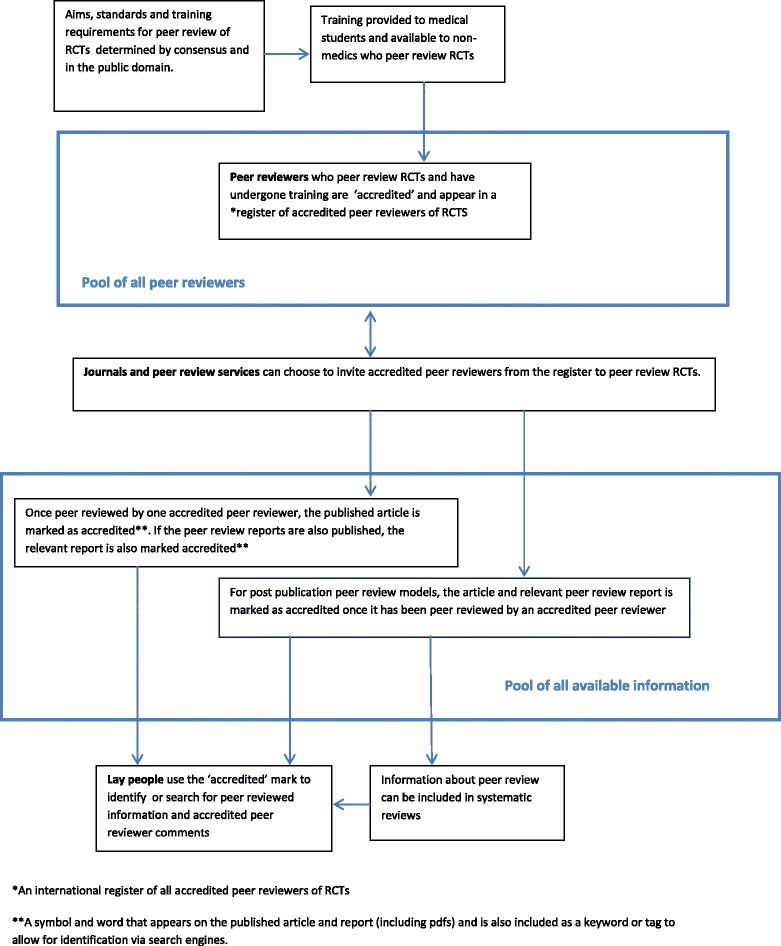
BACKGROUND: The purpose and effectiveness of peer review is currently a subject of hot debate, as is the need for greater openness and transparency in the conduct of clinical trials. Innovations in peer review have focused on the process of peer review rather than its quality. DISCUSSION: The aims of peer review are poorly defined, with no evidence that it works and no established way to provide training. However, despite the lack of evidence for its effectiveness, evidence-based medicine, which directly informs patient care, depends on the system of peer review. The current system applies the same process to all fields of research and all study designs. While the volume of available health related information is vast, there is no consistent means for the lay person to judge its quality or trustworthiness. Some types of research, such as randomized controlled trials, may lend themselves to a more specialized form of peer review where training and ongoing appraisal and revalidation is provided to individuals who peer review randomized controlled trials. Any randomized controlled trial peer reviewed by such a trained peer reviewer could then have a searchable 'quality assurance' symbol attached to the published articles and any published peer reviewer reports, thereby providing some guidance to the lay person seeking to inform themselves about their own health or medical treatment. SUMMARY: Specialization, training and ongoing appraisal and revalidation in peer review, coupled with a quality assurance symbol for the lay person, could address some of the current limitations of peer review for randomized controlled trials.
Overview
The claims and statistics of this paper haven’t been checked yet.
Free: it reads the open-access text and checks the first 5 claims that cite a source we can check. Create a free account to check every claim.
Integrity signals
Registry
Cites
Statistics
Figures
Verification
Claims the paper makes
The claims and statistics of this paper haven’t been checked yet.
Free: it reads the open-access text and checks the first 5 claims that cite a source we can check. Create a free account to check every claim.
Claims other papers make about this one
Each is checked against this paper’s own text: does it say what the citing paper says it does?
In the citing paper
“The lack of a comprehensive reviewer training system may contribute to problems with peer review [11].”
From Is the future of peer review automated? (2022) · cites this paper as [11]
Self-check
Percentages, sums and reported differences re-computed from the paper’s own numbers.
The self-check needs the paper’s full text.
Citations
Cites
CONSORT 2010 Statement: updated guidelines for reporting parallel group randomised trials
the CONSORT Group, Schulz, K. F., Altman, D. G., & Moher, D. (2010) · BMC Medicine · doi:10.1186/1741-7015-8-18 · Cited by 13,371
OLSSON, A. G., McMurray, J. J. V., Thorgeirsson, G., Spaulding, C. M., Slattery, J., Pyörälà, K., Færgeman, O., Wright, R. S., Berg, K. M., Wilhelmsen, L., et al. (1994) · The Lancet · Cited by 8,467
Evidence-Based Medicine: A New Approach to Teaching the Practice of Medicine
Guyatt, G. (1992) · JAMA · doi:10.1001/jama.1992.03490170092032 · Cited by 4,202
CONSORT 2010 statement: updated guidelines for reporting parallel group randomized trials
Schulz, K. F., Altman, D. G., Moher, D., & for the CONSORT Group* (2010) · Annals of Internal Medicine · doi:10.7326/0003-4819-152-11-201006010-00232 · Cited by 3,824
SCANDINAVIANSIMVASTATINSURVIVAL (1994) · The Lancet · doi:10.1016/s0140-6736(94)90566-5 · Cited by 3,645
Improving the Quality of Reporting of Randomized Controlled Trials: The CONSORT Statement
Begg, C. (1996) · JAMA · doi:10.1001/jama.1996.03540080059030 · Cited by 3,127
Pyörälä, K., Pedersen, T. R., Kjekshus, J., Faergeman, O., Olsson, A. G., Thorgeirsson, G., & The Scandinavian Simvastatin Survival Study (4S) Group (1997) · Diabetes Care · doi:10.2337/diacare.20.4.614 · Cited by 1,623 · cited 1×
“A short time later, when I was a junior doctor, a subgroup analysis of the diabetic patients who took part in the original ‘4S study’ [3], reported that simvastatin treatment improved morbidity and mortality in patients with diabetes [4].”
BackgroundClinical Trial Registration: A Statement from the International Committee of Medical Journal Editors
De Angelis, C., Drazen, J. M., Frizelle, F. A., Haug, C., Hoey, J., Horton, R., Kotzin, S., Laine, C., Marusic, A., Overbeke, A. J. P. M., et al. (2004) · New England Journal of Medicine · doi:10.1056/nejme048225 · Cited by 1,241
Peer Review: A Flawed Process at the Heart of Science and Journals
Smith, R. (2006) · Journal of the Royal Society of Medicine · doi:10.1177/014107680609900414 · Cited by 880
Cha, M., Eastwaad, S., Hartan, R., Maher, D., Olkin, I., Pitkin, R., Rennie, D., Schulz, K. F., Simel, D. L., & Straup, D. F. (1996) · Cited by 737
Bero, L. (1995) · JAMA · doi:10.1001/jama.1995.03530240045039 · Cited by 714
Turner, L., Shamseer, L., Altman, D. G., Schulz, K. F., & Moher, D. (2012) · Systematic Reviews · doi:10.1186/2046-4053-1-60 · Cited by 628 · cited 2×
“Since the methodology for conducting and reporting of RCTs has been defined by the CONSORT statement [41] which improves the reporting of RCTs [39] and, thereby, aids the peer review process, peer review of RCTs lends itself to such specialization.”
BackgroundMethodThe STM Report: An overview of scientific and scholarly journal publishing
Ware, M., & Mabe, M. A. (2015) · Lincoln (University of Nebraska) · Cited by 536
van Rooyen, S., Godlee, F., Evans, S., Black, N., & Smith, R. (1999) · BMJ · doi:10.1136/bmj.318.7175.23 · Cited by 415
Peer review in a changing world: An international study measuring the attitudes of researchers
Mulligan, A., Hall, L., & Raphael, E. (2013) · Journal of the American Society for Information Science and Technology · doi:10.1002/asi.22798 · Cited by 393 · cited 2×
“With peer review as a vague and undefined process it is not surprising that in a survey of peer review conducted by Sense about Science, 56% of reviewers in a survey said there was a lack of guidance on how to review and 68% thought formal training would help [31].”
BackgroundEffects of Editorial Peer Review: A Systematic Review
Jefferson, T., Alderson, P., Wager, E., & Davidoff, F. (2002) · JAMA · doi:10.1001/jama.287.21.2784 · Cited by 347 · cited 2×
“[28], but before the effects can be investigated, the aims of”
BackgroundEditorial peer review for improving the quality of reports of biomedical studies
Jefferson, T., Rudin, M., Brodney Folse, S., & Davidoff, F. (2007) · Cochrane Database of Systematic Reviews · doi:10.1002/14651858.mr000016.pub3 · Cited by 312 · cited 1×
“It is not clear what peer review aims to achieve [28] and no evidence that peer review works [29].”
BackgroundEffect of Blinding and Unmasking on the Quality of Peer Review: A Randomized Trial
van Rooyen, S., Godlee, F., Evans, S., Smith, R., & Black, N. (1998) · JAMA · doi:10.1001/jama.280.3.234 · Cited by 280
Effects of training on quality of peer review: randomised controlled trial
Schroter, S., Black, N., Evans, S., Carpenter, J., Godlee, F., & Smith, R. (2004) · BMJ · doi:10.1136/bmj.38023.700775.ae · Cited by 268 · cited 2×
“Training and mentoring schemes for peer review have shown little impact [34-37] and even a decline in peer reviewer performance with time [38].”
BackgroundWhat errors do peer reviewers detect, and does training improve their ability to detect them?
Schroter, S., Black, N., Evans, S., Godlee, F., Osorio, L., & Smith, R. (2008) · Journal of the Royal Society of Medicine · doi:10.1258/jrsm.2008.080062 · Cited by 226 · cited 2×
“Training and mentoring schemes for peer review have shown little impact [34-37] and even a decline in peer reviewer performance with time [38].”
BackgroundAre Peer Reviewers Encouraged to Use Reporting Guidelines? A Survey of 116 Health Research Journals
Hirst, A., & Altman, D. G. (2012) · PLoS ONE · doi:10.1371/journal.pone.0035621 · Cited by 200
Opening up BMJ peer review: A beginning that should lead to complete transparency
Smith, R. (1999) · BMJ · doi:10.1136/bmj.318.7175.4 · Cited by 189 · cited 10×
“BMJ 2004, 328:673.”
BackgroundInfluentialCallaham, M. L., & Tercier, J. (2007) · PLoS Medicine · doi:10.1371/journal.pmed.0040040 · Cited by 139 · cited 1×
“Training and mentoring schemes for peer review have shown little impact [34-37] and even a decline in peer reviewer performance with time [38].”
BackgroundSTM report : an overview of scientific and scholarly journal publishing
urfistinfo (2009) · OpenEdition (OpenEdition) · doi:10.58079/v4as · Cited by 138
Hopewell, S., Collins, G. S., Boutron, I., Yu, L.-M., Cook, J., Shanyinde, M., Wharton, R., Shamseer, L., & Altman, D. G. (2014) · BMJ · doi:10.1136/bmj.g4145 · Cited by 103 · cited 1×
“sometimes even suggesting inappropriate revisions [40].”
Surgical removal versus retention for the management of asymptomatic impacted wisdom teeth
Mettes, T. G., Ghaeminia, H., Nienhuijs, M. E., Perry, J., van der Sanden, W. J. M., & Plasschaert, A. J. M. (2012) · Cochrane Database of Systematic Reviews · doi:10.1002/14651858.cd003879.pub3 · Cited by 98
Does mentoring new peer reviewers improve review quality? A randomized trial
Houry, D., Green, S., & Callaham, M. (2012) · BMC Medical Education · doi:10.1186/1472-6920-12-83 · Cited by 89
Longitudinal Trends in the Performance of Scientific Peer Reviewers
Callaham, M. L., & McCulloch, C. E. (2010) · Annals of Emergency Medicine · doi:10.1016/j.annemergmed.2010.07.027 · Cited by 67 · cited 1×
“Training and mentoring schemes for peer review have shown little impact [34-37] and even a decline in peer reviewer performance with time [38].”
BackgroundMcCook, A. (2006) · The Scientist (Philadelphia, Pa. Online)/The Scientist · Cited by 58
Ho, T. B. L. (2002) · Journal of the Royal Society of Medicine · doi:10.1258/jrsm.95.11.571-a · Cited by 57
Q&A: Re-review opt-out and painless publishing
Robertson, M. (2013) · BMC Biology · doi:10.1186/1741-7007-11-18 · Cited by 5
Research works printed but not linked: 8
- 10. Weller AC: Introduction to the editorial review process. In Editorial Peer Review, Its Strengths and Weeknesss, Chapter 1. 2nd edition.ᅟ USA: Information Today Inc; 2002, 15.
- 16. BioMed Central [ http://www.biomedcentral.com/]
- 21. 21 F1000 Research [ http://f1000research.com/author-guidelines]
- 23. Axious Review [ http://axiosreview.org/the-process/]
- 25. BioMed Central transfers [ http://www.biomedcentral.com/authors/transferfaq]
- 26. eLife [ http://elifesciences.org/about#process]
- 27. Frontiers [ http://www.frontiersin.org/about/reviewsystem]
- 33. House of Commons Science and Technology Committee: Peer review in scientific publications. Eight Report of Session 2010-12 UK.
Cited by
A multi-disciplinary perspective on emergent and future innovations in peer review
Tennant, J. P., Dugan, J. M., Graziotin, D., Jacques, D. C., Waldner, F., Mietchen, D., Elkhatib, Y., B. Collister, L., Pikas, C. K., Crick, T., et al. (2017) · F1000Research · doi:10.12688/f1000research.12037.1 · Cited by 289
“These have built on the concept of deconstructed journals (Smith, 1999), which decouple peer-review from publishing (Hettyey et al., 2012; Stemmle and Collier, 2013; Vines, 2015b; Patel, 2014).”
BackgroundThe Peer Review Process: Past, Present, and Future
Drozdz, J. A., & Ladomery, M. R. (2024) · British Journal of Biomedical Science · doi:10.3389/bjbs.2024.12054 · Cited by 120
“There is also no systematic, formal training for reviewers to ensure that they are objective and ef fi cient [57].”
BackgroundPeer review and the publication process
Ali, P. A., & Watson, R. A. (2016) · Nursing Open · doi:10.1002/nop2.51 · Cited by 154
“Research examining effectiveness of peer review is still limited (Patel 2014).”
BackgroundMethodReporting guidelines: doing better for readers
Moher, D. (2018) · BMC Medicine · doi:10.1186/s12916-018-1226-0 · Cited by 107
Peer review for biomedical publications: we can improve the system
Stahel, P. F., & Moore, E. E. (2014) · BMC Medicine · doi:10.1186/s12916-014-0179-1 · Cited by 103
“We read with enthusiasm the recent opinion article by Jigisha Patel in BMC Medicine [1].”
Influential
Metadata
- Authors
- Patel, J.
- Affiliations
- BioMed Central (United Kingdom) (GB)
- Corresponding author
- Patel, Jigisha
- ORCID
- Patel, Jigisha
- Venue
- BMC Medicine
- Published
- 2014-07-30
- Volume
- 12
- Issue
- 1
- Pages
- 128-128
- ISSN
- 1741-7015 (ISSN-L)
- PMC
- PMC4243268
- OpenAlex
- W2064123557
- Cited by
- 75
- References
- 33
- Citations by year
- 2026: 2 · 2025: 5 · 2024: 8 · 2023: 11 · 2022: 4 · 2021: 6 · 2020: 3 · 2019: 5 · 2018: 3 · 2017: 6 · 2016: 8 · 2015: 9 · 2014: 5
- FWCI
- 9.10
- Type
- journal article
- Language
- en
- Open access
- gold
- doi.org
- Locations
- BMC Medicine (publishedVersion, cc-by)
- Europe PMC (PubMed Central) (publishedVersion, cc-by)
- PubMed Central (publishedVersion, cc-by)
- PubMed (publishedVersion)
- Topics
- Social Sciences › Decision Sciences › Statistics, Probability and Uncertainty › Meta-analysis and systematic reviews
- Social Sciences › Library and Information Sciences › Publishing and Scholarly Communication
- Social Sciences › Library and Information Sciences › Academic Publishing and Open Access
- Keywords
- peer review, randomized controlled trials, peer review training, evidence-based medicine
- MeSH terms
- Education, Continuing, Humans, Peer Review, Publishing, Randomized Controlled Trials as Topic, Evidence-Based Medicine
About these checks
Registry, retraction, Cites and statistics results are computed, not judged, with one exception: a printed reference that no index lists is read once by a model before it counts as a citation error. Claims are extracted by a model and kept only when their quote appears verbatim in the text; each cited source is then checked, with a model’s help, for whether it says what the claim relies on. Those verdicts can be wrong — read the claim’s quote and the cited source before relying on one.
Statistics and arithmetic are recomputed, not judged.
Confidence bands are shown only for fields calibrated on our annotated test set. None is calibrated yet, so no band is shown.
What counts as a claim ›How we measure confidence ›How we check this ›
Are you an author, or do you see a problem with this page? Request a review
Data sources
Bibliographic data: Semantic Scholar, OpenAlex, Crossref.
Contains information from the Semantic Scholar Academic Graph Datasets, made available under the ODC Attribution License (ODC-BY 1.0).
Semantic Scholar’s data is described in: Kinney, R., et al. (2023). The Semantic Scholar Open Data Platform. arXiv:2301.10140.
