

Why training and specialization is needed for peer review: a case study of peer review for randomized controlled trials
Open accessThe DOI matches its Crossref record; 31 of the 33 references it cites were found in a registry or an index.
Abstract
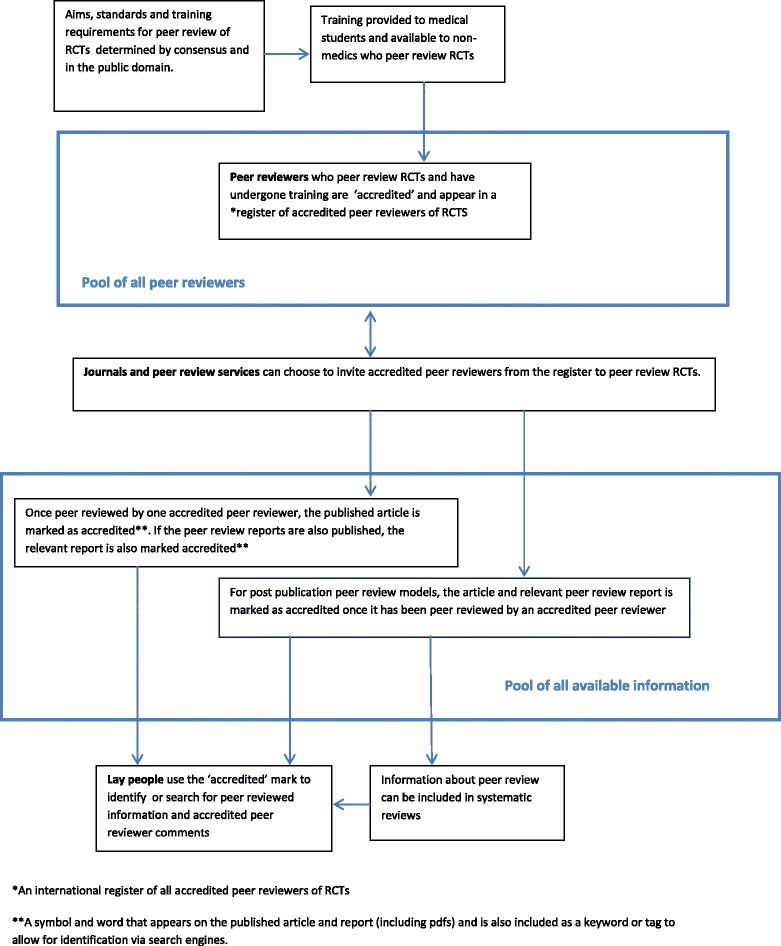
BACKGROUND: The purpose and effectiveness of peer review is currently a subject of hot debate, as is the need for greater openness and transparency in the conduct of clinical trials. Innovations in peer review have focused on the process of peer review rather than its quality. DISCUSSION: The aims of peer review are poorly defined, with no evidence that it works and no established way to provide training. However, despite the lack of evidence for its effectiveness, evidence-based medicine, which directly informs patient care, depends on the system of peer review. The current system applies the same process to all fields of research and all study designs. While the volume of available health related information is vast, there is no consistent means for the lay person to judge its quality or trustworthiness. Some types of research, such as randomized controlled trials, may lend themselves to a more specialized form of peer review where training and ongoing appraisal and revalidation is provided to individuals who peer review randomized controlled trials. Any randomized controlled trial peer reviewed by such a trained peer reviewer could then have a searchable 'quality assurance' symbol attached to the published articles and any published peer reviewer reports, thereby providing some guidance to the lay person seeking to inform themselves about their own health or medical treatment. SUMMARY: Specialization, training and ongoing appraisal and revalidation in peer review, coupled with a quality assurance symbol for the lay person, could address some of the current limitations of peer review for randomized controlled trials.
Overview
The claims and statistics of this paper haven’t been checked yet.
Free: it reads the open-access text and checks the first 5 claims that cite a source we can check. Create a free account to check every claim.
Integrity signals
Registry
Cites
Statistics
Figures
Verification
Claims the paper makes
The claims and statistics of this paper haven’t been checked yet.
Free: it reads the open-access text and checks the first 5 claims that cite a source we can check. Create a free account to check every claim.
Claims other papers make about this one
Each is checked against this paper’s own text: does it say what the citing paper says it does?
In the citing paper
“The lack of a comprehensive reviewer training system may contribute to problems with peer review [11].”
From Is the future of peer review automated? (2022) · cites this paper as [11]
Self-check
Percentages, sums and reported differences re-computed from the paper’s own numbers.
The self-check needs the paper’s full text.
Citations
Cites
CONSORT 2010 Statement: updated guidelines for reporting parallel group randomised trials
the CONSORT Group, Schulz, K. F., Altman, D. G., & Moher, D. (2010) · BMC Medicine · doi:10.1186/1741-7015-8-18 · Cited by 13,371
OLSSON, A. G., McMurray, J. J. V., Thorgeirsson, G., Spaulding, C. M., Slattery, J., Pyörälà, K., Færgeman, O., Wright, R. S., Berg, K. M., Wilhelmsen, L., et al. (1994) · The Lancet · Cited by 8,467
Evidence-Based Medicine: A New Approach to Teaching the Practice of Medicine
Guyatt, G. (1992) · JAMA · doi:10.1001/jama.1992.03490170092032 · Cited by 4,202
CONSORT 2010 statement: updated guidelines for reporting parallel group randomized trials
Schulz, K. F., Altman, D. G., Moher, D., & for the CONSORT Group* (2010) · Annals of Internal Medicine · doi:10.7326/0003-4819-152-11-201006010-00232 · Cited by 3,824
SCANDINAVIANSIMVASTATINSURVIVAL (1994) · The Lancet · doi:10.1016/s0140-6736(94)90566-5 · Cited by 3,645
Improving the Quality of Reporting of Randomized Controlled Trials: The CONSORT Statement
Begg, C. (1996) · JAMA · doi:10.1001/jama.1996.03540080059030 · Cited by 3,127
Pyörälä, K., Pedersen, T. R., Kjekshus, J., Faergeman, O., Olsson, A. G., Thorgeirsson, G., & The Scandinavian Simvastatin Survival Study (4S) Group (1997) · Diabetes Care · doi:10.2337/diacare.20.4.614 · Cited by 1,623 · cited 1×
“A short time later, when I was a junior doctor, a subgroup analysis of the diabetic patients who took part in the original ‘4S study’ [3], reported that simvastatin treatment improved morbidity and mortality in patients with diabetes [4].”
BackgroundClinical Trial Registration: A Statement from the International Committee of Medical Journal Editors
De Angelis, C., Drazen, J. M., Frizelle, F. A., Haug, C., Hoey, J., Horton, R., Kotzin, S., Laine, C., Marusic, A., Overbeke, A. J. P. M., et al. (2004) · New England Journal of Medicine · doi:10.1056/nejme048225 · Cited by 1,241
Peer Review: A Flawed Process at the Heart of Science and Journals
Smith, R. (2006) · Journal of the Royal Society of Medicine · doi:10.1177/014107680609900414 · Cited by 880
Cha, M., Eastwaad, S., Hartan, R., Maher, D., Olkin, I., Pitkin, R., Rennie, D., Schulz, K. F., Simel, D. L., & Straup, D. F. (1996) · Cited by 737
Research works printed but not linked: 8
- 10. Weller AC: Introduction to the editorial review process. In Editorial Peer Review, Its Strengths and Weeknesss, Chapter 1. 2nd edition.ᅟ USA: Information Today Inc; 2002, 15.
- 16. BioMed Central [ http://www.biomedcentral.com/]
- 21. 21 F1000 Research [ http://f1000research.com/author-guidelines]
- 23. Axious Review [ http://axiosreview.org/the-process/]
- 25. BioMed Central transfers [ http://www.biomedcentral.com/authors/transferfaq]
- 26. eLife [ http://elifesciences.org/about#process]
- 27. Frontiers [ http://www.frontiersin.org/about/reviewsystem]
- 33. House of Commons Science and Technology Committee: Peer review in scientific publications. Eight Report of Session 2010-12 UK.
Cited by
A multi-disciplinary perspective on emergent and future innovations in peer review
Tennant, J. P., Dugan, J. M., Graziotin, D., Jacques, D. C., Waldner, F., Mietchen, D., Elkhatib, Y., B. Collister, L., Pikas, C. K., Crick, T., et al. (2017) · F1000Research · doi:10.12688/f1000research.12037.1 · Cited by 289
“These have built on the concept of deconstructed journals (Smith, 1999), which decouple peer-review from publishing (Hettyey et al., 2012; Stemmle and Collier, 2013; Vines, 2015b; Patel, 2014).”
BackgroundThe Peer Review Process: Past, Present, and Future
Drozdz, J. A., & Ladomery, M. R. (2024) · British Journal of Biomedical Science · doi:10.3389/bjbs.2024.12054 · Cited by 120
“There is also no systematic, formal training for reviewers to ensure that they are objective and ef fi cient [57].”
BackgroundPeer review and the publication process
Ali, P. A., & Watson, R. A. (2016) · Nursing Open · doi:10.1002/nop2.51 · Cited by 154
“Research examining effectiveness of peer review is still limited (Patel 2014).”
BackgroundMethodReporting guidelines: doing better for readers
Moher, D. (2018) · BMC Medicine · doi:10.1186/s12916-018-1226-0 · Cited by 107
Peer review for biomedical publications: we can improve the system
Stahel, P. F., & Moore, E. E. (2014) · BMC Medicine · doi:10.1186/s12916-014-0179-1 · Cited by 103
“We read with enthusiasm the recent opinion article by Jigisha Patel in BMC Medicine [1].”
InfluentialFour Proposals to Help Improve the Medical Research Literature
Moher, D., & Altman, D. G. (2015) · PLOS Medicine · doi:10.1371/journal.pmed.1001864 · Cited by 78
“There has been a recent focus on the need to provide comprehensive peer reviewer training and view it more professionally [31].”
BackgroundIs the future of peer review automated?
Schulz, R., Barnett, A., Bernard, R., Brown, N. J. L., Byrne, J. A., Eckmann, P., Gazda, M. A., Kilicoglu, H., Prager, E. M., Salholz-Hillel, M., et al. (2022) · BMC Research Notes · doi:10.1186/s13104-022-06080-6 · Cited by 80
“The lack of a comprehensive reviewer training system may contribute to problems with peer review [11].”
BackgroundKovanis, M., Trinquart, L., Ravaud, P., & Porcher, R. (2017) · Scientometrics · doi:10.1007/s11192-017-2375-1 · Cited by 70
“…allow editors of journals within each respective group to discuss rejected manuscripts and to propose submission to another journal of the group (Walker and Rocha da Silva 2015b; Cals et al. 2013; Gura 2002; Houry et al. 2012; Patel 2014; Stahel and Moore 2014; van Rooyen et al. 1999; Ware 2013).”
BackgroundJournal Peer Review and Editorial Evaluation: Cautious Innovator or Sleepy Giant?
Horbach, S. P. J. M., & Halffman, W. (2019) · Minerva · doi:10.1007/s11024-019-09388-z · Cited by 59
“Moreover, it has been characterised as an ‘empty gun’ (Smith 2010), ‘with no evidence that it works and no established way to provide [reviewer] training’ (Patel 2014).”
BackgroundA multi-disciplinary perspective on emergent and future innovations in peer review
Tennant, J. P., Dugan, J. M., Graziotin, D., Jacques, D. C., Waldner, F., Mietchen, D., Elkhatib, Y., B. Collister, L., Pikas, C. K., Crick, T., et al. (2017) · F1000Research · doi:10.12688/f1000research.12037.2 · Cited by 38
da Silva, J. A. T., Al‐Khatib, A., & Dobránszki, J. (2016) · Science and Engineering Ethics · doi:10.1007/s11948-016-9854-2 · Cited by 42
Open, single-blind, double-blind: which peer review process do you prefer?
Moylan, E. C., Harold, S. J., O’Neill, C., & Kowalczuk, M. K. (2014) · BMC Pharmacology and Toxicology · doi:10.1186/2050-6511-15-55 · Cited by 40
“Having access to peer reviews also provides valuable information for training purposes [24,25] and allows further research into the benefits of peer review [26].”
BackgroundAn Open Science Peer Review Oath
Aleksic, J., & Markie, M. (2026) · F1000Research · doi:10.12688/f1000research.5686.2 · Cited by 37
Kovanis, M., Porcher, R., Ravaud, P., & Trinquart, L. (2015) · Scientometrics · doi:10.1007/s11192-015-1800-6 · Cited by 41
“Interventions such as cascade peer review (passing reviews of rejected manuscripts to the next editor) or ‘‘crowd sourcing’’ of online reviews (the editor consults online comments along with the reviewers’ evaluations) could be implemented at the systemic level (Houry et al. 2012; van Rooyen et al. 1999; Patel 2014; M…”
BackgroundBeware of the predatory science journal: A potential threat to the integrity of medical research
Johal, J., Ward, R. J., Gielecki, J. S., Walocha, J. A., Natsis, K., Tubbs, R. S., & Loukas, M. (2017) · Clinical Anatomy · doi:10.1002/ca.22899 · Cited by 38
“To be effective, the peerreview process must be conducted by individuals who have been trained and specialized in the subject area, and are free of conflicts of interest from the submitting author(s) or organization(s) (Gleicher, 2013; Patel, 2014).”
MethodFraser, H. S., Bush, M., Wintle, B. C., Mody, F., Smith, E. T., Hanea, A. M., Gould, E., Hemming, V., Hamilton, D. G., Rumpff, L., et al. (2023) · PLoS ONE · doi:10.1371/journal.pone.0274429 · Cited by 43
Changing the culture of peer review for a more inclusive and equitable psychological science.
Aly, M., Colunga, E., Crockett, M. J., Goldrick, M., Gómez, P., Kung, F. Y. H., McKee, P. C., Pérez, M., Stilwell, S. M., & Diekman, A. B. (2023) · Journal of Experimental Psychology General · doi:10.1037/xge0001461 · Cited by 38
Vercellini, P., Buggio, L., Viganò, P., & Somigliana, E. (2016) · European Journal of Internal Medicine · doi:10.1016/j.ejim.2016.04.014 · Cited by 34
Knowledge and motivations of training in peer review: An international cross-sectional survey
Willis, J. V., Ramos, J., Cobey, K. D., Ng, J. Y., Khan, H., Albert, M. A., Alayche, M., & Moher, D. (2023) · PLoS ONE · doi:10.1371/journal.pone.0287660 · Cited by 30
“A lack of training could therefore explain the less-than-optimal reporting quality of biomedical research [26] and the inability of reviewers to detect major errors and deficiencies in publications [17].”
BackgroundA guide to performing a peer review of randomised controlled trials
Mar, C. D., & Hoffmann, T. (2015) · BMC Medicine · doi:10.1186/s12916-015-0471-8 · Cited by 32
“There have been calls for innovations in providing training to wouldbe reviewers of RCTs before they can enter a register of ‘RCT reviewers’ that journals could draw upon [6].”
BackgroundBuser, J. M., Morris, K. L., Dzomeku, V. M., Endale, T., Smith, Y. R., & August, E. T. (2023) · BMJ Global Health · doi:10.1136/bmjgh-2023-012224 · Cited by 24
Limited online training opportunities exist for scholarly peer reviewers
Willis, J. V., Cobey, K. D., Ramos, J., Chow, R., Ng, J. Y., Alayche, M., & Moher, D. (2023) · Journal of Clinical Epidemiology · doi:10.1016/j.jclinepi.2023.06.023 · Cited by 24
Reviewing the review: a qualitative assessment of the peer review process in surgical journals
Davis, C. H., Bass, B. L., Behrns, K. E., Lillemoe, K. D., Garden, O. J., Roh, M. S., Lee, J. E., Balch, C. M., & Aloia, T. A. (2018) · Research Integrity and Peer Review · doi:10.1186/s41073-018-0048-0 · Cited by 22
“Despite multiple critiques of the current system [3, 4, 12, 18, 19], implementation of consensus guidelines for standardization and optimization of the peer review process continues to be lacking.”
BackgroundAssociation Between Twitter Reception at a National Urology Conference and Future Publication Status
Nolte, A., Nguyen, K. A., Perecman, A. J., Katz, M. S., Kenney, P. A., Cooperberg, M. R., Gross, C. P., & Leapman, M. (2019) · European Urology Focus · doi:10.1016/j.euf.2019.05.004 · Cited by 22
How to review a surgical paper: a guide for junior referees
Stahel, P. F., & Moore, E. E. (2016) · BMC Medicine · doi:10.1186/s12916-016-0578-6 · Cited by 22
“For this purpose, there are a number of high quality articles in the published literature that provide excellent guidance to the ‘surgeon referee’ in specific arenas of peer review, including surgical outcomes research, evaluation of meta-analyses, randomized controlled trials, statistical analysis, and how to assess…”
Background‘Peer review’ for scientific manuscripts: Emerging issues, potential threats, and possible remedies
Das, A. K. (2016) · Medical Journal Armed Forces India · doi:10.1016/j.mjafi.2016.02.014 · Cited by 20
Nieminen, P. A., & Uribe, S. E. (2021) · Entropy · doi:10.3390/e23040468 · Cited by 26
The Open Science Peer Review Oath
Aleksic, J., Alexa, A., Attwood, T. K., Hong, N. C., Dahlö, M., Davey, R., Dinkel, H., Förstner, K. U., Grigorov, I., Hèriché, J.-K., et al. (2014) · F1000Research · doi:10.12688/f1000research.5686.1 · Cited by 19
“Of course, the peer-review process is not infallible (11, 12).”
van Lent, M., IntHout, J., & Out, H. J. (2015) · BMJ Open · doi:10.1136/bmjopen-2015-007961 · Cited by 20
Scholarly peer reviewing′: The art, its joys and woes
Kurdi, M. (2015) · Indian Journal of Anaesthesia · doi:10.4103/0019-5049.162981 · Cited by 17
“Pre‐publication reviews include varieties like single‐blind review, double‐blind review and open review.[21]”
BackgroundMethodInfluentialTen Points for High-Quality Statistical Reporting and Data Presentation
Nieminen, P. A. (2020) · Applied Sciences · doi:10.3390/app10113885 · Cited by 12
Along with the privilege of authorship come important responsibilities
Moher, D. (2014) · BMC Medicine · doi:10.1186/preaccept-3968294631461098 · Cited by 14
Peer review: tips from field experts for junior reviewers
Alam, S., & Patel, J. (2015) · BMC Medicine · doi:10.1186/s12916-015-0512-3 · Cited by 11
“One of the more recent proposals includes journal editors offering training and recognition for reviewers, and providing readers with a way to identify individual published articles that have been assessed by ‘trained’ reviewers [6].”
Self-citationMiller, C. T., & Rice, R. L. (2023) · Journal of Scholarly Publishing · doi:10.3138/jsp-2022-0073 · Cited by 10
Peer reviewing an original research paper
Tullu, M. S., & Karande, S. (2020) · Journal of Postgraduate Medicine · doi:10.4103/jpgm.jpgm_492_19 · Cited by 8
An Analysis of Sponsors/Collaborators of 69,160 Drug Trials Registered with ClinicalTrials.gov
Keezhupalat, S. M., Naik, A., Gupta, S., Raghunathan, S., & Saberwal, G. (2016) · PLoS ONE · doi:10.1371/journal.pone.0149416 · Cited by 8
“In terms of reporting the results, there may be a publication bias that exaggerates the benefits of a drug candidate or minimizes its risks [13, 14], peer-review of randomized controlled trials may not be up to the mark [15] and journals may not meet the required standards while reporting the results of trials [16].”
BackgroundDeclaring interests and restoring trust in medicine
Heneghan, C. J., & McCartney, M. (2019) · BMJ · doi:10.1136/bmj.l6236 · Cited by 9
Ivlev, I., Ley, K. V., Wiedrick, J. T., Lesley, K., Forester, A., Webb, R., Broitman, M., & Eden, K. (2019) · BMJ Open · doi:10.1136/bmjopen-2018-028732 · Cited by 7
“The OHSU Institutional Review Board (IRB) determined that this activity is exempt from IRB review and approval (IRB ID: STUDY00016016).”
BackgroundPublisher and journal reciprocity for peer review: Not so much
Moher, D., & Armond, A. C. V. (2025) · Accountability in Research · doi:10.1080/08989621.2025.2450451 · Cited by 7
Common Topics of Publication and Levels of Evidence in the Current Hand Surgery Literature
Lemme, N. J., Johnston, B. R., Smith, B. C., Pršić, A., Akelman, E., & Drolet, B. C. (2018) · Journal of Hand and Microsurgery · doi:10.1055/s-0038-1661423 · Cited by 6
Strategies for Developing Journal Peer Reviewers: A Scoping Review
Gazza, E. A., Matthias, A. D., Griffin, J., & Chick, K. (2023) · Nursing Education Perspectives · doi:10.1097/01.nep.0000000000001155 · Cited by 5
Scudeller, L., & Friedman, J. (2022) · Clinical Microbiology and Infection · doi:10.1016/j.cmi.2022.07.003 · Cited by 4
Álvares, S. (2019) · Scientific Repository of Open Access of Portugal (RCAAP) · doi:10.25753/birthgrowthmj.v28.i1.17614 · Cited by 4
Fortifying the external peer review: an editorial perspective.
Sohail, S. (2015) · PubMed · Cited by 3
(FULL GUIDE) A Guide for Social Science Journal Editors on Easing into Open SciencePreprint
Silverstein, P., Elman, C., Montoya, A. K., McGillivray, B., Pennington, C. R., Harrison, C. H., Steltenpohl, C. N., Röer, J. P., Corker, K. S., Charron, L., et al. (2026) · OSF Preprints (OSF Preprints) · doi:10.31219/osf.io/hstcx · Cited by 4
Tomazini, B. M., Bianchini, L., Tramujas, L., Rodrigues, N. V., Lorenzato, F. G., de Alcantara Chaud, M. S., Gervásio, K. C. V., Maia, I. S., da Silva Ramos, F. J., Besen, B. A. M. P., et al. (2026) · Research Integrity and Peer Review · doi:10.1186/s41073-026-00225-y · Cited by 3
“Lack of appropriate training and guidance [3], biases favoring high-income countries [4], and fraud [5] have all been reported in the peer-review process.”
Peer review reports of randomized controlled trials in oncology can be short and superficial
Logullo, P., MacCarthy, A., Kirtley, S., Bullock, G. S., Dhiman, P., Ma, J., & Collins, G. S. (2025) · Journal of Clinical Epidemiology · doi:10.1016/j.jclinepi.2025.111893 · Cited by 4
Historical Assessment of Three Extinct Portable Peer Review and Cascade Peer Review Models
da Silva, J. A. T. (2023) · Library and Information Science Research E-Journal · doi:10.32655/libres.2023.1.2 · Cited by 2
Predicting the Sentiment of Review Aspects in the Peer Review Text using Machine Learning
Basuki, S., Sari, Z., Tsuchiya, M., & Indrabayu, R. (2024) · Kinetik Game Technology Information System Computer Network Computing Electronics and Control · doi:10.22219/kinetik.v9i4.2042 · Cited by 2
Prospects and Importance of Training Needs in Peer Review Models
Singh, S., Sharma, A. C., Chaurasia, P. K., Kumar, V., Bharati, S. L., & Allam, A. Y. (2024) · Springer eBooks · doi:10.1007/978-981-97-4060-4_20 · Cited by 2
Internet Dilettantes' Crowd-Based Peer Review: An Exercise in Mediocrity
Ott, D. E. (2017) · JSLS Journal of the Society of Laparoscopic & Robotic Surgeons · doi:10.4293/jsls.2017.00069 · Cited by 2
Ma, J., MacCarthy, A., Kirtley, S., Logullo, P., Dhiman, P., & Collins, P. G. S. (2025) · Journal of Clinical Epidemiology · doi:10.1016/j.jclinepi.2025.111967 · Cited by 2
Beyond Compliance: Understanding the Role of Peer Review Through a Theory of Change
Kaehne, A., Feather, J., & Simcock, T. (2026) · Journal of Evaluation In Clinical Practice · doi:10.1111/jep.70422 · Cited by 2
“Additionally, the extent to which patients should be involved in the process remains a topic of debate, with some arguing that patient participation enhances transparency, while others caution against shifting the focus away from professional peer assessment [31, 32].”
Stojanovski, J. (2018) · Institutional Repository of the Ruđer Bošković Institute (Ruđer Bošković Institute) · Cited by 3
Is there a need for systematic education on peer-reviewing in Serbia?
Drvenica, I. T., Dekanski, A. B., Budjevac, N., Umeljic, I., & Nedić, O. (2019) · Hemijska industrija · doi:10.2298/hemind191020029d · Cited by 1
“Probably, “when researchers reach the stage in career when they start to peer-review, it is too late to teach peer-review” [13].”
BackgroundPeer Review Week 2020: Acknowledging reviewer contributions
Kumbhare, K., & Raman, S. (2021) · Journal of Ayurveda and Integrative Medicine · doi:10.1016/j.jaim.2020.12.005 · Cited by 1
“Conducting these activities for postgraduate students, PhD scholars and early-career researchers would bemore beneficial as it has been observed that by the time researchers reach a stage in their career when they start to peer review or author articles, it is too late to train them in the same [4].”
BackgroundHow to Address Publication Overload in Environmental Science
Brandt, W. T., & Tague, C. (2023) · Eos · doi:10.1029/2023eo230361 · Cited by 1
Reviewers should not destructively assume the role of a researcher
Diko, M. (2024) · International Journal of Research in Business and Social Science (2147-4478) · doi:10.20525/ijrbs.v13i1.2879 · Cited by 1
“In this process, reviewers check for plagiarism, data fabrication, or ethical transgressions in research (Patel, 2014).”
BackgroundDet du ikke visste at du trengte å vite
Holtermann, M. K. (2017) · Tidsskrift for Den norske legeforening · doi:10.4045/tidsskr.17.0540 · Cited by 1
Does Unblinding Make One King in the Land of the Blind(Ed)?
Hee, N. H. (2015) · Proceedings of Singapore Healthcare · doi:10.1177/201010581502400201
Villar, R. (2014) · Journal of Hip Preservation Surgery · doi:10.1093/jhps/hnu016
Peer review in hematopoietic cell transplantation: are we doing our fair share?
Giralt, S., Korngold, R., & Lazarus, H. M. (2016) · Bone Marrow Transplantation · doi:10.1038/bmt.2016.108
Modeling the complex system of scientific publication
Kovanis, M. (2017) · theses.fr (ABES) · doi:10.70675/93b7a1b4zac63z4b81z9bc6z2e41a9a8b430
“Interventions such as cascade peer review (passing reviews of rejected manuscripts to the next editor) or ‘‘crowd sourcing’’ of online reviews (the editor consults online comments along with the reviewers’ evaluations) could be implemented at the systemic level (Houry et al. 2012; van Rooyen et al. 1999; Patel 2014; M…”
Évaluer l’usage des ressources numériques : quels enjeux, quelles solutions ?
Jouneau, T., & Porquet, T. (2016) · Presses de l’enssib eBooks · doi:10.4000/books.pressesenssib.5758
Long-term impact of an editorial intervention to improve paper transparency and reproducibility
Pacheco, M. V. (2021) · UPCommons institutional repository (Universitat Politècnica de Catalunya) · doi:10.5821/dissertation-2117-351121
Fattahi, R., Beglou, R. R., & Akhshik, S. S. (2022) · JLIS it · doi:10.36253/jlis.it-504
A Preliminary Investigation of the Effects of Open Review on Citation Impact
Liang, T., Zhong, Z., Zuo, Z., Li, H., & Wang, X. (2023) · Proceedings of the Association for Information Science and Technology · doi:10.1002/pra2.831
“In contrast to the traditional anonymous peer review process, open review refers to the process and results of peer review being made public (Patel, 2014).”
BackgroundAlgunas reflexiones sobre la revisión por pares. Respuesta de los autores
Candal‐Pedreira, C., Ruano‐Raviña, A., Pérez‐Ríos, M., & Rey‐Brandariz, J. (2024) · Anales de Pediatría · doi:10.1016/j.anpedi.2024.02.003
Some thoughts on peer review. Authors reply
Candal‐Pedreira, C., Ruano‐Raviña, A., Pérez‐Ríos, M., & Rey‐Brandariz, J. (2024) · Anales de Pediatría (English Edition) · doi:10.1016/j.anpede.2024.02.012
On the Thorny Issue of Single Submission
Izunobi, J. U. (2024) · Publications · doi:10.3390/publications12040037
“Pressing ahead, publishers should embrace and prioritize the training of their editors and reviewers [9], entrench best publishing practices and ethics, as well as implement sustainable quality assurance and control protocols.”
Developing a Strategy to Prevent Poor Quality and Misleading Research
Crombie, I. (2021) · Wiley eBooks · doi:10.1002/9781394322183.ch8
Why Do Researchers Falsify Data or Manipulate Study Findings?
Crombie, I. (2021) · Wiley eBooks · doi:10.1002/9781394322183.ch7
Best Practices for Maintaining Reviewer Quality
(2024) · Advances in medical education, research, and ethics (AMERE) book series · doi:10.4018/979-8-3693-3828-5.ch005
Rising together: Building the next generation of reviewers in headache medicine
Cheng, N., Shirane, R., & Olson, P. A. (2025) · Headache The Journal of Head and Face Pain · doi:10.1111/head.70022
Mellor, K. (2022) · Oxford University Research Archive (ORA) (University of Oxford) · doi:10.5287/ora-ovzgwyejr
Otvorenost u znanosti i visokom obrazovanju
(2018) · ODRAZ (University of Zagreb Faculty of Humanities and SocialSciences)
Ardura, D. (2026) · Educación XX1 · doi:10.5944/educxx1.46383
“De hecho, la cuestión es tan compleja, que existen algunas propuestas sobre la necesidad de formar y especializar a los revisores y revisoras (Patel, 2014).”
Peer review content and communication in biomedical journals
Glonti, K. (2020) · theses.fr (ABES) · doi:10.70675/3b04ecc8zfeadz40e2z85cbz40e2222f94d4 · Cited by 1
Metadata
- Authors
- Patel, J.
- Affiliations
- BioMed Central (United Kingdom) (GB)
- Corresponding author
- Patel, Jigisha
- ORCID
- Patel, Jigisha
- Venue
- BMC Medicine
- Published
- 2014-07-30
- Volume
- 12
- Issue
- 1
- Pages
- 128-128
- ISSN
- 1741-7015 (ISSN-L)
- PMC
- PMC4243268
- OpenAlex
- W2064123557
- Cited by
- 75
- References
- 33
- Citations by year
- 2026: 2 · 2025: 5 · 2024: 8 · 2023: 11 · 2022: 4 · 2021: 6 · 2020: 3 · 2019: 5 · 2018: 3 · 2017: 6 · 2016: 8 · 2015: 9 · 2014: 5
- FWCI
- 9.10
- Type
- journal article
- Language
- en
- Open access
- gold
- doi.org
- Locations
- BMC Medicine (publishedVersion, cc-by)
- Europe PMC (PubMed Central) (publishedVersion, cc-by)
- PubMed Central (publishedVersion, cc-by)
- PubMed (publishedVersion)
- Topics
- Social Sciences › Decision Sciences › Statistics, Probability and Uncertainty › Meta-analysis and systematic reviews
- Social Sciences › Library and Information Sciences › Publishing and Scholarly Communication
- Social Sciences › Library and Information Sciences › Academic Publishing and Open Access
- Keywords
- peer review, randomized controlled trials, peer review training, evidence-based medicine
- MeSH terms
- Education, Continuing, Humans, Peer Review, Publishing, Randomized Controlled Trials as Topic, Evidence-Based Medicine
About these checks
Registry, retraction, Cites and statistics results are computed, not judged, with one exception: a printed reference that no index lists is read once by a model before it counts as a citation error. Claims are extracted by a model and kept only when their quote appears verbatim in the text; each cited source is then checked, with a model’s help, for whether it says what the claim relies on. Those verdicts can be wrong — read the claim’s quote and the cited source before relying on one.
Statistics and arithmetic are recomputed, not judged.
Confidence bands are shown only for fields calibrated on our annotated test set. None is calibrated yet, so no band is shown.
What counts as a claim ›How we measure confidence ›How we check this ›
Are you an author, or do you see a problem with this page? Request a review
Data sources
Bibliographic data: Semantic Scholar, OpenAlex, Crossref.
Contains information from the Semantic Scholar Academic Graph Datasets, made available under the ODC Attribution License (ODC-BY 1.0).
Semantic Scholar’s data is described in: Kinney, R., et al. (2023). The Semantic Scholar Open Data Platform. arXiv:2301.10140.
