

The DOI matches its Crossref record; 54 of the 55 references it cites were found in a registry or an index.
Dairy consumption and risk of type 2 diabetes: 3 cohorts of US adults and an updated meta-analysis
Open accessAbstract
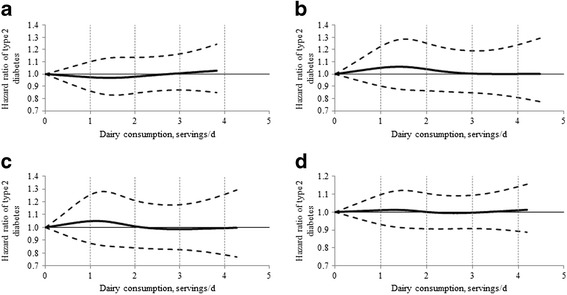
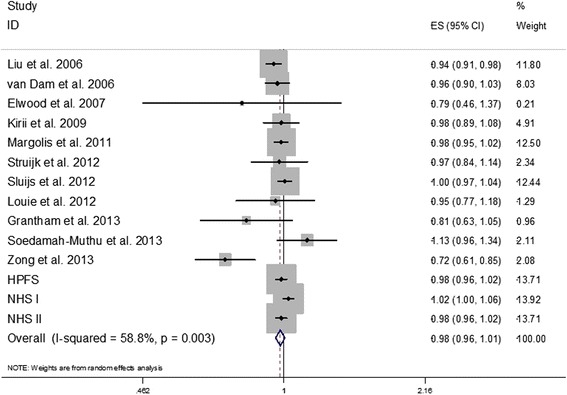
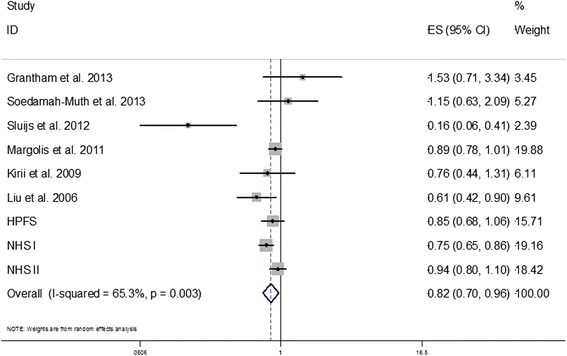
BACKGROUND: The relation between consumption of different types of dairy and risk of type 2 diabetes (T2D) remains uncertain. Therefore, we aimed to evaluate the association between total dairy and individual types of dairy consumptions and incident T2D in US adults. METHODS: We followed 41,436 men in the Health Professionals Follow-Up Study (1986 to 2010), 67,138 women in the Nurses' Health Study (1980 to 2010), and 85,884 women in the Nurses' Health Study II (1991 to 2009). Diet was assessed by validated food-frequency questionnaires, and data were updated every four years. Incident T2D was confirmed by a validated supplementary questionnaire. RESULTS: During 3,984,203 person-years of follow-up, we documented 15,156 incident T2D cases. After adjustment for age, body mass index (BMI) and other lifestyle and dietary risk factors, total dairy consumption was not associated with T2D risk and the pooled hazard ratio (HR) (95% confidence interval (CI)) of T2D for one serving/day increase in total dairy was 0.99 (0.98, 1.01). Among different types of dairy products, neither low-fat nor high-fat dairy intake was appreciably associated with risk of T2D. However, yogurt intake was consistently and inversely associated with T2D risk across the three cohorts with the pooled HR of 0.83 (0.75, 0.92) for one serving/day increment (P for trend <0.001). We conducted a meta-analysis of 14 prospective cohorts with 459,790 participants and 35,863 incident T2D cases; the pooled relative risks (RRs) (95% CIs) were 0.98 (0.96, 1.01) and 0.82 (0.70, 0.96) for one serving total dairy/day and one serving yogurt/day, respectively. CONCLUSIONS: Higher intake of yogurt is associated with a reduced risk of T2D, whereas other dairy foods and consumption of total dairy are not appreciably associated with incidence of T2D.
Overview
The claims and statistics of this paper haven’t been checked yet.
Run the check — free, no account needed. It reads the open-access text and checks the sources it cites.
Integrity signals
Registry
Cites
Statistics
Figures
Verification
Claims the paper makes
The claims and statistics of this paper haven’t been checked yet.
Run the check — free, no account needed. It reads the open-access text and checks the sources it cites.
Claims other papers make about this one
Each is checked against this paper’s own text: does it say what the citing paper says it does?
The source backs part of the claim, not all of it — or backs it for a different population, condition or comparison.
In the citing paper
“For example, yogurt and possibly some other forms of dairy, whole grains, and green leafy vegetables reduce the risk of diabetes,42–44”
From Worldwide trends in diabetes prevalence and treatment from 1990 to 2022: a pooled analysis of 1108 population-representative studies with 141 million participants (2024) · cites this paper as [42]
Experimental — accuracy not yet measuredIn the citing paper
“In longitudinal studies evaluating habitual intakes of dairy foods, relationships with CVD and diabetes do not consistently differ by fat content but appear more specific to food type: e.g., cheese, yogurt, milk, butter (Figure 6).57, 221-226”
From Dietary and Policy Priorities for Cardiovascular Disease, Diabetes, and Obesity: A Comprehensive Review (2016) · cites this paper as [226]
In the citing paper
“For example, intake of yogurt, but not milk, is consistently associated with lower incidence of diabetes; while intake of cheese, which has high calorie, fat, and saturated fat content, also associates with lower diabetes risk in several although not all studies.57, 179-184, 224, 226-228”
From Dietary and Policy Priorities for Cardiovascular Disease, Diabetes, and Obesity: A Comprehensive Review (2016) · cites this paper as [226]
In the citing paper
“In a large meta-analysis of cohort studies (13,000 incident cases), and the EPIC InterAct case-cohort study (12,000 incident cases), fermented dairy (i.e., yogurt, cheese, and thick fermented milk), but not total dairy, was inversely associated with T2DM (155,183).”
From Food Consumption and its Impact on Cardiovascular Disease: Importance of Solutions Focused on the Globalized Food System (2015) · cites this paper as [183]
Self-check
Percentages, sums and reported differences re-computed from the paper’s own numbers.
The self-check needs the paper’s full text.
Citations
Cites
Preferred Reporting Items for Systematic Reviews and Meta-Analyses: the PRISMA statement
Moher, D., Liberati, A., Tetzlaff, J., Altman, D. G., & for the PRISMA Group (2009) · BMJ · doi:10.1136/bmj.b2535 · Cited by 83,823
Preferred reporting items for systematic reviews and meta-analyses: the PRISMA Statement.
(2009) · PubMed Central · Cited by 44,859
Report of the Expert Committee on the Diagnosis and Classification of Diabetes Mellitus
The Expert Committee on the Diagnosis and Classification of Diabetes Mellitus* (2002) · Diabetes Care · doi:10.2337/diacare.25.2007.s5 · Cited by 10,325
IDF Diabetes Atlas: Global estimates for the prevalence of diabetes for 2015 and 2040
Ogurtsova, K., Fernandes, J. D. D. R., Huang, Y., Linnenkamp, U., Guariguata, L., Cho, N. H., Cavan, D. A., Shaw, J. E., & Makaroff, L. (2017) · Diabetes Research and Clinical Practice · doi:10.1016/j.diabres.2017.03.024 · Cited by 7,138
Report of the Expert Committee on the Diagnosis and Classification of Diabetes Mellitus
The Expert Committee on the Diagnosis and Classification of Diabetes Mellitus (1997) · Diabetes Care · doi:10.2337/diacare.20.7.1183 · Cited by 6,220
Sacks, F. M., Svetkey, L. P., Vollmer, W. M., Appel, L. J., Bray, G. A., Harsha, D., Obarzanek, E., Conlin, P. R., Miller, E. R., Simons-Morton, D. G., et al. (2001) · New England Journal of Medicine · doi:10.1056/nejm200101043440101 · Cited by 5,638
Classification and diagnosis of diabetes mellitus and other categories of glucose intolerance.
National Diabetes Data Group (1979) · Diabetes · doi:10.2337/diab.28.12.1039 · Cited by 4,909
Diet, nutrition and the prevention of chronic diseases
Joint, W. (2002) · Medical Entomology and Zoology · Cited by 4,890
Reproducibility and validity of a semiquantitative food frequency questionnaire
WILLETT, W. C., SAMPSON, L., STAMPFER, M. J., ROSNER, B., BAIN, C., WITSCHI, J., HENNEKENS, C. H., & SPEIZER, F. E. (1985) · American Journal of Epidemiology · doi:10.1093/oxfordjournals.aje.a114086 · Cited by 4,274
Self-citationEconomic Costs of Diabetes in the U.S. in 2002
American Diabetes Association (2003) · Diabetes Care · doi:10.2337/diacare.26.3.917 · Cited by 4,147
Cited by
Sorted by citations
Food in the Anthropocene: the EAT–Lancet Commission on healthy diets from sustainable food systems
Willett, W., Rockström, J., Loken, B., Springmann, M., Lang, T., Vermeulen, S., Garnett, T., Tilman, D., DeClerck, F., Wood, A., et al. (2019) · The Lancet · doi:10.1016/s0140-6736(18)31788-4 · Cited by 10,880
Self-citationMozaffarian, D. (2016) · Circulation · doi:10.1161/circulationaha.115.018585 · Cited by 2,216
Self-citationYou are what you eat: Diet, health and the gut microbiota
Zmora, N., Suez, J., & Elinav, E. (2019) · Nature Reviews Gastroenterology & Hepatology · doi:10.1038/s41575-018-0061-2 · Cited by 1,792
Health benefits of fermented foods: Microbiota and beyond
Marco, M. L., Heeney, D., Binda, S., Cifelli, C. J., Cotter, P. D., Foligné, B., Gänzle, M., Kort, R., Pasin, G., Pihlanto, A., et al. (2017) · Current Opinion in Biotechnology · doi:10.1016/j.copbio.2016.11.010 · Cited by 1,674
Satija, A., Bhupathiraju, S. N., Rimm, E. B., Spiegelman, D., Chiuve, S. E., Borgi, L., Willett, W. C., Manson, J. E., Sun, Q., & Hu, F. B. (2016) · PLOS Medicine · doi:10.1371/journal.pmed.1002039 · Cited by 1,069
Self-citation
Metadata
- Authors
- Chen, M., Sun, Q., Giovannucci, E., Mozaffarian, D., Manson, J. E., Willett, W. C., & Hu, F. B.
- Affiliations
- Harvard University (US)
- Brigham and Women's Hospital (US)
- Corresponding author
- Hu, Frank B
- ORCID
- Venue
- BMC Medicine
- Published
- 2014-11-25
- Volume
- 12
- Issue
- 1
- Pages
- 215-215
- ISSN
- 1741-7015 (ISSN-L)
- PMC
- PMC4243376
- OpenAlex
- W2153923696
- Cited by
- 370
- References
- 55
- Citations by year
- 2026: 16 · 2025: 18 · 2024: 21 · 2023: 28 · 2022: 27 · 2021: 28 · 2020: 43 · 2019: 46 · 2018: 31 · 2017: 49 · 2016: 39 · 2015: 21 · 2014: 2
- FWCI
- 36.82
- Type
- journal article
- Language
- en
- Open access
- gold
- doi.org
- Locations
- BMC Medicine (publishedVersion, cc-by)
- Europe PMC (PubMed Central) (publishedVersion, cc-by)
- PubMed Central (publishedVersion, cc-by)
- PubMed (publishedVersion)
- Digital Access to Scholarship at Harvard (DASH) (Harvard University) (submittedVersion, cc-by)
- Funders
- National Heart, Lung, and Blood Institute (R01HL060712, R00HL098459, R01HL034594)
- National Cancer Institute (P01CA087969, P01CA055075)
- National Institute of Diabetes and Digestive and Kidney Diseases (R01DK058845)
- Topics
- Health Sciences › Medicine › Public Health, Environmental and Occupational Health › Nutritional Studies and Diet
- Life Sciences › Agricultural and Biological Sciences › Food Science › Probiotics and Fermented Foods
- Life Sciences › Biochemistry, Genetics and Molecular Biology › Genetics › Nutrition, Genetics, and Disease
- Keywords
- dairy consumption, type 2 diabetes, yogurt, low-fat dairy, high-fat dairy, incident diabetes risk, dietary risk factors, Health Professionals Follow-up Study, Nurses' Health Study, Nurses' Health Study II
- MeSH terms
- Adult, Dairy Products, Diabetes Mellitus, Type 2, Diet, Feeding Behavior, Female, Humans, Male, Middle Aged, Surveys and Questionnaires, Risk Factors, United States, Yogurt, Cohort Studies, Incidence
About these checks
Registry, retraction, Cites and statistics results are computed, not judged, with one exception: a printed reference that no index lists is read once by a model before it counts as a citation error. Claims are extracted by a model and kept only when their quote appears verbatim in the text; each cited source is then checked, with a model’s help, for whether it says what the claim relies on. Those verdicts can be wrong — read the claim’s quote and the cited source before relying on one.
Statistics and arithmetic are recomputed, not judged.
Confidence bands are shown only for fields calibrated on our annotated test set. None is calibrated yet, so no band is shown.
What counts as a claim ›How we measure confidence ›How we check this ›
Are you an author, or do you see a problem with this page? Request a review
