

The DOI matches its Crossref record; 42 of the 42 references it cites were found in a registry or an index.
Sulphadoxine-pyrimethamine plus azithromycin for the prevention of low birthweight in Papua New Guinea: a randomised controlled trial
Open accessAbstract
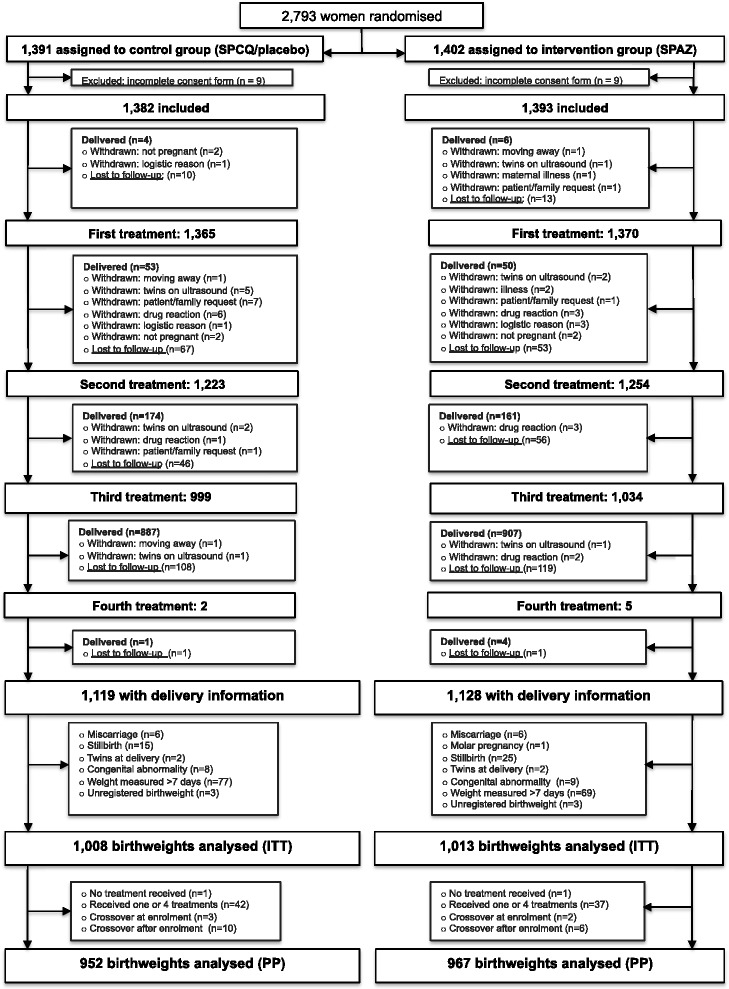
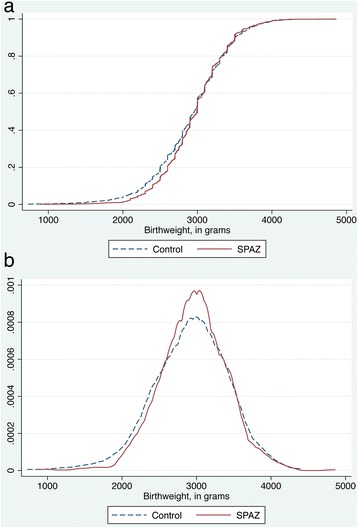
BACKGROUND: Intermittent preventive treatment in pregnancy has not been evaluated outside of Africa. Low birthweight (LBW, <2,500 g) is common in Papua New Guinea (PNG) and contributing factors include malaria and reproductive tract infections. METHODS: From November 2009 to February 2013, we conducted a parallel group, randomised controlled trial in pregnant women (≤ 26 gestational weeks) in PNG. Sulphadoxine-pyrimethamine (1,500/75 mg) plus azithromycin (1 g twice daily for 2 days) (SPAZ) monthly from second trimester (intervention) was compared against sulphadoxine-pyrimethamine and chloroquine (450 to 600 mg, daily for three days) (SPCQ) given once, followed by SPCQ placebo (control). Women were assigned to treatment (1:1) using a randomisation sequence with block sizes of 32. Participants were blinded to assignments. The primary outcome was LBW. Analysis was by intention-to-treat. RESULTS: Of 2,793 women randomised, 2,021 (72.4%) were included in the primary outcome analysis (SPCQ: 1,008; SPAZ: 1,013). The prevalence of LBW was 15.1% (305/2,021). SPAZ reduced LBW (risk ratio [RR]: 0.74, 95% CI: 0.60-0.91, P = 0.005; absolute risk reduction (ARR): 4.5%, 95% CI: 1.4-7.6; number needed to treat: 22), and preterm delivery (0.62, 95% CI: 0.43-0.89, P = 0.010), and increased mean birthweight (41.9 g, 95% CI: 0.2-83.6, P = 0.049). SPAZ reduced maternal parasitaemia (RR: 0.57, 95% CI: 0.35-0.95, P = 0.029) and active placental malaria (0.68, 95% CI: 0.47-0.98, P = 0.037), and reduced carriage of gonorrhoea (0.66, 95% CI: 0.44-0.99, P = 0.041) at second visit. There were no treatment-related serious adverse events (SAEs), and the number of SAEs (intervention 13.1% [181/1,378], control 12.7% [174/1,374], P = 0.712) and AEs (intervention 10.5% [144/1,378], control 10.8% [149/1,374], P = 0.737) was similar. A major limitation of the study was the high loss to follow-up for birthweight. CONCLUSIONS: SPAZ was efficacious and safe in reducing LBW, possibly acting through multiple mechanisms including the effect on malaria and on sexually transmitted infections. The efficacy of SPAZ in the presence of resistant parasites and the contribution of AZ to bacterial antibiotic resistance require further study. The ability of SPAZ to improve pregnancy outcomes warrants further evaluation. TRIAL REGISTRATION: ClinicalTrials.gov NCT01136850 (06 April 2010).
Overview
The claims and statistics of this paper haven’t been checked yet.
Run the check — free, no account needed. It reads the open-access text and checks the sources it cites.
Integrity signals
Registry
Cites
Statistics
Figures
Verification
Claims the paper makes
The claims and statistics of this paper haven’t been checked yet.
Run the check — free, no account needed. It reads the open-access text and checks the sources it cites.
Claims other papers make about this one
Each is checked against this paper’s own text: does it say what the citing paper says it does?
In the citing paper
“A sample size calculation was performed for the original trial but not for the purpose of the present sub-analysis [26].”
In the citing paper
“Second, malarial infection is a well-established risk factor for gestational anaemia [1], and preliminary data from the parent trial indicates the same [46].”
Self-check
Percentages, sums and reported differences re-computed from the paper’s own numbers.
The self-check needs the paper’s full text.
Citations
Cites
Multiple Imputation for Nonresponse in Surveys
Rubin, D. B. (1987) · Wiley Series in Probability and Statistics · doi:10.1002/9780470316696 · Cited by 20,701
A Modified Poisson Regression Approach to Prospective Studies with Binary Data
Zou, G. (2004) · American Journal of Epidemiology · doi:10.1093/aje/kwh090 · Cited by 9,920
Epidemiology and burden of malaria in pregnancy
Desai, M., ter Kuile, F. O., Nosten, F., McGready, R., Asamoa, K., Brabin, B., & Newman, R. D. (2007) · The Lancet Infectious Diseases · doi:10.1016/s1473-3099(07)70021-x · Cited by 1,432
Estimating fetal age: computer-assisted analysis of multiple fetal growth parameters.
Hadlock, F. P., Deter, R. L., Harrist, R. B., & Park, S. K. (1984) · Radiology · doi:10.1148/radiology.152.2.6739822 · Cited by 561
Quantifying the Number of Pregnancies at Risk of Malaria in 2007: A Demographic Study
Dellicour, S., Tatem, A. J., Guerra, C. A., Snow, R. W., & ter Kuile, F. O. (2010) · PLoS Medicine · doi:10.1371/journal.pmed.1000221 · Cited by 490
Impact of malaria during pregnancy on low birth weight in sub-Saharan Africa
Guyatt, H. L., & Snow, R. W. (2004) · Clinical Microbiology Reviews · doi:10.1128/cmr.17.4.760-769.2004 · Cited by 458
National Department of Health.
Whery, W. P. (1907) · JAMA · doi:10.1001/jama.1907.02520300070016 · Cited by 392
The Sick Placenta—The Role of Malaria
Brabin, B. J., Romagosa, C., Abdelgalil, S., Menéndez, C., Verhoeff, F. H., McGready, R. M., Fletcher, K. A., Owens, S., d'Alessandro, U., Nosten, F. H., et al. (2004) · Placenta · doi:10.1016/j.placenta.2003.10.019 · Cited by 382
Placental pathology in malaria: A histological, immunohistochemical, and quantitative study
Ismail, M. R., Ordi, J., Menendez, C., Ventura, P. J., Aponte, J. J., Kahigwa, E., Hirt, R., Cardesa, A., & Alonso, P. L. (2000) · Human Pathology · doi:10.1016/s0046-8177(00)80203-8 · Cited by 328
Zarogoulidis, P., Παπάνας, Ν., Kioumis, I. P., Chatzaki, Ε., Maltezos, E. S., & Zarogoulidis, K. (2011) · European Journal of Clinical Pharmacology · doi:10.1007/s00228-011-1161-x · Cited by 298
Research works printed but not linked: 2
- World Health Organization. WHO policy brief for the implementation of intermittent preventive treatment in malaria in pregnancy using sulfadoxine-pyrimethamine (IPTp-SP) (January 2014). Geneva: World Health Organization; 2014.
- National Competency Training Project. Malaria diagnosis and the new treatment protocol: a training manual for health workers in Papua New Guinea. Port Moresby: Birdwing Publishing; 2010.
Cited by
Sorted by citations
Chlamydia, gonorrhoea, trichomoniasis and syphilis: global prevalence and incidence estimates, 2016
Rowley, J., Vander Hoorn, S., Korenromp, E., Low, N., Unemo, M., Abu-Raddad, L. J., Chico, R. M., Smolak, A., Newman, L., Gottlieb, S., et al. (2019) · Bulletin of the World Health Organization · doi:10.2471/blt.18.228486 · Cited by 1,665
Prevention of malaria in pregnancy
Desai, M., Hill, J., Fernandes, S., Walker, P., Pell, C., Gutman, J., Kayentao, K., Gonzalez, R., Webster, J., Greenwood, B., et al. (2018) · The Lancet Infectious Diseases · doi:10.1016/s1473-3099(18)30064-1 · Cited by 153
Davey, D. J., Shull, H., Billings, J., Wang, D., Adachi, K., & Klausner, J. (2016) · Sexually Transmitted Diseases · doi:10.1097/olq.0000000000000460 · Cited by 125
Adachi, K., Nielsen-Saines, K., & Klausner, J. D. (2016) · BioMed Research International · doi:10.1155/2016/9315757 · Cited by 118
Wilson, D. W., Goodman, C. D., Sleebs, B. E., Weiss, G. E., de Jong, N. W. M., Angrisano, F., Langer, C., Baum, J., Crabb, B. S., Gilson, P. R., et al. (2015) · BMC Biology · doi:10.1186/s12915-015-0162-0 · Cited by 95
Metadata
- Authors
- Unger, H. W., Ome-Kaius, M., Wangnapi, R. A., Umbers, A. J., Hanieh, S., Suen, C. S. L. W., Robinson, L. J., Rosanas-Urgell, A., Wapling, J., Lufele, E., Kongs, C., Samol, P., Sui, D., Singirok, D., Bardaji, A., Schofield, L., Menendez, C., Betuela, I., Siba, P., Mueller, I., & Rogerson, S. J.
- Affiliations
- The Royal Melbourne Hospital (AU)
- Papua New Guinea Institute of Medical Research (PG)
- Walter and Eliza Hall Institute of Medical Research (AU)
- Corresponding author
- Rogerson, Stephen J
- Venue
- BMC Medicine
- Published
- 2015-01-16
- Volume
- 13
- Issue
- 1
- Pages
- 9-9
- ISSN
- 1741-7015 (ISSN-L)
- PMC
- PMC4305224
- OpenAlex
- W1999835984
- Cited by
- 102
- References
- 42
- Citations by year
- 2026: 5 · 2025: 11 · 2024: 5 · 2023: 11 · 2022: 8 · 2021: 12 · 2020: 8 · 2019: 10 · 2018: 5 · 2017: 5 · 2016: 10 · 2015: 12
- FWCI
- 11.44
- Type
- journal article
- Language
- en
- Open access
- gold
- doi.org
- Locations
- BMC Medicine (publishedVersion, cc-by)
- Europe PMC (PubMed Central) (publishedVersion, cc-by)
- PubMed Central (publishedVersion, cc-by)
- PubMed (publishedVersion)
- ResearchOnline - JCU (James Cook University) (submittedVersion)
- Minerva Access (University of Melbourne) (submittedVersion, cc-by)
- Funders
- Bill and Melinda Gates Foundation (46099)
- Pfizer
- European Commission (201588)
- Medical Research Council
- National Health and Medical Research Council
- Topics
- Health Sciences › Medicine › Public Health, Environmental and Occupational Health › Malaria Research and Control
- Health Sciences › Medicine › Pediatrics, Perinatology and Child Health › Global Maternal and Child Health
- Health Sciences › Medicine › Pediatrics, Perinatology and Child Health › Maternal and Neonatal Healthcare
- Keywords
- sulfadoxine-pyrimethamine, azithromycin, intermittent preventive treatment in pregnancy, low birth weight, preterm birth, placental malaria, reproductive tract infections, malaria in pregnancy, chloroquine, Papua New Guinea, maternal health interventions, neonatal mortality reduction
- MeSH terms
- Adult, Antimalarials, Chloroquine, Drug Combinations, Female, Humans, Infant, Low Birth Weight, Infant, Newborn, Malaria, Papua New Guinea, Pregnancy, Pyrimethamine, Sulfadoxine, Pregnancy Complications, Parasitic, Single-Blind Method, Azithromycin, Young Adult
About these checks
Registry, retraction, Cites and statistics results are computed, not judged, with one exception: a printed reference that no index lists is read once by a model before it counts as a citation error. Claims are extracted by a model and kept only when their quote appears verbatim in the text; each cited source is then checked, with a model’s help, for whether it says what the claim relies on. Those verdicts can be wrong — read the claim’s quote and the cited source before relying on one.
Statistics and arithmetic are recomputed, not judged.
Confidence bands are shown only for fields calibrated on our annotated test set. None is calibrated yet, so no band is shown.
What counts as a claim ›How we measure confidence ›How we check this ›
Are you an author, or do you see a problem with this page? Request a review
