

The DOI matches its Crossref record; 56 of the 56 references it cites were found in a registry or an index.
The evolution of mobile apps for asthma: an updated systematic assessment of content and tools
Open accessAbstract
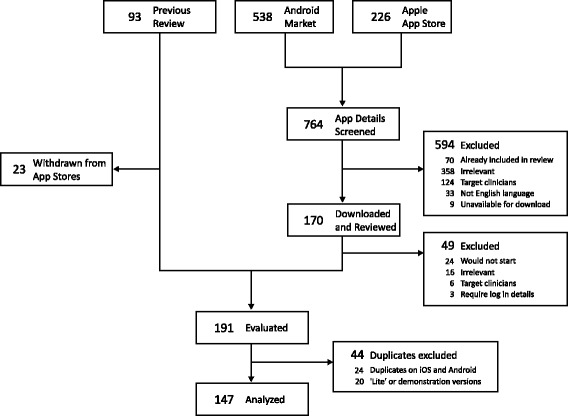
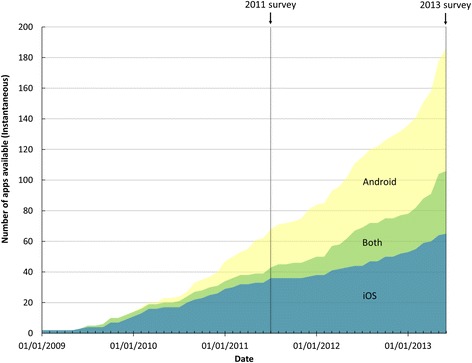
BACKGROUND: Interest in mobile apps that support long-term conditions such as asthma is matched by recognition of the importance of the quality and safety of apps intended for patient use. We assessed how changes over a 2-year period affected the clinical suitability of apps providing self-management information and tools for people with asthma by updating a review first performed in 2011. METHODS: Systematic content assessment of all apps for iOS and Android examining the comprehensiveness of asthma information, consistency with the evidence base for asthma self-management and adherence to best practice principles for trustworthy content, comparing the quality of apps available in 2011 to those released since. RESULTS: Between 2011 and 2013, numbers of asthma apps more than doubled from 93 to 191, despite withdrawal of 25% (n = 23/93) of existing apps. Newer apps were no more likely than those available in 2011 to include comprehensive information, such as the use of action plans, or offer guidance consistent with evidence; 13% (n = 19/147) of all apps, and 39% (n = 9/23) of those intended to manage acute asthma, recommended self-care procedures unsupported by evidence. Despite increases in the numbers of apps targeting specific skills, such as acute asthma management (n = 12 to 23) and inhaler technique (from n = 2 to 12), the proportion consistent with guidelines (17%, n = 4/23) and inhaler instructions (25%, n = 3/12), respectively, was low, and most apps provided only either basic information about asthma (50%, n = 75/147) or simple diary functions (24%, n = 36/147). CONCLUSIONS: In addition to persisting questions about clinical quality and safety, dynamic aspects of app turnover and feature evolution affect the suitability of asthma apps for use in routine care. The findings underline the need for coordinated quality assurance processes that can adapt to changing clinical and information governance-related risks, ensure compliance with the evidence base and reflect local variations in clinical practice. It is unclear if substantial clinical benefits can be realized from a landscape dominated by low quality generic information apps and tools that do not adhere to accepted medical practice.
Overview
The claims and statistics of this paper haven’t been checked yet.
Run the check — free, no account needed. It reads the open-access text and checks the sources it cites.
Integrity signals
Registry
Cites
Statistics
Figures
Verification
Claims the paper makes
The claims and statistics of this paper haven’t been checked yet.
Run the check — free, no account needed. It reads the open-access text and checks the sources it cites.
Claims other papers make about this one
Each is checked against this paper’s own text: does it say what the citing paper says it does?
In the citing paper
“Although these mobile health apps offer a range of features (eg, automated personalized texts, interactive websites, and online modules) to inform patients about asthma, they have not included scalable text-based health care conversational agents to support communication with health care professionals.”
Self-check
Percentages, sums and reported differences re-computed from the paper’s own numbers.
The self-check needs the paper’s full text.
Citations
Cites
A Simple Sequentially Rejective Multiple Test Procedure
(1979) · Scandinavian Journal of Statistics · doi:10.2307/4615733 · Cited by 21,526
GLOBAL STRATEGY FOR ASTHMA MANAGEMENT AND PREVENTION
PAUWELS, R. A. (1996) · Arerugī/Arerugi · doi:10.15036/arerugi.45.792 · Cited by 9,997
Michie, S., Richardson, M., Johnston, M., Abraham, C., Francis, J., Hardeman, W., Eccles, M. P., Cane, J., & Wood, C. E. (2013) · Annals of Behavioral Medicine · doi:10.1007/s12160-013-9486-6 · Cited by 7,629
Expert Panel Report 2: Guidelines for the Diagnosis and Management of Asthma
Program, P., & theDiagnosis, T. E. P. O. (1997) · Cited by 4,082
Patient Self-management of Chronic Disease in Primary Care
Bodenheimer, T. (2002) · JAMA · doi:10.1001/jama.288.19.2469 · Cited by 3,598 · cited 1×
“Secondly, although it is recognized that information provision alone has a limited impact on health behaviour [52], the proportion of apps combining information and tools remains small.”
BackgroundThe global burden of asthma: executive summary of the GINA Dissemination Committee Report
Masoli, M., Fabian, D., Holt, S., Beasley, R. W., & Program, G. I. F. A. (. (2004) · Allergy · doi:10.1111/j.1398-9995.2004.00526.x · Cited by 3,521
On the Interpretation of χ 2 from Contingency Tables, and the Calculation of P
Fisher, R. A. (1922) · Journal Of The Royal Statistical Society · doi:10.2307/2340521 · Cited by 2,975
A review of wearable sensors and systems with application in rehabilitation
Patel, S., Park, H., Bonato, P., Chan, L., & Rodgers, M. (2012) · Journal of NeuroEngineering and Rehabilitation · doi:10.1186/1743-0003-9-21 · Cited by 2,396
British Guideline on the Management of Asthma
British Thoracic Society Scottish Intercollegiate Guidelines Network (2008) · Thorax · doi:10.1136/thx.2008.097741 · Cited by 2,023
Healthcare in the pocket: Mapping the space of mobile-phone health interventions
Klasnja, P., & Pratt, W. (2012) · Journal of Biomedical Informatics · doi:10.1016/j.jbi.2011.08.017 · Cited by 970
Research works printed but not linked: 8
- Aitken M, Gauntlett C. Patient apps for improved healthcare – from novelty to mainstream. Parsippany, NJ: IMS Institute for Healthcare Informatics; 2013.
- Digitas Health. mBook 2013 edition – marketing mobile health. 2013. http://m.2013.digitashealth.com/Mbook2013_web.pdf .
- England NHS. Five year forward view. London: HM Government; 2014.
- Alliance ECD. Green paper on mHealth apps – input from the European Chronic Disease Alliance (ECDA). Brussels: ECDA; 2014.
- Food US, Administration D. Mobile medical applications – guidance for industry and food and drug administration staff. US Department of Health and Human Services: Rockville, MD; 2013.
- Ferrero-Alvarez-Rementeria J, Santana-Lopez V, Escobar-Ubreva A, Vazquez-Vazquez M. Quality and safety strategy for mobile health applications: a certification programme. Eur J ePractice. 2013;21:14–26.
- Health on the Net Foundation. Operational definition of the HONcode principles. Guidelines v2.0. http://www.hon.ch/HONcode/Guidelines/guidelines.html#Review .
- Food US, Administration D. Appendix A – examples of mobile apps that are not medical devices. Mobile Medical Applications – Guidance for Industry and Food and Drug Administration Staff. Rockville, MD: US Department of Health and Human Services; 2013.
Cited by
Sorted by citations
Using science to sell apps: Evaluation of mental health app store quality claims
Larsen, M. E., Huckvale, K., Nicholas, J., Torous, J., Birrell, L., Li, E., & Reda, B. (2019) · npj Digital Medicine · doi:10.1038/s41746-019-0093-1 · Cited by 334
Self-citationAkbar, S., Coiera, E. W., & Magrabi, F. (2019) · Journal of the American Medical Informatics Association · doi:10.1093/jamia/ocz175 · Cited by 246
Criteria for assessing the quality of mHealth apps: a systematic review
Nouri, R., R Niakan Kalhori, S., Ghazisaeedi, M., Marchand, G., & Yasini, M. (2018) · Journal of the American Medical Informatics Association · doi:10.1093/jamia/ocy050 · Cited by 231
Quantifying App Store Dynamics: Longitudinal Tracking of Mental Health Apps
Larsen, M. E., Nicholas, J., & Christensen, H. (2016) · JMIR mHealth and uHealth · doi:10.2196/mhealth.6020 · Cited by 177
eHealth in the future of medications management: personalisation, monitoring and adherence
Car, J., Tan, W. S., Huang, Z., Sloot, P., & Franklin, B. D. (2017) · BMC Medicine · doi:10.1186/s12916-017-0838-0 · Cited by 179
Self-citation
Metadata
- Authors
- Huckvale, K., Morrison, C., Ouyang, J., Ghaghda, A., & Car, J.
- Affiliations
- Imperial College London (GB)
- Nanyang Technological University (SG)
- Corresponding author
- Huckvale, Kit
- Car, Josip
- Venue
- BMC Medicine
- Published
- 2015-03-23
- Volume
- 13
- Issue
- 1
- Pages
- 58-58
- ISSN
- 1741-7015 (ISSN-L)
- PMC
- PMC4391129
- OpenAlex
- W2150664025
- Cited by
- 166
- References
- 56
- Citations by year
- 2025: 2 · 2024: 7 · 2023: 12 · 2022: 7 · 2021: 10 · 2020: 19 · 2019: 25 · 2018: 31 · 2017: 23 · 2016: 23 · 2015: 7
- FWCI
- 51.19
- Type
- journal article
- Language
- en
- Open access
- gold
- doi.org
- Locations
- BMC Medicine (publishedVersion, cc-by)
- PubMed Central (publishedVersion, cc-by)
- PubMed (publishedVersion)
- DR-NTU (Nanyang Technological University) (submittedVersion, cc-by)
- Minerva Access (University of Melbourne) (submittedVersion, cc-by)
- Funders
- National Institute for Health and Care Research
- Topics
- Health Sciences › Health Professions › General Health Professions › Mobile Health and mHealth Applications
- Social Sciences › Psychology › Applied Psychology › Digital Mental Health Interventions
- Health Sciences › Medicine › Pulmonary and Respiratory Medicine › Asthma and respiratory diseases
- Keywords
- asthma, mobile health apps, asthma self-management, app quality, evidence-based recommendations, inhaler technique, action plan, acute asthma management, quality assurance, patient information tools
- MeSH terms
- Asthma, Humans, Self Care, Cell Phone, Mobile Applications
About these checks
Registry, retraction, Cites and statistics results are computed, not judged, with one exception: a printed reference that no index lists is read once by a model before it counts as a citation error. Claims are extracted by a model and kept only when their quote appears verbatim in the text; each cited source is then checked, with a model’s help, for whether it says what the claim relies on. Those verdicts can be wrong — read the claim’s quote and the cited source before relying on one.
Statistics and arithmetic are recomputed, not judged.
Confidence bands are shown only for fields calibrated on our annotated test set. None is calibrated yet, so no band is shown.
What counts as a claim ›How we measure confidence ›How we check this ›
Are you an author, or do you see a problem with this page? Request a review
