

Treatment of idiopathic pulmonary fibrosis: a network meta-analysis
Open accessThe DOI matches its Crossref record; 40 of the 40 references it cites were found in a registry or an index.
Abstract
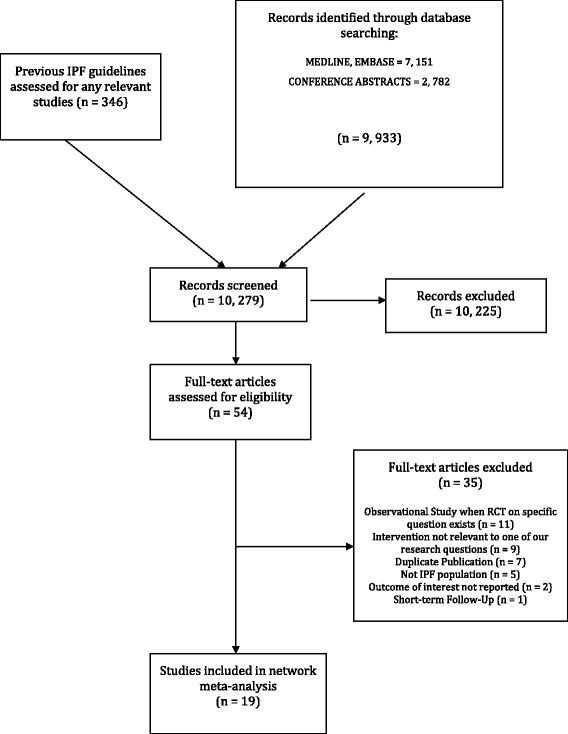
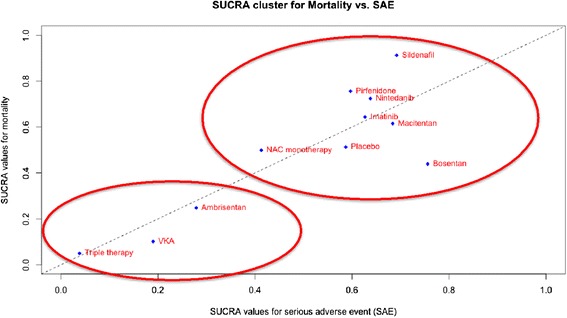
BACKGROUND: Idiopathic pulmonary fibrosis (IPF) is an interstitial lung disease associated with high morbidity and mortality. Effective treatments for IPF are limited. Several recent studies have investigated novel therapeutic agents for IPF, but very few have addressed their comparative benefits and harms. METHODS: We performed a Bayesian network meta-analysis (NMA) to assess the effects of different treatments for IPF on mortality and serious adverse events (SAEs). We searched MEDLINE and EMBASE for randomized controlled trials (RCTs) up to August 2015. The Grading of Recommendations Assessment, Development and Evaluation (GRADE) approach served to assess the certainty in the evidence of direct and indirect estimates. We calculated the surface under the cumulative ranking curve (SUCRA) for each treatment. We included parallel group RCTs, including factorial designs, but excluded quasi-randomized and cross-over trials. Studies were only included if they involved adult (≥18 years of age) patients with IPF as defined by the 2011 criteria and examined one of the 10 interventions of interest (ambrisentan, bosentan, imatinib, macitentan, N-acetylcysteine, nintedanib, pirfenidone, sildenafil, prednisone/azathioprine/N-acetylcysteine triple therapy, and vitamin K antagonist). RESULTS: A total of 19 RCTs (5,694 patients) comparing 10 different interventions with placebo and an average follow-up period of 1 year fulfilled the inclusion criteria. SUCRA analysis suggests nintedanib, pirfenidone, and sildenafil are the three treatments with the highest probability of reducing mortality in IPF. Indirect comparison showed no significant difference in mortality between pirfenidone and nintedanib (NMA OR, 1.05; 95% CrI, 0.45-2.78, moderate certainty of evidence), pirenidone and sildenafil (NMA OR, 2.26; 95% CrI, 0.44-13.17, low certainty of evidence), or nintedanib and sildenafil (NMA OR 2.40; 95% CrI, 0.47-14.66, low certainty of evidence). Sildenafil, pirfenidone, and nintedanib were ranked second, fourth, and sixth out of 10 for SAEs. CONCLUSION: In the absence of direct comparisons between treatment interventions, this NMA suggests that treatment with nintedanib, pirfenidone, and sildenafil extends survival in patients with IPF. The SAEs of these agents are similar to the other interventions and include mostly dermatologic and gastrointestinal manifestations. Head-to-head comparisons need to confirm these findings.
Overview
The claims and statistics of this paper haven’t been checked yet.
Free: it reads the open-access text and checks the first 5 claims that cite a source we can check. Create a free account to check every claim.
Integrity signals
Registry
Cites
Statistics
Figures
Verification
Claims the paper makes
The claims and statistics of this paper haven’t been checked yet.
Free: it reads the open-access text and checks the first 5 claims that cite a source we can check. Create a free account to check every claim.
Claims other papers make about this one
Each is checked against this paper’s own text: does it say what the citing paper says it does?
The source backs part of the claim, not all of it — or backs it for a different population, condition or comparison.
In the citing paper
“The antifibrotic treatments pirfenidone and nintedanib have been shown to slow disease progression as measured by annual rate of decline in forced vital capacity (FVC) [2]”
From Survival and course of lung function in the presence or absence of antifibrotic treatment in patients with idiopathic pulmonary fibrosis: long-term results of the INSIGHTS-IPF registry (2020) · cites this paper as [2]
Experimental — accuracy not yet measured
Self-check
Percentages, sums and reported differences re-computed from the paper’s own numbers.
The self-check needs the paper’s full text.
Citations
Cites
Quantifying heterogeneity in a meta‐analysis
Higgins, J. P. T., & Thompson, S. G. (2002) · Statistics in Medicine · doi:10.1002/sim.1186 · Cited by 36,763 · cited 1×
“Heterogeneity in treatment effects was evaluated by estimating the variance between studies, and through Cochrane Q-test and I [13–15] when at least two studies were available for each pairwise comparison.”
MethodThe Cochrane Collaboration's tool for assessing risk of bias in randomised trials
Higgins, J. P. T., Altman, D. G., Gotzsche, P. C., Juni, P., Moher, D., Oxman, A. D., Savovic, J., Schulz, K. F., Weeks, L., Sterne, J. A. C., et al. (2011) · BMJ · doi:10.1136/bmj.d5928 · Cited by 33,817
Dermyshi, E., Wang, Y., Yan, C., Hong, W., Qiu, G., Gong, X., & Zhang, T. (2017) · Neonatology · doi:10.1159/000454668 · Cited by 24,451
Inference from iterative simulation using multiple sequences
Gelman, A., & Rubin, D. B. (1992) · Statistical Science · doi:10.1214/ss/1177011136 · Cited by 16,627
Raghu, G., Collard, H. R., Egan, J. J., Martinez, F. J., Behr, J., Brown, K. K., Colby, T. V., Cordier, J.-F., Flaherty, K. R., Lasky, J. A., et al. (2011) · American Journal of Respiratory and Critical Care Medicine · doi:10.1164/rccm.2009-040gl · Cited by 7,186
Self-citationEfficacy and Safety of Nintedanib in Idiopathic Pulmonary Fibrosis
Richeldi, L., du Bois, R. M., Raghu, G., Azuma, A., Brown, K. K., Costabel, U., Cottin, V., Flaherty, K. R., Hansell, D. M., Inoue, Y., et al. (2014) · New England Journal of Medicine · doi:10.1056/nejmoa1402584 · Cited by 4,654
Self-citationA phase 3 trial of pirfenidone in patients with idiopathic pulmonary fibrosis.
King, T. E., Bradford, W. Z., Castro-Bernardini, S., Fagan, E. A., Glaspole, I., Glassberg, M. K., Gorina, E., Hopkins, P. M., Kardatzke, D., Lancaster, L., et al. (2014) · New England Journal of Medicine · doi:10.1056/nejmoa1402582 · Cited by 3,975
Salanti, G., Ades, A. E., & Ioannidis, J. P. A. (2011) · Journal of Clinical Epidemiology · doi:10.1016/j.jclinepi.2010.03.016 · Cited by 3,766 · cited 1×
“Goodness-of-fit was evaluated using the mean residual deviance and the surface under the cumulative ranking curve (SUCRA) was employed to rank the treatments [18].”
MethodPirfenidone in patients with idiopathic pulmonary fibrosis (CAPACITY): two randomised trials
Noble, P. W., Albera, C., Bradford, W. Z., Costabel, U., Glassberg, M. K., Kardatzke, D., King, T. E., Lancaster, L., Sahn, S. A., Szwarcberg, J., et al. (2011) · The Lancet · doi:10.1016/s0140-6736(11)60405-4 · Cited by 2,154 · cited 1×
“CAPACITY 2011 [28] Multicenter (110) Worldwide n = 692 Yes FVC >50 % predicted DLCO >35 % predicted Pirfenidone 24 months Low Pirfenidone 27/345 Placebo 34/347 113/345 109/347 Intermune Rchw rg et a.”
BackgroundRaghu, G., Rochwerg, B., Zhang, Y., Garcia, C. A. C., Azuma, A., Behr, J., Brozek, J. L., Collard, H. R., Cunningham, W., Homma, S., et al. (2015) · American Journal of Respiratory and Critical Care Medicine · doi:10.1164/rccm.201506-1063st · Cited by 1,916
Self-citation
Cited by
Items 101–102 of 102
Yin, Y., Wu, X., Liu, Z., Luo, Y., Jing, M., Jing, K., Li, Q., Wang, F., & Huang, J. (2026) · Frontiers in Pharmacology · doi:10.3389/fphar.2026.1761899 · Cited by 1
“…multiple treatment options, and although network meta-analyses have attempted to compare their effectiveness in slowing lung function decline, these analyses did not include all drugs and focused only on a single indicator—FVC (Canestaro et al., 2016; Rochwerg et al., 2016; Pitre et al., 2022).”
Circulating miR-378a-3p attenuates pulmonary inflammation and fibrosis via BAT-lung crosstalk
He, R., Peng, X., Pan, R., Kang, Q., Liu, S., Yang, M., Wang, Z., Deng, H., Li, D., Xie, Y., et al. (2026) · Journal of Nanobiotechnology · doi:10.1186/s12951-026-04296-3
“[6] Although the nintedanib and pirfenidone have been approved for the treatment of PF, [7] they fail to stop the disease progression of PF, [8, 9] underscoring the need for new targets and modalities.”
Metadata
- Authors
- Rochwerg, B., Neupane, B., Zhang, Y., Garcia, C. C., Raghu, G., Richeldi, L., Brozek, J., Beyene, J., & Schünemann, H.
- Affiliations
- McMaster University (CA)
- University of Washington (US)
- National Institute for Health and Care Research (GB)
- Corresponding author
- Rochwerg, Bram
- Venue
- BMC Medicine
- Published
- 2016-02-03
- Volume
- 14
- Issue
- 1
- Pages
- 18-18
- ISSN
- 1741-7015 (ISSN-L)
- PMC
- PMC4741055
- OpenAlex
- W2267642110
- Semantic Scholar
- 19774467f2249f48395d7b9a575d944d3d4efd1c
- Cited by
- 101
- References
- 40
- Citations by year
- 2026: 2 · 2025: 6 · 2024: 4 · 2023: 6 · 2022: 10 · 2021: 14 · 2020: 20 · 2019: 6 · 2018: 11 · 2017: 19 · 2016: 3
- FWCI
- 11.63
- Type
- journal article
- Language
- en
- Open access
- gold
- doi.org
- Licence
- cc-by
- Locations
- BMC Medicine (publishedVersion, cc-by)
- PubMed Central (publishedVersion, cc-by)
- PubMed (publishedVersion)
- ePrints Soton (University of Southampton) (submittedVersion)
- Topics
- Health Sciences › Medicine › Pulmonary and Respiratory Medicine › Interstitial Lung Diseases and Idiopathic Pulmonary Fibrosis
- Health Sciences › Medicine › Pulmonary and Respiratory Medicine › Pulmonary Hypertension Research and Treatments
- Health Sciences › Medicine › Pulmonary and Respiratory Medicine › Occupational and environmental lung diseases
- Keywords
- idiopathic pulmonary fibrosis, interstitial lung disease, mortality, serious adverse events, nintedanib, pirfenidone, sildenafil, imatinib, macitentan, bosentan, ambrisentan, N-acetylcysteine, vitamin K antagonists, antifibrotic therapy, treatment comparison, indirect comparison, prednisone
- MeSH terms
- Acetylcysteine, Adult, Anticoagulants, Bayes Theorem, Female, Humans, Immunosuppressive Agents, Indoles, Male, Middle Aged, Pyridones, Quality of Life, Free Radical Scavengers, Treatment Outcome, Idiopathic Pulmonary Fibrosis, Young Adult
About these checks
Registry, retraction, Cites and statistics results are computed, not judged, with one exception: a printed reference that no index lists is read once by a model before it counts as a citation error. Claims are extracted by a model and kept only when their quote appears verbatim in the text; each cited source is then checked, with a model’s help, for whether it says what the claim relies on. Those verdicts can be wrong — read the claim’s quote and the cited source before relying on one.
Statistics and arithmetic are recomputed, not judged.
Confidence bands are shown only for fields calibrated on our annotated test set. None is calibrated yet, so no band is shown.
What counts as a claim ›How we measure confidence ›How we check this ›
Are you an author, or do you see a problem with this page? Request a review
Data sources
Bibliographic data: Semantic Scholar, OpenAlex, Crossref.
Contains information from the Semantic Scholar Academic Graph Datasets, made available under the ODC Attribution License (ODC-BY 1.0).
Semantic Scholar’s data is described in: Kinney, R., et al. (2023). The Semantic Scholar Open Data Platform. arXiv:2301.10140.
