

The DOI matches its Crossref record; 52 of the 52 references it cites were found in a registry or an index.
Post-marketing withdrawal of anti-obesity medicinal products because of adverse drug reactions: a systematic review
Open accessAbstract
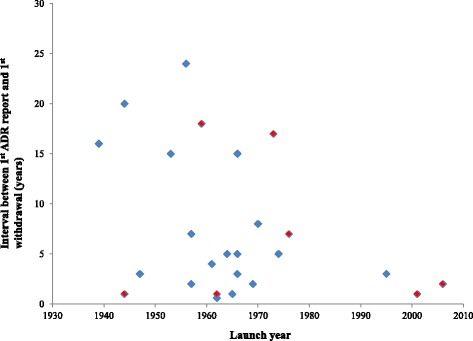
BACKGROUND: We identified anti-obesity medications withdrawn since 1950 because of adverse drug reactions after regulatory approval, and examined the evidence used to support such withdrawals, investigated the mechanisms of the adverse reactions, and explored the trends over time. METHODS: We conducted searches in PubMed, the World Health Organization database of drugs, the websites of drug regulatory authorities, and selected full texts, and we hand searched references in retrieved documents. We included anti-obesity medications that were withdrawn between 1950 and December 2015 and assessed the levels of evidence used for making withdrawal decisions using the Oxford Centre for Evidence-Based Medicine criteria. RESULTS: We identified 25 anti-obesity medications withdrawn between 1964 and 2009; 23 of these were centrally acting, via monoamine neurotransmitters. Case reports were cited as evidence for withdrawal in 80% of instances. Psychiatric disturbances, cardiotoxicity (mainly attributable to re-uptake inhibitors), and drug abuse or dependence (mainly attributable to neurotransmitter releasing agents) together accounted for 83% of withdrawals. Deaths were reportedly associated with seven products (28%). In almost half of the cases, the withdrawals occurred within 2 years of the first report of an adverse reaction. CONCLUSIONS: Most of the drugs that affect monoamine neurotransmitters licensed for the treatment of obesity over the past 65 years have been withdrawn because of adverse reactions. The reasons for withdrawal raise concerns about the wisdom of using pharmacological agents that target monoamine neurotransmitters in managing obesity. Greater transparency in the assessment of harms from anti-obesity medications is therefore warranted.
Overview
The claims and statistics of this paper haven’t been checked yet.
Run the check — free, no account needed. It reads the open-access text and checks the sources it cites.
Integrity signals
Registry
Cites
Statistics
Figures
Verification
Claims the paper makes
The claims and statistics of this paper haven’t been checked yet.
Run the check — free, no account needed. It reads the open-access text and checks the sources it cites.
Claims other papers make about this one
Each is checked against this paper’s own text: does it say what the citing paper says it does?
In the citing paper
“have demonstrated an average body weight loss of ≤10% after one year, but with serious safety concerns such as cardiotoxicity, neuropsychiatric disorders, and cancer (6).”
From Regional trends and disparities in newer GLP1 receptor agonist initiation among real‐world adult patients eligible for obesity treatment (2025) · cites this paper as [6]
Self-check
Percentages, sums and reported differences re-computed from the paper’s own numbers.
The self-check needs the paper’s full text.
Citations
Cites
European Guidelines for Obesity Management in Adults
Yumuk, V., Tsigos, C., Fried, M., Schindler, K., Busetto, L., Micic, D., & Toplak, H. (2015) · Obesity Facts · doi:10.1159/000442721 · Cited by 3,432
Cardiovascular effects of intensive lifestyle intervention in type 2 diabetes
The Look AHEAD Research Group (2013) · New England Journal of Medicine · doi:10.1056/nejmoa1212914 · Cited by 2,908 · cited 1×
“6 years) showed that weight reduction did not reduce the risk of adverse cardiovascular events in obese and overweight adults with type 2 diabetes [29].”
BackgroundValvular heart disease associated with fenfluramine-phentermine
Connolly, H. M., Crary, J. L., McGoon, M. D., Hensrud, D. D., Edwards, B. S., Edwards, W. D., & Schaff, H. V. (1997) · New England Journal of Medicine · doi:10.1056/nejm199708283370901 · Cited by 1,632
Multicenter, placebo-controlled trial of lorcaserin for weight management.
Smith, S. R., Weissman, N. J., Anderson, C. M., Sanchez, M., Chuang, E., Stubbe, S., Bays, H., & Shanahan, W. R. (2010) · New England Journal of Medicine · doi:10.1056/nejmoa0909809 · Cited by 911
Foresight. Tackling obesities: future choices. Project report.
Butland, B. K., Jebb, S. A., Kopelman, P., McPherson, K., Thomas, S., Mardell, J., & Parry, V. G. (2007) · Cited by 832
Rothman, R. B., Baumann, M. H., Savage, J. E., Rauser, L., McBride, A., Hufeisen, S. J., & Roth, B. L. (2000) · Circulation · doi:10.1161/01.cir.102.23.2836 · Cited by 722
Onakpoya, I., Heneghan, C. J., & Aronson, J. K. (2016) · BMC Medicine · doi:10.1186/s12916-016-0553-2 · Cited by 617
Self-citationAnti-Obesity Drugs: A Review about Their Effects and Safety
Kang, J. G., & Park, C. (2012) · Diabetes & Metabolism Journal · doi:10.4093/dmj.2012.36.1.13 · Cited by 605
Fidler, M. C., Sanchez, M., Raether, B., Weissman, N. J., Smith, S. R., Shanahan, W. R., & Anderson, C. M. (2011) · The Journal of Clinical Endocrinology & Metabolism · doi:10.1210/jc.2011-1256 · Cited by 565
O'Neil, P. M., Smith, S. R., Weissman, N. J., Fidler, M. C., Sanchez, M., Zhang, J., Raether, B., Anderson, C. M., & Shanahan, W. R. (2012) · Obesity · doi:10.1038/oby.2012.66 · Cited by 525
Research works printed but not linked: 3
- OCEBM Levels of Evidence Working Group. The Oxford 2011 Levels of Evidence. Oxford Centre for Evidence-Based Medicine. 2016. http://www.cebm.net/ocebm-levels-of-evidence/ .
- Price K. Case notes: phentermine. Bull Int Assoc Foren Toxicol. 1974;10(1):12.
- Anonymous. Italy suspends sibutramine licence. Pharm J. 2002;268(7190):385–91.
Cited by
Sorted by citations
O'Neil, P. M., Birkenfeld, A. L., McGowan, B., Mosenzon, O., Pedersen, S. D., Wharton, S., Carson, C. G., Jepsen, C. H., Kabisch, M., & Wilding, J. P. H. (2018) · The Lancet · doi:10.1016/s0140-6736(18)31773-2 · Cited by 814
Ng, M., Dai, X., Cogen, R. M., Abdelmasseh, M., Abdollahi, A., Abdullahi, A., Aboagye, R. G., Abukhadijah, H. J., Adeyeoluwa, T. E., Afolabi, A. A., et al. (2024) · The Lancet · doi:10.1016/s0140-6736(24)01548-4 · Cited by 407
Pharmacotherapy of obesity: available medications and drugs under investigation.
Pilitsi, E., Farr, O. M., Polyzos, S. A., Perakakis, N., Nolen-Doerr, E., Papathanasiou, A.-E., & Mantzoros, C. S. (2019) · Metabolism · doi:10.1016/j.metabol.2018.10.010 · Cited by 248
Polypharmacology: The science of multi-targeting molecules
Kabir, A., & Muth, A. (2022) · Pharmacological Research · doi:10.1016/j.phrs.2021.106055 · Cited by 245
González, N., Moreno-Villegas, Z., González-Bris, A., Egido, J., & Lorenzo, Ó. (2017) · Cardiovascular Diabetology · doi:10.1186/s12933-017-0528-4 · Cited by 211
“Thus, only five anti-obesity drugs have been approved by the FDA for long-term treatments [101], but their role in VAT, and overall EAT, is rather unknown.”
Background
Metadata
- Authors
- Onakpoya, I. J., Heneghan, C. J., & Aronson, J. K.
- Affiliations
- University of Oxford (GB)
- Corresponding author
- Onakpoya, Igho J.
- Venue
- BMC Medicine
- Published
- 2016-11-29
- Volume
- 14
- Issue
- 1
- Pages
- 191-191
- ISSN
- 1741-7015 (ISSN-L)
- PMC
- PMC5126837
- OpenAlex
- W2551793627
- Cited by
- 171
- References
- 52
- Citations by year
- 2026: 9 · 2025: 15 · 2024: 26 · 2023: 24 · 2022: 13 · 2021: 20 · 2020: 17 · 2019: 15 · 2018: 24 · 2017: 7 · 2016: 1
- FWCI
- 1.79
- Type
- journal article
- Language
- en
- Open access
- gold
- doi.org
- Licence
- Locations
- BMC Medicine (publishedVersion, cc-by)
- PubMed Central (publishedVersion, cc-by)
- PubMed (publishedVersion)
- Funders
- Wellcome Trust
- National Institute for Health and Care Research
- British Pharmacological Society
- University of Oxford
- U.S. Food and Drug Administration
- NIHR School for Primary Care Research
- Clarendon Fund
- Topics
- Health Sciences › Medicine › Pharmacology (medical) › Pharmacology and Obesity Treatment
- Life Sciences › Pharmacology, Toxicology and Pharmaceutics › Toxicology › Pharmacovigilance and Adverse Drug Reactions
- Health Sciences › Nursing › Issues, ethics and legal aspects › Pharmaceutical industry and healthcare
- Keywords
- anti-obesity drugs, drug withdrawal, adverse drug reactions, monoamines, psychiatric disturbances, cardiotoxicity, drug addiction, drug abuse, level of evidence, regulatory decision-making, obesity treatment
- MeSH terms
- Humans, Obesity, Product Surveillance, Postmarketing, Safety-Based Drug Withdrawals, Drug-Related Side Effects and Adverse Reactions
About these checks
Registry, retraction, Cites and statistics results are computed, not judged, with one exception: a printed reference that no index lists is read once by a model before it counts as a citation error. Claims are extracted by a model and kept only when their quote appears verbatim in the text; each cited source is then checked, with a model’s help, for whether it says what the claim relies on. Those verdicts can be wrong — read the claim’s quote and the cited source before relying on one.
Statistics and arithmetic are recomputed, not judged.
Confidence bands are shown only for fields calibrated on our annotated test set. None is calibrated yet, so no band is shown.
What counts as a claim ›How we measure confidence ›How we check this ›
Are you an author, or do you see a problem with this page? Request a review
