

Gestational weight gain across continents and ethnicity: systematic review and meta-analysis of maternal and infant outcomes in more than one million women
Open accessThe DOI matches its Crossref record; 61 of the 61 references it cites were found in a registry or an index.
Abstract
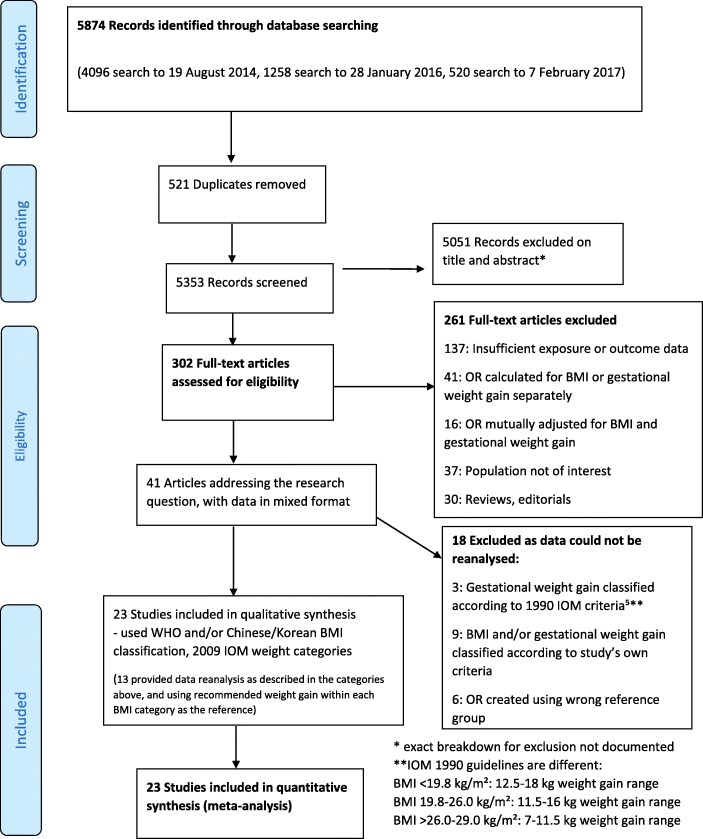
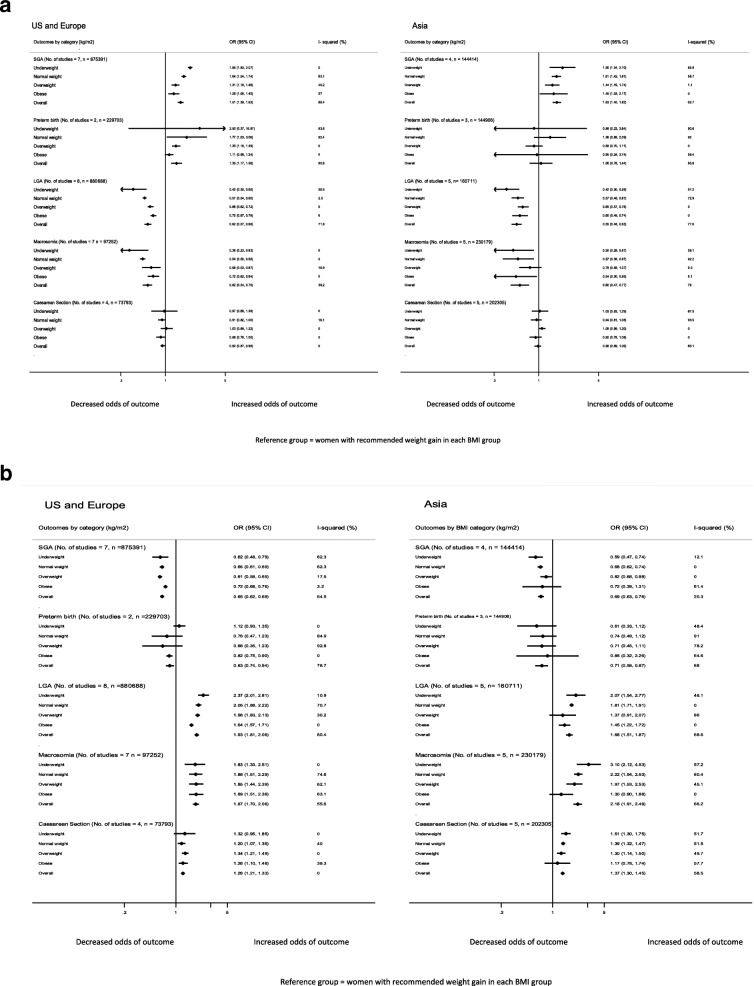
BACKGROUND: The association between Institute of Medicine (IOM) guidelines and pregnancy outcomes across ethnicities is uncertain. We evaluated the associations of gestational weight gain (GWG) outside 2009 IOM guidelines, with maternal and infant outcomes across the USA, western Europe and east Asia, with subgroup analyses in Asia. The aim was to explore ethnic differences in maternal prepregnancy body mass index (BMI), GWG and health outcomes across these regions. METHODS: Systematic review, meta-analysis and meta-regression of observational studies were used for the study. MEDLINE, MEDLINE In-Process, Embase and all Evidence-Based Medicine (EBM) Reviews were searched from 1999 to 2017. Studies were stratified by prepregnancy BMI category and total pregnancy GWG. Odds ratio (ORs) 95% confidence intervals (CI) applied recommended GWG within each BMI category as the reference. Primary outcomes were small for gestational age (SGA), preterm birth and large for gestational age (LGA). Secondary outcomes were macrosomia, caesarean section and gestational diabetes. RESULTS: Overall, 5874 studies were identified and 23 were included (n = 1,309,136). Prepregnancy overweight/obesity in the USA, Europe and Asia was measured at 42%, 30% and 10% respectively, with underweight 5%, 3% and 17%. GWG below guidelines in the USA, Europe and Asia was 21%, 18% and 31%, and above was 51%, 51% and 37% respectively. Applying regional BMI categories in Asia showed GWG above guidelines (51%) was similar to that in the USA and Europe. GWG below guidelines was associated with a higher risk of SGA (USA/Europe [OR 1.51; CI 1.39, 1.63]; Asia [1.63; 1.45, 1.82]) and preterm birth (USA/Europe [1.35; 1.17, 1.56]; Asia [1.06; 0.78, 1.44]) than GWG within guidelines. GWG above guidelines was associated with a higher risk of LGA (USA/Europe [1.93; 1.81, 2.06]; Asia [1.68; 1.51 , 1.87]), macrosomia (USA/Europe [1.87; 1.70, 2.06]; Asia [2.18; 1.91, 2.49]) and caesarean (USA/Europe [1.26; 1.21, 1.33]; Asia [1.37; 1.30, 1.45]). Risks remained elevated when regional BMI categories were applied for GWG recommendations. More women in Asia were categorised as having GWG below guidelines using World Health Organization (WHO) (60%) compared to regional BMI categories (16%), yet WHO BMI was not accompanied by increased risks of adverse outcomes. CONCLUSIONS: Women in the USA and western Europe have higher prepregnancy BMI and higher rates of GWG above guidelines than women in east Asia. However, when using regional BMI categories in east Asia, rates of GWG above guidelines are similar across the three continents. GWG outside guidelines is associated with adverse outcomes across all regions. If regional BMI categories are used in east Asia, IOM guidelines are applicable in the USA, western Europe and east Asia.
Overview
The claims and statistics of this paper haven’t been checked yet.
Free: it reads the open-access text and checks the first 5 claims that cite a source we can check. Create a free account to check every claim.
Integrity signals
Registry
Cites
Statistics
Figures
Verification
Claims the paper makes
The claims and statistics of this paper haven’t been checked yet.
Free: it reads the open-access text and checks the first 5 claims that cite a source we can check. Create a free account to check every claim.
Claims other papers make about this one
Each is checked against this paper’s own text: does it say what the citing paper says it does?
The source backs part of the claim, not all of it — or backs it for a different population, condition or comparison.
In the citing paper
“Excessive GWG is more common in women who are overweight or obese (64%) and is linked to higher risks of delivering large-for-gestational-age (LGA) infants across ethnicities (OR 1.68–1.93) [35].”
From Medical Nutrition Therapy for Women with Gestational Diabetes: Current Practice and Future Perspectives (2025) · cites this paper as [35]
Experimental — accuracy not yet measured
Self-check
Percentages, sums and reported differences re-computed from the paper’s own numbers.
The self-check needs the paper’s full text.
Citations
Cites
Measuring inconsistency in meta-analyses
Higgins, J. P. T., Thompson, S. G., Deeks, J. J., & Altman, D. G. (2003) · BMJ · doi:10.1136/bmj.327.7414.557 · Cited by 63,139
(2004) · The Lancet · doi:10.1016/s0140-6736(03)15268-3 · Cited by 12,717
Trends in Obesity Among Adults in the United States, 2005 to 2014
Flegal, K. M., Kruszon-Moran, D., Carroll, M. D., Fryar, C. D., & Ogden, C. L. (2016) · JAMA · doi:10.1001/jama.2016.6458 · Cited by 2,803 · cited 1×
“Applying WHO prepregnancy BMI categories, the USA had the greatest prevalence of overweight and obesity at 43%, consistent with trends from the 2013– 2014 National Health and Nutrition Examination Survey (NHANES), with 37% of reproductive-aged women obese [43].”
MethodObesity and Kidney Disease: Hidden Consequences of the Epidemic
Kovesdy, C. P., Furth, S. L., Zoccali, C., & on behalf of the World Kidney Day Steering Committee (2017) · American Journal of Nephrology · doi:10.1159/000458467 · Cited by 2,217
New Criteria for `Obesity Disease' in Japan
The Examination Committee of Criter (2002) · Circulation Journal · doi:10.1253/circj.66.987 · Cited by 1,650
Goldstein, R. F., Abell, S. K., Ranasinha, S., Misso, M., Boyle, J. A., Black, M. H., Li, N., Hu, G., Corrado, F., Rode, L., et al. (2017) · JAMA · doi:10.1001/jama.2017.3635 · Cited by 1,636
Self-citationDeurenberg, P., Deurenberg‐Yap, M., & Guricci, S. (2002) · Obesity Reviews · doi:10.1046/j.1467-789x.2002.00065.x · Cited by 1,326
Preconceptional and maternal obesity: epidemiology and health consequences
Poston, L., Caleyachetty, R., Cnattingius, S., Corvalán, C., Uauy, R., Herring, S., & Gillman, M. W. (2016) · The Lancet Diabetes & Endocrinology · doi:10.1016/s2213-8587(16)30217-0 · Cited by 1,111
New Criteria for `Obesity Disease' in Japan
Oda, E. (2006) · Circulation Journal · doi:10.1253/circj.70.150 · Cited by 783
Wang, Y., Mi, J., Shan, X.-Y., Wang, Q. J., & Ge, K.-Y. (2007) · International Journal of Obesity · doi:10.1038/sj.ijo.0803354 · Cited by 779
Nohr, E. A., Vaeth, M., Baker, J. L., Sørensen, T. I., Olsen, J., & Rasmussen, K. M. (2008) · The American Journal of Clinical Nutrition · doi:10.1093/ajcn/87.6.1750 · Cited by 649
The International Weight Management in Pregnancy (i-WIP) Collaborative Group (2017) · BMJ · doi:10.1136/bmj.j3119 · Cited by 529
Outcomes of maternal weight gain.
Viswanathan, M., Siega‐Riz, A. M., Moos, M. K., Deierlein, A. L., Mumford, S. L., Knaack, J., Thieda, P., Lux, L. J., & Lohr, K. N. (2008) · PubMed · Cited by 500
Maternal Prepregnancy Body Mass Index and Gestational Weight Gain on Pregnancy Outcomes
Li, N., Liu, E., Guo, J., Pan, L., Li, B., Wang, P., Liu, J., Wang, Y., Liu, G., Baccarelli, A. A., et al. (2013) · PLoS ONE · doi:10.1371/journal.pone.0082310 · Cited by 356
Self-citationBlack, M. H., Sacks, D. A., Xiang, A. H., & Lawrence, J. M. (2013) · Diabetes Care · doi:10.2337/dc12-0741 · Cited by 322
Self-citationType 2 Diabetes: Demystifying the Global Epidemic
Unnikrishnan, R., Pradeepa, R., Joshi, S. R., & Mohan, V. (2017) · Diabetes · doi:10.2337/db16-0766 · Cited by 309
Haugen, M., Brantsæter, A. L., Winkvist, A., Lissner, L., Alexander, J., Oftedal, B., Magnus, P., & Meltzer, H. M. (2014) · BMC Pregnancy and Childbirth · doi:10.1186/1471-2393-14-201 · Cited by 289
Self-citationMargerison Zilko, C. E., Rehkopf, D., & Abrams, B. (2010) · American Journal of Obstetrics and Gynecology · doi:10.1016/j.ajog.2009.12.007 · Cited by 245
Shin, D., & Song, W. O. (2015) · The Journal of Maternal-Fetal & Neonatal Medicine · doi:10.3109/14767058.2014.964675 · Cited by 200
Self-citationPregnancy Outcomes Based on Pre-Pregnancy Body Mass Index in Japanese Women
Enomoto, K., Aoki, S., Toma, R., Fujiwara, K., Sakamaki, K., & Hirahara, F. (2016) · PLOS ONE · doi:10.1371/journal.pone.0157081 · Cited by 185
Maternal obesity in Europe: where do we stand and how to move forward?
Devlieger, R., Benhalima, K., Damm, P., Van Assche, A., Mathieu, C., Mahmood, T., Dunne, F., & Bogaerts, A. (2016) · European Journal of Obstetrics & Gynecology and Reproductive Biology · doi:10.1016/j.ejogrb.2016.04.005 · Cited by 181
Self-citationBlomberg, M. (2011) · Obstetrics & Gynecology · doi:10.1097/aog.0b013e318214f1d1 · Cited by 174
Overweight and obesity in Australian mothers: epidemic or endemic?
McIntyre, H. D., Gibbons, K. S., Flenady, V. J., & Callaway, L. K. (2012) · Medical Journal of Australia · doi:10.5694/mja11.11120 · Cited by 169
Li, G., Chen, X., Jang, Y., Wang, J., Xing, X., Yang, W., & Hu, Y. (2002) · Obesity Reviews · doi:10.1046/j.1467-789x.2002.00067.x · Cited by 134
Park, S., Sappenfield, W. M., Bish, C. L., Salihu, H. M., Goodman, D. A., & Bensyl, D. M. (2010) · Maternal and Child Health Journal · doi:10.1007/s10995-010-0596-5 · Cited by 125
Association Between Maternal Weight Gain and Birth Weight
Rode, L., Hegaard, H. K., Kjærgaard, H., Møller, L. F., Tabor, A., & Ottesen, B. (2007) · Obstetrics & Gynecology · doi:10.1097/01.aog.0000266556.69952.de · Cited by 125
Self-citationMa, R. C. W., Schmidt, M. I., Tam, W. H., McIntyre, H. D., & Catalano, P. M. (2016) · The Lancet Diabetes & Endocrinology · doi:10.1016/s2213-8587(16)30278-9 · Cited by 125
Hung, T.-H., & Hsieh, T.-T. (2016) · Taiwanese Journal of Obstetrics and Gynecology · doi:10.1016/j.tjog.2016.06.016 · Cited by 120 · cited 7×
“Of the eight studies from Asia, four were from China [16, 26, 31, 36], two from Korea [12, 34], with one each from Japan [19] and Taiwan [21].”
BackgroundInfluentialChoi, S.-K., Park, I.-Y., & Shin, J.-C. (2011) · Reproductive Biology and Endocrinology · doi:10.1186/1477-7827-9-6 · Cited by 96
Liu, L., Hong, Z., & Zhang, L. (2015) · Scientific Reports · doi:10.1038/srep12863 · Cited by 94
Vesco, K. K., Sharma, A. J., Dietz, P. M., Rizzo, J. H., Callaghan, W. M., England, L., Bruce, F. C., Bachman, D. J., Stevens, V. J., & Hornbrook, M. C. (2011) · Obstetrics & Gynecology · doi:10.1097/aog.0b013e3182113ae4 · Cited by 94
Weight Loss in Obese Pregnant Women and Risk for Adverse Perinatal Outcomes
Bogaerts, A., Ameye, L., Martens, E., & Devlieger, R. (2015) · Obstetrics & Gynecology · doi:10.1097/aog.0000000000000677 · Cited by 91 · cited 10×
“Bogaerts, 2015 [35] Belgium 2009–2011 Retrospective 18,053 Flemish study center for perinatal Caesarean section, macrosomia, LGA”
BackgroundInfluentialSelf-citationPreconception Predictors of Weight Gain During Pregnancy
Weisman, C. S., Hillemeier, M. M., Symons Downs, D., Chuang, C. H., & Dyer, A.-M. (2010) · Women's Health Issues · doi:10.1016/j.whi.2009.12.002 · Cited by 87
Wen, T., & Lv, Y. (2015) · PubMed · Cited by 81
Pre-Pregnancy Body Mass Index, Gestational Weight Gain, and Birth Weight: A Cohort Study in China
Yang, S., Peng, A., Wei, S., Wu, J., Zhao, J., Zhang, Y., Wang, J., Lu, Y., Yu, Y., & Zhang, B. (2015) · PLOS ONE · doi:10.1371/journal.pone.0130101 · Cited by 77
A New Recommendation for Maternal Weight Gain in Chinese Women
WONG, W., Tang, N. L. S., Lau, T. K., & WONG, T. W. (2000) · Journal of the American Dietetic Association · doi:10.1016/s0002-8223(00)00230-3 · Cited by 71
Badon, S. E., Dyer, A. R., & Josefson, J. L. (2014) · Obesity · doi:10.1002/oby.20742 · Cited by 65
Gestational weight gain and obesity: is 20 pounds too much?
Kominiarek, M. A., Seligman, N. S., Dolin, C., Gao, W., Berghella, V., Hoffman, M., & Hibbard, J. U. (2013) · American Journal of Obstetrics and Gynecology · doi:10.1016/j.ajog.2013.04.035 · Cited by 64
Huang, A., Ji, Z., Zhao, W., Hu, H., Yang, Q., & Chen, D. (2016) · Reproductive Health · doi:10.1186/s12978-016-0204-2 · Cited by 60
Xiong, C., Zhou, A., Cao, Z., Zhang, Y., Qiu, L., Yao, C., Wang, Y., & Zhang, B. (2016) · Scientific Reports · doi:10.1038/srep37168 · Cited by 60 · cited 5×
“Of the eight studies from Asia, four were from China [16, 26, 31, 36], two from Korea [12, 34], with one each from Japan [19] and Taiwan [21].”
BackgroundInfluentialPark, J. H., Lee, B. E., Park, H. S., Ha, E. H., Lee, S. W., & Kim, Y. J. (2011) · Journal of Obstetrics and Gynaecology Research · doi:10.1111/j.1447-0756.2010.01332.x · Cited by 59 · cited 7×
“Most Asian studies use Caucasian-derived IOM GWG guidelines, and some use their own regional guidelines [12].”
BackgroundInfluentialSelf-citationPrepregnancy Weight, Gestational Weight Gain, and Risk of Growth Affected Neonates
Moore Simas, T. A., Waring, M. E., Liao, X., Garrison, A., Sullivan, G. M. T., Howard, A. E., & Hardy, J. R. (2012) · Journal of Women's Health · doi:10.1089/jwh.2011.2810 · Cited by 58
Harrison, C. L., Skouteris, H., Boyle, J. A., & Teede, H. J. (2017) · Midwifery · doi:10.1016/j.midw.2017.06.003 · Cited by 52
Self-citationDetermining optimal gestational weight gain in a multiethnic Asian population
Ee, T. X., Allen, J. C., Malhotra, R., Koh, H., Østbye, T., & Tan, T. C. (2014) · Journal of Obstetrics and Gynaecology Research · doi:10.1111/jog.12307 · Cited by 50
Walker, L. O., Hoke, M. M., & Brown, A. (2009) · Journal of Obstetric, Gynecologic & Neonatal Nursing · doi:10.1111/j.1552-6909.2009.01036.x · Cited by 50
Rogozinska, E., D'Amico, M., Khan, K., Cecatti, J., Teede, H., Yeo, S., Vinter, C., Rayanagoudar, G., Barakat, R., Perales, M., et al. (2016) · BJOG: An International Journal of Obstetrics & Gynaecology · doi:10.1111/1471-0528.13764 · Cited by 46 · cited 1×
“We also support the recommendations for standardisation of GWG categories and core outcome parameters to enable more accurate comparisons for future studies [42, 52].”
Self-citationHung, T.-H., Chen, S.-F., Hsu, J.-J., & Hsieh, T.-T. (2015) · Taiwanese Journal of Obstetrics and Gynecology · doi:10.1016/j.tjog.2015.06.010 · Cited by 43
Koh, H., Ee, T. X., Malhotra, R., Allen, J. C., Tan, T. C., & Østbye, T. (2013) · Journal of obstetrics and gynaecology research · doi:10.1111/j.1447-0756.2012.02067.x · Cited by 42
Post‐partum weight retention in women in Asia: a systematic review
Cheng, H., Walker, L. O., Tseng, Y., & Lin, P. (2011) · Obesity Reviews · doi:10.1111/j.1467-789x.2011.00886.x · Cited by 41
Effects of Prepregnancy Body Mass Index and Gestational Weight Gain on Pregnancy Outcomes
Zhang, C. H., Liu, X. Y., Zhan, Y., Zhang, L., Huang, Y., & Zhou, H. (2015) · Asia Pacific Journal of Public Health · doi:10.1177/1010539515589810 · Cited by 41
Impact of Gestational Weight Gain on Perinatal Outcomes in Obese Women
Sutton, A., Cliver, S., Tita, A., Biggio, J., & Durst, J. (2016) · American Journal of Perinatology · doi:10.1055/s-0036-1579650 · Cited by 40
Swank, M. L., Marshall, N., Caughey, A. B., Main, E. K., Gilbert, W. M., Melsop, K. A., & Chung, J. M. (2014) · Obstetrics and Gynecology · doi:10.1097/aog.0000000000000553 · Cited by 35
Self-citationGestational Weight Gain: Association with Adverse Pregnancy Outcomes
Tuuli, M. G., Odibo, L., Macones, G. A., Odibo, A. O., & Hannaford, K. (2016) · American Journal of Perinatology · doi:10.1055/s-0036-1584583 · Cited by 34
Gestational weight gain is an important risk factor for excessive fetal growth
Lee, J. M., Kim, M. J., Kim, M. Y., Han, J. Y., Ahn, H. K., Choi, J. S., Chung, J. H., Lee, S. W., Han, Y. J., Kwak, D. W., et al. (2014) · Obstetrics & Gynecology Science · doi:10.5468/ogs.2014.57.6.442 · Cited by 32 · cited 5×
“Lee, 2014 [34] Korea 2010–2012 Retrospective 16,297 Single medical centre LGA”
BackgroundInfluentialSelf-citationBenedetto, A. D., D’Anna, R., Cannata, M. L., Giordano, D., Interdonato, M. L., & Corrado, F. (2011) · Diabetes & Metabolism · doi:10.1016/j.diabet.2011.07.005 · Cited by 30
Self-citationGestational Weight Gain and Perinatal Outcomes of Subgroups of Asian-American Women, Texas, 2009
Cheng, H.-R., Walker, L. O., Brown, A., & Lee, J.-Y. (2015) · Women s Health Issues · doi:10.1016/j.whi.2015.01.003 · Cited by 28
Harita, N., Kariya, M., Hayashi, T., Satō, K., Aoki, T., Nakamura, K., Endo, G., & Narimoto, K. (2012) · Journal of obstetrics and gynaecology research · doi:10.1111/j.1447-0756.2012.01848.x · Cited by 27 · cited 1×
“Studies from Taiwan [38, 39] and Japan used WHO BMI categories [40] despite Japanese Society of Obesity guidelines that define obesity at a BMI ≥ 25 kg/m(2) [41].”
MethodChihara, I., Hayes, D., Chock, L. R., Fuddy, L. J., Rosenberg, D. L., & Handler, A. S. (2013) · Maternal and Child Health Journal · doi:10.1007/s10995-013-1342-6 · Cited by 24
Tsai, Y.-L., Chen, L.-C., Seow, K., & Chong, K. (2015) · Taiwanese Journal of Obstetrics and Gynecology · doi:10.1016/j.tjog.2014.11.007 · Cited by 17 · cited 13×
“Amongst Asian women, Korean and Taiwanese women have greater GWG and postpartum weight retention than women from other Asian countries [11].”
MethodInfluentialMaternal Prepregnancy Body Mass Index and Small for Gestational Age Births in Chinese Women
Zhang, B., Yang, S., Yang, R., Wang, J., Liang, S., Hu, R., Xian, H., Hu, K., Zhang, Y., Weaver, N. L., et al. (2016) · Paediatric and Perinatal Epidemiology · doi:10.1111/ppe.12315 · Cited by 17
Gestational Weight Gain and Outcomes for Mothers and Infants
Caughey, A. B. (2017) · JAMA · doi:10.1001/jama.2017.6265 · Cited by 14
Research works printed but not linked: 1
- Rasmussen K Yaktine AL Institute of Medicine and National Research Council Committee to reexamine IOM pregnancy weight guidelines. Weight gain during pregnancy: reexamining the guidelines 2009 Washington DC National Academic Press
Cited by
Teede, H. J., Bailey, C., Moran, L. J., Bahri Khomami, M., Enticott, J., Ranasinha, S., Rogozińska, E., Skouteris, H., Boyle, J. A., Thangaratinam, S., et al. (2022) · JAMA Internal Medicine · doi:10.1001/jamainternmed.2021.6373 · Cited by 329
Self-citationFerrara, A., Hedderson, M. M., Brown, S. D., Ehrlich, S. F., Tsai, A.-L., Feng, J., Galarce, M., Marcovina, S., Catalano, P., & Quesenberry, C. P. (2020) · The Lancet Diabetes & Endocrinology · doi:10.1016/s2213-8587(20)30107-8 · Cited by 162
McAuliffe, F. M., Killeen, S. L., Jacob, C. M., Hanson, M. A., Hadar, E., McIntyre, D. H., Kapur, A., Kihara, A., Ronald, C. W., Divakar, H., et al. (2020) · International Journal of Gynecology & Obstetrics · doi:10.1002/ijgo.13334 · Cited by 196
Maternal body mass index and pregnancy outcomes: a systematic review and metaanalysis
D’Souza, R., Horyn, I., Pavalagantharajah, S., Zaffar, N., & Jacob, C.-E. (2019) · American Journal of Obstetrics & Gynecology MFM · doi:10.1016/j.ajogmf.2019.100041 · Cited by 150
Martínez‐Hortelano, J. A., Cavero‐Redondo, I., Álvarez‐Bueno, C., Garrido‐Miguel, M., Soriano‐Cano, A., & Martínez‐Vizcaíno, V. (2020) · BMC Pregnancy and Childbirth · doi:10.1186/s12884-020-03335-7 · Cited by 167
“The highest mean prepregnancy BMI was found in South America with 25.05 kg (95% CI: 23.39, 26.72) and the lowest was found in Asia with 11.36 kg (95% CI: 10.14, 12.58).”
ResultInfluential
Metadata
- Authors
- Goldstein, R. F., Abell, S. K., Ranasinha, S., Misso, M. L., Boyle, J. A., Harrison, C. L., Black, M. H., Li, N., Hu, G., Corrado, F., Hegaard, H., Kim, Y. J., Haugen, M., Song, W. O., Kim, M. H., Bogaerts, A., Devlieger, R., Chung, J. H., & Teede, H. J.
- Affiliations
- Monash Health (AU)
- Monash University (AU)
- Kaiser Permanente (US)
- Tianjin Women's and Children's Health Center (CN)
- Pennington Biomedical Research Center (US)
- University of Messina (IT)
- Copenhagen University Hospital (DK)
- Ewha Womans University (KR)
- Norwegian Institute of Public Health (NO)
- Michigan State University (US)
- Dankook University (KR)
- University of Antwerp (BE)
- GZA Ziekenhuizen Campus Sint-Augustinus (BE)
- Monash Medical Centre (AU)
- Corresponding author
- Teede, Helena J.
- ORCID
- Venue
- BMC Medicine
- Published
- 2018-08-31
- Volume
- 16
- Issue
- 1
- Pages
- 153-153
- ISSN
- 1741-7015 (ISSN-L)
- PMC
- PMC6117916
- OpenAlex
- W2888709256
- Cited by
- 515
- References
- 61
- Citations by year
- 2026: 45 · 2025: 65 · 2024: 61 · 2023: 78 · 2022: 108 · 2021: 63 · 2020: 67 · 2019: 27
- FWCI
- 6.41
- Type
- journal article
- Language
- en
- Open access
- gold
- doi.org
- Licence
- cc-by
- creativecommons.org/licenses/by/4.0/ (tdm)
- Locations
- BMC Medicine (publishedVersion, cc-by)
- Europe PMC (PubMed Central) (publishedVersion, other-oa)
- PubMed Central (publishedVersion, cc-by)
- PubMed (publishedVersion)
- Research at the University of Copenhagen (University of Copenhagen) (publishedVersion, cc-by)
- Adelaide Research & Scholarship (AR&S) (University of Adelaide) (submittedVersion, cc-by)
- Monash University Research Portal (Monash University) (submittedVersion, other-oa)
- Lirias (submittedVersion, other-oa)
- DOAJ (DOAJ: Directory of Open Access Journals) (submittedVersion, cc-by-sa)
- eScholarship (California Digital Library) (submittedVersion, cc-by)
- NORA - Norwegian Open Research Archives (submittedVersion, other-oa)
- Funders
- Gentofte Hospital
- Centers for Disease Control and Prevention
- University of Illinois at Urbana-Champaign
- Medical Research Council
- National Health and Medical Research Council
- National Institute of General Medical Sciences (U54GM104940)
- National Center for Chronic Disease Prevention and Health Promotion
- Topics
- Health Sciences › Medicine › Obstetrics and Gynecology › Gestational Diabetes Research and Management
- Health Sciences › Medicine › Pediatrics, Perinatology and Child Health › Birth, Development, and Health
- Health Sciences › Medicine › Pediatrics, Perinatology and Child Health › Maternal and Neonatal Healthcare
- Keywords
- gestational weight gain, IOM weight gain guidelines, pre-pregnancy body mass index, maternal obesity, ethnic differences, small for gestational age, preterm birth, large for gestational age, macrosomia, cesarean section, gestational diabetes mellitus, Asian women, regional comparison, maternal outcomes, infant outcomes, underweight pregnancy, overweight in pregnancy
- MeSH terms
- Adult, Female, Humans, Infant, Newborn, Pregnancy, Pregnancy Complications, Pregnancy Outcome, Weight Gain, Fetal Weight
About these checks
Registry, retraction, Cites and statistics results are computed, not judged, with one exception: a printed reference that no index lists is read once by a model before it counts as a citation error. Claims are extracted by a model and kept only when their quote appears verbatim in the text; each cited source is then checked, with a model’s help, for whether it says what the claim relies on. Those verdicts can be wrong — read the claim’s quote and the cited source before relying on one.
Statistics and arithmetic are recomputed, not judged.
Confidence bands are shown only for fields calibrated on our annotated test set. None is calibrated yet, so no band is shown.
What counts as a claim ›How we measure confidence ›How we check this ›
Are you an author, or do you see a problem with this page? Request a review
Data sources
Bibliographic data: Semantic Scholar, OpenAlex, Crossref.
Contains information from the Semantic Scholar Academic Graph Datasets, made available under the ODC Attribution License (ODC-BY 1.0).
Semantic Scholar’s data is described in: Kinney, R., et al. (2023). The Semantic Scholar Open Data Platform. arXiv:2301.10140.
