

Association between patterns of alcohol consumption (beverage type, frequency and consumption with food) and risk of adverse health outcomes: a prospective cohort study
Open accessThe DOI matches its Crossref record; 37 of the 39 references it cites were found in a registry or an index.
Abstract
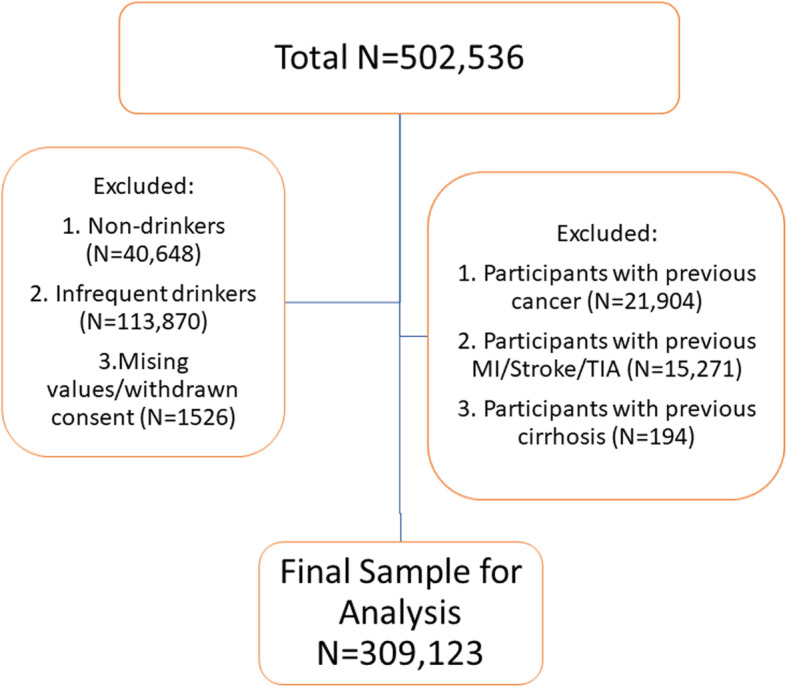
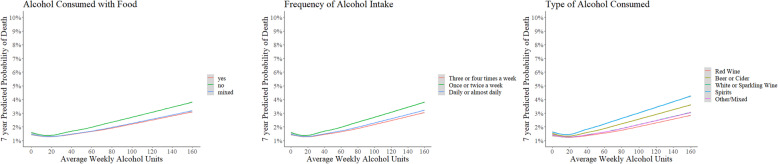
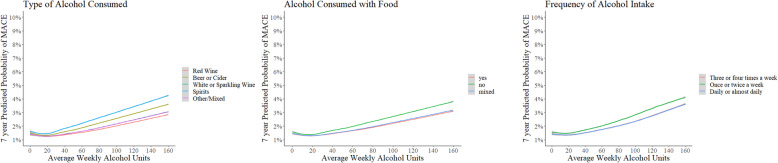
Background: Alcohol consumption is a leading contributor to death and disability worldwide, but previous research has not examined the effects of different patterns of alcohol consumption. The study objective was to understand the relationship between different alcohol consumption patterns and adverse health outcomes risk, adjusting for average amount consumed among regular drinkers. Methods: This was a prospective cohort study of UK Biobank (UKB) participants . Abstainers, infrequent alcohol consumers or those with previous cancer, myocardial infarction (MI), stroke or liver cirrhosis were excluded. We used beverage type, consumption with food and consumption frequency as exposures and adjusted for potential confounding. All-cause mortality, major cardiovascular events-MACE (MI/stroke/cardiovascular death), accidents/injuries, liver cirrhosis, all-cause and alcohol-related cancer incidence over 9-year median follow-up period were outcomes of interest. Results: The final sample size for analysis was N = 309,123 (61.5% of UKB sample). Spirit drinking was associated with higher adjusted mortality (hazard ratio (HR) 1.25; 95% confidence intervals (CI) 1.14–1.38), MACE (HR 1.31; 95% CI 1.15–1.50), cirrhosis (HR 1.48; 95% CI 1.08–2.03) and accident/injuries (HR 1.10; 95% CI 1.03–1.19) risk compared to red wine drinking, after adjusting for the average weekly alcohol consumption amounts. Beer/cider drinkers were also at a higher risk of mortality (HR 1.18; 95% CI 1.10–1.27), MACE (HR 1.16; 95% CI 1.05–1.27), cirrhosis (HR 1.36; 95% CI 1.06–1.74) and accidents/injuries (HR 1.11; 95% CI 1.06–1.17). Alcohol consumption without food was associated with higher adjusted mortality (HR 1.10; 95% CI 1.02–1.17) risk, compared to consumption with food. Alcohol consumption over 1–2 times/week had higher adjusted mortality (HR 1.09; 95% CI 1.03–1.16) and MACE (HR 1.14; 95% CI 1.06–1.23) risk, compared to 3–4 times/week, adjusting for the amount of alcohol consumed. Conclusion: Red wine drinking, consumption with food and spreading alcohol intake over 3–4 days were associated with lower risk of mortality and vascular events among regular alcohol drinkers, after adjusting for the effects of average amount consumed. Selection bias and residual confounding are important possible limitations. These findings, if replicated and validated, have the potential to influence policy and practice advice on less harmful patterns of alcohol consumption.
Overview
The claims and statistics of this paper haven’t been checked yet.
Free: it reads the open-access text and checks the first 5 claims that cite a source we can check. Create a free account to check every claim.
Integrity signals
Registry
Cites
Statistics
Figures
Verification
Claims the paper makes
The claims and statistics of this paper haven’t been checked yet.
Free: it reads the open-access text and checks the first 5 claims that cite a source we can check. Create a free account to check every claim.
Claims other papers make about this one
Each is checked against this paper’s own text: does it say what the citing paper says it does?
The check wasn’t confident either way, so it gives no verdict — never disputed.
In the citing paper
“Although most studies define HED for women as either 40 g or 60 g of absolute alcohol on a single occasion [7, 30], we chose the higher threshold (60 g of absolute alcohol amounts to ≥ five standard drinks) as this is more commonly used in South Africa [6].”
From Associations Between Patterns of Alcohol Use and Viral Load Suppression Amongst Women Living with HIV in South Africa (2021) · cites this paper as [30]
Experimental — accuracy not yet measured
Self-check
Percentages, sums and reported differences re-computed from the paper’s own numbers.
The self-check needs the paper’s full text.
Citations
Cites
Wickham, H. (2016) · Use R! · doi:10.1007/978-3-319-24277-4 · Cited by 33,115
Whelton, P. K., Carey, R. M., Aronow, W. S., Casey, D. E., Collins, K. J., Dennison Himmelfarb, C., DePalma, S. M., Gidding, S., Jamerson, K. A., Jones, D. W., et al. (2018) · Journal of the American College of Cardiology · doi:10.1016/j.jacc.2017.11.006 · Cited by 6,616
mediation:R Package for Causal Mediation Analysis
Tingley, D., Yamamoto, T., Hirose, K., Keele, L., & Imai, K. (2014) · Journal of Statistical Software · doi:10.18637/jss.v059.i05 · Cited by 4,155 · cited 1×
“This analysis was performed using the “mediation package” [31].”
MethodGriswold, M. G., Fullman, N., Hawley, C., Arian, N., Zimsen, S. R. M., Tymeson, H. D., Venkateswaran, V., Tapp, A. D., Forouzanfar, M. H., Salama, J. S., et al. (2018) · The Lancet · doi:10.1016/s0140-6736(18)31310-2 · Cited by 3,524 · cited 1×
“Background Alcohol consumption is one of the leading risk factors for death and disability-adjusted life years (DALY) globally, based on findings from the recent Global Burden of Disease Study that included data from 195 countries [1].”
BackgroundStringhini, S., Carmeli, C., Jokela, M., Avendaño, M., Muennig, P., Guida, F., Ricceri, F., d'Errico, A., Barros, H., Bochud, M., et al. (2017) · The Lancet · doi:10.1016/s0140-6736(16)32380-7 · Cited by 1,319 · cited 1×
“The models in our study were adjusted for the effect of major determinants of health and well-being to minimise the risk of residual confounding [39]; however, it still remains a possibility.”
MethodTownsend, P. (1987) · Journal of Social Policy · doi:10.1017/s0047279400020341 · Cited by 1,294
The relationship between different dimensions of alcohol use and the burden of disease—an update
Rehm, J., Gmel, G. E., Gmel, G., Hasan, O. S. M., Imtiaz, S., Popova, S., Probst, C., Roerecke, M., Room, R., Samokhvalov, A. V., et al. (2017) · Addiction · doi:10.1111/add.13757 · Cited by 1,204 · cited 1×
“A review of 255 systematic reviews and meta-analyses has suggested the need for further research into the health risks associated with different patterns of alcohol consumption (beyond average amount), such as frequency of consumption, consumption of alcohol with or without food and type of alcoholic beverage [2].”
BackgroundWood, A. M., Kaptoge, S., Butterworth, A. S., Willeit, P., Warnakula, S., Bolton, T., Paige, E., Paul, D. S., Sweeting, M., Burgess, S., et al. (2018) · The Lancet · doi:10.1016/s0140-6736(18)30134-x · Cited by 1,188 · cited 1×
“Previous research has suggested that wine drinking (compared to beer or spirit drinking) is associated with lower risk of all-cause mortality [3, 8, 9] and cardiovascular events [3, 8, 10].”
BackgroundKaptoge, S., Pennells, L., De Bacquer, D., Cooney, M. T., Kavousi, M., Stevens, G., Riley, L. M., Savin, S., Khan, T., Altay, S., et al. (2019) · The Lancet Global Health · doi:10.1016/s2214-109x(19)30318-3 · Cited by 1,167
Time-to-Event Analysis of Longitudinal Follow-up of a Survey: Choice of the Time-scale
Korn, E. L., Graubard, B. I., & Midthune, D. (1997) · American Journal of Epidemiology · doi:10.1093/oxfordjournals.aje.a009034 · Cited by 1,007 · cited 1×
“In each of these models, age was used as the underlying time variable [25].”
MethodMuller, C. J., & MacLehose, R. F. (2014) · International Journal of Epidemiology · doi:10.1093/ije/dyu029 · Cited by 775 · cited 1×
“In the next step, a set of predicted probability values for the outcome of interest (all-cause mortality and MACE at 7 years minimum duration of follow-up) were calculated from the Cox regression models described above using multiple fractional polynomials for weekly alcohol units and marginal standardisation in which…”
MethodType of Alcohol Consumed and Mortality from All Causes, Coronary Heart Disease, and Cancer
Grønbæk, M., Becker, U., Johansen, D., Gottschau, A., Schnohr, P., Hein, H. O., Jensen, G., & Sørensen, T. I. A. (2000) · Annals of Internal Medicine · doi:10.7326/0003-4819-133-6-200009190-00008 · Cited by 525 · cited 2×
“Previous research has suggested that wine drinking (compared to beer or spirit drinking) is associated with lower risk of all-cause mortality [3, 8, 9] and cardiovascular events [3, 8, 10].”
Background(1989) · Annals of Internal Medicine · doi:10.7326/0003-4819-111-10-863_3 · Cited by 410
Jani, B. D., Hanlon, P., Nicholl, B. I., McQueenie, R., Gallacher, K. I., Lee, D., & Mair, F. S. (2019) · BMC Medicine · doi:10.1186/s12916-019-1305-x · Cited by 268 · cited 3×
“The physical and mental health conditions (including diabetes and hypertension) self-reported by participants were organised into a list of 42 long-term conditions (LTCs) based on our previously published literature on multimorbidity (see supplementary Table S1) [20, 21].”
BackgroundSelf-citationWine, Liquor, Beer, and Mortality
Klatsky, A. L. (2003) · American Journal of Epidemiology · doi:10.1093/aje/kwg184 · Cited by 229
Alcohol consumption as a cause of cancer
Connor, J. (2017) · Addiction · doi:10.1111/add.13477 · Cited by 229 · cited 1×
“The six outcomes studied were all-cause mortality, major adverse cardiovascular event-MACE (stroke, myocardial infarction (MI) or vascular death), external causes of injuries/accidents, incidence of all-cause and alcohol-related cancers (colon, rectum, breast, liver, oesophagus and larynx) [22].”
BackgroundContribution of Red Wine Consumption to Human Health Protection
Snopek, L., Mlcek, J., Sochorova, L., Baron, M., Hlavacova, I., Jurikova, T., Kizek, R., Sedlackova, E., & Sochor, J. (2018) · Molecules · doi:10.3390/molecules23071684 · Cited by 224
Celis-Morales, C. A., Lyall, D. M., Anderson, J., Iliodromiti, S., Fan, Y., Ntuk, U. E., Mackay, D. F., Pell, J. P., Sattar, N., & Gill, J. M. R. (2016) · European Heart Journal · doi:10.1093/eurheartj/ehw249 · Cited by 216
Alyosef, H., Roggendorf, H., Schneider, D., Inayat, A., Welscher, J., Schwieger, W., Münster, T., Kloess, G., Ibrahim, S., & Enke, D. (2017) · Molecules · doi:10.3390/molecules23010001 · Cited by 180
Testing association of a pathway with survival using gene expression data
Goeman, J. J., Oosting, J., Cleton-Jansen, A.-M., Anninga, J. K., & van Houwelingen, H. C. (2005) · Bioinformatics · doi:10.1093/bioinformatics/bti267 · Cited by 169 · cited 1×
“In view of a large number of co-variates, a global p value for heterogeneity was calculated using the “globaltest” package for each regression model, respectively [27].”
MethodSimpson, R. F., Hermon, C., Liu, B., Green, J., Reeves, G. K., Beral, V., & Floud, S. (2019) · The Lancet Public Health · doi:10.1016/s2468-2667(18)30230-5 · Cited by 154 · cited 1×
“A recently published study on approximately 400,000 UK women suggested that for a given amount of alcohol consumption, daily alcohol consumption and consumption without food were associated with higher risk of liver cirrhosis [12].”
BackgroundBinge Drinking's Effects on the Body
Molina, P. E., & Nelson, S. M. (2018) · Alcohol research · doi:10.35946/arcr.v39.1.13 · Cited by 137 · cited 1×
“Consuming alcohol with meals may lead to lower intestinal absorption and lower blood alcohol levels [35], while binge drinking may lead to accelerated alcohol metabolism and disrupt the antioxidant mechanisms [36].”
BackgroundLack of international consensus in low‐risk drinking guidelines
Furtwængler, N. A. F. F., & de Visser, R. O. (2013) · Drug and Alcohol Review · doi:10.1111/j.1465-3362.2012.00475.x · Cited by 128 · cited 2×
“At a policy level, there is no information available to the general population in the UK or elsewhere on health effects of different patterns of alcohol consumption [5, 6].”
BackgroundRoyston, P., & Sauerbrei, W. (2003) · Statistics in Medicine · doi:10.1002/sim.1310 · Cited by 120 · cited 1×
“Marginal fractional polynomials [28] were used to visualise the relationship between average weekly alcohol units (continuous) and two outcomes of interest (allcause mortality and MACE).”
MethodDrinking Pattern and Mortality:
Trevisan, M., Schisterman, E. F., Mennotti, A., Farchi, G., & Conti, S. (2001) · Annals of Epidemiology · doi:10.1016/s1047-2797(00)00183-6 · Cited by 120 · cited 2×
“In an Italian cohort, wine drinking with food was associated with lower all-cause mortality and cardiovascular events compared to those drinking wine without food [11].”
BackgroundJani, B. D., Nicholl, B. I., McQueenie, R., Connelly, D. T., Hanlon, P., Gallacher, K. I., Lee, D., & Mair, F. S. (2018) · EP Europace · doi:10.1093/europace/eux322 · Cited by 115 · cited 3×
“The physical and mental health conditions (including diabetes and hypertension) self-reported by participants were organised into a list of 42 long-term conditions (LTCs) based on our previously published literature on multimorbidity (see supplementary Table S1) [20, 21].”
BackgroundSelf-citationFerrari, P., Licaj, I., Muller, D. C., Kragh Andersen, P., Johansson, M., Boeing, H., Weiderpass, E., Dossus, L., Dartois, L., Fagherazzi, G., et al. (2014) · BMJ Open · doi:10.1136/bmjopen-2014-005245 · Cited by 105 · cited 1×
“Previous research has suggested that wine drinking (compared to beer or spirit drinking) is associated with lower risk of all-cause mortality [3, 8, 9] and cardiovascular events [3, 8, 10].”
BackgroundPhysical activity in relation to body size and composition in women in UK Biobank
Guo, W., Bradbury, K. E., REEVES, G. K., & Key, T. J. (2015) · Annals of Epidemiology · doi:10.1016/j.annepidem.2015.01.015 · Cited by 92 · cited 1×
“Physical activity was self-reported and classified as: none (no physical activity in the last 4 weeks), low (light activity only in the last 4 weeks), medium (heavy walking for pleasure and/ or other exercises in the last 4 weeks) and high (strenuous sports in the last 4 weeks) [15, 16].”
MethodHow is alcohol consumption affected if we account for under-reporting? A hypothetical scenario
Boniface, S., & Shelton, N. (2013) · European Journal of Public Health · doi:10.1093/eurpub/ckt016 · Cited by 91
Effect of Food on the Pharmacokinetics of Alcohol Absorption*
Gentry, R. T. (2000) · Alcoholism Clinical and Experimental Research · doi:10.1111/j.1530-0277.2000.tb01996.x · Cited by 75 · cited 1×
“Consuming alcohol with meals may lead to lower intestinal absorption and lower blood alcohol levels [35], while binge drinking may lead to accelerated alcohol metabolism and disrupt the antioxidant mechanisms [36].”
BackgroundWallach, J. D., Serghiou, S., Chu, L., Egilman, A. C., Vasiliou, V., Ross, J. S., & Ioannidis, J. P. A. (2020) · BMC Medical Research Methodology · doi:10.1186/s12874-020-0914-6 · Cited by 56 · cited 1×
“In our study, all-cause mortality models were adjusted for 10 covariates, liver cirrhosis models were adjusted for 11 covariates and cardiovascular events models were adjusted for 14 covariates [38].”
MethodZeisser, C., Stockwell, T. R., Chikritzhs, T. N., CHERPITEL, C. J. S., Ye, Y., & Gardner, C. (2012) · Alcoholism Clinical and Experimental Research · doi:10.1111/j.1530-0277.2012.01919.x · Cited by 55
Daily Drinking Is Associated with Increased Mortality
Hartz, S. M., Oehlert, M., Horton, A., Grucza, R. A., Fisher, S. L., Culverhouse, R. C., Nelson, K. G., Sumerall, S. W., Neal, P. C., Regnier, P., et al. (2018) · Alcoholism: Clinical and Experimental Research · doi:10.1111/acer.13886 · Cited by 53 · cited 1×
“A recent study on the frequency of alcohol consumption in > 430,000 participants from two independent US datasets from a community and an outpatient population, respectively, found that there was a higher risk of all-cause and cardiovascular mortality among binge drinkers (1–2 days/week) and very frequent drinkers (6–…”
BackgroundWine, liquor, beer and risk of breast cancer in a large population
Li, Y., Baer, D. M., FRIEDMAN, G. D., Udaltsova, N. V., Shim, V., & Klatsky, A. L. (2008) · European Journal of Cancer · doi:10.1016/j.ejca.2008.11.001 · Cited by 45 · cited 1×
“We did not find an association between various patterns of alcohol consumption and risk of all-cause and alcohol-related cancer incidence; similarly, other studies have not found association between type of alcoholic beverage on risk of cancer-related outcomes [32, 33].”
ResultFry, A., Littlejohns, T. J., Sudlow, C. L. M., Doherty, N., & Allen, N. E. (2016) · Oral Presentations · doi:10.1136/jech-2016-208064.41 · Cited by 43 · cited 1×
“The study sample was recruited from a community setting but there is evidence of participation bias with study participants being more affluent and healthier than the average UK population [37], and therefore, it is likely that the effect sizes reported here are conservative estimates.”
BackgroundAlcohol Intake, Beverage Choice, and Cancer: A Cohort Study in a Large Kaiser Permanente Population
Klatsky, A. L., Li, Y., Tran, H., Baer, D. M., Udaltsova, N. V., Armstrong, M. A., & FRIEDMAN, G. D. (2015) · The Permanente Journal · doi:10.7812/tpp/14-189 · Cited by 34 · cited 1×
“We did not find an association between various patterns of alcohol consumption and risk of all-cause and alcohol-related cancer incidence; similarly, other studies have not found association between type of alcoholic beverage on risk of cancer-related outcomes [32, 33].”
ResultTiming of alcohol consumption and risk of liver cirrhosis: a prospective study of UK women
Simpson, R., Hermon, C., Beral, V., Green, J., Liu, B., Reeves, G., & Floud, S. (2018) · European Journal of Public Health · doi:10.1093/eurpub/cky212.408 · Cited by 1
Research works printed but not linked: 5
- UK Department of Health UK Chief Medical Officers’ Low Risk Drinking Guidelines 2016
- WHO WHO BMI Classification 2004
- National Clinical Guideline Centre (UK). Lipid Modification: Cardiovascular Risk Assessment and the Modification of Blood Lipids for the Primary andSecondary Prevention of Cardiovascular Disease. London: National Institute for Health and Care Excellence (UK); 2014. PMID: 25340243. 25340243
- WHO. International Statistical Classification of Diseases and Related Health Problems (International Classification of Diseases)(ICD) 10th Revision - Version: 2010. Vol. 1, Occupational Health. 2010. p. 1–201.
- Therneau T Package: “survival” 2015
Cited by
Healthy Lifestyle and Cancer Risk: Modifiable Risk Factors to Prevent Cancer
Marino, P., Mininni, M., Deiana, G., Marino, G., Divella, R., Bochicchio, I., Giuliano, A., Lapadula, S., Lettini, A. R., & Sanseverino, F. (2024) · Nutrients · doi:10.3390/nu16060800 · Cited by 240
“In support of these data, studies carried out in countries that use the Mediterranean diet as an eating style have revealed that the moderate consumption of red wine during meals is an important factor in reducing the risk of developing cancer and protecting against cardiovascular diseases [98,99].”
ResultPetermann-Rocha, F. E., Gray, S. R., Forrest, E. H., Welsh, P. I., Sattar, N. A., Celis-Morales, C. A., Ho, F. K. W., & Pell, J. P. (2022) · Journal of Hepatology · doi:10.1016/j.jhep.2022.01.010 · Cited by 145
Gagnon, É., Mitchell, P. L., Manikpurage, H. D., Abner, E., Taba, N., Esko, T., Ghodsian, N., Thériault, S., Mathieu, P., & Arsenault, B. J. (2023) · Journal of Translational Medicine · doi:10.1186/s12967-022-03799-5 · Cited by 122
Alcohol, Drinking Pattern, and Chronic Disease
Barbería-Latasa, M., Gea, A., & Martínez‐González, M. Á. (2022) · Nutrients · doi:10.3390/nu14091954 · Cited by 121
“Specifically, wine consumption, particularly in Mediterranean countries, has been postulated as a key feature of the Mediterranean diet with strong cardio-protective properties [77,78] due to the abundance of polyphenols in red wine with postulated antioxidant or anti-inflammatory effects [79–82].”
BackgroundAlcohol Consumption and Cardiovascular Disease Risk: Placing New Data in Context
Hoek, A. G., van Oort, S., Mukamal, K. J., & Beulens, J. W. J. (2022) · Current Atherosclerosis Reports · doi:10.1007/s11883-022-00992-1 · Cited by 108
Metadata
- Authors
- Jani, B. D., McQueenie, R., Nicholl, B. I., Field, R., Hanlon, P., Gallacher, K. I., Mair, F. S., & Lewsey, J.
- Affiliations
- University of Glasgow (GB)
- Corresponding author
- Jani, Bhautesh Dinesh
- ORCID
- Venue
- BMC Medicine
- Published
- 2021-01-12
- Volume
- 19
- Issue
- 1
- Pages
- 8-8
- ISSN
- 1741-7015 (ISSN-L)
- PMC
- PMC7802201
- OpenAlex
- W3112509457
- Cited by
- 124
- References
- 39
- Citations by year
- 2026: 25 · 2025: 22 · 2024: 22 · 2023: 21 · 2022: 24 · 2021: 10
- FWCI
- 12.83
- Type
- journal article
- Language
- en
- Open access
- gold
- doi.org
- Licence
- cc-by
- creativecommons.org/licenses/by/4.0/ (tdm)
- creativecommons.org/licenses/by/4.0/ (vor)
- Locations
- BMC Medicine (publishedVersion, cc-by)
- Europe PMC (PubMed Central) (publishedVersion, other-oa)
- PubMed Central (publishedVersion, cc-by)
- PubMed (publishedVersion)
- ENLIGHTEN (Jurnal Bimbingan dan Konseling Islam) (acceptedVersion, cc-by-sa)
- HRB National Drugs Library (Health Research Board) (submittedVersion)
- DOAJ (DOAJ: Directory of Open Access Journals) (submittedVersion, cc-by-sa)
- Funders
- Chief Scientist Office, Scottish Government Health and Social Care Directorate
- Topics
- Health Sciences › Medicine › Pathology and Forensic Medicine › Alcohol Consumption and Health Effects
- Health Sciences › Medicine › Epidemiology › Substance Abuse Treatment and Outcomes
- Health Sciences › Medicine › Public Health, Environmental and Occupational Health › Nutritional Studies and Diet
- Keywords
- alcohol consumption patterns, red wine, drinking frequency, all-cause mortality, major adverse cardiovascular events, liver cirrhosis, alcohol-related cancer, accidents and injuries, alcohol-related harm, UK Biobank, prospective cohort
- MeSH terms
- Adult, Aged, Alcohol Drinking, Eating, Humans, Male, Middle Aged, Myocardial Infarction, Neoplasms, Prospective Studies, Risk Factors, Wine, Cohort Studies, Incidence, Proportional Hazards Models, Stroke
About these checks
Registry, retraction, Cites and statistics results are computed, not judged, with one exception: a printed reference that no index lists is read once by a model before it counts as a citation error. Claims are extracted by a model and kept only when their quote appears verbatim in the text; each cited source is then checked, with a model’s help, for whether it says what the claim relies on. Those verdicts can be wrong — read the claim’s quote and the cited source before relying on one.
Statistics and arithmetic are recomputed, not judged.
Confidence bands are shown only for fields calibrated on our annotated test set. None is calibrated yet, so no band is shown.
What counts as a claim ›How we measure confidence ›How we check this ›
Are you an author, or do you see a problem with this page? Request a review
Data sources
Bibliographic data: Semantic Scholar, OpenAlex, Crossref.
Contains information from the Semantic Scholar Academic Graph Datasets, made available under the ODC Attribution License (ODC-BY 1.0).
Semantic Scholar’s data is described in: Kinney, R., et al. (2023). The Semantic Scholar Open Data Platform. arXiv:2301.10140.
