

Dose-response association between device-measured physical activity and incident dementia: a prospective study from UK Biobank
Open accessThe DOI matches its Crossref record; 43 of the 43 references it cites were found in a registry or an index.
Abstract
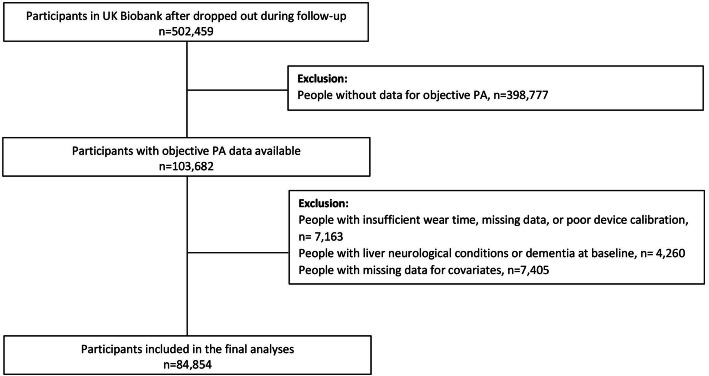
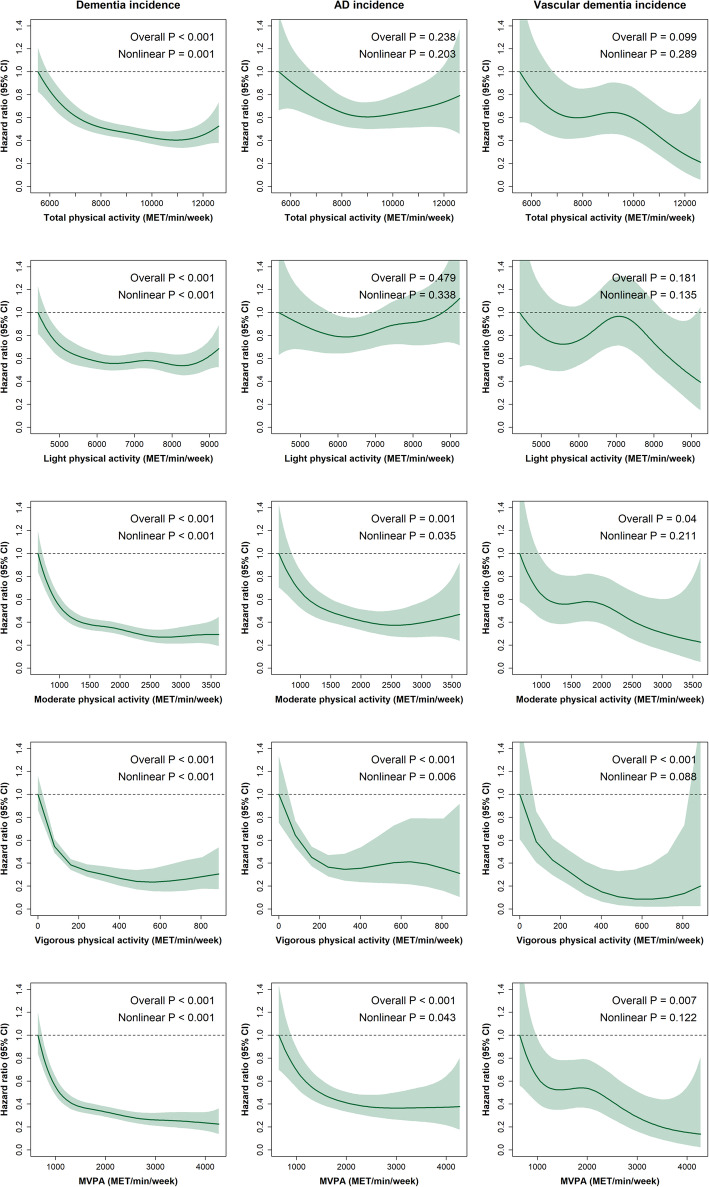
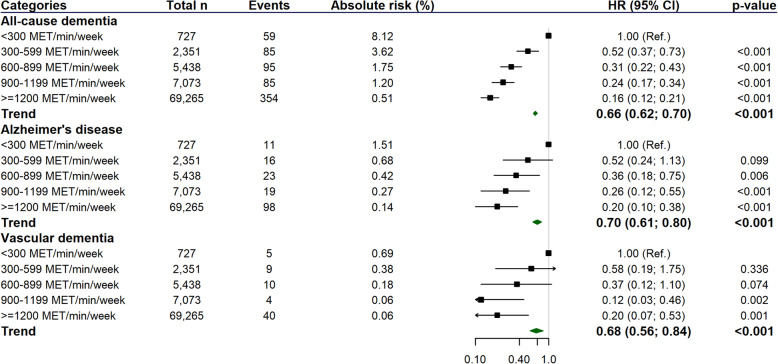
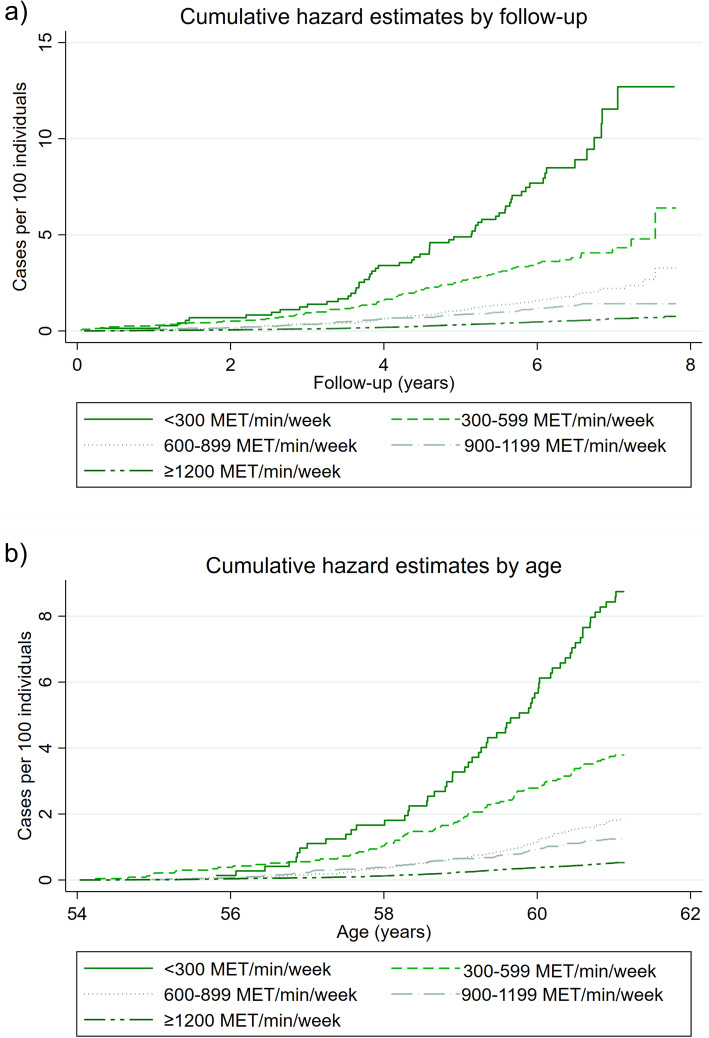
Background: Previous cohort studies have investigated the relationship between self-reported physical activity (PA) and dementia. Evidence from objective device-measured PA data is lacking. This study aimed to explore the association of device-measured PA with the risk of dementia incidence and common subtypes (Alzheimer’s disease [AD] and vascular dementia) using the UK Biobank study. Methods: 84,854 participants (55.8% women), invited to participate in the device-measured PA between 2013 and 2015, were included in this prospective cohort study. Wrist accelerometers were used to measure light, moderate, vigorous, moderate-to-vigorous PA (MVPA) and total PA intensity and duration (MET/min/week). Incident dementia (fatal and non-fatal) was extracted from hospital episodes records for incidence and death register for mortality. Incidence follow-up was carried out until the end of March 2021in England and Scotland and the end of March 2018 in Wales. Mortality data were available until February 2021. Nonlinear associations were first investigated using penalised cubic splines fitted in the Cox proportional hazard models. In addition, using MVPA, five categories were created. Associations of these categories with the outcomes were investigated using Cox proportional hazard models. Analyses were adjusted for sociodemographic, lifestyle and health-related factors. Results: After a median follow-up of 6.3 years, 678 individuals were diagnosed with dementia. Evidence of nonlinearity was observed for all PA modes and all-cause dementia. For categories of MVPA, there was a significant trend towards a low risk of overall dementia when higher levels of MVPA were achieved (HR trend 0.66 [95% CI 0.62 to 0.70]. The lowest risk was identified in individuals who performed more than 1200 MET/min/week, those who had 84% (95% CI 0.12 to 0.21) lower risk of incident dementia compared to those who performed < 300 MET/min/week. Conclusions: Participants with higher PA levels had a lower risk of incident dementia than those less active, independently of sociodemographic, lifestyle factors and comorbidity. Considering that the majority of previous studies have reported this association using self-reported data, our findings highlight the strong inverse association between PA objectively measured and incident dementia.
Overview
The claims and statistics of this paper haven’t been checked yet.
Free: it reads the open-access text and checks the first 5 claims that cite a source we can check. Create a free account to check every claim.
Integrity signals
Registry
Cites
Statistics
Figures
Verification
Claims the paper makes
The claims and statistics of this paper haven’t been checked yet.
Free: it reads the open-access text and checks the first 5 claims that cite a source we can check. Create a free account to check every claim.
Claims other papers make about this one
Each is checked against this paper’s own text: does it say what the citing paper says it does?
The source backs part of the claim, not all of it — or backs it for a different population, condition or comparison.
In the citing paper
“Evidence further supports a dose-dependent inverse relationship between PA levels and the risk of mild cognitive impairment (MCI) and dementia [416].”
From Global consensus on optimal exercise recommendations for enhancing healthy longevity in older adults (ICFSR) (2025) · cites this paper as [416]
Experimental — accuracy not yet measuredIn the citing paper
“Evidence further supports a dose-dependent inverse relationship between PA levels and the risk of mild cognitive impairment (MCI) and dementia [416].”
From Global consensus on optimal exercise recommendations for enhancing healthy longevity in older adults (ICFSR) (2025) · cites this paper as [416]
Self-check
Percentages, sums and reported differences re-computed from the paper’s own numbers.
The self-check needs the paper’s full text.
Citations
Cites
1 retracted
Dementia prevention, intervention, and care: 2020 report of the Lancet Commission
Livingston, G., Huntley, J., Sommerlad, A., Ames, D., Ballard, C., Banerjee, S., Brayne, C., Burns, A., Cohen-Mansfield, J., Cooper, C., et al. (2020) · The Lancet · doi:10.1016/s0140-6736(20)30367-6 · Cited by 10,430 · cited 2×
“This is highly relevant considering that around 50 million individuals are living with dementia worldwide, at a cost to the global economy of US$1trillion each year [5].”
BackgroundRetracted(2000) · PubMed · Cited by 13,173
Sudlow, C., Gallacher, J., Allen, N., Beral, V., Burton, P., Danesh, J., Downey, P., Elliott, P., Green, J., Landray, M., et al. (2015) · PLOS Medicine · doi:10.1371/journal.pmed.1001779 · Cited by 12,728 · cited 5×
“Dates and causes of hospital admissions were identified via record linkage to Health Episode Statistics (HES) (England and Wales) and the Scottish Morbidity Records (SMR01) (Scotland).”
BackgroundInfluentialSelf-citationBarnett, K., Mercer, S. W., Norbury, M., Watt, G., Wyke, S., & Guthrie, B. (2012) · The Lancet · doi:10.1016/s0140-6736(12)60240-2 · Cited by 6,972 · cited 1×
“We calculated morbidity count based on 43 long-term conditions (including depression) developed initially for a large epidemiological study in Scotland and subsequently adapted for UK Biobank [31, 32].”
MethodGuthold, R., Stevens, G. A., Riley, L. M., & Bull, F. C. (2018) · The Lancet Global Health · doi:10.1016/s2214-109x(18)30357-7 · Cited by 4,819 · cited 1×
“5% of the worldwide population was physically inactive in 2016 [3].”
BackgroundFry, A., Littlejohns, T. J., Sudlow, C., Doherty, N., Adamska, L., Sprosen, T., Collins, R., & Allen, N. E. (2017) · American Journal of Epidemiology · doi:10.1093/aje/kwx246 · Cited by 3,979 · cited 1×
“estimates can be generalised [43], summary statistics such as prevalence and incidence should not.”
BackgroundPrince, S. A., Adamo, K. B., Hamel, M., Hardt, J., Connor Gorber, S., & Tremblay, M. (2008) · International Journal of Behavioral Nutrition and Physical Activity · doi:10.1186/1479-5868-5-56 · Cited by 3,162 · cited 3×
“However, to date, research evidence contributing to the understanding of the association of PA with dementia risk has been largely derived from studies using subjective and self-reported data on PA [6–14], which are prone to recall biases, particularly in distinguishing level and intensities of activity [15, 16].”
Health benefits of physical activity: a systematic review of current systematic reviews
Warburton, D. E. R., & Bredin, S. S. D. (2017) · Current Opinion in Cardiology · doi:10.1097/hco.0000000000000437 · Cited by 2,410 · cited 1×
“ated with several health benefits and reduces the risk of adverse health outcomes throughout the life cycle [1, 2].”
BackgroundEkelund, U., Tarp, J., Steene-Johannessen, J., Hansen, B. H., Jefferis, B., Fagerland, M. W., Whincup, P., Diaz, K. M., Hooker, S. P., Chernofsky, A., et al. (2019) · BMJ · doi:10.1136/bmj.l4570 · Cited by 1,769 · cited 1×
“This has been illustrated for other health outcomes, where the health benefits associated with device-measured PA were more than twice as big as those estimated from questionnaires [17].”
BackgroundDoherty, A., Jackson, D., Hammerla, N., Plötz, T., Olivier, P., Granat, M. H., White, T., van Hees, V. T., Trenell, M. I., Owen, C. G., et al. (2017) · PLOS ONE · doi:10.1371/journal.pone.0169649 · Cited by 1,250 · cited 2×
“The dominant wrist of each individual was used over a period of 7 days at 100 Hz, as has been described elsewhere [22].”
BackgroundMethod
Research works printed but not linked: 2
- WHO WHO guidelines on physical activity and sedentary behaviour 2020 World Health Organization 33369898
- IPAQ Guidelines for Data Processing and Analysis of the International Physical Activity Questionnaire (IPAQ) – Short and Long Forms 2005
Cited by
Izquierdo, M., de Souto Barreto, P., Arai, H., Bischoff-Ferrari, H. A., Cadore, E. L., Cesari, M., Chen, L.-K., Coen, P. M., Courneya, K. S., Duque, G., et al. (2025) · The Journal of nutrition, health and aging · doi:10.1016/j.jnha.2024.100401 · Cited by 273
A Proteomics-Based Approach for Prediction of Different Cardiovascular Diseases and Dementia
Ho, F. K. W., Mark, P. B., Lees, J. S., Pell, J. P., Strawbridge, R. J., Kimenai, D. M., Mills, N. L., Woodward, M., McMurray, J. J. V., Sattar, N. A., et al. (2024) · Circulation · doi:10.1161/circulationaha.124.070454 · Cited by 93
Self-citationZhang, X., Li, Q., Cong, W., Mu, S., Zhan, R., Zhong, S., Zhao, M., Zhao, C., Kang, K., & Zhou, Z. (2023) · Ageing Research Reviews · doi:10.1016/j.arr.2023.102127 · Cited by 61
Reparaz-Escudero, I., Izquierdo, M., Bischoff-Ferrari, H. A., Martínez-Lage, P., & Sáez de Asteasu, M. L. (2024) · Ageing Research Reviews · doi:10.1016/j.arr.2024.102463 · Cited by 45
Petermann-Rocha, F. E., Deo, S. V., Lyall, D. M., Orkaby, A. R., Quinn, T. J., Sattar, N. A., Celis-Morales, C. A., Pell, J. P., & Ho, F. K. W. (2023) · Current Problems in Cardiology · doi:10.1016/j.cpcardiol.2023.101934 · Cited by 41
“34 Our RAPs analyses highlighted that following healthier lifestyle patterns could delay the effect of ageing on cognitive decline.”
BackgroundSelf-citationNguyen, S., LaCroix, A. Z., Hayden, K. M., Di, C., Palta, P., Stefanick, M. L., Manson, J. E., Rapp, S. R., LaMonte, M. J., & Bellettiere, J. (2023) · Alzheimer s & Dementia · doi:10.1002/alz.12908 · Cited by 44
Wang, X., Zhang, J., Chen, C., Lu, Z., Zhang, D., & Li, S. (2023) · Frontiers in Aging Neuroscience · doi:10.3389/fnagi.2023.1168892 · Cited by 41
“Previous studies have explored the relationship between PA and cognitive function, but the conclusions are controversial (Xu et al., 2017; Dupré et al., 2020; Petermann-Rocha et al., 2021; Iso-Markku et al., 2022).”
BackgroundFeter, N., de Paula, D., dos Reis, R. C. P., Matos, S. M. A., Barreto, S. M., Duncan, B. B., & Schmidt, M. I. (2023) · Innovation in Aging · doi:10.1093/geroni/igad030 · Cited by 34
“, 2022), ultimately resulting in improved cognitive function and reduced risk of dementia (Petermann-Rocha et al., 2021; Rojer et al., 2021).”
BackgroundLópez‐Bueno, R., Yang, L., Stamatakis, E., & Cruz, B. D. P. (2023) · The Lancet Healthy Longevity · doi:10.1016/s2666-7568(23)00212-x · Cited by 30
Associations of frailty with cardiovascular disease and life expectancy: A prospective cohort study
Hou, Y., Xu, C., Lu, Q., Zhang, Y., Cao, Z., Li, S., Yang, H., Sun, L., Cao, X., Zhao, Y., et al. (2021) · Archives of Gerontology and Geriatrics · doi:10.1016/j.archger.2021.104598 · Cited by 30
Zhong, Q., Zhou, R., Huang, Y., Chen, H.-W., Liu, H., Huang, Z., Yuan, Z., Wu, K., Cao, B., Liu, K., et al. (2023) · International Journal of Behavioral Nutrition and Physical Activity · doi:10.1186/s12966-023-01464-8 · Cited by 29
Liu, B.-P., & Jia, C.-X. (2023) · Psychiatry Research · doi:10.1016/j.psychres.2023.115206 · Cited by 27
Wanigatunga, A. A., Dong, Y., Jin, M., Leroux, A., Cui, E., Zhou, X., Zhao, A., Schrack, J. A., Bandeen‐Roche, K., Walston, J. D., et al. (2025) · Journal of the American Medical Directors Association · doi:10.1016/j.jamda.2024.105456 · Cited by 27
Liu, H., Shi, Y., Yu, M., Guo, X., Ruan, Y., Qin, F., Zhou, R., Feng, J., Hu, Z., Wu, F., et al. (2024) · Alzheimer s & Dementia · doi:10.1002/alz.14212 · Cited by 17
Zhao, A., Cui, E., Leroux, A., Zhou, X., Muschelli, J., Lindquist, M. A., & Crainiceanu, C. M. (2024) · The Journals of Gerontology Series A · doi:10.1093/gerona/glae287 · Cited by 15
Jiang, Y., Jin, Z., Wang, H., He, X., Fu, R., Yu, X., Fu, Q., Tian, J., Li, W., Zhu, X., et al. (2025) · Journal of Neurology · doi:10.1007/s00415-025-12960-1 · Cited by 17
“The 29 studies included by Zhang et al. may have been affected by lax quality control, with four of them using the same UK Biobank cohort [70, 78, 79, 98], potentially leading to sample overlap and bias in the effect estimates.”
Accelerometer-derived “weekend warrior” physical activity, sedentary behavior, and risk of dementia
Ning, Y., Chen, M., Yang, H., & Jia, J. (2025) · Alzheimer s Research & Therapy · doi:10.1186/s13195-024-01657-8 · Cited by 14
“MVPA has been shown to have positive effects on brain health parameters, such as cognitive abilities, and individuals with higher levels of physical activity have a lower risk of developing dementia compared to those with lower activity levels [19, 20].”
Feter, N., de Paula, D., dos Reis, R. C. P., Raichlen, D. A., Patrão, A. L., Barreto, S. M., Suemoto, C. K., Duncan, B. B., & Schmidt, M. I. (2024) · Diabetes Care · doi:10.2337/dc23-1524 · Cited by 14
Accelerometer‐measured physical activity timing with incident dementia
Ning, Y., Chen, M., Yang, H., & Jia, J. (2025) · Alzheimer s & Dementia · doi:10.1002/alz.14452 · Cited by 13
Hoogen, H., Vieira, B. H., & Langer, N. (2025) · European Journal of Neuroscience · doi:10.1111/ejn.70085 · Cited by 11
“We used a higher threshold than previous studies to ensure the measured activity corresponds to activity over a whole week, thus also enabling a comparison with the self-reported PA (Doherty et al. 2017; Petermann-Rocha et al. 2021).”
InfluentialDong, X., Bai, M., Qian, J., Xiao, J., Zhang, S., Hou, X., & Zhou, C. (2025) · Alzheimer s & Dementia · doi:10.1002/alz.70785 · Cited by 11
Zhang, Y.-H., Xu, H.-R., Yang, Q., Du, S.-H., Su, X., Zheng, Y.-L., Peng, M., & Wang, X. (2024) · Journal of Orthopaedic and Sports Physical Therapy · doi:10.2519/jospt.2024.12338 · Cited by 11
Sakal, C., Zhao, W., Xu, W., & Li, X. (2024) · BMC Public Health · doi:10.1186/s12889-024-20115-6 · Cited by 8
Associations between physical inactivity and dementia prevalence: ecological study using global data
Lloyd-Hazlegreaves, P., Hayes, L., & Pearce, M. S. (2023) · Public Health · doi:10.1016/j.puhe.2023.10.011 · Cited by 8
Spencer, F. S. E., Elsworthy, R. J., Breen, L., Bishop, J. R. B., Morrissey, S., & Aldred, S. (2024) · Journal of Alzheimer s Disease · doi:10.3233/jad-240269 · Cited by 7
Wu, J.-Y., Li, Y., Zhang, D., Gao, P., Fu, Y., Zhang, W., Feng, J., Zhang, Y.-R., Cheng, W., & Yu, J. (2025) · Molecular Psychiatry · doi:10.1038/s41380-025-03268-7 · Cited by 6
“Previous studies have identi fi ed dose-response associations between device-measured PA and SB with dementia, stroke, and Parkinson ’ s disease (PD) [9 – 11].”
Niu, Y., Zhong, J.-F., Wen, H.-Y., Yan, H., Diao, Z., Li, J., Bai, X., Qiu, J., Xu, Z. N., Chen, L., et al. (2024) · The Journals of Gerontology Series A · doi:10.1093/gerona/glae034 · Cited by 6
Physical Activity Intensity and Risk of Dementia
Brellenthin, A. G., Lee, D.-C., Lefferts, E. C., Lefferts, W. K., Dougherty, R. J., & Kim, Y. (2024) · American Journal of Preventive Medicine · doi:10.1016/j.amepre.2024.01.015 · Cited by 6
Du, L., Li, T., Xue, X., He, Q., Pan, Y., Chen, S., & Zhang, X. (2024) · General Hospital Psychiatry · doi:10.1016/j.genhosppsych.2024.09.003 · Cited by 5
Associations between the 24-h Activity Daily Cycle and Incident Dementia
Raichlen, D. A., Aslan, D. H., Sayre, M. K., Nanda, A., Bharadwaj, P. K., Ally, M., Maltagliati, S., Lai, M. H. C., Wilcox, R. R., Klimentidis, Y. C., et al. (2025) · Medicine & Science in Sports & Exercise · doi:10.1249/mss.0000000000003745 · Cited by 5
Multi-organ imaging and genetics show the impact of sleep patterns on the human brain and body
Fan, Z., Yang, Y., Guo, Y., Li, Y., Shu, J., Yang, X., Li, B., Lin, J., Wang, Q., Gibson, C., et al. (2026) · Communications Medicine · doi:10.1038/s43856-026-01656-w · Cited by 4
“PreviousUKBstudiesonsleeporphysical activitytraitsfrequentlyaccountedforthesebasiccovariates,suchas assessmentcenter 43,45 , BMI 90 – 92 , TDI 90,92,93 , and season of wearing the device 94 .”
Feter, N., Mielke, G. I., da Cunha, L. L., Leite, J. S., Dumith, S. C., & Rombaldi, A. J. (2022) · Psychiatry Research · doi:10.1016/j.psychres.2022.114865 · Cited by 4
Ward, J., Lyall, L. M., Strawbridge, R. J., Stanciu, I., Veldsman, M., Garfield, V., Celis-Morales, C. A., Newby, D., Stewart, W. B., Jr., Pell, J. P., et al. (2022) · Diabetes Obesity and Metabolism · doi:10.1111/dom.14879 · Cited by 4
“Dates and causes were identified via record linkage to HES (England and Wales) and Scottish Morbidity Records (Scotland), as detailed in open-access reports.(11) Hospital admissions data were available until the end of March 2021 for England/Scotland and the end of March 2018 for Wales.”
MethodSelf-citationChamberlin, K. W., Etzkorn, L., Davoudi, A., Wang, W. T. J., Dougherty, R. J., Palta, P., Wanigatunga, A. A., Windham, B. G., Chen, L. Y., Spira, A. P., et al. (2026) · Alzheimer s & Dementia Translational Research & Clinical Interventions · doi:10.1002/trc2.70219 · Cited by 3
Minimum physical activities protective against Alzheimer’s disease in late life: a systematic review
Sakazaki, A., Lui, A., Muhammad, H., Vu, C., le Roux, A., Lacayo, P., & Murakami, S. (2025) · Journal of Osteopathic Medicine · doi:10.1515/jom-2025-0065 · Cited by 3
Chandrasekaran, B., Arumugam, A., Pesola, A. J., Davis, F., & Rao, C. R. (2024) · Work · doi:10.3233/wor-240129 · Cited by 3
Feter, N., de Paula, D., dos Reis, R. C. P., Raichlen, D. A., Barreto, S. M., Suemoto, C. K., Schmidt, M. I., & Duncan, B. B. (2024) · Public Health · doi:10.1016/j.puhe.2024.11.008 · Cited by 2
Lin, Z., Chen, J., Cai, Y., Wang, Z., Xu, J., Shi, Y., Li, J., Xu, P., Shen, J., Chen, G., et al. (2025) · BMC Public Health · doi:10.1186/s12889-025-24662-4 · Cited by 2
Shen, F., Liu, Y.-Y., Yang, J.-Q., Liu, H.-Y., Zhang, L.-W., Li, Q.-M., Gong, T.-T., Wu, Q., & Gao, S. (2026) · American Journal of Preventive Medicine · doi:10.1016/j.amepre.2026.108370 · Cited by 2
Brown, K. J., Shutes‐David, A., Payne, S., Jankowski, A., Wilson, K., Seto, E., & Tsuang, D. W. (2025) · Digital Health · doi:10.1177/20552076251330808 · Cited by 3
“8 11 Accelerometry-based studies have established that individuals with dementia are less active than age-and sex-matched controls 1,12 – 15 and that individuals with dementia experience a variety of symptoms that affect their daily PA patterns, including sleep disturbances at night and sleepiness…”
Zhang, Y., & Xu, W. (2026) · Frontiers in Public Health · doi:10.3389/fpubh.2025.1695462 · Cited by 1
Zawada, S. J., Ganjizadeh, A., Demaerschalk, B. M., & Erickson, B. J. (2025) · Sensors · doi:10.3390/s25030963 · Cited by 1
“…280), Stahl et al. found that stroke survivors with high levels of intra-daily variability in their rest–activity rhythms (RARs) were more likely to exhibit depression symptoms captured by the Personal Health Questionairre-9 (PHQ-9), a pattern also established in incident dementia patients [12,13].”
Technologies and Frailty: A Multidimensional Approach
Cella, A., Barbagelata, M., & Pilotto, A. (2023) · Practical issues in geriatrics · doi:10.1007/978-3-031-32246-4_5 · Cited by 1
Brown, K., Shutes‐David, A., Payne, S., Jankowski, A., Wilson, K., Seto, E., & Tsuang, D. W. (2024) · medRxiv · doi:10.1101/2024.05.09.24307083
“…non-accelerometry studies have established that individuals with dementia are less active than age-and sex-matched controls (Barnes & Yaffe, 2011; Petermann-Rocha et al., 2021; Taylor et al., 2019; Zhu et al., 2017) and that individuals with dementia experience a variety of symptoms that affect…”
BackgroundSapkota, S., Maillard, P., Fletcher, E. M., Harvey, D. J., Olichney, J., Farias, S. T., Gilsanz, P., Mungas, D., Whitmer, R. A., & DeCarli, C. S. (2025) · Neurobiology of Aging · doi:10.1016/j.neurobiolaging.2025.07.002
Zhong, Q., Zhou, R., Huang, Y.-N., Chen, H.-W., Liu, H.-M., Huang, Z., Yuan, Z., Wu, K., Cao, B., Liu, K., et al. (2023) · Figshare · doi:10.6084/m9.figshare.22914593
Zhong, Q., Zhou, R., Huang, Y.-N., Chen, H.-W., Liu, H.-M., Huang, Z., Yuan, Z., Wu, K., Cao, B., Liu, K., et al. (2023) · Figshare · doi:10.6084/m9.figshare.22914596
Zhong, Q., Zhou, R., Huang, Y.-N., Chen, H.-W., Liu, H.-M., Huang, Z., Yuan, Z., Wu, K., Cao, B., Liu, K., et al. (2023) · Figshare · doi:10.6084/m9.figshare.22914590
Zhong, Q., Zhou, R., Huang, Y.-N., Chen, H., Liu, H.-M., Huang, Z., Yuan, Z., Wu, K., Cao, B., Liu, K., et al. (2023) · Figshare · doi:10.6084/m9.figshare.22914587
Zhong, Q., Zhou, R., Huang, Y.-N., Chen, H.-W., Liu, H.-M., Huang, Z., Yuan, Z., Wu, K., Cao, B., Liu, K., et al. (2023) · Figshare · doi:10.6084/m9.figshare.22914602
Zhong, Q., Zhou, R., Huang, Y.-N., Chen, H.-W., Liu, H.-M., Huang, Z., Yuan, Z., Wu, K., Cao, B., Liu, K., et al. (2023) · Figshare · doi:10.6084/m9.figshare.22914578
Zhong, Q., Zhou, R., Huang, Y.-N., Chen, H.-W., Liu, H.-M., Huang, Z., Yuan, Z., Wu, K., Cao, B., Liu, K., et al. (2023) · Figshare · doi:10.6084/m9.figshare.22914572
Zhong, Q., Zhou, R., Huang, Y.-N., Chen, H.-W., Liu, H.-M., Huang, Z., Yuan, Z., Wu, K., Cao, B., Liu, K., et al. (2023) · Figshare · doi:10.6084/m9.figshare.22914599
Zhong, Q., Zhou, R., Huang, Y.-N., Chen, H.-W., Liu, H.-M., Huang, Z., Yuan, Z., Wu, K., Cao, B., Liu, K., et al. (2023) · Figshare · doi:10.6084/m9.figshare.22914575
Zhong, Q., Zhou, R., Huang, Y.-N., Chen, H.-W., Liu, H.-M., Huang, Z., Yuan, Z., Wu, K., Cao, B., Liu, K., et al. (2023) · Figshare · doi:10.6084/m9.figshare.22914584
Siti Nur Fuadi (2023) · Repository at Universitas Pendidikan Indonesia (Universitas Pendidikan Indonesia)
Li, S., Li, X., Yong, C., Xiong, Y., Liu, W., Yue, Z., Li, N., Wang, Y., & Zhou, J. (2026) · Alzheimer Disease & Associated Disorders · doi:10.1097/wad.0000000000000713
Zhang, X., & Ping, Z. (2026) · medRxiv · doi:10.64898/2026.04.06.26350269
UK Biobank at 20 — a growing, global resource for dementia research
Matthews, P. M., Allen, N. E., Debette, S., Doherty, A., Douaud, G., Duff, E. P., Elliott, P., Fulda, E. S., Ilina, A., Grand, Q. L., et al. (2026) · Nature Reviews Neurology · doi:10.1038/s41582-026-01200-3
“The data have been used to discover measures of dementia risk and brain health on the basis of features such as sedentary time 28–30 , average acceleration 30–32 , step count 33 and circadian rest–activity rhythms 34–37 .”
Changes in device-measured daily physical activity over one year in memory clinic patients
Gundrosen, K. F., Taraldsen, K., Sverdrup, K., Knapskog, A., Selbæk, G., & Tangen, G. G. (2026) · European Review of Aging and Physical Activity · doi:10.1186/s11556-026-00414-0
“Although some longitudinal studies have explored the relationship between physical activity and cognition, they have focused on changes in cognitive function [6, 7].”
Li, L., Xu, M., Wu, L., Hu, Z. L., Liu, L., Zhou, L., Zhao, M., Xiong, Y., Zhang, Z., Zheng, L., et al. (2026) · The Journal of Prevention of Alzheimer s Disease · doi:10.1016/j.tjpad.2026.100603
“A dose-response analysis using accelerometer data revealed a significant inverse relationship between PA intensity and dementia risk [33].”
Sakal, C., Xu, W., Zhang, W., & Li, X. (2026) · Translational Psychiatry · doi:10.1038/s41398-026-04272-3
“Physical activity is an important component of a healthy lifestyle [1, 2] that is associated with a lower risk of adverse cognitive [3 – 5] and mental health outcomes [6 – 8].”
Liu, C., Wang, J.-Y., Jia, X.-Y., Jia, C.-X., & Liu, B.-P. (2026) · International Journal of Behavioral Nutrition and Physical Activity · doi:10.1186/s12966-026-01966-1
“Cognitive function included visual memory and reaction time [35].”
Li, D., Zhu, R., Zhang, W., Xiao, X., Kuang, M., Qin, Y., & Wu, C. (2026) · Research Square · doi:10.21203/rs.3.rs-10253264/v1
Association between physical activity and incident dementia among individuals with hypertension
Yang, C., Zhao, Y., Li, J., Lei, L., Li, Y., Wang, W., Meng, X., Xia, C., Zhang, L., Wang, X., et al. (2026) · Frontiers in Aging Neuroscience · doi:10.3389/fnagi.2026.1833102
Serio, L., Askarinejad, A., Wang, C., Ahmadzadeh, K., Gu, T., Proietti, R., Ferri, C., Buckley, B., & Lip, G. Y. H. (2026) · European Stroke Journal · doi:10.1093/esj/aakag127
“20 , 21 Furthermore, a recent systematic review including 1085 patients with acute coronar y syndrome reported consistent positive effects of exercise -based cardiac rehabilitation on cognitive function.”
Metadata
- Authors
- Petermann-Rocha, F., Lyall, D. M., Gray, S. R., Gill, J. M. R., Sattar, N., Welsh, P., Quinn, T. J., Stewart, W., Pell, J. P., Ho, F. K., & Celis-Morales, C.
- Affiliations
- British Heart Foundation (GB)
- University of Glasgow (GB)
- Universidad Mayor (CL)
- Corresponding author
- Celis-Morales, Carlos
- ORCID
- Venue
- BMC Medicine
- Published
- 2021-12
- Volume
- 19
- Issue
- 1
- Pages
- 305-305
- ISSN
- 1741-7015 (ISSN-L)
- PMC
- PMC8638378
- OpenAlex
- W3215387477
- Semantic Scholar
- 92fb1ee37023cfeaf4b587ad46feb0cadbe77ceb
- Cited by
- 60
- References
- 42
- Citations by year
- 2026: 9 · 2025: 13 · 2024: 15 · 2023: 20 · 2022: 2 · 2021: 1
- FWCI
- 6.82
- Type
- journal article
- Language
- en
- Open access
- gold
- doi.org
- Licence
- cc-by
- creativecommons.org/licenses/by/4.0 (tdm)
- creativecommons.org/licenses/by/4.0 (vor, 1 d)
- Locations
- BMC Medicine (publishedVersion, cc-by)
- PubMed Central (publishedVersion, cc-by)
- PubMed (publishedVersion)
- ENLIGHTEN (Jurnal Bimbingan dan Konseling Islam) (acceptedVersion, cc-by-sa)
- DOAJ (DOAJ: Directory of Open Access Journals) (submittedVersion, cc-by-sa)
- Funders
- anid-chile (ANID-Becas Chile 2018 – 72190067)
- Topics
- Health Sciences › Medicine › Psychiatry and Mental health › Dementia and Cognitive Impairment Research
- Health Sciences › Medicine › Public Health, Environmental and Occupational Health › Physical Activity and Health
- Health Sciences › Medicine › Critical Care and Intensive Care Medicine › Intensive Care Unit Cognitive Disorders
- Keywords
- physical activity, dementia, device-measured physical activity, accelerometry, moderate-to-vigorous physical activity, Alzheimer's disease, vascular dementia, dose-response relationship, incident dementia risk, UK Biobank
- MeSH terms
- Dementia, Female, United Kingdom, Humans, Male, Prospective Studies, Exercise, Biological Specimen Banks
About these checks
Registry, retraction, Cites and statistics results are computed, not judged, with one exception: a printed reference that no index lists is read once by a model before it counts as a citation error. Claims are extracted by a model and kept only when their quote appears verbatim in the text; each cited source is then checked, with a model’s help, for whether it says what the claim relies on. Those verdicts can be wrong — read the claim’s quote and the cited source before relying on one.
Statistics and arithmetic are recomputed, not judged.
Confidence bands are shown only for fields calibrated on our annotated test set. None is calibrated yet, so no band is shown.
What counts as a claim ›How we measure confidence ›How we check this ›
Are you an author, or do you see a problem with this page? Request a review
Data sources
Bibliographic data: Semantic Scholar, OpenAlex, Crossref.
Contains information from the Semantic Scholar Academic Graph Datasets, made available under the ODC Attribution License (ODC-BY 1.0).
Semantic Scholar’s data is described in: Kinney, R., et al. (2023). The Semantic Scholar Open Data Platform. arXiv:2301.10140.
