

Dose-response association between device-measured physical activity and incident dementia: a prospective study from UK Biobank
Open accessThe DOI matches its Crossref record; 43 of the 43 references it cites were found in a registry or an index.
Abstract
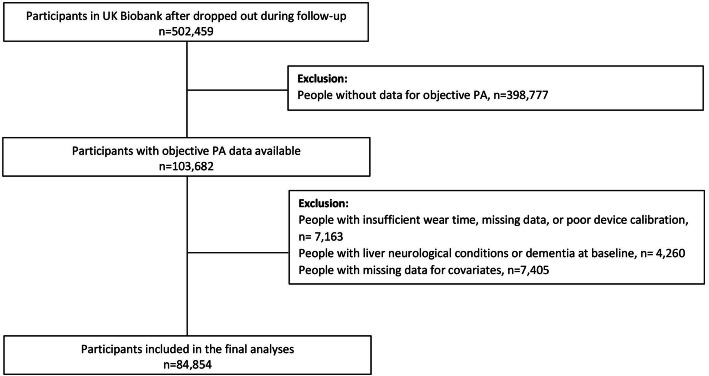
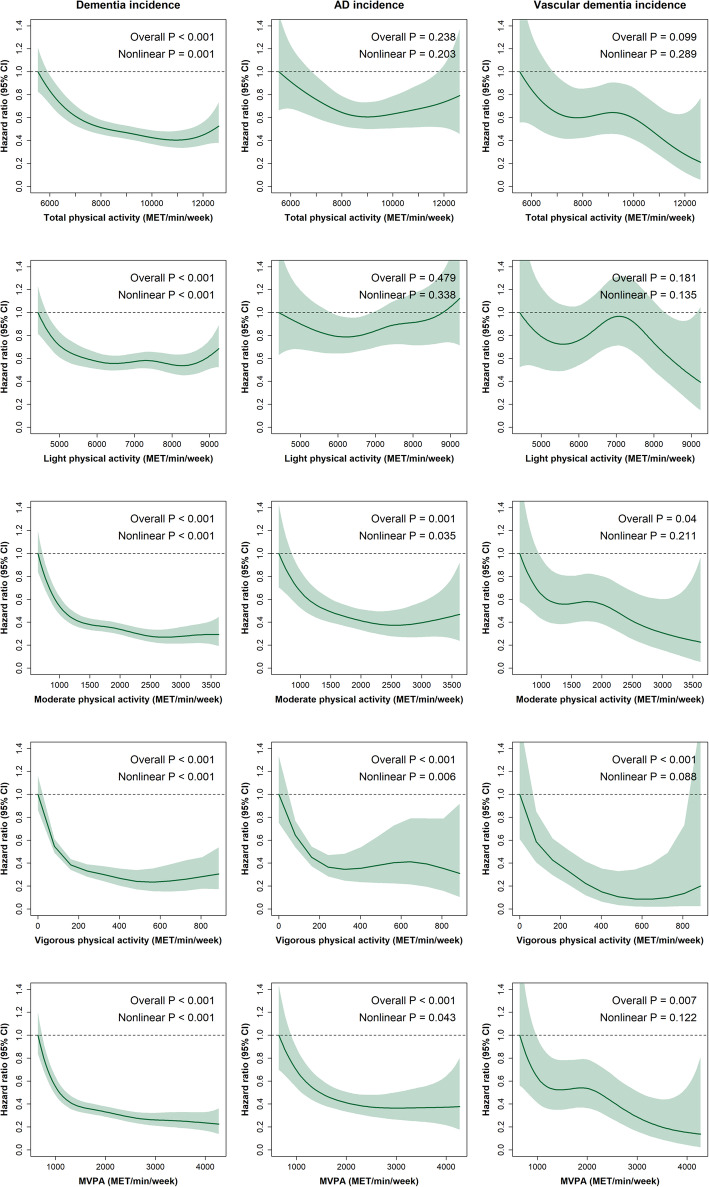
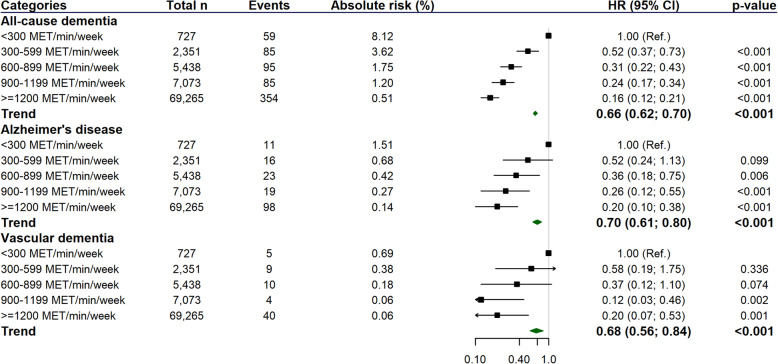
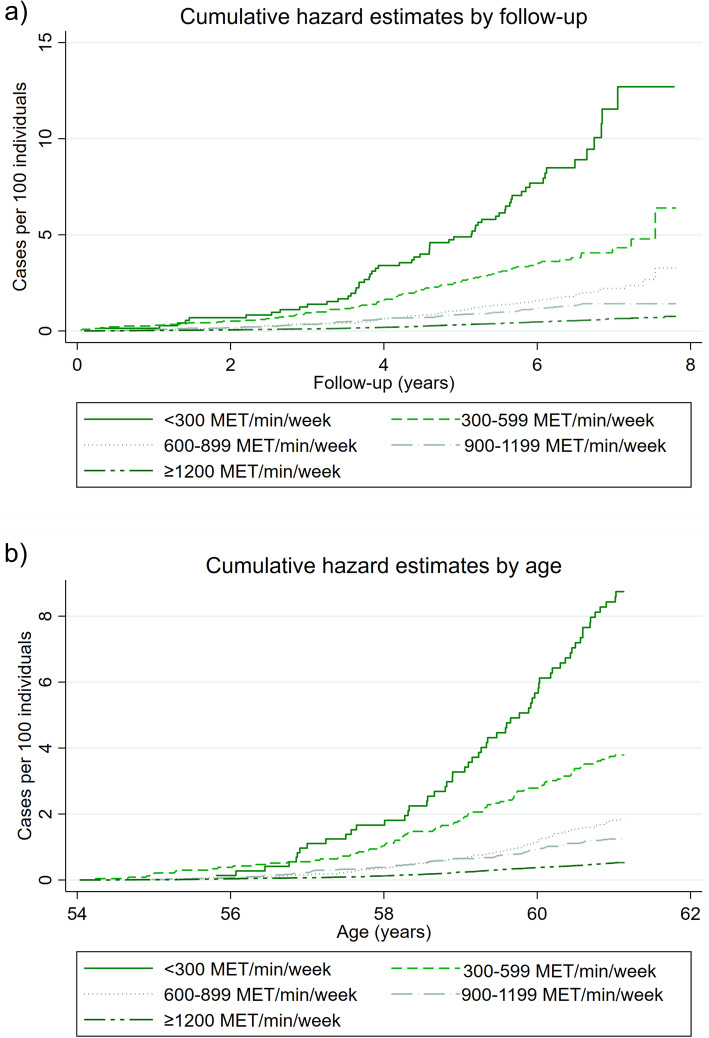
Background: Previous cohort studies have investigated the relationship between self-reported physical activity (PA) and dementia. Evidence from objective device-measured PA data is lacking. This study aimed to explore the association of device-measured PA with the risk of dementia incidence and common subtypes (Alzheimer’s disease [AD] and vascular dementia) using the UK Biobank study. Methods: 84,854 participants (55.8% women), invited to participate in the device-measured PA between 2013 and 2015, were included in this prospective cohort study. Wrist accelerometers were used to measure light, moderate, vigorous, moderate-to-vigorous PA (MVPA) and total PA intensity and duration (MET/min/week). Incident dementia (fatal and non-fatal) was extracted from hospital episodes records for incidence and death register for mortality. Incidence follow-up was carried out until the end of March 2021in England and Scotland and the end of March 2018 in Wales. Mortality data were available until February 2021. Nonlinear associations were first investigated using penalised cubic splines fitted in the Cox proportional hazard models. In addition, using MVPA, five categories were created. Associations of these categories with the outcomes were investigated using Cox proportional hazard models. Analyses were adjusted for sociodemographic, lifestyle and health-related factors. Results: After a median follow-up of 6.3 years, 678 individuals were diagnosed with dementia. Evidence of nonlinearity was observed for all PA modes and all-cause dementia. For categories of MVPA, there was a significant trend towards a low risk of overall dementia when higher levels of MVPA were achieved (HR trend 0.66 [95% CI 0.62 to 0.70]. The lowest risk was identified in individuals who performed more than 1200 MET/min/week, those who had 84% (95% CI 0.12 to 0.21) lower risk of incident dementia compared to those who performed < 300 MET/min/week. Conclusions: Participants with higher PA levels had a lower risk of incident dementia than those less active, independently of sociodemographic, lifestyle factors and comorbidity. Considering that the majority of previous studies have reported this association using self-reported data, our findings highlight the strong inverse association between PA objectively measured and incident dementia.
Overview
The claims and statistics of this paper haven’t been checked yet.
Free: it reads the open-access text and checks the first 5 claims that cite a source we can check. Create a free account to check every claim.
Integrity signals
Registry
Cites
Statistics
Figures
Verification
Claims the paper makes
The claims and statistics of this paper haven’t been checked yet.
Free: it reads the open-access text and checks the first 5 claims that cite a source we can check. Create a free account to check every claim.
Claims other papers make about this one
Each is checked against this paper’s own text: does it say what the citing paper says it does?
The source backs part of the claim, not all of it — or backs it for a different population, condition or comparison.
In the citing paper
“Evidence further supports a dose-dependent inverse relationship between PA levels and the risk of mild cognitive impairment (MCI) and dementia [416].”
From Global consensus on optimal exercise recommendations for enhancing healthy longevity in older adults (ICFSR) (2025) · cites this paper as [416]
Experimental — accuracy not yet measuredIn the citing paper
“Evidence further supports a dose-dependent inverse relationship between PA levels and the risk of mild cognitive impairment (MCI) and dementia [416].”
From Global consensus on optimal exercise recommendations for enhancing healthy longevity in older adults (ICFSR) (2025) · cites this paper as [416]
Self-check
Percentages, sums and reported differences re-computed from the paper’s own numbers.
The self-check needs the paper’s full text.
Citations
Cites
1 retracted
Dementia prevention, intervention, and care: 2020 report of the Lancet Commission
Livingston, G., Huntley, J., Sommerlad, A., Ames, D., Ballard, C., Banerjee, S., Brayne, C., Burns, A., Cohen-Mansfield, J., Cooper, C., et al. (2020) · The Lancet · doi:10.1016/s0140-6736(20)30367-6 · Cited by 10,430 · cited 2×
“This is highly relevant considering that around 50 million individuals are living with dementia worldwide, at a cost to the global economy of US$1trillion each year [5].”
BackgroundRetracted(2000) · PubMed · Cited by 13,173
Sudlow, C., Gallacher, J., Allen, N., Beral, V., Burton, P., Danesh, J., Downey, P., Elliott, P., Green, J., Landray, M., et al. (2015) · PLOS Medicine · doi:10.1371/journal.pmed.1001779 · Cited by 12,728 · cited 5×
“Dates and causes of hospital admissions were identified via record linkage to Health Episode Statistics (HES) (England and Wales) and the Scottish Morbidity Records (SMR01) (Scotland).”
BackgroundInfluentialSelf-citationBarnett, K., Mercer, S. W., Norbury, M., Watt, G., Wyke, S., & Guthrie, B. (2012) · The Lancet · doi:10.1016/s0140-6736(12)60240-2 · Cited by 6,972 · cited 1×
“We calculated morbidity count based on 43 long-term conditions (including depression) developed initially for a large epidemiological study in Scotland and subsequently adapted for UK Biobank [31, 32].”
MethodGuthold, R., Stevens, G. A., Riley, L. M., & Bull, F. C. (2018) · The Lancet Global Health · doi:10.1016/s2214-109x(18)30357-7 · Cited by 4,819 · cited 1×
“5% of the worldwide population was physically inactive in 2016 [3].”
BackgroundFry, A., Littlejohns, T. J., Sudlow, C., Doherty, N., Adamska, L., Sprosen, T., Collins, R., & Allen, N. E. (2017) · American Journal of Epidemiology · doi:10.1093/aje/kwx246 · Cited by 3,979 · cited 1×
“estimates can be generalised [43], summary statistics such as prevalence and incidence should not.”
BackgroundPrince, S. A., Adamo, K. B., Hamel, M., Hardt, J., Connor Gorber, S., & Tremblay, M. (2008) · International Journal of Behavioral Nutrition and Physical Activity · doi:10.1186/1479-5868-5-56 · Cited by 3,162 · cited 3×
“However, to date, research evidence contributing to the understanding of the association of PA with dementia risk has been largely derived from studies using subjective and self-reported data on PA [6–14], which are prone to recall biases, particularly in distinguishing level and intensities of activity [15, 16].”
Health benefits of physical activity: a systematic review of current systematic reviews
Warburton, D. E. R., & Bredin, S. S. D. (2017) · Current Opinion in Cardiology · doi:10.1097/hco.0000000000000437 · Cited by 2,410 · cited 1×
“ated with several health benefits and reduces the risk of adverse health outcomes throughout the life cycle [1, 2].”
BackgroundEkelund, U., Tarp, J., Steene-Johannessen, J., Hansen, B. H., Jefferis, B., Fagerland, M. W., Whincup, P., Diaz, K. M., Hooker, S. P., Chernofsky, A., et al. (2019) · BMJ · doi:10.1136/bmj.l4570 · Cited by 1,769 · cited 1×
“This has been illustrated for other health outcomes, where the health benefits associated with device-measured PA were more than twice as big as those estimated from questionnaires [17].”
BackgroundDoherty, A., Jackson, D., Hammerla, N., Plötz, T., Olivier, P., Granat, M. H., White, T., van Hees, V. T., Trenell, M. I., Owen, C. G., et al. (2017) · PLOS ONE · doi:10.1371/journal.pone.0169649 · Cited by 1,250 · cited 2×
“The dominant wrist of each individual was used over a period of 7 days at 100 Hz, as has been described elsewhere [22].”
BackgroundMethodWhat makes UK Biobank special?
Collins, R. (2012) · The Lancet · doi:10.1016/s0140-6736(12)60404-8 · Cited by 1,128
Physical Activity, Diet, and Risk of Alzheimer Disease
Scarmeas, N. (2009) · JAMA · doi:10.1001/jama.2009.1144 · Cited by 916
Total daily physical activity and the risk of AD and cognitive decline in older adults
Buchman, A. S., Boyle, P. A., Yu, L., Shah, R. C., Wilson, R. S., & Bennett, D. A. (2012) · Neurology · doi:10.1212/wnl.0b013e3182535d35 · Cited by 730 · cited 3×
“To date, only one previous study has investigated this association using device-measured PA [18].”
BackgroundInfluentialHealth and deprivation. Inequality and the North
Mackenbach, J. P. (1988) · Health Policy · doi:10.1016/0168-8510(88)90006-1 · Cited by 661
Sabia, S., Dugravot, A., Dartigues, J.-F., Abell, J., Elbaz, A., Kivimäki, M., & Singh-Manoux, A. (2017) · BMJ · doi:10.1136/bmj.j2709 · Cited by 440
Palmer, L. J. (2007) · The Lancet · doi:10.1016/s0140-6736(07)60924-6 · Cited by 373
Wearable-device-measured physical activity and future health risk
Strain, T., Wijndaele, K., Dempsey, P. C., Sharp, S. J., Pearce, M., Jeon, J., Lindsay, T., Wareham, N., & Brage, S. (2020) · Nature Medicine · doi:10.1038/s41591-020-1012-3 · Cited by 355 · cited 1×
“Using the accelerometer data in milligravities (mg) units, we first determined the duration of PA in minutes per week (min/week) of light, moderate and vigorous PA as the time spent between 30-mg and 125-mg, 125-mg and 400-mg and above 400-mg of activity intensity for light, moderate and vigorous PA, respectively [24,…”
MethodKivimäki, M., Singh-Manoux, A., Pentti, J., Sabia, S., Nyberg, S. T., Alfredsson, L., Goldberg, M., Knutsson, A., Koskenvuo, M., Koskinen, A., et al. (2019) · BMJ · doi:10.1136/bmj.l1495 · Cited by 313 · cited 2×
“when comparing physically active with inactive individuals when restricting follow-up time to ≥ 10 years [45].”
BackgroundBrasure, M., Desai, P., Davila, H., Nelson, V. A., Calvert, C., Jutkowitz, E., Butler, M., Fink, H. A., Ratner, E., Hemmy, L. S., et al. (2018) · Annals of Internal Medicine · doi:10.7326/m17-1528 · Cited by 280
Willetts, M., Hollowell, S., Aslett, L., Holmes, C., & Doherty, A. (2018) · Scientific Reports · doi:10.1038/s41598-018-26174-1 · Cited by 250 · cited 1×
“More details about data collection, validation and processing can be found elsewhere [22, 23].”
BackgroundAre Self-report Measures Able to Define Individuals as Physically Active or Inactive?
STEENE-JOHANNESSEN, J., ANDERSSEN, S. A., VAN DER PLOEG, H. P., HENDRIKSEN, I. J. M., DONNELLY, A. E., BRAGE, S., & EKELUND, U. (2016) · Medicine & Science in Sports & Exercise · doi:10.1249/mss.0000000000000760 · Cited by 234 · cited 3×
“However, to date, research evidence contributing to the understanding of the association of PA with dementia risk has been largely derived from studies using subjective and self-reported data on PA [6–14], which are prone to recall biases, particularly in distinguishing level and intensities of activity [15, 16].”
BackgroundMethodResultPhysical Activity, Brain Volume, and Dementia Risk: The Framingham Study
Tan, Z. S., Spartano, N. L., Beiser, A. S., DeCarli, C., Auerbach, S. H., Vasan, R. S., & Seshadri, S. (2016) · The Journals of Gerontology Series A: Biological Sciences and Medical Sciences · doi:10.1093/gerona/glw130 · Cited by 212
Du, Z., Li, Y., Li, J., Zhou, C., Li, F., & Yang, X. (2018) · Clinical Interventions in Aging · doi:10.2147/cia.s169565 · Cited by 201 · cited 2×
“Although our study provides evidence of an inverse association between device-measured PA and dementia risk, our findings are not entirely consistent with recent causal evidence derived from Mendelian randomisation (MR) studies [36–38] or meta-analyses of randomised controlled trials [39, 40].”
BackgroundResultCognitive and physical activity and dementia: A 44-year longitudinal population study of women
Najar, J., Östling, S., Gudmundsson, P., Sundh, V., Johansson, L., Kern, S., Guo, X., Hällström, T., & Skoog, I. (2019) · Neurology · doi:10.1212/wnl.0000000000007021 · Cited by 189
Associations between physical frailty and dementia incidence: a prospective study from UK Biobank
Petermann-Rocha, F., Lyall, D. M., Gray, S. R., Esteban-Cornejo, I., Quinn, T. J., Ho, F. K., Pell, J. P., & Celis-Morales, C. (2020) · The Lancet Healthy Longevity · doi:10.1016/s2666-7568(20)30007-6 · Cited by 180
Self-citationWhite, T., Westgate, K., Hollidge, S., Venables, M., Olivier, P., Wareham, N., & Brage, S. (2019) · International Journal of Obesity · doi:10.1038/s41366-019-0352-x · Cited by 157 · cited 1×
“Using the accelerometer data in milligravities (mg) units, we first determined the duration of PA in minutes per week (min/week) of light, moderate and vigorous PA as the time spent between 30-mg and 125-mg, 125-mg and 400-mg and above 400-mg of activity intensity for light, moderate and vigorous PA, respectively [24,…”
MethodCausal associations between modifiable risk factors and the Alzheimer's phenome
Andrews, S. J., Fulton‐Howard, B., O'Reilly, P., Marcora, E., Goate, A. M., & collaborators of the Alzheimer's Disease Genetics Consortium (2021) · Annals of Neurology · doi:10.1002/ana.25918 · Cited by 156 · cited 1×
“The authors reported no association between AD and a genetic instrumental PA variable derived from 8 SNPs (Single Nucleotide Polymorphisms) with device-measured vigorous PA [38].”
BackgroundGovindarajulu, U. S., Malloy, E. J., Ganguli, B., Spiegelman, D., & Eisen, E. A. (2009) · The International Journal of Biostatistics · doi:10.2202/1557-4679.1104 · Cited by 139
Nicholl, B. I., Mackay, D., Cullen, B., Martin, D. J., Ul-Haq, Z., Mair, F. S., Evans, J., McIntosh, A. M., Gallagher, J., Roberts, B., et al. (2014) · BMC Psychiatry · doi:10.1186/preaccept-1965461416135619 · Cited by 127 · cited 1×
“We calculated morbidity count based on 43 long-term conditions (including depression) developed initially for a large epidemiological study in Scotland and subsequently adapted for UK Biobank [31, 32].”
MethodSelf-citationStubbs, B., Chen, L.-J., Chang, C.-Y., Sun, W.-J., & Ku, P.-W. (2017) · Experimental Gerontology · doi:10.1016/j.exger.2017.03.003 · Cited by 93 · cited 2×
“95)] reduction in cognitive decline [41].”
BackgroundMidlife physical activity, psychological distress, and dementia risk: the HUNT study
Zotcheva, E., Bergh, S., Selbæk, G., Krokstad, S., Håberg, A. K., Strand, B. H., & Ernstsen, L. (2018) · Journal of Alzheimer's Disease · doi:10.3233/jad-180768 · Cited by 87
Petermann-Rocha, F., Ho, F. K., Foster, H., Boopor, J., Parra-Soto, S., Gray, S. R., Mathers, J. C., Celis-Morales, C., & Pell, J. P. (2021) · Mayo Clinic Proceedings · doi:10.1016/j.mayocp.2021.01.036 · Cited by 86 · cited 1×
“and non-oily fish), processed meat and red meat was also self-reported and then categorised into ‘do not meet the recommendations’ or ‘meet the recommendations’ following current UK Guidelines as it has been described elsewhere [30].”
BackgroundSelf-citationBody mass index, diet, physical inactivity, and the incidence of dementia in 1 million UK women
Floud, S., Simpson, R. F., Balkwill, A., Brown, A., Goodill, A., Gallacher, J., Sudlow, C., Harris, P., Hofman, A., Parish, S., et al. (2020) · Neurology · doi:10.1212/wnl.0000000000008779 · Cited by 85
Korologou-Linden, R., Bhatta, L., Brumpton, B. M., Howe, L. D., Millard, L. A. C., Kolaric, K., Ben-Shlomo, Y., Williams, D. M., Smith, G. D., Anderson, E. L., et al. (2022) · Nature Communications · doi:10.1038/s41467-022-32183-6 · Cited by 71
Hansson, O., Svensson, M., Gustavsson, A.-M., Andersson, E., Yang, Y., Nägga, K., Hållmarker, U., James, S., & Deierborg, T. (2019) · Alzheimer's Research & Therapy · doi:10.1186/s13195-019-0538-4 · Cited by 57
Halloway, S., Arfanakis, K., Wilbur, J., Schoeny, M. E., & Pressler, S. J. (2018) · The Journals of Gerontology Series B · doi:10.1093/geronb/gby010 · Cited by 56 · cited 2×
“Individuals from the Rush Memory and Aging Project with higher daily PA levels also had larger grey matter volumes (including subcortical and total volume), highlighting the overall positive effect of PA on mental health and brain structure [42].”
BackgroundPhysical activity pre- and post-dementia: English Longitudinal Study of Ageing
Soni, M., Orrell, M., Bandelow, S., Steptoe, A., Rafnsson, S., d'Orsi, E., Xavier, A., & Hogervorst, E. (2019) · Aging & Mental Health · doi:10.1080/13607863.2017.1390731 · Cited by 54
Physical activity and dementia: Long-term follow-up study of adult twins
Iso-Markku, P., Waller, K., Kujala, U. M., & Kaprio, J. (2015) · Annals of Medicine · doi:10.3109/07853890.2014.994675 · Cited by 50
Duprè, C., Bongué, B., Helmer, C., Dartigues, J., Hupin, D., Roche, F., Berr, C., & Carrière, I. (2020) · BMC Geriatrics · doi:10.1186/s12877-020-01538-3 · Cited by 43
Physical activity and risk of Alzheimer disease: A 2-sample mendelian randomization study
Baumeister, S. E., Karch, A., Bahls, M., Teumer, A., Leitzmann, M. F., & Baurecht, H. (2020) · Neurology · doi:10.1212/wnl.0000000000010013 · Cited by 40
On the interpretation of risk and rate advancement periods
Discacciati, A., Bellavia, A., Orsini, N., & Greenland, S. (2016) · International Journal of Epidemiology · doi:10.1093/ije/dyv320 · Cited by 39 · cited 1×
“the number of additional chronologic years that would be required to yield the equivalent risk rate for dementia incidence among the categories of MVPA—was also estimated as described previously [34, 35].”
Folley, S., Zhou, A., Llewellyn, D. J., & Hyppönen, E. (2019) · Journal of Alzheimer’s Disease · doi:10.3233/jad-181132 · Cited by 25 · cited 3×
“Additionally, we did not adjust for apolipoprotein E (APOE)-polymorphism, a major risk factor for dementia.”
ResultInfluentialKorologou-Linden, R., Howe, L. D., Millard, L. A. C., et al. (2019) · medRxiv · doi:10.1101/2019.12.18.19013847 · Cited by 15
Research works printed but not linked: 2
- WHO WHO guidelines on physical activity and sedentary behaviour 2020 World Health Organization 33369898
- IPAQ Guidelines for Data Processing and Analysis of the International Physical Activity Questionnaire (IPAQ) – Short and Long Forms 2005
Cited by
Izquierdo, M., de Souto Barreto, P., Arai, H., Bischoff-Ferrari, H. A., Cadore, E. L., Cesari, M., Chen, L.-K., Coen, P. M., Courneya, K. S., Duque, G., et al. (2025) · The Journal of nutrition, health and aging · doi:10.1016/j.jnha.2024.100401 · Cited by 273
A Proteomics-Based Approach for Prediction of Different Cardiovascular Diseases and Dementia
Ho, F. K. W., Mark, P. B., Lees, J. S., Pell, J. P., Strawbridge, R. J., Kimenai, D. M., Mills, N. L., Woodward, M., McMurray, J. J. V., Sattar, N. A., et al. (2024) · Circulation · doi:10.1161/circulationaha.124.070454 · Cited by 93
Self-citationZhang, X., Li, Q., Cong, W., Mu, S., Zhan, R., Zhong, S., Zhao, M., Zhao, C., Kang, K., & Zhou, Z. (2023) · Ageing Research Reviews · doi:10.1016/j.arr.2023.102127 · Cited by 61
Reparaz-Escudero, I., Izquierdo, M., Bischoff-Ferrari, H. A., Martínez-Lage, P., & Sáez de Asteasu, M. L. (2024) · Ageing Research Reviews · doi:10.1016/j.arr.2024.102463 · Cited by 45
Petermann-Rocha, F. E., Deo, S. V., Lyall, D. M., Orkaby, A. R., Quinn, T. J., Sattar, N. A., Celis-Morales, C. A., Pell, J. P., & Ho, F. K. W. (2023) · Current Problems in Cardiology · doi:10.1016/j.cpcardiol.2023.101934 · Cited by 41
“34 Our RAPs analyses highlighted that following healthier lifestyle patterns could delay the effect of ageing on cognitive decline.”
BackgroundSelf-citation
Metadata
- Authors
- Petermann-Rocha, F., Lyall, D. M., Gray, S. R., Gill, J. M. R., Sattar, N., Welsh, P., Quinn, T. J., Stewart, W., Pell, J. P., Ho, F. K., & Celis-Morales, C.
- Affiliations
- British Heart Foundation (GB)
- University of Glasgow (GB)
- Universidad Mayor (CL)
- Corresponding author
- Celis-Morales, Carlos
- ORCID
- Venue
- BMC Medicine
- Published
- 2021-12
- Volume
- 19
- Issue
- 1
- Pages
- 305-305
- ISSN
- 1741-7015 (ISSN-L)
- PMC
- PMC8638378
- OpenAlex
- W3215387477
- Cited by
- 60
- References
- 42
- Citations by year
- 2026: 9 · 2025: 13 · 2024: 15 · 2023: 20 · 2022: 2 · 2021: 1
- FWCI
- 6.82
- Type
- journal article
- Language
- en
- Open access
- gold
- doi.org
- Licence
- cc-by
- creativecommons.org/licenses/by/4.0 (tdm)
- creativecommons.org/licenses/by/4.0 (vor, 1 d)
- Locations
- BMC Medicine (publishedVersion, cc-by)
- PubMed Central (publishedVersion, cc-by)
- PubMed (publishedVersion)
- ENLIGHTEN (Jurnal Bimbingan dan Konseling Islam) (acceptedVersion, cc-by-sa)
- DOAJ (DOAJ: Directory of Open Access Journals) (submittedVersion, cc-by-sa)
- Funders
- anid-chile (ANID-Becas Chile 2018 – 72190067)
- Topics
- Health Sciences › Medicine › Psychiatry and Mental health › Dementia and Cognitive Impairment Research
- Health Sciences › Medicine › Public Health, Environmental and Occupational Health › Physical Activity and Health
- Health Sciences › Medicine › Critical Care and Intensive Care Medicine › Intensive Care Unit Cognitive Disorders
- Keywords
- physical activity, dementia, device-measured physical activity, accelerometry, moderate-to-vigorous physical activity, Alzheimer's disease, vascular dementia, dose-response relationship, incident dementia risk, UK Biobank
- MeSH terms
- Dementia, Female, United Kingdom, Humans, Male, Prospective Studies, Exercise, Biological Specimen Banks
About these checks
Registry, retraction, Cites and statistics results are computed, not judged, with one exception: a printed reference that no index lists is read once by a model before it counts as a citation error. Claims are extracted by a model and kept only when their quote appears verbatim in the text; each cited source is then checked, with a model’s help, for whether it says what the claim relies on. Those verdicts can be wrong — read the claim’s quote and the cited source before relying on one.
Statistics and arithmetic are recomputed, not judged.
Confidence bands are shown only for fields calibrated on our annotated test set. None is calibrated yet, so no band is shown.
What counts as a claim ›How we measure confidence ›How we check this ›
Are you an author, or do you see a problem with this page? Request a review
Data sources
Bibliographic data: Semantic Scholar, OpenAlex, Crossref.
Contains information from the Semantic Scholar Academic Graph Datasets, made available under the ODC Attribution License (ODC-BY 1.0).
Semantic Scholar’s data is described in: Kinney, R., et al. (2023). The Semantic Scholar Open Data Platform. arXiv:2301.10140.
