

The DOI matches its Crossref record; 191 of the 191 references it cites were found in a registry or an index.
Artificial intelligence in the risk prediction models of cardiovascular disease and development of an independent validation screening tool: a systematic review
Open accessAbstract
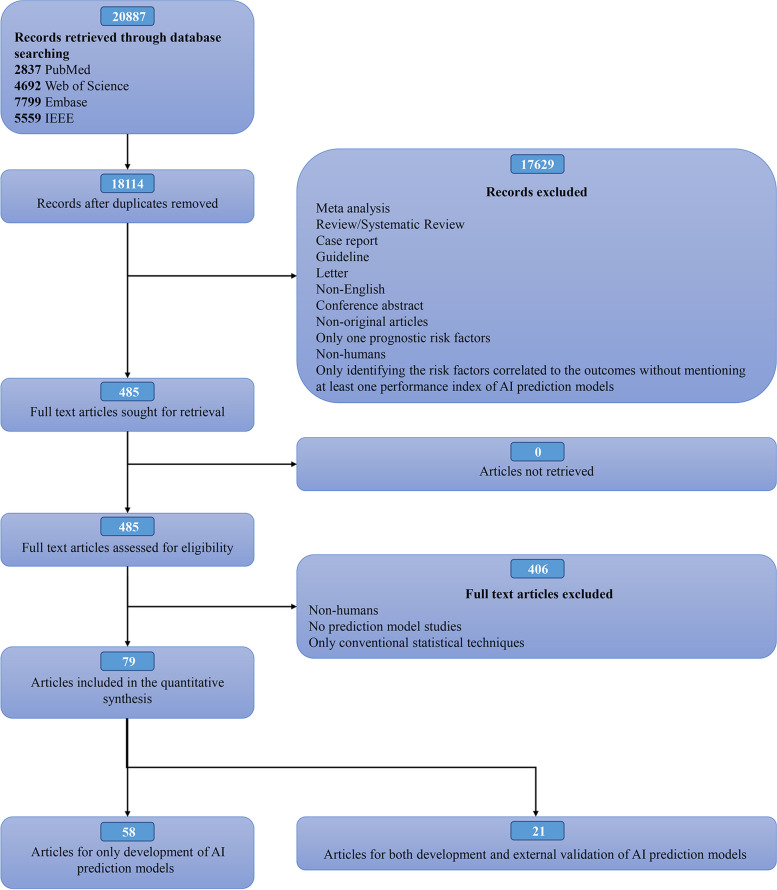
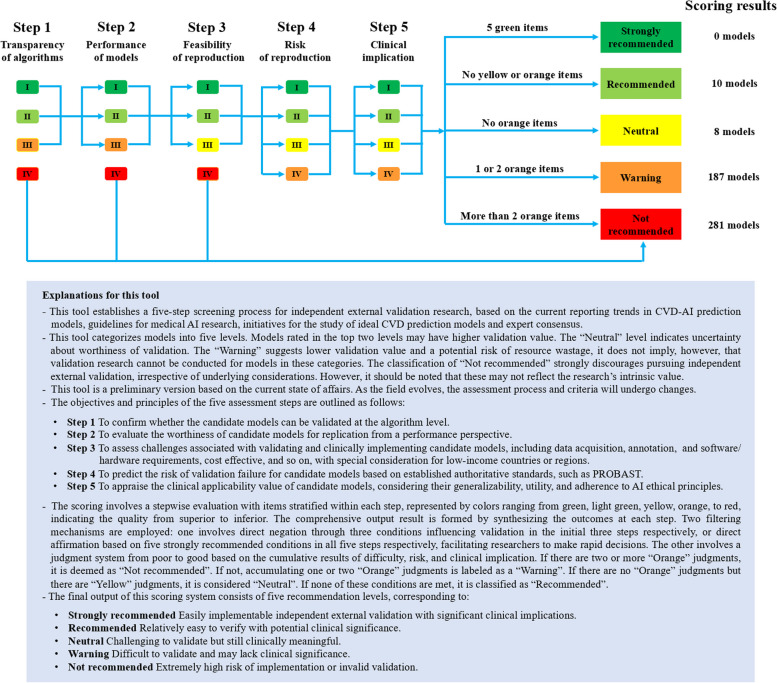
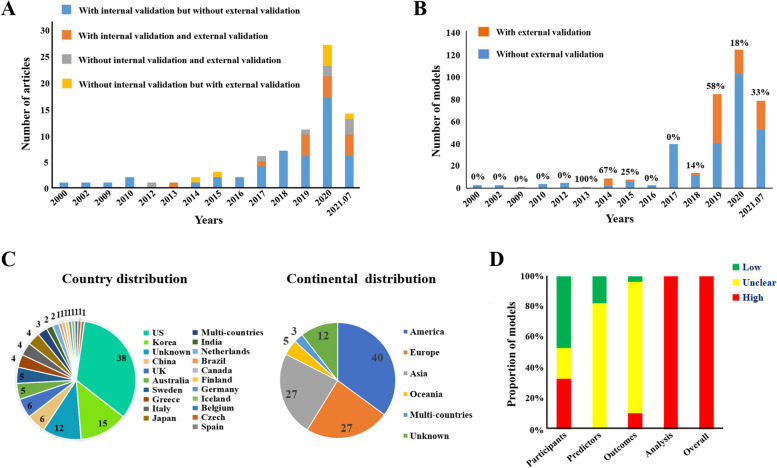
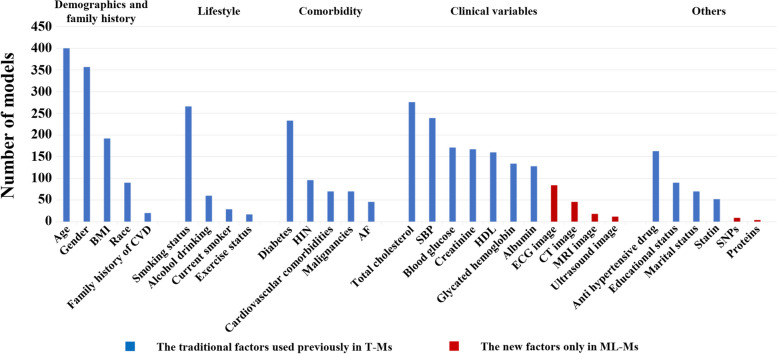
Background: A comprehensive overview of artificial intelligence (AI) for cardiovascular disease (CVD) prediction and a screening tool of AI models (AI-Ms) for independent external validation are lacking. This systematic review aims to identify, describe, and appraise AI-Ms of CVD prediction in the general and special populations and develop a new independent validation score (IVS) for AI-Ms replicability evaluation. Methods: PubMed, Web of Science, Embase, and IEEE library were searched up to July 2021. Data extraction and analysis were performed for the populations, distribution, predictors, algorithms, etc. The risk of bias was evaluated with the prediction risk of bias assessment tool (PROBAST). Subsequently, we designed IVS for model replicability evaluation with five steps in five items, including transparency of algorithms, performance of models, feasibility of reproduction, risk of reproduction, and clinical implication, respectively. The review is registered in PROSPERO (No. CRD42021271789). Results: In 20,887 screened references, 79 articles (82.5% in 2017–2021) were included, which contained 114 datasets (67 in Europe and North America, but 0 in Africa). We identified 486 AI-Ms, of which the majority were in development ( n = 380), but none of them had undergone independent external validation. A total of 66 idiographic algorithms were found; however, 36.4% were used only once and only 39.4% over three times. A large number of different predictors (range 5–52,000, median 21) and large-span sample size (range 80–3,660,000, median 4466) were observed. All models were at high risk of bias according to PROBAST, primarily due to the incorrect use of statistical methods. IVS analysis confirmed only 10 models as “recommended”; however, 281 and 187 were “not recommended” and “warning,” respectively. Conclusion: AI has led the digital revolution in the field of CVD prediction, but is still in the early stage of development as the defects of research design, report, and evaluation systems. The IVS we developed may contribute to independent external validation and the development of this field.
Overview
The claims and statistics of this paper haven’t been checked yet.
Run the check — free, no account needed. It reads the open-access text and checks the sources it cites.
Integrity signals
Registry
Cites
Statistics
Figures
Verification
Claims the paper makes
The claims and statistics of this paper haven’t been checked yet.
Run the check — free, no account needed. It reads the open-access text and checks the sources it cites.
Claims other papers make about this one
Each is checked against this paper’s own text: does it say what the citing paper says it does?
The source backs part of the claim, not all of it — or backs it for a different population, condition or comparison.
In the citing paper
“Numerous studies have demonstrated that algorithms such as neural networks and gradient boosting machines exhibit superior discriminative ability over traditional methods in predicting cardiovascular complications in diabetes (6–8).”
From AI-driven cardiovascular risk prediction in patients with diabetes: bridging algorithmic innovation to equitable clinical application (2026) · cites this paper as [7]
Experimental — accuracy not yet measuredThe source backs part of the claim, not all of it — or backs it for a different population, condition or comparison.
In the citing paper
“A large proportion of studies rely on populations from Europe and North America, with inadequate representation of Asian and other non-Western groups, directly compromising clinical applicability in high-burden regions (6, 7).”
From AI-driven cardiovascular risk prediction in patients with diabetes: bridging algorithmic innovation to equitable clinical application (2026) · cites this paper as [7]
Experimental — accuracy not yet measuredThe source backs part of the claim, not all of it — or backs it for a different population, condition or comparison.
In the citing paper
“A large proportion of studies rely on populations from Europe and North America, with inadequate representation of Asian and other non-Western groups, directly compromising clinical applicability in high-burden regions (6, 7).”
From AI-driven cardiovascular risk prediction in patients with diabetes: bridging algorithmic innovation to equitable clinical application (2026) · cites this paper as [7]
Experimental — accuracy not yet measuredThe source backs part of the claim, not all of it — or backs it for a different population, condition or comparison.
In the citing paper
“Despite excellent algorithmic results in many studies, systematic evaluations have revealed a high prevalence of risk of bias, primarily stemming from deficiencies in the participant selection domain, outcome measurement domain, and analysis domain (6, 7).”
From AI-driven cardiovascular risk prediction in patients with diabetes: bridging algorithmic innovation to equitable clinical application (2026) · cites this paper as [7]
Experimental — accuracy not yet measuredThe source backs part of the claim, not all of it — or backs it for a different population, condition or comparison.
In the citing paper
“As a consequence, even models that perform exceptionally well on development datasets often show substantially lower or uncertain performance in external settings, highlighting a critical limitation in generalizability (7, 8).”
From AI-driven cardiovascular risk prediction in patients with diabetes: bridging algorithmic innovation to equitable clinical application (2026) · cites this paper as [7]
Experimental — accuracy not yet measured
The source backs part of the claim, not all of it — or backs it for a different population, condition or comparison.
In the citing paper
“Furthermore, current models are predominantly developed using populations from Europe and North America, resulting in a critical lack of representativeness for Asian populations, where the burden of cardiovascular disease is particularly heavy.”
From AI-driven cardiovascular risk prediction in patients with diabetes: bridging algorithmic innovation to equitable clinical application (2026) · cites this paper as [7]
Experimental — accuracy not yet measured
Self-check
Percentages, sums and reported differences re-computed from the paper’s own numbers.
The self-check needs the paper’s full text.
Citations
Cites
Global Burden of Cardiovascular Diseases and Risk Factors, 1990–2019
Roth, G. A., Mensah, G. A., Johnson, C. O., Addolorato, G., Ammirati, E., Baddour, L. M., Barengo, N. C., Beaton, A. Z., Benjamin, E. J., Benziger, C. P., et al. (2020) · Journal of the American College of Cardiology · doi:10.1016/j.jacc.2020.11.010 · Cited by 11,449
High-performance medicine: the convergence of human and artificial intelligence
Topol, E. J. (2019) · Nature Medicine · doi:10.1038/s41591-018-0300-7 · Cited by 10,450
Prediction of coronary heart disease using risk factor categories
Wilson, P. W. F., D’Agostino, R. B., Levy, D., Belanger, A. M., Silbershatz, H., & Kannel, W. B. (1998) · Circulation · doi:10.1161/01.cir.97.18.1837 · Cited by 9,581
Roffi, M., Patrono, C., Collet, J.-P., Mueller, C., Valgimigli, M., Andreotti, F., Bax, J. J., Borger, M. A., Brotons, C., Chew, D. P., et al. (2016) · European Heart Journal · doi:10.1093/eurheartj/ehv320 · Cited by 8,261
Decision curve analysis: a novel method for evaluating prediction models
Vickers, A. J., & Elkin, E. B. (2006) · Medical Decision Making · doi:10.1177/0272989x06295361 · Cited by 6,341
Radiomics: the bridge between medical imaging and personalized medicine
Lambin, P., Leijenaar, R. T. H., Deist, T. M., Peerlings, J., de Jong, E. E. C., van Timmeren, J., Sanduleanu, S., Larue, R. T. H. M., Even, A. J. G., Jochems, A., et al. (2017) · Nature Reviews Clinical Oncology · doi:10.1038/nrclinonc.2017.141 · Cited by 5,688
Estimation of ten-year risk of fatal cardiovascular disease in Europe: the SCORE project
Conroy, R. (2003) · European Heart Journal · doi:10.1016/s0195-668x(03)00114-3 · Cited by 5,290
Moons, K. G. M., Altman, D. G., Reitsma, J. B., Ioannidis, J. P. A., Macaskill, P., Steyerberg, E. W., Vickers, A. J., Ransohoff, D. F., & Collins, G. S. (2015) · Annals of Internal Medicine · doi:10.7326/m14-0698 · Cited by 5,147
Arnett, D. K., Blumenthal, R. S., Albert, M. A., Buroker, A. B., Goldberger, Z. D., Hahn, E. J., Himmelfarb, C. D., Khera, A., Lloyd-Jones, D., McEvoy, J. W., et al. (2019) · Circulation · doi:10.1161/cir.0000000000000678 · Cited by 4,536
(2019) · doi:10.1161/cir.0000000000000677 · Cited by 4,501
Research works printed but not linked: 2
- Vollmer S, Mateen BA, Bohner G, Király FJ, Ghani R, Jonsson P, Cumbers S, Jonas A, McAllister KSL, Myles P, et al. Machine learning and artificial intelligence research for patient benefit: 20 critical questions on transparency, replicability, ethics, and effectiveness. BMJ. 2020;368:l6927. https://doi.org/10.1136/bmj.l6927. · DOI
- Directorate-General for Communications Networks, Content and Technology (2019) Ethics guidelines for trustworthy AI https://www.data.europa.eu/doi/10.2759/177365. · DOI
Cited by
Sorted by citations
Innovation and challenges of artificial intelligence technology in personalized healthcare
Li, Y.-H., Li, Y., Wei, M.-Y., & Li, G.-Y. (2024) · Scientific Reports · doi:10.1038/s41598-024-70073-7 · Cited by 342
Transforming Cardiovascular Care With Artificial Intelligence: From Discovery to Practice
Khera, R., Oikonomou, E. K., Nadkarni, G. N., Morley, J., Wiens, J., Butte, A. J., & Topol, E. J. (2024) · Journal of the American College of Cardiology · doi:10.1016/j.jacc.2024.05.003 · Cited by 324
Liu, T., Krentz, A., Lu, L., & Curcin, V. (2025) · European Heart Journal - Digital Health · doi:10.1093/ehjdh/ztae080 · Cited by 177
DNA methylation in cardiovascular disease and heart failure: novel prediction models?
Desiderio, A., Pastorino, M., Campitelli, M., Longo, M., Miele, C., Napoli, R., Bèguinot, F., & Raciti, G. A. (2024) · Clinical Epigenetics · doi:10.1186/s13148-024-01722-x · Cited by 57
The Heart of Transformation: Exploring Artificial Intelligence in Cardiovascular Disease
Chowdhury, M. A., Rizk, R., Chiu, C., Zhang, J., Scholl, J. L., Bosch, T. J., Singh, A. P., Baugh, L. A., McGough, J. S., Santosh, K., et al. (2025) · Biomedicines · doi:10.3390/biomedicines13020427 · Cited by 60
Metadata
- Authors
- Cai, Y., Cai, Y.-Q., Tang, L.-Y., Wang, Y.-H., Gong, M., Jing, T.-C., Li, H.-J., Li-Ling, J., Hu, W., Yin, Z., Gong, D.-X., & Zhang, G.-W.
- Affiliations
- China Medical University (CN)
- Digital China Health (China) (CN)
- First Hospital of China Medical University (CN)
- Corresponding author
- Yin, Zhihua
- Gong, Da-Xin
- Venue
- BMC Medicine
- Published
- 2024-02-05
- Volume
- 22
- Issue
- 1
- Pages
- 56-56
- ISSN
- 1741-7015 (ISSN-L)
- PMC
- PMC10845808
- OpenAlex
- W4391531696
- Cited by
- 122
- References
- 191
- Citations by year
- 2026: 62 · 2025: 45 · 2024: 15
- FWCI
- 9.58
- Type
- journal article
- Language
- en
- Open access
- gold
- doi.org
- Locations
- BMC Medicine (publishedVersion, cc-by)
- PubMed Central (publishedVersion, cc-by)
- PubMed (publishedVersion)
- DOAJ (DOAJ: Directory of Open Access Journals) (submittedVersion, cc-by-sa)
- Funders
- National Key Research and Development Program of China (2020YFC2006406)
- Topics
- Health Sciences › Health Professions › Health Information Management › Artificial Intelligence in Healthcare
- Health Sciences › Medicine › Health Informatics › Artificial Intelligence in Healthcare and Education
- Physical Sciences › Computer Science › Artificial Intelligence › Machine Learning in Healthcare
- Keywords
- artificial intelligence, cardiovascular disease, risk prediction model, algorithmic transparency, risk of bias, PROBAST, clinical prediction tool, digital health
- MeSH terms
- Heart Disease Risk Factors, Prediction Methods, Machine, Africa, Algorithms, Artificial Intelligence, Cardiovascular Diseases, Europe, Humans, Mass Screening, Reproducibility of Results, Risk Assessment, Datasets as Topic
About these checks
Registry, retraction, Cites and statistics results are computed, not judged, with one exception: a printed reference that no index lists is read once by a model before it counts as a citation error. Claims are extracted by a model and kept only when their quote appears verbatim in the text; each cited source is then checked, with a model’s help, for whether it says what the claim relies on. Those verdicts can be wrong — read the claim’s quote and the cited source before relying on one.
Statistics and arithmetic are recomputed, not judged.
Confidence bands are shown only for fields calibrated on our annotated test set. None is calibrated yet, so no band is shown.
What counts as a claim ›How we measure confidence ›How we check this ›
Are you an author, or do you see a problem with this page? Request a review
