

The DOI matches its Crossref record; 1 of the 1 references it cites were found in a registry or an index.
Protein truncating variants in mitochondrial-related nuclear genes and the risk of chronic liver disease
Open accessAbstract
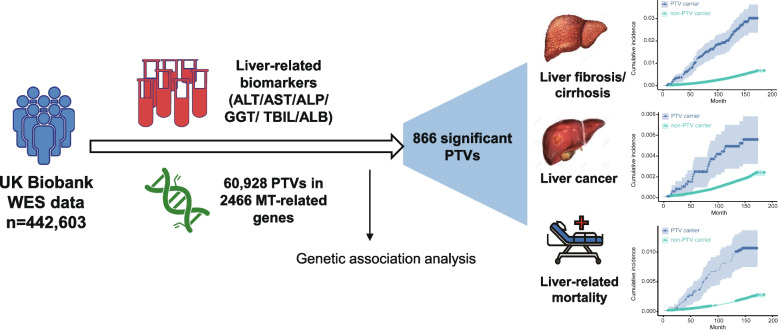
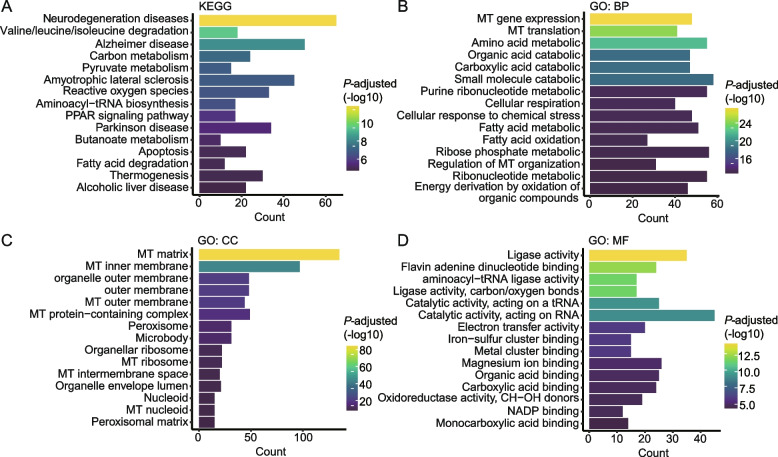
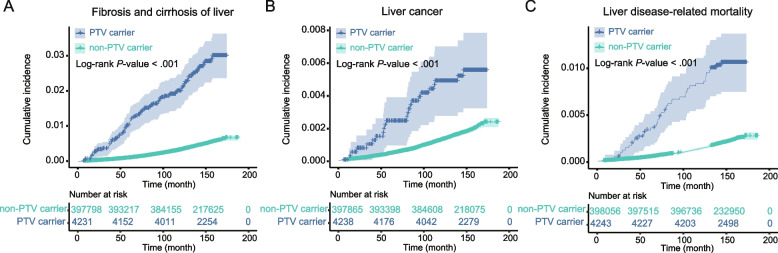
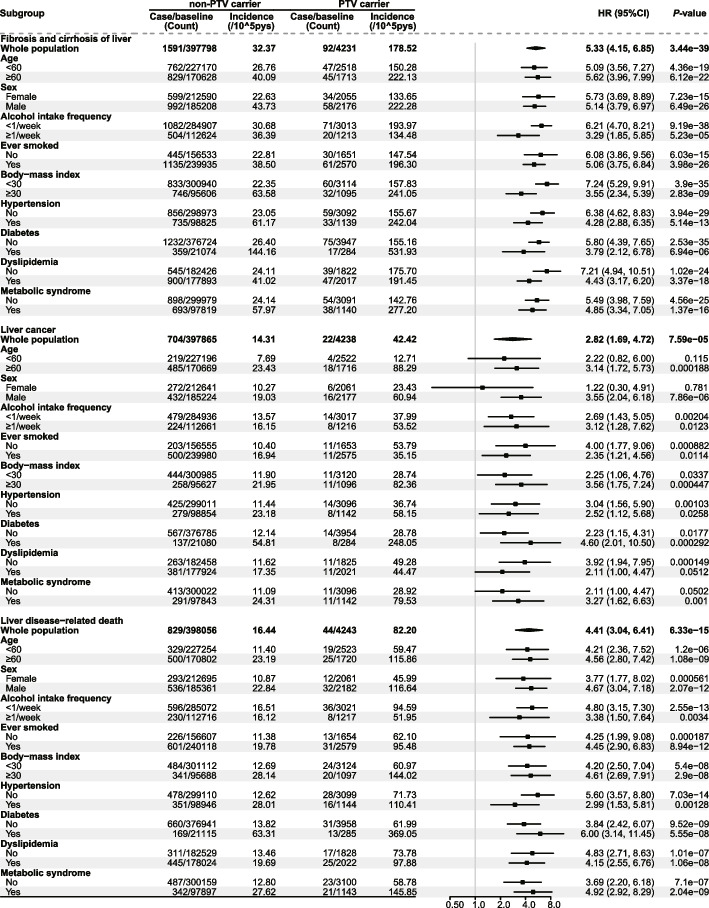
Background: Mitochondrial (MT) dysfunction is a hallmark of liver diseases. However, the effects of functional variants such as protein truncating variants (PTVs) in MT-related genes on the risk of liver diseases have not been extensively explored. Methods: We extracted 60,928 PTVs across 2466 MT-related nucleus genes using whole-exome sequencing data obtained from 442,603 participants in the UK Biobank. We examined their associations with liver dysfunction that represented by the liver-related biomarkers and the risks of chronic liver diseases and liver-related mortality. Results: 96.10% of the total participants carried at least one PTV. We identified 866 PTVs that were positively associated with liver dysfunction at the threshold of P value < 8.21e − 07. The coding genes of these PTVs were mainly enriched in pathways related to lipid, fatty acid, amino acid, and carbohydrate metabolisms. The 866 PTVs were presented in 1.07% (4721) of participants. Compared with participants who did not carry any of the PTVs, the carriers had a 5.33-fold (95% CI 4.15–6.85), 2.82-fold (1.69–4.72), and 4.41-fold (3.04–6.41) increased risk for fibrosis and cirrhosis of liver, liver cancer, and liver disease-related mortality, respectively. These adverse effects were consistent across subgroups based on age, sex, body mass index, smoking status, and presence of hypertension, diabetes, dyslipidemia, and metabolic syndrome. Conclusions: Our findings revealed a significant impact of PTVs in MT-related genes on liver disease risk, highlighting the importance of these variants in identifying populations at risk of liver diseases and facilitating early clinical interventions.
Overview
The claims and statistics of this paper haven’t been checked yet.
Run the check — free, no account needed. It reads the open-access text and checks the sources it cites.
Integrity signals
Registry
Cites
Statistics
Figures
Verification
Claims the paper makes
The claims and statistics of this paper haven’t been checked yet.
Run the check — free, no account needed. It reads the open-access text and checks the sources it cites.
Claims other papers make about this one
Each is checked against this paper’s own text: does it say what the citing paper says it does?
The source backs part of the claim, not all of it — or backs it for a different population, condition or comparison.
In the citing paper
“Recent population-scale genomic analysis demonstrated that protein-truncating variants in mitochondrial-related nuclear genes markedly increase the risks of hepatic fibrosis, cirrhosis, and related mortality, underscoring mitochondrial dysfunction as a causal determinant of chronic liver disease [119].”
From Mechanisms, efficacy, and future perspectives of cellular-based therapies for liver fibrosis/cirrhosis: focusing on mesenchymal stromal cells (2025) · cites this paper as [119]
Experimental — accuracy not yet measured
Self-check
Percentages, sums and reported differences re-computed from the paper’s own numbers.
The self-check needs the paper’s full text.
Citations
Cites
Peng, J.-K., Hepgul, N., Higginson, I. J., & Gao, W. (2019) · Palliative Medicine · doi:10.1177/0269216318807051 · Cited by 283
Research works printed but not linked: 30
- Sepanlou SG, Safiri S, Bisignano C, Ikuta KS, Merat S, Saberifiroozi M, Poustchi H, Tsoi D, Colombara DV, Abdoli A, et al. The global, regional, and national burden of cirrhosis by cause in 195 countries and territories, 1990–2017: a systematic analysis for the Global Burden of Disease Study 2017. Lancet Gastroenterol Hepatol. 2020;5(3):245–66. · DOI · Paper page
- Cheemerla S, Balakrishnan M. Global epidemiology of chronic liver disease. Clin Liver Dis (Hoboken). 2021;17(5):365–70. · DOI · Paper page
- Huang DQ, Singal AG, Kono Y, Tan DJH, El-Serag HB, Loomba R. Changing global epidemiology of liver cancer from 2010 to 2019: NASH is the fastest growing cause of liver cancer. Cell Metab. 2022;34(7):969-977.e962. · DOI
- Morio B, Panthu B, Bassot A, Rieusset J. Role of mitochondria in liver metabolic health and diseases. Cell Calcium. 2021;94:102336. · DOI
- El-Hattab AW, Craigen WJ, Scaglia F. Mitochondrial DNA maintenance defects. Biochim Biophys Acta Mol Basis Dis. 2017;1863(6):1539–55. · DOI
- Ramanathan R, Ali AH, Ibdah JA. Mitochondrial dysfunction plays central role in nonalcoholic fatty liver disease. Int J Mol Sci. 2022;23(13):7280. · DOI
- Lee HY, Nga HT, Tian J, Yi HS. Mitochondrial metabolic signatures in hepatocellular carcinoma. Cells. 2021;10(8):1901. · DOI
- Kraja AT, Liu C, Fetterman JL, Graff M, Have CT, Gu C, Yanek LR, Feitosa MF, Arking DE, Chasman DI, et al. Associations of mitochondrial and nuclear mitochondrial variants and genes with seven metabolic traits. Am J Hum Genet. 2019;104(1):112–38. · DOI
- DeBoever C, Tanigawa Y, Lindholm ME, McInnes G, Lavertu A, Ingelsson E, Chang C, Ashley EA, Bustamante CD, Daly MJ, et al. Medical relevance of protein-truncating variants across 337,205 individuals in the UK Biobank study. Nat Commun. 2018;9(1):1612. · DOI
- Bycroft C, Freeman C, Petkova D, Band G, Elliott LT, Sharp K, Motyer A, Vukcevic D, Delaneau O, O’Connell J, et al. The UK Biobank resource with deep phenotyping and genomic data. Nature. 2018;562(7726):203–9. · DOI · Paper page
- Backman JD, Li AH, Marcketta A, Sun D, Mbatchou J, Kessler MD, Benner C, Liu D, Locke AE, Balasubramanian S, et al. Exome sequencing and analysis of 454,787 UK Biobank participants. Nature. 2021;599(7886):628–34. · DOI
- McLaren W, Gil L, Hunt SE, Riat HS, Ritchie GR, Thormann A, Flicek P, Cunningham F. The Ensembl Variant Effect Predictor. Genome Biol. 2016;17(1):122. · DOI · Paper page
- Karczewski KJ, Francioli LC, Tiao G, Cummings BB, Alföldi J, Wang Q, Collins RL, Laricchia KM, Ganna A, Birnbaum DP, et al. The mutational constraint spectrum quantified from variation in 141,456 humans. Nature. 2020;581(7809):434–43. · DOI · Paper page
- Rath S, Sharma R, Gupta R, Ast T, Chan C, Durham TJ, Goodman RP, Grabarek Z, Haas ME, Hung WHW, et al. MitoCarta3.0: an updated mitochondrial proteome now with sub-organelle localization and pathway annotations. Nucleic Acids Res. 2021;49(D1):D1541-d1547. · DOI · Paper page
- Smith AC, Robinson AJ. MitoMiner v4.0: an updated database of mitochondrial localization evidence, phenotypes and diseases. Nucleic Acids Res. 2019;47(D1):D1225-d1228. · DOI
- Cotter D, Guda P, Fahy E, Subramaniam S. MitoProteome: mitochondrial protein sequence database and annotation system. Nucleic Acids Res. 2004;32(Database issue):D463-467. · DOI
- Chang CC, Chow CC, Tellier LC, Vattikuti S, Purcell SM, Lee JJ. Second-generation PLINK: rising to the challenge of larger and richer datasets. Gigascience. 2015;4:7. · DOI · Paper page
- Yu G, Wang LG, Han Y, He QY. clusterProfiler: an R package for comparing biological themes among gene clusters. OMICS. 2012;16(5):284–7. · DOI · Paper page
- Saklayen MG. The global epidemic of the metabolic syndrome. Curr Hypertens Rep. 2018;20(2):12. · DOI · Paper page
- Schwantes-An TH, Darlay R, Mathurin P, Masson S, Liangpunsakul S, Mueller S, Aithal GP, Eyer F, Gleeson D, Thompson A, et al. Genome-wide association study and meta-analysis on alcohol-associated liver cirrhosis identifies genetic risk factors. Hepatology. 2021;73(5):1920–31. · DOI
- Yang J, Trépo E, Nahon P, Cao Q, Moreno C, Letouzé E, Imbeaud S, Gustot T, Deviere J, Debette S, et al. PNPLA3 and TM6SF2 variants as risk factors of hepatocellular carcinoma across various etiologies and severity of underlying liver diseases. Int J Cancer. 2019;144(3):533–44. · DOI
- Emdin CA, Haas M, Ajmera V, Simon TG, Homburger J, Neben C, Jiang L, Wei WQ, Feng Q, Zhou A, et al. Association of genetic variation with cirrhosis: a multi-trait genome-wide association and gene-environment interaction study. Gastroenterology. 2021;160(5):1620-1633.e1613. · DOI
- Bendapudi PK, Nazeen S, Ryu J, Söylemez O, Robbins A, Rouaisnel B, O’Neil JK, Pokhriyal R, Yang M, Colling M, et al. Low-frequency inherited complement receptor variants are associated with purpura fulminans. Blood. 2024;143(11):1032–44. · DOI
- Chambers JC, Zhang W, Sehmi J, Li X, Wass MN, Van der Harst P, Holm H, Sanna S, Kavousi M, Baumeister SE, et al. Genome-wide association study identifies loci influencing concentrations of liver enzymes in plasma. Nat Genet. 2011;43(11):1131–8. · DOI
- Chen VL, Du X, Chen Y, Kuppa A, Handelman SK, Vohnoutka RB, Peyser PA, Palmer ND, Bielak LF, Halligan B, et al. Genome-wide association study of serum liver enzymes implicates diverse metabolic and liver pathology. Nat Commun. 2021;12(1):816. · DOI
- Liu Z, Suo C, Jiang Y, Zhao R, Zhang T, Jin L, Chen X. Phenome-wide association analysis reveals novel links between genetically determined levels of liver enzymes and disease phenotypes. Phenomics. 2022;2(5):295–311. · DOI
- Ozaki M. Cellular and molecular mechanisms of liver regeneration: proliferation, growth, death and protection of hepatocytes. Semin Cell Dev Biol. 2020;100:62–73. · DOI
- Yan S, Yang XF, Liu HL, Fu N, Ouyang Y, Qing K. Long-chain acyl-CoA synthetase in fatty acid metabolism involved in liver and other diseases: an update. World J Gastroenterol. 2015;21(12):3492–8. · DOI
- Mansouri A, Gattolliat CH, Asselah T. Mitochondrial dysfunction and signaling in chronic liver diseases. Gastroenterology. 2018;155(3):629–47. · DOI
- Ortiz M, Soto-Alarcón SA, Orellana P, Espinosa A, Campos C, López-Arana S, Rincón MA, Illesca P, Valenzuela R, Videla LA. Suppression of high-fat diet-induced obesity-associated liver mitochondrial dysfunction by docosahexaenoic acid and hydroxytyrosol co-administration. Dig Liver Dis. 2020;52(8):895–904. · DOI
Cited by
Sorted by citations
Pan, X., Gao, T., & Wang, B. (2025) · Cell & Bioscience · doi:10.1186/s13578-025-01520-9 · Cited by 2
“…population-scale genomic analysis demonstrated that protein-truncating variants in mito-chondrial-related nuclear genes markedly increase the risks of hepatic fibrosis, cirrhosis, and related mortality, underscoring mitochondrial dysfunction as a causal determinant of chronic liver disease [119].”
Metadata
- Authors
- Yuan, H., Liu, Z., Chen, M., Xu, Q., Jiang, Y., Zhang, T., Suo, C., & Chen, X.
- Affiliations
- Fudan University (CN)
- Corresponding author
- Suo, Chen
- Chen, Xingdong
- Venue
- BMC Medicine
- Published
- 2024-06-11
- Volume
- 22
- Issue
- 1
- Pages
- 239-239
- ISSN
- 1741-7015 (ISSN-L)
- PMC
- PMC11167739
- OpenAlex
- W4399544394
- Cited by
- 3
- References
- 1
- Citations by year
- 2026: 1 · 2025: 2
- FWCI
- 0.80
- Type
- journal article
- Language
- en
- Open access
- gold
- doi.org
- Locations
- BMC Medicine (publishedVersion, cc-by)
- PubMed Central (publishedVersion, cc-by)
- PubMed (publishedVersion)
- DOAJ (DOAJ: Directory of Open Access Journals) (submittedVersion)
- Funders
- National Natural Science Foundation of China (82122060, 82204125)
- Fudan University
- Topics
- Life Sciences › Biochemistry, Genetics and Molecular Biology › Genetics › Genetic Associations and Epidemiology
- Life Sciences › Biochemistry, Genetics and Molecular Biology › Molecular Biology › Mitochondrial Function and Pathology
- Life Sciences › Biochemistry, Genetics and Molecular Biology › Genetics › Genomics and Rare Diseases
- Keywords
- truncating mutations, mitochondrial dysfunction, chronic liver disease, liver fibrosis, liver cirrhosis, hepatocellular carcinoma, liver disease mortality, lipid metabolism, amino acid metabolism, carbohydrate metabolism, fatty acid metabolism, genetic risk
- MeSH terms
- Exome Sequencing, Adult, Aged, Chronic Disease, Female, United Kingdom, Humans, Liver Diseases, Male, Middle Aged, Genetic Variation, Genetic Predisposition to Disease, Genes, Mitochondrial
About these checks
Registry, retraction, Cites and statistics results are computed, not judged, with one exception: a printed reference that no index lists is read once by a model before it counts as a citation error. Claims are extracted by a model and kept only when their quote appears verbatim in the text; each cited source is then checked, with a model’s help, for whether it says what the claim relies on. Those verdicts can be wrong — read the claim’s quote and the cited source before relying on one.
Statistics and arithmetic are recomputed, not judged.
Confidence bands are shown only for fields calibrated on our annotated test set. None is calibrated yet, so no band is shown.
What counts as a claim ›How we measure confidence ›How we check this ›
Are you an author, or do you see a problem with this page? Request a review
