

40 Hz biparietal transcranial alternating current stimulation for Alzheimer’s disease: a prospective study
Open accessThe DOI matches its Crossref record; 89 of the 89 references it cites were found in a registry or an index; none of the 71 sources its claims cite is checked for support yet.
Abstract
BACKGROUND: Alzheimer's disease (AD) is characterized by dysfunction in multiple cognitive domains. Patients with AD demonstrate a relative attenuation and dysregulation of theta and gamma oscillations in the temporal and parietal lobes at an early stage. Transcranial alternating current stimulation (tACS) has been shown to modulate neural oscillations in different regions of the brain, affecting higher cognitive functions such as motor function, memory, and learning. OBJECTIVE: To observe the clinical efficacy and after-effects of biparietal 40 Hz tACS in treating AD patients, to analyze its safety and feasibility, and to deeply explore the effects of tACS on time-varying brain networks and dynamic functional connectivity. METHODS: In the study, patients with mild AD who were treated in the First Hospital of Hebei Medical University from October 2022 to August 2023 were recruited, randomly divided into tACS group or Sham group, and then respectively received either biparietal 40 Hz tACS or sham stimulation for 15 consecutive days, each lasting 30 min. Neuropsychological assessment scales were collected to assess the efficacy at three time points: pre-stimulation, post-stimulation, and 10-week follow-up. Additionally, transcranial magnetic stimulation with electroencephalography (TMS-EEG) and functional magnetic resonance imaging (fMRI) were collected to explore time-varying brain networks and functional connectivity. RESULTS: Patients with AD exhibited improvements in global cognition, memory, language, attention, and executive functions following tACS treatment compared with those before treatment. Additionally, the neuropsychiatric inventory scores were decreased significantly after tACS treatment. The clinical efficacies were not obvious in Sham group. These results indicated that tACS treatment had significant short-term efficacy and good stability. The brain time-varying EEG network patterns were analyzed using the adaptive directed transfer function. The analysis showed enhanced information flows from the temporal and prefrontal regions and from the posterior to anterior regions after tACS treatment. In contrast, decreased information flow was observed from the left to right frontal regions. The fMRI analysis revealed enhanced connectivity within default mode network and between default mode network and Frontoparietal network after active treatment. CONCLUSIONS: The 40 Hz biparietal tACS is a potentially safe and effective treatment for AD with certain long-term efficacy by modulating dynamic functional connectivity. TRIAL REGISTRATION: The trial was retrospectively registered at the Chinese Clinical Trial Registry (registration number: ChiCTR2500115019).
Overview
CoChat Summary
TL;DR
In a single-blinded, sham-controlled trial of 34 completers with mild Alzheimer’s disease, 15 days of 40 Hz biparietal HD-tACS improved several cognitive and neuropsychiatric measures versus sham at post-stimulation, with some benefits persisting at 10-week follow-up. TMS-EEG and rs-fMRI suggested treatment-related changes in time-varying information flow and dynamic functional connectivity, especially within the default mode network and between the default mode network and frontoparietal network.
Key findings
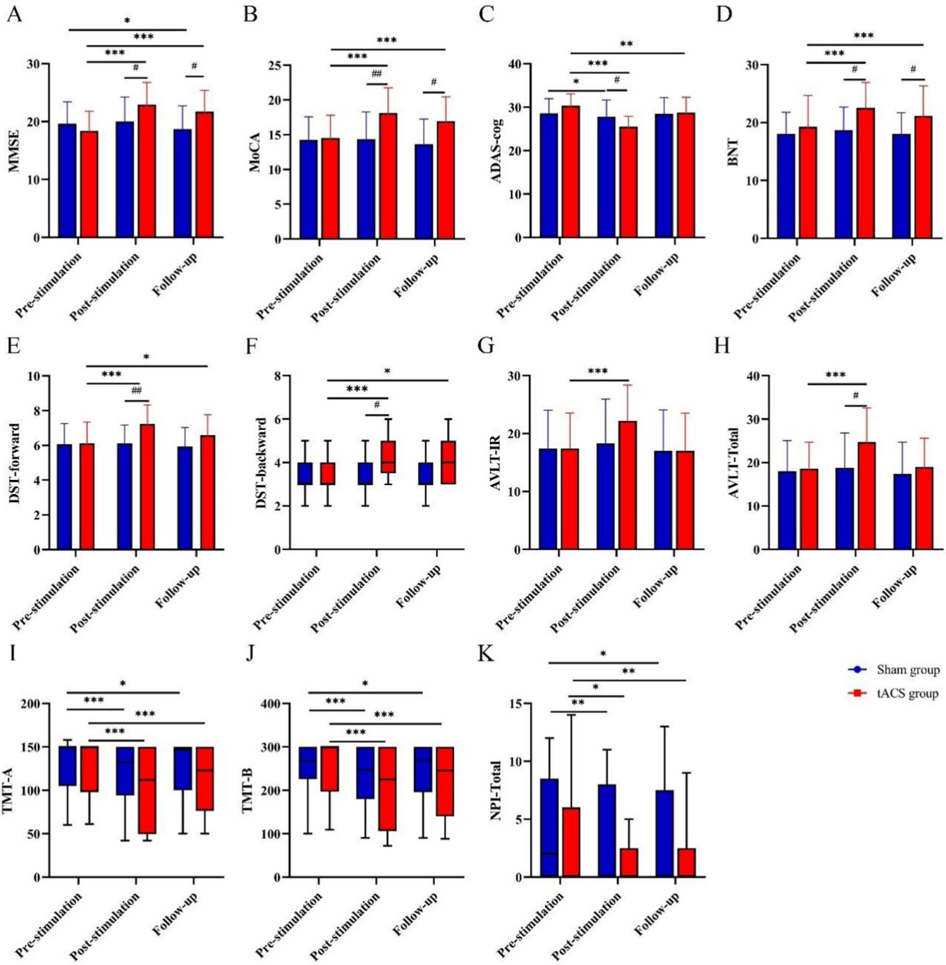
- In the tACS group, all neuropsychological scales improved from pre- to post-stimulation. At 10-week follow-up, MMSE, MoCA, ADAS-cog, BNT, DST-forward, DST-backward, TMT-A, TMT-B, and NPI-Total remained significantly better than baseline. Between-group differences at post-stimulation were significant for MMSE, MoCA, ADAS-cog, BNT, DST-forward, DST-backward, and AVLT-Total; at 10-week follow-up, significant differences remained for MMSE, MoCA, and BNT.
- The Sham group also improved on ADAS-cog, TMT-A, TMT-B, and NPI at post-stimulation; at follow-up, TMT-A, TMT-B, and NPI-Total remained better than baseline, while MMSE was poorer than baseline.
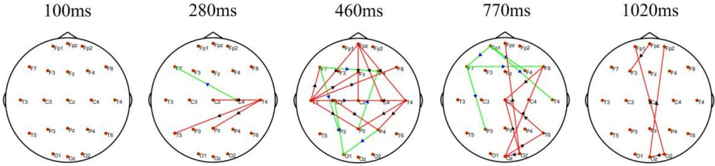
- TMS-EEG showed no significant RMT change (pre 57.88 ± 7.47 vs post 56.94 ± 7.87; t = 1.747, p = 0.100). Enhanced information flow arose from bilateral temporal (T3, T4) and prefrontal (Fpz) regions; at 280–460 ms from T3/T4 to frontal (F7, Fz, F8) and parietal (P4, Pz); at 770–1020 ms from posterior to anterior regions (occipital to prefrontal); and decreased left-to-right frontal flow throughout.
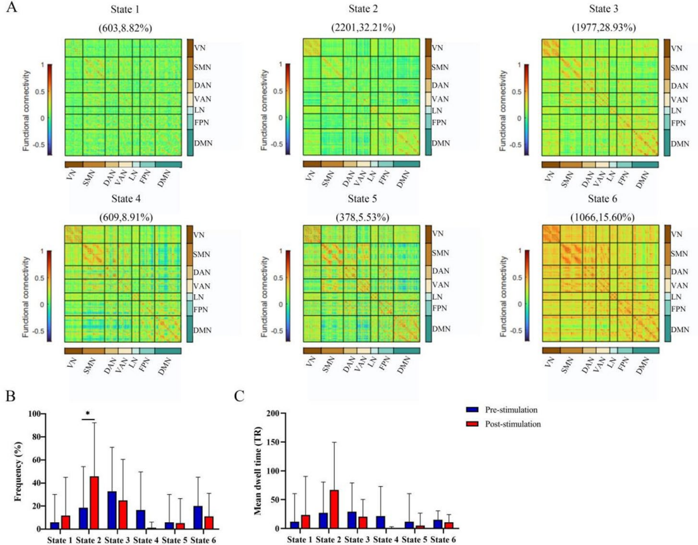
- rs-fMRI dynamic functional connectivity analysis identified 6 recurring states; state 2 (sparse connectivity) had the highest frequency (32.21%). After tACS, frequency and mean dwell time increased for states 1 and 2 and decreased for states 3–6; state 2 frequency was significantly higher post- vs pre-stimulation (p < 0.05), with no significant mean dwell time differences (p > 0.05). Connectivity was enhanced within the DMN and between the DMN and FPN after active treatment. Adverse events: two tACS participants reported transient tingling and one reported mild fatigue; no severe adverse events occurred.
Methods
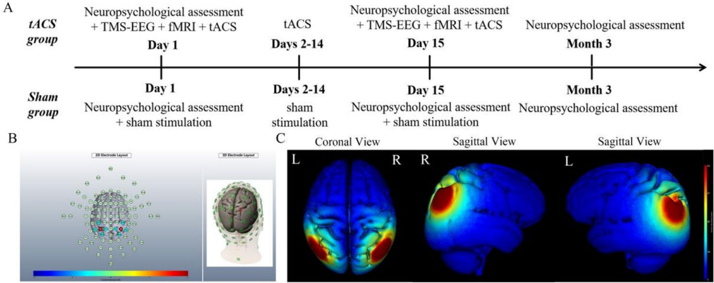
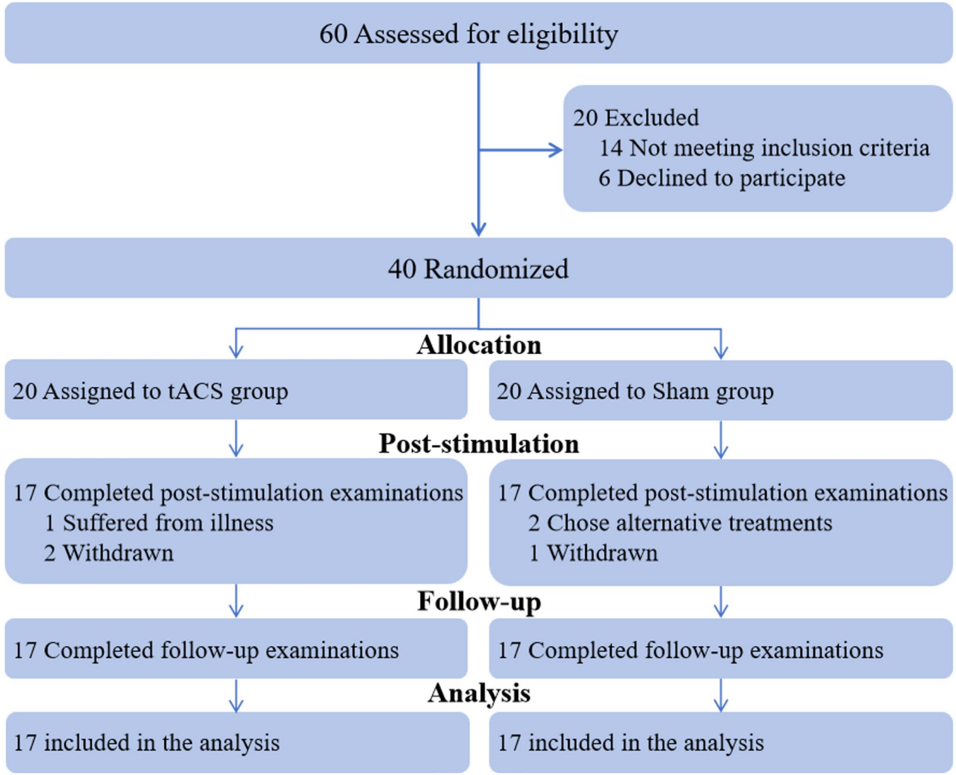
- Randomized, single-blinded, sham-controlled trial. Forty patients with probable AD were recruited at the First Hospital of Hebei Medical University (October 2022–August 2023) and randomized 1:1 to tACS or Sham; 34 completed the trial (17 per group). Inclusion criteria included right-handedness, age 55–85 years, at least 6 years of education, NIA-AA probable AD, and CDR 1.0. Primary outcome was change in ADAS-Cog; secondary outcomes included global cognition, episodic memory, language, executive function, attention, neuropsychiatric symptoms, TMS-EEG network characteristics, and rs-fMRI connectivity.
- Intervention: 40 Hz HD-tACS at 1.5 mA peak-to-peak (current density 0.86 mA/cm²) for 30 min daily for 15 consecutive days, with central electrodes over the posterior parietal cortex (P3/P4) and four surrounding electrodes per hemisphere. Sham stimulation used ramp-up/ramp-down without sustained current. Assessments occurred pre-stimulation, post-stimulation, and at 10-week follow-up.
- Analyses: neuropsychological scales used repeated-measures ANOVA or generalized estimating equations with Bonferroni correction. TMS-EEG time-varying networks used the adaptive directed transfer function. rs-fMRI dynamic functional connectivity used sliding-window analysis and k-means clustering; the results report 6 recurring states, while the methods text states the optimal number was determined to be 3. Sample size estimation required at least 14 participants per group, with at least 34 planned assuming 20% dropout. The trial was retrospectively registered (ChiCTR2500115019).
Limitations
- Stated by the paper: small sample size; no correlation between cognitive improvement and fMRI findings, likely due to the 12–24 h post-intervention scan timing; no standardized quantitative metrics (e.g., ADTF) in TMS-EEG analysis; sham-control group lacked assessments beyond cognitive evaluations; resting-state only, without online or task-specific states; no biomarker data (amyloid/tau imaging, CSF, or plasma assays); and blinding success was not formally assessed.
- Evident from the text: the design was single-blinded, and although participants/caregivers and assessors were blinded, blinding efficacy was not quantitatively tested. Six of 40 recruited patients did not complete the trial and were excluded from final analyses, with no imputation for missing data. Sham stimulation was not entirely current-free because ramp-up/ramp-down currents were delivered, which may have contributed to sham-group improvements. The methods/results inconsistency in the number of dFC states (3 vs 6) also limits reproducibility.
Model-written summary. Check it against the paper before relying on it.
Integrity signals
Registry
Cites
Statistics
Figures
Verification
Claims the paper makes
0 Valid · 0 Not valid · 37 Not checked · 77 Own results and interpretations
A result the paper reports from its own data — it cites no other source for it, so there is none to check. The quote shows it is in the paper.
In the paper
“At post-stimulation, statistically significant differences were observed in MMSE, MoCA, ADAS-cog, BNT, DST-forward, DST-backward, and AVLT-Total scores between the tACS and Sham groups.”
§ 40 Hz biparietal transcranial alternating current stimulation for Alzheimer’s disease: a prospective study > Results > Neuropsychological characteristic
plainstates an association- Asserted: passes — The authors put it forward as true.
- Checkable: passes — It can be checked against evidence.
- Load-bearing: passes — The paper’s conclusions depend on it.
- Based: passes — The paper gives a reason why it holds.
A result the paper reports from its own data — it cites no other source for it, so there is none to check. The quote shows it is in the paper.
In the paper
“In the study, the interaction effect of scores on all neuropsychological assessments was found to be statistically significant (Fig. 3).”
§ 40 Hz biparietal transcranial alternating current stimulation for Alzheimer’s disease: a prospective study > Results > Neuropsychological characteristic
plainstates an association- Asserted: passes — The authors put it forward as true.
- Checkable: passes — It can be checked against evidence.
- Load-bearing: passes — The paper’s conclusions depend on it.
- Based: passes — The paper gives a reason why it holds.
A result the paper reports from its own data — it cites no other source for it, so there is none to check. The quote shows it is in the paper.
In the paper
“Subsequently, an enhanced information flow was induced from Fpz to the temporal (T4, T5) and parietal (Cz, C4) regions.”
§ 40 Hz biparietal transcranial alternating current stimulation for Alzheimer’s disease: a prospective study > Results > Differences in the time-varying EEG network patterns
plainstates a cause- Asserted: passes — The authors put it forward as true.
- Checkable: passes — It can be checked against evidence.
- Load-bearing: unclear — It is unclear whether the paper’s conclusions depend on it.
- Based: passes — The paper gives a reason why it holds.
A result the paper reports from its own data — it cites no other source for it, so there is none to check. The quote shows it is in the paper.
In the paper
“Additionally, the information flow diminished from the left (Fp1, F7) to the right frontal (F4, F8) regions throughout the observation period.”
§ 40 Hz biparietal transcranial alternating current stimulation for Alzheimer’s disease: a prospective study > Results > Differences in the time-varying EEG network patterns
plainstates a cause- Asserted: passes — The authors put it forward as true.
- Checkable: passes — It can be checked against evidence.
- Load-bearing: unclear — It is unclear whether the paper’s conclusions depend on it.
- Based: passes — The paper gives a reason why it holds.
A result the paper reports from its own data — it cites no other source for it, so there is none to check. The quote shows it is in the paper.
In the paper
“Notably, the sham group also exhibited improvements in cognitive tasks.”
§ 40 Hz biparietal transcranial alternating current stimulation for Alzheimer’s disease: a prospective study > Discussion
plain- Asserted: passes — The authors put it forward as true.
- Checkable: passes — It can be checked against evidence.
- Load-bearing: unclear — It is unclear whether the paper’s conclusions depend on it.
- Based: passes — The paper gives a reason why it holds.
40 more claims
Create a free account to see all 114 claims and to verify the 71 references still open.
- It may state two separate claims as one. 49
- Probably not a substantial claim. 34
- The quote only partly states this claim. 1
Self-check
Percentages, sums and reported differences re-computed from the paper’s own numbers.
Each contradiction between two passages listed here was confirmed by an independent check.
Rated major: it would touch a result — a value a result rests on, reported and recomputed p-values on opposite sides of the significance level, two passages that conflict with no sign which is right, or a cited work retracted before this paper was published.
In the paper
§ 40 Hz biparietal transcranial alternating current stimulation for Alzheimer’s disease: a prospective study > Methods > Dynamic functional connectivity (dFC)
“The number was determined to be 3, which means 3 FC states, showing different FC patterns.”
§ 40 Hz biparietal transcranial alternating current stimulation for Alzheimer’s disease: a prospective study > Results > Differences in cluster analysis
“All FC matrices were clustered into 6 connectivity states (Fig. 5A), state 1 (8.82%), state 2 (32.21%), state 3 (28.93%), state 4 (8.91%), state 5 (5.53%) and state 6 (15.60%).”
Citations
Cites
McKhann, G. M., Knopman, D. S., Chertkow, H., Hyman, B. T., Jack, C. R., Kawas, C. H., Klunk, W. E., Koroshetz, W. J., Manly, J. J., Mayeux, R., et al. (2011) · Alzheimer's & Dementia · doi:10.1016/j.jalz.2011.03.005 · Cited by 18,657
Lecanemab in early Alzheimer's disease
van Dyck, C. H., Swanson, C. J., Aisen, P., Bateman, R. J., Chen, C., Gee, M., Kanekiyo, M., Li, D., Reyderman, L., Cohen, S., et al. (2023) · New England Journal of Medicine · doi:10.1056/nejmoa2212948 · Cited by 5,678
Scheltens, P., De Strooper, B., Kivipelto, M., Holstege, H., Chételat, G., Teunissen, C. E., Cummings, J., & van der Flier, W. M. (2021) · The Lancet · doi:10.1016/s0140-6736(20)32205-4 · Cited by 5,465
The Mini‐Mental State Examination: A Comprehensive Review
Tombaugh, T. N., & McIntyre, N. J. (1992) · Journal of the American Geriatrics Society · doi:10.1111/j.1532-5415.1992.tb01992.x · Cited by 5,152 · cited 1×
“…one hand, we think these improvements may be related to the potential learning effects inherent in repeated neuropsychological assessments over short intervals [65, 66], which aligns with previous reports of sham transcranial direct current stimulation (tDCS), improving memory function [50, 67–70].”
Large-scale brain networks and psychopathology: a unifying triple network model
Menon, V. (2011) · Trends in Cognitive Sciences · doi:10.1016/j.tics.2011.08.003 · Cited by 4,168 · cited 1×
“Temporal and frontal lobes are the core nodes of DMN and FPN, and their abnormal functions are potential pathogenesis of AD [74].”
The economy of brain network organization
Bullmore, E., & Sporns, O. (2012) · Nature Reviews Neuroscience · doi:10.1038/nrn3214 · Cited by 3,284 · cited 1×
“The diminution of long-distance connections potentially disrupts functional integration amongst diverse brain regions, which is the basis of cognitive impairment in AD [50, 75].”
Dynamic functional connectivity: Promise, issues, and interpretations
Hutchison, R. M., Womelsdorf, T., Allen, E. A., Bandettini, P. A., Calhoun, V. D., Corbetta, M., Della Penna, S., Duyn, J. H., Glover, G. H., Gonzalez-Castillo, J., et al. (2013) · NeuroImage · doi:10.1016/j.neuroimage.2013.05.079 · Cited by 2,962 · cited 1×
“In comparison to the static functional connectivity, dFC can more accurately reflect the time-varying pattern of brain activity, which helps to reveal deeper brain neural activity [78].”
The projected effect of risk factor reduction on Alzheimer's disease prevalence
Barnes, D. E., & Yaffe, K. (2011) · The Lancet Neurology · doi:10.1016/s1474-4422(11)70072-2 · Cited by 2,666
Amyloid deposition as the central event in the aetiology of Alzheimer’s disease
Hardy, J., & Allsop, D. (1991) · Trends in Pharmacological Sciences · doi:10.1016/0165-6147(91)90609-v · Cited by 2,538 · cited 1×
“The amyloid cascade has long been recognized as the main explanation for the pathogenesis of AD, which is the most common clinical therapeutic target for AD [28, 29].”
Karran, E., Mercken, M., & Strooper, B. D. (2011) · Nature Reviews Drug Discovery · doi:10.1038/nrd3505 · Cited by 2,188 · cited 1×
“The amyloid cascade has long been recognized as the main explanation for the pathogenesis of AD, which is the most common clinical therapeutic target for AD [28, 29].”
Research works printed but not linked: 2
- Li Y, Liu Y, Han YB, Wang HL, Xoa XW. Research progress on the effects of 40 Hz transcranial alternating current stimulation on cognition. Chin J Nerv Mental Dis. 2023;49(2):119–24.
- Yuan YM, Zhang L, Zhang ZG. A review of methods and clinical applications for dynamic functional connectivity analysis based on resting-state functional magnetic resonance imaging. Chin J Magn Reson Imaging. 2018;9(08):579–88.
Metadata
- Authors
- Ma, X., Yuan, M., Gao, Y., Guo, Z., Liang, J., Yan, F., Wang, S., Qiu, H., He, S., Li, Y., & Wang, Y.
- Affiliations
- Hebei Medical University (CN)
- Corresponding author
- Li, Yang
- Wang, Yuping
- Venue
- BMC Medicine
- Published
- 2026-06-26
- Volume
- 24
- Issue
- 1
- Pages
- 531
- ISSN
- 1741-7015 (ISSN-L)
- PMC
- PMC13621547
- OpenAlex
- W7166166567
- Semantic Scholar
- 034d83e3a89f64c4603616dd87fe93f0df1ce426
- Cited by
- 0
- References
- 89
- FWCI
- 0.00
- Type
- journal article
- Language
- en
- Open access
- gold
- doi.org
- Licence
- cc-by-nc-nd
- creativecommons.org/licenses/by-nc-nd/4.0 (tdm)
- creativecommons.org/licenses/by-nc-nd/4.0 (vor, 95 d)
- Locations
- BMC Medicine (publishedVersion, cc-by-nc-nd)
- PubMed Central (publishedVersion, cc-by-nc-nd)
- PubMed (publishedVersion)
- DOAJ (DOAJ: Directory of Open Access Journals) (submittedVersion)
- Funders
- the Brain Science and Brain-like Intelligence Technology Research Projects of China (2021ZD0201800 and 2021ZD0201801)
- the senile disease prevention project of Hebei Province (LNB202204)
- the “Spark” Research Project Outstanding Fund of the First Hospital of Hebei Medical University (XH202402)
- the Medica science research subject of Hebei Provincial Health Commission (20231065)
- Topics
- Life Sciences › Neuroscience › Neurology › Transcranial Magnetic Stimulation Studies
- Life Sciences › Neuroscience › Cellular and Molecular Neuroscience › Alzheimer's disease research and treatments
- Health Sciences › Medicine › Psychiatry and Mental health › Dementia and Cognitive Impairment Research
- Keywords
- Alzheimer's disease, transcranial alternating current stimulation, mild cognitive impairment, dynamic functional connectivity, directed transfer function, default mode network, frontoparietal network, neuropsychological outcomes, neuropsychiatric symptoms
- MeSH terms
- Cognitive Enhancement, Aged, Alzheimer Disease, Brain, Cognition, Electroencephalography, Female, Humans, Magnetic Resonance Imaging, Male, Middle Aged, Neuropsychological Tests, Prospective Studies, Treatment Outcome, Transcranial Direct Current Stimulation
About these checks
Registry, retraction, Cites and statistics results are computed, not judged, with one exception: a printed reference that no index lists is read once by a model before it counts as a citation error. Claims are extracted by a model and kept only when their quote appears verbatim in the text; each cited source is then checked, with a model’s help, for whether it says what the claim relies on. Those verdicts can be wrong — read the claim’s quote and the cited source before relying on one.
A language model drew the claims from the paper on 2026-11-27, under version 3 of the claim definition (model deepseek-v4.1-flash, prompt extract-v3).
A second model labelled each claim on 2026-11-27 (model jev-1.13-20260917, definition revision gold-guideline-v0.2).
Statistics and arithmetic are recomputed, not judged.
Confidence bands are shown only for fields calibrated on our annotated test set. None is calibrated yet, so no band is shown.
What counts as a claim ›How we measure confidence ›How we check this ›
Are you an author, or do you see a problem with this page? Request a review
Data sources
Bibliographic data: Semantic Scholar, OpenAlex, Crossref.
Contains information from the Semantic Scholar Academic Graph Datasets, made available under the ODC Attribution License (ODC-BY 1.0).
Semantic Scholar’s data is described in: Kinney, R., et al. (2023). The Semantic Scholar Open Data Platform. arXiv:2301.10140.
