

Evaluation of ELISA for the detection of rabies virus antibodies from the thoracic liquid and muscle extract samples in the monitoring of fox oral vaccination campaigns
Open accessThe DOI matches its Crossref record; 19 of the 19 references it cites were found in a registry or an index.
Abstract
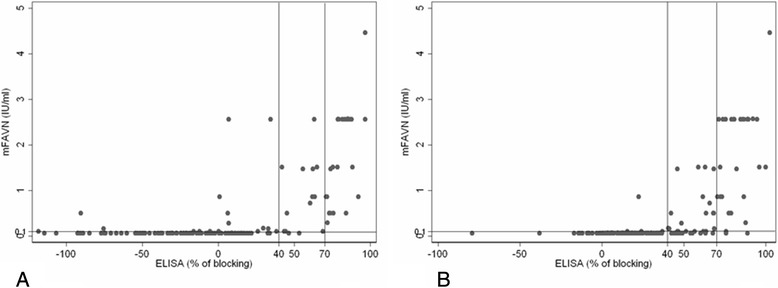
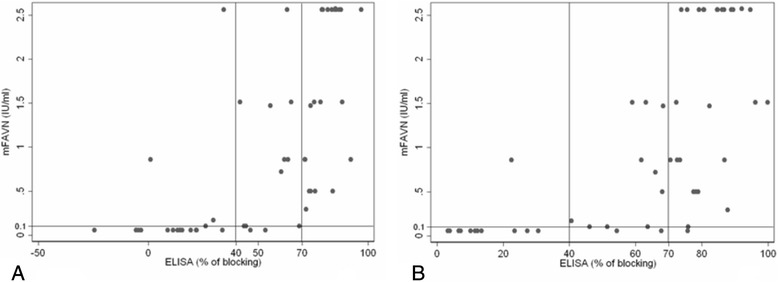
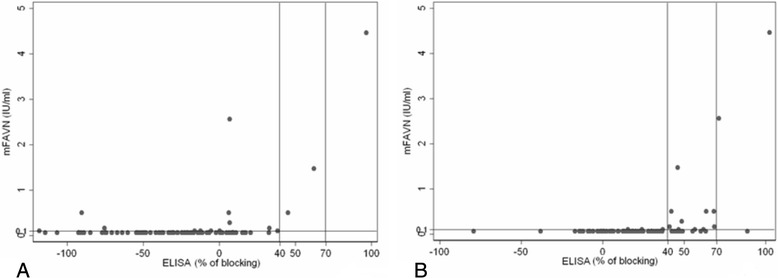
BACKGROUND: The main goal of oral vaccination of foxes is eradication of rabies in the red fox population as rabies reservoirs. To evaluate the success of vaccination a serological testing is conducted as a part of monitoring program. Two different methods are used regarding rabies serology: virus neutralisation test and ELISA. METHODS: In this study the reliability of BioPro ELISA was evaluated for testing haemolytic thoracic liquids and muscle extracts originated from 147 foxes in comparison to mFAVN. Also, the influence of heat treatment of samples on test results was investigated. RESULTS: The specificity of the test for not-heat treated samples was 92.98% and sensitivity 79.20%. Diagnostic validity of the ELISA compared to the mFAVN test when not-heat treated samples were used was 89.16%. The specificity of the test for heat treated samples was 79.10% and sensitivity 96.36%. Diagnostic validity of the BioPro ELISA compared to the mFAVN test for heat treated samples was 94.30%. CONCLUSION: According to this study, the BioPro ELISA is reliable tool for detection of rabies specific antibodies in the context of evaluation of oral vaccination of foxes from poor quality samples as a substitution for virus neutralisation tests.
Overview
The claims and statistics of this paper haven’t been checked yet.
Free: it reads the open-access text and checks the first 5 claims that cite a source we can check. Create a free account to check every claim.
Integrity signals
Registry
Cites
Statistics
Figures
Verification
Claims the paper makes
The claims and statistics of this paper haven’t been checked yet.
Free: it reads the open-access text and checks the first 5 claims that cite a source we can check. Create a free account to check every claim.
Claims other papers make about this one
Each is checked against this paper’s own text: does it say what the citing paper says it does?
The source backs part of the claim, not all of it — or backs it for a different population, condition or comparison.
In the citing paper
“Similarly in Croatia, due to the implementation of the oral rabies vaccination (ORV) campaign in 2011, the number of rabies cases decreased consistently with no cases detected since 2015 [11,12].”
From Genetic and spatial characterization of the red fox (Vulpes vulpes) population in the area stretching between the Eastern and Dinaric Alps and its relationship with rabies and canine distemper dynamics (2019) · cites this paper as [11]
Experimental — accuracy not yet measured
Self-check
Percentages, sums and reported differences re-computed from the paper’s own numbers.
The self-check needs the paper’s full text.
Citations
Cites
A rapid reproducible test for determining rabies neutralizing antibody.
Smith, J. S., Yager, P. A., & Baer, G. Μ. (1973) · Europe PMC (PubMed Central) · Cited by 576
Epidemiologic issues in the validation of veterinary diagnostic tests
Greiner, M., & Gardner, I. A. (2000) · Preventive Veterinary Medicine · doi:10.1016/s0167-5877(00)00114-8 · Cited by 484 · cited 1×
“Evaluation of ELISA and results were interpreted according to previous studies [14, 15].”
ResultCliquet, F., Aubert, M., & Sagné, L. (1998) · Journal of Immunological Methods · doi:10.1016/s0022-1759(97)00212-3 · Cited by 432 · cited 1×
“evaluation of successful vaccination [5–8].”
The elimination of fox rabies from Europe: determinants of success and lessons for the future
Freuling, C. M., Hampson, K., Selhorst, T., Schröder, R., Meslin, F. X., Mettenleiter, T. C., & Müller, T. (2013) · Philosophical Transactions of the Royal Society B: Biological Sciences · doi:10.1098/rstb.2012.0142 · Cited by 266 · cited 2×
“As a part of monitoring, vaccination efficacy is evaluated considering the rabies incidence, bait uptake and humoral immune response [1].”
BackgroundGUTIERREZ DIEZ, F., & CRESPO LEON, F. (2004) · Revue Scientifique et Technique de l'OIE · doi:10.20506/rst.23.3.1542 · Cited by 238
Rabies-Specific Antibodies: Measuring Surrogates of Protection against a Fatal Disease
Moore, S. M., & Hanlon, C. A. (2010) · PLoS Neglected Tropical Diseases · doi:10.1371/journal.pntd.0000595 · Cited by 197 · cited 2×
“1 IU/ml in the RFFIT as originally described [20].”
BackgroundMethodRabies: Scientific Basis of the Disease and Its Management
Jackson, A. C. (2007) · Cited by 193
The immune response to rabies virus infection and vaccination
Johnson, N., Cunningham, A. F., & Fooks, A. R. (2010) · Vaccine · doi:10.1016/j.vaccine.2010.03.039 · Cited by 184 · cited 1×
“evaluation of successful vaccination [5–8].”
Evaluation of ELISA for detection of rabies antibodies in domestic carnivores
Wasniewski, M., & Cliquet, F. (2011) · Journal of Virological Methods · doi:10.1016/j.jviromet.2011.10.019 · Cited by 73 · cited 4×
“neutralisation tests are time consuming, expensive and require live rabies virus [9].”
BackgroundMethodInfluentialWasniewski, M., Guiot, A.-L., Schereffer, J. L., Tribout, L., Mähar, K., & Cliquet, F. (2012) · Journal of Virological Methods · doi:10.1016/j.jviromet.2012.11.022 · Cited by 69 · cited 3×
“Recently, the ELISA was evaluated on fresh collected thoracic liquid samples of foxes [11] and on sera samples of dogs and cats [9].”
BackgroundMethodResult
Research works printed but not linked: 4
- Blas Rico A Panayiotis D Status of EU support of CSF and rabies eradication, control and monitoring programmes in the EU-MS and neighbouring countries 2011 Budapest 1st Veterinary Forum for South East Europe
- OIE/Office Internationale des Epizooties Rabies Manual for diagnostic tests and vaccines for terrestrial animals 2011 Paris OIE
- World Health Organization WHO expert committee on rabies World Health Organ Tech Rep Ser 2005 931 1 121
- Advisory Committee on Imunization Practices Human rabies prevention-United States Morb Mortal Wkly Rep 1999 48 1 17
Cited by
Singh, R., Singh, K. P., Cherian, S., Saminathan, M., Kapoor, S., Manjunatha Reddy, G. B., Panda, S., & Dhama, K. (2017) · Veterinary Quarterly · doi:10.1080/01652176.2017.1343516 · Cited by 318
Detection of rabies antibodies in wild boars in north-east Romania by a rabies ELISA test
Dascălu, M. A., Wasniewski, M., Meyer, E. P., Servat, A., Bocaneti, F. D., Tanase, O. I., Velescu, E., & Cliquet, F. (2019) · BMC Veterinary Research · doi:10.1186/s12917-019-2209-x · Cited by 27
Biosensor as an alternative diagnostic method for rabies virus detection: A literature review
Zandi, M., Zandi, S., Mohammadi, R., Hosseini, P., Teymouri, S., Soltani, S., & Rasouli, A. (2021) · Biotechnology and Applied Biochemistry · doi:10.1002/bab.2207 · Cited by 25
Control and elimination of rabies in Croatia
Bedeković, T., Janković, I. L., Šimić, I., Krešić, N., Lojkić, I., Sučec, I., Robardet, E., & Cliquet, F. (2018) · PLoS ONE · doi:10.1371/journal.pone.0204115 · Cited by 22
Self-citationImmunogenicity of Oral Rabies Vaccine Strain SPBN GASGAS in Local Dogs in Bali, Indonesia
Saputra, I. L. M., Suwarno, S., Husein, W. F., Suseno, P. P., Prayoga, I. M. A., Vos, A. C., Arthawan, I. M., Schoonman, L., Weaver, J., & Zainuddin, N. (2023) · Viruses · doi:10.3390/v15061405 · Cited by 21
Rabies vaccine response measurement is assay dependent
Moore, S. M., Pralle, S. J., Engelman, L., Hartschuh, H., & Smith, M. (2016) · Biologicals · doi:10.1016/j.biologicals.2016.09.007 · Cited by 21
Zecchin, B., De Nardi, M., Nouvellet, P., Vernesi, C., Babbucci, M., Crestanello, B., Bagó, Z., Bedeković, T., Hostnik, P., Milani, A., et al. (2019) · PLOS ONE · doi:10.1371/journal.pone.0213515 · Cited by 20
Self-citationRobardet, E., Zdravkova, A., Ilieva, D., Hakmann, E., Georgopoulou, I., Tasioudi, K. E., Nokireki, T., Isomursu, M., Janković, I. L., Lojkić, I., et al. (2023) · Veterinary Microbiology · doi:10.1016/j.vetmic.2023.109917 · Cited by 9
Self-citationRabies prevention: the role of serology in parenteral vaccination of companion animals and livestock
Moore, S. M. (2018) · Scientific and Technical Review (World Organisation for Animal Health) · doi:10.20506/rst.37.2.2815 · Cited by 9
Moore, S. M., & Gordon, C. R. (2020) · Elsevier eBooks · doi:10.1016/b978-0-12-818705-0.00013-3 · Cited by 9
History of Rabies and Rabies Vaccines
Nagarajan, T., & Rupprecht, C. E. (2020) · Springer eBooks · doi:10.1007/978-3-030-21084-7_2 · Cited by 8
Wu, Q., Lin, Z., Wu, J., Qian, K., Shao, H., Ye, J., & Qin, A. (2021) · BMC Veterinary Research · doi:10.1186/s12917-021-02757-5 · Cited by 7
“Are there faster and easier ways to determine the titers of serum neutralizing antibodies (Abs)? Several well-known serological techniques, including immunofluorescence [9] and enzyme-linked immunosorbent assay (ELISA) [10], have been tested to potentially replace the neutralization test for other viruses.”
BackgroundRossouw, L., Boshoff, C., Sabeta, C. T., & Kotzé, J. (2021) · Koedoe · doi:10.4102/koedoe.v63i1.1651 · Cited by 5
“Bedeković et al. (2016) used the BioPro ELISA kit for testing thoracic liquid and muscle extraction of orally vaccinated foxes to identify rabies antibodies in these samples.”
MethodEvaluation of In‐House ELISA for Antirabies Antibodies Detection in Domestic Canine
Fitria, Y., Febrianto, N., Putri, R. E., Rahmadani, I., & Subekti, D. T. (2023) · Veterinary Medicine International · doi:10.1155/2023/4096258 · Cited by 5
“Even though the RFFIT is known to be the most reliable test for the evaluation of successful vaccination, unfortunately, this is time-consuming, expensive, and requires a live rabies virus; sometimes, the results cannot be read of due to the cytotoxic efect on the cells [10, 11].”
BackgroundMethodAssessment of the effectiveness of anti-rabies vaccination of dogs in Kigali city, Rwanda
Ntampaka, P. (2018) · Cited by 5
Santosh, A. K., Kumar, D., Kaur, C., Gupta, P., Jasmeen, P., Dilip, L., Govindaiah, K., Basagoudanavar, S. H., Hosamani, M., Balamurugan, V., et al. (2024) · PLoS ONE · doi:10.1371/journal.pone.0314516 · Cited by 4
Wang, H., Guo, H., Wang, L., Yu, S., Li, Y., & Wang, X. (2023) · European Journal of Wildlife Research · doi:10.1007/s10344-023-01655-5 · Cited by 4
“ELISA has been proven as a valuable method for detecting RV antibodies and CDV antibodies in the serum of wild animals (Vengušt et al. 2011; Bedeković et al. 2016).”
MethodPapatheodorou, D. P., Tasioudi, K. E., Κορού, Λ.-Μ., Georgiou, V. L., Iliadou, P., Markantonatos, G., Kirtzalidou, A., Tzani, M., Chondrokouki, E. D., & Mangana-Vougiouka, O. (2018) · Veterinary Microbiology · doi:10.1016/j.vetmic.2018.01.015 · Cited by 4
Qi, 杨. Y., Binbin, 罗. L., Zhipeng, 谷. G., Shengxi, 吴. W., Shenghui, 石. S., & Mingfu, 赵. Z. (2023) · Laser & Optoelectronics Progress · doi:10.3788/lop220600 · Cited by 3
Wasniewski, M., Barrat, J., Maiez, S. B., Kharmachi, H., Handous, M., & Cliquet, F. (2022) · Viruses · doi:10.3390/v14040711 · Cited by 3
Nagarajan, T., & Ertl, H. C. J. (2020) · Elsevier eBooks · doi:10.1016/b978-0-12-818705-0.00014-5 · Cited by 2
Devedžić, A., Urzi, F., Pokorny, B., Vengušt, G., Vengušt, D. Ž., Janžekovič, F., Velić, L., Eterović, T., Stroil, B. K., & Bužan, E. (2024) · Vavilov Journal of Genetics and Breeding · doi:10.18699/vjgb-24-83 · Cited by 1
Lobanova, V. A., Николаевна, Ц. К., Bogomolova, O. A., Matveeva, I. N., & Klyukina, V. I. (2022) · Problems of Virology · doi:10.36233/0507-4088-127 · Cited by 1
Moore, S. M., Keating, C. C., & Gordon, C. R. (2025) · Elsevier eBooks · doi:10.1016/b978-0-443-29979-7.00021-0
Emeka, N., Tekki, I. S., & Adebajo, M. C. (2025) · Science World Journal · doi:10.4314/swj.v20i2.46
Genetska variabilnost populacije navadne lisice (Vulpes vulpes) v Bosni in Hercegovini
Devedžić, A. (2023) · University of Maribor digital library (University of Maribor)
Metadata
- Authors
- Bedeković, T., Šimić, I., Krešić, N., Lojkić, I., Mihaljević, Ž., Sučec, I., Janković, I. L., & Hostnik, P.
- Affiliations
- Croatian Veterinary Institute (HR)
- University of Ljubljana (SI)
- Corresponding author
- Bedeković, Tomislav
- Venue
- BMC Veterinary Research
- Published
- 2016-05-10
- Volume
- 12
- Issue
- 1
- Pages
- 76-76
- ISSN
- 1746-6148 (ISSN-L)
- PMC
- PMC4862130
- OpenAlex
- W2372328390
- Cited by
- 24
- References
- 19
- Citations by year
- 2025: 1 · 2024: 2 · 2023: 5 · 2022: 2 · 2021: 2 · 2020: 3 · 2019: 2 · 2018: 5 · 2017: 1 · 2016: 1
- FWCI
- 2.07
- Type
- journal article
- Language
- en
- Open access
- gold
- doi.org
- Licence
- cc-by
- Locations
- BMC Veterinary Research (publishedVersion, cc-by)
- PubMed Central (publishedVersion, cc-by)
- PubMed (publishedVersion)
- Funders
- U.S. Department of Agriculture
- Topics
- Life Sciences › Immunology and Microbiology › Virology › Rabies epidemiology and control
- Life Sciences › Agricultural and Biological Sciences › Animal Science and Zoology › Animal Disease Management and Epidemiology
- Life Sciences › Agricultural and Biological Sciences › Animal Science and Zoology › Animal Virus Infections Studies
- Keywords
- ELISA, oral rabies vaccination, red fox, serological surveillance, virus neutralization test, muscle extracts, sensitivity and specificity, rabies eradication
- MeSH terms
- Animals, Antibodies, Viral, Body Fluids, Enzyme-Linked Immunosorbent Assay, Foxes, Rabies, Rabies Vaccines, Rabies virus, Sensitivity and Specificity, Reproducibility of Results, Immunization Programs, Muscle, Skeletal
About these checks
Registry, retraction, Cites and statistics results are computed, not judged, with one exception: a printed reference that no index lists is read once by a model before it counts as a citation error. Claims are extracted by a model and kept only when their quote appears verbatim in the text; each cited source is then checked, with a model’s help, for whether it says what the claim relies on. Those verdicts can be wrong — read the claim’s quote and the cited source before relying on one.
Statistics and arithmetic are recomputed, not judged.
Confidence bands are shown only for fields calibrated on our annotated test set. None is calibrated yet, so no band is shown.
What counts as a claim ›How we measure confidence ›How we check this ›
Are you an author, or do you see a problem with this page? Request a review
Data sources
Bibliographic data: Semantic Scholar, OpenAlex, Crossref.
Contains information from the Semantic Scholar Academic Graph Datasets, made available under the ODC Attribution License (ODC-BY 1.0).
Semantic Scholar’s data is described in: Kinney, R., et al. (2023). The Semantic Scholar Open Data Platform. arXiv:2301.10140.
