

The DOI matches its Crossref record; 21 of the 21 references it cites were found in a registry or an index.
Comprehensive detection of germline variants by MSK-IMPACT, a clinical diagnostic platform for solid tumor molecular oncology and concurrent cancer predisposition testing
Open accessAbstract
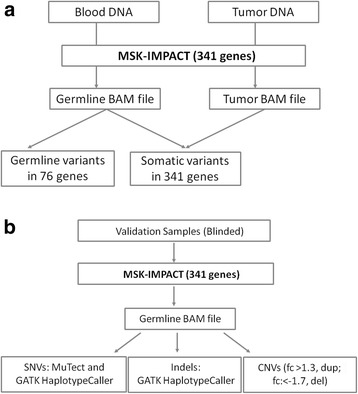
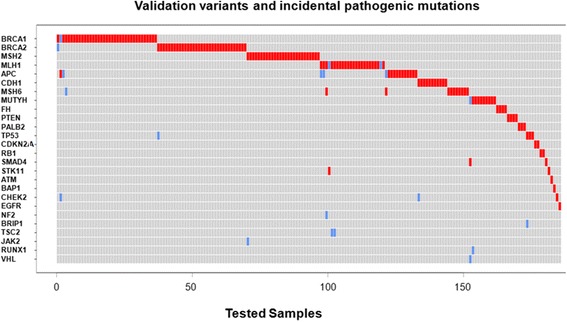
BACKGROUND: The growing number of Next Generation Sequencing (NGS) tests is transforming the routine clinical diagnosis of hereditary cancers. Identifying whether a cancer is the result of an underlying disease-causing mutation in a cancer predisposition gene is not only diagnostic for a cancer predisposition syndrome, but also has significant clinical implications in the clinical management of patients and their families. METHODS: Here, we evaluated the performance of MSK-IMPACT (Memorial Sloan Kettering-Integrated Mutation Profiling of Actionable Cancer Targets) in detecting genetic alterations in 76 genes implicated in cancer predisposition syndromes. Output from hybridization-based capture was sequenced on an Illumina HiSeq 2500. A custom analysis pipeline was used to detect single nucleotide variants (SNVs), small insertions/deletions (indels) and copy number variants (CNVs). RESULTS: MSK-IMPACT detected all germline variants in a set of 233 unique patient DNA samples, previously confirmed by previous single gene testing. Reproducibility of variant calls was demonstrated using inter- and intra- run replicates. Moreover, in 16 samples, we identified additional pathogenic mutations other than those previously identified through a traditional gene-by-gene approach, including founder mutations in BRCA1, BRCA2, CHEK2 and APC, and truncating mutations in TP53, TSC2, ATM and VHL. CONCLUSIONS: This study highlights the importance of the NGS-based gene panel testing approach in comprehensively identifying germline variants contributing to cancer predisposition and simultaneous detection of somatic and germline alterations.
Overview
The claims and statistics of this paper haven’t been checked yet.
Run the check — free, no account needed. It reads the open-access text and checks the sources it cites.
Integrity signals
Registry
Cites
Statistics
Figures
Verification
Claims the paper makes
The claims and statistics of this paper haven’t been checked yet.
Run the check — free, no account needed. It reads the open-access text and checks the sources it cites.
Claims other papers make about this one
Each is checked against this paper’s own text: does it say what the citing paper says it does?
In the citing paper
“MSK-IMPACT is an NGS assay that can detect variants in up to 505 unique cancer genes, including EGFR, TP53, KRAS, STK11, and ALK.”
From A clinical benchmark of public self-supervised pathology foundation models (2025) · cites this paper as [44]
Self-check
Percentages, sums and reported differences re-computed from the paper’s own numbers.
The self-check needs the paper’s full text.
Citations
Cites
Richards, S., Aziz, N., Bale, S., Bick, D., Das, S., Gastier-Foster, J., Grody, W. W., Hegde, M., Lyon, E., Spector, E., et al. (2015) · Genetics in Medicine · doi:10.1038/gim.2015.30 · Cited by 32,594
The Genome Analysis Toolkit: A MapReduce framework for analyzing next-generation DNA sequencing data
McKenna, A., Hanna, M., Banks, E., Sivachenko, A., Cibulskis, K., Kernytsky, A., Garimella, K., Altshuler, D., Gabriel, S., Daly, M., et al. (2010) · Genome Research · doi:10.1101/gr.107524.110 · Cited by 27,895
ANNOVAR: functional annotation of genetic variants from high-throughput sequencing data
Wang, K., Li, M., & Hakonarson, H. H. (2010) · Nucleic Acids Research · doi:10.1093/nar/gkq603 · Cited by 14,724
An integrated map of genetic variation from 1,092 human genomes
The 1000 Genomes Project Consortium (2012) · Nature · doi:10.1038/nature11632 · Cited by 7,711
dbSNP: the NCBI database of genetic variation
Sherry, S. T. (2001) · Nucleic Acids Research · doi:10.1093/nar/29.1.308 · Cited by 7,502
Sensitive detection of somatic point mutations in impure and heterogeneous cancer samples
Cibulskis, K., Lawrence, M. S., Carter, S. L., Sivachenko, A., Jaffe, D. B., Sougnez, C. L., Gabriel, S., Meyerson, M. M., Lander, E. S., & Getz, G. A. (2013) · Nature Biotechnology · doi:10.1038/nbt.2514 · Cited by 4,965
ClinVar: public archive of relationships among sequence variation and human phenotype
Landrum, M. J., Lee, J. M., Riley, G. R., Jang, W., Rubinstein, W. S., Church, D. M., & Maglott, D. R. (2014) · Nucleic Acids Research · doi:10.1093/nar/gkt1113 · Cited by 3,516
ACMG recommendations for reporting of incidental findings in clinical exome and genome sequencing
Green, R. C., Berg, J. S., Grody, W. W., Kalia, S. S., Korf, B. R., Martin, C. L., McGuire, A. L., Nussbaum, R. L., O’Daniel, J. M., Ormond, K. E., et al. (2013) · Genetics in Medicine · doi:10.1038/gim.2013.73 · Cited by 2,544
DELLY: structural variant discovery by integrated paired-end and split-read analysis
Rausch, T., Zichner, T., Schlattl, A., Stütz, A. M., Beneš, V., & Korbel, J. O. (2012) · Bioinformatics · doi:10.1093/bioinformatics/bts378 · Cited by 2,438
Memorial Sloan Kettering-Integrated Mutation Profiling of Actionable Cancer Targets (MSK-IMPACT)
Cheng, D. T., Mitchell, T. N., Zehir, A., Shah, R. H., Benayed, R., Syed, A., Chandramohan, R., Liu, Z. Y., Won, H. H., Scott, S. N., et al. (2015) · The Journal of Molecular Diagnostics · doi:10.1016/j.jmoldx.2014.12.006 · Cited by 2,119
Self-citationEvolution and functional impact of rare coding variation from deep sequencing of human exomes
Tennessen, J. A., Bigham, A. W., O’Connor, T. D., Fu, W., Kenny, E. E., Gravel, S., McGee, S., Do, R., Liu, X., Jun, G., et al. (2012) · Science · doi:10.1126/science.1219240 · Cited by 1,613
Walsh, T., Casadei, S., Lee, M. K., Pennil, C. C., Nord, A. S., Thornton, A., Roeb, W., Agnew, K. J., Stray, S. M., Wickramanayake, A., et al. (2011) · Proceedings of the National Academy of Sciences · doi:10.1073/pnas.1115052108 · Cited by 960
Realizing the promise of cancer predisposition genes
Rahman, N. (2014) · Nature · doi:10.1038/nature12981 · Cited by 632
Walsh, T., Lee, M. K., Casadei, S., Thornton, A., Stray, S. M., Pennil, C. C., Nord, A. S., Mandell, J. B., Swisher, E. M., & King, M. (2010) · Proceedings of the National Academy of Sciences · doi:10.1073/pnas.1007983107 · Cited by 503
Personalized genomic analyses for cancer mutation discovery and interpretation
Jones, S., Anagnostou, V., Lytle, K., Parpart-Li, S. T., Nesselbush, M. C., Riley, D. R. J., Shukla, M., Chesnick, B., Kadan, M., Papp, E., et al. (2015) · Science Translational Medicine · doi:10.1126/scitranslmed.aaa7161 · Cited by 418
Germline Variants in Targeted Tumor Sequencing Using Matched Normal DNA
Schrader, K. A., Cheng, D. T., Vijai, J., Prasad, M., Walsh, M. F., Zehir, A., Ni, A., Thomas, T., Benayed, R., Ashraf, A. M., et al. (2015) · JAMA Oncology · doi:10.1001/jamaoncol.2015.5208 · Cited by 348
Self-citationPritchard, C. C., Smith, C., Salipante, S. J., Lee, M. K., Thornton, A., Nord, A. S., Gulden, C., Kupfer, S. S., Swisher, E. M., Bennett, R. L., et al. (2012) · Journal of Molecular Diagnostics · doi:10.1016/j.jmoldx.2012.03.002 · Cited by 209
Cancer Genomics and Inherited Risk
Stadler, Z. K., Schrader, K. A., Vijai, J., Robson, M. E., & Offit, K. (2014) · Journal of Clinical Oncology · doi:10.1200/jco.2013.49.7271 · Cited by 149
Self-citationMainstreaming genetic testing of cancer predisposition genes
Rahman, N. (2014) · Clinical Medicine · doi:10.7861/clinmedicine.14-4-436 · Cited by 84
Trujillano, D., Weiss, M. E. R., Schneider, J., Köster, J., Papachristos, E. B., Saviouk, V., Zakharkina, T., Nahavandi, N., Kovačević, L., & Rolfs, A. (2014) · Journal of Molecular Diagnostics · doi:10.1016/j.jmoldx.2014.11.004 · Cited by 63
Long-Range PCR and Next-Generation Sequencing of BRCA1 and BRCA2 in Breast Cancer
Özçelik, H., Shi, X., Chang, M. C., Tram, E., Vlasschaert, M., Nicola, N. D., Kiselova, A., Yee, D., Goldman, A. J., Dowar, M., et al. (2012) · Journal of Molecular Diagnostics · doi:10.1016/j.jmoldx.2012.03.006 · Cited by 56
Cited by
Sorted by citations
Pathogenic Germline Variants in 10,389 Adult Cancers
Huang, K., Mashl, R. J., Wu, Y., Ritter, D., Wang, J., Oh, C., Paczkowska, M., Reynolds, S. M., Wyczalkowski, M. A., Oak, N., et al. (2018) · Cell · doi:10.1016/j.cell.2018.03.039 · Cited by 839
Microsatellite Instability Is Associated With the Presence of Lynch Syndrome Pan-Cancer
Latham, A. J., Srinivasan, P., Kemel, Y. M., Shia, J., Bandlamudi, C., Mandelker, D. L., Middha, S., Hechtman, J. F., Zehir, A., Dubard-Gault, M. E., et al. (2018) · Journal of Clinical Oncology · doi:10.1200/jco.18.00283 · Cited by 623
Self-citationMandelker, D. L., Zhang, L., Kemel, Y. M., Stadler, Z. K., Vijai, J., Zehir, A., Pradhan, N., Arnold, A. G., Walsh, M. F., Li, Y., et al. (2017) · JAMA · doi:10.1001/jama.2017.11137 · Cited by 521
Self-citationMicrosatellite instability: a review of what the oncologist should know
Li, K., Luo, H., Huang, L., Luo, H., & Zhu, X. (2020) · Cancer Cell International · doi:10.1186/s12935-019-1091-8 · Cited by 509
Tumour lineage shapes BRCA-mediated phenotypes
Jonsson, P., Bandlamudi, C., Cheng, M. L., Srinivasan, P., Chavan, S. S., Friedman, N. D., Rosen, E. Y., Richards, A. L., Bouvier, N., Selçuklu, S. D., et al. (2019) · Nature · doi:10.1038/s41586-019-1382-1 · Cited by 400
Self-citation
Metadata
- Authors
- Cheng, D. T., Prasad, M., Chekaluk, Y., Benayed, R., Sadowska, J., Zehir, A., Syed, A., Wang, Y. E., Somar, J., Li, Y., Yelskaya, Z., Wong, D., Robson, M. E., Offit, K., Berger, M. F., Nafa, K., Ladanyi, M., & Zhang, L.
- Affiliations
- Memorial Sloan Kettering Cancer Center (US)
- Brigham and Women's Hospital (US)
- Corresponding author
- Ladanyi, Marc
- Zhang, Liying
- ORCID
- Venue
- BMC Medical Genomics
- Published
- 2017-05-19
- Volume
- 10
- Issue
- 1
- Pages
- 33-33
- ISSN
- 1755-8794 (ISSN-L)
- PMC
- PMC5437632
- OpenAlex
- W2614654783
- Cited by
- 158
- References
- 21
- Citations by year
- 2026: 9 · 2025: 19 · 2024: 12 · 2023: 23 · 2022: 21 · 2021: 20 · 2020: 22 · 2019: 16 · 2018: 13 · 2017: 2
- FWCI
- 9.60
- Type
- journal article
- Language
- en
- Open access
- gold
- doi.org
- Licence
- cc-by
- Locations
- BMC Medical Genomics (publishedVersion, cc-by)
- PubMed Central (publishedVersion, cc-by)
- PubMed (publishedVersion)
- DOAJ (DOAJ: Directory of Open Access Journals) (submittedVersion)
- eScholarship (California Digital Library) (submittedVersion)
- eScholarship (California Digital Library) (submittedVersion, cc-by)
- Funders
- Memorial Sloan-Kettering Cancer Center (CA008748, P30 CA008748)
- Geoffrey Beene Cancer Research Center (P30 CA008748)
- Farmer Family Foundation
- National Cancer Institute (P30CA008748)
- Topics
- Life Sciences › Biochemistry, Genetics and Molecular Biology › Genetics › BRCA gene mutations in cancer
- Life Sciences › Biochemistry, Genetics and Molecular Biology › Genetics › Genomics and Rare Diseases
- Life Sciences › Biochemistry, Genetics and Molecular Biology › Cancer Research › Cancer Genomics and Diagnostics
- Keywords
- MSK-IMPACT, germline variant detection, cancer predisposition syndromes, cancer susceptibility genes, gene panel testing, founder mutation, BRCA1, BRCA2, CHEK2, APC, TP53, TSC2, ATM, VHL, copy number variation, single nucleotide variants, hereditary cancer
- MeSH terms
- Tuberous Sclerosis Complex 2 Protein, DNA Mutational Analysis, Humans, Neoplasm Proteins, Neoplasms, Biomarkers, Tumor, Reproducibility of Results, Tumor Suppressor Protein p53, Germ-Line Mutation, BRCA1 Protein, Genetic Predisposition to Disease, Polymorphism, Single Nucleotide, BRCA2 Protein, Tumor Suppressor Proteins, Adenomatous Polyposis Coli Protein, Von Hippel-Lindau Tumor Suppressor Protein, DNA Copy Number Variations, Ataxia Telangiectasia Mutated Proteins, Checkpoint Kinase 2
About these checks
Registry, retraction, Cites and statistics results are computed, not judged, with one exception: a printed reference that no index lists is read once by a model before it counts as a citation error. Claims are extracted by a model and kept only when their quote appears verbatim in the text; each cited source is then checked, with a model’s help, for whether it says what the claim relies on. Those verdicts can be wrong — read the claim’s quote and the cited source before relying on one.
Statistics and arithmetic are recomputed, not judged.
Confidence bands are shown only for fields calibrated on our annotated test set. None is calibrated yet, so no band is shown.
What counts as a claim ›How we measure confidence ›How we check this ›
Are you an author, or do you see a problem with this page? Request a review
