

Effects of evolocumab in individuals with type 2 diabetes with and without atherogenic dyslipidemia: An analysis from BANTING and BERSON
Open accessThe DOI matches its Crossref record; 48 of the 48 references it cites were found in a registry or an index.
Abstract
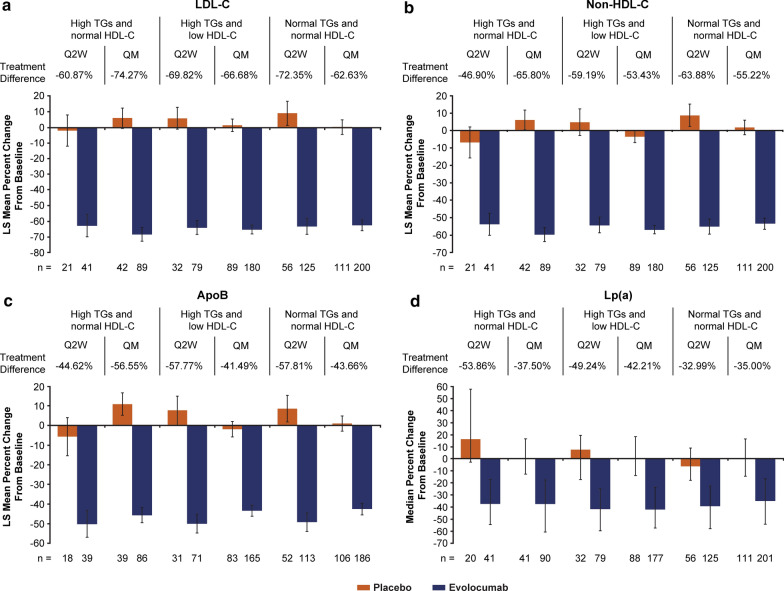
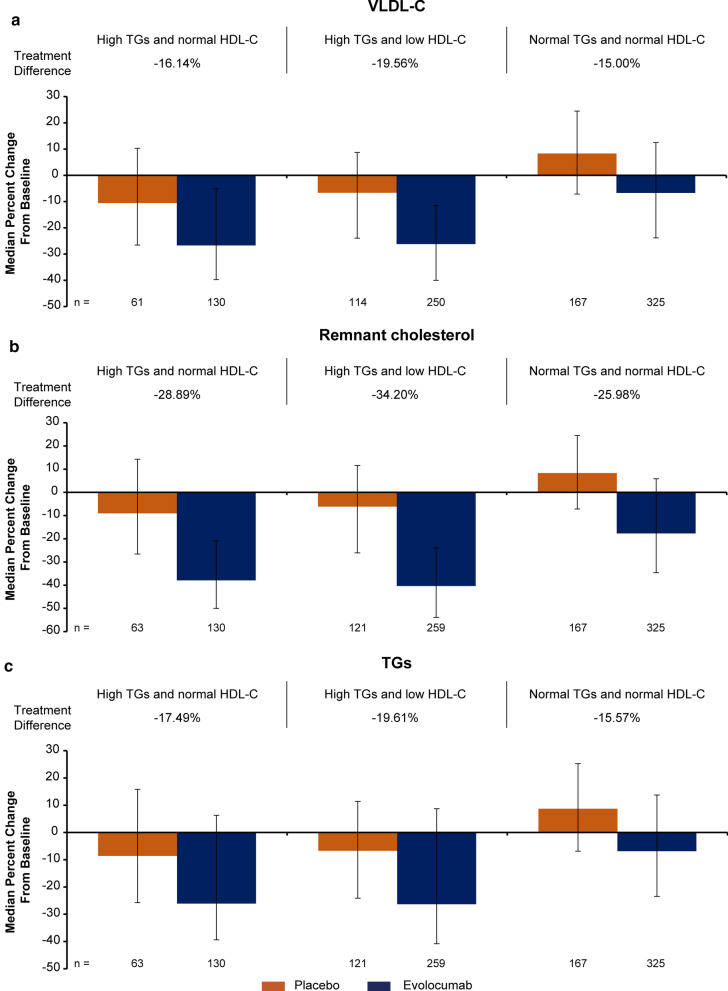
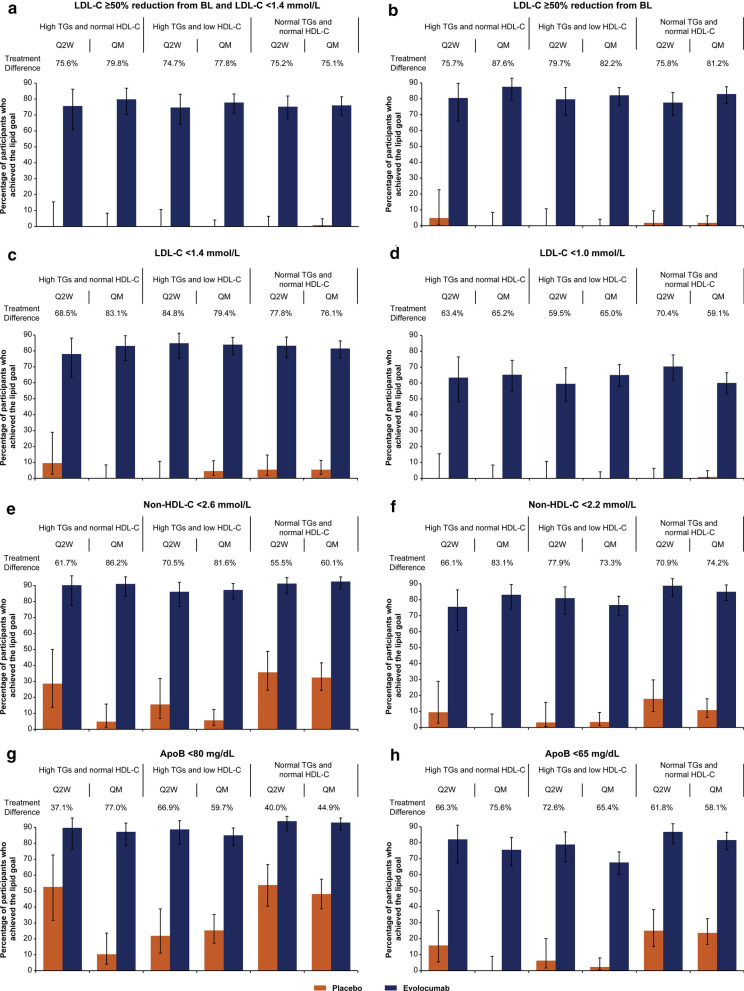
Background: Atherogenic dyslipidemia (AD), characterized by increased concentrations of apolipoprotein B (ApoB)-containing particles, is often present in individuals with type 2 diabetes mellitus (T2DM). Non-high-density lipoprotein cholesterol (non-HDL-C), cholesterol transported by apolipoprotein B (ApoB)-containing particles), and total apoB are considered secondary goals of lipid-lowering therapy to guide treatment of residual cardiovascular risk. The BANTING and BERSON studies demonstrated that evolocumab added to statin therapy reduced atherogenic lipid and lipoproteins concentrations in patients with T2DM. Methods: This post-hoc analysis combined data from two randomized, placebo-controlled trials, BANTING and BERSON, to investigate the effect of evolocumab (140 mg every two weeks [Q2W] or 420 mg monthly [QM]) on atherogenic lipid (LDL-C, non-HDL-C, VLDL-C, remnant cholesterol) and lipoproteins (ApoB, lipoprotein(a) (Lp[a])), and achievement of 2019 European Society of Cardiology/European Atherosclerosis Society lipid treatment goals in individuals with and without AD. Results: In individuals with high TGs with (n = 389) and without (n = 196) AD receiving background statin therapy, evolocumab, compared with placebo, substantially reduced the cholesterol levels from all ApoB atherogenic lipoproteins (least squares (LS) mean LDL-C by 66.7% to 74.3%, non-HDL-C by 53.4% to 65.8%, median remnant cholesterol by 28.9% to 34.2%, VLDL-C by 16.1% to 19.6%) and median TGs levels (by 17.5% to 19.6%) at the mean of weeks 10 and 12. LS mean ApoB was significantly reduced by 41.5% to 56.6% at week 12. Results were consistent in diabetic individuals with normal TGs (n = 519). Evolocumab was also associated with a significant reduction in median Lp(a) by 35.0% to 53.9% at the mean of weeks 10 and 12. A majority (74.7% to 79.8%) of evolocumab-treated individuals achieved the goal of both an LDL-C < 1.4 mmol/L and an LDL-C reduction of at least 50%, > 75% achieved non-HDL-C < 2.2 mmol/L at the mean of weeks 10 and 12, and > 67% achieved ApoB < 65 mg/dL at week 12. Conclusions: Evolocumab effectively reduced LDL-C, non-HDL-C, ApoB, Lp(a), and remnant cholesterol in individuals with T2DM with and without AD. Evolocumab Q2W or QM enabled most individuals at high/very-high cardiovascular disease risk to achieve their LDL-C, non-HDL-C, and ApoB recommended goals.
Overview
The claims and statistics of this paper haven’t been checked yet.
Free: it reads the open-access text and checks the first 5 claims that cite a source we can check. Create a free account to check every claim.
Integrity signals
Registry
Cites
Statistics
Figures
Verification
Claims the paper makes
The claims and statistics of this paper haven’t been checked yet.
Free: it reads the open-access text and checks the first 5 claims that cite a source we can check. Create a free account to check every claim.
Claims other papers make about this one
Each is checked against this paper’s own text: does it say what the citing paper says it does?
In the citing paper
“Compared with placebo, evolocumab also significantly reduced other atherogenic lipids (i.e.TGs, non-HDL-C, apolipoprotein B-containing particles) in patients with diabetes and mixed dyslipidaemia enrolled in the BANTING (Evaluation of Evolocumab Efficacy in Diabetic Adults With Hypercholesterolemia/Mixed Dyslipidemia) and BERSON (Safety and Efficacy of Evolocumab in Combination With Statin Therapy”
From 2023 ESC guidelines for the management of cardiovascular disease in patients with diabetes. (2023) · cites this paper as [266]
Self-check
Percentages, sums and reported differences re-computed from the paper’s own numbers.
The self-check needs the paper’s full text.
Citations
Cites
Grundy, S. M., Bilheimer, D. W., Chait, A., Clark, L. T., Denke, M. A., Havel, R. J., Hazzard, W. R., Hulley, S. B., Hunninghake, D. B., Kreisberg, R. A., et al. (1993) · JAMA · doi:10.1001/jama.269.23.3015 · Cited by 27,947
Expert Panel on Detection, E. (2001) · JAMA: The Journal of the American Medical Association · doi:10.1001/jama.285.19.2486 · Cited by 26,011
Yusuf, S., Hawken, S., Ôunpuu, S., Dans, T., Avezum, A., Lanas, F., McQueen, M., Budaj, A., Pais, P., Varigos, J., et al. (2004) · The Lancet · doi:10.1016/s0140-6736(04)17018-9 · Cited by 12,026
Mach, F., Baigent, C., Catapano, A. L., Koskinas, K. C., Casula, M., Badimon, L., Chapman, M. J., De Backer, G. G., Delgado, V., Ference, B. A., et al. (2020) · European Heart Journal · doi:10.1093/eurheartj/ehz455 · Cited by 8,961
Grundy, S. M., Stone, N. J., Bailey, A. L., Beam, C., Birtcher, K. K., Blumenthal, R. S., Braun, L. T., de Ferranti, S., Faiella-Tommasino, J., Forman, D. E., et al. (2019) · Circulation · doi:10.1161/cir.0000000000000625 · Cited by 6,185
Mach, F., Baigent, C., Catapano, A. L., Koskinas, K. C., Casula, M., Badimon, L., Chapman, M. J., De Backer, G. G., Delgado, V., Ference, B. A., et al. (2019) · Atherosclerosis · doi:10.1016/j.atherosclerosis.2019.08.014 · Cited by 4,854
Cosentino, F., Grant, P. J., Aboyans, V., Bailey, C. J., Ceriello, A., Delgado, V., Federici, M., Filippatos, G., Grobbee, D. E., Hansen, T. B., et al. (2020) · European Heart Journal · doi:10.1093/eurheartj/ehz486 · Cited by 4,763
Atherogenic lipoprotein phenotype. A proposed genetic marker for coronary heart disease risk
Austin, M. A., King, M. C., Vranizan, K. M., & Krauss, R. M. (1990) · Circulation · doi:10.1161/01.cir.82.2.495 · Cited by 1,411 · cited 1×
“The lipoprotein assessment in these patients reveals an increase in triglyceride-rich lipoproteins (TRL) (chylomicrons, verylow-density lipoprotein [VLDL]), accumulation of lipoprotein remnants (chylomicron remnants, small VLDL, and intermediate-density lipoprotein), and predominantly small, dense LDL particles [1, 2].”
BackgroundSarwar, N., Danesh, J., Eiriksdottir, G., Sigurdsson, G., Wareham, N., Bingham, S., Boekholdt, S. M., Khaw, K.-T., & Gudnason, V. (2007) · Circulation · doi:10.1161/circulationaha.106.637793 · Cited by 1,408
Nicholls, S. J., Puri, R., Anderson, T., Ballantyne, C. M., Cho, L., Kastelein, J. J. P., Koenig, W., Somaratne, R., Kassahun, H., Yang, J., et al. (2016) · JAMA · doi:10.1001/jama.2016.16951 · Cited by 1,178
Cited by
2023 ESC guidelines for the management of cardiovascular disease in patients with diabetes.
Marx, N., Federici, M., Schütt, K., Müller-Wieland, D., Ajjan, R. A., Antunes, M. J., Christodorescu, R. M., Crawford, C., Di Angelantonio, E., Eliasson, B., et al. (2023) · European Heart Journal · doi:10.1093/eurheartj/ehad192 · Cited by 1,642
Lipoprotein (a) and diabetes mellitus
Lamina, C., & Ward, N. C. (2022) · Atherosclerosis · doi:10.1016/j.atherosclerosis.2022.04.016 · Cited by 121
Banach, M., Surma, S., Reiner, Z., Katsiki, N., Penson, P. E., Fras, Z., Sahebkar, A., Paneni, F., Rizzo, M., & Kastelein, J. (2022) · Cardiovascular Diabetology · doi:10.1186/s12933-022-01684-5 · Cited by 100
“Thus, we do not discuss the role of non-HDL-C, which is now an equivalent lipid biomarker to LDL-C [13, 67], the remnants—and their important role in CV risk prediction in patients with atherogenic dyslipidemia [68], as well as apolipoprotein B (ApoB)—which has the largest predictive power, but it is still measured de…”
BackgroundLipoprotein(a): Knowns, unknowns and uncertainties
Ruscica, M., Sirtori, C. R., Corsini, A., Watts, G. F., & Sahebkar, A. (2021) · Pharmacological Research · doi:10.1016/j.phrs.2021.105812 · Cited by 96
Wang, X., Wen, D., Chen, Y., Ma, L., & You, C. (2022) · Cardiovascular Diabetology · doi:10.1186/s12933-022-01542-4 · Cited by 67
“Furthermore, it has been reported that more individuals with type 2 diabetes mellitus (T2DM), with and without atherogenic dyslipidemia, achieve the recommended LDL-C targets compared to those without T2DM [41, 42].”
BackgroundGuan, B., Wang, A., & Xu, H. (2023) · Cardiovascular Diabetology · doi:10.1186/s12933-023-01927-z · Cited by 54
Chinese expert consensus on blood lipid management in patients with diabetes (2024 edition)
Xiao, Y., Yu, B., Chen, C., Wang, S., Hu, D., Wu, C., Luo, Y., Xie, L., Li, C., Peng, D., et al. (2024) · Journal of Translational Internal Medicine · doi:10.2478/jtim-2024-0014 · Cited by 42
“[92] 93-95] The results of the BANTING [96] and BERSON studies [97,98] further confirm that PCSK9 monoclonal antibodies can help high-risk and very high-risk ASCVD T2DM patients quickly achieve lipid control, with good safety and tolerability, without affecting blood glucose levels.”
Vekić, J., Zeljković, A., Al‐Rasadi, K., Cesur, M., Silva‐Nunes, J., Stoian, A. P., & Rizzo, M. (2022) · Metabolites · doi:10.3390/metabo12020108 · Cited by 32
“the presence of atherogenic dyslipidemia [46].”
ResultSposito, A. C., Breder, I. S. S., Barreto, J., Breder, J. D. S. C., Bonilha, I., Lima, M. F. D. G., Oliveira, A., Wolf, V. L. W., Luchiari, B., do Carmo, H. R. P., et al. (2022) · Cardiovascular Diabetology · doi:10.1186/s12933-022-01584-8 · Cited by 23
Unravelling lipoprotein metabolism with stable isotopes: tracing the flow
Ying, Q., Chan, D. C., Barrett, P. H. R., & Watts, G. F. (2021) · Metabolism · doi:10.1016/j.metabol.2021.154887 · Cited by 21
Diabetic dyslipidemia impairs coronary collateral formation: An update
Shen, Y. H., Wang, X. Q., Dai, Y., Wang, Y. X., Zhang, R., Lu, L., Ding, F. H., & Shen, W. F. (2022) · Frontiers in Cardiovascular Medicine · doi:10.3389/fcvm.2022.956086 · Cited by 19
PCSK9 Inhibition in Atherosclerotic Cardiovascular Disease
Delialis, D., Dimopoulou, M., Papaioannou, M., Kotsira, G., Maneta, E., Mavraganis, G., Loutos, C., Georgiopoulos, G. A., & Stamatelopoulos, K. S. (2023) · Current Pharmaceutical Design · doi:10.2174/1381612829666230412105238 · Cited by 14
Tognola, C., Bernasconi, D. P., Intravaia, R. C. M., Brioschi, G., Toscani, G., Algeri, M., Shkodra, A., Inglese, E., Sciumè, L., Danesi, R., et al. (2025) · International Journal of Cardiology · doi:10.1016/j.ijcard.2025.133608 · Cited by 13
Zhou, Q., Tang, H., & Li, S. (2023) · Journal of Diabetes and its Complications · doi:10.1016/j.jdiacomp.2023.108593 · Cited by 7
Chen, R., Wang, Q., Wang, Y. Y., Wang, Y., Liu, J., Liao, Z., & Xiao, X. (2023) · Frontiers in Endocrinology · doi:10.3389/fendo.2023.1094458 · Cited by 7
Yang, J., Zhang, R., Han, B., Li, H. Z., Wang, J., Xiao, Y., Yu, X., Guan, S., Dai, C., Yan, H., et al. (2024) · Lipids in Health and Disease · doi:10.1186/s12944-024-02244-4 · Cited by 4
Avogaro, A., Buzzetti, R., Candido, R., Cosmo, S. D., Notarianni, L., Consolo, E., & Luciano, M. (2025) · Diabetes Research and Clinical Practice · doi:10.1016/j.diabres.2025.112055 · Cited by 3
Li, Q., Xu, J., Xiong, Z., & Ying, Q. (2025) · Diabetes Research and Clinical Practice · doi:10.1016/j.diabres.2025.112940 · Cited by 2
Mirghani, H. O., Albalawi, B. H., Alshehri, M. S., Almalawi, W. M., Alanezi, S. A., Alarki, M., Alyahya, A. A., Alshaman, S., Shaman, M. S., & Al-Anazi, A. B. (2024) · Cureus · doi:10.7759/cureus.70411 · Cited by 5
“Additionally, people with type 2 DM (T2DM) are more likely to meet the prescribed LDL-C targets than those without the disease, both with and without atherogenic dyslipidemia [23,24].”
BackgroundA predictive model to assess the risk of developing hyperlipidemia in patients with type 2 diabetes
Ye, R., Huang, X., Yang, H., Pan, W., Wang, P., Men, J., Huang, D., & Wu, S. (2025) · PLoS ONE · doi:10.1371/journal.pone.0315781 · Cited by 4
“The PCSK9 inhibitor evolocumab has been shown to significantly reduce LDL-C and other lipid markers, providing substantial therapeutic benefits for T2D patients with hyper-lipidemia [31].”
Production and Metabolism of Triglyceride-Rich Lipoproteins: Impact of Diabetes
Pirillo, A., Norata, G. D., & Catapano, A. L. (2023) · Contemporary diabetes · doi:10.1007/978-3-031-26681-2_7 · Cited by 3
Hussein, K. R., Salih, S., & Al-Timimi, D. J. (2023) · Cureus · doi:10.7759/cureus.46829 · Cited by 1
“High levels of serum total cholesterol (TC), triglycerides (TGs), very-low-density lipoprotein cholesterol (VLDL-c), low-density lipoprotein cholesterol (LDL-c), and high-density lipoprotein cholesterol (HDL-c) are all hallmarks of atherogenic dyslipidemia [3].”
BackgroundEthnicity should be included as a risk factor for coronary artery calcium score
Al-Sawalha, I., & Alzoubi, D. (2022) · Cardiovascular Diabetology · doi:10.1186/s12933-022-01587-5
Genetic lipid disorders, the APOE gene and Familial Dysbetalipoproteinemia
Heidemann, B. E. (2022) · Utrecht University Repository (Utrecht University) · doi:10.33540/1408
Su, J., Zhou, L., Yang, N., Xu, Y., Wang, G., & Liu, J. (2023) · Research Square · doi:10.21203/rs.3.rs-2849094/v1
Guan, B., Wang, A., & Xu, H. (2023) · Figshare · doi:10.6084/m9.figshare.23930438
Wu, R., Su, Y., Liao, J., Shen, J., Ma, Y., Gao, W., Dong, Z., Dai, Y., Kang, Y., & Ge, J. (2024) · Clinical Cardiology · doi:10.1002/clc.70066 · Cited by 1
Leveraging drug-target Mendelian randomization for tailored lipoprotein-lipid lowering
Gagnon, É., & Arsenault, B. J. (2025) · Current Opinion in Lipidology · doi:10.1097/mol.0000000000000977
Guan, B., Wang, A., & Xu, H. (2023) · Figshare · doi:10.6084/m9.figshare.23930435
Wang, X., Wen, D., Chen, Y., Ma, L., & You, C. (2022) · Figshare · doi:10.6084/m9.figshare.20081087
Guan, B., Wang, A., & Xu, H. (2023) · Figshare · doi:10.6084/m9.figshare.23930429
Sposito, A. C., Breder, I. S. S., Barreto, J., Breder, J. D. S. C., Bonilha, I., Lima, M., Oliveira, A., Wolf, V. L. W., Luchiari, B., do Carmo, H. R. P., et al. (2022) · Figshare · doi:10.6084/m9.figshare.20445376
How to Evaluate and Reduce Micro- and/or Macrovascular Residual Risk?
Hermans, M. P., Lurquin, F. O., Ahn, S. A., Rousseau, M. F., & (R3i), O. B. O. T. R. R. R. I. (2026) · Springer eBooks · doi:10.1007/978-3-031-82232-2_24
Effect of Lipid Management on Coronary Heart Disease Risk in Persons With Type 2 Diabetes
Brandts, J., & Ray, K. K. (2026) · Elsevier eBooks · doi:10.1016/b978-0-323-87862-3.00019-7
Piro, V., González, E. F., Romano, F., Galván, M., Fernández, Groba, M. D. V., López, M., & García, A. (2026) · Clínica e Investigación en Arteriosclerosis · doi:10.1016/j.arteri.2026.500949 · Cited by 1
Metadata
- Authors
- Lorenzatti, A. J., Monsalvo, M. L., López, J. A. G., Wang, H., & Rosenson, R. S.
- Affiliations
- Instituto Médico DAMIC (AR)
- Amgen (United States) (US)
- Icahn School of Medicine at Mount Sinai (US)
- Corresponding author
- Lorenzatti, Alberto J.
- Venue
- Cardiovascular Diabetology
- Published
- 2021-04-30
- Volume
- 20
- Issue
- 1
- Pages
- 94-94
- ISSN
- 1475-2840 (ISSN-L)
- PMC
- PMC8091704
- OpenAlex
- W3158914372
- Cited by
- 34
- References
- 48
- Citations by year
- 2026: 3 · 2025: 5 · 2024: 4 · 2023: 10 · 2022: 10 · 2021: 2
- FWCI
- 6.34
- Type
- journal article
- Language
- en
- Open access
- gold
- doi.org
- Licence
- cc-by
- creativecommons.org/licenses/by/4.0 (tdm)
- creativecommons.org/licenses/by/4.0 (vor)
- Locations
- Cardiovascular Diabetology (publishedVersion, cc-by)
- PubMed Central (publishedVersion, cc-by)
- PubMed (publishedVersion)
- DOAJ (DOAJ: Directory of Open Access Journals) (submittedVersion, cc-by-sa)
- Funders
- Amgen
- Topics
- Health Sciences › Medicine › Cardiology and Cardiovascular Medicine › Lipoproteins and Cardiovascular Health
- Health Sciences › Medicine › Endocrinology, Diabetes and Metabolism › Diabetes, Cardiovascular Risks, and Lipoproteins
- Life Sciences › Biochemistry, Genetics and Molecular Biology › Biochemistry › Cholesterol and Lipid Metabolism
- Keywords
- evolocumab, type 2 diabetes, atherogenic dyslipidemia, apolipoprotein B, non-HDL cholesterol, remnant cholesterol, lipoprotein(a), triglycerides, LDL cholesterol, VLDL cholesterol, PCSK9 inhibition, statin therapy, cardiovascular risk
- MeSH terms
- Proprotein Convertase 9, PCSK9 Inhibitors, Aged, Anticholesteremic Agents, Cholesterol, Diabetes Mellitus, Type 2, Drug Therapy, Combination, Female, Humans, Lipids, Male, Middle Aged, Time Factors, Triglycerides, Biomarkers, Randomized Controlled Trials as Topic, Treatment Outcome, Clinical Trials, Phase III as Topic, Hydroxymethylglutaryl-CoA Reductase Inhibitors, Dyslipidemias, Apolipoprotein B-100, Antibodies, Monoclonal, Humanized
About these checks
Registry, retraction, Cites and statistics results are computed, not judged, with one exception: a printed reference that no index lists is read once by a model before it counts as a citation error. Claims are extracted by a model and kept only when their quote appears verbatim in the text; each cited source is then checked, with a model’s help, for whether it says what the claim relies on. Those verdicts can be wrong — read the claim’s quote and the cited source before relying on one.
Statistics and arithmetic are recomputed, not judged.
Confidence bands are shown only for fields calibrated on our annotated test set. None is calibrated yet, so no band is shown.
What counts as a claim ›How we measure confidence ›How we check this ›
Are you an author, or do you see a problem with this page? Request a review
Data sources
Bibliographic data: Semantic Scholar, OpenAlex, Crossref.
Contains information from the Semantic Scholar Academic Graph Datasets, made available under the ODC Attribution License (ODC-BY 1.0).
Semantic Scholar’s data is described in: Kinney, R., et al. (2023). The Semantic Scholar Open Data Platform. arXiv:2301.10140.
