

Identification of lysine acetylome in cervical cancer by label-free quantitative proteomics
Open accessThe DOI matches its Crossref record; 34 of the 34 references it cites were found in a registry or an index.
Abstract
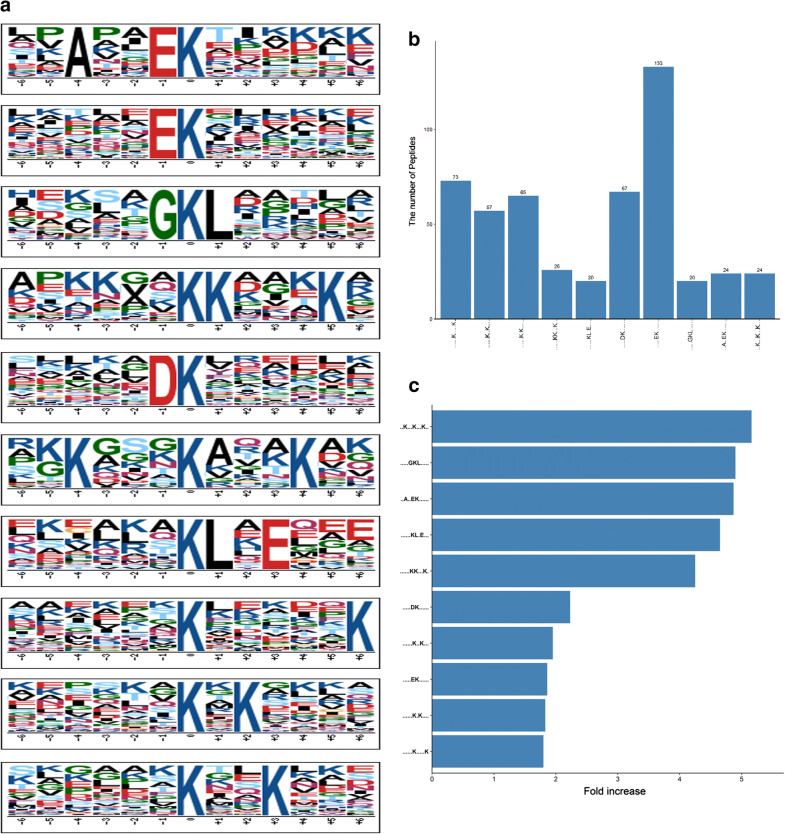
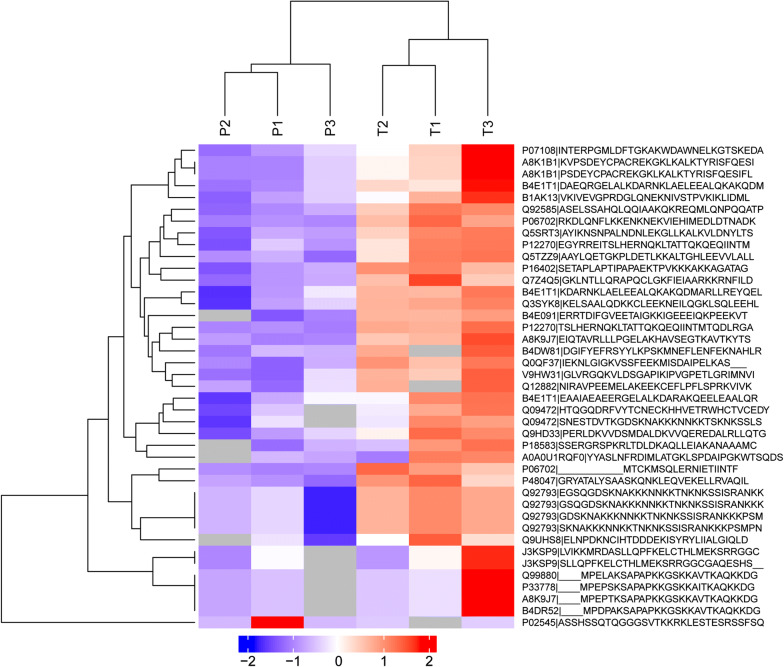
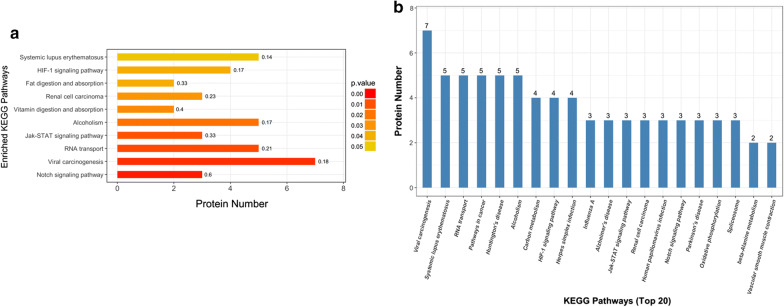
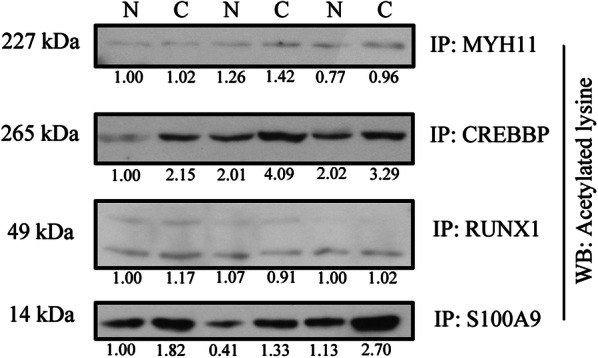
Background: Lysine acetylation is a post-translational modification that regulates a diversity of biological processes, including cancer development. Methods: Here, we performed the quantitative acetylproteomic analysis of three primary cervical cancer tissues and corresponding adjacent normal tissues by using the label-free proteomics approach. Results: We identified a total of 928 lysine acetylation sites from 1547 proteins, in which 495 lysine acetylation sites corresponding to 296 proteins were quantified. Further, 41 differentially expressed lysine acetylation sites corresponding to 30 proteins were obtained in cervical cancer tissues compared with adjacent normal tissues (Fold change > 2 and P < 0.05), of which 1 was downregulated, 40 were upregulated. Moreover, 75 lysine acetylation sites corresponding to 58 proteins were specifically detected in cancer tissues or normal adjacent tissues. Motif-X analysis showed that kxxxkxxxk, GkL, AxxEk, kLxE, and kkxxxk are the most enriched motifs with over four-fold increases when compared with the background matches. KEGG analysis showed that proteins identified from differently and specifically expressed peptides may influence key pathways, such as Notch signaling pathway, viral carcinogenesis, RNA transport, and Jak-STAT, which play an important role in tumor progression. Furthermore, the acetylated levels of CREBBP and S100A9 in cervical cancer tissues were confirmed by immunoprecipitation (IP) and Western blot analysis. Conclusions: Taken together, our data provide novel insights into the role of protein lysine acetylation in cervical carcinogenesis.
Overview
The claims and statistics of this paper haven’t been checked yet.
Free: it reads the open-access text and checks the first 5 claims that cite a source we can check. Create a free account to check every claim.
Integrity signals
Registry
Cites
Statistics
Figures
Verification
Claims the paper makes
The claims and statistics of this paper haven’t been checked yet.
Free: it reads the open-access text and checks the first 5 claims that cite a source we can check. Create a free account to check every claim.
Claims other papers make about this one
Each is checked against this paper’s own text: does it say what the citing paper says it does?
The source backs part of the claim, not all of it — or backs it for a different population, condition or comparison.
In the citing paper
“This theory is further evidenced by a profound overlap between acetylated proteins in the cytosol and proteins involved in metabolic processes [10–13,53,54].”
From Acetylation: a new target for protein degradation in cancer (2025) · cites this paper as [13]
Experimental — accuracy not yet measuredThe cited source says what the claim attributes to it.
In the citing paper
“the acetylome displays significant shifts between tumor and non-tumor tissues from the same organs [10–13].”
From Acetylation: a new target for protein degradation in cancer (2025) · cites this paper as [13]
Self-check
Percentages, sums and reported differences re-computed from the paper’s own numbers.
The self-check needs the paper’s full text.
Citations
Cites
Lysine acetylation targets protein complexes and co-regulates major cellular functions
Choudhary, C., Kumar, C., Gnad, F., Nielsen, M. L., Rehman, M., Walther, T. C., Olsen, J. V., & Mann, M. (2009) · Science · doi:10.1126/science.1175371 · Cited by 4,040
Global Cancer Incidence and Mortality Rates and Trends—An Update
Torre, L. A., Siegel, R. L., Ward, E. M., & Jemal, A. (2016) · Cancer Epidemiology, Biomarkers & Prevention · doi:10.1158/1055-9965.epi-15-0578 · Cited by 3,692
Histone acetylation in chromatin structure and transcription
Grunstein, M. (1997) · Nature · doi:10.1038/38664 · Cited by 2,884
HDAC6 is a microtubule-associated deacetylase
Hubbert, C., Guardiola, A., Shao, R., Kawaguchi, Y., Ito, A., Nixon, A., Yoshida, M., Wang, X.-F., & Yao, T.-P. (2002) · Nature · doi:10.1038/417455a · Cited by 2,403
Substrate and Functional Diversity of Lysine Acetylation Revealed by a Proteomics Survey
Kim, S. C., Sprung, R., Chen, Y., Xu, Y., Ball, H., Pei, J., Cheng, T., Kho, Y., Xiao, H., Xiao, L., et al. (2006) · Molecular Cell · doi:10.1016/j.molcel.2006.06.026 · Cited by 1,487
HDAC family: What are the cancer relevant targets?
Witt, O., Deubzer, H. E., Milde, T., & Oehme, I. (2009) · Cancer Letters · doi:10.1016/j.canlet.2008.08.016 · Cited by 1,069
Protein Lysine Acetylation by p300/CBP
Dancy, B. M., & Cole, P. A. (2015) · Chemical Reviews · doi:10.1021/cr500452k · Cited by 609
Fidler, M. M., Gupta, S., Soerjomataram, I., Ferlay, J., Steliarova-Foucher, E., & Bray, F. (2017) · The Lancet Oncology · doi:10.1016/s1470-2045(17)30677-0 · Cited by 579
SIRT3, a human SIR2 homologue, is an NAD- dependent deacetylase localized to mitochondria
Onyango, P., Celic, I., McCaffery, J. M., Boeke, J. D., & Feinberg, A. P. (2002) · Proceedings of the National Academy of Sciences · doi:10.1073/pnas.222538099 · Cited by 574
HDAC expression and clinical prognosis in human malignancies
Weichert, W. (2009) · Cancer Letters · doi:10.1016/j.canlet.2008.10.047 · Cited by 409
HPV testing as a screen for cervical cancer
Goodman, A. (2015) · BMJ · doi:10.1136/bmj.h2372 · Cited by 262
Lysine acetylation and cancer: A proteomics perspective
Gil, J., Ramírez-Torres, A., & Encarnación-Guevara, S. (2017) · Journal of Proteomics · doi:10.1016/j.jprot.2016.10.003 · Cited by 184
Valor, L., Viosca, J., Lopez-Atalaya, J., & Barco, A. (2013) · Current Pharmaceutical Design · doi:10.2174/13816128113199990382 · Cited by 172
Connexins: Synthesis, Post-Translational Modifications, and Trafficking in Health and Disease
Aasen, T., Johnstone, S. R., Vidal-Brime, L., Lynn, K. S., & Koval, M. H. (2018) · International Journal of Molecular Sciences · doi:10.3390/ijms19051296 · Cited by 156
Histone acetyltransferase inhibitors block neuroblastoma cell growth in vivo
Gajer, J. M., Furdas, S. D., Gründer, A., Gothwal, M., Heinicke, U., Keller, K., Colland, F., Fulda, S., Pahl, H. L., Fichtner, I., et al. (2015) · Oncogenesis · doi:10.1038/oncsis.2014.51 · Cited by 127
The CREB-Binding Protein Inhibitor ICG-001 Suppresses Pancreatic Cancer Growth
Arensman, M. D., Telesca, D., Lay, A. R., Kershaw, K. M., Wu, N., Donahue, T. R., & Dawson, D. W. (2014) · Molecular Cancer Therapeutics · doi:10.1158/1535-7163.mct-13-1005 · Cited by 115
Histone deacetylases function as novel potential therapeutic targets for cancer
Zhang, H., Shang, Y., Chen, H., & Li, J. (2016) · Hepatology Research · doi:10.1111/hepr.12757 · Cited by 110
CBP and p300 acetylate PCNA to link its degradation with nucleotide excision repair synthesis
Cazzalini, O., Sommatis, S., Tillhon, M., Dutto, I., Bachi, A., Rapp, A., Nardo, T., Scovassi, A. I., Necchi, D., Cardoso, M. C., et al. (2014) · Nucleic Acids Research · doi:10.1093/nar/gku533 · Cited by 106
Giotopoulos, G., Chan, W.-I., Horton, S. J., Ruau, D., Gallipoli, P., Fowler, A., Crawley, C., Papaemmanuil, E., Campbell, P. J., Göttgens, B., et al. (2016) · Oncogene · doi:10.1038/onc.2015.92 · Cited by 100
Liu, Y., Wang, L., Han, R., Beier, U. H., Akimova, T., Bhatti, T. R., Xiao, H., Cole, P. A., Brindle, P. K., & Hancock, W. W. (2014) · Molecular and Cellular Biology · doi:10.1128/mcb.00919-14 · Cited by 100
Self-citationJansma, A. L., Martinez‐Yamout, M. A., Liao, R., Sun, P., Dyson, H. J., & Wright, P. E. (2014) · Journal of Molecular Biology · doi:10.1016/j.jmb.2014.10.021 · Cited by 99
Aberrant lysine acetylation in tumorigenesis: Implications in the development of therapeutics
Kaypee, S., Sudarshan, D., Shanmugam, M. K., Mukherjee, D., Sethi, G., & Kundu, T. K. (2016) · Pharmacology & Therapeutics · doi:10.1016/j.pharmthera.2016.01.011 · Cited by 97
A Proteomic Approach to Analyze the Aspirin-mediated Lysine Acetylome
Tatham, M. H., Cole, C., Scullion, P., Wilkie, R., Westwood, N. J., Stark, L. A., & Hay, R. T. (2017) · Molecular & Cellular Proteomics · doi:10.1074/mcp.o116.065219 · Cited by 61
Proteome-wide acetylation dynamics in human cells
Kori, Y., Sidoli, S., Yuan, Z., Lund, P. J., Zhao, X., & Garcia, B. A. (2017) · Scientific Reports · doi:10.1038/s41598-017-09918-3 · Cited by 59
Surgical Treatment of Early-Stage Cervical Cancer
Brucker, S. Y., & Ulrich, U. A. (2016) · Oncology Research and Treatment · doi:10.1159/000448794 · Cited by 55
Neoadjuvant chemotherapy in cervical cancer: an update
Lapresa, M., Parma, G., Portuesi, R., & Colombo, N. (2015) · Expert Review of Anticancer Therapy · doi:10.1586/14737140.2015.1079777 · Cited by 54
Ku80 cooperates with CBP to promote COX-2 expression and tumor growth
Xiao, Y., Wang, J., Qin, Y., Xuan, Y., Jia, Y., Hu, W., Yu, W., Dai, M., Li, Z., Yi, C., et al. (2015) · Oncotarget · doi:10.18632/oncotarget.3508 · Cited by 53
Self-citation“Nuclear FGF Receptor‐1 and CREB Binding Protein: An Integrative Signaling Module”
Stachowiak, M. K., Birkaya, B. G., Aletta, J. M., Narla, S. T., Benson, C. A., Decker, B., & Stachowiak, E. K. (2014) · Journal of Cellular Physiology · doi:10.1002/jcp.24879 · Cited by 42
Zhu, D., Hou, L., Hu, B., Zhao, H., Sun, J., Wang, J., & Meng, X. (2016) · Scientific Reports · doi:10.1038/srep37478 · Cited by 40
Cai, K., Wan, Y., Wang, Z., Wang, Y., Zhao, X., & Bao, X. (2014) · Oncology Reports · doi:10.3892/or.2014.3420 · Cited by 31
Self-citationHuman histone acetyltransferase 1 (Hat1) acetylates lysine 5 of histone H2A in vivo
Tafrova, J. I., & Tafrov, S. T. (2014) · Molecular and Cellular Biochemistry · doi:10.1007/s11010-014-2036-0 · Cited by 29
Thymine DNA glycosylase promotes transactivation of β-catenin/TCFs by cooperating with CBP
Jia, Y., Nie, F., Du, A., Chen, Z., Qin, Y., Huang, T., Song, X., & Li, L. (2014) · Journal of Molecular Cell Biology · doi:10.1093/jmcb/mju014 · Cited by 29
Neoadjuvant and Adjuvant Chemotherapy of Cervical Cancer
Mallmann, P. K., & Mallmann, C. A. (2016) · Oncology Research and Treatment · doi:10.1159/000449023 · Cited by 20
Gu, X., Hua, Z., Dong, Y., Zhan, Y., Zhang, X., Tian, W., Liu, Z., Thiele, C. J., & Li, Z. (2017) · Scientific Reports · doi:10.1038/srep42062 · Cited by 20
Cited by
A proteogenomic analysis of cervical cancer reveals therapeutic and biological insights
Yu, J. X., Gui, X., Zou, Y., Liu, Q., Yang, Z., An, J., Guo, X., Wang, K., Guo, J., Huang, M., et al. (2024) · Nature Communications · doi:10.1038/s41467-024-53830-0 · Cited by 37
Self-citationInhibition of acetylation, is it enough to fight cancer?
López-Bañuelos, L., & Vega, L. (2022) · Critical Reviews in Oncology/Hematology · doi:10.1016/j.critrevonc.2022.103752 · Cited by 32
Acetylation: a new target for protein degradation in cancer
Crawford, C. E. W., & Burslem, G. M. (2025) · Trends in Cancer · doi:10.1016/j.trecan.2025.01.013 · Cited by 20
Wang, W., Li, X., Xu, Y., Guo, W., Yu, H., Zhang, L., Wang, Y., & Chen, X. (2021) · Cellular Oncology · doi:10.1007/s13402-020-00582-w · Cited by 23
Self-citationWen, S., Li, J., Yang, J., Li, B., Li, N., & Zhan, X. (2021) · Frontiers in Endocrinology · doi:10.3389/fendo.2021.753606 · Cited by 16
Metadata
- Authors
- Zhang, L., Wang, W., Zhang, S., Wang, Y., Guo, W., Liu, Y., Wang, Y., & Zhang, Y.
- Affiliations
- Harbin Medical University (CN)
- Qiqihar Medical University (CN)
- Yue Bei People's Hospital (CN)
- Corresponding author
- Wang, Yuxin
- Venue
- Cancer Cell International
- Published
- 2020-05-24
- Volume
- 20
- Issue
- 1
- Pages
- 182-182
- ISSN
- 1475-2867 (ISSN-L)
- PMC
- PMC7247262
- OpenAlex
- W3030580393
- Cited by
- 15
- References
- 34
- Citations by year
- 2025: 2 · 2024: 7 · 2023: 1 · 2022: 2 · 2021: 3
- FWCI
- 0.57
- Type
- journal article
- Language
- en
- Open access
- gold
- doi.org
- Licence
- cc-by
- creativecommons.org/licenses/by/4.0 (tdm)
- creativecommons.org/licenses/by/4.0 (vor)
- Locations
- Cancer Cell International (publishedVersion, cc-by)
- PubMed Central (publishedVersion, cc-by)
- PubMed (publishedVersion)
- DOAJ (DOAJ: Directory of Open Access Journals) (submittedVersion, cc-by-sa)
- Funders
- Natural Science Foundation of Heilongjiang Province (H2017045)
- National Natural Science Foundation of China (81672584)
- Key Project for Petrel Foundation of Harbin Medical University Cancer Hospital (JJZD2020-07)
- Topics
- Physical Sciences › Chemistry › Spectroscopy › Advanced Proteomics Techniques and Applications
- Life Sciences › Biochemistry, Genetics and Molecular Biology › Molecular Biology › Ubiquitin and proteasome pathways
- Life Sciences › Biochemistry, Genetics and Molecular Biology › Molecular Biology › Cancer-related gene regulation
- Keywords
- lysine acetylation, acetylome, cervical cancer, post-translational modification, Notch signaling, viral oncogenesis, RNA transport, JAK/STAT signaling, CREB-binding protein, S100A9, tumor progression
About these checks
Registry, retraction, Cites and statistics results are computed, not judged, with one exception: a printed reference that no index lists is read once by a model before it counts as a citation error. Claims are extracted by a model and kept only when their quote appears verbatim in the text; each cited source is then checked, with a model’s help, for whether it says what the claim relies on. Those verdicts can be wrong — read the claim’s quote and the cited source before relying on one.
Statistics and arithmetic are recomputed, not judged.
Confidence bands are shown only for fields calibrated on our annotated test set. None is calibrated yet, so no band is shown.
What counts as a claim ›How we measure confidence ›How we check this ›
Are you an author, or do you see a problem with this page? Request a review
Data sources
Bibliographic data: Semantic Scholar, OpenAlex, Crossref.
Contains information from the Semantic Scholar Academic Graph Datasets, made available under the ODC Attribution License (ODC-BY 1.0).
Semantic Scholar’s data is described in: Kinney, R., et al. (2023). The Semantic Scholar Open Data Platform. arXiv:2301.10140.
