

The DOI matches its Crossref record; 77 of the 78 references it cites were found in a registry or an index.
Feasibility and preliminary efficacy of the ‘HEYMAN’ healthy lifestyle program for young men: a pilot randomised controlled trial
Open accessAbstract
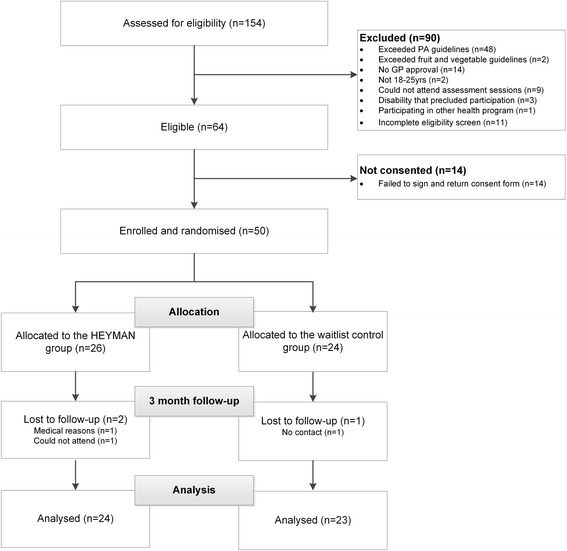
BACKGROUND: In young men, unhealthy lifestyle behaviours can be detrimental to their physical and/or mental health and set them on a negative health trajectory into adulthood. Despite this, there is a lack of evidence to guide development of effective health behaviour change interventions for young men. This study assessed the feasibility and preliminary efficacy of the 'HEYMAN' (Harnessing Ehealth to enhance Young men's Mental health, Activity and Nutrition) healthy lifestyle program for young men. METHODS: A pilot RCT with 50 young men aged 18-25 years randomised to the HEYMAN intervention (n = 26) or waitlist control (n = 24). HEYMAN was a 3-month intervention, targeted for young men to improve eating habits, activity levels and well-being. Intervention development was informed by a participatory research model (PRECEDE-PROCEED). Intervention components included eHealth support (website, wearable device, Facebook support group), face-to-face sessions (group and individual), a personalised food and nutrient report, home-based resistance training equipment and a portion control tool. Outcomes included: feasibility of research procedures (recruitment, randomisation, data collection and retention) and of intervention components. Generalized linear mixed models estimated the treatment effect at 3-months for the primary outcomes: pedometer steps/day, diet quality, well-being and several secondary outcomes. RESULTS: A 7-week recruitment period was required to enrol 50 young men. A retention rate of 94% was achieved at 3-months post-intervention. Retained intervention participants (n = 24) demonstrated reasonable usage levels for most program components and also reported reasonable levels of program component acceptability for attractiveness, comprehension, usability, support, satisfaction and ability to persuade, with scores ranging from 3.0 to 4.6 (maximum 5). No significant intervention effects were observed for the primary outcomes of steps/day (1012.7, 95% CI = -506.2, 2531.6, p = 0.191, d = 0.36), diet quality score (3.6, 95% CI = -0.4, 7.6, p = 0.081, d = 0.48) or total well-being score (0.4, 95% CI = -1.6, 2.5, p = 0.683, d = 0.11). Significant intervention effects were found for daily vegetable servings, energy-dense, nutrient-poor foods, MVPA, weight, BMI, fat mass, waist circumference and cholesterol (all p < 0.05). CONCLUSIONS: The HEYMAN program demonstrated feasibility in assisting young men to make some positive lifestyle changes. This provides support for the conduct of a larger, fully-powered RCT, but with minor amendments to research procedures and intervention components required. TRIAL REGISTRATION: Australian New Zealand Clinical Trials Registry ACTRN12616000350426 .
Overview
The claims and statistics of this paper haven’t been checked yet.
Run the check — free, no account needed. It reads the open-access text and checks the sources it cites.
Integrity signals
Registry
Cites
Statistics
Figures
Verification
Claims the paper makes
The claims and statistics of this paper haven’t been checked yet.
Run the check — free, no account needed. It reads the open-access text and checks the sources it cites.
Claims other papers make about this one
Each is checked against this paper’s own text: does it say what the citing paper says it does?
The source backs part of the claim, not all of it — or backs it for a different population, condition or comparison.
In the citing paper
“Two of the included studies [34,44] reported a significant increase in daily steps, 4 studies [30,34,36,53] reported a significant increase in MVPA, and 2 studies [45,47] reported a significant increase in energy expenditure for the intervention group compared with control.”
From Consumer-based wearable activity trackers increase physical activity participation: systematic review and meta-analysis (2019) · cites this paper as [30]
Experimental — accuracy not yet measuredThe cited source says what the claim attributes to it.
In the citing paper
“A total of 26 studies were included across all meta-analyses [21,22,29-48,50-53].”
From Consumer-based wearable activity trackers increase physical activity participation: systematic review and meta-analysis (2019) · cites this paper as [30]
The cited source says what the claim attributes to it.
In the citing paper
“Thirteen studies included young adults (≤39.9 years) [30-34,37,38,42,44,46-48,50], 15 included middle-aged adults (40-64.9 years) [21,22,29,35,36,39-41, 43,45,51-54], and 1 study included adults aged over 65 years [49].”
From Consumer-based wearable activity trackers increase physical activity participation: systematic review and meta-analysis (2019) · cites this paper as [30]
The cited source says what the claim attributes to it.
In the citing paper
“Moreover, 17 studies reported activity tracker adherence data [21,22,30,32,34,35, 37,38,40,41,43-45,50-52,54], with 13 of these studies [21,22,30,34,35,40,41,43,44,50-52,54] reporting activity tracker wear on at least 50% of the study intervention days.”
From Consumer-based wearable activity trackers increase physical activity participation: systematic review and meta-analysis (2019) · cites this paper as [30]
The cited source says what the claim attributes to it.
In the citing paper
“Furthermore, 17 studies specified that the participant must have regular access to the internet, a computer, tablet, and/or smartphone [21,30,33,35-37,39,41-47,51-53]”
From Consumer-based wearable activity trackers increase physical activity participation: systematic review and meta-analysis (2019) · cites this paper as [30]
The cited source says what the claim attributes to it.
In the citing paper
“This is most likely because of the inclusion of a greater range of intervention types when compared with other outcome measures and the method by which MVPA was measured, including 2 studies [30,48] that subjectively measured MVPA and another study [39] that presented MVPA data in bouts.”
From Consumer-based wearable activity trackers increase physical activity participation: systematic review and meta-analysis (2019) · cites this paper as [30]
Self-check
Percentages, sums and reported differences re-computed from the paper’s own numbers.
The self-check needs the paper’s full text.
Citations
Cites
Ryan, R. M., & Deci, E. L. (2000) · American Psychologist · doi:10.1037//0003-066x.55.1.68 · Cited by 54,599
The satisfaction with life scale
Diener, E., Emmons, R. A., Larsen, R. J., & Griffin, S. (1985) · Journal of Personality Assessment · doi:10.1207/s15327752jpa4901_13 · Cited by 31,768
(1985) · Medical Entomology and Zoology · Cited by 19,180
Health Behavior and Health Education: Theory, Research, and Practice
(1992) · Annals of Internal Medicine · doi:10.7326/0003-4819-116-4-350_1 · Cited by 13,232
KESSLER, R. C., ANDREWS, G., COLPE, L. J., HIRIPI, E., MROCZEK, D. K., NORMAND, S.-L. T., WALTERS, E. E., & ZASLAVSKY, A. M. (2002) · Psychological Medicine · doi:10.1017/s0033291702006074 · Cited by 10,327
‘Small Changes' to Diet and Physical Activity Behaviors for Weight Management
Hills, A. P., Byrne, N. M., Lindstrom, R. C., & Hill, J. O. (2013) · Obesity Facts · doi:10.1159/000345030 · Cited by 9,526
Bush, K. (1998) · Archives of Internal Medicine · doi:10.1001/archinte.158.16.1789 · Cited by 6,196
Moher, D., Schulz, K. F., & Altman, D. G. (2001) · The Lancet · doi:10.1016/s0140-6736(00)04337-3 · Cited by 5,373
Antony, M. M., Bieling, P. J., Cox, B. J., Enns, M. W., & Swinson, R. P. (1998) · Psychological Assessment · doi:10.1037/1040-3590.10.2.176 · Cited by 4,874
Moral Identity and Developmental Theory
Lapsley, D. K. (2015) · Human Development · doi:10.1159/000435926 · Cited by 3,843
Research works printed but not linked: 3
- Oliffe JL, Greaves L. Designing and conducting gender, Sex, and health research. Thousand Oak: Sage Publishers; 2012.
- Misan G, Oosterbroek C. Practitioners’ guide to effective Men’s health messaging: Men’s health resource Kit 2. Penrith: University of Western Sydney MHIRC; 2014.
- ACMA. Communications report 2011–12 series. Report 2—Australia’s progress in the digital economy: participation, trust and confidence. Canberra: Australian Communications and Media Authority; 2012. p. 1–35.
Cited by
Sorted by citations
Items 101–111 of 111
Health-related social media use : A systematic review
Yusoff, H. A. M., Hamzah, M. R., Manaf, A. R. A., Ismail, A., Ahmad, Y., Hussin, H., & Huzili, A. I. (2023) · AIP conference proceedings · doi:10.1063/5.0132822
Application of social media in designing and implementing effective healthcare programs
Saluja, P., Grover, V., Arora, S., Batra, K., & Kaur, J. (2023) · Elsevier eBooks · doi:10.1016/b978-0-323-95630-7.00017-2
Reading, J. M., Crane, M. M., Guan, J., Jackman, R., Thomson, M. D., & LaRose, J. G. (2024) · JMIR Formative Research · doi:10.2196/53841 · Cited by 1
Braune, T., Livingstone, K. M., Adams, J. M., & Winpenny, E. M. (2024) · Research Square · doi:10.21203/rs.3.rs-4324934/v1
Electronic Activity Monitoring
Lewis, Z. H., & Christopherson, U. (2023) · Cambridge University Press eBooks · doi:10.1017/9781107165250.017
Technologies in Cyber Behavior
Yukang, X., & Zhu, L. (2023) · Cambridge University Press eBooks · doi:10.1017/9781107165250.010
Özsoy, A., Yıldız, N. O., Çar, B., Salamone, E. A., Mazzara, F., Gürer, M., Agbulut, B., Erkadam, E. K., Karakus, Z., Ahraz, A. O., et al. (2025) · Spor Bilimleri Araştırmaları Dergisi · doi:10.25307/jssr.1591617
Goodyear, V. A., Wood, G., Skinner, B., & Thompson, J. L. (2021) · Figshare · doi:10.6084/m9.figshare.14738303
Clinical and community perspectives on sport-based care for young adults with testicular cancer
Petrella, A. R., Sabiston, C. M., O’Rourke, R. H., Mina, D. S., & Matthew, A. (2026) · Academia oncology. · doi:10.20935/acadonco8233
Armstrong, N., Ciorciari, A., & Woolf, K. (2026) · Nutrients · doi:10.3390/nu18172797
Jegminat, J., Shahnawaz, S., Rodrigues, J., Danieletto, M., Landell, K., Campanella, G. S. V., Garber, C. E., Fayad, Z. A., & Ensari, I. (2026) · npj Women s Health · doi:10.1038/s44294-026-00156-5
Metadata
- Authors
- Ashton, L. M., Morgan, P. J., Hutchesson, M. J., Rollo, M. E., & Collins, C. E.
- Affiliations
- University of Newcastle Australia (AU)
- Corresponding author
- Collins, Clare E.
- Venue
- Nutrition Journal
- Published
- 2017-01-13
- Volume
- 16
- Issue
- 1
- Pages
- 2-2
- ISSN
- 1475-2891 (ISSN-L)
- PMC
- PMC5237246
- OpenAlex
- W2576530535
- Cited by
- 111
- References
- 78
- Citations by year
- 2026: 4 · 2025: 12 · 2024: 9 · 2023: 9 · 2022: 16 · 2021: 19 · 2020: 22 · 2019: 10 · 2018: 7 · 2017: 3
- FWCI
- 18.54
- Type
- journal article
- Language
- en
- Open access
- gold
- doi.org
- Licence
- cc-by
- Locations
- Nutrition Journal (publishedVersion, cc-by)
- PubMed Central (publishedVersion, cc-by)
- PubMed (publishedVersion)
- Figshare (submittedVersion, cc-by)
- NOVA (University of Newcastle Australia) (submittedVersion, cc-by)
- Funders
- Hunter Medical Research Institute (14-30)
- National Health and Medical Research Council (Senior Research Fellowship)
- Topics
- Health Sciences › Medicine › Public Health, Environmental and Occupational Health › Health and Lifestyle Studies
- Health Sciences › Health Professions › General Health Professions › Mobile Health and mHealth Applications
- Health Sciences › Medicine › Public Health, Environmental and Occupational Health › Physical Activity and Health
- Keywords
- young men, healthy lifestyle intervention, e-health, physical activity, diet quality, well-being, mental health, resistance training, wearable devices, Facebook support groups, intervention feasibility, treatment acceptability, PRECEDE-PROCEED, health behavior change, university students, portion control, recruitment and retention
- MeSH terms
- Healthy Lifestyle, Adolescent, Adult, Body Weight, Diet, Feasibility Studies, Health Promotion, Humans, Male, New Zealand, Nutritional Status, Pilot Projects, Body Mass Index, Waist Circumference, Young Adult
About these checks
Registry, retraction, Cites and statistics results are computed, not judged, with one exception: a printed reference that no index lists is read once by a model before it counts as a citation error. Claims are extracted by a model and kept only when their quote appears verbatim in the text; each cited source is then checked, with a model’s help, for whether it says what the claim relies on. Those verdicts can be wrong — read the claim’s quote and the cited source before relying on one.
Statistics and arithmetic are recomputed, not judged.
Confidence bands are shown only for fields calibrated on our annotated test set. None is calibrated yet, so no band is shown.
What counts as a claim ›How we measure confidence ›How we check this ›
Are you an author, or do you see a problem with this page? Request a review
