

Research on subgroups is not research on equity attributes: Evidence from an overview of systematic reviews on vaccination
Open accessThe DOI matches its Crossref record; 39 of the 39 references it cites were found in a registry or an index.
Abstract
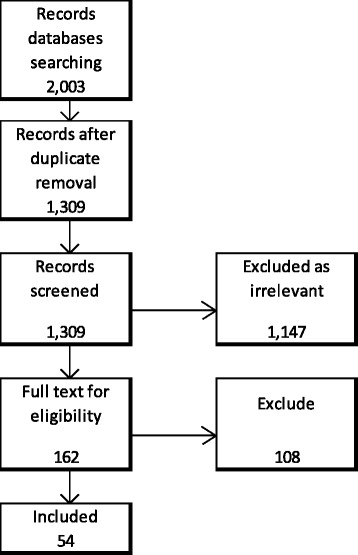
BACKGROUND: Equity remains a priority in the international health development agenda. However, major inequities in vaccination coverage jeopardise the achievement of the Sustainable Development Goals. We aim at comprehensively describing how research has addressed equity issues related to vaccination. METHODS: We carried out an overview of systematic reviews (SRs) that explicitly explored the effects of interventions to improve vaccination in any context; for any vaccine and, in any language. We followed standard research synthesis methods to systematically search for SR, assess them for inclusion and extracting relevant data, particularly on vaccination related outcomes. To gather evidence on equity issues addressed in the SR, we used the PROGRESS-plus framework. FINDINGS: Our search obtained 2,003 hits which resulted in 54 included SRs, published between 1994 and 2014. The quality of SRs was generally poor, with less than half complying with most of the quality criteria. Reported vaccines included, by order of frequency, influenza and Expanded Programme on Immunisation vaccines. The types of interventions more frequently reported were related to vaccination delivery strategies, financial support and information, education and communication. Most of the SRs suggested effects favouring intervention groups as opposed to comparison groups. The most frequently reported equity attribute was 'place of residence' and the least reported equity attributes were sexual orientation and religion. Very few estimates of effects actually measured differences or changes between groups having those attributes and all of them referred to the place of residence. No data was found about reducing equity gaps for vulnerable groups or minorities, or attributes such as sexual orientation, education or specific religious groups. CONCLUSIONS: Although research on vulnerable populations as a subgroup is abundant, it fails to report on the interventions that will actually reduce inequities and consider how redistribution of health care resources could shrink the gap between the privileged and most vulnerable groups including minorities. Research, if aiming at being responsive to global health policy trends, needs to report not only on specific attributes but also on how a better redistribution of health care resources could contribute to alleviating the unjust situation of the most vulnerable populations.
Overview
The claims and statistics of this paper haven’t been checked yet.
Free: it reads the open-access text and checks the first 5 claims that cite a source we can check. Create a free account to check every claim.
Integrity signals
Registry
Cites
Statistics
Figures
Verification
Claims the paper makes
The claims and statistics of this paper haven’t been checked yet.
Free: it reads the open-access text and checks the first 5 claims that cite a source we can check. Create a free account to check every claim.
Claims other papers make about this one
Each is checked against this paper’s own text: does it say what the citing paper says it does?
In the citing paper
“One example is the PROGRESS Plus framework, which focuses on highlighting unfair differences in disease burden and interventions in order to reduce these differential effects, but which does not explicitly involve implementation considerations [37, 42].”
From Conceptual framework of equity-focused implementation research for health programs (EquIR) (2019) · cites this paper as [42]
Self-check
Percentages, sums and reported differences re-computed from the paper’s own numbers.
The self-check needs the paper’s full text.
Citations
Cites
Transforming Our World: The 2030 Agenda for Sustainable Development
(2018) · A New Era in Global Health · doi:10.1891/9780826190123.ap02 · Cited by 19,351 · cited 1×
“With the recent declaration of the Sustainable Development Goals (SDG), communities, social entities, Non-Governmental Organisations, multi-lateral organisations, academia and other actors have repeatedly acknowledged the relevance of equity to ensure sustainable development [3].”
Vos, T., Abajobir, A. A., Abate, K. H., Abbafati, C., Abbas, K. M., Abd-Allah, F., Abdulkader, R. S., Abdulle, A. M., Abebo, T. A., Abera, S. F., et al. (2017) · The Lancet · doi:10.1016/s0140-6736(17)32154-2 · Cited by 13,220
Vos, T., Barber, R. M., Bell, B., Bertozzi-Villa, A., Biryukov, S., Bolliger, I., Charlson, F., Davis, A., Degenhardt, L., Dicker, D., et al. (2015) · The Lancet · doi:10.1016/s0140-6736(15)60692-4 · Cited by 6,414
Closing the gap in a generation: health equity through action on the social determinants of health
Marmot, M., Friel, S., Bell, R., Houweling, T. A., & Taylor, S. (2008) · The Lancet · doi:10.1016/s0140-6736(08)61690-6 · Cited by 3,247
The Concepts and Principles of Equity and Health
Whitehead, M. (1992) · International Journal of Health Services · doi:10.2190/986l-lhq6-2vte-yrrn · Cited by 2,284
O'Neill, J., Tabish, H., Welch, V., Petticrew, M., Pottie, K., Clarke, M., Evans, T., Pardo Pardo, J., Waters, E., White, H., et al. (2014) · Journal of Clinical Epidemiology · doi:10.1016/j.jclinepi.2013.08.005 · Cited by 1,657 · cited 1×
“Data on equity was extracted following PROGRESS‐plus [24], which stands for Place of residence; Race/ethnicity, Occupation, Gender, Religion, Education, Socioeconomic status (SES), Social capital, ‘plus’ age, disability and the sexual orientation.”
MethodBauer, G. R. (2014) · Social Science & Medicine · doi:10.1016/j.socscimed.2014.03.022 · Cited by 1,620 · cited 1×
“We acknowledge that research on equity may pose methodological challenges [43], which could explain the relative lack of comparators in a large proportion of the underlying (observational) studies, confirmed in the findings of a recent review [44]; for example, larger sample sizes may be needed to allow comparisons be…”
What are Health Disparities and Health Equity? We Need to Be Clear
Braveman, P. (2014) · Public Health Reports® · doi:10.1177/00333549141291s203 · Cited by 860 · cited 1×
“Equity in health is a fundamental moral and ethical commitment to reduce and eliminate unfair and unjust disparities in health and its determinants [1].”
BackgroundThe neglected epidemic: road traffic injuries in developing countries
Nantulya, V. M., & Reich, M. R. (2002) · BMJ · doi:10.1136/bmj.324.7346.1139 · Cited by 777 · cited 1×
“Besides, agreement across research areas on critical equity outcomes would benefit further efforts to conduct research synthesis on inequities [48].”
BackgroundTransgender Youth: Invisible and Vulnerable
Grossman, A. H., & D'augelli, A. R. (2006) · Journal of Homosexuality · doi:10.1300/j082v51n01_06 · Cited by 588
Research works printed but not linked: 2
- Melamed C Samman E Equity, inequality and human development in a post 2015
- WHO Towards a monitoring framework with targets and indicators for the health goals of the post-2015 Sustainable Development Goals 2015
Cited by
Conceptual framework of equity-focused implementation research for health programs (EquIR)
Eslava-Schmalbach, J., Garzón-Orjuela, N., Elias, V., Reveiz, L., Tran, N., & Langlois, E. V. (2019) · International Journal for Equity in Health · doi:10.1186/s12939-019-0984-4 · Cited by 160
“One example is the PROGRESS Plus framework, which focuses on highlighting unfair differences in disease burden and interventions in order to reduce these differential effects, but which does not explicitly involve implementation considerations [37, 42].”
BackgroundHow effects on health equity are assessed in systematic reviews of interventions
Welch, V., Dewidar, O., Ghogomu, E. T., Abdisalam, S., Ameer, A. A., Barbeau, V. I., Brand, K., Kebedom, K., Benkhalti, M., Kristjansson, E., et al. (2022) · Cochrane Database of Systematic Reviews · doi:10.1002/14651858.mr000028.pub3 · Cited by 90
Allan, S., Adetifa, I., & Abbas, K. (2021) · BMC Infectious Diseases · doi:10.1186/s12879-021-06271-9 · Cited by 77
“We need implementation research and evidence on interventions that would reduce inequities in childhood immunisation in Kenya and to inform the redistribution of healthcare resources to protect all children with full immunisation, regardless of location, age, socioeconomic status or gender-related barriers [10, 50].”
MethodBesnier, E., Thomson, K. H., Stonkute, D., Mohammad, T., Akhter, N., Todd, A., Jensen, M. R., Kilvik, A., & Bambra, C. L. (2021) · PLoS ONE · doi:10.1371/journal.pone.0251905 · Cited by 45
“These trends are in line with those from previous global umbrella reviews [14, 16], thus highlighting once again the need for a stronger equity lens and systematic reporting of intervention effects across population groups in systematic reviews.”
Hosking, J., Macmillan, A. K., Jones, R., Ameratunga, S. N., & Woodward, A. J. (2019) · Systematic Reviews · doi:10.1186/s13643-019-1009-5 · Cited by 40
Besnier, E., Thomson, K. H., Stonkute, D., Mohammad, T., Akhter, N., Todd, A., Jensen, M. R., Kilvik, A., & Bambra, C. L. (2019) · BMJ Open · doi:10.1136/bmjopen-2019-032981 · Cited by 34
Kunonga, P., Hanratty, B., Bower, P., & Craig, D. (2023) · Journal of Clinical Epidemiology · doi:10.1016/j.jclinepi.2023.02.013 · Cited by 32
Ukke, G. G., Boyle, J. A., Reja, A., Lee, W. K., Chen, M., Ko, M. S. M., Alycia, C., Kwon, J., & Lim, S. S. (2023) · Nutrients · doi:10.3390/nu15214666 · Cited by 28
Huang, Y., & Danovaro-Holliday, M. C. (2021) · BMC Public Health · doi:10.1186/s12889-021-10364-0 · Cited by 17
“Now, research about interventions that will actually decrease inequities and identify and reduce immunization gaps between the privileged and vulnerable populations are still lackin g[144].”
BackgroundDada, S., Battles, H. T., Pilbeam, C., Singh, B., Solomon, T., & Gobat, N. (2021) · Humanities and Social Sciences Communications · doi:10.1057/s41599-021-00898-4 · Cited by 17
Wang, X., Pan, J., Yan, B., Zhang, R., Yang, T., & Zhou, X. (2024) · International Journal for Equity in Health · doi:10.1186/s12939-024-02199-z · Cited by 15
Patenaude, B., Odihi, D., Sriudomporn, S., Mak, J., Watts, E. A., & Broucker, G. D. (2021) · Social Science & Medicine · doi:10.1016/j.socscimed.2022.114979 · Cited by 16
Yadee, J., Bangpan, M., Thavorn, K., Welch, V. A., Tugwell, P., & Chaiyakunapruk, N. (2019) · International Journal for Equity in Health · doi:10.1186/s12939-019-0970-x · Cited by 15
“We extracted information from primary studies to evaluate the effect of health interventions based on the equity attributes while the previous study [36] performed an overview of systematic reviews.”
BackgroundMethodResultInfluentialCox, S. N., Wedlock, P. T., Pallas, S. W., Mitgang, E. A., Yemeke, T. T., Bartsch, S. M., Abimbola, T. O., Sigemund, S. S., Wallace, A. S., Ozawa, S., et al. (2021) · Vaccine · doi:10.1016/j.vaccine.2021.05.033 · Cited by 12
Patenaude, B., Sriudomporn, S., Odihi, D., Mak, J., & Broucker, G. D. (2023) · Vaccines · doi:10.3390/vaccines11030536 · Cited by 15
Gates, A., Rahman, S., Sim, S., Pillay, J., Ismail, S. J., Tunis, M. C., Keto‐Lambert, D., & Hartling, L. (2021) · Vaccine · doi:10.1016/j.vaccine.2021.05.054 · Cited by 9
Jalloh, M. F., Hickler, B., Parmley, L., Sutton, R., Kulkarni, S., Mansaray, A., Eleeza, O., Patel, P. Y., Wilhelm, E., Conklin, L. M., et al. (2021) · BMJ Global Health · doi:10.1136/bmjgh-2021-005525 · Cited by 7
“1 Inequities in vaccination coverage also exist across and within LMICs, 6 contributing to undervaccination among those living in conflict-affected places, hard- to-reach areas and urban poor settings 7–11 and populations with low socioeconomic status.”
BackgroundAppraisal of umbrella reviews on vaccines
Bellomo, R. K., & Ioannidis, J. P. A. (2024) · Communications Medicine · doi:10.1038/s43856-024-00679-5 · Cited by 5
Mitigating inequalities at a large COVID-19 vaccination centre
Taplin, S., Andrews‐Jones, B., Chainey, A., Das, S., Dawson, D., Dean, A., Harvey, K., Holloway, J., King, N., Pennell, B., et al. (2022) · Future Healthcare Journal · doi:10.7861/fhj.2022-0035 · Cited by 2
Bhartiya, S. (2023) · International Journal of Community Medicine and Public Health · doi:10.18203/2394-6040.ijcmph20230635
Allan, S., Adetifa, I. M. O., & Abbas, K. (2021) · Figshare · doi:10.6084/m9.figshare.14767356
Wang, X., Pan, J., Yan, B., Zhang, R., Yang, T., & Zhou, X. (2024) · Figshare · doi:10.6084/m9.figshare.25951752
Huang, Y., & Danovaro-Holliday, M. C. (2021) · Figshare · doi:10.6084/m9.figshare.14006149
Evidence synthesis without equity: a missed opportunity to promote health and improve health care
Baum, F. E., & Popay, J. (2026) · JBI Evidence Synthesis · doi:10.11124/jbies-26-00301
Metadata
- Authors
- Bosch-Capblanch, X., Zuske, M.-K., & Auer, C.
- Affiliations
- Swiss Tropical and Public Health Institute (CH)
- Venue
- International Journal for Equity in Health
- Published
- 2017-06-07
- Volume
- 16
- Issue
- 1
- Pages
- 95-95
- ISSN
- 1475-9276 (ISSN-L)
- PMC
- PMC5463415
- OpenAlex
- W2623985795
- Cited by
- 25
- References
- 39
- Citations by year
- 2026: 1 · 2024: 3 · 2023: 4 · 2022: 3 · 2021: 10 · 2019: 4
- FWCI
- 0.19
- Type
- journal article
- Language
- en
- Open access
- gold
- doi.org
- Licence
- cc-by
- Locations
- International Journal for Equity in Health (publishedVersion, cc-by)
- Europe PMC (PubMed Central) (publishedVersion, cc-by)
- PubMed Central (publishedVersion, cc-by)
- PubMed (publishedVersion)
- edoc (University of Basel) (acceptedVersion)
- DOAJ (DOAJ: Directory of Open Access Journals) (submittedVersion, cc-by-sa)
- Funders
- Federal Office of Public Health of Switzerland
- Global Development Network – International Initiative for Impact Evaluation
- Topics
- Social Sciences › Health › Vaccine Coverage and Hesitancy
- Social Sciences › Health › Public Health and Social Inequalities
- Life Sciences › Immunology and Microbiology › Immunology › Immune responses and vaccinations
- Keywords
- vaccination, health equity, subgroups, vaccination coverage, PROGRESS-Plus framework, vulnerable populations, influenza vaccination, Expanded Programme on Immunization, sexual orientation, place of residence
- MeSH terms
- Health Equity, Humans, Vaccination, Global Health, Randomized Controlled Trials as Topic, Biomedical Research, Population Groups
About these checks
Registry, retraction, Cites and statistics results are computed, not judged, with one exception: a printed reference that no index lists is read once by a model before it counts as a citation error. Claims are extracted by a model and kept only when their quote appears verbatim in the text; each cited source is then checked, with a model’s help, for whether it says what the claim relies on. Those verdicts can be wrong — read the claim’s quote and the cited source before relying on one.
Statistics and arithmetic are recomputed, not judged.
Confidence bands are shown only for fields calibrated on our annotated test set. None is calibrated yet, so no band is shown.
What counts as a claim ›How we measure confidence ›How we check this ›
Are you an author, or do you see a problem with this page? Request a review
Data sources
Bibliographic data: Semantic Scholar, OpenAlex, Crossref.
Contains information from the Semantic Scholar Academic Graph Datasets, made available under the ODC Attribution License (ODC-BY 1.0).
Semantic Scholar’s data is described in: Kinney, R., et al. (2023). The Semantic Scholar Open Data Platform. arXiv:2301.10140.
