

Reported Māori consumer experiences of health systems and programs in qualitative research: a systematic review with meta-synthesis
Open accessThe DOI matches its Crossref record; 71 of the 73 references it cites were found in a registry or an index.
Abstract
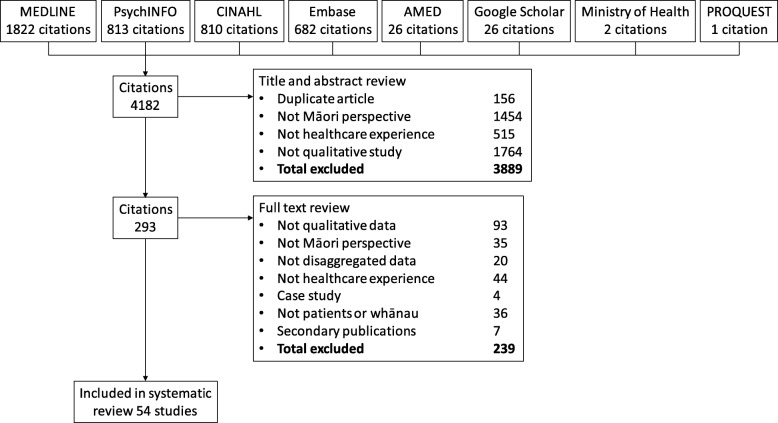
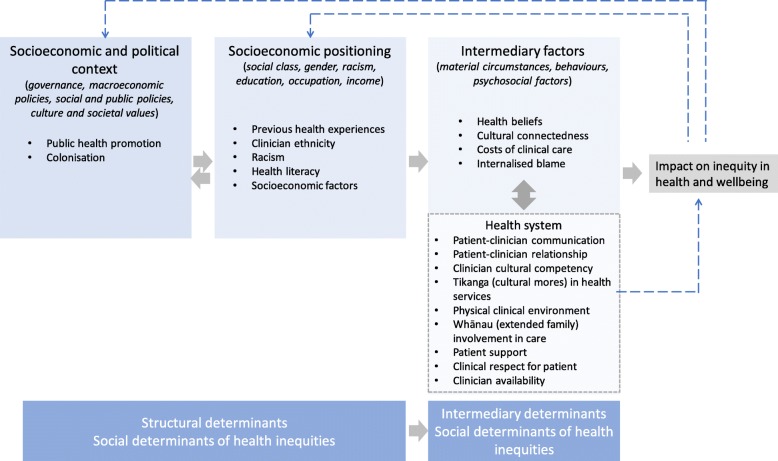
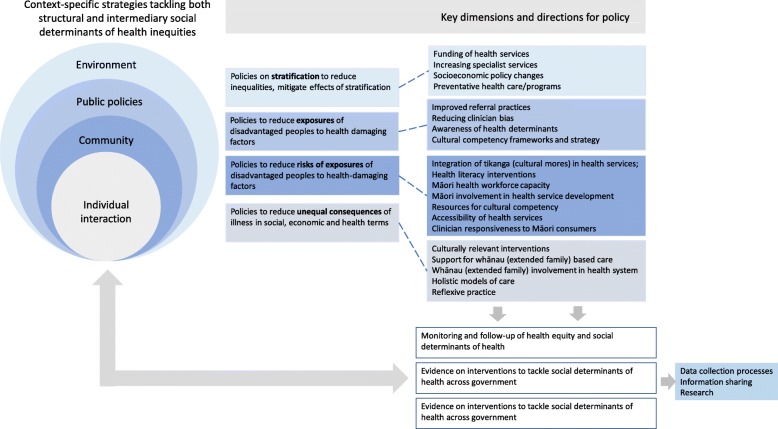
Background: Persistent inequities in health experiences and outcomes are observed for Māori compared to non-Māori in Aotearoa New Zealand. We conceptualised factors associated with Māori consumer experiences of health programs and services and characterise how the recommendations arising from qualitative research inform strategies to address inequities. Methods: In this systematic review, electronic literature searching was conducted in February 2018. Qualitative studies reporting Māori consumer experiences of health services and programs in Aotearoa New Zealand were eligible. Māori consumer experiences of health services were mapped to the WHO Commission of Social Determinants of Health (CSDH) conceptual framework on health inequities as related to: (i) the socioeconomic and political context; (ii) socioeconomic positioning; or (iii) intermediary factors that increase exposure to health-compromising conditions. Recommendations to improve consumer experiences were mapped to the CSDH framework for tackling social determinants of health inequities as policy directions on: (i) unequal consequences of illness (individual interaction); (ii) risks of exposure to health-damaging factors (community); (iii) exposures to health-damaging factors (public policies); and (iv) mitigating effects of socioeconomic and political stratification (environment). Results: Fifty-four studies were included. Māori consumer experiences mapped to social determinants of health inequities were most frequently related to direct interactions with health services and programs, particularly patient-clinician interactions (communication, relationships) and cultural competencies of clinicians and the system. Key recommendations by researchers mapped to potential strategies to address inequity were identified at all levels of the political, social and health system from individual interactions, community change, and broader public and system-level strategies. Recommendations were predominantly focused on actions to reduce risks of exposure to health-damaging factors including health literacy interventions, increased resources in cultural competencies and Māori capacity in health service development and workforce. Conclusions: Māori consumer experiences of health services and programs are an important informer of variables that impact health inequity. Strategies to tackle health inequities informed by Māori consumer experiences can be drawn from existing empirical research. Future qualitative exploration of how socioeconomic, political and public policies influence Māori consumer experiences of health services and programs could inform a broader range of structural policies to address health inequities.
Overview
The claims and statistics of this paper haven’t been checked yet.
Free: it reads the open-access text and checks the first 5 claims that cite a source we can check. Create a free account to check every claim.
Integrity signals
Registry
Cites
Statistics
Figures
Verification
Claims the paper makes
The claims and statistics of this paper haven’t been checked yet.
Free: it reads the open-access text and checks the first 5 claims that cite a source we can check. Create a free account to check every claim.
Claims other papers make about this one
Each is checked against this paper’s own text: does it say what the citing paper says it does?
The source backs part of the claim, not all of it — or backs it for a different population, condition or comparison.
In the citing paper
“For Māori, they include a sense of stigma and stoicism, experiences of institutional racism19 and restricted access to healthcare.20”
From Clinical and cost-effectiveness of an online-delivered group-based pain management programme in improving pain-related disability for people with persistent pain - Protocol for a non-inferiority randomised controlled trial (iSelf-help trial) (2021) · cites this paper as [19]
Experimental — accuracy not yet measured
Self-check
Percentages, sums and reported differences re-computed from the paper’s own numbers.
The self-check needs the paper’s full text.
Citations
Cites
Tong, A., Sainsbury, P., & Craig, J. (2007) · International Journal for Quality in Health Care · doi:10.1093/intqhc/mzm042 · Cited by 42,509
The Coding Manual for Qualitative Researchers
Lungu, M. (2022) · American Journal of Qualitative Research · doi:10.29333/ajqr/12085 · Cited by 10,826
Enhancing transparency in reporting the synthesis of qualitative research: ENTREQ
Tong, A., Flemming, K., McInnes, E., Oliver, S., & Craig, J. (2012) · BMC Medical Research Methodology · doi:10.1186/1471-2288-12-181 · Cited by 3,569
Qualitative Data Analysis for Health Services Research: Developing Taxonomy, Themes, and Theory
Bradley, E. H., Curry, L. A., & Devers, K. J. (2007) · Health Services Research · doi:10.1111/j.1475-6773.2006.00684.x · Cited by 3,437
Dixon-Woods, M., Cavers, D., Agarwal, S., Annandale, E., Arthur, A., Harvey, J., Hsu, R., Katbamna, S., Olsen, R., Smith, L., et al. (2006) · BMC Medical Research Methodology · doi:10.1186/1471-2288-6-35 · Cited by 2,289
WHO European review of social determinants of health and the health divide
Marmot, M., Allen, J., Bell, R., Bloomer, E., & Goldblatt, P. (2012) · The Lancet · doi:10.1016/s0140-6736(12)61228-8 · Cited by 1,571
Anderson, I., Robson, B., Connolly, M., Al-Yaman, F., Bjertness, E., King, A., Tynan, M., Madden, R., Bang, A., Coimbra, C. E. A., et al. (2016) · The Lancet · doi:10.1016/s0140-6736(16)00345-7 · Cited by 990
Booth, A. (2016) · Systematic Reviews · doi:10.1186/s13643-016-0249-x · Cited by 569
Patients’ engagement in primary care: powerlessness and compounding jeopardy. A qualitative study
Sheridan, N. F., Kenealy, T. W., Kidd, J. D., Schmidt‐Busby, J. I. G., Hand, J. E., Raphael, D. L., McKillop, A. M., & Rea, H. H. (2015) · Health Expectations · doi:10.1111/hex.12006 · Cited by 128
Addressing inequities in access to quality health care for indigenous people
Peiris, D., Brown, A., & Cass, A. (2008) · Canadian Medical Association Journal · doi:10.1503/cmaj.081445 · Cited by 120
The significance of a culturally appropriate health service for Indigenous Māori women
Wilson, D. (2008) · Contemporary Nurse · doi:10.5172/conu.673.28.1-2.173 · Cited by 108
Quality of hospital care for Māori patients in New Zealand: retrospective cross-sectional assessment
Davis, P. B., Lay‐Yee, R., Dyall, L., Briant, R., Sporle, A. A., Brunt, D., & Scott, A. (2006) · The Lancet · doi:10.1016/s0140-6736(06)68847-8 · Cited by 95
Indigenous hospital experiences: a New Zealand case study
Wilson, D., & Barton, P. (2012) · Journal of Clinical Nursing · doi:10.1111/j.1365-2702.2011.04042.x · Cited by 94
Mapping the themes of Maori talk about health.
Cram, F., Smith, L., & Johnstone, W. (2003) · PubMed · Cited by 91
Community responses to communication campaigns for influenza A (H1N1): a focus group study
Gray, L., MacDonald, C., Mackie, B., Paton, D., Johnston, D., & Baker, M. G. (2012) · BMC Public Health · doi:10.1186/1471-2458-12-205 · Cited by 76
Major abdominal surgery in octogenarians.
Abbas, S. M., & Booth, M. (2003) · PubMed · Cited by 75
Maori experiences and perceptions of gout and its treatment: a kaupapa Maori qualitative study
Karu, L. T., Bryant, L. J. M., & Elley, C. R. (2013) · Journal of Primary Health Care · doi:10.1071/hc13214 · Cited by 70
Walker, R., Walker, S., Morton, R. L., Tong, A., Howard, K., & Palmer, S. C. (2017) · BMJ Open · doi:10.1136/bmjopen-2016-013829 · Cited by 67
Self-citationLiving with type 2 diabetes: ‘Putting the person in the pilots’ seat’
Handley, J., Pullon, S., & Gifford, H. (2010) · Australian journal of advanced nursing · doi:10.37464/2010.273.1708 · Cited by 64
Sociocultural barriers to cervical screening in South Auckland, New Zealand
Lovell, S. A., KEARNS, R. A., & Friesen, W. (2007) · Social Science & Medicine · doi:10.1016/j.socscimed.2007.02.042 · Cited by 61
Provider, father, and bro – Sedentary Māori men and their thoughts on physical activity
Warbrick, I., Wilson, D., & Boulton, A. (2016) · International Journal for Equity in Health · doi:10.1186/s12939-016-0313-0 · Cited by 60
‘Where do I go from here’? A cultural perspective on challenges to the use of hospice services
Frey, R. A., Gott, M., Raphael, D. L., Black, S., Teleo-Hope, L., Lee, H., & Wang, Z. (2013) · Health & Social Care in the Community · doi:10.1111/hsc.12038 · Cited by 58
The road we travel: Māori experience of cancer.
Walker, T., Signal, L. N., Russell, M., Smiler, K., & Tuhiwai-Ruru, R. (2008) · PubMed · Cited by 56
Gout in Aotearoa New Zealand: the equity crisis continues in plain sight.
Dalbeth, N., Dowell, T., Gerard, C., Gow, P. J., Jackson, G., Shuker, C., & Karu, L. T. (2018) · PubMed · Cited by 56
Experiences of Maori families accessing health care for their unwell children: a pilot study.
Bolitho, S., & Huntington, A. (2006) · PubMed · Cited by 55
Wahakura Versus Bassinet for Safe Infant Sleep: A Randomized Trial
Baddock, S. A., Tipene‐Leach, D., Williams, S., Tangiora, A., Jones, R., Iosua, E. E., Macleod, E., & Taylor, B. J. (2017) · PEDIATRICS · doi:10.1542/peds.2016-0162 · Cited by 53
Māori experiences of aphasia therapy: “But I'm from Hauiti and we've got shags”
McLellan, K. M., McCann, C., Worrall, L. E., & Harwood, M. L. N. (2013) · International Journal of Speech-Language Pathology · doi:10.3109/17549507.2013.864334 · Cited by 45
Slater, T., Matheson, A., Davies, C., Tavite, H., Ruhe, T., Holdaway, M., & Ellison‐Loschmann, L. (2013) · Journal of Primary Health Care · doi:10.1071/hc13308 · Cited by 43
Arlidge, B., Abel, S. L., Asiasiga, L., Milne, S., Crengle, S. M., & Ameratunga, S. N. (2008) · Ethnicity and Health · doi:10.1080/13557850802307791 · Cited by 42
Tapera, R. M., Harwood, M. L. N., & Anderson, A. (2016) · Public Health Nutrition · doi:10.1017/s1368980016002950 · Cited by 42
Maori Experience of Community Treatment Orders in Otago, New Zealand
Gibbs, A., Dawson, J., Forsyth, H., Mullen, R., & Te Oranga Tonu Tanga (Maori Mental Health Team) (2004) · Australian & New Zealand Journal of Psychiatry · doi:10.1080/j.1440-1614.2004.01468.x · Cited by 40
Dew, K. P., Morgan, S. J., Dowell, A. C., McLeod, D. L., Bushnell, J., & Collings, S. C. (2007) · Sociology of Health & Illness · doi:10.1111/j.1467-9566.2007.01022.x · Cited by 39
Glover, M., Waldon, J., Manaena-Biddle, H., Holdaway, M., & Cunningham, C. W. (2009) · Journal of Human Lactation · doi:10.1177/0890334409332436 · Cited by 38
Initiation of maternity care for young Maori women under 20 years of age.
Makowharemahihi, C., LAWTON, B. A., Cram, F., Ngata, T., Brown, S., & Robson, B. (2014) · PubMed · Cited by 37
Analyzing Smoking Using Te Whare Tapa Wha
Glover, M. (2013) · Elsevier eBooks · doi:10.1016/b978-0-12-415921-1.00011-7 · Cited by 36
Critical considerations for the practical utility of health equity tools: a concept mapping study
Pauly, B., Martin, W., Perkin, K., van Roode, T., Kwan, A., Patterson, T., Tong, S., Prescott, C., Wallace, B. B., Hancock, T., et al. (2018) · International Journal for Equity in Health · doi:10.1186/s12939-018-0764-6 · Cited by 36
Metcalfe, S., Laking, G. R., & Arnold, J. (2013) · PubMed · Cited by 35
Talking about TB: multicultural diversity and tuberculosis services in Waikato, New Zealand.
van der Oest, C., Chenhall, R. D., Hood, D., & Kelly, P. (2005) · PubMed · Cited by 33
Pregnant Māori Smokers’ Perception of Cessation Support and How It Can Be More Helpful
Glover, M., & Kira, A. (2012) · The Journal of Smoking Cessation · doi:10.1017/jsc.2012.13 · Cited by 30
Ethnic differences of medicines-taking in older adults: a cross cultural study in New Zealand
Bassett-Clarke, D., Krass, I., & Bajorek, B. V. (2011) · International Journal of Pharmacy Practice · doi:10.1111/j.2042-7174.2011.00169.x · Cited by 30
At a cultural crossroads: Lessons on culture and policy from the New Zealand DISABILITY STRATEGY
Wiley, A. (2009) · Disability and Rehabilitation · doi:10.1080/09638280902773935 · Cited by 29
Narratives of deprivation: Women’s life stories around Maori sudden infant death syndrome
McManus, V., Abel, S. L., McCreanor, T., & Tipene‐Leach, D. (2010) · Social Science & Medicine · doi:10.1016/j.socscimed.2010.04.028 · Cited by 26
Elder, H. (2013) · Brain Impairment · doi:10.1017/brimp.2013.28 · Cited by 26
Nurse Practitioner provision of patient education related to medicine
Cashin, A. J., Buckley, T. A., Newman, C., & Dunn, S. V. (2010) · Australian journal of advanced nursing · doi:10.37464/2010.272.1720 · Cited by 25
Tipene‐Leach, D., Abel, S. L., Finau, S. A., Park, J., & Lenna, M. (2000) · PubMed · Cited by 25
Exploring Māori cancer patients', their families', community and hospice views of hospice care
Slater, T., Matheson, A., Ellison‐Loschmann, L., Davies, C., Earp, R., Gellatly, K., & Holdaway, M. (2015) · International Journal of Palliative Nursing · doi:10.12968/ijpn.2015.21.9.439 · Cited by 23
Barriers to Maori sole mothers' primary health care access.
Lee, R., & North, N. (2013) · Journal of Primary Health Care · doi:10.1071/hc13315 · Cited by 23
Bakker, J. P., O’Keeffe, K., Neill, A. M., & Campbell, A. (2014) · Journal of Primary Health Care · doi:10.1071/hc14221 · Cited by 21
Thompson-Evans, T. P., Glover, M. P., & Walker, N. (2011) · Nicotine & Tobacco Research · doi:10.1093/ntr/ntr002 · Cited by 20
Willams, P. N., Gray, M. A., Ka‘ai, T., Moorfield, J. C., McPherson, K. M., Weinstein, P., & Nacey, J. N. (2003) · PubMed · Cited by 20
The impact of dialysis on rurally based Māori and their whānau/families.
Shih, L.-C., & Honey, M. L. L. (2011) · PubMed · Cited by 20
The value of te reo in primary care
Pitama, S. G., Ahuriri‐Driscoll, A., Huria, T., Lacey, C. J., & Robertson, P. (2011) · Journal of Primary Health Care · doi:10.1071/hc11123 · Cited by 19
Self-citationAbel, S. L., Stockdale-Frost, A., Rolls, R., & Tipene‐Leach, D. (2015) · PubMed · Cited by 18
Maori women's views on smoking cessation initiatives.
Fernandez, C., & Wilson, D. (2008) · PubMed · Cited by 17
Angelo, J., & Wilson, L. S. (2014) · Occupational Therapy International · doi:10.1002/oti.1367 · Cited by 16
A Humanistic Approach to Addressing the Needs of Maori Homeless People With Mental Health Concerns
Johnson, D., Hodgetts, D., & Nīkora, L. W. (2012) · Journal of Humanistic Psychology · doi:10.1177/0022167812447297 · Cited by 16
Maori Men and the Grief of SIDS
Edwards, S., McCreanor, T., Ormsby, M., Tuwhangai, N., & Tipene‐Leach, D. (2009) · Death Studies · doi:10.1080/07481180802602774 · Cited by 15
The experience ofwhanaucaring for members disabled from the effects of a cerebro-vascular accident
Corbett, A., Francis, K. L., & Chapman, Y. B. (2006) · Contemporary Nurse · doi:10.5172/conu.2006.22.2.255 · Cited by 14
Assisted Human Reproduction: Issues for Takatāpui (New Zealand Indigenous Non-Heterosexuals)
Glover, M., McKree, A., & Dyall, L. (2009) · Journal of GLBT Family Studies · doi:10.1080/15504280903263702 · Cited by 12
WHAKAPAPA, GENEALOGY AND GENETICS
Evans, D. (2010) · Bioethics · doi:10.1111/j.1467-8519.2010.01850.x · Cited by 12
Waetford, C. (2008) · Tuwhera (Auckland University of Technology) · Cited by 11
Why Don't Some Women Return for Cervical Smears? A Hermeneutic Phenomenological Investigation
Buetow, S., Janes, R., Steed, R., Ihimaera, L., & Elley, C. R. (2007) · Health Care For Women International · doi:10.1080/07399330701563251 · Cited by 10
Kriznik, N. M. (2015) · Durham e-Theses (Durham University) · Cited by 9
Over and under? Ethnic inequities in community antibacterial prescribing.
Metcalfe, S., Bhawan, S., Vallabh, M., Murray, P., Proffitt, C., & Williams, G. (2019) · PubMed · Cited by 9
Laird, B., Smith, B. D., Dutu, G., & Mellsop, G. W. (2009) · International Journal of Social Psychiatry · doi:10.1177/0020764008101637 · Cited by 8
Buetow, S., Adair, V., Coster, G., Hight, M., Gribben, B., & Mitchell, E. A. (2003) · Health Education · doi:10.1108/09654280310467717 · Cited by 8
Perceptions of health, illness and physiotherapy of Maori identifying with Ngati Tama iwi
White, N. R., Mavoa, H., & Bassett, S. (1999) · Deakin Research Online (Deakin University) · Cited by 7
Raphael, D. (2018) · International Journal of Health Policy and Management · doi:10.15171/ijhpm.2018.70 · Cited by 6
Choosing Wisely means choosing equity.
Loring, B., Ineson, S., Sherwood, D., & Tipene‐Leach, D. (2019) · PubMed · Cited by 6
Handy, E. S. C., & Handy, E. G. (1942) · The William and Mary Quarterly · doi:10.2307/1923336 · Cited by 4
Rushton, C. (2016) · Nursing Inquiry · doi:10.1111/nin.12126 · Cited by 1
Research works printed but not linked: 6
- 1. Ministry of Health. Mortality and demographic data 2012. Wellington: Ministry of Health; 2015.
- 4. Robson B, Purdie G, Cormack D. Unequal impact: Māori and non-Māori Cancer statistics 1996–2001. Ministry of Health: Wellington; 2006.
- 22. Bassett SF, Tango SM. Māori people's experiences of being physiotherapy patients: a phenomenological study. N Z J Physiother. 2002;30(1):30–40.
- 42. Jansen P, Bacal K, Crengle S. He Ritenga Whakaaro: Māori experiences of health services. Auckland: Mauri Ora Associates 2008; 2009.
- 64. Johnston Taylor E, Simmonds S, Earp R, Dip PT. Māori perspectives on hospice care. Divers Equal Health Care. 2014;11(1):61–70.
- 67. The Centre for Health Activity and Rehabilitation Research, School of Physiotherapy University of Otago. Haua Mana Māori: Living unique and enriched lives. A report for the Health Research Council and the Ministry of Health. 2014.
Cited by
Haitana, T., Pitama, S. G., Cormack, D. M., Clarke, M., & Lacey, C. J. (2020) · International Journal of Qualitative Methods · doi:10.1177/1609406920953752 · Cited by 91
Self-citationCOVID-19 Vaccine Hesitancy and Acceptance in a Cohort of Diverse New Zealanders
Prickett, K. C., Habibi, H., & Carr, P. A. (2021) · The Lancet Regional Health - Western Pacific · doi:10.1016/j.lanwpc.2021.100241 · Cited by 84
Understanding how whānau-centred initiatives can improve Māori health in Aotearoa New Zealand
Reweti, A. (2023) · Health Promotion International · doi:10.1093/heapro/daad070 · Cited by 57
Reflecting on challenges and opportunities for the practice of person-centred rehabilitation
Kayes, N. M., & Papadimitriou, C. (2023) · Clinical Rehabilitation · doi:10.1177/02692155231152970 · Cited by 58
Hunter, K., & Cook, C. M. (2020) · Nursing Praxis in Aotearoa New Zealand · doi:10.36951/27034542.2020.011 · Cited by 47
Metadata
- Authors
- Palmer, S. C., Gray, H., Huria, T., Lacey, C., Beckert, L., & Pitama, S. G.
- Affiliations
- University of Otago (NZ)
- Corresponding author
- Pitama, Suzanne G.
- Venue
- International Journal for Equity in Health
- Published
- 2019-10-28
- Volume
- 18
- Issue
- 1
- Pages
- 163-163
- ISSN
- 1475-9276 (ISSN-L)
- PMC
- PMC6816189
- OpenAlex
- W2981941617
- Cited by
- 109
- References
- 73
- Citations by year
- 2026: 8 · 2025: 14 · 2024: 29 · 2023: 17 · 2022: 16 · 2021: 18 · 2020: 7
- FWCI
- 2.18
- Type
- journal article
- Language
- en
- Open access
- gold
- doi.org
- Licence
- cc-by
- creativecommons.org/licenses/by/4.0/ (tdm)
- creativecommons.org/licenses/by/4.0/ (vor)
- Locations
- International Journal for Equity in Health (publishedVersion, cc-by)
- Europe PMC (PubMed Central) (publishedVersion, cc-by)
- PubMed Central (publishedVersion, cc-by)
- PubMed (publishedVersion)
- DOAJ (DOAJ: Directory of Open Access Journals) (submittedVersion, cc-by-sa)
- Funders
- Royal Society
- Royal Society Te Apārangi
- Topics
- Social Sciences › Health › Indigenous Health, Education, and Rights
- Health Sciences › Medicine › Public Health, Environmental and Occupational Health › Cultural Competency in Health Care
- Social Sciences › Health › Public Health and Social Inequalities
- Keywords
- Māori, customer experience, health disparities, social determinants of health, patient-clinician communication, cultural competence, health literacy, healthcare workers, health policy, WHO Commission on Social Determinants of Health, New Zealand
- MeSH terms
- Humans, New Zealand, Socioeconomic Factors, Qualitative Research, Population Groups, Cultural Competency, Healthcare Disparities
About these checks
Registry, retraction, Cites and statistics results are computed, not judged, with one exception: a printed reference that no index lists is read once by a model before it counts as a citation error. Claims are extracted by a model and kept only when their quote appears verbatim in the text; each cited source is then checked, with a model’s help, for whether it says what the claim relies on. Those verdicts can be wrong — read the claim’s quote and the cited source before relying on one.
Statistics and arithmetic are recomputed, not judged.
Confidence bands are shown only for fields calibrated on our annotated test set. None is calibrated yet, so no band is shown.
What counts as a claim ›How we measure confidence ›How we check this ›
Are you an author, or do you see a problem with this page? Request a review
Data sources
Bibliographic data: Semantic Scholar, OpenAlex, Crossref.
Contains information from the Semantic Scholar Academic Graph Datasets, made available under the ODC Attribution License (ODC-BY 1.0).
Semantic Scholar’s data is described in: Kinney, R., et al. (2023). The Semantic Scholar Open Data Platform. arXiv:2301.10140.
