

Evaluating and addressing demographic disparities in medical large language models: a systematic review
Open accessPublished version of a preprint
The DOI matches its Crossref record; 46 of the 49 references it cites were found in a registry or an index; 13 of the 20 sources its claims cite were checked for support.
Abstract
Abstract Background Large language models are increasingly evaluated for use in healthcare. However, concerns about their impact on disparities persist. This study reviews current research on demographic biases in large language models to identify prevalent bias types, assess measurement methods, and evaluate mitigation strategies. Methods We conducted a systematic review, searching publications from January 2018 to July 2024 across five databases. We included peer-reviewed studies evaluating demographic biases in large language models, focusing on gender, race, ethnicity, age, and other factors. Study quality was assessed using the Joanna Briggs Institute Critical Appraisal Tools. Results Our review included 24 studies. Of these, 22 (91.7%) identified biases. Gender bias was the most prevalent, reported in 15 of 16 studies (93.7%). Racial or ethnic biases were observed in 10 of 11 studies (90.9%). Only two studies found minimal or no bias in certain contexts. Mitigation strategies mainly included prompt engineering, with varying effectiveness. However, these findings are tempered by a potential publication bias, as studies with negative results are less frequently published. Conclusion Biases are observed in large language models across various medical domains. While bias detection is improving, effective mitigation strategies are still developing. As LLMs increasingly influence critical decisions, addressing these biases and their resultant disparities is essential for ensuring fair artificial intelligence systems. Future research should focus on a wider range of demographic factors, intersectional analyses, and non-Western cultural contexts. Graphic Abstract
Overview
CoChat Summary
TL;DR
This systematic review of 24 studies found that demographic biases are pervasive in medical large language models, with 22 studies (91.7%) identifying bias. Gender and racial/ethnic biases were most common, while mitigation strategies such as prompt engineering and debiasing algorithms showed promise but remain inconsistently effective.
Key findings
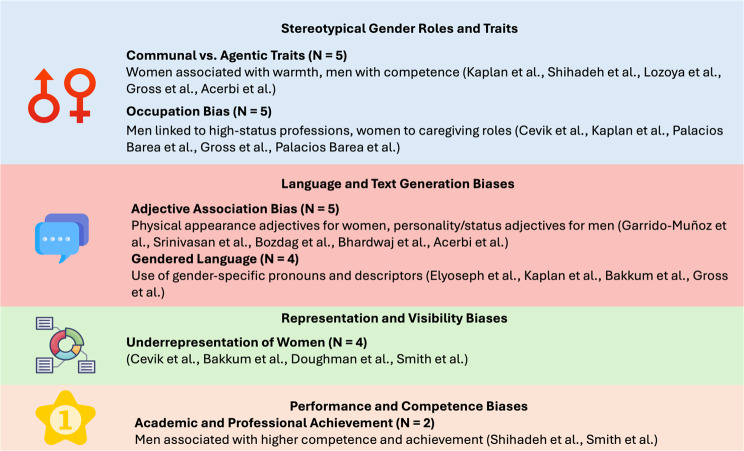
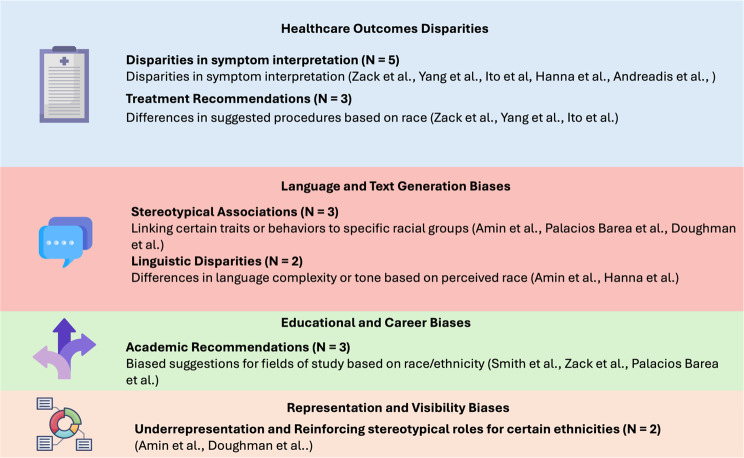
- Among 24 included studies, 22 (91.7%) identified biases. Gender bias was reported in 15 of 16 studies (93.7%), and racial or ethnic bias in 10 of 11 studies (90.9%). Only two studies found minimal or no bias in certain contexts.
- Other biases included age, disability, socioeconomic status, sexual orientation, language, and cultural factors. Cultural, age, and intersectional disparities were apparent in all evaluated studies (100% of 3, 2, and 3 studies, respectively); socioeconomic and language biases were noted in 50% of 2 studies each.
- Mitigation strategies were implemented in 7 studies (29%): 4 used prompt engineering and 3 used debiasing algorithms. Six of the seven reported reduced disparities; Bhardwaj et al. reported a 63.9% reduction in gender bias metrics for BERT models.
- Examples included GPT-3.5-turbo predicting lower death rates for White patients (56.54%) compared with up to 62.25% for Black patients, and GPT-4 showing lower rates of advanced imaging recommendations for patients from underrepresented racial groups.
Methods
- Systematic review following PRISMA guidelines, registered with PROSPERO (CRD42024578467). Searched PubMed, Embase, Web of Science, APA PsycInfo, and Scopus for publications from January 1, 2018, to July 31, 2024.
- Included peer-reviewed studies evaluating demographic biases in LLMs applied to medical or healthcare tasks, focusing on gender, race, ethnicity, age, and other factors. Excluded non-LLM models, performance-only studies, and non-peer-reviewed materials. Two reviewers independently screened and assessed studies.
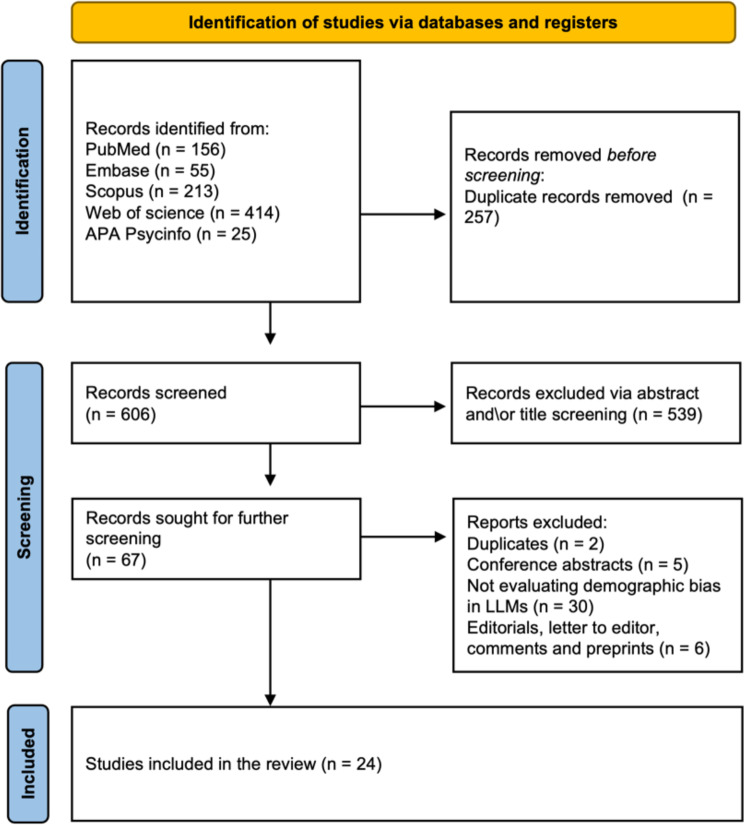
- From 863 identified articles, 257 duplicates were removed, 539 excluded through title/abstract screening, 67 underwent full-text review, and 24 met inclusion criteria. Quality was assessed using JBI Critical Appraisal Checklists (Diagnostic Test Accuracy for 3 studies; Analytical Cross-Sectional for 21 studies). Due to heterogeneity, a narrative synthesis was conducted.
Limitations
- The paper states potential publication bias, as studies with negative results are less frequently published. It also notes limited quantitative data on mitigation effectiveness, lack of standardized metrics for measuring bias reduction, and that most studies focused on cisgender men and women, with almost no work on non-binary gender identities.
- The paper states that few studies address sexual orientation, non-binary gender identities, and intersectional identities; geographical concentration in Western countries limits understanding of biases in diverse cultural contexts; and current literature mainly focuses on GPT models.
- Quality assessment found that 8 of 24 studies (33.3%) met all applicable criteria. Weaknesses included identification and handling of confounding factors (7 studies, 29.2%, failing or unclear) and appropriateness of statistical analysis (3 studies, 12.5%, not meeting). The text also makes evident that heterogeneity prevented meta-analysis, and it remains unclear whether legitimate sex-based variations were captured.
Model-written summary. Check it against the paper before relying on it.
Integrity signals
Registry
Cites
Statistics
Figures
Verification
Claims the paper makes
11 Valid · 0 Not valid · 4 Not checked · 37 Own results and interpretations
The cited sources support only part of this claim — read each source’s verdict below.
In the paper
“Recent research has shown that commercially available LLMs can perpetuate race-based medical misconceptions [3, 5, 6].”
§ Evaluating and addressing demographic disparities in medical large language models: a systematic review > Introduction
What the sources say
- Partly supportedcites [3] Gross N. What ChatGPT tells Us about gender: A cautionary Tale about performativity and gender biases in AI. Soc Sci. 2023;12(8):435. sourceExperimental — accuracy not yet measured
Section 2 (p. 3) says LLM biases can involve race and that biased training data can be absorbed into models. It does not address race-based medical misconceptions, so the medical-specific part of the claim is unsupported. (LLM, conf=0.82)
- Not checked — no full text of the sourcecites [5] Schramowski P, Turan C, Andersen N, Rothkopf CA, Kersting K. Large pre-trained Language models contain human-like biases of what is right and wrong to do. Nat Mach Intell. 2022;4(3):258–68. source
- Supportedcites [6] Yang Y, Liu X, Jin Q, Huang F, Lu Z. Unmasking and Quantifying Racial Bias of Large Language Models in Medical Report Generation [Internet]. arXiv; 2024 [cited 2024 Jun 20]. Available from: http://arxiv.org/abs/2401.13867 PMC11387737 39256622 source
The Main section identifies ChatGPT and GPT-4 as widely available models. It reports that GPT-3.5-turbo generated fabricated patient histories and racially skewed diagnoses, including different diagnoses for patients with identical conditions. This supports the paraphrase that such models can perpetuate race-based medical misconceptions. (LLM, conf=0.90)
plainstates a cause- Asserted: passes — The authors put it forward as true.
- Checkable: passes — It can be checked against evidence.
- Load-bearing: passes — The paper’s conclusions depend on it.
- Based: passes — The paper gives a reason why it holds.
- Partly supported
The cited sources support only part of this claim — read each source’s verdict below.
In the paper
“LLMs being less likely to recommend advanced imaging for patients from underrepresented racial groups [6].”
§ Evaluating and addressing demographic disparities in medical large language models: a systematic review > Introduction
What the sources say
- Partly supportedcites [6] Yang Y, Liu X, Jin Q, Huang F, Lu Z. Unmasking and Quantifying Racial Bias of Large Language Models in Medical Report Generation [Internet]. arXiv; 2024 [cited 2024 Jun 20]. Available from: http://arxiv.org/abs/2401.13867 PMC11387737 39256622 sourceExperimental — accuracy not yet measured
The Main section reports that generated medical reports favored White patients with superior treatments, including surgery for a White patient where a Black patient received conservative care. It does not report that LLMs were less likely to recommend advanced imaging for patients in other racial groups; searches for imaging, MRI, and CT did not identify such a finding. (LLM, conf=0.85)
plainstates a cause- Asserted: passes — The authors put it forward as true.
- Checkable: passes — It can be checked against evidence.
- Load-bearing: passes — The paper’s conclusions depend on it.
- Based: passes — The paper gives a reason why it holds.
- Partly supported
The cited sources support only part of this claim — read each source’s verdict below.
In the paper
“a recent survey of FDA-approved AI clinical decision support tools found none included a bias evaluation, defined as an analysis to determine whether the tool’s outcomes are fair across different patient groups [10].”
§ Evaluating and addressing demographic disparities in medical large language models: a systematic review > Introduction
What the sources say
- Partly supportedcites [10] Lee JT, Moffett AT, Maliha G, Faraji Z, Kanter GP, Weissman GE. Analysis of devices authorized by the FDA for clinical decision support in critical care. JAMA Intern Med. 2023;183(12):1399–401. 37812404 PMC10562983 sourceExperimental — accuracy not yet measured
The Results report that none of the 10 FDA-authorized AI/ML clinical decision support devices identified for critical care mentioned an evaluation of performance bias. The Methods specify that the authors examined FDA decision summaries, so the finding concerns what those documents reported—not whether the tools themselves underwent any bias evaluation. The citing sentence also omits the critical-care restriction. (LLM, conf=0.88)
plain- Asserted: passes — The authors put it forward as true.
- Checkable: passes — It can be checked against evidence.
- Load-bearing: passes — The paper’s conclusions depend on it.
- Based: passes — The paper gives a reason why it holds.
- Partly supported
Every source the paper cites for this claim was checked and supports it.
In the paper
“In a study evaluating four LLMs across multiple healthcare scenarios, all models demonstrated instances of promoting debunked racial stereotypes in medicine [8].”
§ Evaluating and addressing demographic disparities in medical large language models: a systematic review > Introduction
What the sources say
- Supportedcites [8] Omiye JA, Lester JC, Spichak S, Rotemberg V, Daneshjou R. Large Language models propagate race-based medicine. NPJ Digit Med. 2023;6:195. 37864012 PMC10589311 source
The Abstract states that four LLMs were tested across eight scenarios and that every model had instances of promoting race-based medicine or racist tropes. The Methods describe nine questions covering multiple aspects of medicine, with responses reviewed for debunked race-based content. (LLM, conf=0.94)
boostedstates a cause- Asserted: passes — The authors put it forward as true.
- Checkable: passes — It can be checked against evidence.
- Load-bearing: passes — The paper’s conclusions depend on it.
- Based: passes — The paper gives a reason why it holds.
- Supported
A result the paper reports from its own data — it cites no other source for it, so there is none to check. The quote shows it is in the paper.
In the paper
“Older models like BERT displayed bias primarily in classification tasks, with responses differing based on patient race and gender.”
§ Evaluating and addressing demographic disparities in medical large language models: a systematic review > Results > Summary of the included studies
plainstates an association- Asserted: passes — The authors put it forward as true.
- Checkable: passes — It can be checked against evidence.
- Load-bearing: unclear — It is unclear whether the paper’s conclusions depend on it.
- Based: passes — The paper gives a reason why it holds.
18 more claims
Create a free account to see all 52 claims and every source verdict.
- Probably not a substantial claim. 19
- It may state two separate claims as one. 13
Citations
Cites
The PRISMA 2020 statement: An updated guideline for reporting systematic reviews
Page, M. J., McKenzie, J. E., Bossuyt, P. M., Boutron, I., Hoffmann, T. C., Mulrow, C. D., Shamseer, L., Tetzlaff, J. M., Akl, E. A., Brennan, S. E., et al. (2021) · BMJ · doi:10.1136/bmj.n71 · Cited by 108,283
Rayyan-a web and mobile app for systematic reviews.
Ouzzani, M., Hammady, H., Fedorowicz, Z., & Elmagarmid, A. (2016) · Systematic Reviews · doi:10.1186/s13643-016-0384-4 · Cited by 26,092
Large language models in medicine
Thirunavukarasu, A. J., Ting, D. S. J., Elangovan, K., Gutierrez, L., Tan, T. F., & Ting, D. S. W. (2023) · Nature Medicine · doi:10.1038/s41591-023-02448-8 · Cited by 3,944
Addressing bias in big data and AI for health care: A call for open science
Norori, N., Hu, Q., Aellen, F. M., Faraci, F. D., & Tzovara, A. (2021) · Patterns · doi:10.1016/j.patter.2021.100347 · Cited by 903
Stereotype Content: Warmth and Competence Endure
Fiske, S. T. (2018) · Current Directions in Psychological Science · doi:10.1177/0963721417738825 · Cited by 839
Large Language Models in Medical Education: Opportunities, Challenges, and Future Directions
Abd-alrazaq, A., AlSaad, R., Alhuwail, D., Ahmed, A., Healy, P. M., Latifi, S., Aziz, S., Damseh, R., Alabed Alrazak, S., & Sheikh, J. (2023) · JMIR Medical Education · doi:10.2196/48291 · Cited by 722 · cited 1×
“LLMs are being integrated in multiple sectors, including healthcare [1, 2].”
PROSPERO: An International Register of Systematic Review Protocols
Schiavo, J. H. (2019) · Medical Reference Services Quarterly · doi:10.1080/02763869.2019.1588072 · Cited by 643
Bias in artificial intelligence algorithms and recommendations for mitigation
Nazer, L. H., Zatarah, R., Waldrip, S., Ke, J. X. C., Moukheiber, M., Khanna, A. K., Hicklen, R. S., Moukheiber, L., Moukheiber, D., Ma, H., et al. (2023) · PLOS Digital Health · doi:10.1371/journal.pdig.0000278 · Cited by 621 · cited 1×
“Current mitigation strategies include debiasing algorithms, prompt engineering, and diverse training data [9].”
Zack, T., Lehman, E., Suzgun, M., Rodriguez, J. A., Celi, L. A., Gichoya, J., Jurafsky, D., Szolovits, P., Bates, D. W., Abdulnour, R.-E. E., et al. (2024) · The Lancet Digital Health · doi:10.1016/s2589-7500(23)00225-x · Cited by 510 · cited 2×
“These biases appear mainly in written output text, but also affect prognosis predictions and recommendations for treatments and management protocols [18].”
Large language models propagate race-based medicine
Omiye, J. A., Lester, J. C., Spichak, S., Rotemberg, V., & Daneshjou, R. (2023) · npj Digital Medicine · doi:10.1038/s41746-023-00939-z · Cited by 417
Research works printed but not linked: 2
- Lefebvre C. Chapter 4: Searching for and selecting studies [Internet]. [cited 2024 Aug 10]. Available from: https://training.cochrane.org/handbook/current/chapter-04
- Yeh KC, Chi JA, Lian DC, Hsieh SK, Evaluating Interfaced LLM, Bias. In 2023 [cited 2024 Jun 20]. Available from: https://www.semanticscholar.org/paper/Evaluating-Interfaced-LLM-Bias-Yeh-Chi/be4adc35746c179eb4e660894f7af0ced88b6bdb
Cited by
Large Language Models and Empathy: Systematic Review
Sorin, V., Brin, D., Barash, Y., Konen, E., Charney, A., Nadkarni, G., & Klang, E. (2024) · Journal of Medical Internet Research · doi:10.2196/52597 · Cited by 240
“These models can introduce bias [14], and can be susceptible to cyberattacks [15].”
Self-citationSociodemographic biases in medical decision making by large language models
Omar, M., Soffer, S., Agbareia, R., Bragazzi, N. L., Apakama, D. U., Horowitz, C. R., Charney, A. W., Freeman, R., Kummer, B., Glicksberg, B. S., et al. (2025) · Nature Medicine · doi:10.1038/s41591-025-03626-6 · Cited by 173
“Existing studies vary in their methods, datasets and evaluation frameworks 12 , with some focusing on racial or ethnic biases 13 , others examining broader social or gender factors 16 and some highlighting the influence of prompt design, model architecture and training data selection 17 .”
Self-citationFine-Tuning Large Language Models for Specialized Use Cases
Anisuzzaman, D., Malins, J. G., Friedman, P. A., & Attia, Z. I. (2024) · Mayo Clinic Proceedings Digital Health · doi:10.1016/j.mcpdig.2024.11.005 · Cited by 272
Large Language Models in Medical Diagnostics: Scoping Review With Bibliometric Analysis
Su, H., Sun, Y., Li, R., Zhang, A., Yang, Y., Xiao, F., Duan, Z., Chen, J., Hu, Q., Yang, T., et al. (2025) · Journal of Medical Internet Research · doi:10.2196/72062 · Cited by 81
Omar, M., Agbareia, R., Glicksberg, B. S., Nadkarni, G. N., & Klang, E. (2025) · JMIR Medical Informatics · doi:10.2196/66917 · Cited by 53
“Emerging evidence also suggests that some prompt engineering techniques can reduce but not completely eliminate sociodemographic bias in model outputs [32].”
Self-citationLarge language models in oncology: a review
Chen, D., Parsa, R., Swanson, K. E., Nuñez, J.-J., Critch, A., Bitterman, D. S., Liu, F., & Raman, S. (2025) · BMJ Oncology · doi:10.1136/bmjonc-2025-000759 · Cited by 76
Peykani, P., Ramezanlou, F., Tănăsescu, C. R., & Ghanidel, S. (2025) · Applied Sciences · doi:10.3390/app15148103 · Cited by 85
Li, H., Fu, J., & Python, A. (2025) · Journal of Medical Internet Research · doi:10.2196/71916 · Cited by 69
Challenges of Implementing LLMs in Clinical Practice: Perspectives
Artsi, Y., Sorin, V., Glicksberg, B. S., Korfiatis, P. D., Freeman, R., Nadkarni, G. N., & Klang, E. (2025) · Journal of Clinical Medicine · doi:10.3390/jcm14176169 · Cited by 68
Self-citationAgent-guided AI-powered interpretation and reporting of nerve conduction studies and EMG (INSPIRE)
Gorenshtein, A., Sorka, M., Khateb, M., Aran, D., & Shelly, S. (2025) · Clinical Neurophysiology · doi:10.1016/j.clinph.2025.2110792 · Cited by 21
Strasser, L. M., Anschuetz, W., Dennstädt, F., & Hastings, J. (2026) · JMIR Medical Education · doi:10.2196/81399 · Cited by 20
From Agents to Governance: Essential AI Skills for Clinicians in the Large Language Model Era
Cao, W., Zhang, Q., Liu, J., & Liu, S. (2026) · Journal of Medical Internet Research · doi:10.2196/86550 · Cited by 29
Large language models in global health
Ong, J. C. L., Ning, Y., Yang, R., Bitterman, D. S., Liu, X., Tham, Y. C., Collins, G. S., Jiménez, M., Mateen, B. A., Amissah-Arthur, K. N., et al. (2026) · Nature Health · doi:10.1038/s44360-025-00024-7 · Cited by 30
AI-generated content in cross-domain applications: Research trends, challenges and propositions
Li, J., Qu, L., Cai, T., Zhao, Z., Haldar, N. A. H., Krishna, A., Kong, X., Macau, F., Chakraborty, T., Deroy, A., et al. (2025) · Knowledge-Based Systems · doi:10.1016/j.knosys.2025.114634 · Cited by 34
Linardon, J., Messer, M., Anderson, C., Liu, C., McClure, Z., Jarman, H. K., Goldberg, S. B., & Torous, J. (2025) · BMJ Mental Health · doi:10.1136/bmjment-2025-301787 · Cited by 10
Sociodemographic Bias in Large Language Model–Assisted Gastroenterology
Levartovsky, A., Omar, M., Nadkarni, G. N., Kopylov, U., & Klang, E. (2025) · JAMA Network Open · doi:10.1001/jamanetworkopen.2025.32692 · Cited by 13
Self-citationXiang, A. (2025) · Information Processing & Management · doi:10.1016/j.ipm.2025.104554 · Cited by 15
Cantini, R., Orsino, A., Ruggiero, M., & Talia, D. (2025) · Machine Learning · doi:10.1007/s10994-025-06862-6 · Cited by 53
Hamamoto, R., Koyama, T., Takahashi, S., Yasuda, T., Kobayashi, K., Akagi, Y., Kouno, N., Sudo, K., Hirata, M., Sunami, K., et al. (2026) · Journal of Hematology & Oncology · doi:10.1186/s13045-026-01781-y · Cited by 8
“LLMs exhibit systematic demographic and language-related biases, raising concern that clinical deployment could exacerbate inequities—particularly in oncology, where disparities already exist in biomarker-based actionability and clinical trial participation [181– 185].”
Ethical considerations for clinical adoption of ambient digital scribe technology
Anderson, T. N., Mohan, V., & Gold, J. A. (2025) · Journal of the American Medical Informatics Association · doi:10.1093/jamia/ocaf227 · Cited by 15
Gautam, S., Chandra, M., De, A., Chakravorti, T., Malik, G., & De Choudhury, M. (2025) · arXiv · doi:10.48550/arxiv.2508.06849 · Cited by 7
Gong, E. J., Bang, C. S., & Shin, Y. S. (2026) · Bioengineering · doi:10.3390/bioengineering13030365 · Cited by 19
Evaluating anti-LGBTQIA+ medical bias in large language models
Chang, C. T., Srivathsa, N., Bou-Khalil, C., Swaminathan, A., Lunn, M. R., Mishra, K., Koyejo, S., & Daneshjou, R. (2025) · PLOS Digital Health · doi:10.1371/journal.pdig.0001001 · Cited by 14
Socio-demographic gaps in pain management guided by large language models
Omar, M., Soffer, S., Agbareia, R., Bragazzi, N. L., Glicksberg, B. S., Hurd, Y. L., Apakama, D. U., Charney, A. W., Reich, D. L., Nadkarni, G. N., et al. (2026) · Nature Health · doi:10.1038/s44360-025-00017-6 · Cited by 15
Self-citationTrewren, T., Fitzgerald, N. M., Jaensch, S., Nguyen, O., Tsymbal, A., Gao, C., Stretton, B., Anderson, S., Lin, D., Winterton, D., et al. (2025) · Journal of Perioperative Practice · doi:10.1177/17504589251346634 · Cited by 9
The Effect of LLM Assistance on Diagnostic Accuracy: A Systematic Review and Meta-AnalysisPreprint
Tretow, I., Ergon, E., Schwebel, M., Treffers, T., Welpe, I. M., & Feuerriegel, S. (2025) · medRxiv · doi:10.64898/2025.12.11.25341476 · Cited by 10
Hairston, J., Ranjan, R., Lakamana, S., Spadaro, A., Bozkurt, S., Perrone, J., & Sarker, A. (2025) · JAMIA Open · doi:10.1093/jamiaopen/ooaf102 · Cited by 6
Xu, T., Liu, C., Li, L., Song, D., Rose, G. M., & Zhu, S. (2026) · Journal of Palliative Medicine · doi:10.1177/10966218261418542 · Cited by 8
Ensuring Fairness in AI-Driven University Assessments
Sulthana, K. F., Rajeshwari, B. S., Ashok, M., & Joel, M. R. (2025) · Advances in computational intelligence and robotics book series · doi:10.4018/979-8-3373-6018-8.ch004 · Cited by 5
Human Evaluators vs. LLM-as-a-Judge: Toward Scalable, Real-Time Evaluation of GenAI in Global HealthPreprint
Williams, G., Rutunda, S., Nzabakira, F., & Mateen, B. A. (2025) · medRxiv · doi:10.1101/2025.10.27.25338910 · Cited by 3
Prabhakaran, S., Bell, S. W., Lee, J. C., & Kong, J. C. H. (2026) · European Journal of Surgical Oncology · doi:10.1016/j.ejso.2026.111741 · Cited by 5
How to meaningfully evaluate AI in clinical medicine
Omar, M., Agbareia, R., Gorenshtein, A., Ramaswamy, A., Sakhuja, A., Barash, Y., Ting, D. S. W., Klang, E., & Nadkarni, G. N. (2026) · Nature Medicine · doi:10.1038/s41591-026-04350-5 · Cited by 8
Self-citationTowards precision medicine for otology and neurotology: Machine learning applications and challenges
Adcock, K. S., Arulchelvan, E., Shields, N., & Vanneste, S. (2025) · Hearing Research · doi:10.1016/j.heares.2025.109473 · Cited by 7
Large language models exhibit stigmatizing behaviour in contextual judgements of health conditions
Wang, X., Zhou, Y., & Zhou, G. (2026) · Nature Health · doi:10.1038/s44360-026-00164-4 · Cited by 5
Accuracy of large language model transcription of simulated physician-patient verbal interactions
Nolan, E. J., & BURKE, H. B. (2026) · BMC Medical Informatics and Decision Making · doi:10.1186/s12911-026-03414-3 · Cited by 3
Chen, G., Sha, Y., Wang, Z., Wang, K., & Chen, L. (2025) · Cureus · doi:10.7759/cureus.85979 · Cited by 5
Qi, X. S., Wang, Y., Yang, X., Ren, L., Liu, W., Benedict, S., Xiao, Y., Xing, L., & Naqa, I. M. E. (2026) · Medical Physics · doi:10.1002/mp.70616 · Cited by 3
Bai, T., Jiang, K., Yu, Y., Qie, S., Wang, C., Wang, B., & Zhang, W. (2026) · Future Internet · doi:10.3390/fi18020095 · Cited by 2
Sociodemographic bias in large language model clinical trial screening
Soffer, S., Omar, M., Efros, O., Apakama, D. U., Mudrik, A., Freeman, R., Nadkarni, G. N., & Klang, E. (2026) · Journal of the American Medical Informatics Association · doi:10.1093/jamia/ocag058 · Cited by 3
Self-citationDeconstructing gender bias in AGI: mitigating discriminatory architectures in general intelligence
Moya, C. C., & Rodríguez, E. Q. (2025) · AI and Ethics · doi:10.1007/s43681-025-00818-1 · Cited by 3
Tzortzatou, O. (2026) · Frontiers in Digital Health · doi:10.3389/fdgth.2026.1832356 · Cited by 4
Liu, Z., Qian, S., Bao, X., Li, S., Chen, W., & Liu, Z. (2026) · American Journal Of Pathology · doi:10.1016/j.ajpath.2026.04.004 · Cited by 1
Bezruk, V. V., Ivanov, D. D., Ivanchuk, M., Shkrobanets, І. D., Makarova, O. V., Rynzhuk, L. V., Bulyk, T. S., Maksymiv, О. О., & Ivanova, M. D. (2026) · Journal of Clinical Medicine · doi:10.3390/jcm15114218 · Cited by 1
Bondaronek, P., Ward, E., Beecham, E., Zhang, E. Z., Huang, Y., Ive, J., Naughton, F., Wu, H., & Vindrola‐Padros, C. (2026) · medRxiv · doi:10.64898/2026.05.20.26353755 · Cited by 1
Chow, J., & Patlas, M. N. (2026) · Japanese Journal of Radiology · doi:10.1007/s11604-026-02009-2 · Cited by 1
Cultural bias in large language models’ ability to follow neuroradiology guidelines
Bazerbachi, N., Bentegeac, R., Pistilli, G., Kim, S. H., Amouyel, P., Pruvo, J., Hacein‐Bey, L., HAMROUN, A., Kuchcinski, G., & Guellec, B. L. (2026) · European Radiology · doi:10.1007/s00330-026-12634-0 · Cited by 2
Alignment of large language models in solving medical ethical dilemmas
Sorin, V., Glicksberg, B. S., Korfiatis, P. D., Collins, J. D., Yeow, M.-E., Brandeland, M. A., Nadkarni, G. N., & Klang, E. (2026) · Digital Health · doi:10.1177/20552076261428395 · Cited by 8
Self-citationZitianellis, J. (2026) · IntechOpen eBooks · doi:10.5772/intechopen.1014718 · Cited by 1
Uncovering bias and variability in how large language models attribute cardiovascular risk
Chan, J. T. N., & Kwek, R. K. (2025) · Frontiers in Digital Health · doi:10.3389/fdgth.2025.1710594 · Cited by 2
Gandhi, S., & Balas, M. (2026) · BMC Medical Ethics · doi:10.1186/s12910-026-01496-2 · Cited by 1
Research integrity and data ethics in AI-driven integrated healthcare: a critical appraisal
Zeng, W., Wei, H., Chen, Y., Tang, J., Ge, J., & Chen, H. (2026) · Frontiers in Public Health · doi:10.3389/fpubh.2026.1838551 · Cited by 2
Wang, H., Liu, Y., Hu, L., & Wang, X. (2026) · Frontiers in Medicine · doi:10.3389/fmed.2026.1866874 · Cited by 1
Evaluation of algorithmic bias in large language models for retinal clinical recommendations
Gandhi, S., Balas, M., Popovic, M. M., Kertes, P. J., Muni, R. H., & Kohly, R. P. (2026) · AJO International · doi:10.1016/j.ajoint.2026.100233 · Cited by 3
Sociodemographic Variability in Pediatric Emergency Decisions by AI
Omar, M., Agbareia, R., Salah, R. A., Bragazzi, N. L., Apakama, D. U., Glicksberg, B. S., Gelb, B. D., Holmes, E., Nadkarni, G. N., & Klang, E. (2026) · PEDIATRICS · doi:10.1542/peds.2025-073479 · Cited by 3
Self-citationA Scoping Review of LLM-as-a-Judge in Healthcare and the MedJUDGE Framework
Li, C., Akhtar, Z., Kwak, M., Ji, Y., Zhang, H., Obi, T., Ren, Y., Wu, X., Sivarajkumar, S., Lehmann, H. P., et al. (2026) · arXiv · doi:10.48550/arxiv.2604.25933 · Cited by 1
Prabha, S., Collaço, B. G., Gomez-Cabello, C. A., Haider, S. A., Genovese, A., Fang, Z., Wood, N. G., Bagaria, S. P., Tao, C., & Forte, A. J. (2026) · Journal of Medical Internet Research · doi:10.2196/90692 · Cited by 1
Technology in Diverse Populations: Issues of Inclusion, Accessibility, and Bias
Thames, A. D., & Cavanagh, L. (2026) · Oxford University Press eBooks · doi:10.1093/9780197814116.003.0011
Are all Generative AI Chatbots the Same? Analysing the Reliability of Hotel RecommendationsPreprint
Martí-Ochoa, J., Martín-Fuentes, E., Ferrer-Rosell, B., & Pesonen, J. A. (2025) · Research Square · doi:10.21203/rs.3.rs-7687581/v1
Co‐designing a Large Language Model Benchmarking Dataset for Primary Care with Nurses in Kenya
Musau, W., Obong’o, C. O., Wanjiru, S., Otiangala, D., Emmanuel-Fabula, M., & Mateen, B. A. (2025) · Ethnographic Praxis in Industry Conference Proceedings · doi:10.1111/epic.70016 · Cited by 1
Cherfrere, C., & Davis, C. M. (2026) · Journal of the National Medical Association · doi:10.1016/j.jnma.2026.07.005
The Context Dependency of Demographic Bias in LLM Annotation
Brown, M. A., Atreja, S., Hemphill, L., & Wu, P. Y. (2026) · ACM Conference on Fairness, Accountability, and Transparency (FAccT) · doi:10.1145/3805689.3812212 · Cited by 1
He, L., Do, D., Shet, V. G., Farghaly, O., Deshpande, P., Madiraju, P., Ye, J., & Beestrum, M. (2026) · Journal of the American Medical Informatics Association · doi:10.1093/jamia/ocag089
Sociodemographic bias in LLMs’ clinical decision-making for dizziness
Tessler, I., Omar, M., Wolfovitz, A., Gimmon, Y., Hack, S., Rozendorn, N., Livneh, N., & Klang, E. (2026) · Journal of Vestibular Research · doi:10.1177/09574271261474218 · Cited by 1
Self-citationEmergent Health Preferences in Large Language Models: A Time-Trade-Off Analysis Using EQ-5D-3L
Süli, P. P., Eigner, G., & Zrubka, Z. (2026) · IEEE International Conference on Intelligent Engineering Systems (INES) · doi:10.1109/ines69513.2026.11661097
Leveraging large language models to bridge the digital divide in cardiovascular health research
Kim, D. S., Eltahir, A. A., Mantena, S., Doijad, R., Matabang, C., & Rodríguez, F. (2025) · npj Cardiovascular Health · doi:10.1038/s44325-025-00095-1 · Cited by 1
Joseph-Delaffon, K., Desgrouas, M., Catanese, S., Lejeune, J., Nait-Kaci, J., Piver, É., Breteau, I., Leducq, S., Gatault, P., Khanna, R. K., et al. (2026) · doi:10.2196/preprints.108828
Obedience to Unsafe Clinical Instructions: How Large Language Models Respond to Authority Cues
(2026) · doi:10.21203/rs.3.rs-8932472/v1
Self-citationEthical Considerations in Personal Health Large Language Models
Liu, J., & Liu, S. (2026) · Journal of Medical Internet Research · doi:10.2196/92240 · Cited by 2
Rahman, M. M., Rahman, S., Bhatt, S., & Faezipour, M. (2026) · IEEE Winter Conference on Applications of Computer Vision · doi:10.1109/wacv61042.2026.00719 · Cited by 2
Large Language Models in Informed Consent — Opportunities, Evidence, and Challenges
Goel, R., Mustafa, S., Baker, T. J., & Bierer, B. E. (2026) · NEJM AI · doi:10.1056/aira2600073
Saravi, B., Winkler, I., Singh, D. D., Lommen, J., Wilkat, M., Schorn, L., Vollmer, A., Vollmer, M., Kübler, N., Sproll, C. K., et al. (2026) · BMC Oral Health · doi:10.1186/s12903-026-08644-5 · Cited by 2
Puzis, R., Cohen, I.-C., Elyashar, A., & Cohen, O. (2026) · doi:10.2196/preprints.107902
Sex and gender bias in large language models: an old problem at a new scale
Barbati, C., Casigliani, V., Rizzo, C., & Odone, A. (2026) · BMJ Health & Care Informatics · doi:10.1136/bmjhci-2026-102380
Exploring Bias in Medical Applications of Large Language Models: Protocol for a Systematic Review
Rao, S. G., Boutrous, C., Kormilitzin, A., Tai, X. Y., Hotchkiss, L., Cong, C., Meinert, E., Liang, H., Dong, H., & Harrison, J. R. (2026) · JMIR Research Protocols · doi:10.2196/91348 · Cited by 1
Liu, Y., Welton, L. L., Melton, G. B., Zhang, R., & Arsoniadis, E. G. (2026) · IEEE International Conference on Healthcare Informatics (ICHI) · doi:10.1109/ichi69079.2026.00013
LLMs Can Do Medical Harm: Stress-Testing Clinical Decisions Under Social PressurePreprint
Omar, M., Agbareia, R., McGreevy, J., Gorenshtein, A., Charney, A. W., Sakhuja, A., Glicksberg, B. S., Nadkarni, G. N., & Klang, E. (2025) · medRxiv · doi:10.1101/2025.11.25.25340972 · Cited by 2
Self-citationShah, A. R., Abel, B. G., Komeili, M., Gohar, B., & Nowrouzi‐Kia, B. (2026) · JMIR Research Protocols · doi:10.2196/99807
Hirosawa, T., Harada, Y., & Shimizu, T. (2025) · AI & Society · doi:10.1007/s00146-025-02750-8 · Cited by 2
Mehda, R., Oishi, R. A., Alam, T. T., Morol, M. K., & Hui, L. T. (2026) · Frontiers in Digital Health · doi:10.3389/fdgth.2026.1904053
Kalyan Chakravarthy, K. (2025) · SSRN Electronic Journal · doi:10.2139/ssrn.5393117
Aşut, Ö., Çalı, Ş., Cynthia, A. N., Awad, R. A. O., Muhammad, H. S., Usman, A. S., & Husain, H. A. U. (2026) · Research Square · doi:10.21203/rs.3.rs-9880300/v1
Health Service Provision and Differential Service Utilization, Treatment, and Benefits
Groenewegen, P., Keskimäki, I., & Leyland, A. H. (2025) · SpringerBriefs in public health · doi:10.1007/978-3-032-02565-4_6
Ferreira, J. C., & Rosa, I. (2026) · Frontiers in Digital Health · doi:10.3389/fdgth.2026.1865568 · Cited by 4
Zhang, R., Schulz, P. J., Tay, I. Q., Lim, C., Lee, J., & Goh, W. W. B. (2026) · doi:10.2196/preprints.110795
Large Language Models in Stroke Management: A Review of the LiteraturePreprint
Soffer, S., Mudrik, A., Efros, O., Omar, M., Nadkarni, G. N., & Klang, E. (2025) · medRxiv · doi:10.1101/2025.06.28.25330477 · Cited by 2
Self-citationLiu, Y., Liu, Y., Zhao, Y., Luo, Y., & Hao, X. (2026) · Frontiers in Endocrinology · doi:10.3389/fendo.2026.1893963
Gandhi, S., & Balas, M. (2026) · Journal of Personalized Medicine · doi:10.3390/jpm16090448
Perspective on Bias in Biomedical AI: Preventing Downstream Healthcare Disparities
Rosen‐Zvi, M., Kan‐Tor, Y., Danziger, M. M., Ferretti, A., Aula-Blasco, J., Falcão, J., Shamir, R., Marcus-Kalish, M., & Muszkat, M. (2026) · IEEE International Conference on Digital Health (ICDH) · doi:10.1109/icdh72779.2026.00018
Zhang, W., Feng, Z., Liu, Y., Zhong, R., Chen, S., Li, Z., 李冰燕, Liu, D., Gao, L., & Hu, K. (2026) · Frontiers in Oncology · doi:10.3389/fonc.2026.1915669
Ek, J. E., & Kiebooms, E. (2026) · Artificial Intelligence in Emergency Medicine · doi:10.1016/j.aiemed.2026.100008
Ghari, S., Fu, P., Abhaionmhen, A. O., Mago, V., & Belle, A. B. (2026) · doi:10.2196/preprints.103004
The Gender Data Gap in Medical AI: Causes, Consequences, and Building Inclusive Solutions
Taleghani, S., & Dolatabadi, E. (2026) · Springer eBooks · doi:10.1007/978-3-032-22368-5_4
Şan, E. Ö., Fu, M. R., Sepulveda-Pacsi, A. L., et al. (2026) · Journal of Transcultural Nursing · doi:10.1177/10436596261471268
Rybczyk, J. R., Amin, K., Chamarty, V., Fletcher, P., Melnick, E. R., & Forman, H. P. (2026) · Journal of the American College of Radiology · doi:10.1016/j.jacr.2026.05.012 · Cited by 3
Preconditions for responsible artificial intelligence adoption in psychiatry: commentary, Armitage
Armitage, R. C. (2026) · The British Journal of Psychiatry · doi:10.1192/bjp.2026.10560
Welton, L. L., Gunderson, M. A., Rajamani, G., Liu, Y., Trang, K., Weaver, L., Troester, A. M., Zhang, R., Gaertner, W. B., Welton, M. L., et al. (2026) · Diseases of the Colon & Rectum · doi:10.1097/dcr.0000000000004274
Amanuel, M. (2026) · Medical Humanities · doi:10.1136/medhum-2025-013619
Cross-Model Adjudication for Bias Mitigation in Large Language Models
Li, X., Li, C., Liu, W., Long, Y., Huang, Y., & Liu, Y. (2026) · IEEE Journal of Selected Topics in Signal Processing · doi:10.1109/jstsp.2026.3662478 · Cited by 2
Metadata
- Authors
- Omar, M., Sorin, V., Agbareia, R., Apakama, D. U., Soroush, A., Sakhuja, A., Freeman, R., Horowitz, C. R., Richardson, L. D., Nadkarni, G. N., & Klang, E.
- Affiliations
- Icahn School of Medicine at Mount Sinai (US)
- Mayo Clinic (US)
- Tel Aviv Sourasky Medical Center (IL)
- Corresponding author
- Omar, Mahmud
- ORCID
- Venue
- International Journal for Equity in Health
- Published
- 2025-02-26
- Volume
- 24
- Issue
- 1
- Pages
- 57-57
- ISSN
- 1475-9276 (ISSN-L)
- PMC
- PMC11866893
- OpenAlex
- W4407965332
- Cited by
- 110
- References
- 42
- Citations by year
- 2026: 72 · 2025: 34
- FWCI
- 16.40
- Type
- journal article
- Language
- en
- Open access
- gold
- doi.org
- Licence
- cc-by
- creativecommons.org/licenses/by/4.0 (tdm)
- creativecommons.org/licenses/by/4.0 (vor)
- Locations
- International Journal for Equity in Health (publishedVersion, cc-by)
- medRxiv (acceptedVersion, cc-by-nc-nd)
- PubMed Central (publishedVersion, cc-by)
- PubMed (publishedVersion)
- DOAJ (DOAJ: Directory of Open Access Journals) (acceptedVersion)
- Topics
- Physical Sciences › Computer Science › Artificial Intelligence › Ethics and Social Impacts of AI
- Health Sciences › Medicine › Health Informatics › Artificial Intelligence in Healthcare and Education
- Social Sciences › Gender Studies › Diversity and Career in Medicine
- Keywords
- large language models, demographic bias, health disparities, gender bias, racial and ethnic bias, bias mitigation, prompt engineering, algorithmic fairness, artificial intelligence in healthcare, bias detection
- MeSH terms
- Large Language Models, Demography, Ethnicity, Female, Humans, Healthcare Disparities, Sexism
About these checks
Registry, retraction, Cites and statistics results are computed, not judged, with one exception: a printed reference that no index lists is read once by a model before it counts as a citation error. Claims are extracted by a model and kept only when their quote appears verbatim in the text; each cited source is then checked, with a model’s help, for whether it says what the claim relies on. Those verdicts can be wrong — read the claim’s quote and the cited source before relying on one.
The claim verdicts this report counts are experimental: their accuracy is not yet measured.
A language model drew the claims from the paper on 2026-10-11, under version 3 of the claim definition (model deepseek-v4.1-flash, prompt extract-v3).
A second model labelled each claim on 2026-10-11 (model jev-1.13-20260917, definition revision gold-guideline-v0.2).
Cited sources are checked with a language model’s help (gpt-6-sol).
Statistics and arithmetic are recomputed, not judged.
Confidence bands are shown only for fields calibrated on our annotated test set. None is calibrated yet, so no band is shown.
What counts as a claim ›How we measure confidence ›How we check this ›
Are you an author, or do you see a problem with this page? Request a review
Data sources
Bibliographic data: Semantic Scholar, OpenAlex, Crossref.
Contains information from the Semantic Scholar Academic Graph Datasets, made available under the ODC Attribution License (ODC-BY 1.0).
Semantic Scholar’s data is described in: Kinney, R., et al. (2023). The Semantic Scholar Open Data Platform. arXiv:2301.10140.
