

Diacylglycerol-evoked activation of PKC and PKD isoforms in regulation of glucose and lipid metabolism: a review
Open accessThe DOI matches its Crossref record; 206 of the 206 references it cites were found in a registry or an index.
Abstract
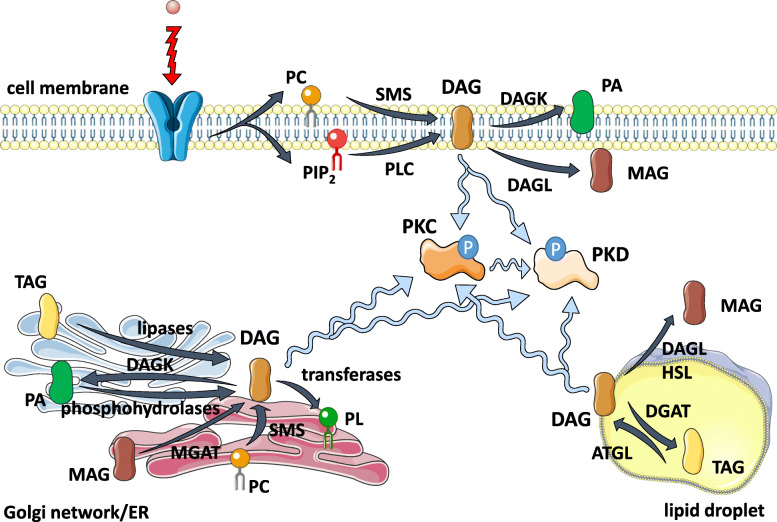
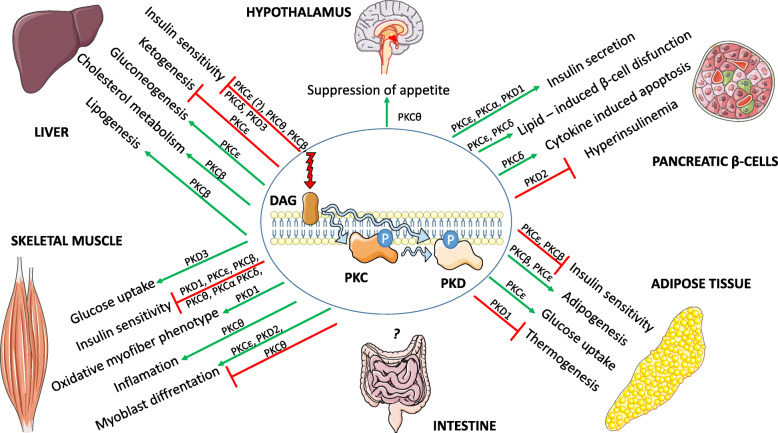
Protein kinase C (PKC) and Protein kinase D (PKD) isoforms can sense diacylglycerol (DAG) generated in the different cellular compartments in various physiological processes. DAG accumulates in multiple organs of the obese subjects, which leads to the disruption of metabolic homeostasis and the development of diabetes as well as associated diseases. Multiple studies proved that aberrant activation of PKCs and PKDs contributes to the development of metabolic diseases. DAG-sensing PKC and PKD isoforms play a crucial role in the regulation of metabolic homeostasis and therefore might serve as targets for the treatment of metabolic disorders such as obesity and diabetes.
Overview
The claims and statistics of this paper haven’t been checked yet.
Free: it reads the open-access text and checks the first 5 claims that cite a source we can check. Create a free account to check every claim.
Integrity signals
Registry
Cites
Statistics
Figures
Verification
Claims the paper makes
The claims and statistics of this paper haven’t been checked yet.
Free: it reads the open-access text and checks the first 5 claims that cite a source we can check. Create a free account to check every claim.
Claims other papers make about this one
Each is checked against this paper’s own text: does it say what the citing paper says it does?
The source backs part of the claim, not all of it — or backs it for a different population, condition or comparison.
In the citing paper
“Treatment with GLP-1RAs can alleviate insulin signaling by reducing the phosphorylation of Akt protein (Decreased Akt-P) and activating Protein Kinase C-ε (PKC-ε).485,486”
From Glucagon-like peptide-1 receptor: mechanisms and advances in therapy (2024) · cites this paper as [486]
Experimental — accuracy not yet measured
Self-check
Percentages, sums and reported differences re-computed from the paper’s own numbers.
The self-check needs the paper’s full text.
Citations
Cites
Items 201–206 of 206
Protein kinase Cδ but not PKCα is involved in insulin‐induced glucose metabolism in hepatocytes
Brutman‐Barazani, T., Horovitz‐Fried, M., Aga‐Mizrachi, S., Brand, C., Brodie, C., Roša, J., & Sampson, S. R. (2012) · Journal of Cellular Biochemistry · doi:10.1002/jcb.24078 · Cited by 13
Peck, B. D., Huot, J. R., Renzi, T., Arthur, S. T., Turner, M. J., & Marino, J. S. (2017) · American Journal of Physiology-Regulatory, Integrative and Comparative Physiology · doi:10.1152/ajpregu.00521.2016 · Cited by 12
Raddatz, K., Frangioudakis, G., Diakanastasis, B., Liao, B. M., Leitges, M., & Schmitz‐Peiffer, C. (2012) · Diabetologia · doi:10.1007/s00125-012-2647-5 · Cited by 10
Basics of Skeletal Muscle Function and Normal Physiology
Brown, S., & Sewry, C. A. (2016) · Elsevier eBooks · doi:10.1016/b978-0-12-800040-3.00002-9 · Cited by 10
Protein kinase Cδ knockout mice are protected from cocaine-induced hepatotoxicity
Nhu, H., Lee, S. H., Sharma, G., Kim, D.-J., Sharma, N., Shin, E., Pham, D. T., Trinh, Q. D., Jang, C., Nah, S.-Y., et al. (2018) · Chemico-Biological Interactions · doi:10.1016/j.cbi.2018.10.017 · Cited by 10
Haeffner, E. W., & Wittmann, U. (1994) · Cellular Signalling · doi:10.1016/0898-6568(94)90077-9 · Cited by 5
Cited by
Glucagon-like peptide-1 receptor: mechanisms and advances in therapy
Zheng, Z., Zong, Y., Ma, Y., Tian, Y., Pang, Y., Zhang, C., & Gao, J. (2024) · Signal Transduction and Targeted Therapy · doi:10.1038/s41392-024-01931-z · Cited by 1,036
“485,486 This affects the synthesis of triacylglycerol (TAG), phosphatidic acid (di-P PA), and diacylglycerol (DAG) in the liver.”
BackgroundA new perspective on NAFLD: Focusing on lipid droplets
Scorletti, E., & Carr, R. M. (2022) · Journal of Hepatology · doi:10.1016/j.jhep.2021.11.009 · Cited by 373
Causal relationship between insulin resistance and sarcopenia
Liu, Z.-J., & Zhu, C. (2023) · Diabetology & Metabolic Syndrome · doi:10.1186/s13098-023-01022-z · Cited by 177
“PKCθ in the muscle leads to inhibition of ISR1, leading to the development of insulin resistance [56].”
BackgroundJubaidi, F. F., Zainalabidin, S., Taib, I. S., Hamid, Z. A., Anuar, N. N. M., Jalil, J., Nor, N. A. M., & Budin, S. B. (2022) · International Journal of Molecular Sciences · doi:10.3390/ijms23158582 · Cited by 130
“One of the most common ways is by increasing de novo DAG synthesis from the glycolytic intermediate dihydroxyacetone phosphate (DHAP) through its reduction to glycerol-3-phosphate (G3P) and stepwise acylation [23].”
BackgroundWen, J.-J., Li, M., Chen, C., Hong, T., Yang, J., Huang, X.-J., Geng, F., Hu, J., & Nie, S. (2022) · Food Chemistry · doi:10.1016/j.foodchem.2022.134591 · Cited by 107
Metadata
- Authors
- Kolczynska, K., Loza-Valdes, A., Hawro, I., & Sumara, G.
- Affiliations
- Instytut Biologii Doświadczalnej im. Marcelego Nenckiego (PL)
- Corresponding author
- Sumara, Grzegorz
- Venue
- Lipids in Health and Disease
- Published
- 2020-05-28
- Volume
- 19
- Issue
- 1
- Pages
- 113-113
- ISSN
- 1476-511X (ISSN-L)
- PMC
- PMC7257441
- OpenAlex
- W3030139699
- Cited by
- 199
- References
- 206
- Citations by year
- 2026: 23 · 2025: 41 · 2024: 59 · 2023: 29 · 2022: 22 · 2021: 17 · 2020: 8
- FWCI
- 1.87
- Type
- journal article
- Language
- en
- Open access
- gold
- doi.org
- Licence
- cc-by
- creativecommons.org/licenses/by/4.0 (tdm)
- creativecommons.org/licenses/by/4.0 (vor)
- Locations
- Lipids in Health and Disease (publishedVersion, cc-by)
- PubMed Central (publishedVersion, cc-by)
- PubMed (publishedVersion)
- DOAJ (DOAJ: Directory of Open Access Journals) (submittedVersion, cc-by-sa)
- Funders
- H2020 European Research Council (678119 - SiCMetabol)
- Polish Ministry of Science and Higher Education (Dioscuri Centre of Scientific Excellence)
- European Molecular Biology Organization (EMBO Installation Grant 2020 - GSumara)
- Topics
- Life Sciences › Biochemistry, Genetics and Molecular Biology › Molecular Biology › Protein Kinase Regulation and GTPase Signaling
- Life Sciences › Biochemistry, Genetics and Molecular Biology › Molecular Biology › Metabolism, Diabetes, and Cancer
- Life Sciences › Biochemistry, Genetics and Molecular Biology › Molecular Biology › Sphingolipid Metabolism and Signaling
- Keywords
- diacylglycerol, protein kinase C, protein kinase D, PKC isoforms, glucose metabolism, lipid metabolism, metabolic homeostasis, obesity, diabetes mellitus, metabolic disorders
- MeSH terms
- Animals, Diabetes Mellitus, Diglycerides, Glucose, Humans, Insulin, Obesity, Protein Kinase C, Signal Transduction, Lipid Metabolism
About these checks
Registry, retraction, Cites and statistics results are computed, not judged, with one exception: a printed reference that no index lists is read once by a model before it counts as a citation error. Claims are extracted by a model and kept only when their quote appears verbatim in the text; each cited source is then checked, with a model’s help, for whether it says what the claim relies on. Those verdicts can be wrong — read the claim’s quote and the cited source before relying on one.
Statistics and arithmetic are recomputed, not judged.
Confidence bands are shown only for fields calibrated on our annotated test set. None is calibrated yet, so no band is shown.
What counts as a claim ›How we measure confidence ›How we check this ›
Are you an author, or do you see a problem with this page? Request a review
Data sources
Bibliographic data: Semantic Scholar, OpenAlex, Crossref.
Contains information from the Semantic Scholar Academic Graph Datasets, made available under the ODC Attribution License (ODC-BY 1.0).
Semantic Scholar’s data is described in: Kinney, R., et al. (2023). The Semantic Scholar Open Data Platform. arXiv:2301.10140.
