

Challenges and opportunities for implementation of substance misuse interventions in conflict-affected populations
Open accessThe DOI matches its Crossref record; 55 of the 56 references it cites were found in a registry or an index.
Abstract
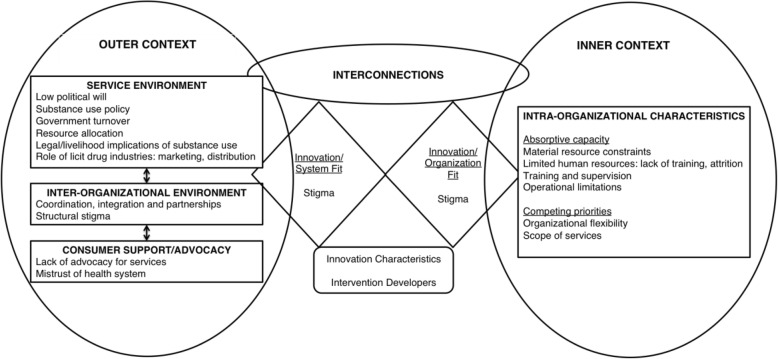
Alcohol and other drug misuse are significant but neglected public health issues in conflict-affected populations. In this article, we review the literature on the challenges and strategies for implementing substance misuse treatment and prevention services in conflict and post-conflict settings in low- and middle-income countries. We identified nine studies describing interventions in conflict-affected populations residing in Afghanistan, Croatia, India, Kenya, Kosovo, Pakistan, and Thailand. Six of these nine studies focused on refugee populations. Reports revealed challenges to intervention implementation, as well as promising practices and recommendations for future implementation that we characterized as existing in the inner and outer contexts of an implementing organization. Challenges existing in the outer context included low political prioritization, lack of coordination and integration, and limited advocacy for access to substance misuse services. Challenges within the inner context related to competing priorities and a shortage of providers. Resource limitations existed in both the inner and outer contexts. Stigma was a challenge that threatened implementation and utilization of substance use services in situations when substance use interventions were not congruent with the roles, structure, values, and authority of the system or implementing organization. Future research should focus on developing, applying, and evaluating strategies for overcoming these challenges in order to make progress toward meeting the need for substance misuse services in conflict-affected populations.
Overview
The claims and statistics of this paper haven’t been checked yet.
Free: it reads the open-access text and checks the first 5 claims that cite a source we can check. Create a free account to check every claim.
Integrity signals
Registry
Cites
Statistics
Figures
Verification
Claims the paper makes
The claims and statistics of this paper haven’t been checked yet.
Free: it reads the open-access text and checks the first 5 claims that cite a source we can check. Create a free account to check every claim.
Claims other papers make about this one
Each is checked against this paper’s own text: does it say what the citing paper says it does?
The source backs part of the claim, not all of it — or backs it for a different population, condition or comparison.
In the citing paper
“However, despite evidence of effectiveness, implementation of BI in LMICs is rare.”
From Brief interventions for alcohol use disorders in low- and middle-income countries: barriers and potential solutions (2022) · cites this paper as [29]
Experimental — accuracy not yet measuredThe source backs part of the claim, not all of it — or backs it for a different population, condition or comparison.
In the citing paper
“Furthermore, there is very limited evidence for both efficacy and effectiveness of BIs in LMICs”
From Brief interventions for alcohol use disorders in low- and middle-income countries: barriers and potential solutions (2022) · cites this paper as [29]
Experimental — accuracy not yet measuredThe source backs part of the claim, not all of it — or backs it for a different population, condition or comparison.
In the citing paper
“Another barrier is the stigma related to AUDs, leading to limited acceptability and adherence to treatment [29, 40, 41].”
From Brief interventions for alcohol use disorders in low- and middle-income countries: barriers and potential solutions (2022) · cites this paper as [29]
Experimental — accuracy not yet measured
Self-check
Percentages, sums and reported differences re-computed from the paper’s own numbers.
The self-check needs the paper’s full text.
Citations
Cites
Advancing a Conceptual Model of Evidence-Based Practice Implementation in Public Service Sectors
Aarons, G. A., Hurlburt, M., & Horwitz, S. M. (2011) · Administration and Policy in Mental Health and Mental Health Services Research · doi:10.1007/s10488-010-0327-7 · Cited by 3,240
Reducing Risks for Mental Disorders: Frontiers for Preventive Intervention Research
(1994) · doi:10.17226/2139 · Cited by 2,073 · cited 1×
“Notably, the focus of these interventions was to reduce risky substance use, as opposed to preventing the incidence of alcohol use disorder, which is the traditional target of indicated prevention approaches [25].”
BackgroundAn introduction to implementation science for the non-specialist
Bauer, M. S., Damschroder, L., Hagedorn, H., Smith, J., & Kilbourne, A. M. (2015) · BMC Psychology · doi:10.1186/s40359-015-0089-9 · Cited by 1,611
Livingston, J. D., Milne, T., Fang, M. L., & Amari, E. (2012) · Addiction · doi:10.1111/j.1360-0443.2011.03601.x · Cited by 927
Stigma, social inequality and alcohol and drug use
ROOM, R. (2005) · Drug and Alcohol Review · doi:10.1080/09595230500102434 · Cited by 891
Mental health and psychosocial support in humanitarian settings: linking practice and research
Tol, W. A., Barbui, C., Galappatti, A., Silove, D., Betancourt, T. S., Souza, R., Golaz, A., & van Ommeren, M. (2011) · The Lancet · doi:10.1016/s0140-6736(11)61094-5 · Cited by 625
Self-citationvan Ginneken, N., Tharyan, P., Lewin, S., Rao, G. N., Meera, S., Pian, J., Chandrashekar, S., & Patel, V. (2013) · Cochrane Database of Systematic Reviews · doi:10.1002/14651858.cd009149.pub2 · Cited by 575
Humanitarian Charter and Minimum Standards in Humanitarian Response: The Sphere Handbook
The Sphere Project (2011) · The Sphere Project eBooks · doi:10.3362/9781908176202 · Cited by 556
Wessells, M. (2010) · 57th Annual Meeting (October 26-31, 2010) · Cited by 544
Santana, C. L. A. D. (2018) · Jornal Brasileiro de Psiquiatria · doi:10.1590/0047-2085000000206 · Cited by 329
Research works printed but not linked: 3
- 18. UNODC. Drug abuse treatment and rehabilitation: a practical planning and implementation guide. 2003.
- 19. UNODC. Substance abuse treatment and care for women: case studies and lessons learned. 2004.
- 43. Kane JC, Greene MC, Augustinavicius J, Murray LK, Kizza D, Odokonyero R, et al. Key challenges in the dissemination and implementation of guidelines for mental health and psychosocial interventions in low-and middle-income countries. In: Caspi Y, Morina N, editors. International perspectives on traumatic stress: theory, access, and mental health services. Hoboken: Wiley; 2016.
Cited by
Kiss, L., Quinlan-Davidson, M., Pasquero, L., Tejero, P. O., Hogg, C. L., Theis, J., Park, A., Zimmerman, C., & Hossain, M. (2020) · Conflict and Health · doi:10.1186/s13031-020-0254-5 · Cited by 98
Tol, W. A., Ager, A., Bizouerne, C., Bryant, R. A., Chammay, R. E., Colebunders, R., Garcia‐Moreno, C., Hamdani, S. U., James, L. E., Jansen, S., et al. (2020) · Conflict and Health · doi:10.1186/s13031-020-00317-6 · Cited by 81
Self-citationPeer-delivered services for substance use in low- and middle-income countries: A systematic review
Satinsky, E. N., Kleinman, M. B., Tralka, H. M., Jack, H. E., MYERS, B. J., & Magidson, J. F. (2021) · International Journal of Drug Policy · doi:10.1016/j.drugpo.2021.103252 · Cited by 68
Greene, M. C., Huang, T. T. ‐., Giusto, A. M., Lovero, K. L., Stockton, M. A., Shelton, R. C., dos Santos, P., Saúte, F., & Wainberg, M. L. (2021) · Harvard Review of Psychiatry · doi:10.1097/hrp.0000000000000306 · Cited by 48
Self-citationWen, B., Wu, Y. Y., Xu, R., Guo, Y., & Li, S. (2021) · The Science of The Total Environment · doi:10.1016/j.scitotenv.2021.152226 · Cited by 40
Keasley, J., Oyebode, O. O., Shantikumar, S., Proto, W., McGranahan, M., Sabouni, A., & Kidy, F. (2020) · BMJ Global Health · doi:10.1136/bmjgh-2020-002440 · Cited by 43
Nadkarni, A., Bhatia, U., Bedendo, A., de Paula, T. C. S., de Andrade Tostes, J. G., Segura-Garcia, L., Tiburcio, M., & Andréasson, S. (2022) · International Journal of Mental Health Systems · doi:10.1186/s13033-022-00548-5 · Cited by 28
“Another barrier is the stigma related to AUDs, leading to limited acceptability and adherence to treatment [29, 40, 41].”
BackgroundSubstance use services for refugees
Greene, M. C., Ventevogel, P., & Kane, J. C. (2019) · Bulletin of the World Health Organization · doi:10.2471/blt.18.225086 · Cited by 28
Self-citationNadkarni, A., Costa, S., Gupta, D., Fernandes, D. M., Catalano, A., Velleman, R. D. B., Sambari, S., Pednekar, S., Hussain, F. N., D’Souza, E., et al. (2021) · Journal of Substance Abuse Treatment · doi:10.1016/j.jsat.2021.108331 · Cited by 21
Priorities for addressing substance use disorder in humanitarian settings
Greene, M. C., Haddad, S., Busse, A., Ezard, N., Ventevogel, P., Demis, L. Y., Inoue, S., Gumm, J.-C., Campello, G., Tol, W. A., et al. (2021) · Conflict and Health · doi:10.1186/s13031-021-00407-z · Cited by 30
“, political commitment, policy constraints), human resource capacity, stigma, and limited advocacy for services were central barriers to service delivery [22].”
BackgroundSelf-citationTonin, F. S., da Costa, F. A., & Fernández-Llimós, F. (2024) · Addiction Science & Clinical Practice · doi:10.1186/s13722-024-00439-9 · Cited by 20
“This means that strategies and policies should be constantly adapted and innovated to address these evolving patterns and align with the culture and population characteristics [78, 89].”
BackgroundGender differences in substance use and associated factors among urban refugees in Uganda
Bahati, R., Ashaba, S., Sigmund, C. D., Rukundo, G. Z., & Ainamani, H. (2023) · European Journal of Psychotraumatology · doi:10.1080/20008066.2023.2238583 · Cited by 17
“Besides our participants were conflict affected participants (refugees) who are generally thought to be at an increased risk for alcohol use (Greene et al., 2018).”
BackgroundКарагодіна, О., Kovtun, O., Filippovych, M., & Neduzhko, O. (2023) · AIDS Research and Therapy · doi:10.1186/s12981-023-00578-0 · Cited by 12
“Unfortunately, there is a dearth of data on the specifics of implementing HIV prevention and care interventions in the context of war, especially for WWID [19, 23].”
BackgroundOwczarzak, J., Monton, O., Fuller, S. M., Burlaka, J., Kiriazova, T. K., Morozova, O., & Dumchev, K. V. (2024) · Journal of the International AIDS Society · doi:10.1002/jia2.26307 · Cited by 12
Nadkarni, A., Fernandes, D., Bhatia, U., Velleman, R. D. B., D’souza, E., D’souza, J., Pacheco, G. M., & Sambari, S. (2022) · Public Health Nutrition · doi:10.1017/s1368980022000313 · Cited by 11
“SMS-based interventions have been tested on multiple therapeutic targets such as appointment attendance, motivation, self-efficacy, relapse prevention and social support in those with drug or alcohol dependence(14), but the potential of such interventions for hazardous drinking has not been explored in LMIC(15,16).”
BackgroundInfluentialHout, M. C. V., Aaraj, E., & Maalouf, W. E. (2020) · International Journal of Drug Policy · doi:10.1016/j.drugpo.2020.102931 · Cited by 9
“This is further to the response to attend to the needs of those already affected by co-morbidities, substance use and problematic use (including their parents, siblings and children) using a stepped care approach (Kane & Greene, 2018).”
Aaraj, E., Haddad, P., Khalife, S., Fawaz, M. A., & Hout, M. C. V. (2021) · International Journal of Mental Health and Addiction · doi:10.1007/s11469-021-00714-9 · Cited by 9
Patel, S. S., Sukhovii, O., Звінчук, О., Neylan, J., & Erickson, T. B. (2021) · Journal of Emergency Management · doi:10.5055/jem.0603 · Cited by 7
“Conflicts and wars contribute to a higher burden of behavioral health issues among individuals across all generations who experience trauma as well as among those living in or near conflict zones (8, 9).”
BackgroundSubstance Use Disorders in Conflict-Displaced Populations
Ezard, N., Manji, H. K., & Busse, A. (2020) · Springer eBooks · doi:10.1007/978-3-030-36391-8_103 · Cited by 12
Nadkarni, A., Massazza, A., Tol, W. A., Bogdanov, S., Andersen, L. S., Moore, Q., Roberts, B., Weiss, H. A., Singh, S., Neuman, M., et al. (2025) · International Journal of Mental Health Systems · doi:10.1186/s13033-024-00656-4 · Cited by 10
Self-citationPavlenko, V., Kurapov, A., Drozdov, A., Korchakova, N., Reznik, A., & Isralowitz, R. (2022) · International Journal of Mental Health and Addiction · doi:10.1007/s11469-022-00831-z · Cited by 6
“…common to disaster conditions and conflict zones in Syria, Afghanistan, Ethiopia, and Croatia for example (Doty et al., 2018; Gire & Ibaishwa, 2019; Greene et al., 2018; Malla, 2021; Mohsen et al., 2021), are expected to have increased in Ukraine resulting from its present war with Russia.”
BackgroundPrävention des riskanten und abhängigen Substanzkonsums bei geflüchteten Menschen
Lorenz, M. H., Taggert, J., Laging, M., & Heidenreich, T. (2021) · SUCHT - Zeitschrift für Wissenschaft und Praxis / Journal of Addiction Research and Practice · doi:10.1024/0939-5911/a000732 · Cited by 6
Shortland, T., McGranahan, M., Stewart, D. E., Oyebode, O. O., Shantikumar, S., Proto, W., Malik, B., Yau, R., Cobbin, M., Sabouni, A., et al. (2023) · PLoS ONE · doi:10.1371/journal.pone.0282823 · Cited by 7
“To inform these developments, there are a suite of systematic reviews which bring together the evidence on diabetes [16, 17], substance misuse [18, 19], smoking [20], alcohol [21, 22], cardiovascular disease [23, 24], hypertension [25], mixed NCDs [26–29] and models of care [30, 31] in specific settings.”
BackgroundLogie, C. H., Loutet, M. G., Okumu, M., Coelho, M., Lukone, S. O., Kisubi, N., Latif, M., McAlpine, A., & Kyambadde, P. (2023) · AIDS Care · doi:10.1080/09540121.2023.2277151 · Cited by 6
“Existing research suggests that the co-occurrence of cumulative violence, mental health challenges, and substance use in con fl ict settings can a ff ect sexual practices that elevate HIV exposure (Casey et al., 2015; Greene et al., 2018; Jennings et al., 2019; Mootz et al., 2021; Singh et al., 2018).”
BackgroundMeteliuk, A., Sazonova, Y., Goldmann, E., Xu, S., Лютий, В., Лях, Т. Л., Спіріна, Т. П., Lekholetova, М., Islam, Z., & Ompad, D. C. (2024) · Journal of Substance Use and Addiction Treatment · doi:10.1016/j.josat.2024.209312 · Cited by 5
Al-Musway, J. M. H. (2024) · Mustansiriya Medical Journal · doi:10.4103/mj.mj_54_23 · Cited by 5
van der Boor, C., Andersen, L. S., Massazza, A., Tol, W. A., Taban, D., Roberts, B., Ssebunnya, J., Kinyanda, E., May, C. R., Nadkarni, A., et al. (2024) · Cambridge Prisms Global Mental Health · doi:10.1017/gmh.2023.93 · Cited by 4
“However, there remains limited evidence to guide the management of AUDs among conflict-affected people in low-income settings (Roberts and Ezard, 2015; Kane and Greene, 2018; Fuhr et al., 2021).”
BackgroundInfluentialSelf-citationO’Brien, S., Kyaw, K. W. Y., Jaramillo, M. M., Roberts, B., Bijl, M., & Platt, L. (2022) · Conflict and Health · doi:10.1186/s13031-022-00467-9 · Cited by 6
“Armed conflict and consequences such as forced displacement have been linked to elevated drug use, as well as exacerbating challenges to the implementation of interventions related to resource limitations, stigma, and low political prioritization [14, 26, 27].”
BackgroundUso de Substâncias em Populações de Refugiados: Propostas de Abordagem a Uma População Vulnerável
Mota, P. M. P. C., & Neto, A. (2021) · Acta Médica Portuguesa · doi:10.20344/amp.16624 · Cited by 2
Tutaryebwa, F., Kyomuhendo, J., Kibedi, H. K., Namanya, J., & Bahati, R. (2025) · Open Journal of Social Sciences · doi:10.4236/jss.2025.135008 · Cited by 2
Yousefi, S., Sadeghi-Adl, M., Tarashi, S., & Siadat, S. D. (2026) · BMC Gastroenterology · doi:10.1186/s12876-026-04669-w · Cited by 1
“The urgent need for new and effective treatments for morphine addiction is clear, yet developing successful addiction management strategies presents significant challenges [5].”
Loeffel, L. B., Kwak, H. R., Shin, J., Lee, M., Jester, D. J., Dawes, M. A., Kudler, H. S., Jeste, D. V., & Na, P. J. (2026) · American Journal on Addictions · doi:10.1111/ajad.70133 · Cited by 4
Mental Health of Adult Refugees
Emmelkamp, P. M. G. (2023) · Springer eBooks · doi:10.1007/978-3-031-34078-9_1 · Cited by 1
Elmahdi, O. E. H., & AbdAlgane, M. (2024) · English Language Teaching · doi:10.5539/elt.v17n9p34 · Cited by 2
“Stockouts ensue from disrupted infrastructure or conflict-affected supply chains (Greene et al., 2018).”
BackgroundEvidence of the Impact of Harm Minimization Programs
Tonin, F. S., Fernández-Llimós, F., & da Costa, F. A. (2023) · Springer eBooks · doi:10.1007/978-3-030-50247-8_18-1
Substance Abuse, Personality Disorders, and Severe Mental Illness
Emmelkamp, P. M. G. (2023) · Springer eBooks · doi:10.1007/978-3-031-34078-9_9
Evidence of the Impact of Harm Minimization Programs
Tonin, F. S., Fernández-Llimós, F., & da Costa, F. A. (2023) · Springer eBooks · doi:10.1007/978-3-030-64477-2_18
Strengthening Legal Frameworks For Drug Education In Indian Schools: A Policy Perspective
Damle, V., & Sharma, A. (2024) · doi:10.53555/kuey.v30i5.2863
Nicholls, M. J., Weitensteiner, A., Smith, L. R., & Urada, L. A. (2025) · Research Square · doi:10.21203/rs.3.rs-6307033/v1
Nadkarni, A., van der Boor, C., Ndlovu, J. N., Taban, D., Tol, W. A., Roberts, B., Weiss, H. A., Akellot, J., Singh, S., Neuman, M., et al. (2025) · Journal of Migration and Health · doi:10.1016/j.jmh.2025.100361
“However, AUD interventions are typically not included in humanitarian responses (Greene et al., 2018), which may be because of a lack of evidence-based and scalable interventions for AUDs in conflict-affected settings (Greene et al., 2019).”
Self-citationUricher, J. (2025) · European Addiction Research · doi:10.1159/000548714 · Cited by 2
“While SU among refugees remain under-researched [9], emerging studies suggest that various pre-migration, peri-migration, and post-migration stressors may contribute to increased risk of SU [10–18].”
Additional file 1 of Priorities for addressing substance use disorder in humanitarian settings
Greene, M. C., Haddad, S., Busse, A., Ezard, N., Ventevogel, P., Demis, L. Y., Inoue, S., Gumm, J.-C., Campello, G., Tol, W. A., et al. (2021) · Figshare · doi:10.6084/m9.figshare.16674914
Self-citationO’Brien, S., Jaramillo, M. M., Roberts, B., & Platt, L. (2022) · Figshare · doi:10.6084/m9.figshare.20267844
Khalil, R. B. (2026) · Lebanese Journal of Mental Health · doi:10.4103/ljmh.ljmh_9_26
Understanding morphine influence on gut health and depression: Evidence from a rat model
Ferdosnejad, K., Salafutdinov, I. I., Khaiboullina, S. F., Zamani, M. S., & Tarashi, S. (2026) · Physiology & Behavior · doi:10.1016/j.physbeh.2026.115419
Ivasiy, R., Madden, L. M., Meteliuk, A., Bromberg, D. J., Machavariani, E., Ahmad, B., Fomenko, T., Filippovych, M., Kharandiuk, I., Farnum, S. O., et al. (2026) · The Lancet Regional Health - Europe · doi:10.1016/j.lanepe.2026.101831
“16 Despite this knowledge, few studies have provided empirical data from national OAMT programs on how war, including its geographic specificity, impacts retention in HIV prevention interventions.”
Metadata
- Authors
- Greene, M. C., Kane, J. C., Khoshnood, K., Ventevogel, P., & Tol, W. A.
- Affiliations
- Johns Hopkins University (US)
- Yale University (US)
- Office of the United Nations High Commissioner for Refugees (CH)
- Corresponding author
- Greene, M. Claire
- Venue
- Harm Reduction Journal
- Published
- 2018-11-28
- Volume
- 15
- Issue
- 1
- Pages
- 58-58
- ISSN
- 1477-7517 (ISSN-L)
- PMC
- PMC6263054
- OpenAlex
- W2902155535
- Cited by
- 47
- References
- 56
- Citations by year
- 2026: 5 · 2025: 5 · 2024: 7 · 2023: 8 · 2022: 6 · 2021: 10 · 2020: 5 · 2019: 1
- FWCI
- 0.57
- Type
- journal article
- Language
- en
- Open access
- gold
- doi.org
- Licence
- cc-by
- creativecommons.org/licenses/by/4.0/ (tdm)
- creativecommons.org/licenses/by/4.0/ (vor)
- Locations
- Harm Reduction Journal (publishedVersion, cc-by)
- Europe PMC (PubMed Central) (publishedVersion, cc-by)
- PubMed Central (publishedVersion, cc-by)
- PubMed (publishedVersion)
- DOAJ (DOAJ: Directory of Open Access Journals) (submittedVersion, cc-by-sa)
- Funders
- National Institute on Drug Abuse (T32DA007292)
- United Nations High Commissioner for Refugees
- Topics
- Health Sciences › Medicine › Epidemiology › Substance Abuse Treatment and Outcomes
- Health Sciences › Health Professions › General Health Professions › Health Policy Implementation Science
- Social Sciences › Psychology › Clinical Psychology › Migration, Health and Trauma
- Keywords
- substance abuse, alcohol abuse, drug abuse, conflict-affected populations, post-conflict societies, refugees, addiction treatment, substance use prevention, implementation barriers, stigma, service integration, low- and middle-income countries
- MeSH terms
- Armed Conflicts, Consumer Advocacy, Delivery of Health Care, Health Plan Implementation, Health Priorities, Humans, Interinstitutional Relations, Refugees, Substance-Related Disorders, Vulnerable Populations
About these checks
Registry, retraction, Cites and statistics results are computed, not judged, with one exception: a printed reference that no index lists is read once by a model before it counts as a citation error. Claims are extracted by a model and kept only when their quote appears verbatim in the text; each cited source is then checked, with a model’s help, for whether it says what the claim relies on. Those verdicts can be wrong — read the claim’s quote and the cited source before relying on one.
Statistics and arithmetic are recomputed, not judged.
Confidence bands are shown only for fields calibrated on our annotated test set. None is calibrated yet, so no band is shown.
What counts as a claim ›How we measure confidence ›How we check this ›
Are you an author, or do you see a problem with this page? Request a review
Data sources
Bibliographic data: Semantic Scholar, OpenAlex, Crossref.
Contains information from the Semantic Scholar Academic Graph Datasets, made available under the ODC Attribution License (ODC-BY 1.0).
Semantic Scholar’s data is described in: Kinney, R., et al. (2023). The Semantic Scholar Open Data Platform. arXiv:2301.10140.
