

Dimensionality of the Pittsburgh Sleep Quality Index: a systematic review
Open accessThe DOI matches its Crossref record; 97 of the 97 references it cites were found in a registry or an index.
Abstract
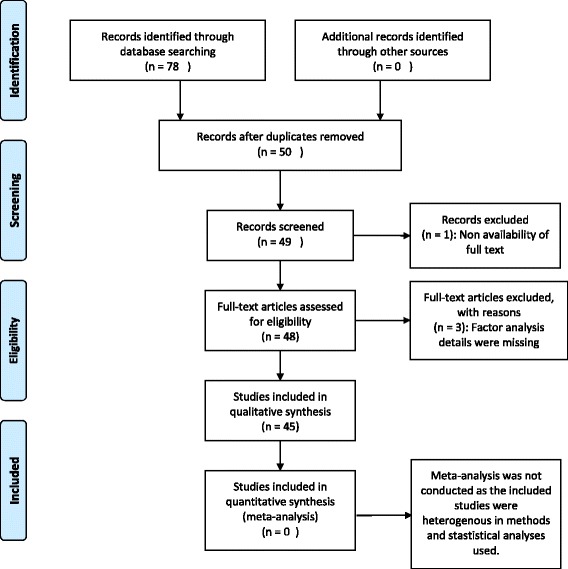
BACKGROUND: The Pittsburgh Sleep Quality Index (PSQI) dimensionality is much debated, with the greatest number of reported factor structures. Therefore, this review appraised the methodologies of studies investigating the factor structure of the PSQI. MATERIAL AND METHODS: MEDLINE, PsycInfo, AJOL, BASE, Cochrane Library, Directory of Open Access Journals (Lund University), CINAHL, and Embase were searched systematically to include articles published till 23rd March, 2018. The articles with the objective of factor analysis of the PSQI (20 articles) or with a major section on the same subject (25 articles) were included. There was no limitation about participant characteristics. Descriptive analysis of articles for measures of the suitability of the data for factor analysis, details of the exploratory factor analysis (EFA) and details of the confirmatory factor analysis (CFA) was performed. RESULTS: The analysis used by the majority did not employ the simplest scheme for interpreting the observed data: the parsimony principle. Other shortcomings included under- or non-reporting of sample adequacy measures (11 out of 45 articles), non-use of EFA (20 out of 45 articles), use of EFA without relevant details, non-use of CFA (11 out of 45 articles), and use of CFA without relevant details. Overall, 31 out of 45 articles did not use either EFA or CFA. CONCLUSION: We conclude that the various PSQI factor structures for standard sleep assessment in research and clinical settings may need further validation. TRIAL REGISTRATION: Not applicable because this was a review of existing literature.
Overview
The claims and statistics of this paper haven’t been checked yet.
Free: it reads the open-access text and checks the first 5 claims that cite a source we can check. Create a free account to check every claim.
Integrity signals
Registry
Cites
Statistics
Figures
Verification
Claims the paper makes
The claims and statistics of this paper haven’t been checked yet.
Free: it reads the open-access text and checks the first 5 claims that cite a source we can check. Create a free account to check every claim.
Claims other papers make about this one
Each is checked against this paper’s own text: does it say what the citing paper says it does?
The source backs part of the claim, not all of it — or backs it for a different population, condition or comparison.
In the citing paper
“A global PSQI score ≥5 indicates poor sleep quality (29).”
From Anxiety in Polish adult patients with inborn errors of immunity: a cross-sectional study (2024) · cites this paper as [29]
Experimental — accuracy not yet measured
Self-check
Percentages, sums and reported differences re-computed from the paper’s own numbers.
The self-check needs the paper’s full text.
Citations
Cites
Tabachnick, B. G., & Fidell, L. S. (1983) · Cited by 80,058
Herne, H., Cooley, W. W., & Lohnes, P. R. (1973) · Journal of the Royal Statistical Society. Series A (General) · doi:10.2307/2344428 · Cited by 35,697
The Pittsburgh Sleep Quality Index: a new instrument for psychiatric practice and research
Buysse, D. J., Reynolds, C. F., Monk, T. H., Berman, S. R., & Kupfer, D. J. (1989) · Psychiatry Research · doi:10.1016/0165-1781(89)90047-4 · Cited by 35,234
Alternative Ways of Assessing Model Fit
Browne, M. W., & Cudeck, R. (1992) · Sociological Methods & Research · doi:10.1177/0049124192021002005 · Cited by 27,200
Evaluating Goodness-of-Fit Indexes for Testing Measurement Invariance
Cheung, G. W., & Rensvold, R. B. (2002) · Structural Equation Modeling: A Multidisciplinary Journal · doi:10.1207/s15328007sem0902_5 · Cited by 16,280 · cited 2×
“Cheung GW, Rensvold RB. Evaluating goodness-of-fit indexes for testing measurement invariance.”
BackgroundThe Scree Test For The Number Of Factors
Cattell, R. B. (1966) · Multivariate Behavioral Research · doi:10.1207/s15327906mbr0102_10 · Cited by 13,554 · cited 1×
“Seven studies reported using a Cattell’s scree test to determine the number of factors to retain [16, 17, 44, 46, 58, 61, 65, 69].”
MethodCostello, A. B., & Osborne, J. (2005) · University of Massachusetts Amherst · doi:10.7275/jyj1-4868 · Cited by 10,297
Multivariate Data Analysis, 6th ed
Tatham, R. L., Anderson, R. E., Babin, B. J., Black, W. C., & Hair, J. F. (2006) · Cited by 9,807
A Rationale and Test for the Number of Factors in Factor Analysis
Horn, J. L. (1965) · Psychometrika · doi:10.1007/bf02289447 · Cited by 8,714
O'fallon, W. M. (1973) · Technometrics · doi:10.1080/00401706.1973.10489095 · Cited by 6,289
Cited by
Measuring Subjective Sleep Quality: A Review
Fabbri, M., Beracci, A., Martoni, M., Meneo, D., Tonetti, L., & Natale, V. (2021) · International Journal of Environmental Research and Public Health · doi:10.3390/ijerph18031082 · Cited by 599
Physical activity and sleep quality in relation to mental health among college students
Ghrouz, A. K., Noohu, M. M., Dilshad Manzar, M., Warren Spence, D., BaHammam, A. S., & Pandi-Perumal, S. R. (2019) · Sleep and Breathing · doi:10.1007/s11325-019-01780-z · Cited by 337
Self-citationEffects of physical activity programs on sleep outcomes in older adults: a systematic review
Vanderlinden, J., Boen, F., & van Uffelen, J. G. Z. (2020) · International Journal of Behavioral Nutrition and Physical Activity · doi:10.1186/s12966-020-0913-3 · Cited by 231
The examination of sleep quality for frontline healthcare workers during the outbreak of COVID-19
Jahrami, H., BaHammam, A. S., AlGahtani, H., Ebrahim, A., Faris, M., AlEid, K., Saif, Z., Haji, E., Dhahi, A., Marzooq, H., et al. (2021) · Sleep and Breathing · doi:10.1007/s11325-020-02135-9 · Cited by 203
Self-citationZhang, C., Zhang, H., Zhao, M., Li, Z., Cook, C. E., Buysse, D. J., Zhao, Y., & Yao, Y. (2020) · Frontiers in Psychiatry · doi:10.3389/fpsyt.2020.573530 · Cited by 166
Metadata
- Authors
- Manzar, M. D., BaHammam, A. S., Hameed, U. A., Spence, D. W., Pandi-Perumal, S. R., Moscovitch, A., & Streiner, D. L.
- Affiliations
- Majmaah University (SA)
- King Saud University (SA)
- University of Calgary (CA)
- University of Toronto (CA)
- Corresponding author
- Manzar, Md Dilshad
- ORCID
- Venue
- Health and Quality of Life Outcomes
- Published
- 2018-05-09
- Volume
- 16
- Issue
- 1
- Pages
- 89-89
- ISSN
- 1477-7525 (ISSN-L)
- PMC
- PMC5944037
- OpenAlex
- W2799957611
- Cited by
- 204
- References
- 97
- Citations by year
- 2026: 18 · 2025: 24 · 2024: 33 · 2023: 29 · 2022: 33 · 2021: 29 · 2020: 25 · 2019: 9 · 2018: 4
- FWCI
- 2.64
- Type
- journal article
- Language
- en
- Open access
- gold
- doi.org
- Licence
- cc-by
- creativecommons.org/licenses/by/4.0/ (tdm)
- Locations
- Health and Quality of Life Outcomes (publishedVersion, cc-by)
- Europe PMC (PubMed Central) (publishedVersion, other-oa)
- PubMed Central (publishedVersion, cc-by)
- PubMed (publishedVersion)
- DOAJ (DOAJ: Directory of Open Access Journals) (submittedVersion, cc-by-sa)
- Libraries and Cultural Resources (University of Calgary) (submittedVersion)
- TSpace (University of Toronto) (submittedVersion, cc-by)
- Libraries and Cultural Resources (University of Calgary)
- Topics
- Social Sciences › Psychology › Experimental and Cognitive Psychology › Sleep and related disorders
- Social Sciences › Decision Sciences › Management Science and Operations Research › Psychometric Methodologies and Testing
- Health Sciences › Medicine › Physiology (medical) › Obstructive Sleep Apnea Research
- Keywords
- Pittsburgh Sleep Quality Index, factor structure, dimensionality, sleep quality assessment, exploratory factor analysis, confirmatory factor analysis, Occam's razor, scale validation
- MeSH terms
- Factor Analysis, Statistical, Female, Humans, Male, Psychometrics, Quality of Life, Surveys and Questionnaires, Sleep Wake Disorders, Reproducibility of Results
About these checks
Registry, retraction, Cites and statistics results are computed, not judged, with one exception: a printed reference that no index lists is read once by a model before it counts as a citation error. Claims are extracted by a model and kept only when their quote appears verbatim in the text; each cited source is then checked, with a model’s help, for whether it says what the claim relies on. Those verdicts can be wrong — read the claim’s quote and the cited source before relying on one.
Statistics and arithmetic are recomputed, not judged.
Confidence bands are shown only for fields calibrated on our annotated test set. None is calibrated yet, so no band is shown.
What counts as a claim ›How we measure confidence ›How we check this ›
Are you an author, or do you see a problem with this page? Request a review
How to cite
Cite CoChat for the checks on this page, and the paper for its own findings.
- This page
- CoChat. (2026). Citation check: Dimensionality of the Pittsburgh Sleep Quality Index: a systematic review. https://app.cochat.ai/papers/10.1186/s12955-018-0915-x
- The paper
- Manzar, M. D., BaHammam, A. S., Hameed, U. A., Spence, D. W., Pandi-Perumal, S. R., Moscovitch, A., & Streiner, D. L. (2018). Dimensionality of the Pittsburgh Sleep Quality Index: a systematic review. Health and Quality of Life Outcomes. https://doi.org/10.1186/s12955-018-0915-x
Data sources
Bibliographic data: Semantic Scholar, OpenAlex, Crossref.
Contains information from the Semantic Scholar Academic Graph Datasets, made available under the ODC Attribution License (ODC-BY 1.0).
Semantic Scholar’s data is described in: Kinney, R., et al. (2023). The Semantic Scholar Open Data Platform. arXiv:2301.10140.
