

Dimensionality of the Pittsburgh Sleep Quality Index: a systematic review
Open accessThe DOI matches its Crossref record; 97 of the 97 references it cites were found in a registry or an index.
Abstract
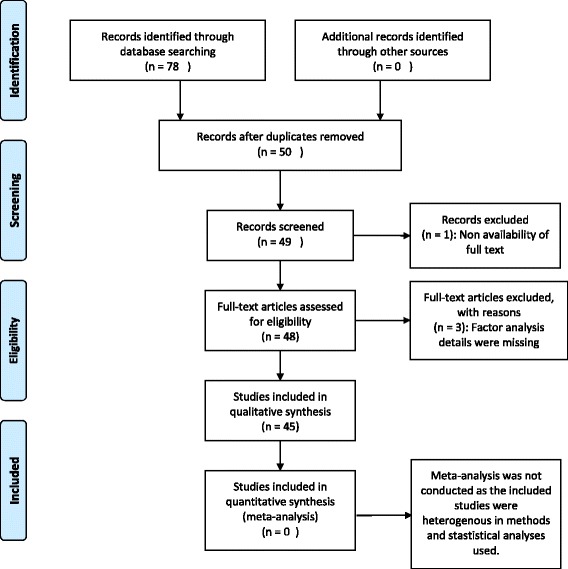
BACKGROUND: The Pittsburgh Sleep Quality Index (PSQI) dimensionality is much debated, with the greatest number of reported factor structures. Therefore, this review appraised the methodologies of studies investigating the factor structure of the PSQI. MATERIAL AND METHODS: MEDLINE, PsycInfo, AJOL, BASE, Cochrane Library, Directory of Open Access Journals (Lund University), CINAHL, and Embase were searched systematically to include articles published till 23rd March, 2018. The articles with the objective of factor analysis of the PSQI (20 articles) or with a major section on the same subject (25 articles) were included. There was no limitation about participant characteristics. Descriptive analysis of articles for measures of the suitability of the data for factor analysis, details of the exploratory factor analysis (EFA) and details of the confirmatory factor analysis (CFA) was performed. RESULTS: The analysis used by the majority did not employ the simplest scheme for interpreting the observed data: the parsimony principle. Other shortcomings included under- or non-reporting of sample adequacy measures (11 out of 45 articles), non-use of EFA (20 out of 45 articles), use of EFA without relevant details, non-use of CFA (11 out of 45 articles), and use of CFA without relevant details. Overall, 31 out of 45 articles did not use either EFA or CFA. CONCLUSION: We conclude that the various PSQI factor structures for standard sleep assessment in research and clinical settings may need further validation. TRIAL REGISTRATION: Not applicable because this was a review of existing literature.
Overview
The claims and statistics of this paper haven’t been checked yet.
Free: it reads the open-access text and checks the first 5 claims that cite a source we can check. Create a free account to check every claim.
Integrity signals
Registry
Cites
Statistics
Figures
Verification
Claims the paper makes
The claims and statistics of this paper haven’t been checked yet.
Free: it reads the open-access text and checks the first 5 claims that cite a source we can check. Create a free account to check every claim.
Claims other papers make about this one
Each is checked against this paper’s own text: does it say what the citing paper says it does?
The source backs part of the claim, not all of it — or backs it for a different population, condition or comparison.
In the citing paper
“A global PSQI score ≥5 indicates poor sleep quality (29).”
From Anxiety in Polish adult patients with inborn errors of immunity: a cross-sectional study (2024) · cites this paper as [29]
Experimental — accuracy not yet measured
Self-check
Percentages, sums and reported differences re-computed from the paper’s own numbers.
The self-check needs the paper’s full text.
Citations
Cites
Tabachnick, B. G., & Fidell, L. S. (1983) · Cited by 80,054
Herne, H., Cooley, W. W., & Lohnes, P. R. (1973) · Journal of the Royal Statistical Society. Series A (General) · doi:10.2307/2344428 · Cited by 35,697
The Pittsburgh Sleep Quality Index: a new instrument for psychiatric practice and research
Buysse, D. J., Reynolds, C. F., Monk, T. H., Berman, S. R., & Kupfer, D. J. (1989) · Psychiatry Research · doi:10.1016/0165-1781(89)90047-4 · Cited by 35,234
Alternative Ways of Assessing Model Fit
Browne, M. W., & Cudeck, R. (1992) · Sociological Methods & Research · doi:10.1177/0049124192021002005 · Cited by 27,200
Evaluating Goodness-of-Fit Indexes for Testing Measurement Invariance
Cheung, G. W., & Rensvold, R. B. (2002) · Structural Equation Modeling: A Multidisciplinary Journal · doi:10.1207/s15328007sem0902_5 · Cited by 16,280 · cited 2×
“Cheung GW, Rensvold RB. Evaluating goodness-of-fit indexes for testing measurement invariance.”
BackgroundThe Scree Test For The Number Of Factors
Cattell, R. B. (1966) · Multivariate Behavioral Research · doi:10.1207/s15327906mbr0102_10 · Cited by 13,554 · cited 1×
“Seven studies reported using a Cattell’s scree test to determine the number of factors to retain [16, 17, 44, 46, 58, 61, 65, 69].”
MethodCostello, A. B., & Osborne, J. (2005) · University of Massachusetts Amherst · doi:10.7275/jyj1-4868 · Cited by 10,297 · cited 1×
“The suitable data for factor analysis and replicable factor extraction may require large samples and the satisfaction of a number of conditions as determined by such measures as the KMO, Bartlett’s test, the determinant of the matrix, the anti-image of the anti-correlation matrix, and inter-component correlations [79].”
MethodMultivariate Data Analysis, 6th ed
Tatham, R. L., Anderson, R. E., Babin, B. J., Black, W. C., & Hair, J. F. (2006) · Cited by 9,807
A Rationale and Test for the Number of Factors in Factor Analysis
Horn, J. L. (1965) · Psychometrika · doi:10.1007/bf02289447 · Cited by 8,714
O'fallon, W. M. (1973) · Technometrics · doi:10.1080/00401706.1973.10489095 · Cited by 6,289
Harman, H. H. (1960) · Cited by 5,148
A First Course in Factor Analysis
Comrey, A. L., & Lee, H. B. (2013) · doi:10.4324/9781315827506 · Cited by 4,546
O’connor, B. P. (2000) · Behavior Research Methods, Instruments, & Computers · doi:10.3758/bf03200807 · Cited by 4,116
Exploratory and confirmatory factor analysis: Understanding concepts and applications.
Thompson, B. (2004) · doi:10.1037/10694-000 · Cited by 3,469
A Beginner’s Guide to Factor Analysis: Focusing on Exploratory Factor Analysis
Yong, A. G., & Pearce, S. (2013) · Tutorials in Quantitative Methods for Psychology · doi:10.20982/tqmp.09.2.p079 · Cited by 3,304 · cited 29×
“The reported correlation values between the factors of the final CFA models varied from 0.07 to 1.0.”
BackgroundMethodInfluentialExploratory Factor Analysis: A Five-Step Guide for Novices
Williams, B., Onsman, A., & Brown, T. (2010) · Australasian Journal of Paramedicine · doi:10.33151/ajp.8.3.93 · Cited by 2,739
Henson, R. K., & Roberts, J. K. (2006) · Educational and Psychological Measurement · doi:10.1177/0013164405282485 · Cited by 2,454 · cited 1×
“There are also different opinions on such issues as sample to variable ratio (N:p ratio) criteria [72, 75], the factorability of the correlation matrix [76, 77], use of the KMO/Bartlett’s Test of Sphericity [76, 78], and use of the determinant of the matrix and anti-image or diagonal element of the anticorrelation mat…”
MethodReporting practices in confirmatory factor analysis: an overview and some recommendations
Jackson, D. L., Gillaspy, J. A., & Purc-Stephenson, R. (2009) · Psychological Methods · doi:10.1037/a0014694 · Cited by 2,242 · cited 1×
“It may be better to validate the modification index incorporated models on unrelated samples [87].”
BackgroundMaking Sense of Factor Analysis
Pett, M., Lackey, N., & Sullivan, J. (2003) · doi:10.4135/9781412984898 · Cited by 2,168
Mollayeva, T., Thurairajah, P., Burton, K., Mollayeva, S., Shapiro, C. M., & Colantonio, A. (2016) · Sleep Medicine Reviews · doi:10.1016/j.smrv.2015.01.009 · Cited by 1,847 · cited 9×
“These disturbances are in turn linked to sympathetic activity changes and an increased risk of cardiovascular and cerebrovascular diseases [4, 5, 8].”
BackgroundMethodResultInfluentialBootstrapping goodness-of-fit measures in structural equation models.
Bollen, K. A., & Stine, R. A. (1992) · Sociological Methods & Research · doi:10.1177/0049124192021002004 · Cited by 1,831
Sullivan, J., Pett, M. A., & Lackey, N. R. (2003) · Medical Entomology and Zoology · Cited by 1,692
The essentials of factor analysis
Child, D. (1970) · Medical Entomology and Zoology · Cited by 1,652
Practical Considerations for Using Exploratory Factor Analysis in Educational Research
Beavers, A. S., Lounsbury, J. W., Richards, J., Huck, S. W., Skolits, G., & Esquivel, S. L. (2020) · doi:10.7275/qv2q-rk76 · Cited by 1,230
LISREL Approaches to Interaction Effects in Multiple Regression
Jaccard, J., & Wan, C. (1996) · Sage eBooks · doi:10.4135/9781412984782 · Cited by 884
Buysse, D. J., Hall, M. L., Strollo, P. J., Kamarck, T. W., Owens, J., Lee, L., Reis, S. E., & Matthews, K. A. (2008) · Journal of Clinical Sleep Medicine · doi:10.5664/jcsm.27351 · Cited by 858 · cited 5×
“Some of the PSQI models are based only on EFA [25, 27, 28, 31, 39, 43], while some are based only on CFA [15, 23, 26, 29, 32, 34–36, 38, 42], neither of which is the recommended practice for performing factor analysis [85].”
BackgroundMethodInfluentialLatent Variable Models and Factor Analysis: A Unified Approach
Bartholomew, D., Knott, M., & Moustaki, I. (2011) · Wiley Series in Probability and Statistics · doi:10.1002/9781119970583 · Cited by 842
Insomnia and daytime cognitive performance: A meta-analysis
Fortier-Brochu, É., Beaulieu-Bonneau, S., Ivers, H., & Morin, C. M. (2012) · Sleep Medicine Reviews · doi:10.1016/j.smrv.2011.03.008 · Cited by 753
Factor Analysis and Related Methods
Widaman, K. F., & McDonald, R. P. (1987) · Journal of Educational Statistics · doi:10.2307/1164692 · Cited by 664
Mollayeva, T., Thurairajah, P., Mollayeva, S., Shapiro, C., Burton, K., & Colantonio, A. (2015) · Sleep Medicine · doi:10.1016/j.sleep.2015.02.156 · Cited by 616
Validity of the Italian Version of the Pittsburgh Sleep Quality Index (PSQI)
Curcio, G., Tempesta, D., Scarlata, S., Marzano, C., Moroni, F., Rossini, P. M., Ferrara, M., & De Gennaro, L. (2013) · Neurological Sciences · doi:10.1007/s10072-012-1085-y · Cited by 595
Factor Analysis and Related Methods
McDonald, R. P. (2014) · Psychology Press eBooks · doi:10.4324/9781315802510 · Cited by 533
Latent Variable Models and Factor Analysis: A Unified Approach
Bartholomew, D. J., Knott, M. J., & Moustaki, I. (2011) · Cited by 499
Minimizing Sample Size When Using Exploratory Factor Analysis for Measurement
Sapnas, K. G., & Zeller, R. A. (2002) · Journal of Nursing Measurement · doi:10.1891/jnum.10.2.135.52552 · Cited by 405
Prevalence of Sleep-disordered Breathing and Sleep Apnea in Middle-aged Urban Indian Men
Udwadia, Z. F., Doshi, A. V., Lonkar, S. G., & Singh, C. I. (2004) · American Journal of Respiratory and Critical Care Medicine · doi:10.1164/rccm.200302-265oc · Cited by 388
Validation of a 3-Factor Scoring Model for the Pittsburgh Sleep Quality Index in Older Adults
Cole, J. C., Motivala, S. J., Buysse, D. J., Oxman, M. N., Levin, M. J., & Irwin, M. R. (2006) · Sleep · doi:10.1093/sleep/29.1.112 · Cited by 377
Confirmatory Factor Analysis using Amos, LISREL, Mplus, SAS/STAT CALIS*
Albright, J. J., & Park, H. M. (2009) · IUScholarWorks (Indiana University) · Cited by 333
Epidemiological Overview of sleep Disorders in the General Population
Ohayon, M. M. (2011) · Sleep Medicine Research · doi:10.17241/smr.2011.2.1.1 · Cited by 312
Courtney, M. G. R., & Gordon, R. (2020) · ScholarWorks@UMassAmherst (University of Massachusetts Amherst) · doi:10.7275/9cf5-2m72 · Cited by 269
LISREL analyses of interaction effects in multiple regression
Jaccard, J. J., & Wan, W. (1996) · Cited by 235
Validity of the Pittsburgh Sleep Quality Index (PSQI) among Nigerian university students
Aloba, O. O., Adewuya, A. O., Ola, B. A., & Mapayi, B. M. (2007) · Sleep Medicine · doi:10.1016/j.sleep.2006.08.003 · Cited by 219
The Pittsburgh Sleep Quality Index: Validity and factor structure in young people.
de la Vega, R., Tomé-Pires, C., Solé, E., Racine, M., Castarlenas, E., Jensen, M. P., & Miró, J. (2015) · Psychological Assessment · doi:10.1037/pas0000128 · Cited by 217
Hita-Contreras, F., Martínez-López, E., Latorre-Román, P. A., Garrido, F., Santos, M. A., & Martínez-Amat, A. (2014) · Rheumatology International · doi:10.1007/s00296-014-2960-z · Cited by 199
(2007) · Routledge eBooks · doi:10.4324/9780203936764 · Cited by 177
Zhong, Q., Gelaye, B., Sánchez, S. E., & Williams, M. A. (2015) · Journal of Clinical Sleep Medicine · doi:10.5664/jcsm.4936 · Cited by 162
Léger, D., Bayon, V., Ohayon, M. M., Philip, P., Ement, P., Metlaine, A., Chennaoui, M., & Faraut, B. (2014) · Journal of Sleep Research · doi:10.1111/jsr.12104 · Cited by 161
Skouteris (2009) · doi:10.1016/j.whi.2008.10.004 · Cited by 153 · cited 10×
“, 2 or 3 first-order latent factors loaded on a higherorder factor [23, 33] (Table 3).”
BackgroundMethodInfluentialValidity of the Pittsburgh Sleep Quality Index in Indian University Students
Centre for Physiotherapy and Rehabilitation Sciences, Manzar, M. D., Moiz, J. A., Zannat, W., Spence, D. W., Researcher, I., Pandi-Perumal, S. R., BaHammam, A. S., & Hussain, M. E. (2015) · Oman Medical Journal · doi:10.5001/omj.2015.41 · Cited by 147
Self-citationStructural Validity of the Pittsburgh Sleep Quality Index in Chinese Undergraduate Students
Guo, S., Sun, W., Liu, C., & Wu, S. (2016) · Frontiers in Psychology · doi:10.3389/fpsyg.2016.01126 · Cited by 144
Sleep habits and sleep problems among Palestinian students
Sweileh, W. M., Ali, I. A., Sawalha, A. F., Abu-Taha, A. S., Zyoud, S. H., & Al-Jabi, S. W. (2011) · Child and Adolescent Psychiatry and Mental Health · doi:10.1186/1753-2000-5-25 · Cited by 143
Validation of the Portuguese version of the Pittsburgh Sleep Quality Index (PSQI-PT)
Del Rio João, K. A., Becker, N. B., de Neves Jesus, S., & Isabel Santos Martins, R. (2017) · Psychiatry Research · doi:10.1016/j.psychres.2016.11.042 · Cited by 140
Validation of the Pittsburgh sleep quality index in community dwelling Ethiopian adults
Salahuddin, M., Maru, T. T., Kumalo, A., Pandi-Perumal, S. R., Bahammam, A. S., & Manzar, M. D. (2017) · Health and Quality of Life Outcomes · doi:10.1186/s12955-017-0637-5 · Cited by 134
Self-citationHo, R. T. H., & Fong, T. C. T. (2014) · Sleep Medicine · doi:10.1016/j.sleep.2013.10.019 · Cited by 129
Shekleton, J. A., Flynn-Evans, E. E., Miller, B., Epstein, L. J., Kirsch, D., Brogna, L. A., Burke, L. M., Bremer, E., Murray, J. M., Gehrman, P., et al. (2014) · Sleep · doi:10.5665/sleep.3318 · Cited by 126
Kotronoulas, G., Papadopoulou, C., Papapetrou, A., & Patiraki, E. I. (2010) · Supportive Care in Cancer · doi:10.1007/s00520-010-1025-4 · Cited by 122
Qiu, C., Gelaye, B., Zhong, Q.-Y., Enquobahrie, D. A., Frederick, I. O., & Williams, M. A. (2016) · Sleep and Breathing · doi:10.1007/s11325-016-1313-4 · Cited by 116
Gelaye, B., Lohsoonthorn, V., Lertmeharit, S., Pensuksan, W. C., Sanchez, S. E., Lemma, S., Berhane, Y., Zhu, X., Vélez, J. C., Barbosa, C., et al. (2014) · PLoS ONE · doi:10.1371/journal.pone.0116383 · Cited by 108
(2008) · PubMed · Cited by 107
Assessment and relationship of sleep quality to depression in early pregnancy
Jomeen, J., & Martin, C. R. (2007) · Journal of Reproductive and Infant Psychology · doi:10.1080/02646830601117308 · Cited by 106
Zheng, B., Li, M., Wang, K. L., & Lv, J. (2016) · PubMed · Cited by 106
Confirmatory Factor Analysis of the Pittsburgh Sleep Quality Index in Rheumatoid Arthritis Patients
Nicassio, P. M., Ormseth, S. R., Custodio, M. K., Olmstead, R., Weisman, M. H., & Irwin, M. R. (2014) · Behavioral Sleep Medicine · doi:10.1080/15402002.2012.720315 · Cited by 103
Passos, M. H. P., Silva, H. A., Pitangui, A. C. R., Oliveira, V. M. A., Lima, A. S., & Araújo, R. C. (2017) · Jornal de Pediatria · doi:10.1016/j.jped.2016.06.006 · Cited by 101
Mariman, A., Vogelaers, D., Hanoulle, I. P., Delesie, L. M., Tobback, E., & Pevernagie, D. (2011) · Journal of Psychosomatic Research · doi:10.1016/j.jpsychores.2011.11.004 · Cited by 91
An investigation of the dimensionality of the Pittsburgh Sleep Quality Index in Australian adults
Magee, C., Caputi, P., Iverson, D. C., & Huang, X. (2008) · Sleep and Biological Rhythms · doi:10.1111/j.1479-8425.2008.00371.x · Cited by 86
Reliability and validity of the Pittsburgh Sleep Quality Index in breast cancer patients
Fontes, F., Gonçalves, M., Maia, S., Pereira, S., Severo, M., & Lunet, N. (2017) · Supportive Care in Cancer · doi:10.1007/s00520-017-3713-9 · Cited by 79
Tomfohr‐Madsen, L. M., Schweizer, C. A., Dimsdale, J. E., & Loredo, J. S. (2013) · Journal of Clinical Sleep Medicine · doi:10.5664/jcsm.2342 · Cited by 77
Guallar-Castillón, P., Bayán-Bravo, A., León-Muñoz, L. M., Balboa-Castillo, T., López-García, E., Gutierrez-Fisac, J. L., & Rodríguez-Artalejo, F. (2014) · Preventive Medicine · doi:10.1016/j.ypmed.2014.08.015 · Cited by 67
Sex Differences in the Psychometric Properties of the Pittsburgh Sleep Quality Index
Morris, J. L., Rohay, J. M., & Chasens, E. R. (2017) · Journal of Women s Health · doi:10.1089/jwh.2017.6447 · Cited by 64
Babson, K. A., Blonigen, D. M., Boden, M. T., Drescher, K. D., & Bonn‐Miller, M. O. (2012) · Journal of Traumatic Stress · doi:10.1002/jts.21757 · Cited by 63
Factor Analysis of the Pittsburgh Sleep Quality Index in Breast Cancer Survivors
Otte, J. L., Rand, K. L., Carpenter, J. S., Russell, K. M., & Champion, V. L. (2013) · Journal of Pain and Symptom Management · doi:10.1016/j.jpainsymman.2012.03.008 · Cited by 59
Rener-Sitar, K., John, M. T., Bandyopadhyay, D., Howell, M. J., & Schiffman, E. L. (2014) · Health and Quality of Life Outcomes · doi:10.1186/1477-7525-12-10 · Cited by 59 · cited 9×
“The software packages used to perform CFA (LISREL, Mplus, SAS, STATA, Amos, and EQS) differ with regard to estimation; path diagrams; availability of standard errors for standardized estimates, factor covariance, and factor correlations; availability of modification indices; and ability to handle different types (i.e.…”
MethodResultInfluentialAdaptation of the Pittsburgh Sleep Quality Index in Chinese adults with type 2 diabetes
Zhu, B., Xie, M., Park, C. G., & Kapella, M. C. (2017) · Journal of the Chinese Medical Association · doi:10.1016/j.jcma.2017.06.021 · Cited by 59
Casement, M. D., Harrington, K. M., Miller, M. W., & Resick, P. A. (2012) · Sleep Medicine · doi:10.1016/j.sleep.2012.02.014 · Cited by 58
Benhayon, D., Youk, A., McCarthy, F. N., Davis, S., Keljo, D. J., Bousvaros, A., Fairclough, D., Kupfer, D., Buysse, D. J., & Szigethy, E. M. (2013) · Journal of Pediatric Gastroenterology and Nutrition · doi:10.1097/mpg.0b013e31829641df · Cited by 56
Chen, P., Jan, Y.-W., & Yang, C. (2017) · Sleep Medicine · doi:10.1016/j.sleep.2017.04.003 · Cited by 56
Burkhalter, H., Sereika, S. M., Engberg, S. J., Wirz‐Justice, A., Steiger, J. U., & Geest, S. D. (2010) · Sleep and Biological Rhythms · doi:10.1111/j.1479-8425.2010.00473.x · Cited by 54
Yurcheshen, M. E., Guttuso, T., McDermott, M., Holloway, R. G., & Perlis, M. (2009) · Journal of Women's Health · doi:10.1089/jwh.2008.1257 · Cited by 52
Factor structure of a Cantonese-version Pittsburgh Sleep Quality Index
Chong, A. M. L., & Cheung, C. (2012) · Sleep and Biological Rhythms · doi:10.1111/j.1479-8425.2011.00532.x · Cited by 51
Dimensionality of the Pittsburgh Sleep Quality Index in the young collegiate adults
Manzar, M. D., Zannat, W., Hussain, M. E., Pandi-Perumal, S. R., BaHammam, A. S., Barakat, D. H., Ojike, N. I., Olaish, A. H., & Spence, D. W. (2016) · SpringerPlus · doi:10.1186/s40064-016-3234-x · Cited by 50
Self-citationPsychometric Properties of the Persian Translation of Pittsburgh Sleep Quality Index
Nazifi, M., Mokarami, H., Akbaritabar, A., Kalte, H. O., & Rahi, A. (2014) · Health Scope · doi:10.17795/jhealthscope-15547 · Cited by 46
Association between elder abuse and poor sleep: A cross-sectional study among rural older Malaysians
Yunus, R. M., Wazid, S. W., Hairi, N. N., Choo, W. Y., Hairi, F. M., Sooryanarayana, R., Ahmad, S. N., Razak, I. A., Peramalah, D., Aziz, S. B. A., et al. (2017) · PLoS ONE · doi:10.1371/journal.pone.0180222 · Cited by 45
Manzar, M. D., Zannat, W., Moiz, J. A., Spence, D. W., Pandi-Perumal, S. R., BaHammam, A. S., & Hussain, M. E. (2016) · Biological Rhythm Research · doi:10.1080/09291016.2016.1202375 · Cited by 41
Self-citationDiagnostic utility of the Pittsburgh sleep Quality Index in memory clinics
Hancock, P., & Larner, A. J. (2009) · International Journal of Geriatric Psychiatry · doi:10.1002/gps.2251 · Cited by 40
Koh, H. W. L., Lim, R. B. T., Chia, K. S., & Lim, W. Y. (2015) · Sleep And Breathing · doi:10.1007/s11325-015-1130-1 · Cited by 36
Epidemiology of Insomnia: Prevalence and Risk Factors
Lopes, C. D. S., Rodrigues, J., & Rotenberg, L. (2012) · InTech eBooks · doi:10.5772/32991 · Cited by 33
Confirmatory factor analysis of the Pittsburgh Sleep Quality Index in women with hot flashes
Otte, J. L., Rand, K. L., Landis, C. A., Paudel, M. L., Newton, K. M., Woods, N. F., & Carpenter, J. S. (2015) · Menopause The Journal of The North American Menopause Society · doi:10.1097/gme.0000000000000459 · Cited by 33
Adaptation of a 3-factor model for the Pittsburgh Sleep Quality Index in Portuguese older adults
Becker, N. B., & de Jesús, S. N. (2017) · Psychiatry Research · doi:10.1016/j.psychres.2017.02.033 · Cited by 26
Bryant, F. B., & Yarnold, P. R. (1995) · Journal of Personality Assessment · doi:10.1207/s15327752jpa6401_10 · Cited by 24
Validation of the Sinhala version of the Pittsburgh Sleep Quality Index
Anandakumar, D., Dayabandara, M., Ratnatunga, S. S., Hanwella, R., & Silva, V. A. D. (2016) · Ceylon Medical Journal · doi:10.4038/cmj.v61i1.8255 · Cited by 24
Lequerica, A. H., Chiaravalloti, N. D., Cantor, J. B., Dijkers, M. P. J. M., Wright, J., Kolakowsky‐Hayner, S. A., Bushnik, T. L., Hammond, F. M., & Bell, K. R. (2014) · Neurorehabilitation · doi:10.3233/nre-141141 · Cited by 23
Sleep and physiological systems: a functional perspective
Manzar, M. D., Zannat, W., & Hussain, M. E. (2014) · Biological Rhythm Research · doi:10.1080/09291016.2014.966504 · Cited by 22
Self-citationDegutis, J. M., Chiu, C. W., Thai, M., Esterman, M. S., Milberg, W., & McGlinchey, R. E. (2016) · Behavioral Sleep Medicine · doi:10.1080/15402002.2016.1173550 · Cited by 17
Khosravifar, S., Bandi, M. F. G., Alavi, K., & Javadi, P. H. S. (2015) · Electronic physician · doi:10.19082/1644 · Cited by 16
Dudysová, D., Mala, I., Mladá, K., Saifutdinová, E., Kopřivová, J., & Šóš, P. (2017) · PubMed · Cited by 12
Bassetti, C. L., Dijk, D., Đogaš, Z., Levy, P. A., Nobili, L., Peigneux, P., Pollmächer, T., Riemann, D. W., Skene, D. J., Schulz, H., et al. (2012) · Dépôt institutionnel de l'Université libre de Bruxelles (Université Libre de Bruxelles) · Cited by 5
Epidemiology of Sleep Disorders in Women
Attarian, H. P. (2007) · Humana Press eBooks · doi:10.1007/978-1-59745-115-4_2 · Cited by 4
Sleep Disorders in Women: A Guide to Practical Management
Attarian, H. P., & Viola-Saltzman, M. (2013) · Humana Press eBooks · doi:10.1007/978-1-62703-324-4 · Cited by 3
Cited by
Measuring Subjective Sleep Quality: A Review
Fabbri, M., Beracci, A., Martoni, M., Meneo, D., Tonetti, L., & Natale, V. (2021) · International Journal of Environmental Research and Public Health · doi:10.3390/ijerph18031082 · Cited by 599
Physical activity and sleep quality in relation to mental health among college students
Ghrouz, A. K., Noohu, M. M., Dilshad Manzar, M., Warren Spence, D., BaHammam, A. S., & Pandi-Perumal, S. R. (2019) · Sleep and Breathing · doi:10.1007/s11325-019-01780-z · Cited by 337
Self-citationEffects of physical activity programs on sleep outcomes in older adults: a systematic review
Vanderlinden, J., Boen, F., & van Uffelen, J. G. Z. (2020) · International Journal of Behavioral Nutrition and Physical Activity · doi:10.1186/s12966-020-0913-3 · Cited by 231
The examination of sleep quality for frontline healthcare workers during the outbreak of COVID-19
Jahrami, H., BaHammam, A. S., AlGahtani, H., Ebrahim, A., Faris, M., AlEid, K., Saif, Z., Haji, E., Dhahi, A., Marzooq, H., et al. (2021) · Sleep and Breathing · doi:10.1007/s11325-020-02135-9 · Cited by 203
Self-citationZhang, C., Zhang, H., Zhao, M., Li, Z., Cook, C. E., Buysse, D. J., Zhao, Y., & Yao, Y. (2020) · Frontiers in Psychiatry · doi:10.3389/fpsyt.2020.573530 · Cited by 166
Metadata
- Authors
- Manzar, M. D., BaHammam, A. S., Hameed, U. A., Spence, D. W., Pandi-Perumal, S. R., Moscovitch, A., & Streiner, D. L.
- Affiliations
- Majmaah University (SA)
- King Saud University (SA)
- University of Calgary (CA)
- University of Toronto (CA)
- Corresponding author
- Manzar, Md Dilshad
- ORCID
- Venue
- Health and Quality of Life Outcomes
- Published
- 2018-05-09
- Volume
- 16
- Issue
- 1
- Pages
- 89-89
- ISSN
- 1477-7525 (ISSN-L)
- PMC
- PMC5944037
- OpenAlex
- W2799957611
- Cited by
- 204
- References
- 97
- Citations by year
- 2026: 18 · 2025: 24 · 2024: 33 · 2023: 29 · 2022: 33 · 2021: 29 · 2020: 25 · 2019: 9 · 2018: 4
- FWCI
- 2.64
- Type
- journal article
- Language
- en
- Open access
- gold
- doi.org
- Licence
- cc-by
- creativecommons.org/licenses/by/4.0/ (tdm)
- Locations
- Health and Quality of Life Outcomes (publishedVersion, cc-by)
- Europe PMC (PubMed Central) (publishedVersion, other-oa)
- PubMed Central (publishedVersion, cc-by)
- PubMed (publishedVersion)
- DOAJ (DOAJ: Directory of Open Access Journals) (submittedVersion, cc-by-sa)
- Libraries and Cultural Resources (University of Calgary) (submittedVersion)
- TSpace (University of Toronto) (submittedVersion, cc-by)
- Libraries and Cultural Resources (University of Calgary)
- Topics
- Social Sciences › Psychology › Experimental and Cognitive Psychology › Sleep and related disorders
- Social Sciences › Decision Sciences › Management Science and Operations Research › Psychometric Methodologies and Testing
- Health Sciences › Medicine › Physiology (medical) › Obstructive Sleep Apnea Research
- Keywords
- Pittsburgh Sleep Quality Index, factor structure, dimensionality, sleep quality assessment, exploratory factor analysis, confirmatory factor analysis, Occam's razor, scale validation
- MeSH terms
- Factor Analysis, Statistical, Female, Humans, Male, Psychometrics, Quality of Life, Surveys and Questionnaires, Sleep Wake Disorders, Reproducibility of Results
About these checks
Registry, retraction, Cites and statistics results are computed, not judged, with one exception: a printed reference that no index lists is read once by a model before it counts as a citation error. Claims are extracted by a model and kept only when their quote appears verbatim in the text; each cited source is then checked, with a model’s help, for whether it says what the claim relies on. Those verdicts can be wrong — read the claim’s quote and the cited source before relying on one.
Statistics and arithmetic are recomputed, not judged.
Confidence bands are shown only for fields calibrated on our annotated test set. None is calibrated yet, so no band is shown.
What counts as a claim ›How we measure confidence ›How we check this ›
Are you an author, or do you see a problem with this page? Request a review
Data sources
Bibliographic data: Semantic Scholar, OpenAlex, Crossref.
Contains information from the Semantic Scholar Academic Graph Datasets, made available under the ODC Attribution License (ODC-BY 1.0).
Semantic Scholar’s data is described in: Kinney, R., et al. (2023). The Semantic Scholar Open Data Platform. arXiv:2301.10140.
