

Employment and working conditions of nurses: where and how health inequalities have increased during the COVID-19 pandemic?
Open accessThe DOI matches its Crossref record; 57 of the 60 references it cites were found in a registry or an index.
Abstract
Background: Nurses and midwives play a critical role in the provision of care and the optimization of health services resources worldwide, which is particularly relevant during the current COVID-19 pandemic. However, they can only provide quality services if their work environment provides adequate conditions to support them. Today the employment and working conditions of many nurses worldwide are precarious, and the current pandemic has prompted more visibility to the vulnerability to health-damaging factors of nurses’ globally. This desk review explores how employment relations, and employment and working conditions may be negatively affecting the health of nurses in countries such as Brazil, Croatia, India, Ireland, Italy, México, Nepal, Spain, and the United Kingdom. Main body: Nurses’ health is influenced by the broader social, economic, and political system and the redistribution of power relations that creates new policies regarding the labour market and the welfare state. The vulnerability faced by nurses is heightened by gender inequalities, in addition to social class, ethnicity/race (and caste), age and migrant status, that are inequality axes that explain why nurses’ workers, and often their families, are exposed to multiple risks and/or poorer health. Before the COVID-19 pandemic, informalization of nurses’ employment and working conditions were unfair and harmed their health. During COVID-19 pandemic, there is evidence that the employment and working conditions of nurses are associated to poor physical and mental health. Conclusion: The protection of nurses’ health is paramount. International and national enforceable standards are needed, along with economic and health policies designed to substantially improve employment and working conditions for nurses and work–life balance. More knowledge is needed to understand the pathways and mechanisms on how precariousness might affect nurses’ health and monitor the progress towards nurses’ health equity.
Overview
The claims and statistics of this paper haven’t been checked yet.
Free: it reads the open-access text and checks the first 5 claims that cite a source we can check. Create a free account to check every claim.
Integrity signals
Registry
Cites
Statistics
Figures
Verification
Claims the paper makes
The claims and statistics of this paper haven’t been checked yet.
Free: it reads the open-access text and checks the first 5 claims that cite a source we can check. Create a free account to check every claim.
Claims other papers make about this one
Each is checked against this paper’s own text: does it say what the citing paper says it does?
In the citing paper
“Other vulnerable groups not identified in our review included the migrant HCWs who have been separated from their families since the start of pandemic and were unable to visit their country of origin due to travel or hospital administration restrictions [94].”
From A global overview of healthcare workers’ turnover intention amid COVID-19 pandemic: a systematic review with future directions (2022) · cites this paper as [94]
In the citing paper
“Escalating this issue are high rates of absence and turnover, driven by an unprecedented level of physician and nurse burnout due to psychosocial stressors and occupational hazards such as exposure to infectious diseases, shiftwork, or ergonomic challenges, that place health care workers at risk for long-term mental and physical health consequences [6-9].”
From AI Interventions to Alleviate Healthcare Shortages and Enhance Work Conditions in Critical Care: Qualitative Analysis (2025) · cites this paper as [8]
Self-check
Percentages, sums and reported differences re-computed from the paper’s own numbers.
The self-check needs the paper’s full text.
Citations
Cites
Pappa, S., Ntella, V., Giannakas, T., Giannakoulis, V. G., Papoutsi, E., & Katsaounou, P. (2020) · Brain Behavior and Immunity · doi:10.1016/j.bbi.2020.05.026 · Cited by 3,617 · cited 1×
“Moreover, this systematic review also found gender and occupational differences, where female and nurses had higher rates of affective symptoms [10].”
BackgroundNguyen, L. H., Drew, D. A., Graham, M. S., Joshi, A. D., Guo, C.-G., Ma, W., Mehta, R. S., Warner, E. T., Sikavi, D. R., Lo, C.-H., et al. (2020) · The Lancet Public Health · doi:10.1016/s2468-2667(20)30164-x · Cited by 2,395
The experiences of health-care providers during the COVID-19 crisis in China: a qualitative study
Liu, Q., Luo, D., Haase, J. E., Guo, Q., Wang, X. Q., Liu, S., Xia, L., Liu, Z., Yang, J., & Yang, B. X. (2020) · The Lancet Global Health · doi:10.1016/s2214-109x(20)30204-7 · Cited by 1,552 · cited 1×
“This responsibility has turned to be particularly relevant during the current COVID-19 pandemic, where nurses in the public and private sectors are leading COVID-19 care, testing, triage, and management [1], placing them to a unique position able to deal Open Access”
BackgroundFernandez, R., Lord, H., Halcomb, E., Moxham, L., Middleton, R., Alananzeh, I., & Ellwood, L. (2020) · International Journal of Nursing Studies · doi:10.1016/j.ijnurstu.2020.103637 · Cited by 728 · cited 4×
“During COVID-19 pandemic, nurses, as other healthcare workers, have been working longer hours and/or with different shift patterns, and nursing staff has been reassigned from other clinical areas to, for example, ICU [34], current employment and working conditions of nurses are associated to poor physical and mental i…”
BackgroundResultInfluentialThe neglected health of international migrant workers in the COVID-19 epidemic
Liem, A., Wang, C., Wariyanti, Y., Latkin, C. A., & Hall, B. J. (2020) · The Lancet Psychiatry · doi:10.1016/s2215-0366(20)30076-6 · Cited by 373 · cited 1×
“Countries are failing to evaluate and respond to the impact of COVID-19 on the physical and mental wellbeing of migrant workers [77] and data on SARS-CoV-2 infection and COVID-19 deaths in migrant nurses is not systematically collected.”
BackgroundMoss, M., Good, V. S., Gozal, D., Kleinpell, R., & Sessler, C. N. (2016) · American Journal of Respiratory and Critical Care Medicine · doi:10.1164/rccm.201604-0708st · Cited by 327 · cited 1×
“Under usual employment and working conditions, health care workers are known to be at risk for depression, stress, anxiety, burnout or insomnia [9].”
BackgroundMonitoring approaches for health-care workers during the COVID-19 pandemic
Bielicki, J. A., Duval, X., Gobat, N., Goossens, H., Koopmans, M., Tacconelli, E., & van der Werf, S. (2020) · The Lancet Infectious Diseases · doi:10.1016/s1473-3099(20)30458-8 · Cited by 315 · cited 15×
“For example, the country’s purchasing capacity, the availability of PPE or vaccine production capacities, and the international dispute over scarce health workers.”
BackgroundInfluentialRacial Disparities in COVID‐19 Mortality Among Essential Workers in the United States
Rogers, T. N., Rogers, C. R., VanSant‐Webb, E., Gu, L. Y., Yan, B., & Qeadan, F. (2020) · World Medical & Health Policy · doi:10.1002/wmh3.358 · Cited by 309 · cited 1×
“It has also been shown that Black workers were nearly three times more likely than White workers to hold support roles in health care, such as nurse aides or orderlies [73].”
BackgroundMoss, M., Good, V. S., Gozal, D., Kleinpell, R., & Sessler, C. N. (2016) · Chest · doi:10.1016/j.chest.2016.02.649 · Cited by 302
CARACTERISTICAS GERAIS DA ENFERMAGEM: O PERFIL SÓCIO DEMOGRÁFICO
Machado, M. H., Filho, W. A., De Lacerda, W. F., De Oliveira, E., Lemos, W., Wermelinger, M., Vieira, M., Dos Santos, M. R., Junior, P. B. D. S., Justino, E., et al. (2016) · Enfermagem em Foco · doi:10.21675/2357-707x.2016.v7.nesp.686 · Cited by 217 · cited 7×
“Evidence from countries in South Africa [20], Kenya, Tanzania and Uganda [21], Catalonia [17, 22], Brazil [23], Chile [24], Colombia [25], Mexico [26–28], and Thailand [29] show that employment and working conditions of nurses before this pandemic were already associated to poor physical and mental health, and in some…”
BackgroundInfluentialWright, E. O. (2000) · Cambridge University Press eBooks · doi:10.1017/cbo9780511488917 · Cited by 206
The “Handling” of power in the physician-patient encounter: perceptions from experienced physicians
Nimmon, L., & Stenfors-Hayes, T. (2016) · BMC Medical Education · doi:10.1186/s12909-016-0634-0 · Cited by 196
Association of US Nurse and Physician Occupation With Risk of Suicide
Davis, M. A., Cher, B. A. Y., Friese, C. R., & Bynum, J. P. W. (2021) · JAMA Psychiatry · doi:10.1001/jamapsychiatry.2021.0154 · Cited by 175 · cited 1×
“Evidence from countries in South Africa [20], Kenya, Tanzania and Uganda [21], Catalonia [17, 22], Brazil [23], Chile [24], Colombia [25], Mexico [26–28], and Thailand [29] show that employment and working conditions of nurses before this pandemic were already associated to poor physical and mental health, and in some…”
BackgroundNurses’ Mental Health During the Covid-19 Outbreak: A Cross-Sectional Study
Sampaio, F., Sequeira, C., & Teixeira, L. (2020) · Journal of Occupational & Environmental Medicine · doi:10.1097/jom.0000000000001987 · Cited by 160 · cited 1×
“Evidence shows that nurses who do not consider the availability and quality of PPE to be adequate had significantly higher levels of depression, anxiety, and stress [35, 36, 47].”
BackgroundHughes, M. M., Groenewold, M. R., Lessem, S. E., Xu, K., Ussery, E. N., Wiegand, R. E., Qin, X., Do, T., Thomas, D., Tsai, S., et al. (2020) · MMWR Morbidity and Mortality Weekly Report · doi:10.15585/mmwr.mm6938a3 · Cited by 154 · cited 3×
“CDC data from six states of the US suggest that professional nurses, nurse aides, and women are disproportionately affected of COVID-19, despite men being at highest risk of case fatality [5].”
BackgroundNurses' extended work hours: Patient, nurse and organizational outcomes
Kunaviktikul, W., Wichaikhum, O., Nantsupawat, A., Nantsupawat, R., Chontawan, R., Klunklin, A., Roongruangsri, S., Nantachaipan, P., Supamanee, T., Chitpakdee, B., et al. (2015) · International Nursing Review · doi:10.1111/inr.12195 · Cited by 147 · cited 1×
“Evidence from countries in South Africa [20], Kenya, Tanzania and Uganda [21], Catalonia [17, 22], Brazil [23], Chile [24], Colombia [25], Mexico [26–28], and Thailand [29] show that employment and working conditions of nurses before this pandemic were already associated to poor physical and mental health, and in some…”
BackgroundZhan, Y.-X., Zhao, S.-Y., Yuan, J., Liu, H., Liu, Y.-F., Gui, L.-L., Zheng, H., Zhou, Y.-M., Qiu, L.-H., Chen, J.-H., et al. (2020) · Current Medical Science · doi:10.1007/s11596-020-2226-9 · Cited by 136 · cited 2×
“During COVID-19 pandemic, nurses, as other healthcare workers, have been working longer hours and/or with different shift patterns, and nursing staff has been reassigned from other clinical areas to, for example, ICU [34], current employment and working conditions of nurses are associated to poor physical and mental i…”
BackgroundJob conditions, job satisfaction, somatic complaints and burnout among East African nurses
van der Doef, M., Mbazzi, F. B., & Verhoeven, C. (2012) · Journal of Clinical Nursing · doi:10.1111/j.1365-2702.2011.03995.x · Cited by 130 · cited 1×
“Evidence from countries in South Africa [20], Kenya, Tanzania and Uganda [21], Catalonia [17, 22], Brazil [23], Chile [24], Colombia [25], Mexico [26–28], and Thailand [29] show that employment and working conditions of nurses before this pandemic were already associated to poor physical and mental health, and in some…”
BackgroundKambhampati, A. K., O’Halloran, A. C., Whitaker, M., Magill, S. S., Chea, N., Chai, S. J., Daily Kirley, P., Herlihy, R. K., Kawasaki, B., Meek, J., et al. (2020) · MMWR. Morbidity and Mortality Weekly Report · doi:10.15585/mmwr.mm6943e3 · Cited by 128 · cited 2×
“5%) required invasive mechanical ventilation [6], also there are reports of pregnant women deaths [70].”
BackgroundBurgess, D. J., Burke, S. E., Cunningham, B. A., Dovidio, J. F., Hardeman, R. R., Hou, Y., Nelson, D. B., Perry, S. P., Phelan, S. M., Yeazel, M. W., et al. (2016) · BMC Medical Education · doi:10.1186/s12909-016-0769-z · Cited by 118
García, A. J. (2007) · Salud Pública de México · doi:10.1590/s0036-36342007000200006 · Cited by 113
Class Counts: Index of subjects
Wright, E. O. (2000) · Cited by 111
Class Counts: Structural analyses of classes
Wright, E. O. (2000) · Cited by 111
Maraqa, B. N., Nazzal, Z. A. S., & Zink, T. (2020) · Journal of Primary Care & Community Health · doi:10.1177/2150132720955026 · Cited by 107 · cited 1×
“As the pandemic spread, these occurrences interlinked with additional problems and continuous blockades, including lack of PPE, guidelines and long working hours [33].”
BackgroundA Macro-Level Model of Employment Relations and Health Inequalities
Muntaner, C., Chung, H., Solar, O., Santana, V. S., Castedo, A., Benach, J., & EMCONET Network (2010) · International Journal of Health Services · doi:10.2190/hs.40.2.c · Cited by 102 · cited 1×
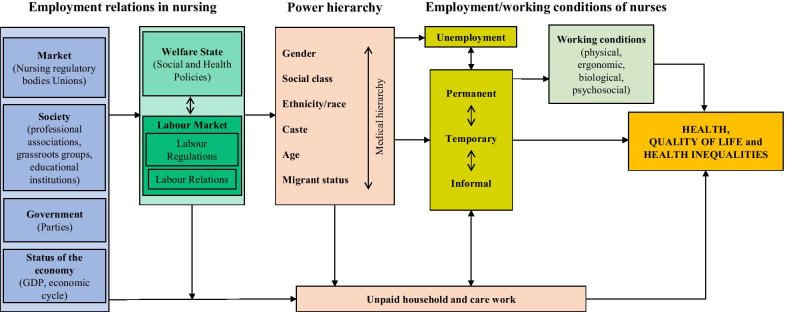
“Employment relations in nursing The macro-structural framework encompasses the broader social, economic, and political system that exerts significant power over the distribution of resources in a society, shedding light on the complex health and health care politics, and how the redistribution of power relations creat…”
Self-citationA Micro-Level Model of Employment Relations and Health Inequalities
Benach, J., Solar, O., Santana, V. S., Castedo, A., Chung, H., Muntaner, C., & EMCONET Network (2010) · International Journal of Health Services · doi:10.2190/hs.40.2.d · Cited by 83
Self-citationHealth situation of migrant and minority nurses: A systematic review
Schilgen, B., Nienhaus, A., Handtke, O., Schulz, H., & Mösko, M. (2017) · PLoS ONE · doi:10.1371/journal.pone.0179183 · Cited by 83
Pre‐registration undergraduate nurses and the COVID‐19 pandemic: Students or workers?
Hayter, M., & Jackson, D. W. (2020) · Journal of Clinical Nursing · doi:10.1111/jocn.15317 · Cited by 80 · cited 1×
“Less has been explored about the role of universities in allowing, enabling and even possibly encouraging their students to enter high-risk health environments [83].”
BackgroundUnderstanding Mexican health worker COVID-19 deaths
Agren, D. (2020) · The Lancet · doi:10.1016/s0140-6736(20)31955-3 · Cited by 80 · cited 1×
“For example, in Mexico, a number of nurses have been affected by COVID-19 and they have not had access to testing [53].”
BackgroundDavidson, J. E., Proudfoot, J. A., Lee, K. C., & Zisook, S. (2019) · Archives of Psychiatric Nursing · doi:10.1016/j.apnu.2019.04.006 · Cited by 78
Alameddine, M. S., Baumann, A. O., Laporte, A., & Deber, R. B. (2012) · Human Resources for Health · doi:10.1186/1478-4491-10-23 · Cited by 68 · cited 1×
“One of the measures implemented set caps on employment in the public sector which had a significant impact in the precarization of nurses [90].”
BackgroundReport 16: Role of testing in COVID-19 control
Grassly, N. C., Pons-Salort, M., Parker, E. P. K., White, P. J., Ainslie, K. E. C., Baguelin, M., Bhatt, S., Boonyasiri, A., Boyd, O., Brazeau, N. F., et al. (2020) · Spiral (Imperial College London) · doi:10.25561/78439 · Cited by 68 · cited 1×
“However, one study suggests that weekly screening staff might reduce their contribution to transmission by 25–33% on top of other measures, such as the health workers self-isolation if they develop symptoms [50].”
BackgroundGlobal migration of internationally educated nurses: Experiences of employment discrimination
Walani, S. R. (2015) · International Journal of Africa Nursing Sciences · doi:10.1016/j.ijans.2015.08.004 · Cited by 58 · cited 1×
“terms of lack of job opportunities, poor career progression or a poor learning environment have been identified as the cause of worse health among migrant and minority nurses compared to native-born nurses [75, 76].”
BackgroundGunn, V., Muntaner, C., Villeneuve, M. J., Chung, H., & Gea‐Sánchez, M. (2018) · Nursing Inquiry · doi:10.1111/nin.12263 · Cited by 56 · cited 1×
“Government, economy, and political priorities There is evidence of numerous links between the characteristics of welfare state regimes and the regulation of nurse and nursing professionalization, suggesting that the political context has to be acknowledged and addressed to significantly influence nursing employment an…”
BackgroundAdvancing Diversity Through Inclusive Excellence in Nursing Education
Bleich, M. R., MacWilliams, B., & Schmidt, B. J. (2014) · Journal of Professional Nursing · doi:10.1016/j.profnurs.2014.09.003 · Cited by 55 · cited 1×
“For example, the nursing workforce in countries like the United States is still predominantly White (75%) as a result of privatization of nursing education that creates unequal access to education, and has left many nurses indebted when they finish their studies, putting pressure on them to take available employment r…”
BackgroundHøgh, A., Carneiro, I. G., Giver, H., & Rugulies, R. (2010) · Scandinavian Journal of Psychology · doi:10.1111/j.1467-9450.2010.00840.x · Cited by 52 · cited 1×
“Also, in Denmark there is evidence that immigrant students from Eastern Europe, Iran, Pakistan, Africa or Asia are at significantly higher risk of being bullied in colleges compared to their native counterparts [41].”
BackgroundEngelbrecht, M. C., Bester, C. L., Van Den Berg, H., & Van Rensburg, H. C. J. (2008) · South African Journal of Economics · doi:10.1111/j.1813-6982.2008.00164.x · Cited by 45 · cited 1×
“Evidence from countries in South Africa [20], Kenya, Tanzania and Uganda [21], Catalonia [17, 22], Brazil [23], Chile [24], Colombia [25], Mexico [26–28], and Thailand [29] show that employment and working conditions of nurses before this pandemic were already associated to poor physical and mental health, and in some…”
BackgroundCaldera-Villalobos, C., Veloz, I. G., Martínez-Avila, N., Delgado‐Enciso, I., Ortiz‐Castro, Y., Cabral-Pacheco, G. A., & Martínez‐Fierro, M. L. (2020) · Frontiers in Public Health · doi:10.3389/fpubh.2020.00337 · Cited by 45 · cited 1×
“In Mexico, cases of physical and verbal assaults on health workers, including nurses, have been documented both inside and outside hospital facilities, as well as while making home visits to assess patients, and on their way home [64].”
BackgroundQuality of life in the workplace for nursing staff at public healthcare institutions
Zavala, M. O. Q., Klinj, T. P., & Carrillo, K. L. S. (2016) · Revista Latino-Americana de Enfermagem · doi:10.1590/1518-8345.1149.2713 · Cited by 42
Regional Office for Europe, Williams, A. E., Cláudia, C., Maier, C. B., Giada, Scarpetti, de, A. G., Belvis, Giovanni, G., Fattore, et al. (2020) · Eurohealth · Cited by 40
Employment, Work and Health Inequalities: A Global Perspective
Benach, J., Muntaner, C., Solar, O., Santana, V. S., & Quinlan, M. G. (2013) · doi:10.13140/2.1.1424.0006 · Cited by 39 · cited 2×
“Employment relations in nursing The macro-structural framework encompasses the broader social, economic, and political system that exerts significant power over the distribution of resources in a society, shedding light on the complex health and health care politics, and how the redistribution of power relations creat…”
BackgroundSelf-citationCOVID-19 as a Recognized Work-Related Disease: The Current Situation Worldwide
Sandal, A., & Yıldız, A. N. (2021) · Safety and Health at Work · doi:10.1016/j.shaw.2021.01.001 · Cited by 37 · cited 1×
“In addition, the declaration of COVID-19 as an occupational disease has been uneven and several countries have not yet developed this policy [85].”
A qualitative study of the work environments of Mexican nurses
Squires, A. P., & Juarez-Cuellar, A. (2012) · International Journal of Nursing Studies · doi:10.1016/j.ijnurstu.2012.02.001 · Cited by 35 · cited 1×
“Other effects of the economy in the current nursing workforce can be found in Mexico, where prioritization in hiring nurses’ aides instead of professional nurses started as a response to the economic development plans of the 1970s that resulted in policies set by Mexico state [93].”
BackgroundNurses' perception of implicit nursing care rationing in Croatia—A cross‐sectional multicentre study
Friganović, A., Režić, S., Kurtović, B., Vidmanić, S., Zeleníková, R., Rotim, C., Konjevoda, V., Režek, B., & Piškor, S. (2020) · Journal of Nursing Management · doi:10.1111/jonm.13002 · Cited by 34 · cited 1×
“For example, in Croatia it resulted in overburdening employed nurses; the inability of newly graduated professional nurses to access employment and, therefore, an increase in migration and a deepening of the serious shortage of nursing personnel [91, 92].”
BackgroundEr, F., & Sökmen, S. (2018) · International Journal of Nursing Sciences · doi:10.1016/j.ijnss.2018.01.001 · Cited by 32 · cited 1×
“Nurses and other health care workers can only provide quality services if their work environment provides adequate conditions to support them [11].”
BackgroundAristizabal, P., Nígenda, G., & Servan-Mori, E. E. (2019) · Human Resources for Health · doi:10.1186/s12960-019-0417-x · Cited by 32 · cited 1×
“For example, in Mexico during the period 2005–2018 they reported an increase of informalization among the group of nurses analysed in relation to: (a) the percentage of people without a written contract; (b) the percentage of people with incomes lower than two times the minimum wage; (c) the percentage of nurses witho…”
ResultOccupational Precariousness of Nursing Staff in Catalonia’s Public and Private Nursing Homes
Fité-Serra, A. M., Gea-Sánchez, M., Alconada-Romero, Á., Mateos, J., Blanco-Blanco, J., Barallat-Gimeno, E., Roca-Llobet, J., & Muntaner, C. (2019) · International Journal of Environmental Research and Public Health · doi:10.3390/ijerph16244921 · Cited by 24 · cited 4×
“For example, in Catalonia (Spain), compared to medical doctors, professional nurses received 200 euros less, and nurse aides 650 euros less, based on supposed “productivity” criteria [58].”
BackgroundInfluentialMalestar psicofisiológico en profesionales de la salud pública de la Región Metropolitana
Ansoleaga, E., Juan Pablo Toro, C., Lorena Godoy, C., Stecher, A., & Ribas, J. M. B. I. (2011) · Revista médica de Chile · doi:10.4067/s0034-98872011000900011 · Cited by 19
Calidad de vida profesional y trastornos musculoesqueléticos en profesionales de Enfermería
Cuevas, L. R., Araujo-Espino, R., Ortiz, P. M. T., & Tovar, J. G. (2016) · Enfermería Clínica · doi:10.1016/j.enfcli.2016.08.002 · Cited by 18
Palestinian nurses' lived experiences working in the occupied West Bank
Taha, A. A., & Westlake, C. A. (2016) · International Nursing Review · doi:10.1111/inr.12332 · Cited by 15 · cited 1×
“For example, previous to the COVID-19 pandemic, nurses in Palestine reported continuous exposure to traumatic events, and a related feeling of general powerlessness [32].”
BackgroundCordeiro, T. M. S. C. E., & de Araújo, T. M. (2018) · Revista de Salud Pública · doi:10.15446/rsap.v20n4.53568 · Cited by 15
Asymptomatic health-care worker screening during the COVID-19 pandemic
Chow, A. L., Htun, H. L., Kyaw, W. M., Lee, L. T., & Ang, B. S. P. (2020) · The Lancet · doi:10.1016/s0140-6736(20)32208-x · Cited by 15 · cited 15×
“For example, the country’s purchasing capacity, the availability of PPE or vaccine production capacities, and the international dispute over scarce health workers.”
BackgroundInfluentialUse of assessment scales, turnover and job strain in nursing staff: A study in a Colombian hospital
Triana-Palencia, E., Cárdenas, L. M. C., García, A. J., Quiroz-Muysina, J., & Idrovo, Á. J. (2018) · Journal of Nursing Management · doi:10.1111/jonm.12647 · Cited by 13 · cited 2×
“Use of assessment scales, turnover and job strain in nursing staff: a study in a Colombian hospital.”
BackgroundGunn, V., Muntaner, C., Ng, E., Villeneuve, M. J., Gea‐Sánchez, M., & Chung, H. (2019) · Journal of Advanced Nursing · doi:10.1111/jan.14155 · Cited by 9
Williams, G. A., Maier, C., Scarpetti, G., de Belvis, A. G., Morsella, A., Pastorino, G., Poscia, A., Ricciardi, W., & Silenzi, A. (2020) · Eurohealth · Cited by 9
Nursing Comiittee to Coping with COVID-19 in Bahia
dos Santos, T. A., Santos, H. S., Moraes, M. D. A., & Mussi, F. C. (2020) · Revista Brasileira de Enfermagem · doi:10.1590/0034-7167-2020-0469 · Cited by 8 · cited 7×
“Evidence from countries in South Africa [20], Kenya, Tanzania and Uganda [21], Catalonia [17, 22], Brazil [23], Chile [24], Colombia [25], Mexico [26–28], and Thailand [29] show that employment and working conditions of nurses before this pandemic were already associated to poor physical and mental health, and in some…”
BackgroundInfluentialHerdman, E. A. (1992) · Research Online (University of Wollongong) · Cited by 5
Research works printed but not linked: 5
- Julià Pérez M. Precarització de les condicions d'ocupació a la Unió Europea: Precarietat, informalitat, i associació amb la salut (Ph.D. Thesis). TDX (Tesis Doctorals en Xarxa). Universitat Pompeu Fabra; 2016 (cited 2020 Nov 26). http:// www. tdx. cat/ handle/ 10803/ 406084.
- Paudel S, Menge J. Under pressure: health care workers fighting at the frontlines in Nepal. The Friedrich-Ebert-Stiftung; 2020. https:// www. fes- asia. org/ news/ alrea dy-under-press ure-health-care-worke rs-fight ing-at- the-front lines-in-nepal/.
- The Guardian. Pregnant nurse's death adds to concern among health workers. the Guardian. 2020 (cited 2020 Nov 26); http:// www. thegu ardian. com/ world/ 2020/ apr/ 15/ pregn ant-healt hcare-worke rs-press ured- into-covid-19-front line.
- Baru RV. Privatisation of Health services: a South Asian perspective. Eco- nomic Political Weekly. 2003;38:4433-7.
- Sørensen A. Kvindefag i historisk skruetvinge: En analyse af tjenest- emandsreformens betydning for hierarkiet i offentlige lønninger fra 1969 til 2019. Copenhagen: Institut for Menneskerettigheder; 2020.
Cited by
Poon, Y.-S. R., Lin, Y. P., Griffiths, P., Yong, K. K., Seah, B., & Liaw, S. Y. (2022) · Human Resources for Health · doi:10.1186/s12960-022-00764-7 · Cited by 394
Bienefeld, N., Keller, E., & Grote, G. (2025) · Journal of Medical Internet Research · doi:10.2196/50852 · Cited by 91
Aloweni, F. B. A. B., Bouchoucha, S., Hutchinson, A. F., Ang, S. Y., Toh, H. X., Suhari, N. A. B., Sunari, R. N. B., & Lim, S. H. (2022) · Journal of Advanced Nursing · doi:10.1111/jan.15164 · Cited by 59
Smallwood, N., Bismark, M., & Willis, K. (2023) · BMJ Leader · doi:10.1136/leader-2022-000687 · Cited by 43
“13 19 Another major issue described by many HCWs was moral distress.”
BackgroundDavey, Z., Srikesavan, C. S., Cipriani, A., & Henshall, C. L. (2022) · Healthcare · doi:10.3390/healthcare10091674 · Cited by 43
Metadata
- Authors
- Llop-Gironés, A., Vračar, A., Llop-Gironés, G., Benach, J., Angeli-Silva, L., Jaimez, L., Thapa, P., Bhatta, R., Mahindrakar, S., Bontempo Scavo, S., Nar Devi, S., Barria, S., Marcos Alonso, S., & Julià, M.
- Affiliations
- Johns Hopkins University (US)
- Universitat Pompeu Fabra (ES)
- Corresponding author
- Llop-Gironés, Gisela
- ORCID
- Venue
- Human Resources for Health
- Published
- 2021-09-16
- Volume
- 19
- Issue
- 1
- Pages
- 112-112
- ISSN
- 1478-4491 (ISSN-L)
- PMC
- PMC8444178
- OpenAlex
- W3200721359
- Cited by
- 140
- References
- 60
- Citations by year
- 2026: 12 · 2025: 24 · 2024: 37 · 2023: 45 · 2022: 22
- FWCI
- 5.36
- Type
- journal article
- Language
- en
- Open access
- gold
- doi.org
- Licence
- cc-by
- creativecommons.org/licenses/by/4.0 (tdm)
- creativecommons.org/licenses/by/4.0 (vor)
- Locations
- Human Resources for Health (publishedVersion, cc-by)
- Europe PMC (PubMed Central) (publishedVersion, other-oa)
- PubMed Central (publishedVersion, cc-by)
- PubMed (publishedVersion)
- Dipòsit Digital de Documents de la UAB (Universitat Autònoma de Barcelona) (submittedVersion, cc-by)
- DOAJ (DOAJ: Directory of Open Access Journals) (submittedVersion, cc-by-sa)
- Repositori digital de la UPF (Universitat Pompeu Fabra) (submittedVersion, cc-by)
- Topics
- Health Sciences › Health Professions › General Health Professions › Healthcare Systems and Challenges
- Health Sciences › Medicine › Public Health, Environmental and Occupational Health › Occupational Health and Burnout
- Health Sciences › Medicine › Public Health, Environmental and Occupational Health › Employment and Welfare Studies
- Keywords
- working conditions, health disparities, COVID-19 pandemic, precarious employment, nurses' health, mental health, physical health, gender inequality, caste, migrant status, work-life balance, health equity, labour market policy, welfare state
- MeSH terms
- COVID-19, SARS-CoV-2, Employment, Humans, Nurses, Health Status Disparities, Pandemics
About these checks
Registry, retraction, Cites and statistics results are computed, not judged, with one exception: a printed reference that no index lists is read once by a model before it counts as a citation error. Claims are extracted by a model and kept only when their quote appears verbatim in the text; each cited source is then checked, with a model’s help, for whether it says what the claim relies on. Those verdicts can be wrong — read the claim’s quote and the cited source before relying on one.
Statistics and arithmetic are recomputed, not judged.
Confidence bands are shown only for fields calibrated on our annotated test set. None is calibrated yet, so no band is shown.
What counts as a claim ›How we measure confidence ›How we check this ›
Are you an author, or do you see a problem with this page? Request a review
Data sources
Bibliographic data: Semantic Scholar, OpenAlex, Crossref.
Contains information from the Semantic Scholar Academic Graph Datasets, made available under the ODC Attribution License (ODC-BY 1.0).
Semantic Scholar’s data is described in: Kinney, R., et al. (2023). The Semantic Scholar Open Data Platform. arXiv:2301.10140.
