

Employment and working conditions of nurses: where and how health inequalities have increased during the COVID-19 pandemic?
Open accessThe DOI matches its Crossref record; 57 of the 60 references it cites were found in a registry or an index.
Abstract
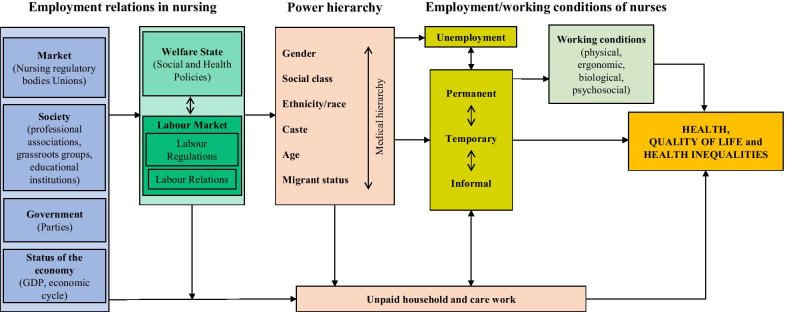
Background: Nurses and midwives play a critical role in the provision of care and the optimization of health services resources worldwide, which is particularly relevant during the current COVID-19 pandemic. However, they can only provide quality services if their work environment provides adequate conditions to support them. Today the employment and working conditions of many nurses worldwide are precarious, and the current pandemic has prompted more visibility to the vulnerability to health-damaging factors of nurses’ globally. This desk review explores how employment relations, and employment and working conditions may be negatively affecting the health of nurses in countries such as Brazil, Croatia, India, Ireland, Italy, México, Nepal, Spain, and the United Kingdom. Main body: Nurses’ health is influenced by the broader social, economic, and political system and the redistribution of power relations that creates new policies regarding the labour market and the welfare state. The vulnerability faced by nurses is heightened by gender inequalities, in addition to social class, ethnicity/race (and caste), age and migrant status, that are inequality axes that explain why nurses’ workers, and often their families, are exposed to multiple risks and/or poorer health. Before the COVID-19 pandemic, informalization of nurses’ employment and working conditions were unfair and harmed their health. During COVID-19 pandemic, there is evidence that the employment and working conditions of nurses are associated to poor physical and mental health. Conclusion: The protection of nurses’ health is paramount. International and national enforceable standards are needed, along with economic and health policies designed to substantially improve employment and working conditions for nurses and work–life balance. More knowledge is needed to understand the pathways and mechanisms on how precariousness might affect nurses’ health and monitor the progress towards nurses’ health equity.
Overview
The claims and statistics of this paper haven’t been checked yet.
Free: it reads the open-access text and checks the first 5 claims that cite a source we can check. Create a free account to check every claim.
Integrity signals
Registry
Cites
Statistics
Figures
Verification
Claims the paper makes
The claims and statistics of this paper haven’t been checked yet.
Free: it reads the open-access text and checks the first 5 claims that cite a source we can check. Create a free account to check every claim.
Claims other papers make about this one
Each is checked against this paper’s own text: does it say what the citing paper says it does?
The source backs part of the claim, not all of it — or backs it for a different population, condition or comparison.
In the citing paper
“Escalating this issue are high rates of absence and turnover, driven by an unprecedented level of physician and nurse burnout due to psychosocial stressors and occupational hazards such as exposure to infectious diseases, shiftwork, or ergonomic challenges, that place health care workers at risk for long-term mental and physical health consequences [6-9].”
From AI Interventions to Alleviate Healthcare Shortages and Enhance Work Conditions in Critical Care: Qualitative Analysis (2025) · cites this paper as [8]
Experimental — accuracy not yet measuredIn the citing paper
“Other vulnerable groups not identified in our review included the migrant HCWs who have been separated from their families since the start of pandemic and were unable to visit their country of origin due to travel or hospital administration restrictions [94].”
From A global overview of healthcare workers’ turnover intention amid COVID-19 pandemic: a systematic review with future directions (2022) · cites this paper as [94]
Self-check
Percentages, sums and reported differences re-computed from the paper’s own numbers.
The self-check needs the paper’s full text.
Citations
Cites
Pappa, S., Ntella, V., Giannakas, T., Giannakoulis, V. G., Papoutsi, E., & Katsaounou, P. (2020) · Brain Behavior and Immunity · doi:10.1016/j.bbi.2020.05.026 · Cited by 3,617 · cited 1×
“Moreover, this systematic review also found gender and occupational differences, where female and nurses had higher rates of affective symptoms [10].”
BackgroundNguyen, L. H., Drew, D. A., Graham, M. S., Joshi, A. D., Guo, C.-G., Ma, W., Mehta, R. S., Warner, E. T., Sikavi, D. R., Lo, C.-H., et al. (2020) · The Lancet Public Health · doi:10.1016/s2468-2667(20)30164-x · Cited by 2,395
The experiences of health-care providers during the COVID-19 crisis in China: a qualitative study
Liu, Q., Luo, D., Haase, J. E., Guo, Q., Wang, X. Q., Liu, S., Xia, L., Liu, Z., Yang, J., & Yang, B. X. (2020) · The Lancet Global Health · doi:10.1016/s2214-109x(20)30204-7 · Cited by 1,552 · cited 1×
“This responsibility has turned to be particularly relevant during the current COVID-19 pandemic, where nurses in the public and private sectors are leading COVID-19 care, testing, triage, and management [1], placing them to a unique position able to deal Open Access”
BackgroundFernandez, R., Lord, H., Halcomb, E., Moxham, L., Middleton, R., Alananzeh, I., & Ellwood, L. (2020) · International Journal of Nursing Studies · doi:10.1016/j.ijnurstu.2020.103637 · Cited by 728 · cited 4×
“During COVID-19 pandemic, nurses, as other healthcare workers, have been working longer hours and/or with different shift patterns, and nursing staff has been reassigned from other clinical areas to, for example, ICU [34], current employment and working conditions of nurses are associated to poor physical and mental i…”
BackgroundResultInfluentialThe neglected health of international migrant workers in the COVID-19 epidemic
Liem, A., Wang, C., Wariyanti, Y., Latkin, C. A., & Hall, B. J. (2020) · The Lancet Psychiatry · doi:10.1016/s2215-0366(20)30076-6 · Cited by 373 · cited 1×
“Countries are failing to evaluate and respond to the impact of COVID-19 on the physical and mental wellbeing of migrant workers [77] and data on SARS-CoV-2 infection and COVID-19 deaths in migrant nurses is not systematically collected.”
BackgroundMoss, M., Good, V. S., Gozal, D., Kleinpell, R., & Sessler, C. N. (2016) · American Journal of Respiratory and Critical Care Medicine · doi:10.1164/rccm.201604-0708st · Cited by 327 · cited 1×
“Under usual employment and working conditions, health care workers are known to be at risk for depression, stress, anxiety, burnout or insomnia [9].”
BackgroundMonitoring approaches for health-care workers during the COVID-19 pandemic
Bielicki, J. A., Duval, X., Gobat, N., Goossens, H., Koopmans, M., Tacconelli, E., & van der Werf, S. (2020) · The Lancet Infectious Diseases · doi:10.1016/s1473-3099(20)30458-8 · Cited by 315 · cited 15×
“For example, the country’s purchasing capacity, the availability of PPE or vaccine production capacities, and the international dispute over scarce health workers.”
BackgroundInfluentialRacial Disparities in COVID‐19 Mortality Among Essential Workers in the United States
Rogers, T. N., Rogers, C. R., VanSant‐Webb, E., Gu, L. Y., Yan, B., & Qeadan, F. (2020) · World Medical & Health Policy · doi:10.1002/wmh3.358 · Cited by 309 · cited 1×
“It has also been shown that Black workers were nearly three times more likely than White workers to hold support roles in health care, such as nurse aides or orderlies [73].”
BackgroundMoss, M., Good, V. S., Gozal, D., Kleinpell, R., & Sessler, C. N. (2016) · Chest · doi:10.1016/j.chest.2016.02.649 · Cited by 302
CARACTERISTICAS GERAIS DA ENFERMAGEM: O PERFIL SÓCIO DEMOGRÁFICO
Machado, M. H., Filho, W. A., De Lacerda, W. F., De Oliveira, E., Lemos, W., Wermelinger, M., Vieira, M., Dos Santos, M. R., Junior, P. B. D. S., Justino, E., et al. (2016) · Enfermagem em Foco · doi:10.21675/2357-707x.2016.v7.nesp.686 · Cited by 217 · cited 7×
“Evidence from countries in South Africa [20], Kenya, Tanzania and Uganda [21], Catalonia [17, 22], Brazil [23], Chile [24], Colombia [25], Mexico [26–28], and Thailand [29] show that employment and working conditions of nurses before this pandemic were already associated to poor physical and mental health, and in some…”
BackgroundInfluential
Research works printed but not linked: 5
- Julià Pérez M. Precarització de les condicions d'ocupació a la Unió Europea: Precarietat, informalitat, i associació amb la salut (Ph.D. Thesis). TDX (Tesis Doctorals en Xarxa). Universitat Pompeu Fabra; 2016 (cited 2020 Nov 26). http:// www. tdx. cat/ handle/ 10803/ 406084.
- Paudel S, Menge J. Under pressure: health care workers fighting at the frontlines in Nepal. The Friedrich-Ebert-Stiftung; 2020. https:// www. fes- asia. org/ news/ alrea dy-under-press ure-health-care-worke rs-fight ing-at- the-front lines-in-nepal/.
- The Guardian. Pregnant nurse's death adds to concern among health workers. the Guardian. 2020 (cited 2020 Nov 26); http:// www. thegu ardian. com/ world/ 2020/ apr/ 15/ pregn ant-healt hcare-worke rs-press ured- into-covid-19-front line.
- Baru RV. Privatisation of Health services: a South Asian perspective. Eco- nomic Political Weekly. 2003;38:4433-7.
- Sørensen A. Kvindefag i historisk skruetvinge: En analyse af tjenest- emandsreformens betydning for hierarkiet i offentlige lønninger fra 1969 til 2019. Copenhagen: Institut for Menneskerettigheder; 2020.
Cited by
Poon, Y.-S. R., Lin, Y. P., Griffiths, P., Yong, K. K., Seah, B., & Liaw, S. Y. (2022) · Human Resources for Health · doi:10.1186/s12960-022-00764-7 · Cited by 394
Bienefeld, N., Keller, E., & Grote, G. (2025) · Journal of Medical Internet Research · doi:10.2196/50852 · Cited by 91
Aloweni, F. B. A. B., Bouchoucha, S., Hutchinson, A. F., Ang, S. Y., Toh, H. X., Suhari, N. A. B., Sunari, R. N. B., & Lim, S. H. (2022) · Journal of Advanced Nursing · doi:10.1111/jan.15164 · Cited by 59
Smallwood, N., Bismark, M., & Willis, K. (2023) · BMJ Leader · doi:10.1136/leader-2022-000687 · Cited by 43
“13 19 Another major issue described by many HCWs was moral distress.”
BackgroundDavey, Z., Srikesavan, C. S., Cipriani, A., & Henshall, C. L. (2022) · Healthcare · doi:10.3390/healthcare10091674 · Cited by 43
The impact of COVID-19 on nurses’ job satisfaction: a systematic review and meta-analysis
Yasin, Y. M., Alomari, A. M. A., Al‐Hamad, A., & Kehyayan, V. (2024) · Frontiers in Public Health · doi:10.3389/fpubh.2023.1285101 · Cited by 50
“National policies regarding healthcare workers’ remuneration, workload, and support during the pandemic might have been different between different countries (43).”
BackgroundTaylor, C., Maben, J., Jagosh, J., Carrieri, D., Briscoe, S., Klepacz, N. A., & Mattick, K. L. (2024) · BMJ Quality & Safety · doi:10.1136/bmjqs-2023-016468 · Cited by 30
Mothupi, M. C., Dasgupta, J., Jebeli, S. S. H., Stevenson, J., Berdichevsky, K., Vong, S., Barasa, E., & George, A. S. (2023) · BMJ · doi:10.1136/bmj-2022-072243 · Cited by 37
Maben, J., Taylor, C., Jagosh, J., Carrieri, D., Briscoe, S., Klepacz, N. A., & Mattick, K. L. (2024) · Health and Social Care Delivery Research · doi:10.3310/twdu4109 · Cited by 41
Extending ageing nurses' working lives: A mixed‐methods systematic review
Nurmeksela, A., Välimäki, T. H., Kvist, T. A., Savolainen, H., Tahiraj, V., & Hult, M. (2023) · Journal of Advanced Nursing · doi:10.1111/jan.15569 · Cited by 29
Botezat, A., Încalțărău, C., & Nijkamp, P. J. (2023) · World Development · doi:10.1016/j.worlddev.2023.106445 · Cited by 26
Al‐Hammouri, M. M., & Rababah, J. A. (2022) · Journal of Clinical Nursing · doi:10.1111/jocn.16581 · Cited by 29
Tomaszewska, K., Majchrowicz, B., & Delong, M. (2022) · International Journal of Environmental Research and Public Health · doi:10.3390/ijerph19063555 · Cited by 18
“The services provided will only be of high quality if the work environment provides nurses with the right conditions to support them [16].”
BackgroundWork intensification and occupational fatigue on nurses: a cross-sectional and correlational study
Güngör, S., & Sönmez, B. (2025) · BMC Health Services Research · doi:10.1186/s12913-025-12325-4 · Cited by 22
Kuhlmann, E., Denis, J., Côté, N., Lotta, G., & Neri, S. (2023) · International Journal of Environmental Research and Public Health · doi:10.3390/ijerph20065035 · Cited by 19
Understanding key factors for strengthening Nepal’s healthcare needs: health systems perspectives
Dumka, N., Gurung, A., Hannah, E., Goel, S., & Kotwal, A. (2024) · Journal of Global Health Reports · doi:10.29392/001c.94931 · Cited by 32
Carnesten, H., Gustin, L. W., Skoglund, K., & Wågert, P. V. H. (2022) · Nursing Open · doi:10.1002/nop2.1250 · Cited by 21
Double-duty caregivers enduring COVID-19 pandemic to endemic: “It’s just wearing me down”
Parmar, J., L’Heureux, T., Lobchuk, M., Penner, J., Charles, L., St. Amant, O., Ward-Griffin, C., & Anderson, S. (2024) · PLOS ONE · doi:10.1371/journal.pone.0298584 · Cited by 11
Inequalities in COVID-19 inequalities research: Who had the capacity to respond?
Benach, J., Cash‐Gibson, L., Rojas‐Gualdrón, D. F., Padilla‐Pozo, Á., Fernández-Gracia, J., Eguı́luz, V. M., & the COVID-SHINE group (2022) · PLoS ONE · doi:10.1371/journal.pone.0266132 · Cited by 11
Self-citationHult, M., Kallio, H., Kangasniemi, M. K., Pesonen, T., & Kopra, J. (2023) · International Archives of Occupational and Environmental Health · doi:10.1007/s00420-023-02017-z · Cited by 20
“The challenges posed by the COVID-19 pandemic have further exacerbated the pre-existing issues (Matilla-Santander et al. 2021), affecting job quality and well-being within the care sector (Llop-Gironés et al. 2021), especially among young workers (Moreno Martínez et al. 2022).”
BackgroundRamos, W., Guerrero, N., Napanga-Saldaña, E. O., Medina, J., Loayza, M., Cruz-Vargas, J. A. D. L., de Vargas, M. E. O., Ibargüen, L. O., Seclén-Ubillús, Y., Álvarez-Antonio, C., et al. (2022) · Human Resources for Health · doi:10.1186/s12960-022-00787-0 · Cited by 15
van de Pas, R., Mans, L., & Koutsoumpa, M. (2023) · Human Resources for Health · doi:10.1186/s12960-023-00835-3 · Cited by 20
“Decent work will be important in the Covid-19 economic recovery [29] and applying a gender-equity lens remains highly pertinent [30].”
BackgroundPhysical working conditions over time: a repeated cross-sectional study in German employees
Beller, J., Graßhoff, J., & Safieddine, B. (2024) · Journal of Occupational Medicine and Toxicology · doi:10.1186/s12995-024-00423-8 · Cited by 13
“Certain occupational sectors such as healthcare and education, which often involve different physical working conditions compared to traditional industries, experienced especially pronounced growth [19].”
BackgroundCubelo, F., Turunen, H. E., & Jokiniemi, K. S. (2024) · Nursing Outlook · doi:10.1016/j.outlook.2024.102299 · Cited by 18
Eweida, R. S., Hamad, N. I., Abdelrahman, M. M., Shalhoub, A. A. B., Elsmalosy, M. F. A., Othman, A. A., & Atta, M. H. R. (2025) · International Nursing Review · doi:10.1111/inr.13090 · Cited by 12
Santini, S., Finco, M., & Galassi, F. (2022) · Sustainability · doi:10.3390/su14063540 · Cited by 10
Kapilashrami, A., & Aziz, R. (2023) · The International Journal of Health Planning and Management · doi:10.1002/hpm.3677 · Cited by 14
Benavente, P., Ronda, E., & Díaz, E. (2023) · International Journal for Equity in Health · doi:10.1186/s12939-023-02013-2 · Cited by 9
“For example, in nursing, it was reported that discrimination and racism at work were factors worsening health among migrants compared to native-born, which is consistent with our results [33].”
ResultPark, J., Wolfart, R., King, J., Sicam, A., & Viswesvaran, C. (2025) · Journal of Management & Organization · doi:10.1017/jmo.2025.10013 · Cited by 9
“Notably, nursing is one profession in which professionals are increasingly contemplating leaving the workplace (Llop-Gironés et al., 2021; Nagel et al., 2022; Zhu, Wang, Xu, Ma, & Luo, 2023), with more than 66% of nurses expressing a desire to leave their organization within three years (Ulrich,…”
Hult, M., Bosmans, K., Padrosa, E., Julià, M., Vos, M., Mikkonen, S. J., & Vanroelen, C. (2025) · European Journal of Work and Organizational Psychology · doi:10.1080/1359432x.2025.2517620 · Cited by 13
“Despite the increased burden on nurses during the COVID-19 pandemic (Llop-Gironés et al., 2021), their perceived job insecurity decreased (Bußmann & Pomorin, 2023).”
Self-citationThe impact of precarious employment on the commitment of registered nurses
Hult, M., & Ring, M. A. (2024) · International Nursing Review · doi:10.1111/inr.12945 · Cited by 13
Communication in interprofessional health care teams from the perspective of patients and staff
Erjavec, K., Knavs, N., & Bedenčič, K. (2022) · Journal of Health Sciences · doi:10.17532/jhsci.2022.1591 · Cited by 22
“This can be explained by the fact that nurses have gained importance and role in health care teams, health care organizations, and society in general, especially during the Covid-19 pandemic, when the health care system was forced to involve them in the co-management of the pandemic (39).”
BackgroundEthical Challenges to the Self-care of Nurses during the Covid-19 Pandemic
Manookian, A., Nayeri, N. D., Dashti, S., & Shahmari, M. (2023) · Nursing Ethics · doi:10.1177/09697330231180753 · Cited by 9
Duka, B., Dervishi, A., Grosha, E., Ivziku, D., Rocco, G., Stievano, A., & Notarnicola, I. (2025) · Nursing Reports · doi:10.3390/nursrep15020030 · Cited by 10
“The uneven distribution of nursing staff can drastically reduce access to care services and compromise the overall quality of healthcare services offered to the population [2].”
Ogungbe, O., Jabakhanji, S. B., Mehta, R., McCaffrey, J., Byrne, D., Hurley, S. M., Rosman, L. M., Bansah, E. C., Ibukun, F. A., Quarshie, I. A., et al. (2025) · BMC Health Services Research · doi:10.1186/s12913-025-12760-3 · Cited by 10
“32 Increased negative health behaviors, including smoking, alcohol use, and reduced physical activity, were also reported among healthcare workers.”
Condições de trabalho em enfermagem no enfrentamento da Covid-19 sob o prisma da precarização
de Magalhães, A. P. N., Souza, D. D. O., de Macêdo, F. P., Cruz, S. Â. F. D. S., Abagaro, C. P., & Flores, R. A. R. (2023) · Revista Brasileira de Enfermagem · doi:10.1590/0034-7167-2022-0679 · Cited by 11
“Regarding the precariousness of nursing working conditions during the pandemic, the study by Llop-Gironés et al. (11) system-atized a set of evidence from several countries, which allows us to get a sense of the process internationally.”
BackgroundManaging Talent Among Healthcare Human Resource: Strategies for a New Normal
Aggarwal, D., Chaturvedi, V., Ramachandran, A., & Singh, T. (2024) · Journal of Health Management · doi:10.1177/09720634231218769 · Cited by 9
“Burnout and stress related to work are the results of the enormous demands of extended work hours (Llop-Gironés et al., 2021).”
BackgroundOgbuabor, D. C., Ghasi, N. C., & Eneh, R. (2022) · AIMS Public Health · doi:10.3934/publichealth.2022050 · Cited by 5
“As was found elsewhere [19,20,29], nurses lacked personal protective equipment during the COVID-19 pandemic, which undermined their QWL.”
BackgroundResultInfluentialSouza, D. D. O., Santos, M. L. C., Santos, E. P. D. A., de Magalhães, A. P. N., & Cruz, S. Â. F. D. S. (2023) · Interface - Comunicação Saúde Educação · doi:10.1590/interface.230286 · Cited by 5
“However, Llop-Gironés et al. 1 warn that this number is underestimated because there are weaknesses in the information systems regarding nursing follow-up.”
BackgroundInfluentialEbrahimi, H., Rahmani, F., & Ghorbani, K. (2025) · BMC Psychology · doi:10.1186/s40359-025-02721-0 · Cited by 8
“Contract-employed nurses often face uncertainty regarding their job stability, which can contribute to increased stress and anxiety, especially during the COVID-19 pandemic [59].”
Nígenda, G., Servan-Mori, E. E., Aristizabal, P., Zárate-Grajales, R. A., Fajardo-Dolci, G., & Lozano, R. (2025) · Human Resources for Health · doi:10.1186/s12960-025-00975-8 · Cited by 5
“As mentioned before, labour precarisation also has severe expressions in other countries of the world [44– 47].”
Thapa, P. P., Giridharan, B., Khanal, J., & Adhikari, K. (2023) · MODERN ISSUES OF MEDICINE AND MANAGEMENT · doi:10.56580/geomedi24 · Cited by 5
Self-citationHealthcare workers’ survival in times of COVID-19: The need for social dialogue
García, A. B., Elgoibar, P., Medina, F. J., Munduate, L., & Euwema, M. (2022) · Revista Internacional de Organizaciones · doi:10.17345/rio29.35-55 · Cited by 5
“Several groups of healthcare workers, such as nurses and midwives do not have stable positions (Llop-Gironés et al., 2021) and working conditions have worsened over the course of the pandemic.”
BackgroundWorking conditions in COVID-19 hospital units: perceptions of nursing workers
Centenaro, A. P. F. C., de Andrade, A., Franco, G. P., Spagnolo, L. M. D. L., Cardoso, L. S., da Costa, M. C., Bonow, C. A., & da Silva, R. M. (2023) · Revista gaúcha de enfermagem · doi:10.1590/1983-1447.2023.20220007.en · Cited by 5
“This result differs from other studies with this population, in Brazil and other countries, which reported a situation contrary to that found in this research (3,14–16) .”
BackgroundResultInfluentialNurses’ professional competencies in urgency and emergency units: A mixed-methods study
Ferreira, K. M., Balsanelli, A. P., & dos Santos, J. L. G. (2023) · Revista Latino-Americana de Enfermagem · doi:10.1590/1518-8345.6554.3936 · Cited by 4
Quantifying Health Policy Uncertainty in China Using Newspapers: Text Mining Study
Chen, C., & Zhu, J. (2023) · Journal of Medical Internet Research · doi:10.2196/46589 · Cited by 4
“In the postpandemic era, health policies even have an impact on travel and employment [20-22], yet no studies have systematically constructed the HPU index to reflect HPU.”
Wang, Y., & Li, C. (2025) · Digital Health · doi:10.1177/20552076251326673 · Cited by 7
“10 This is related to their work in health care, 18 exposure to the motherhood penalty in the labor market, 19 and a greater burden of family caregivers, 20 which contribute to women ’ s to have higher levels of stress exposure than the male population.”
COVID-19 pandemic exacerbated food insecurity in South American countries
Neto, C. F. A. D. V., Jacob, M. C. M., Tregidgo, D., do Valle, D. R., Bizri, H. R. E., Gomes, S. M., Fa, J. E., Morcatty, T. Q., Monteiro, F. O. B., Scofield, A., et al. (2025) · Food Security · doi:10.1007/s12571-025-01538-4 · Cited by 7
“The increase in unemployment during the pandemic boosted informality and precariousness, and restriction and flexibility of laws and labour rights (Acevedo et al., 2021; Huang, 2022; Lima & Durán, 2021; Llop-Gironés et al., 2021; McNamara et al., 2021; Parwez, 2022).”
Erika, E. J. O., Blando, K., Grapa, K. A., Limon, J. E., Claraval, C. C. P., & Mangaoil, R. M. C. (2023) · Jurnal Keperawatan Respati Yogyakarta · doi:10.35842/jkry.v10i2.749 · Cited by 4
Wang, Y., Perera, S. C., Mangla, S. K., Han, L., & Song, M. (2024) · Production and Operations Management · doi:10.1177/10591478231224932 · Cited by 6
Simonovich, S. D., Bush, N. M., Wiesemann, L. M., & Piñeros-Leaño, M. (2022) · Journal of Obstetric, Gynecologic & Neonatal Nursing · doi:10.1016/j.jogn.2022.12.006 · Cited by 4
“FLA 5.6.0 DTD JOGN760_proof 24 January made their jobs riskier and affected their ability to provide patient care (Llop-Gironés et al., 2021).”
InfluentialBenavides, F. G., Utzet, M., Serra, C., Delano, P., García-Gómez, M., Ayala, A., Delclós, J., Ronda, E., López, V. G., & García, A. M. (2024) · Gaceta Sanitaria · doi:10.1016/j.gaceta.2024.102378 · Cited by 32
Addressing the COVID-19 Shock: The Potential Job Creation in China by the RCEP
Wu, X., Yong, C. C., & Lee, S. T. (2022) · International Journal of Environmental Research and Public Health · doi:10.3390/ijerph192315669 · Cited by 7
Palompon, D. R., Naranjo, M. A., Abalos, E. E., Omus, N., & Flores, P. J. A. (2024) · Belitung Nursing Journal · doi:10.33546/bnj.3349 · Cited by 7
“Nurses are a valuable workforce in the implementation of health services in the community (Chan et al., 2021; Llop-Gironés et al., 2021; Roush, 2020).”
BackgroundSouza, D. D. O., Santos, M. L. C., Santos, E. P. D. A., de Magalhães, A. P. N., & Cruz, S. Â. F. D. S. (2023) · Interface - Comunicação Saúde Educação · doi:10.1590/interface.230021 · Cited by 3
Health Workforce Talent Management in a Post-COVID-19 Digital Age
Aggarwal, D., Chaturvedi, V., & Ramachandran, A. (2022) · Advances in human and social aspects of technology book series · doi:10.4018/978-1-6684-5274-5.ch011 · Cited by 5
Kuhlmann, E., Ungureanu, M., Behrens, G. M. N., Cossmann, A., Fehr, L. M., Klawitter, S., Mikuteit, M., Müller, F., Thilo, N., Brînzac, M. G., et al. (2023) · Frontiers in Public Health · doi:10.3389/fpubh.2023.1152862 · Cited by 4
“The Canadian and Swedish studies and a few reports of international associations considered migrant HCWsmore explicitly (67, 77).”
BackgroundInfluentialAlevizos, A., Michail, M., Eleftheroglou, M., & Sidiropoulos, S. (2023) · HAPSc Policy Briefs Series · doi:10.12681/hapscpbs.35196 · Cited by 4
Maqsood, M. B., Ishaqui, A. A., Shaheen, S., Almutairi, S., Ahmad, S. A., Imran, M., Ahmed, Z., Farooq, J., Arab, M. A., & Akbar, Z. (2024) · Cureus · doi:10.7759/cureus.63263 · Cited by 4
“This is in line with a study's results that the vulnerability of nurses' health during COVID-19 was influenced by gender [28].”
ResultTukayo, I. J. H., Afzal, R., Korompis, M. D., Hardy, S., Kuswandari, S., & Maulana, D. (2022) · Journal of Public Health for Tropical and Coastal Region · doi:10.14710/jphtcr.v5i3.13719 · Cited by 2
Barriers driving health care disparities in utilization of age-appropriate screening
Keruakous, A. R., Soror, N., Jiménez, S., Ashley, R., Keruakous, M., & Sadek, B. T. (2023) · Frontiers in Public Health · doi:10.3389/fpubh.2023.1100466 · Cited by 2
Condições de trabalho em enfermagem no enfrentamento da Covid-19 sob o prisma da precarização
de Magalhães, A. P. N., Souza, D. D. O., de Macêdo, F. P., Cruz, S. Â. F. D. S., Abagaro, C. P., & Flores, R. A. R. (2023) · Revista Brasileira de Enfermagem · doi:10.1590/0034-7167-2022-0679pt · Cited by 2
Changes in nurses' work: A comparative study during the waves of COVID‐19 pandemic
Usberg, G., Clari, M., Conti, A., Põld, M., Kalda, R., & Kangasniemi, M. K. (2024) · International Journal of Nursing Practice · doi:10.1111/ijn.13250 · Cited by 1
Garcia‐Pereyra, F., Matute, J., & Argilés-Bosch, J. M. (2024) · Journal of Advanced Nursing · doi:10.1111/jan.16699 · Cited by 2
Piexak, D. R., Dallegrave, D., da Silva, K. A., Sarria, A. M., Gu, Y., & Barroso, T. M. M. D. D. A. (2025) · Journal of Integrative and Complementary Medicine · doi:10.1089/jicm.2024.0398 · Cited by 7
“20 This situation still prevails in several countries, as studies conducted in Taiwan and the United States show.”
Ma, C., Lan, H.-Y., Li, W.-P., & Chiang, H. (2025) · BMC Nursing · doi:10.1186/s12912-025-03323-2 · Cited by 4
Zakaria, M., Bardoe, D., Bio, R. B., Yar, D. D., & Hayford, D. (2025) · PLOS mental health. · doi:10.1371/journal.pmen.0000478 · Cited by 3
“Depending on the patient’s perceived condition, healthcare workers provide services to improve or maintain anatomical, physiological, and psychological function or, to a larger extent, obtain information about the health status and prognosis [2].”
Kim, M., & Chae, H.-J. (2022) · Korean journal of women health nursing/Yeoseong geon'gang ganho hag'hoeji/Yeoseong geon-gang ganho hakoeji · doi:10.4069/kjwhn.2022.08.22 · Cited by 2
Exploring the working conditions and performance of healthcare providers: The emerging market study
Attah, F. M., Akintola, A. I., Archibong, E. P., Bassey, U. A., Nwadike, N. C., Dan, F. A.-O., Ofem, N. O., Okpa, J. T., Abang, T. A., & Ajimase, A. A. (2023) · Corporate Governance and Organizational Behavior Review · doi:10.22495/cgobrv7i3p9 · Cited by 3
Interprofessional Education to Impact Professional Nursing Clinical Practice
Penrod, D., Whittington, K. D., & Blumenstock, E. (2024) · Medical Research Archives · doi:10.18103/mra.v12i1.5017 · Cited by 2
Bastani, P., Yusefi, A. R., Ahmadidarrehsima, S., & Mashayekhi, M. (2023) · The Open Public Health Journal · doi:10.2174/18749445-v16-230831-2023-41 · Cited by 2
Becene, I. A., Shah, A. H., Nguyen, K., West, M. L., Berrill, J., Stuart, J. J., Borba, C. P. C., & Rich-Edwards, J. W. (2024) · Annals of Work Exposures and Health · doi:10.1093/annweh/wxae026 · Cited by 3
Critical Race Studies and Intersectionality Responses to COVID-19
Zevallos, Z. (2024) · Springer eBooks · doi:10.1007/978-3-031-52227-7_13 · Cited by 3
Nursing competencies in aeromedical transport in the Brazilian Air Force: a descriptive study
Borges, L. L., Aguiar, B. G. C., Haberland, D. F., Guimarães, C. C. V., de Lima, R. A., & de Souza, B. B. S. (2024) · Revista da Escola de Enfermagem da USP · doi:10.1590/1980-220x-reeusp-2024-0129en · Cited by 2
“The results obtained indicate the predominance of female professionals, which reinforces the concept of nursing being carried out mainly by women, accounting for 89% of the profession, with variations between different regions of the world (8) .”
BackgroundTiga-Loza, D. C., Lucumi, A. M., Castro-Bernal, M. A., Escobar, Ó. J. V., Osorio, D. M. L., & Acosta, E. G. R. (2024) · Revista Latino-Americana de Enfermagem · doi:10.1590/1518-8345.7337.4392 · Cited by 6
Tiga-Loza, D. C., Lucumi, A. M., Castro-Bernal, M. A., Escobar, Ó. J. V., Osorio, D. M. L., & Acosta, E. G. R. (2024) · Revista Latino-Americana de Enfermagem · doi:10.1590/1518-8345.7337.4393 · Cited by 4
Woo, J., Shook, J. J., Tillman, H., Vang, H., & Goodkind, S. A. (2025) · Labor Studies Journal · doi:10.1177/0160449x251370759 · Cited by 2
“Nurses, along with service and technical hospital workers, are integral to delivering both direct and indirect care; however, their ability to provide high-quality care depends on a work environment that offers suf fi cient support and appropriate conditions (Llop-Gironés et al., 2021).”
The Status Related to Migration and Working Conditions of Nurses Who Migrated from Türkiye
Duran, I., & Altuntaş, S. (2025) · Ordu Üniversitesi Hemşirelik Çalışmaları Dergisi · doi:10.38108/ouhcd.1406120 · Cited by 4
Durand-Moreau, Q. V. (2022) · Canadian Journal of Public Health · doi:10.17269/s41997-022-00645-5 · Cited by 2
Murphy, G. T., Puertas, E. B., Rigby, J. A., & Gladbach, K. (2023) · Revista Panamericana de Salud Pública · doi:10.26633/rpsp.2023.6 · Cited by 2
“The literature provided support for many strategies, including strengthening leadership and governance for HRH (13-15, 23-24), strengthening HRH for primary health care, as primary health care is critical to universal health coverage (9, 14, 25, 26), retention and recruitment, particularly for rural areas (5), trainin…”
BackgroundMontes-Orozco, E., Mora-Gutiérrez, R. A., de-los-Cobos-Silva, S. G., Bernal-Jaquez, R., Rincón-García, E. A., Andrade, M. Á. G., & Lara-Velázquez, P. (2023) · Complexity · doi:10.1155/2023/9011738 · Cited by 2
Ferreira, K. M., Balsanelli, A. P., & dos Santos, J. L. G. (2023) · Revista Latino-Americana de Enfermagem · doi:10.1590/1518-8345.6554.3937 · Cited by 2
Babilonia, L. H., Escobar, Á. E. S., & Núñez, W. A. N. (2023) · Investigación e Innovación en Ingenierías · doi:10.17081/invinno.11.1.6578 · Cited by 2
Martínez‐Rodríguez, A., Martínez‐Faneca, L., & Fabrellas, N. (2023) · Nursing Inquiry · doi:10.1111/nin.12579 · Cited by 2
RESILIENCE AND WELL-BEING AMONG NURSES IN SELECTED HOSPITALS, KATHMANDU
Prajapati, R., Rana, H., Palladino, F. P., & Thapa, P. P. (2024) · Journal of Healthcare Management and Leadership · doi:10.35345/johmal.1297216 · Cited by 3
Self-citationClosser, S., Cooney, E. E., Atkins, K., Park, S., Fritz, H., Schneider-Firestone, S., & Veenema, T. G. (2024) · Social Science & Medicine · doi:10.1016/j.socscimed.2024.117463 · Cited by 1
Tiga-Loza, D. C., Lucumi, A. M., Castro-Bernal, M. A., Escobar, Ó. J. V., Osorio, D. M. L., & Acosta, E. G. R. (2024) · Revista Latino-Americana de Enfermagem · doi:10.1590/1518-8345.7337.4391 · Cited by 5
Regulation of Working Time in the Context of the Global Transition to Flexible Forms of Work
Yaroshenko, O. M., Getman, A. P., Nazymko, Y. S., Tkachenko, V. S., & Lutsenko, О. Y. (2024) · Science of law. · doi:10.55284/sol.v2024i4.149 · Cited by 1
López-Millán, B., Benavides, F. G., Ramada, J. M., Serra, C., Serra, L., & Utzet, M. (2025) · La Medicina del Lavoro · doi:10.23749/mdl.v116i1.16525 · Cited by 1
Fatima, S., Brenisin, K., Bayo-Idowu, E., Trumm, A., & Breen, K. C. (2025) · The Journal of Mental Health Training Education and Practice · doi:10.1108/jmhtep-10-2024-0111 · Cited by 1
Understanding recent dynamics: prosperity and longevity in Ghana
Sirin, U. A.-A., Anafo, R., Onumah, E. E., Mohammed, J., & Ussif, R. (2026) · Health Economics Review · doi:10.1186/s13561-026-00716-0 · Cited by 1
“Deaton [35] argues diminishing returns in high-income settings [35, 65], but in Ghana, inequality amplifies this: Kawachi et al. [57] and Schenkman & Bousquat [90] show income disparities harm lower-income groups even amid growth.”
Escrig-Piñol, A., Padrosa, E., Nuñez-Doyle, A., Rodríguez‐Monforte, M., Pedreira‐Robles, G., McGilton, K. S., Alcover, C., Allaoui, I., Margañón, R. A., Álvarez, E. C., et al. (2026) · BMJ Open · doi:10.1136/bmjopen-2025-106920 · Cited by 1
“17 However, expanding the number of nursing students creates structural challenges, 5 17 as they must be mentored by a workforce that is already overburdened, 18 has a history of suboptimal working conditions 13 19 and faces limited recognition of the CM role.”
Cırık, V. A., Bulut, E., & Kahrıman, İ. (2022) · Journal of Pediatric Nursing · doi:10.1016/j.pedn.2022.07.006 · Cited by 2
Ferreira, K. M., Balsanelli, A. P., & dos Santos, J. L. G. (2023) · Revista Latino-Americana de Enfermagem · doi:10.1590/1518-8345.6554.3935 · Cited by 1
“The results obtained indicate predominance of the female gender, strengthening the concept that Nursing is a profession mostly developed by women, representing 89% of the profession’s workforce, with variations between regions of the world(17) and mostly young people with a mean age of 37.”
BackgroundCondições de trabalho em unidades hospitalares COVID-19: percepções de trabalhadores de enfermagem
Centenaro, A. P. F. C., de Andrade, A., Franco, G. P., Spagnolo, L. M. D. L., Cardoso, L. S., da Costa, M. C., Bonow, C. A., & da Silva, R. M. (2023) · Revista gaúcha de enfermagem · doi:10.1590/1983-1447.2023.20220007.pt · Cited by 1
Modelo de bienestar en salud, insatisfacción y estrés laboral en enfermería ante el COVID-19
González-Sánchez, D. L., López-Ramos, M. D. J., Lara-Esquivel, E. C., Cruz-Zúñiga, N., & Armenta-Rojas, E. (2023) · Horizon Interdisciplinary Journal · doi:10.56935/hij.v1i1.1 · Cited by 2
Healthy Markets or Health Equity?: Neoliberalism and the Rationing of Health Care in Australia
O’Keeffe, P. (2024) · Springer eBooks · doi:10.1007/978-981-97-1144-4_9 · Cited by 1
Mishra, A., & Santosh, S. (2024) · Indian Journal of Medical Ethics · doi:10.20529/ijme.2024.019 · Cited by 1
Bulcão, C. D. S., Miranda, L. D. S. O., Joaquim, J. D. S., Carvalho, K. M. D. O., Sant’Ana, R. S. E., Machuca‐Contreras, F., Silva, G. W. D. S., Araujo, J. S., de Almeida, L. C. G., & de Sousa, A. R. (2024) · Enfermagem em Foco · doi:10.21675/2357-707x.2024.v15.e-202415supl2 · Cited by 1
Ariasari, A. N., & Tjahjono, H. K. (2024) · Society · doi:10.33019/society.v12i2.703 · Cited by 19
“Working conditions also experienced a surge from 2021 to 2023 due to the effects of the pandemic on the environment and workplace policies (Llop-Gironés et al., 2021).”
Metadata
- Authors
- Llop-Gironés, A., Vračar, A., Llop-Gironés, G., Benach, J., Angeli-Silva, L., Jaimez, L., Thapa, P., Bhatta, R., Mahindrakar, S., Bontempo Scavo, S., Nar Devi, S., Barria, S., Marcos Alonso, S., & Julià, M.
- Affiliations
- Johns Hopkins University (US)
- Universitat Pompeu Fabra (ES)
- Corresponding author
- Llop-Gironés, Gisela
- ORCID
- Venue
- Human Resources for Health
- Published
- 2021-09-16
- Volume
- 19
- Issue
- 1
- Pages
- 112-112
- ISSN
- 1478-4491 (ISSN-L)
- PMC
- PMC8444178
- OpenAlex
- W3200721359
- Cited by
- 140
- References
- 60
- Citations by year
- 2026: 12 · 2025: 24 · 2024: 37 · 2023: 45 · 2022: 22
- FWCI
- 5.36
- Type
- journal article
- Language
- en
- Open access
- gold
- doi.org
- Licence
- cc-by
- creativecommons.org/licenses/by/4.0 (tdm)
- creativecommons.org/licenses/by/4.0 (vor)
- Locations
- Human Resources for Health (publishedVersion, cc-by)
- Europe PMC (PubMed Central) (publishedVersion, other-oa)
- PubMed Central (publishedVersion, cc-by)
- PubMed (publishedVersion)
- Dipòsit Digital de Documents de la UAB (Universitat Autònoma de Barcelona) (submittedVersion, cc-by)
- DOAJ (DOAJ: Directory of Open Access Journals) (submittedVersion, cc-by-sa)
- Repositori digital de la UPF (Universitat Pompeu Fabra) (submittedVersion, cc-by)
- Topics
- Health Sciences › Health Professions › General Health Professions › Healthcare Systems and Challenges
- Health Sciences › Medicine › Public Health, Environmental and Occupational Health › Occupational Health and Burnout
- Health Sciences › Medicine › Public Health, Environmental and Occupational Health › Employment and Welfare Studies
- Keywords
- working conditions, health disparities, COVID-19 pandemic, precarious employment, nurses' health, mental health, physical health, gender inequality, caste, migrant status, work-life balance, health equity, labour market policy, welfare state
- MeSH terms
- COVID-19, SARS-CoV-2, Employment, Humans, Nurses, Health Status Disparities, Pandemics
About these checks
Registry, retraction, Cites and statistics results are computed, not judged, with one exception: a printed reference that no index lists is read once by a model before it counts as a citation error. Claims are extracted by a model and kept only when their quote appears verbatim in the text; each cited source is then checked, with a model’s help, for whether it says what the claim relies on. Those verdicts can be wrong — read the claim’s quote and the cited source before relying on one.
Statistics and arithmetic are recomputed, not judged.
Confidence bands are shown only for fields calibrated on our annotated test set. None is calibrated yet, so no band is shown.
What counts as a claim ›How we measure confidence ›How we check this ›
Are you an author, or do you see a problem with this page? Request a review
Data sources
Bibliographic data: Semantic Scholar, OpenAlex, Crossref.
Contains information from the Semantic Scholar Academic Graph Datasets, made available under the ODC Attribution License (ODC-BY 1.0).
Semantic Scholar’s data is described in: Kinney, R., et al. (2023). The Semantic Scholar Open Data Platform. arXiv:2301.10140.
