

A novel conceptual model and heuristic tool to strengthen understanding and capacities for health inequalities research
Open accessThe DOI matches its Crossref record; 88 of the 90 references it cites were found in a registry or an index.
Abstract
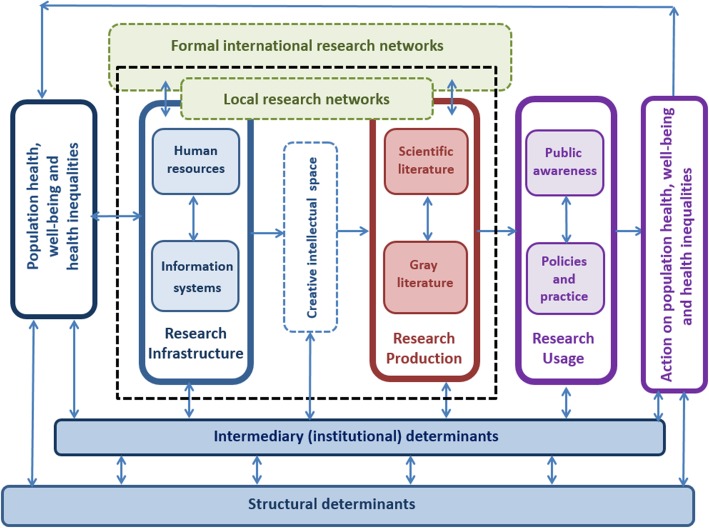
Background: Despite increasing evidence on health inequalities over the past decades, further efforts to strengthen capacities to produce research on this topic are still urgently needed to inform effective interventions aiming to address these inequalities. To strengthen these research capacities, an initial comprehensive understanding of the health inequalities research production process is vital. However, most existing research and models are focused on understanding the relationship between health inequalities research and policy, with less focus on the health inequalities research production process itself. Existing conceptual frameworks provide valuable, yet limited, advancements on this topic; for example, they lack the capacity to comprehensively explain the health (and more specifically the health inequalities) research production process at the local level, including the potential pathways, components and determinants as well as the dynamics that might be involved. This therefore reduces their ability to be empirically tested and to provide practical guidance on how to strengthen the health inequalities research process and research capacities in different settings. Several scholars have also highlighted the need for further understanding and guidance in this area to inform effective action. Methods: Through a critical review, we developed a novel conceptual model that integrates the social determinants of health and political economy perspectives to provide a comprehensive understanding of how health inequalities research and the related research capacities are likely to be produced (or inhibited) at local level. Results: Our model represents a global hypothesis on the fundamental processes involved, and can serve as a heuristic tool to guide local level assessments of the determinants, dynamics and relations that might be relevant to better understand the health inequalities research production process and the related research capacities. Conclusions: This type of knowledge can assist researchers and decision-makers to identify any information gaps or barriers to be addressed, and establish new entry points to effectively strengthen these research capacities. This can lead to the production of a stronger evidence base, both locally and globally, which can be used to inform strategic efforts aimed at achieving health equity.
Overview
The claims and statistics of this paper haven’t been checked yet.
Free: it reads the open-access text and checks the first 5 claims that cite a source we can check. Create a free account to check every claim.
Integrity signals
Registry
Cites
Statistics
Figures
Verification
Claims the paper makes
The claims and statistics of this paper haven’t been checked yet.
Free: it reads the open-access text and checks the first 5 claims that cite a source we can check. Create a free account to check every claim.
Claims other papers make about this one
Each is checked against this paper’s own text: does it say what the citing paper says it does?
The cited source says what the claim attributes to it.
In the citing paper
“In this context, the structural determinants of health-underlying structures and mechanisms that establish, maintain, or eliminate hierarchical advantages within social groups regarding health-reflect these power dynamics.”
From Bridging Sectors and Disciplines to Gain a Critical Understanding of the Eco-Social Determinants of Health Inequities: The ESDHI-EU Conference (2025) · cites this paper as [10]
The cited source says what the claim attributes to it.
In the citing paper
“Therefore, focusing on power as an underlying cause of health inequities shifts the analysis beyond static, fixed realities and emphasizes the importance of power dynamics (9, 10).”
From Bridging Sectors and Disciplines to Gain a Critical Understanding of the Eco-Social Determinants of Health Inequities: The ESDHI-EU Conference (2025) · cites this paper as [10]
Self-check
Percentages, sums and reported differences re-computed from the paper’s own numbers.
The self-check needs the paper’s full text.
Citations
Cites
A typology of reviews: an analysis of 14 review types and associated methodologies
Grant, M. J., & Booth, A. (2009) · Health Information & Libraries Journal · doi:10.1111/j.1471-1842.2009.00848.x · Cited by 10,817
Powers, C. H., & Giddens, A. (1988) · Social Forces · doi:10.2307/2579442 · Cited by 8,828
Closing the gap in a generation: health equity through action on the social determinants of health
Marmot, M., Friel, S., Bell, R., Houweling, T. A., & Taylor, S. (2008) · The Lancet · doi:10.1016/s0140-6736(08)61690-6 · Cited by 3,247
The Unanticipated Consequences of Purposive Social Action
Merton, R. K. (1936) · American Sociological Review · doi:10.2307/2084615 · Cited by 2,520
Theories for social epidemiology in the 21st century: An ecosocial perspective
Krieger, N. (2001) · International Journal of Epidemiology · doi:10.1093/ije/30.4.668 · Cited by 2,155
Southern Theory: The global dynamics of knowledge in social science
Connell, R. W. (2007) · Cited by 2,034
Gama e Colombo, D. (2010) · Revista de Direito Sanitário · doi:10.11606/issn.2316-9044.v10i3p253-266 · Cited by 1,788
Stokols, D., Hall, K. L., Taylor, B. K., & Moser, R. P. (2008) · American Journal of Preventive Medicine · doi:10.1016/j.amepre.2008.05.002 · Cited by 753
3 Epistemologies of the South: Justice Against Epistemicide
Sousa Santos, B. D. (2024) · Foundational Concepts of Decolonial and Southern Epistemologies · doi:10.21832/9781800418868-007 · Cited by 741
The political origins of health inequity: prospects for change
Ottersen, O. P., Dasgupta, J., Blouin, C., Buss, P., Chongsuvivatwong, V., Frenk, J., Fukuda-Parr, S., Gawanas, B. P., Giacaman, R., Gyapong, J., et al. (2014) · The Lancet · doi:10.1016/s0140-6736(13)62407-1 · Cited by 683
Røttingen, J.-A., Regmi, S., Eide, M., Young, A. J., Viergever, R. F., Årdal, C., Guzman, J., Edwards, D., Matlin, S. A., & Terry, R. F. (2013) · The Lancet · doi:10.1016/s0140-6736(13)61046-6 · Cited by 477 · cited 1×
“and micro level, across time, are also pending issues in many countries [5, 55, 56].”
BackgroundFranzen, S. R. P., Chandler, C., & Lang, T. (2017) · BMJ Open · doi:10.1136/bmjopen-2016-012332 · Cited by 410 · cited 2×
“Yet, the political determinants of health and HI have been largely neglected and marginalised from mainstream public health debate and analyses [31, 34, 72, 84], this includes an absence of questions related to politics and power dynamics within and between societies and countries [44].”
BackgroundBambra, C., Fox, D., & Scott-Samuel, A. (2005) · Health Promotion International · doi:10.1093/heapro/dah608 · Cited by 392
Building capacity in health research in the developing world.
Lansang, M. A., & Dennis, R. (2004) · Europe PMC (PubMed Central) · Cited by 376
Theorising Inequalities in Health: The Place of Lay Knowledge
Popay, J., Williams, G., Thomas, C., & Gatrell, T. (1998) · Sociology of Health & Illness · doi:10.1111/1467-9566.00122 · Cited by 320
Gkiouleka, A., Huijts, T., Beckfield, J., & Bambra, C. (2018) · Social Science & Medicine · doi:10.1016/j.socscimed.2018.01.025 · Cited by 319
Schrecker, T., & Bambra, C. (2015) · Palgrave Macmillan UK eBooks · doi:10.1057/9781137463074 · Cited by 295
Challenging inequities in health: from ethics to action
Braveman, P. (2002) · Europe PMC (PubMed Central) · doi:10.1590/s0042-96862002000200015 · Cited by 273
Knowledge for better health: a conceptual framework and foundation for health research systems.
Pang, T., Sadana, R., Hanney, S., Bhutta, Z. A., Hyder, A. A., & Simon, J. L. (2003) · Europe PMC (PubMed Central) · Cited by 240
Research capacity strengthening in the South
Nchinda, T. C. (2002) · Social Science & Medicine · doi:10.1016/s0277-9536(01)00338-0 · Cited by 236
Inequalities in global health inequalities research: A 50-year bibliometric analysis (1966-2015)
Cash-Gibson, L., Rojas-Gualdrón, D. F., Pericàs, J. M., & Benach, J. (2018) · PLOS ONE · doi:10.1371/journal.pone.0191901 · Cited by 215 · cited 4×
“and micro level, across time, are also pending issues in many countries [5, 55, 56].”
BackgroundInfluentialSelf-citationResearch capacity building—obligations for global health partners
Beran, D., Byass, P., Gbakima, A. A., Kahn, K., Sankoh, O. A., Tollman, S. M., Witham, M. D., & Davies, J. I. (2017) · The Lancet Global Health · doi:10.1016/s2214-109x(17)30180-8 · Cited by 168
Sitthi-amorn, C. (2000) · BMJ · doi:10.1136/bmj.321.7264.813 · Cited by 161 · cited 2×
“However, there are also concerns that, as unanticipated consequences, these new research environments can potentially create research dependence, “intellectual colonialism” [70, 91, 92] and/or establish parallel structures that bypass domestic research systems [15, 22], which can restrict and/or erode local sovereignt…”
BackgroundResearch relationships between the South and the North: Cinderella and the ugly sisters?
Jentsch, B., & Pilley, C. (2003) · Social Science & Medicine · doi:10.1016/s0277-9536(03)00060-1 · Cited by 161
Diffusion of Ideas on Social Inequalities in Health: A European Perspective
Whitehead, M. (1998) · The Milbank Quarterly · doi:10.1111/1468-0009.00099 · Cited by 161
Building the Field of Health Policy and Systems Research: An Agenda for Action
Bennett, S., Agyepong, I. A., Sheikh, K., Hanson, K., Ssengooba, F., & Gilson, L. (2011) · PLoS Medicine · doi:10.1371/journal.pmed.1001081 · Cited by 159
Birn, A.-E., Pillay, Y., & Holtz, T. H. (2017) · doi:10.1093/acprof:oso/9780199392285.001.0001 · Cited by 157
How politics makes us sick: neoliberal epidemics
(2016) · Choice Reviews Online · doi:10.5860/choice.194207 · Cited by 149
Health inequalities: critical perspectives
O’Keefe, E. (2016) · Journal of Public Health · doi:10.1093/pubmed/fdw118 · Cited by 144
Evaluation of Health in All Policies: concept, theory and application
Baum, F., Lawless, A., Delany, T., Macdougall, C., Williams, C., Broderick, D., Wildgoose, D., Harris, E., Mcdermott, D., Kickbusch, I., et al. (2014) · Health Promotion International · doi:10.1093/heapro/dau032 · Cited by 143
Beyond two communities – from research utilization and knowledge translation to co-production?
Wehrens, R. (2014) · Public Health · doi:10.1016/j.puhe.2014.02.004 · Cited by 136 · cited 1×
“However, this perspective takes a linear view on how health or HI research is produced, disseminated and incorporated into policy and practice to improve health and well-being [8, 80].”
BackgroundHarris, M., Marti, J., Watt, H., Bhatti, Y., Macinko, J., & Darzi, A. W. (2017) · Health Affairs · doi:10.1377/hlthaff.2017.0773 · Cited by 119
Self-citationHealth Inequalities: Critical Perspectives
(2015) · DigitalGeorgetown (Georgetown University Library) · doi:10.1093/acprof:oso/9780198703358.001.0001 · Cited by 118 · cited 2×
“For example, this has been highlighted in the case of the United Kingdom over various historical and political periods [8, 75, 81, 87].”
BackgroundPriorities for Research on Equity and Health: Towards an Equity-Focused Health Research Agenda
Östlin, P., Schrecker, T., Sadana, R., Bonnefoy, J., Gilson, L., Hertzman, C., Kelly, M. P., Kjellstrom, T., Labonté, R., Lundberg, O., et al. (2011) · PLoS Medicine · doi:10.1371/journal.pmed.1001115 · Cited by 116
Walsh, A., Brugha, R., & Byrne, E. (2016) · International Journal for Equity in Health · doi:10.1186/s12939-016-0488-4 · Cited by 112
Philosophical Problems with Social Research on Health Inequalities
Wainwright, S. P., & Forbes, A. (2000) · Health Care Analysis · doi:10.1023/a:1009479515070 · Cited by 110
Gill, S. R., & Benatar, S. R. (2016) · International Journal of Health Services · doi:10.1177/0020731416631734 · Cited by 106
Research for universal health coverage: World health report 2013
Harries, A. D., Lienhardt, C., Dye, C., Evans, D., McManus, J., Terry, R. F., Zachariah, R., Boerma, T., & Pang, T. (2015) · Cited by 99
Strengthening health information systems to address health equity challenges.
Nolen, L. B., Braveman, P., Dachs, J. N. W., Delgado, I., Gakidou, E. E., Moser, K. A., Rolfe, L., Vega, J., & Zarowsky, C. (2005) · Europe PMC (PubMed Central) · Cited by 92
Measuring the bias against low-income country research: an Implicit Association Test
Harris, M., Macinko, J., Jimenez, G., & Mullachery, P. (2017) · Globalization and Health · doi:10.1186/s12992-017-0304-y · Cited by 91
Self-citationHealth Divides. Where you live can kill you
Baum, F. (2017) · International Journal of Epidemiology · doi:10.1093/ije/dyx111 · Cited by 84
Changing Mindsets: Research Capacity strengthening in low and middle-income countries
Ghaffar, A., IJsselmuiden, C., & Zicker, F. (2008) · Cited by 80
Kok, M. O., Gyapong, J. O., Wolffers, I., Ofori‐Adjei, D., & Ruitenberg, E. J. (2017) · Health Research Policy and Systems · doi:10.1186/s12961-017-0251-3 · Cited by 79
Assessing the state of health research in the Eastern Mediterranean Region
Ismail, S., McDonald, A., Dubois, E., Aljohani, F. A., Coutts, A. P., Majeed, A., & Rawaf, S. (2013) · Journal of the Royal Society of Medicine · doi:10.1258/jrsm.2012.120240 · Cited by 76
The silencing of political context in health research in Ethiopia: why it should be a concern
Østebø, M. T., Cogburn, M. D., & Mandani, A. S. (2018) · Health Policy and Planning · doi:10.1093/heapol/czx150 · Cited by 76
Ethical Dimensions of Health Equity
PETER, F., & EVANS, T. (2001) · Challenging Inequities in Health · doi:10.1093/acprof:oso/9780195137408.003.0003 · Cited by 74 · cited 1×
“These processes, which are generated and maintained by “unjust social arrangements” [2], then become embodied by individuals, and can lead to avoidable and unfair systematic differences in health, within and between communities and countries (i.”
BackgroundPolitics and health: a neglected area of research
Navarro, V. (2008) · European Journal of Public Health · doi:10.1093/eurpub/ckn040 · Cited by 74
Atkins, S. A., Marsden, S., Diwan, V., Zwarenstein, M., & for the ARCADE consortium (2016) · Global Health Action · doi:10.3402/gha.v9.30524 · Cited by 70
Health Equity in a Globalizing Era
Labonté, R., & Rückert, A. (2019) · doi:10.1093/oso/9780198835356.001.0001 · Cited by 70
Harris, M. J., Macinko, J. A., Jimenez, G., Mahfoud, M., & Anderson, C. (2015) · BMJ Open · doi:10.1136/bmjopen-2015-008993 · Cited by 65
Self-citationD’Souza, C., & Sadana, R. (2005) · Social Science & Medicine · doi:10.1016/j.socscimed.2005.08.022 · Cited by 64 · cited 1×
“gets supported (or not), where and by whom, as well as the ‘appropriateness’ of the research frame used, often in line with certain ideologies [32, 33, 47, 52, 69, 70].”
BackgroundPeralta, A., Benach, J., Borrell, C., Espinel-Flores, V., Cash‐Gibson, L., Queiroz, B. L., & Marí-Dell’Olmo, M. (2019) · Population Health Metrics · doi:10.1186/s12963-019-0183-y · Cited by 58
Self-citationHealth intersectoralism in the Sustainable Development Goal era: from theory to practice
Hussain, S., Javadi, D., Andrey, J., Ghaffar, A., & Labonté, R. (2020) · Globalization and Health · doi:10.1186/s12992-020-0543-1 · Cited by 58
The emergence and current performance of a health research system: lessons from Guinea Bissau
Kok, M. O., Rodrigues, A., Silva, A. P., & de Haan, S. (2012) · Health Research Policy and Systems · doi:10.1186/1478-4505-10-5 · Cited by 55
Rethinking health research capacity strengthening
Vasquez, E. E., Hirsch, J. S., Giang, L. M., & Parker, R. G. (2013) · Global Public Health · doi:10.1080/17441692.2013.786117 · Cited by 52
Building Sustainable Local Capacity for Global Health Research in West Africa
Sam-Agudu, N. A., Paintsil, E., Aliyu, M. H., Kwara, A., Ogunsola, F. T., Afrane, Y. A., Onoka, C. A., Awandare, G. A., Amponsah, G., Cornelius, L. J., et al. (2017) · Annals of Global Health · doi:10.1016/j.aogh.2016.10.011 · Cited by 51
Tugwell, P., Sitthi‐Amorn, C., Hatcher-Roberts, J., Neufeld, V. R., MAKARA, P., Munoz, F., Czerny, P., Robinson, V. A., Nuyens, Y., & Okello, D. (2006) · BMC Public Health · doi:10.1186/1471-2458-6-151 · Cited by 50
Cash‐Gibson, L., Guerra, G., & Salgado-de-Snyder, V. N. (2015) · Health Research Policy and Systems · doi:10.1186/s12961-015-0048-1 · Cited by 50
Self-citationPolitical economy analysis for health
Reich, M. R. (2019) · Bulletin of the World Health Organization · doi:10.2471/blt.19.238311 · Cited by 49
National health research systems in the WHO African Region: current status and the way forward
Kirigia, J. M., Ota, M. O., Motari, M., Bataringaya, J. E., & Mouhouelo, P. (2015) · Health Research Policy and Systems · doi:10.1186/s12961-015-0054-3 · Cited by 48
Health Divides: where you live can kill you
Bambra, C. L. (2016) · Project Muse (Johns Hopkins University) · doi:10.25405/ncl.34294884 · Cited by 48
Trostle, J., & Simon, J. L. (1992) · Social Science & Medicine · doi:10.1016/0277-9536(92)90041-n · Cited by 47 · cited 3×
“However, there are also concerns that, as unanticipated consequences, these new research environments can potentially create research dependence, “intellectual colonialism” [70, 91, 92] and/or establish parallel structures that bypass domestic research systems [15, 22], which can restrict and/or erode local sovereignt…”
BackgroundMuntaner, C., Chung, H., Murphy, K., & Ng, E. (2012) · Journal of Urban Health · doi:10.1007/s11524-012-9699-1 · Cited by 45
Tagoe, N., Molyneux, S. C., Pulford, J., Murunga, V. I., & Kinyanjui, S. (2019) · BMJ Global Health · doi:10.1136/bmjgh-2018-001318 · Cited by 43
Social Inequalities in health: Challenges, knowledge gaps, key debates and the need for new data
Eikemo, T. A., & Øversveen, E. (2019) · Scandinavian Journal of Public Health · doi:10.1177/1403494819866416 · Cited by 38
Sombié, I., Aidam, J., Konaté, B., Some, T., & Kambou, S. S. (2013) · Health Research Policy and Systems · doi:10.1186/1478-4505-11-35 · Cited by 36
Hofman, K. J., Blomstedt, Y., Addei, S., Kalage, R. E., Maredza, M., Sankoh, O. A., Bangha, M. W., Kahn, K., Becher, H., Haafkens, J. A., et al. (2013) · Global Health Action · doi:10.3402/gha.v6i0.19668 · Cited by 33
Neoliberalism and health inequalities
Collins, C., McCartney, G., & Garnham, L. M. (2015) · Oxford University Press eBooks · doi:10.1093/acprof:oso/9780198703358.003.0009 · Cited by 33 · cited 1×
“global political determinants, that impact on health and HI [6, 78].”
BackgroundMapping of capacities for research on health and its social determinants in Brazil
Borde, E., Akerman, M., & Filho, A. P. (2014) · Cadernos de Saúde Pública · doi:10.1590/0102-311x00162513 · Cited by 29
Guerra, G., Borde, E., & de Snyder, V. N. S. (2016) · International Journal for Equity in Health · doi:10.1186/s12939-016-0297-9 · Cited by 29
Self-citationAuthorities and Partisans: The Debate on Unemployment and Health
Bartley, M. (1993) · Cited by 28
Poor Health: Social Inequality before and after the Black Report
Dale, P. (2005) · Social History of Medicine · doi:10.1093/shm/hki057 · Cited by 28
(2013) · Routledge eBooks · doi:10.4324/9781315039305 · Cited by 28
Sadana, R., & Pang, T. (2004) · Ciência & Saúde Coletiva · doi:10.1590/s1413-81232004000200012 · Cited by 27
Ichoku, H. E., MOONEY, G. H., & Ataguba, J. E.-O. (2013) · International Journal of Health Services · doi:10.2190/hs.43.4.i · Cited by 27
Mtenga, S., Masanja, I. M., & Mamdani, M. (2016) · International Journal for Equity in Health · doi:10.1186/s12939-016-0308-x · Cited by 24
Psychosocial epidemiology, social structure, and ideology.
Muntaner, C., Mutaner, C., & Chung, H. (2005) · Europe PMC (PubMed Central) · Cited by 21
Authorities and Partisans: the Debate on Unemployment and Health
Payne, N. (1993) · Journal of Epidemiology & Community Health · doi:10.1136/jech.47.4.337-c · Cited by 17
AlKhaldi, M., Abed, Y. A., Pfeiffer, C., Haj‐Yahia, S., Alkaiyat, A. S., & Tanner, M. (2018) · Health Research Policy and Systems · doi:10.1186/s12961-018-0315-z · Cited by 17
Haafkens, J. A., Blomstedt, Y., Eriksson, M., Becher, H., Ramroth, H., & Kinsman, J. (2014) · BMC Public Health · doi:10.1186/1471-2458-14-1254 · Cited by 14 · cited 1×
“These have been identified as pending needs in many countries and regions around the world [12, 31, 54].”
BackgroundGill, S. R., & Benatar, S. R. (2016) · International Journal of Health Policy and Management · doi:10.15171/ijhpm.2016.119 · Cited by 13 · cited 1×
“Yet, the political determinants of health and HI have been largely neglected and marginalised from mainstream public health debate and analyses [31, 34, 72, 84], this includes an absence of questions related to politics and power dynamics within and between societies and countries [44].”
BackgroundCapacidades de investigación sobre determinantes sociales de la salud en Brasil, Colombia y México
Pública, E. N. D. S., Borde, E., Akerman, M., Carolina Morales, B., de Colombia, U. N., Hernández-Álvarez, M., de Colombia, U. N., y Guerra, G. G., Pública, I. N. D. S., de Snyde, N. S., et al. (2016) · Revista Facultad Nacional de Salud Pública · doi:10.17533/udea.rfnsp.v34n3a07 · Cited by 13
Self-citationHealth equity monitoring is essential in public health: lessons from Mozambique
Llop‐Gironés, A., Cash‐Gibson, L., Chicumbe, S., Álvarez, F. M., Zahinos, I., Mazive, E., & Benach, J. (2019) · Globalization and Health · doi:10.1186/s12992-019-0508-4 · Cited by 10
Self-citationBarr, B., Bambra, C. L., & Smith, K. F. (2015) · Oxford University Press eBooks · doi:10.1093/acprof:oso/9780198703358.003.0018 · Cited by 8 · cited 2×
“certain (often higher-income country) settings [46, 47] and the adoption of privileged, hegemonic methodological (and philosophical) approaches often used in public health and HI research due to “their perceived strength in establishing cause and effect” ([36], p.”
BackgroundObligations under global health partnerships in LMICs should be contractual
Olusanya, B. O., & Opoka, R. O. (2017) · The Lancet Global Health · doi:10.1016/s2214-109x(17)30260-7 · Cited by 8
Evidence-Informed Policy in Public Health
Smith, K. E. (2013) · Palgrave Macmillan UK eBooks · doi:10.1057/9781137026583_2 · Cited by 5
The political economy of NCDs, and the limits of global health
Thompson, R., & Garry, S. (2019) · The Lancet · doi:10.1016/s0140-6736(19)30432-5 · Cited by 5
Jiménez, G., & Harris, M. J. (2018) · Revista Chilena de Dermatología · doi:10.31879/rcderm.v33i1.144 · Cited by 3
Self-citation
Research works printed but not linked: 10
- Solar O Irwin A A Conceptual Framework for Action on the Social Determinants of Health: Social Determinants of Health Discussion Paper 2. Debates, Policy & Practice, Case Studies 2010 Geneva World Health Organization
- Global Forum for Health Research Global Forum for Health Research. The 10/90 Report on Health Research 2000 Geneva WHO
- Ijsselmuiden C, Matlin S. Why Health Research? Geneva: WHO; 2006. http://www.cohred.org/downloads/cohred_publications/Why_Health_Research_Research-vol.1_0_0.pdf. Accessed 22 Nov 2018.
- World Health Organization WHO Global Observatory on Health Research and Development (R&D) 2017 Geneva WHO
- World Health Organization Handbook on Health Inequality Monitoring: With a Special Focus on Low- and Middle-Income Countries 2013 Geneva WHO
- O’Dowd J Cichowska Myrup A Jakab M Farrington J Borgermans L Mantingh F Krayer von Krauss M, Rechel B, T A. Chapter 7: Strengthening public health services to tackle NCDs Health Systems Respond to NonCommunicable Diseases: Time for Ambition 2018 Copenhagen World Health Organization, Regional Office for Europe
- Smith KE Hill S Bambra C Health Inequalities: Critical Perspectives 2016 Oxford Oxford University Press 27748106
- Bartley M. Health Inequality: An Introduction to Concepts, Theories and Methods. 2nd ed: Wiley; 2016. ISBN: 978-0-745-69109-1.
- Lander E Eurocentrism and Colonialism in Latin American Social Thought. Nepantla: Views from South 2000 Durham Duke University Press 519 532
- Pawson R Tilley N Realistic Evaluation 1997 Thousand Oaks SAGE Publications Ltd
Cited by
Hanney, S. R., Kanya, L., Pokhrel, S., Jones, T. H., & Boaz, A. (2020) · Health Research Policy and Systems · doi:10.1186/s12961-020-00581-1 · Cited by 52
Health equity: A concept analysis
Lewis, C. L., Yan, Q., Williams, M. Y., Apen, L. V., Crawford, C. L., Morse, L. M., Valdez, A. M., Alexander, G. R., Grant, E. J., Valderama‐Wallace, C., et al. (2023) · Nursing Outlook · doi:10.1016/j.outlook.2023.102032 · Cited by 60
Cash‐Gibson, L., Pericàs, J. M., Martínez‐Herrera, E., & Benach, J. (2021) · International Journal of Health Services · doi:10.1177/0020731421993939 · Cited by 37
“Research infrastructure: Information systems Limited stewardship, governance, and limited provision of human, financial, and information resources(19,21,40); limitations in the completeness and quality of geographical information and surveillance resources, with a health equity lens(27,28,37); limitations in the avail…”
BackgroundInfluentialSelf-citationEthical Frameworks and Global Health: A Narrative Review of the “Leave No One Behind” Principle
Oehring, D., & Gunasekera, P. (2024) · INQUIRY The Journal of Health Care Organization Provision and Financing · doi:10.1177/00469580241288346 · Cited by 39
Inequalities in COVID-19 inequalities research: Who had the capacity to respond?
Benach, J., Cash‐Gibson, L., Rojas‐Gualdrón, D. F., Padilla‐Pozo, Á., Fernández-Gracia, J., Eguı́luz, V. M., & the COVID-SHINE group (2022) · PLoS ONE · doi:10.1371/journal.pone.0266132 · Cited by 11
“Also, assessments of the capacity to produce COVID19 inequalities research at national level could help identify any strengthens, challenges or information gaps, and assist to guide future strategies that aim to further strengthen these capacities [3, 20, 21], to ensure better scientific preparedness for future crises.”
BackgroundSelf-citation
Metadata
- Authors
- Cash-Gibson, L., Harris, M., Guerra, G., & Benach, J.
- Affiliations
- Imperial College London (GB)
- Instituto Nacional de Salud Pública (MX)
- Johns Hopkins University (US)
- Venue
- Health Research Policy and Systems
- Published
- 2020-05-04
- Volume
- 18
- Issue
- 1
- Pages
- 42-42
- ISSN
- 1478-4505 (ISSN-L)
- PMC
- PMC7197115
- OpenAlex
- W3022826676
- Cited by
- 15
- References
- 90
- Citations by year
- 2026: 1 · 2025: 2 · 2024: 1 · 2023: 3 · 2022: 2 · 2021: 3 · 2020: 2
- FWCI
- 1.38
- Type
- journal article
- Language
- en
- Open access
- gold
- doi.org
- Licence
- cc-by
- creativecommons.org/licenses/by/4.0/ (tdm)
- creativecommons.org/licenses/by/4.0/ (vor)
- Locations
- Health Research Policy and Systems (publishedVersion, cc-by)
- PubMed Central (publishedVersion, cc-by)
- PubMed (publishedVersion)
- DOAJ (DOAJ: Directory of Open Access Journals) (submittedVersion, cc-by-sa)
- Repositori digital de la UPF (Universitat Pompeu Fabra) (submittedVersion, cc-by)
- Spiral (Imperial College London) (submittedVersion, cc-by)
- Funders
- National Institute for Health and Care Research
- Imperial College London
- Generalitat de Catalunya
- Institució Catalana de Recerca i Estudis Avançats
- Topics
- Social Sciences › Health › Public Health and Social Inequalities
- Social Sciences › Health › Health disparities and outcomes
- Health Sciences › Health Professions › General Health Professions › Health Policy Implementation Science
- Keywords
- research capacity building, conceptual model, heuristic tools, social determinants of health, political economy, local level, health equity, research evidence base
- MeSH terms
- Heuristics, Health Equity, Health Policy, Humans, Research, Socioeconomic Factors, Global Health, Health Status Disparities, Social Determinants of Health
About these checks
Registry, retraction, Cites and statistics results are computed, not judged, with one exception: a printed reference that no index lists is read once by a model before it counts as a citation error. Claims are extracted by a model and kept only when their quote appears verbatim in the text; each cited source is then checked, with a model’s help, for whether it says what the claim relies on. Those verdicts can be wrong — read the claim’s quote and the cited source before relying on one.
Statistics and arithmetic are recomputed, not judged.
Confidence bands are shown only for fields calibrated on our annotated test set. None is calibrated yet, so no band is shown.
What counts as a claim ›How we measure confidence ›How we check this ›
Are you an author, or do you see a problem with this page? Request a review
Data sources
Bibliographic data: Semantic Scholar, OpenAlex, Crossref.
Contains information from the Semantic Scholar Academic Graph Datasets, made available under the ODC Attribution License (ODC-BY 1.0).
Semantic Scholar’s data is described in: Kinney, R., et al. (2023). The Semantic Scholar Open Data Platform. arXiv:2301.10140.
