

Improving the usefulness of US mortality data: new methods for reclassification of underlying cause of death.
Open accessThe DOI matches its Crossref record; 24 of the 26 references it cites were found in a registry or an index.
Abstract
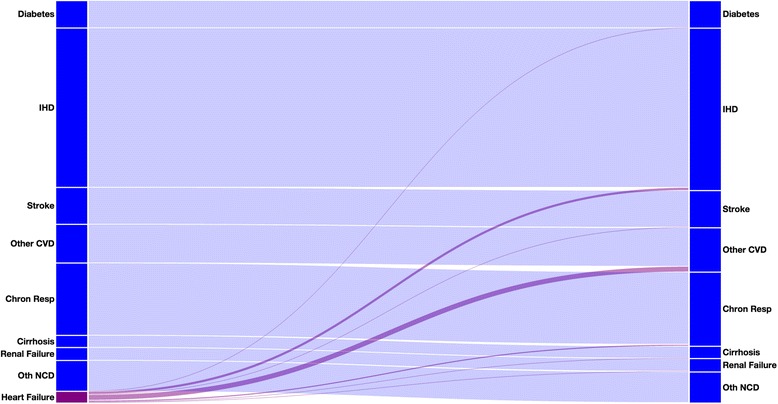
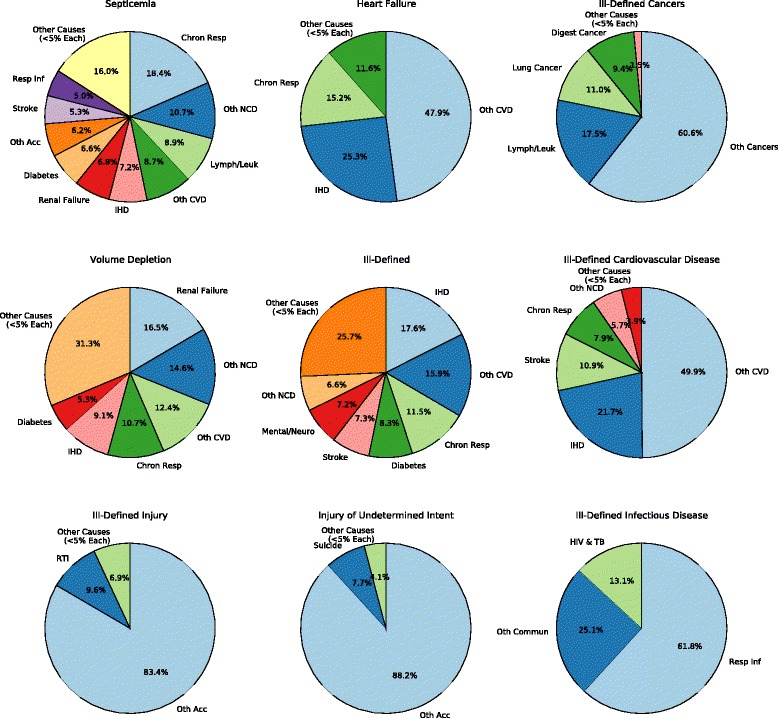
BACKGROUND: Mortality data are affected by miscertification of the medical cause of death deaths and changes to cause of death classification systems. We present both mappings of ICD9 and ICD10 to a unified list of causes, and a new statistical model for reducing the impact of misclassification of cause of death. METHODS: We propose a Bayesian mixed-effects multinomial logistic model that can be run on individual record level death certificates to reclassify "garbage-coded" deaths onto causes that are more meaningful for public health purposes. The model uses information on the contributing causes of death and demographic characteristics of each decedent to make informed predictions of the underlying cause of death. We apply our method to death certificate data in the US from 1979 to 2011, creating more directly comparable series of cause-specific mortality for 25 major causes of death. RESULTS: We find that many death certificates coded to garbage codes contain other information that provides strong clues about the valid underlying cause of death. In particular, a plausible underlying cause often appears in the contributing causes of death, implying that it may be incorrect ordering of the causal chain and not missed cause assignment that leads to many garbage-coded deaths. We present an example that redistributes 48 % of heart failure deaths to other cardiovascular diseases, 25 % to ischemic heart disease, and 15 % to chronic respiratory diseases. CONCLUSIONS: Our methods take advantage of more detailed micro-level data than is typically considered in garbage code redistribution algorithms, making it a useful tool in circumstances in which detailed death certificate data needs to be aggregated for public health purposes. We find that this method gives different redistribution results than commonly used methods that only consider population-level proportions.
Overview
The claims and statistics of this paper haven’t been checked yet.
Free: it reads the open-access text and checks the first 5 claims that cite a source we can check. Create a free account to check every claim.
Integrity signals
Registry
Cites
Statistics
Figures
Verification
Claims the paper makes
The claims and statistics of this paper haven’t been checked yet.
Free: it reads the open-access text and checks the first 5 claims that cite a source we can check. Create a free account to check every claim.
Self-check
Percentages, sums and reported differences re-computed from the paper’s own numbers.
The self-check needs the paper’s full text.
Citations
Cites
International Statistical Classification of Diseases and Related Health Problems
Eisfeld, J. (2014) · TSQ: Transgender Studies Quarterly · doi:10.1215/23289252-2399740 · Cited by 3,570
International Statistical Classification of Diseases and Related Health Problems 10th Revision
(2013) · A Companion to the Classification of Mental Disorders · doi:10.1093/med/9780199669493.005.0005 · Cited by 2,059
(2001) · PubMed · Cited by 612
Algorithms for enhancing public health utility of national causes-of-death data
Naghavi, M., Makela, S., Foreman, K., O'Brien, J., Pourmalek, F., & Lozano, R. (2010) · Population Health Metrics · doi:10.1186/1478-7954-8-9 · Cited by 440 · cited 4×
“This mapping is based on the Global Burden of Disease 2010 cause of death hierarchy [16], abbreviated to account for small numbers issues when analyzing data at the state level, to minimize the effects of the shift from ICD9 to ICD10, and to reflect the causes of interest in the US across all demographic groups.”
BackgroundMethodInfluentialSelf-citationUnited States Census 2000 population with bridged race categories.
Ingram, D. D., Parker, J. D., Nathaniel Schenker, A., Weed, J. A., Hamilton, B. E., Arias, E., & Madans, J. H. (2003) · PubMed · Cited by 226
Population health metrics: crucial inputs to the development of evidence for health policy
Mathers, C. D., Murray, C. J., Ezzati, M., Gakidou, E., Salomon, J. A., & Stein, C. (2003) · Population Health Metrics · doi:10.1186/1478-7954-1-6 · Cited by 191
Self-citationCause of death. Proper completion of the death certificate
Kircher, T. (1987) · JAMA · doi:10.1001/jama.258.3.349 · Cited by 170 · cited 1×
“While the ICD has rules for determining a single underlying cause of death in each case (as opposed to possibly multiple contributing, intermediate, or immediate causes of death), it is a complicated rubric that can be disrupted by local coding practices, the particulars of a case, or physician experience [10, 13].”
Accuracy of Death Certificate Completion: The Need for Formalized Physician Training
Messite, J. (1996) · JAMA · doi:10.1001/jama.1996.03530340058030 · Cited by 164 · cited 1×
“While the ICD has rules for determining a single underlying cause of death in each case (as opposed to possibly multiple contributing, intermediate, or immediate causes of death), it is a complicated rubric that can be disrupted by local coding practices, the particulars of a case, or physician experience [10, 13].”
BackgroundAccuracy of death certificate completion: the need for formalized physician training
Messite, J., & Stellman, S. D. (1996) · PubMed · doi:10.7916/d81v5c5n · Cited by 111
Ahern, R. M., Lozano, R., Naghavi, M., Foreman, K., Gakidou, E., & Murray, C. J. (2011) · Population Health Metrics · doi:10.1186/1478-7954-9-8 · Cited by 106 · cited 3×
“We treat the first candidate target cause as a reference category in order to ensure identifiability, setting θ([1]) to 0, and all other target causes are modeled as relative risk ratios (RRRs) representing the probability of each target being the underlying cause compared to the reference category.”
BackgroundSelf-citationD'Amico, M., Agozzino, E., Biagino, A., Simonetti, A., & Marinelli, P. (1999) · European Journal of Epidemiology · doi:10.1023/a:1007570405888 · Cited by 95
Comparability of the death certificate and the 1986 National Mortality Followback Survey.
Poe, G. S., Powell‐Griner, E., McLaughlin, J. K., Placek, P. J., Gb, T., & Robinson, K. (1993) · PubMed · Cited by 78
Freedman, M. A., Gay, G., Brockert, J. E., Potrzebowski, P. W., & Rothwell, C. J. (1988) · American Journal of Public Health · doi:10.2105/ajph.78.2.168 · Cited by 70 · cited 1×
“ICD codes listed on line six were excluded from the training and prediction datasets, as they come from Part II of the death certificate, which corresponds to “other significant conditions contributing to death but not resulting in death” [5].”
Murray, C. J. L., Kulkarni, S. C., & Ezzati, M. (2006) · Circulation · doi:10.1161/circulationaha.105.595777 · Cited by 62
Self-citationDeaths from heart failure: using coarsened exact matching to correct cause-of-death statistics
Stevens, G. A., King, G., & Shibuya, K. (2010) · Population Health Metrics · doi:10.1186/1478-7954-8-6 · Cited by 62 · cited 2×
“use coarsened exact matching and redistribute 53 % of heart failure deaths to ischemic heart disease in the US [21].”
MethodIngram, D. D., Parker, J. D., Nathaniel Schenker, A., Weed, J. A., Hamilton, B. E., Arias, E., & Madans, J. H. (2003) · Cited by 48
Mortalidade segundo causas: considerações sobre a fidedignidade dos dados
Laurenti, R., Jorge, M. H. P. D. M., & Gotlieb, S. L. D. (2008) · Revista Panamericana de Salud Pública · doi:10.1590/s1020-49892008000500007 · Cited by 46
Improving the comparability of diabetes mortality statistics in the U.S. and Mexico.
Murray, C. J. L., Dias, R. H., Kulkarni, S. C., Lozano, R., Stevens, G. A., & Ezzati, M. (2008) · Diabetes Care · doi:10.2337/dc07-1370 · Cited by 44
Self-citationAutomation of mortality data coding and processing in the United States of America.
Israel, R. A. (1990) · PubMed · Cited by 32
Statistical Studies of Heart Diseases: II. Important Factors in Heart Disease Mortality Trends
Woolsey, T. D., & Moriyama, I. M. (1948) · Public Health Reports (1896-1970) · doi:10.2307/4586707 · Cited by 30
Griffiths, C., Brock, A., & Rooney, C. (2004) · PubMed · Cited by 30
National mortality followback survey: 1986 summary, United States.
Seeman, I. (1992) · PubMed · Cited by 18
Jemal, A. (2003) · CancerSpectrum Knowledge Environment · doi:10.1093/jnci/djg116 · Cited by 14 · cited 1×
““cancers”) and are not comparable across ICD revisions [2, 9].”
BackgroundMcKenzie, K., Walker, S., & Tong, S. (2002) · PubMed · Cited by 10
Research works printed but not linked: 4
- Birch D Automatic coding of causes of death Popul Trends 1993 73 36 8
- Rooney C Griffiths C Cook L The implementation of ICD-10 for cause of death coding-some preliminary results from the bridge coding study Health Stat Q 2002 13 31 41
- World Health Organization Manual of the International Statistical Classification of Diseases, Injuries, and Causes of Death, 1975 Revision 1977 Geneva World Health Organization
- World Health Organization WHO | The International Classification of Diseases 11th Revision is due by 2017 2015
Cited by
US Health Care Spending by Payer and Health Condition, 1996-2016
Dieleman, J. L., Cao, J., Chapin, A., Chen, C., Li, Z., Liu, A., Horst, C., Kaldjian, A., Matyasz, T., Scott, K. W., et al. (2020) · JAMA · doi:10.1001/jama.2020.0734 · Cited by 1,313
Self-citationNascimento, B. R., Brant, L. C. C., de Oliveira, G. M. M., Malachias, M. V. B., Reis, G. M. A., Teixeira, R. A., Malta, D. C., França, E. B., de Souza, M. D. F. M., Roth, G. A., et al. (2018) · Arquivos Brasileiros de Cardiologia · doi:10.5935/abc.20180098 · Cited by 250
Brant, L. C. C., Nascimento, B. R., Passos, V. M. D. A., Duncan, B. B., Benseñor, I. M., Malta, D. C., de Souza, M. D. F. M., Ishitani, L. H., França, E. B., de Oliveira, M. S., et al. (2017) · Revista Brasileira de Epidemiologia · doi:10.1590/1980-5497201700050010 · Cited by 238
Self-citationJames, S. L., Castle, C. D., Dingels, Z. V., Fox, J. T., Hamilton, E. B., Liu, Z., S Roberts, N. L., Sylte, D. O., Henry, N. J., LeGrand, K. E., et al. (2020) · Injury Prevention · doi:10.1136/injuryprev-2019-043494 · Cited by 219
James, S. L., Lucchesi, L. R., Bisignano, C., Castle, C. D., Dingels, Z. V., Fox, J. T., Hamilton, E. B., Henry, N. J., McCracken, D., Roberts, N. L. S., et al. (2020) · Injury Prevention · doi:10.1136/injuryprev-2019-043299 · Cited by 209
Metadata
- Authors
- Foreman, K. J., Naghavi, M., & Ezzati, M.
- Affiliations
- Imperial College London (GB)
- University of Washington (US)
- Corresponding author
- Foreman, Kyle J.
- Venue
- Population Health Metrics
- Published
- 2016-04-28
- Volume
- 14
- Issue
- 1
- Pages
- 14-14
- ISSN
- 1478-7954 (ISSN-L)
- PMC
- PMC4848792
- OpenAlex
- W2342869184
- Cited by
- 56
- References
- 26
- Citations by year
- 2026: 1 · 2025: 3 · 2024: 8 · 2023: 5 · 2022: 4 · 2021: 8 · 2020: 9 · 2019: 8 · 2018: 6 · 2017: 3
- FWCI
- 9.64
- Type
- journal article
- Language
- en
- Open access
- gold
- doi.org
- Licence
- cc-by
- Locations
- Population Health Metrics (publishedVersion, cc-by)
- Europe PMC (PubMed Central) (publishedVersion, cc-by)
- PubMed Central (publishedVersion, cc-by)
- PubMed (publishedVersion)
- Spiral (Imperial College London) (submittedVersion, cc-by)
- Funders
- Wellcome Trust (100693)
- Topics
- Health Sciences › Health Professions › Health Information Management › Medical Coding and Health Information
- Physical Sciences › Mathematics › Statistics and Probability › Statistical Methods in Epidemiology
- Social Sciences › Demography › Insurance, Mortality, Demography, Risk Management
- Keywords
- underlying cause of death, cause of death misclassification, cause-specific mortality, heart failure, ischemic heart disease, chronic respiratory disease, death certificate data
About these checks
Registry, retraction, Cites and statistics results are computed, not judged, with one exception: a printed reference that no index lists is read once by a model before it counts as a citation error. Claims are extracted by a model and kept only when their quote appears verbatim in the text; each cited source is then checked, with a model’s help, for whether it says what the claim relies on. Those verdicts can be wrong — read the claim’s quote and the cited source before relying on one.
Statistics and arithmetic are recomputed, not judged.
Confidence bands are shown only for fields calibrated on our annotated test set. None is calibrated yet, so no band is shown.
What counts as a claim ›How we measure confidence ›How we check this ›
Are you an author, or do you see a problem with this page? Request a review
Data sources
Bibliographic data: Semantic Scholar, OpenAlex, Crossref.
Contains information from the Semantic Scholar Academic Graph Datasets, made available under the ODC Attribution License (ODC-BY 1.0).
Semantic Scholar’s data is described in: Kinney, R., et al. (2023). The Semantic Scholar Open Data Platform. arXiv:2301.10140.
