

Four decades of measuring stillbirths and neonatal deaths in Demographic and Health Surveys: historical review
Open accessThe DOI matches its Crossref record; 42 of the 44 references it cites were found in a registry or an index.
Abstract
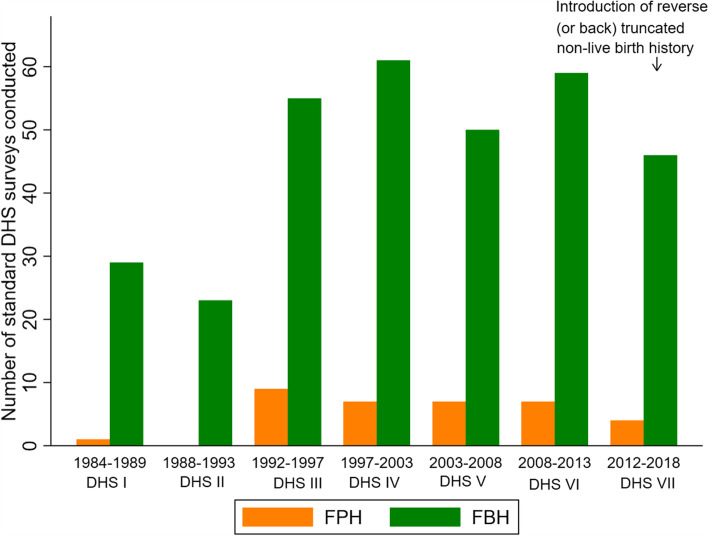
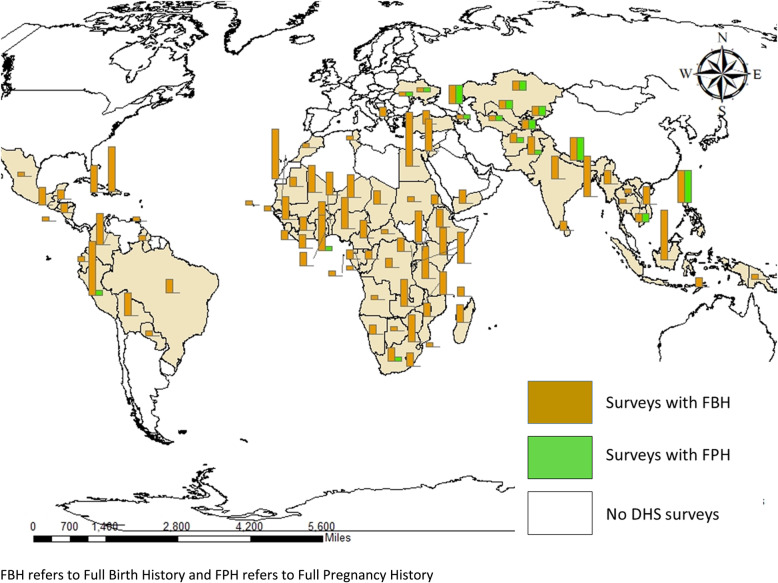
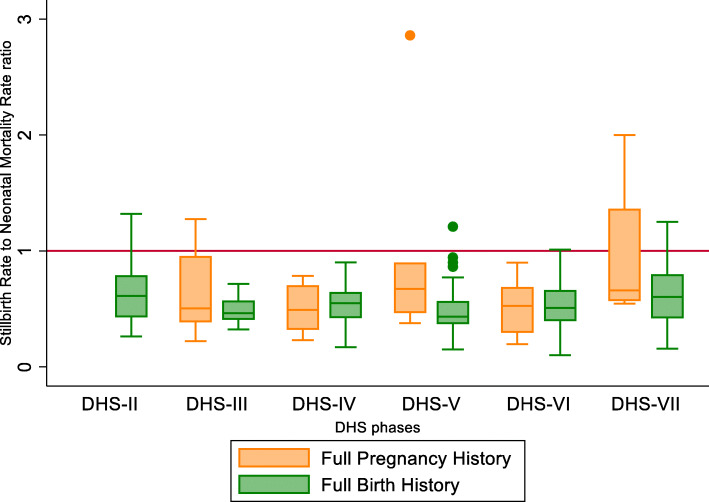
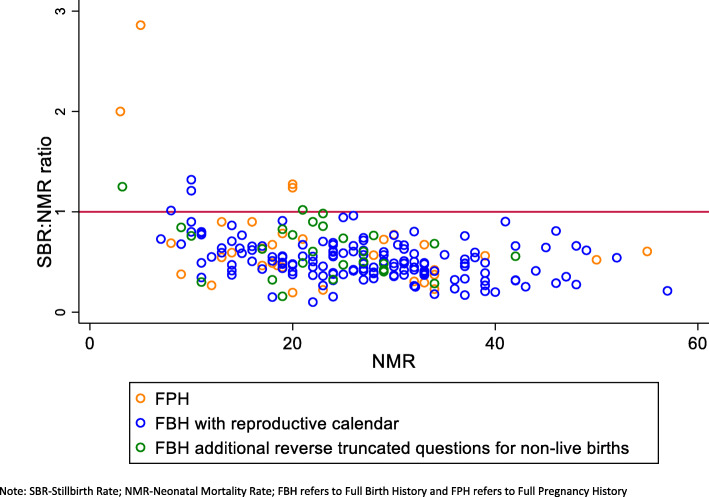
Background: Worldwide, an estimated 5.1 million stillbirths and neonatal deaths occur annually, 98% in low- and middle-income countries. Limited coverage of civil and vital registration systems necessitates reliance on women’s retrospective reporting in household surveys for data on these deaths. The predominant platform, Demographic and Health Surveys (DHS), has evolved over the last 35 years and differs by country, yet no previous study has described these differences and the effects of these changes on stillbirth and neonatal death measurement. Methods: We undertook a review of DHS model questionnaires, protocols and methodological reports from DHS-I to DHS-VII, focusing on the collection of information on stillbirth and neonatal deaths describing differences in approaches, questionnaires and geographic reach up to December 9, 2019. We analysed the resultant data, applied previously used data quality criteria including ratios of stillbirth rate (SBR) to neonatal mortality rate (NMR) and early NMR (ENMR) to NMR, comparing by country, over time and by DHS module. Results: DHS has conducted >320 surveys in 90 countries since 1984. Two types of maternity history have been used: full birth history (FBH) and full pregnancy history (FPH). A FBH collecting information only on live births has been included in all model questionnaires to date, with data on stillbirths collected through a reproductive calendar (DHS II-VI) or using additional questions on non-live births (DHS-VII). FPH collecting information on all pregnancies including live births, miscarriages, abortions and stillbirths has been used in 17 countries. We found no evidence of variation in stillbirth data quality assessed by SBR:NMR over time for FBH surveys with reproductive calendar, some variation for surveys with FBH in DHS-VII and most variation among the surveys conducted with a FPH. ENMR:NMR ratio increased over time, which may reflect changes in data quality or real epidemiological change. Conclusion: DHS remains the major data source for pregnancy outcomes worldwide. Although the DHS model questionnaire has evolved over the last three and half decades, more robust evidence is required concerning optimal methods to obtain accurate data on stillbirths and neonatal deaths through household surveys and also to develop and test standardised data quality criteria.
Overview
The claims and statistics of this paper haven’t been checked yet.
Free: it reads the open-access text and checks the first 5 claims that cite a source we can check. Create a free account to check every claim.
Integrity signals
Registry
Cites
Statistics
Figures
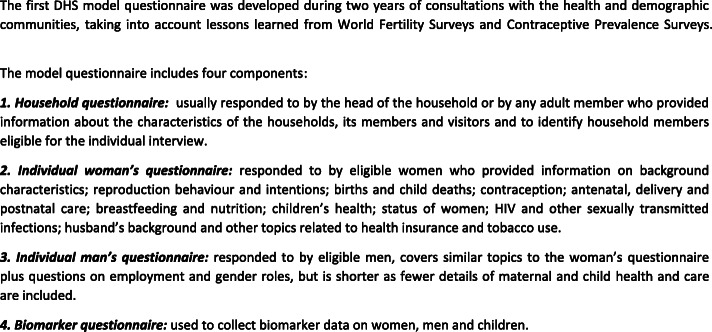
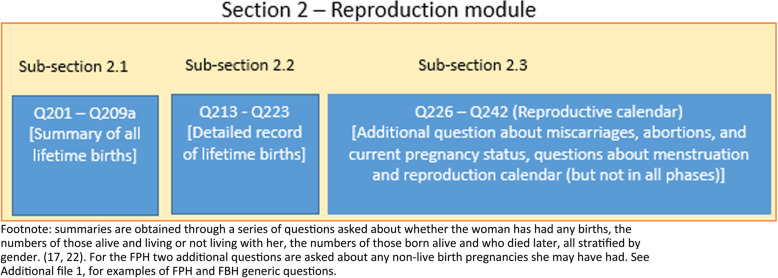
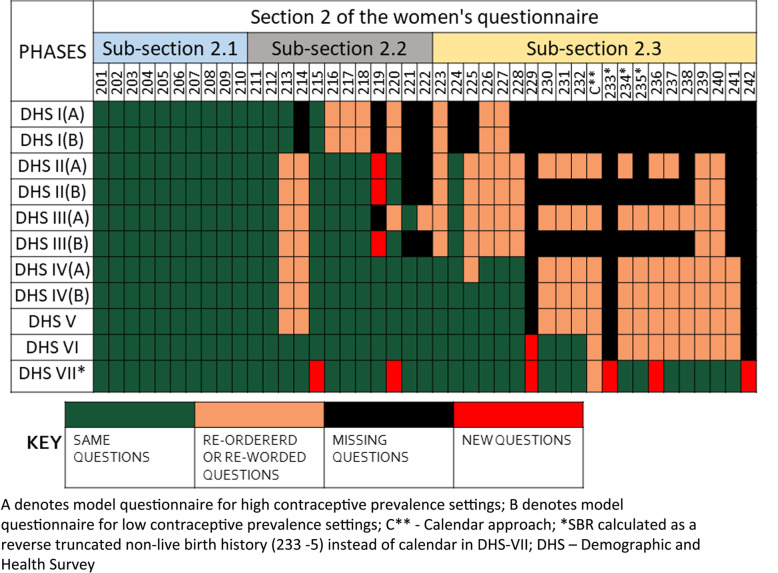
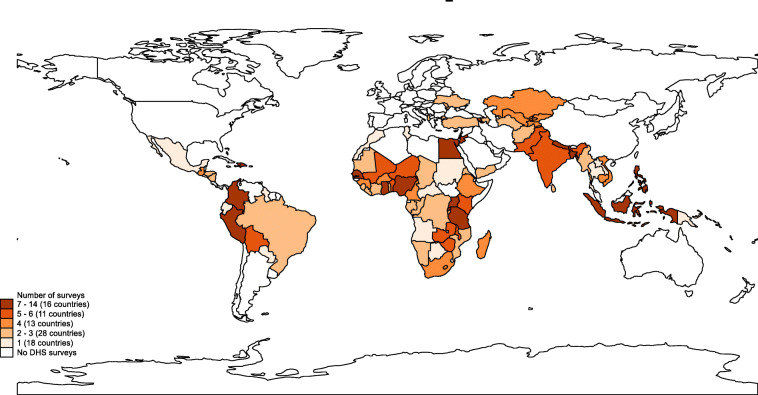
Verification
Claims the paper makes
The claims and statistics of this paper haven’t been checked yet.
Free: it reads the open-access text and checks the first 5 claims that cite a source we can check. Create a free account to check every claim.
Claims other papers make about this one
Each is checked against this paper’s own text: does it say what the citing paper says it does?
The source backs part of the claim, not all of it — or backs it for a different population, condition or comparison.
In the citing paper
“The DHS has robust methodology to estimate crude birth rates, using pregnancy history, and is the standard in global health.18”
From Estimating stillbirth and neonatal mortality rate among Rohingya refugees in Bangladesh, September 2017 to December 2018: a prospective surveillance (2022) · cites this paper as [18]
Experimental — accuracy not yet measuredThe cited source says what the claim attributes to it.
In the citing paper
“In the absence of civil registration of vital events (ie, births, deaths), low-income and middle-income countries depend on household surveys, such as the Demographic and Health Survey (DHS), to estimate neonatal mortality.17 18”
From Estimating stillbirth and neonatal mortality rate among Rohingya refugees in Bangladesh, September 2017 to December 2018: a prospective surveillance (2022) · cites this paper as [18]
The cited source says what the claim attributes to it.
In the citing paper
“The DHS uses full birth history and/or full pregnancy history as recalled retrospectively by the respondent that captures data from women of reproductive age on their pregnancies and pregnancy outcomes.18”
From Estimating stillbirth and neonatal mortality rate among Rohingya refugees in Bangladesh, September 2017 to December 2018: a prospective surveillance (2022) · cites this paper as [18]
Self-check
Percentages, sums and reported differences re-computed from the paper’s own numbers.
The self-check needs the paper’s full text.
Citations
Cites
Every Newborn: progress, priorities, and potential beyond survival
Lawn, J. E., Blencowe, H., Oza, S., You, D., Lee, A. C., Waiswa, P., Lalli, M., Bhutta, Z., Barros, A. J., Christian, P., et al. (2014) · The Lancet · doi:10.1016/s0140-6736(14)60496-7 · Cited by 1,929
Self-citationStillbirths: rates, risk factors, and acceleration towards 2030
Lawn, J. E., Blencowe, H., Waiswa, P., Amouzou, A., Mathers, C., Hogan, D., Flenady, V., Frøen, J. F., Qureshi, Z. U., Calderwood, C., et al. (2016) · The Lancet · doi:10.1016/s0140-6736(15)00837-5 · Cited by 1,778
Self-citationDemographic and Health Surveys
(2008) · Choice Reviews Online · doi:10.5860/choice.45-6819 · Cited by 1,439
Bhutta, Z. A., Das, J. K., Bahl, R., Lawn, J. E., Salam, R. A., Paul, V. K., Sankar, M. J., Blencowe, H., Rizvi, A., Chou, V. B., et al. (2014) · The Lancet · doi:10.1016/s0140-6736(14)60792-3 · Cited by 1,367
Self-citationDemographic and health surveys: a profile
Corsi, D. J., Neuman, M., Finlay, J. E., & Subramanian, S. (2012) · International Journal of Epidemiology · doi:10.1093/ije/dys184 · Cited by 1,178
Blencowe, H., Cousens, S., Jassir, F. B., Say, L., Chou, D., Mathers, C., Hogan, D., Shiekh, S., Qureshi, Z. U., You, D., et al. (2016) · The Lancet Global Health · doi:10.1016/s2214-109x(15)00275-2 · Cited by 1,062
Self-citationStillbirths: economic and psychosocial consequences
Heazell, A. E. P., Siassakos, D., Blencowe, H., Burden, C., Bhutta, Z. A., Cacciatore, J., Dang, N., Das, J., Flenady, V., Gold, K. J., et al. (2016) · The Lancet · doi:10.1016/s0140-6736(15)00836-3 · Cited by 807
Self-citationCousens, S., Blencowe, H., Stanton, C., Chou, D., Ahmed, S., Steinhardt, L., Creanga, A. A., Tunçalp, Ö., Balsara, Z. P., Gupta, S., et al. (2011) · The Lancet · doi:10.1016/s0140-6736(10)62310-0 · Cited by 649
Self-citationYou, D., Hug, L., Ejdemyr, S., & Beise, J. (2015) · Cited by 563
Oestergaard, M. Z., Inoue, M., Yoshida, S., Mahanani, W. R., Gore, F. M., Cousens, S., Lawn, J. E., Mathers, C. D., & on behalf of the United Nations Inter-agency Group for Child Mortality Estimation and the Child Health Epidemiology Reference Group (2011) · PLoS Medicine · doi:10.1371/journal.pmed.1001080 · Cited by 481
Self-citationStillbirths: ending preventable deaths by 2030
de Bernis, L., Kinney, M. V., Stones, W., ten Hoope-Bender, P., Vivio, D., Leisher, S. H., Bhutta, Z. A., Gülmezoglu, M., Mathai, M., Belizán, J. M., et al. (2016) · The Lancet · doi:10.1016/s0140-6736(15)00954-x · Cited by 473
Self-citationSo, R., & Rojas, G. V. E. (2003) · Cited by 470
World Health Statistics Quarterly 1993.
Organization, W. H. (1994) · Biometrics · doi:10.2307/2533484 · Cited by 463
World Health Statistics Quarterly
Beauchamp, G. R. (1985) · American Journal of Ophthalmology · doi:10.1016/s0002-9394(14)75890-8 · Cited by 338
Alkema, L., New, J. R., Pedersen, J., You, D., & all members of the UN Inter-agency Group for Child Mortality Estimation and its Technical Advisory Group (2014) · PLoS ONE · doi:10.1371/journal.pone.0101112 · Cited by 291
AbouZahr, C., de Savigny, D., Mikkelsen, L., Setel, P. W., Lozano, R., Nichols, E., Notzon, F., & Lopez, A. D. (2015) · The Lancet · doi:10.1016/s0140-6736(15)60173-8 · Cited by 252
Short Fabic, M., Choi, Y., & Bird, S. (2012) · Bulletin of the World Health Organization · doi:10.2471/blt.11.095513 · Cited by 198
Oza, S., Cousens, S. N., & Lawn, J. E. (2014) · The Lancet Global Health · doi:10.1016/s2214-109x(14)70309-2 · Cited by 185
Self-citationDemographic and health surveys (DHS): contributions and limitations.
Boerma, J. T., & Sommerfelt, A. E. (1993) · PubMed · Cited by 132
Akuze, J., Blencowe, H., Waiswa, P., Baschieri, A., Gordeev, V. S., Kwesiga, D., Fisker, A. B., Thysen, S. M., Rodrigues, A., Biks, G. A., et al. (2020) · The Lancet Global Health · doi:10.1016/s2214-109x(20)30044-9 · Cited by 121
Self-citationMeasuring Under-Five Mortality: Validation of New Low-Cost Methods
Rajaratnam, J. K., Tran, L. N., Lopez, A. D., & Murray, C. J. L. (2010) · PLoS Medicine · doi:10.1371/journal.pmed.1000253 · Cited by 119
Liu, L., Kalter, H. D., Chu, Y., Kazmi, N., Koffi, A. K., Amouzou, A., Joos, O., Munos, M., & Black, R. E. (2016) · PLOS ONE · doi:10.1371/journal.pone.0168743 · Cited by 112
Demographic Data Collection in Less Developed Countries 1946–1996
Cleland, J. (1996) · Population Studies · doi:10.1080/0032472031000149556 · Cited by 105
Weeping in silence: community experiences of stillbirths in rural eastern Uganda
Kiguli, J., Namusoko, S., Kerber, K., Peterson, S., & Waiswa, P. (2015) · Global Health Action · doi:10.3402/gha.v8.24011 · Cited by 91
Self-citationThe International Statistical Institute
Falkner, R. P. (1895) · Publications of the American Statistical Association · doi:10.2307/2276163 · Cited by 87
Evidence of omission and displacement in DHS birth histories.
Pullum, T. W., & Becker, S. (2014) · Cited by 64
[Maternal and perinatal health].
Ja, W., Feifer, C. N., Ar, M., & Pj, G. (1991) · PubMed · Cited by 61
Collection of Survey Data on Contraception: An Evaluation of an Experiment in Peru
Goldman, N., Moreno, L., & Westoff, C. F. (1989) · Studies in Family Planning · doi:10.2307/1966569 · Cited by 59
the Every Newborn-INDEPTH Study Collaborative Group, Kwesiga, D. K., Tawiah, C., Imam, M. A., Tesega, A. K., Nareeba, T., Enuameh, Y., Biks, G. A., Manu, G., Beedle, A., et al. (2021) · Population Health Metrics · doi:10.1186/s12963-020-00228-x · Cited by 54
Self-citationThe epidemiology of perinatal mortality.
Edouard, L. (1985) · PubMed · Cited by 48
Peru experimental study: an evaluation of fertility and child health information.
Goldman, N., Moreno, L., & Cf, W. (1989) · Medical Entomology and Zoology · Cited by 44
Christou, A., Alam, A., Hofiani, S. M. S., Rasooly, M. H., Mubasher, A., Rashidi, M. K., Dibley, M. J., & Raynes‐Greenow, C. H. (2019) · Social Science & Medicine · doi:10.1016/j.socscimed.2019.112413 · Cited by 43
The validity of birth and pregnancy histories in rural Bangladesh
Espeut, D., & Becker, S. (2015) · Journal of Health Population and Nutrition · doi:10.1186/s41043-015-0027-8 · Cited by 41
CHAPTER 3. Methods of Analysis and Estimation
Brass, W., & Coale, A. J. (1968) · Princeton University Press eBooks · doi:10.1515/9781400877140-007 · Cited by 41
Bradley, S., Winfrey, W. L., & Croft, T. N. (2015) · Cited by 38
Self-citationDominican Republic experimental study : an evaluation of fertility and child health information
Westoff, C. F., Goldman, N., Moreno, L., & y Familia, D. R. C. N. D. P. (1990) · Medical Entomology and Zoology · Cited by 37
A New Approach to Eliciting Information about Induced Abortion
Huntington, D., Mensch, B., & Toubia, N. (1993) · Studies in Family Planning · doi:10.2307/2939205 · Cited by 37
Consistency of reporting of terminated pregnancies in DHS calendars
MacQuarrie, K. L. D., Winfrey, W. L., Meijer-Irons, J., & Morse, A. (2018) · Cited by 17
Collecting demographic data in Bangladesh : evidence from tape-recorded interviews
Thompson, L. V., Ali, M., & Casterline, J. B. (1982) · International Statistical Institute , World Fertility Survey eBooks · Cited by 9
Comparability of questionnaires
Singh, S. D. (1980) · International Statistical Institute , World Fertility Survey eBooks · Cited by 4
BUTLER, N. (1961) · PubMed · Cited by 3
Moreno, L., Goldman, N., & Babakol, O. (1991) · PubMed · Cited by 2
Research works printed but not linked: 1
- UN Inter-agency Group for Child Mortality Estimation: Levels and trends in child mortality. pp. 8; 2017:8.
Cited by
Dimitrova, A., Dimitrova, A., Mengel, M., Gasparrini, A., Lotze‐Campen, H., & Gabrysch, S. (2024) · Nature Communications · doi:10.1038/s41467-024-49890-x · Cited by 65
Gage, A. D., Fink, G., Ataguba, J. E.-O., & Kruk, M. E. (2021) · PLoS Medicine · doi:10.1371/journal.pmed.1003843 · Cited by 53
Stillbirth outcome capture and classification in population-based surveys: EN-INDEPTH study
the Every Newborn-INDEPTH Study Collaborative Group, Blencowe, H. K., Bottecchia, M., Kwesiga, D. K., Akuze, J., Haider, M. M., Galiwango, E., Dzabeng, F., Fisker, A. B., Enuameh, Y., et al. (2021) · Population Health Metrics · doi:10.1186/s12963-020-00239-8 · Cited by 35
Self-citationAli, M. M., Bellizzi, S., & Boerma, T. (2023) · The Lancet Global Health · doi:10.1016/s2214-109x(23)00125-0 · Cited by 35
Amsalu, R., Costello, J., Hasna, Z., & Handzel, E. (2022) · BMJ Global Health · doi:10.1136/bmjgh-2021-008110 · Cited by 8
Metadata
- Authors
- Akuze, J., Cousens, S., Lawn, J. E., Waiswa, P., Gordeev, V. S., Arnold, F., Croft, T., Baschieri, A., & Blencowe, H.
- Affiliations
- London School of Hygiene & Tropical Medicine (GB)
- Karolinska Institutet (SE)
- Queen Mary University of London (GB)
- Corresponding author
- Akuze, Joseph
- ORCID
- Venue
- Population Health Metrics
- Published
- 2021-02
- Volume
- 19
- Issue
- S1
- Pages
- 8-8
- ISSN
- 1478-7954 (ISSN-L)
- PMC
- PMC7869207
- OpenAlex
- W3128085333
- Cited by
- 35
- References
- 44
- Citations by year
- 2026: 5 · 2025: 9 · 2024: 4 · 2023: 7 · 2022: 6 · 2021: 4
- FWCI
- 5.19
- Type
- journal article
- Language
- en
- Open access
- gold
- doi.org
- Licence
- cc-by
- creativecommons.org/licenses/by/4.0/ (tdm)
- creativecommons.org/licenses/by/4.0/ (vor, 7 d)
- Locations
- Population Health Metrics (publishedVersion, cc-by)
- Europe PMC (PubMed Central) (publishedVersion, other-oa)
- PubMed Central (publishedVersion, cc-by)
- PubMed (publishedVersion)
- LSHTM Research Online (London School of Hygiene and Tropical Medicine) (acceptedVersion)
- DOAJ (DOAJ: Directory of Open Access Journals) (submittedVersion, cc-by-sa)
- Funders
- London School of Hygiene and Tropical Medicine
- Children's Investment Fund Foundation
- Topics
- Health Sciences › Medicine › Pediatrics, Perinatology and Child Health › Global Maternal and Child Health
- Health Sciences › Medicine › Pediatrics, Perinatology and Child Health › Maternal and Neonatal Healthcare
- Health Sciences › Medicine › Public Health, Environmental and Occupational Health › Reproductive Health and Contraception
- Keywords
- stillbirth, neonatal mortality, Demographic and Health Surveys, survey data quality, early neonatal mortality, retrospective reports, low- and middle-income countries
- MeSH terms
- Demography, Family Characteristics, Female, Humans, Infant, Infant Mortality, Infant, Newborn, Pregnancy, Surveys and Questionnaires, Retrospective Studies, History, 20th Century, History, 21st Century, Stillbirth, Perinatal Death
About these checks
Registry, retraction, Cites and statistics results are computed, not judged, with one exception: a printed reference that no index lists is read once by a model before it counts as a citation error. Claims are extracted by a model and kept only when their quote appears verbatim in the text; each cited source is then checked, with a model’s help, for whether it says what the claim relies on. Those verdicts can be wrong — read the claim’s quote and the cited source before relying on one.
Statistics and arithmetic are recomputed, not judged.
Confidence bands are shown only for fields calibrated on our annotated test set. None is calibrated yet, so no band is shown.
What counts as a claim ›How we measure confidence ›How we check this ›
Are you an author, or do you see a problem with this page? Request a review
Data sources
Bibliographic data: Semantic Scholar, OpenAlex, Crossref.
Contains information from the Semantic Scholar Academic Graph Datasets, made available under the ODC Attribution License (ODC-BY 1.0).
Semantic Scholar’s data is described in: Kinney, R., et al. (2023). The Semantic Scholar Open Data Platform. arXiv:2301.10140.
