

The DOI matches its Crossref record; 105 of the 105 references it cites were found in a registry or an index.
A code within the genetic code: codon usage regulates co-translational protein folding
Open accessAbstract
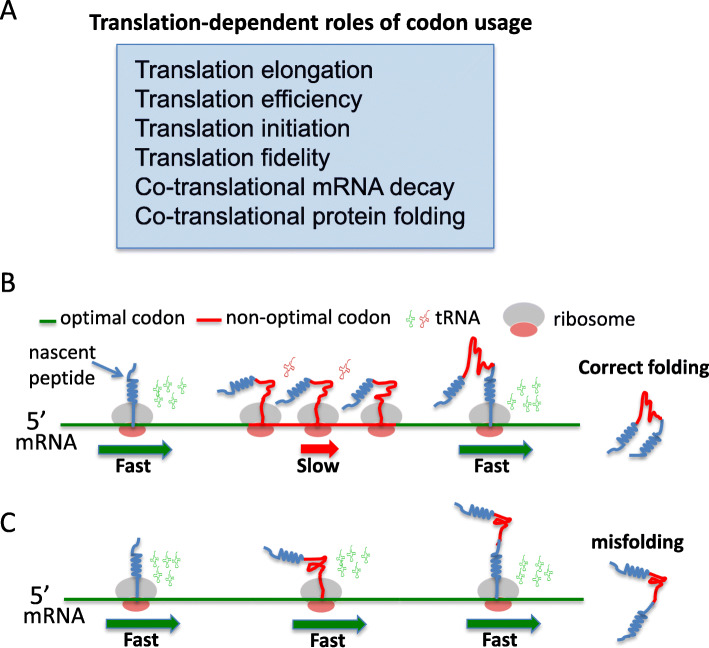
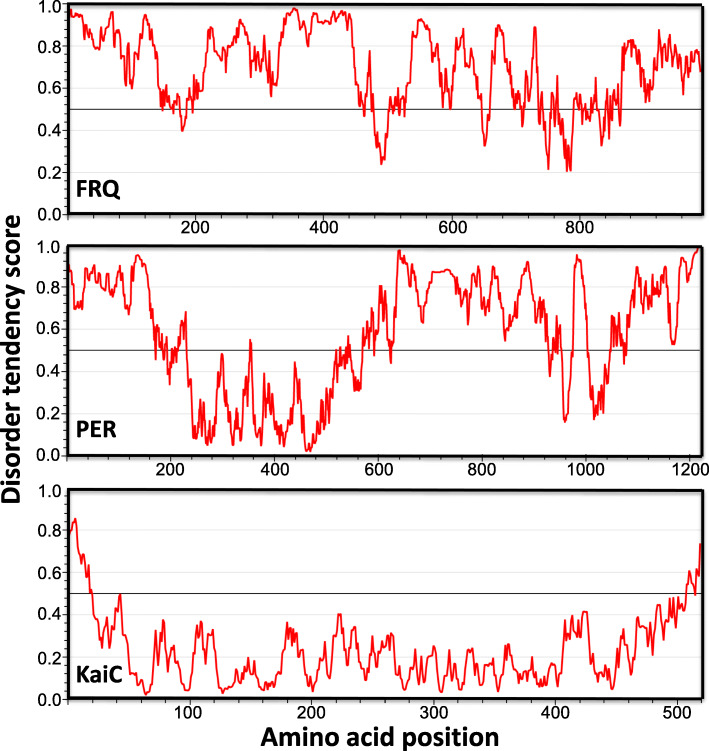
The genetic code is degenerate, and most amino acids are encoded by two to six synonymous codons. Codon usage bias, the preference for certain synonymous codons, is a universal feature of all genomes examined. Synonymous codon mutations were previously thought to be silent; however, a growing body evidence now shows that codon usage regulates protein structure and gene expression through effects on co-translational protein folding, translation efficiency and accuracy, mRNA stability, and transcription. Codon usage regulates the speed of translation elongation, resulting in non-uniform ribosome decoding rates on mRNAs during translation that is adapted to co-translational protein folding process. Biochemical and genetic evidence demonstrate that codon usage plays an important role in regulating protein folding and function in both prokaryotic and eukaryotic organisms. Certain protein structural types are more sensitive than others to the effects of codon usage on protein folding, and predicted intrinsically disordered domains are more prone to misfolding caused by codon usage changes than other domain types. Bioinformatic analyses revealed that gene codon usage correlates with different protein structures in diverse organisms, indicating the existence of a codon usage code for co-translational protein folding. This review focuses on recent literature on the role and mechanism of codon usage in regulating translation kinetics and co-translational protein folding. Video abstract.
Overview
The claims and statistics of this paper haven’t been checked yet.
Run the check — free, no account needed. It reads the open-access text and checks the sources it cites.
Integrity signals
Registry
Cites
Statistics
Figures
Verification
Claims the paper makes
The claims and statistics of this paper haven’t been checked yet.
Run the check — free, no account needed. It reads the open-access text and checks the sources it cites.
Claims other papers make about this one
Each is checked against this paper’s own text: does it say what the citing paper says it does?
In the citing paper
“Codon optimization can not only result in an improvement in protein expression yield, but also antibody assembly, affinity, and biological activity [85,86].”
From Computational and artificial intelligence-based methods for antibody development (2023) · cites this paper as [86]
Self-check
Percentages, sums and reported differences re-computed from the paper’s own numbers.
The self-check needs the paper’s full text.
Citations
Cites
Intrinsically unstructured proteins and their functions
Dyson, H. J., & Wright, P. E. (2005) · Nature Reviews Molecular Cell Biology · doi:10.1038/nrm1589 · Cited by 3,871
Genome-Wide Analysis in Vivo of Translation with Nucleotide Resolution Using Ribosome Profiling
Ingolia, N. T., Ghaemmaghami, S., Newman, J. R. S., & Weissman, J. S. (2009) · Science · doi:10.1126/science.1168978 · Cited by 3,853
Protein Misfolding, Amyloid Formation, and Human Disease: A Summary of Progress Over the Last Decade
Chiti, F., & Dobson, C. M. (2017) · Annual Review of Biochemistry · doi:10.1146/annurev-biochem-061516-045115 · Cited by 2,629
A "Silent" Polymorphism in the MDR 1 Gene Changes Substrate Specificity
Kimchi-Sarfaty, C., Oh, J. M., Kim, I.-W., Sauna, Z. E., Calcagno, A. M., Ambudkar, S. V., & Gottesman, M. M. (2007) · Science · doi:10.1126/science.1135308 · Cited by 2,416
Ingolia, N. T., Lareau, L. F., & Weissman, J. S. (2011) · Cell · doi:10.1016/j.cell.2011.10.002 · Cited by 2,187
Synonymous but not the same: the causes and consequences of codon bias
Plotkin, J. B., & Kudla, G. (2010) · Nature Reviews Genetics · doi:10.1038/nrg2899 · Cited by 1,733
Codon usage and tRNA content in unicellular and multicellular organisms.
Ikemura, T. (1985) · Molecular Biology and Evolution · doi:10.1093/oxfordjournals.molbev.a040335 · Cited by 1,712
Codon bias and heterologous protein expression
Gustafsson, C., Govindarajan, S., & Minshull, J. (2004) · Trends in Biotechnology · doi:10.1016/j.tibtech.2004.04.006 · Cited by 1,330
Converging concepts of protein folding in vitro and in vivo
Hartl, F. U., & Hayer-Hartl, M. K. (2009) · Nature Structural & Molecular Biology · doi:10.1038/nsmb.1591 · Cited by 1,235
Codon usage in yeast: cluster analysis clearly differentiates highly and lowly expressed genes
Sharp, P. M., Tuohy, T. M. F., & Mosurski, K. (1986) · Nucleic Acids Research · doi:10.1093/nar/14.13.5125 · Cited by 1,206
Cited by
Sorted by citations
Items 201–254 of 254
Medina, N. S., Moreno-Carmona, M., Canal, N. A., & Quiroga, C. F. P. (2024) · SSRN Electronic Journal · doi:10.2139/ssrn.4782978
Codon Bias of the DDR1 Gene and Transcription Factor EHF in Multiple Species
Zhang, Z., Li, W., Wang, Z., Ma, S., Zheng, F., Liu, H., Zhang, X., Ding, Y., Yin, Z., & Zheng, X. (2024) · International Journal of Molecular Sciences · doi:10.3390/ijms251910696
Ribosome demand links transcriptional bursts to protein expression noisePreprint
Pal, S., Ray, U., & Dhar, R. (2024) · eLife · doi:10.7554/elife.99322.1
Diverse tendencies in codon usage evolution of SARS-CoV-2 genesPreprint
Błażej, P., Mackiewicz, D., & Mackiewicz, P. (2025) · bioRxiv (Cold Spring Harbor Laboratory) · doi:10.1101/2025.05.30.657095
Kato, F. (2025) · Enzyme and Microbial Technology · doi:10.1016/j.enzmictec.2025.110694
Rafiei, F., Shahnejat-Bushehri, A.-A., Mehrizi, F. A., Sabzian, S. A., & Alizadeh, H. (2025) · Biochemical Engineering Journal · doi:10.1016/j.bej.2025.109850
Silva, H. G. D. S., Kimura, S., Lima, P. L. C., Pires, D. S., Waldor, M. K., & da Cunha, J. P. C. (2025) · mBio · doi:10.1128/mbio.01622-25
Multi-omic assessment of mRNA translation dynamics in liver cancer cell lines
González, A., Pandey, M., Schlusser, N., Rahaman, S., Ataman, M., Mittal, N., Schmidt, A., Becskei, A., & Zavolan, M. (2025) · Scientific Data · doi:10.1038/s41597-025-05861-5 · Cited by 1
Labar, R., Ghosh, S., & Sen, A. (2025) · Sustainable landscape planning and natural resources management · doi:10.1007/978-3-031-90139-3_10
Ran, X., He, H., Yang, L., Long, J., Chang, Z., Li, Z., Gao, J., & Chen, X. (2025) · Ecology and Evolution · doi:10.1002/ece3.72282
Information optimality and the geometry of chromatin
Kak, S. C. (2025) · Biophysical Reviews · doi:10.1007/s12551-025-01374-y
Sahoo, S. (2021) · International Journal of Biosciences (IJB) · doi:10.12692/ijb/19.1.31-45
Jeong, Y., Yang, C., Hariri, R. F. M., Kim, J., Lee, E. K., Lee, Y., Kim, W. J., Lee, S. S., & Choi, I. S. (2026) · ACS Synthetic Biology · doi:10.1021/acssynbio.5c00844
Clement, N. J., Hamasaki‐Katagiri, N., Lin, B., Komar, A. A., DiCuccio, M. N., Bar, H., & Kimchi‐Sarfaty, C. (2025) · NAR Genomics and Bioinformatics · doi:10.1093/nargab/lqaf169
Wu, M., He, L., Ma, G., Zhang, K., Yang, H., & Yang, X. (2023) · Figshare · doi:10.6084/m9.figshare.24202497
Fan, K., Li, Y., Chen, Z., & Fan, L. (2024) · Figshare · doi:10.6084/m9.figshare.27124007
Lee, H., Özbulak, U., Park, H., Depuydt, S., Neve, W. D., & Vankerschaver, J. (2024) · Figshare · doi:10.6084/m9.figshare.26714335
Rao, Y., Ahmed, N., Pritchard, J. R., & O’Brien, E. P. (2024) · Figshare · doi:10.6084/m9.figshare.26650965
Wu, M., He, L., Ma, G., Zhang, K., Yang, H., & Yang, X. (2023) · Figshare · doi:10.6084/m9.figshare.24202500
Rao, Y., Ahmed, N., Pritchard, J. R., & O’Brien, E. P. (2024) · Figshare · doi:10.6084/m9.figshare.26650962
Rao, Y., Ahmed, N., Pritchard, J. R., & O’Brien, E. P. (2024) · Figshare · doi:10.6084/m9.figshare.26650968
Köppl, C., Buchinger, W., Striedner, G., & Cserjan‐Puschmann, M. (2024) · Figshare · doi:10.6084/m9.figshare.25449039
Wu, M., He, L., Ma, G., Zhang, K., Yang, H., & Yang, X. (2023) · Figshare · doi:10.6084/m9.figshare.24202491
Fan, K., Li, Y., Chen, Z., & Fan, L. (2024) · Figshare · doi:10.6084/m9.figshare.27124010
Gao, W., Chen, X., He, J., Sha, A., Luo, Y., Xiao, W., Xiong, Z., & Li, Q. (2024) · Figshare · doi:10.6084/m9.figshare.25800919
Wu, M., He, L., Ma, G., Zhang, K., Yang, H., & Yang, X. (2023) · Figshare · doi:10.6084/m9.figshare.24202494
Chuckran, P. F., Blazewicz, S. J., Ceja-Navarro, J. A., Pett‐Ridge, J., Schwartz, E., & Dijkstra, P. (2026) · PeerJ · doi:10.7717/peerj.20641
Núñez-Muñoz, L. A., Calderón-Pérez, B., Ruíz‐Medrano, R., Xoconostle‐Cázares, B., & Torre-Almaráz, R. D. L. (2026) · Molecular Biotechnology · doi:10.1007/s12033-026-01556-3
Yan, J., Tang, C., Tang, H., Jia, B., Feng, C., Qi, J., Li, Y., & Li, X. (2026) · Biology · doi:10.3390/biology15040346
Temporal and gene-specific dynamics of codon usage evolution in SARS-CoV-2 genomes
Błażej, P., Mackiewicz, D., & Mackiewicz, P. (2026) · BMC Genomics · doi:10.1186/s12864-026-12672-4
Mapping the inter- and intra-genic codon-usage landscape in Homo sapiens
Arshad, M., Uchmanowicz, M., Rana, V., Trost, B., Scherer, S. W., & Rafiq, M. A. (2026) · NAR Genomics and Bioinformatics · doi:10.1093/nargab/lqag024
Qiao, S., Li, S., Zhang, T., Yang, F., Zhang, R. L., & Li, M. (2026) · Biotechnology Letters · doi:10.1007/s10529-026-03714-8
Designing mRNA coding sequence via multimodal reverse translation language modeling with Pro2RNAPreprint
Bian, B., Zhang, Y., Zhang, J., Asai, K., & Saito, Y. (2026) · bioRxiv (Cold Spring Harbor Laboratory) · doi:10.64898/2026.03.18.712790
Wang, Z.-F., Xiao, Z.-T., Jiang, X., Song, F., & Liu, F. (2026) · Genes · doi:10.3390/genes17040430
Bénitière, F. (2024) · theses.fr (ABES) · doi:10.70675/a3e412c0z2333z4c62zb12ezf5e361ef1275
Functional exploration of the Plasmodium tRNA import machinery
Pitolli, M. (2023) · theses.fr (ABES) · doi:10.70675/088f0755z4f29z434czb21fze696e294b023
Otsuka, F. A. M., & André, I. (2026) · Cell Reports · doi:10.1016/j.celrep.2026.117266
Jin, C., Ji, Y.-Y., Tang, L.-X., Ma, J.-X., Li, X., Si, J., & Cui, B. (2026) · BMC Genomics · doi:10.1186/s12864-026-12832-6
Jiang, L., Zhang, S., Zhang, Z.-W., Ali, S., Shen, J., Xin, W., Feng, L., Hu, J., & Ma, M. (2026) · International Biodeterioration & Biodegradation · doi:10.1016/j.ibiod.2026.106355
Islam, M. N., Akter, M., Irtiza, M. H., Sultana, S., Alam, M. J., & Khan, M. N. (2026) · Molecular Biology Reports · doi:10.1007/s11033-026-11936-2
Katanski, C. D., Pathirage, C., Chang, J. C., Veseli, I., Smith, T. J., Foo, M., Wu, Y., Hou, Y., Tran, H. A. V., Rudzka, D. A., et al. (2026) · PNAS Nexus · doi:10.1093/pnasnexus/pgag187
Regulatory and metabolic control of microbial biosynthetic gene clusters
Matine, I., Clasen, F., García-Guevara, F., Guo, M., & Shoaie, S. (2026) · Communications Biology · doi:10.1038/s42003-026-10623-z · Cited by 1
Huang, Y., Tang, W., Huang, S., Xiong, C., & Wu, L. (2026) · BMC Genomics · doi:10.1186/s12864-026-13066-2
Haseltine, W. A., & Patarca, R. (2026) · Springer eBooks · doi:10.1007/978-3-032-31089-7_6
Directed Evolution in Codon SpacePreprint
Heuschkel, J., Kingsley, L. J., Reed, J. M., Li, D., Warner, M. J., Pefaur, N. B., & Cramer, S. (2026) · bioRxiv (Cold Spring Harbor Laboratory) · doi:10.64898/2026.08.03.742557
SayedAhmed, Z., & Qabajah, M. (2026) · Research Square · doi:10.21203/rs.3.rs-10508284/v1
Design principles for stable and balanced multigene expression in plant synthetic biology
Lee, N., & Kwon, M. (2026) · Applied Biological Chemistry · doi:10.1186/s13765-026-01135-9
Bian, B., Zhang, J., Zhang, Y., & Saitō, Y. (2026) · Briefings in Bioinformatics · doi:10.1093/bib/bbag558
Wang, Y., & Wu, J. (2026) · British Journal of Pharmacology · doi:10.1111/bph.70712
Mutations in PRMT family genes arising in human cancers
Duff, N. M., Sudal, X., Rabbani, A. Z., Donahue, K. N., Bush, W. A., Mirzaei, G., Bouley, R. A., & Petreaca, R. C. (2026) · Mutation research. Fundamental and molecular mechanisms of mutagenesis · doi:10.1016/j.mrfmmm.2026.111953
Metadata
- Authors
- Liu, Y.
- Affiliations
- The University of Texas Southwestern Medical Center (US)
- Corresponding author
- Liu, Yi
- ORCID
- Liu, Yi
- Venue
- Cell Communication and Signaling
- Published
- 2020-09-09
- Volume
- 18
- Issue
- 1
- Pages
- 145-145
- ISSN
- 1478-811X (ISSN-L)
- PMC
- PMC7488015
- OpenAlex
- W3083874241
- Cited by
- 252
- References
- 105
- Citations by year
- 2026: 29 · 2025: 54 · 2024: 63 · 2023: 48 · 2022: 36 · 2021: 21 · 2020: 1
- FWCI
- 2.54
- Type
- journal article
- Language
- en
- Open access
- gold
- doi.org
- Locations
- Cell Communication and Signaling (publishedVersion, cc-by)
- PubMed Central (publishedVersion, cc-by)
- PubMed (publishedVersion)
- DOAJ (DOAJ: Directory of Open Access Journals) (submittedVersion, cc-by-sa)
- Funders
- National Institute of General Medical Sciences (R35GM118118)
- Welch Foundation (I-1560)
- Topics
- Life Sciences › Biochemistry, Genetics and Molecular Biology › Molecular Biology › RNA and protein synthesis mechanisms
- Life Sciences › Biochemistry, Genetics and Molecular Biology › Molecular Biology › Protein Structure and Dynamics
- Life Sciences › Biochemistry, Genetics and Molecular Biology › Molecular Biology › RNA Research and Splicing
- Keywords
- codon usage bias, co-translational folding, synonymous codons, genetic code degeneracy, translation elongation rate, intrinsically disordered regions, protein misfolding, translation efficiency, mRNA stability
- MeSH terms
- Codon Usage, Animals, Genetic Code, Humans, Protein Conformation, Proteins, RNA, Messenger, Protein Biosynthesis, Protein Folding, Intrinsically Disordered Proteins
About these checks
Registry, retraction, Cites and statistics results are computed, not judged, with one exception: a printed reference that no index lists is read once by a model before it counts as a citation error. Claims are extracted by a model and kept only when their quote appears verbatim in the text; each cited source is then checked, with a model’s help, for whether it says what the claim relies on. Those verdicts can be wrong — read the claim’s quote and the cited source before relying on one.
Statistics and arithmetic are recomputed, not judged.
Confidence bands are shown only for fields calibrated on our annotated test set. None is calibrated yet, so no band is shown.
What counts as a claim ›How we measure confidence ›How we check this ›
Are you an author, or do you see a problem with this page? Request a review
