

The DOI matches its Crossref record; 58 of the 58 references it cites were found in a registry or an index.
Evaluating the effectiveness of organisational-level strategies with or without an activity tracker to reduce office workers’ sitting time: a cluster-randomised trial
Open accessAbstract
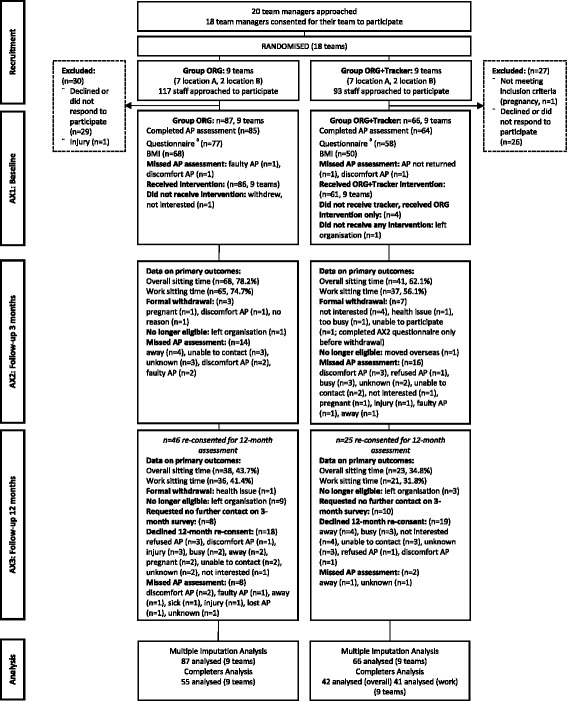
BACKGROUND: Office workers engage in high levels of sitting time. Effective, context-specific, and scalable strategies are needed to support widespread sitting reduction. This study aimed to evaluate organisational-support strategies alone or in combination with an activity tracker to reduce sitting in office workers. METHODS: From one organisation, 153 desk-based office workers were cluster-randomised (by team) to organisational support only (e.g., manager support, emails; 'Group ORG', 9 teams, 87 participants), or organisational support plus LUMOback activity tracker ('Group ORG + Tracker', 9 teams, 66 participants). The waist-worn tracker provided real-time feedback and prompts on sitting and posture. ActivPAL3 monitors were used to ascertain primary outcomes (sitting time during work- and overall hours) and other activity outcomes: prolonged sitting time (≥30 min bouts), time between sitting bouts, standing time, stepping time, and number of steps. Health and work outcomes were assessed by questionnaire. Changes within each group (three- and 12 months) and differences between groups were analysed by linear mixed models. Missing data were multiply imputed. RESULTS: At baseline, participants (46 % women, 23-58 years) spent (mean ± SD) 74.3 ± 9.7 % of their workday sitting, 17.5 ± 8.3 % standing and 8.1 ± 2.7 % stepping. Significant (p < 0.05) reductions in sitting time (both work and overall) were observed within both groups, but only at 12 months. For secondary activity outcomes, Group ORG significantly improved in work prolonged sitting, time between sitting bouts and standing time, and overall prolonged sitting time (12 months), and in overall standing time (three- and 12 months); while Group ORG + Tracker, significantly improved in work prolonged sitting, standing, stepping and overall standing time (12 months). Adjusted for confounders, the only significant between-group differences were a greater stepping time and step count for Group ORG + Tracker relative to Group ORG (+20.6 min/16 h day, 95 % CI: 3.1, 38.1, p = 0.021; +846.5steps/16 h day, 95 % CI: 67.8, 1625.2, p = 0.033) at 12 months. Observed changes in health and work outcomes were small and not statistically significant. CONCLUSIONS: Organisational-support strategies with or without an activity tracker resulted in improvements in sitting, prolonged sitting and standing; adding a tracker enhanced stepping changes. Improvements were most evident at 12 months, suggesting the organisational-support strategies may have taken time to embed within the organisation. TRIAL REGISTRATION: Australian New Zealand Clinical Trial Registry: ACTRN12614000252617 . Registered 10 March 2014.
Overview
The claims and statistics of this paper haven’t been checked yet.
Run the check — free, no account needed. It reads the open-access text and checks the sources it cites.
Integrity signals
Registry
Cites
Statistics
Figures
Verification
Claims the paper makes
The claims and statistics of this paper haven’t been checked yet.
Run the check — free, no account needed. It reads the open-access text and checks the sources it cites.
Claims other papers make about this one
Each is checked against this paper’s own text: does it say what the citing paper says it does?
The cited source doesn’t support the claim as written.
In the citing paper
“One study [32] reported a 56% loss to follow-up in the intervention group and 65% in the control group”
From Consumer-based wearable activity trackers increase physical activity participation: systematic review and meta-analysis (2019) · cites this paper as [32]
Checked by a reasoning model — may be wrong.
Experimental — accuracy not yet measuredThe source backs part of the claim, not all of it — or backs it for a different population, condition or comparison.
In the citing paper
“Furthermore, 4 studies [32,37,38,45] reported low activity tracker wear time, with 1 study [32] reporting that all participants had ceased wearing their activity tracker by the end of the intervention.”
From Consumer-based wearable activity trackers increase physical activity participation: systematic review and meta-analysis (2019) · cites this paper as [32]
Experimental — accuracy not yet measuredThe source backs part of the claim, not all of it — or backs it for a different population, condition or comparison.
In the citing paper
“Actual wear time of the activity tracker varied, ranging from over 90% wear time [21,22] to all participants ceasing to wear the device by the end of the intervention [32] as the study design allowed self-directed wear of the activity tracker.”
From Consumer-based wearable activity trackers increase physical activity participation: systematic review and meta-analysis (2019) · cites this paper as [32]
Experimental — accuracy not yet measuredThe source backs part of the claim, not all of it — or backs it for a different population, condition or comparison.
In the citing paper
“The 2 studies that were 12 months or longer [32,37] reported lower adherence rates compared with shorter duration studies.”
From Consumer-based wearable activity trackers increase physical activity participation: systematic review and meta-analysis (2019) · cites this paper as [32]
Experimental — accuracy not yet measuredThe source backs part of the claim, not all of it — or backs it for a different population, condition or comparison.
In the citing paper
“Less time was spent in sedentary behavior for those receiving a consumer-based wearable activity tracker intervention compared with control groups; however, the finding was not significant, and the quality of the evidence was graded as very low [29,31-33,37-40].”
From Consumer-based wearable activity trackers increase physical activity participation: systematic review and meta-analysis (2019) · cites this paper as [32]
Experimental — accuracy not yet measured
The cited source says what the claim attributes to it.
In the citing paper
“A total of 26 studies were included across all meta-analyses [21,22,29-48,50-53].”
From Consumer-based wearable activity trackers increase physical activity participation: systematic review and meta-analysis (2019) · cites this paper as [32]
The cited source says what the claim attributes to it.
In the citing paper
“Moreover, 17 studies reported activity tracker adherence data [21,22,30,32,34,35, 37,38,40,41,43-45,50-52,54], with 13 of these studies [21,22,30,34,35,40,41,43,44,50-52,54] reporting activity tracker wear on at least 50% of the study intervention days.”
From Consumer-based wearable activity trackers increase physical activity participation: systematic review and meta-analysis (2019) · cites this paper as [32]
The cited source says what the claim attributes to it.
In the citing paper
“Thirteen studies included young adults (≤39.9 years) [30-34,37,38,42,44,46-48,50], 15 included middle-aged adults (40-64.9 years) [21,22,29,35,36,39-41, 43,45,51-54], and 1 study included adults aged over 65 years [49].”
From Consumer-based wearable activity trackers increase physical activity participation: systematic review and meta-analysis (2019) · cites this paper as [32]
The cited source says what the claim attributes to it.
In the citing paper
“In addition, 8 studies [29,32,33,37,42,43,46,48] that reported physical activity outcome measures had greater than 20% loss to follow-up, with 3 of these studies reporting a reduction in physical activity participation.”
From Consumer-based wearable activity trackers increase physical activity participation: systematic review and meta-analysis (2019) · cites this paper as [32]
The cited source says what the claim attributes to it.
In the citing paper
“Only 1 included study [32] specifically aimed to reduce sitting time.”
From Consumer-based wearable activity trackers increase physical activity participation: systematic review and meta-analysis (2019) · cites this paper as [32]
Self-check
Percentages, sums and reported differences re-computed from the paper’s own numbers.
The self-check needs the paper’s full text.
Citations
Cites
WARE, J. E., KOSINSKI, M., & KELLER, S. D. (1996) · Medical Care · doi:10.1097/00005650-199603000-00003 · Cited by 17,392
Multiple imputation using chained equations: Issues and guidance for practice
White, I. R., Royston, P., & Wood, A. M. (2011) · Statistics in Medicine · doi:10.1002/sim.4067 · Cited by 9,792
Moher, D., Hopewell, S., Schulz, K. F., Montori, V., Gotzsche, P. C., Devereaux, P. J., Elbourne, D., Egger, M., & Altman, D. G. (2010) · BMJ · doi:10.1136/bmj.c869 · Cited by 8,883
An ecological perspective on health promotion programs
McLeroy, K. R., Bibeau, D., Steckler, A., & Glanz, K. (1988) · Health Education Quarterly · doi:10.1177/109019818801500401 · Cited by 8,502
Hietala, M. (1983) · Scandinavian Journal of History · doi:10.1080/03468758308579015 · Cited by 6,232
Standardised Nordic questionnaires for the analysis of musculoskeletal symptoms
Kuorinka, I., Jonsson, B., Kilbom, Å., Vinterberg, H., Biering‐Sørensen, F., Andersson, G., & Jørgensen, K. M. (1987) · Applied Ergonomics · doi:10.1016/0003-6870(87)90010-x · Cited by 5,117
Schafer, J. L. (1999) · Statistical Methods in Medical Research · doi:10.1177/096228029900800102 · Cited by 3,949 · cited 1×
“, 5 % or 10 %) at which results can be unbiased despite data not meeting the missing completely at random assumption [40, 41].”
BackgroundHow Many Steps/Day Are Enough?: Preliminary Pedometer Indices for Public Health
Tudor-Locke, C., & Bassett, D. R. (2004) · Sports Medicine · doi:10.2165/00007256-200434010-00001 · Cited by 2,054
A multivariate technique for multiply imputing missing values using a sequence of regression models
Raghunathan, T. E., Lepkowski, J. M., Hoewyk, J. V., & Solenberger, P. W. (2001) · Survey methodology · Cited by 1,981
How can I deal with missing data in my study?
Bennett, D. A. (2001) · Australian and New Zealand Journal of Public Health · doi:10.1111/j.1467-842x.2001.tb00294.x · Cited by 1,656
Research works printed but not linked: 1
- Zielinski D. Wearable Wellness. HRMAGAZINE. 2014;59(10):58–61.
Cited by
Sorted by citations
Items 101–109 of 109
Chaudhry, U. A. R., Wahlich, C., Fortescue, R., Cook, D. G., Knightly, R., & Harris, T. (2020) · Figshare · doi:10.6084/m9.figshare.13076519
Chaudhry, U. A. R., Wahlich, C., Fortescue, R., Cook, D. G., Knightly, R., & Harris, T. (2020) · Figshare · doi:10.6084/m9.figshare.13076510
Chaudhry, U. A. R., Wahlich, C., Fortescue, R., Cook, D. G., Knightly, R., & Harris, T. (2020) · Figshare · doi:10.6084/m9.figshare.13076507
Chaudhry, U. A. R., Wahlich, C., Fortescue, R., Cook, D. G., Knightly, R., & Harris, T. (2020) · Figshare · doi:10.6084/m9.figshare.13076504
Chaudhry, U. A. R., Wahlich, C., Fortescue, R., Cook, D. G., Knightly, R., & Harris, T. (2020) · Figshare · doi:10.6084/m9.figshare.13076516
Brakenridge, C. L., Silverwood, A. J., Ashley, D. P., Healy, G. N., Goode, A. D., Parker, S. L., Brough, P. A., & Clark, B. (2026) · Work & Stress · doi:10.1080/02678373.2026.2633716
Self-citationHematabadi, A., Rashidlamir, A., Motevalli, M. S., Schauer, M., & Arazi, H. (2026) · Health Education & Behavior · doi:10.1177/10901981261458638
Sensor technologies to monitor sedentary behaviour in the workplace: a scoping review
Ye, A., Schmidt, D. M., Maiti, A., & Pedersen, S. J. (2026) · International Journal of Occupational Safety and Ergonomics · doi:10.1080/10803548.2026.2688645
Mathiassen, S. E., Rudolfsson, T., & Vidlund, E. (2026) · Annals of Work Exposures and Health · doi:10.1093/annweh/wxag056
Metadata
- Authors
- Brakenridge, C. L., Fjeldsoe, B. S., Young, D. C., Winkler, E. A. H., Dunstan, D. W., Straker, L. M., & Healy, G. N.
- Affiliations
- The University of Queensland (AU)
- Baker Heart and Diabetes Institute (AU)
- Curtin University (AU)
- Corresponding author
- Brakenridge, C. L.
- ORCID
- Venue
- International Journal of Behavioral Nutrition and Physical Activity
- Published
- 2016-11-04
- Volume
- 13
- Issue
- 1
- Pages
- 115-115
- ISSN
- 1479-5868 (ISSN-L)
- PMC
- PMC5097432
- OpenAlex
- W2548170855
- Cited by
- 109
- References
- 58
- Citations by year
- 2026: 6 · 2025: 5 · 2024: 7 · 2023: 9 · 2022: 12 · 2021: 12 · 2020: 21 · 2019: 12 · 2018: 18 · 2017: 6 · 2016: 1
- FWCI
- 9.93
- Type
- journal article
- Language
- en
- Open access
- gold
- doi.org
- Licence
- cc-by
- Locations
- International Journal of Behavioral Nutrition and Physical Activity (publishedVersion, cc-by)
- PubMed Central (publishedVersion, cc-by)
- PubMed (publishedVersion)
- Monash University Research Portal (Monash University) (submittedVersion, other-oa)
- UWA Profiles and Research Repository (UWA) (submittedVersion, cc-by)
- Own your potential (DEAKIN) (submittedVersion)
- eSpace (Curtin University) (submittedVersion, cc-by)
- Figshare (submittedVersion, cc-by)
- Funders
- National Heart Foundation of Australia (100216)
- Office Ergonomics Research Committee
- Lendlease
- National Health and Medical Research Council (1019980, 108029)
- Victorian Government’s Operational Infrastructure Support Program
- Australian Postgraduate Award
- Topics
- Health Sciences › Medicine › Public Health, Environmental and Occupational Health › Physical Activity and Health
- Social Sciences › Human Factors and Ergonomics › Ergonomics and Musculoskeletal Disorders
- Health Sciences › Medicine › Public Health, Environmental and Occupational Health › Workplace Health and Well-being
- Keywords
- sitting time, office workers, wearable activity trackers, organizational support, workplace health promotion, real-time feedback, posture, standing time, stepping, prolonged sitting, step count, manager support, sedentary behavior, workplace interventions
- MeSH terms
- Fitness Trackers, Adult, Feedback, Female, Health Promotion, Humans, Male, Middle Aged, Occupations, Posture, Surveys and Questionnaires, Work, Walking, Occupational Health, Treatment Outcome, Workplace, Monitoring, Ambulatory, Young Adult, Actigraphy, Sedentary Behavior
About these checks
Registry, retraction, Cites and statistics results are computed, not judged, with one exception: a printed reference that no index lists is read once by a model before it counts as a citation error. Claims are extracted by a model and kept only when their quote appears verbatim in the text; each cited source is then checked, with a model’s help, for whether it says what the claim relies on. Those verdicts can be wrong — read the claim’s quote and the cited source before relying on one.
Statistics and arithmetic are recomputed, not judged.
Confidence bands are shown only for fields calibrated on our annotated test set. None is calibrated yet, so no band is shown.
What counts as a claim ›How we measure confidence ›How we check this ›
Are you an author, or do you see a problem with this page? Request a review
