

The DOI matches its Crossref record; 95 of the 96 references it cites were found in a registry or an index.
Factors of physical activity among Chinese children and adolescents: a systematic review
Open accessAbstract
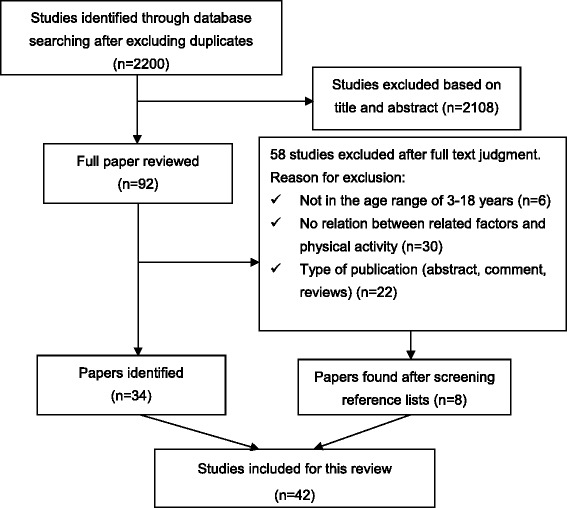
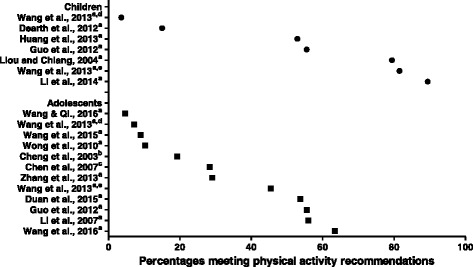
BACKGROUND: Lack of physical activity is a growing problem in China, due to the fast economic development and changing living environment over the past two decades. The aim of this review is to summarize the factors related to physical activity in Chinese children and adolescents during this distinct period of development. METHODS: , 2017, and identified 2200 hits through PubMed and Web of Science. English-language published studies were included if they reported statistical associations between factors and physical activity. Adapted criteria from the Strengthening The Reporting of OBservational studies in Epidemiology (STROBE) statement and evaluation of the quality of prognosis studies in systematic reviews (QUIPS) were used to assess the risk of bias of the included studies. Related factors that were reported in at least three studies were summarized separately for children and adolescents using a semi-quantitative method. RESULTS: Forty two papers (published 2002-2016) were included. Most designs were cross-sectional (79%), and most studies used questionnaires to assess physical activity. Sample size was above 1000 in 18 papers (43%). Thirty seven studies (88%) showed acceptable quality by methodological quality assessment. Most studies reported a low level of physical activity. Boys were consistently more active than girls, the parental physical activity was positively associated with children and adolescents' physical activity, children in suburban/rural regions showed less activity than in urban regions, and, specifically in adolescents, self-efficacy was positively associated with physical activity. Family socioeconomic status and parental education were not associated with physical activity in children and adolescents. CONCLUSIONS: The studies included in this review were large but mostly of low quality in terms of study design (cross-sectional) and methods (questionnaires). Parental physical activity and self-efficacy are promising targets for future physical activity promotion programmes. The low level of physical activity raises concern, especially in suburban/rural regions. Future research is required to enhance our understanding of other influences, such as the physical environment, especially in early childhood.
Overview
The claims and statistics of this paper haven’t been checked yet.
Run the check — free, no account needed. It reads the open-access text and checks the sources it cites.
Integrity signals
Registry
Cites
Statistics
Figures
Verification
Claims the paper makes
The claims and statistics of this paper haven’t been checked yet.
Run the check — free, no account needed. It reads the open-access text and checks the sources it cites.
Claims other papers make about this one
Each is checked against this paper’s own text: does it say what the citing paper says it does?
In the citing paper
“Evidence from China indicates that there is a positive association between various forms of parental support, including parental encouragement, accompaniment, financial support, involvement, and role modelling, and high levels of physical activity participation among children and adolescents.106–108”
From Physical activity and health in Chinese children and adolescents: expert consensus statement (2020) (2020) · cites this paper as [106]
In the citing paper
“There is no clear evidence from China to suggest that socioeconomic status (eg, family socioeconomic status, parental education) is associated with levels of physical activity among Chinese children and adolescents.106”
From Physical activity and health in Chinese children and adolescents: expert consensus statement (2020) (2020) · cites this paper as [106]
Self-check
Percentages, sums and reported differences re-computed from the paper’s own numbers.
The self-check needs the paper’s full text.
Citations
Cites
Preferred Reporting Items for Systematic Reviews and Meta-Analyses: the PRISMA statement
Moher, D., Liberati, A., Tetzlaff, J., Altman, D. G., & for the PRISMA Group (2009) · BMJ · doi:10.1136/bmj.b2535 · Cited by 83,823
Preferred reporting items for systematic reviews and meta-analyses: The PRISMA statement
Moher, D., Liberati, A., Tetzlaff, J., & Altman, D. G. (2010) · International Journal of Surgery · doi:10.1016/j.ijsu.2010.02.007 · Cited by 12,156
‘Small Changes' to Diet and Physical Activity Behaviors for Weight Management
Hills, A. P., Byrne, N. M., Lindstrom, R. C., & Hill, J. O. (2013) · Obesity Facts · doi:10.1159/000345030 · Cited by 9,526
Vandenbroucke, J. P., von Elm, E., Altman, D. G., Gøtzsche, P. C., Mulrow, C. D., Pocock, S. J., Poole, C., Schlesselman, J. J., Egger, M., & Initiative, F. T. S. (2007) · PLoS Medicine · doi:10.1371/journal.pmed.0040297 · Cited by 8,613
Global physical activity levels: surveillance progress, pitfalls, and prospects
Hallal, P. C., Andersen, L. B., Bull, F. C., Guthold, R., Haskell, W., & Ekelund, U. (2012) · The Lancet · doi:10.1016/s0140-6736(12)60646-1 · Cited by 5,711
Janssen, I., & LeBlanc, A. G. (2010) · International Journal of Behavioral Nutrition and Physical Activity · doi:10.1186/1479-5868-7-40 · Cited by 4,829
A review of correlates of physical activity of children and adolescents
SALLIS, J. F., PROCHASKA, J. J., & TAYLOR, W. C. (2000) · Medicine & Science in Sports & Exercise · doi:10.1097/00005768-200005000-00014 · Cited by 4,421
Correlates of physical activity: why are some people physically active and others not?
Bauman, A. E., Reis, R. S., Sallis, J. F., Wells, J. C., Loos, R. J., & Martin, B. W. (2012) · The Lancet · doi:10.1016/s0140-6736(12)60735-1 · Cited by 4,151
Vandenbroucke, J. P., von Elm, E., Altman, D. G., Gøtzsche, P. C., Mulrow, C. D., Pocock, S. J., Poole, C., Schlesselman, J. J., & Egger, M. (2007) · Epidemiology · doi:10.1097/ede.0b013e3181577511 · Cited by 2,779
Evaluation of the Quality of Prognosis Studies in Systematic Reviews
Hayden, J. A., Côté, P., & Bombardier, C. (2006) · Annals of Internal Medicine · doi:10.7326/0003-4819-144-6-200603210-00010 · Cited by 1,452
Research works printed but not linked: 1
- World Health Organization. Global recommendations on physical activity for health. Geneva: World Health Organization; 2010.
Cited by
Sorted by citations
Items 101–155 of 155
THE COGNITIVE SCIENCE OF URBAN SPACE DESIGN FOR CHILDREN
Christie, S., Lyu, J., Fang, Y., & Xili, H. (2020) · Landscape Architecture Frontiers · doi:10.15302/j-laf-1-030014 · Cited by 4
Effect of family life quality on youth badminton athletes' identity and achievement
Zhu, D., li, Y., & Tang, C. (2025) · Frontiers in Psychology · doi:10.3389/fpsyg.2025.1559107 · Cited by 2
A healthy behavior and socioeconomic inequality in school-age children in the West of Iran
Karyani, A. K., Matin, B. K., Kazemi, Z., Soltani, S., Ebrahimi, M., & Rezaei, S. (2020) · Journal of Education and Health Promotion · doi:10.4103/jehp.jehp_418_19 · Cited by 2
Getachew, E., Wasihun, Y., Gutema, H., Bogale, E. K., Shewaye, M., Dessie, A. M., & Yenew, C. (2023) · BMJ Open Sport & Exercise Medicine · doi:10.1136/bmjsem-2022-001424 · Cited by 2
Siagian, L. A., Agustiningsih, D., & Supriyati, S. (2023) · Malaysian Journal of Medicine and Health Sciences · doi:10.47836/mjmhs.19.5.17 · Cited by 2
Zhao, H., Chen, H., Luo, Y., & Xiao, M. (2024) · Journal of Public Health · doi:10.1007/s10389-024-02316-w · Cited by 2
Chao, W.-C., Khan, A., Shih, J.-C., Li, W., Wu, C.-L., Chen, K.-C., & Cheng, B. (2025) · Children · doi:10.3390/children12030329 · Cited by 2
Santiworakul, A., Piya-amornphan, N., Srirug, P., Amornsriwatanakul, A., Kumban, W., & Cetthakrikul, S. (2022) · Child & Youth Services · doi:10.1080/0145935x.2022.2119953 · Cited by 2
Đido, V., Pilav, A., Marjanović, M., Phillips, J., Švaljug, D., Boskovic, S., Konjo, H., & Omerović, Đ. (2020) · Journal of Health Sciences · doi:10.17532/jhsci.2020.1072 · Cited by 2
Orientación familiar y hábitos saludables en estudiantes de Educación Primaria
Galiano, I. M. M., Díaz, C. P., & Torres‐Luque, G. (2021) · REOP - Revista Española de Orientación y Psicopedagogía · doi:10.5944/reop.vol.32.num.3.2021.32556 · Cited by 2
Deng, Y., Li, X., Huang, J., Liang, X., Sit, C. H. P., & Li, C. (2025) · Adapted Physical Activity Quarterly · doi:10.1123/apaq.2024-0172 · Cited by 1
Omojor-Oche, J. E. O., Tempest, G. D., Hettinga, F. J., & McCullogh, N. (2025) · PLoS ONE · doi:10.1371/journal.pone.0324781 · Cited by 2
Feng, Y., Luo, X., Li, X., Liu, Y., & Zeng, Y. (2025) · BMC Psychology · doi:10.1186/s40359-025-02996-3 · Cited by 1
Valladares-Garrido, M. J., Hernández-Yépez, P. J., Castillo, S. A., Aguilar-Manay, L. A., Vásquez, J. S., León‐Figueroa, D. A., Vera-Ponce, V. J., Valladares-Garrido, D., Aguirre-Milachay, E., Failoc‐Rojas, V. E., et al. (2025) · BMC Public Health · doi:10.1186/s12889-025-23596-1 · Cited by 1
Pan, S., Lin, Y., Chen, Y., Cao, R., & Zhang, Y. (2025) · International Journal of Sport and Exercise Psychology · doi:10.1080/1612197x.2025.2547366 · Cited by 1
Understanding the “how” and “why”: A mixed methods process evaluation for the PRO-HIIT intervention
Liu, Y., Barker, A. R., Li, M., Adlam, A., Duncombe, S. L., Agbaje, A. O., Gu, Y., Zhou, H., & Williams, C. A. (2026) · PLoS ONE · doi:10.1371/journal.pone.0352772 · Cited by 1
Visualized Analysis of Research Publications on Physical Activity among Higher Education Students
Sweileh, W. M. (2023) · American Journal of Health Education · doi:10.1080/19325037.2023.2232427 · Cited by 1
Chen, J., & Yao, S. (2025) · Youth & Society · doi:10.1177/0044118x251329505 · Cited by 1
Reliability and Validity of the HBSC Physical Activity Questionnaire in Japanese Adolescents
Tanaka, C., Watanabe, M., Oishi, K., Reilly, J. J., Ishii, K., & Tanaka, S. (2025) · Children · doi:10.3390/children12101360 · Cited by 1
Compliance with a physical activity guideline among junior high school students
Tanaka, C., Abe, T., Takenaga, R., Suzuki, T., Noi, S., Tanaka, S., Miyachi, M., Inoue, S., Hatamoto, Y., & Reilly, J. J. (2021) · Pediatrics International · doi:10.1111/ped.14716 · Cited by 1
Rišová, K. (2022) · Sociológia - Slovak Sociological Review · doi:10.31577/sociologia.2022.54.4.13 · Cited by 1
Xia, J., Chen, P., Wang, J.-H., Zhuang, J., Cao, Z., & Zhang, Q. (2019) · Preprints.org · doi:10.20944/preprints201912.0015.v1 · Cited by 1
Physical Activity and Health in Dutch and Chinese Children
Lu, C. (2020) · doi:10.33612/diss.131752838
Self-citationLeng, B., Fang, H., & Ho, I. M. K. (2022) · Science & Sports · doi:10.1016/j.scispo.2021.05.008
Su, X., Yan, Q., Kovess–Masféty, V., Li, P., Li, M., Yan, G., Yin, H., & Xu, G. (2023) · Research Square · doi:10.21203/rs.3.rs-2900299/v1 · Cited by 1
Primo, L., Hernández, J. G., Yang, Y., & de Subijana, C. L. (2023) · Frontiers in Education · doi:10.3389/feduc.2023.1265793
THE IMPACT OF EXERCISE ON ANXIETY AMONG BEIJING STUDENTS
Hongzhu, L., Samu, Q. B., & Xing, L. (2023) · International Journal of Entrepreneurship Business and Technology · doi:10.59021/ijebt.v1i2.71
Sha-sha, W., & Sungkawadee, P. (2024) · International Journal of Sociologies and Anthropologies Science Reviews · doi:10.60027/ijsasr.2024.3852
Shahzad, S., Iqbal, S., & Ahmed, H. (2024) · Allied Medical Research Journal · doi:10.59564/amrj/02.01/010
Azimkhani, A. (2024) · Journal of Motor Control and Learning · doi:10.5812/jmcl-146114
Li, J., Zheng, S., Wang, L., Li, J., & Diao, Y. (2024) · Child Care Health and Development · doi:10.1111/cch.13275 · Cited by 2
Li, Y., Wang, J., Li, D., Li, Y., Xu, Y., & Li, Y. (2024) · Healthcare · doi:10.3390/healthcare12181889
A chat about sedentarism in adolescence
Silva, R. M. F., Felício, C. M., Ferreira, J. C., & Noll, M. A. (2024) · Revista Brasileira da Educação Profissional e Tecnológica · doi:10.15628/rbept.2024.13603
Healthy Lifestyle Self-Management Strategies of Sports School Students
Shmarion, Y. V., & Degtyareva, M. V. (2024) · ЗДОРОВЬЕ НАСЕЛЕНИЯ И СРЕДА ОБИТАНИЯ - ЗНиСО / PUBLIC HEALTH AND LIFE ENVIRONMENT · doi:10.35627/2219-5238/2024-32-12-22-31
Why Do Most Children Not Walk or Cycle to and from School?
Fitriani, A., & Hidayati (2025) · Jurnal PROMKES · doi:10.20473/jpk.v13.i1.2025.65-75
Chen, Q., Jiang, L., Hui, Y., Xin, G., Li, P., Wang, Y., Gao, T., Li, Q., Wang, X., Wang, X., et al. (2025) · Applied Developmental Science · doi:10.1080/10888691.2025.2476619
The Impact of Fun Sports on the Changes in Middle School Students' Exercise Behavior Habits
Sun, G. (2025) · Advances in Education Humanities and Social Science Research · doi:10.56028/aehssr.13.1.740.2025
Yang, W., Zhao, Z., Gao, P., Guo, X., Jia, X., & Białas, M. (2025) · Frontiers in Public Health · doi:10.3389/fpubh.2025.1556246 · Cited by 1
López-Obregon, D., Martínez‐Flores, R., Ferrari, G., Jorquera-Aguilera, C., & Rodríguez‐Rodríguez, F. (2025) · Health Education & Behavior · doi:10.1177/10901981251396549 · Cited by 1
Huang, W., Shi, X., Wang, Y., Li, X., Gao, P., Lu, J., & Zhuang, J. (2021) · Figshare · doi:10.6084/m9.figshare.14228434
An, M., Chen, T., Zhou, Q., & Ma, J. (2021) · Figshare · doi:10.6084/m9.figshare.16714305
Carver, A., Cerin, E., Akram, M., Sallis, J. F., Cain, K. L., Frank, L. D., Geremia, C. M., Conway, T. L., Glanz, K., & Saelens, B. E. (2023) · Figshare · doi:10.6084/m9.figshare.22606057
Carver, A., Cerin, E., Akram, M., Sallis, J. F., Cain, K. L., Frank, L. D., Geremia, C. M., Conway, T. L., Glanz, K., & Saelens, B. E. (2023) · Figshare · doi:10.6084/m9.figshare.22606063
Guo, M. M., Koh, K. T., & Wang, X. Z. (2024) · Figshare · doi:10.6084/m9.figshare.26719983
Carver, A., Akram, M., Barnett, A. H., Huang, W. Y., Gao, G. Y., Mellecker, R. R., & Cerin, E. (2021) · Figshare · doi:10.6084/m9.figshare.13612191
Carver, A., Cerin, E., Akram, M., Sallis, J. F., Cain, K. L., Frank, L. D., Geremia, C. M., Conway, T. L., Glanz, K., & Saelens, B. E. (2023) · Figshare · doi:10.6084/m9.figshare.22606060
An, M., Chen, T., Zhou, Q., & Ma, J. (2021) · Figshare · doi:10.6084/m9.figshare.16714302
Carver, A., Cerin, E., Akram, M., Sallis, J. F., Cain, K. L., Frank, L. D., Geremia, C. M., Conway, T. L., Glanz, K., & Saelens, B. E. (2023) · Figshare · doi:10.6084/m9.figshare.22606054
Hong, C., Tsai, R.-T., Fabricant, P. D., Wang, C.-H., Lee, S.-Y., Shih, C., & Wang, J.-H. (2026) · Orthopaedic Journal of Sports Medicine · doi:10.1177/23259671251408800
Christianson, K., Jiang, H. Q., Zeng, F., Yin, A., Li, X., Fan, J., Baillargeon, J., Mâsse, L. C., González, O. D.-J., Abdelouahab, N., et al. (2026) · International Journal for Equity in Health · doi:10.1186/s12939-026-02878-z
Limited physical literacy outcomes in Singapore children: Implications for public health practice
Tay, V., Morrison, S. A., Padmapriya, N., Bernard, J. Y., Müller‐Riemenschneider, F., Lee, Y. S., Chong, Y. S., Yap, F., Eriksson, J. G., & LEE, J. K. W. (2026) · Journal of Exercise Science & Fitness · doi:10.1016/j.jesf.2026.200517
Xu, P., Li, M., & Jia, K. (2026) · Frontiers in Psychology · doi:10.3389/fpsyg.2026.1929519
Li, P., Hui, Y., Chen, Q., Xin, G., Wang, Y., Xu, J., Luo, P., & Wang, X. (2026) · Acta Psychologica · doi:10.1016/j.actpsy.2026.108001
Lin, Y., Jiang, J., Huang, Z., Chen, X., Alias, H., Wong, L. P., & Hu, Z. (2026) · Current Psychology · doi:10.1007/s12144-026-10185-7
Metadata
- Authors
- Lu, C., Stolk, R. P., Sauer, P. J. J., Sijtsma, A., Wiersma, R., Huang, G., & Corpeleijn, E.
- Affiliations
- University Medical Center Groningen (NL)
- Tianjin Medical University (CN)
- Corresponding author
- Lu, Congchao
- Venue
- International Journal of Behavioral Nutrition and Physical Activity
- Published
- 2017-03-21
- Volume
- 14
- Issue
- 1
- Pages
- 36-36
- ISSN
- 1479-5868 (ISSN-L)
- PMC
- PMC5360041
- OpenAlex
- W2599960949
- Cited by
- 155
- References
- 96
- Citations by year
- 2026: 8 · 2025: 18 · 2024: 18 · 2023: 22 · 2022: 18 · 2021: 21 · 2020: 23 · 2019: 9 · 2018: 15 · 2017: 3
- FWCI
- 1.68
- Type
- journal article
- Language
- en
- Open access
- gold
- doi.org
- Licence
- cc-by
- Locations
- International Journal of Behavioral Nutrition and Physical Activity (publishedVersion, cc-by)
- PubMed Central (publishedVersion, cc-by)
- PubMed (publishedVersion)
- University of Groningen research database (University of Groningen / Centre for Information Technology) (submittedVersion, cc-by)
- Funders
- Universitair Medisch Centrum Groningen
- Topics
- Health Sciences › Medicine › Public Health, Environmental and Occupational Health › Physical Activity and Health
- Health Sciences › Medicine › Public Health, Environmental and Occupational Health › Obesity, Physical Activity, Diet
- Social Sciences › Life-span and Life-course Studies › Recreational Sport and Physical Activity
- Keywords
- physical activity, children, adolescents, Chinese children, parental physical activity, self-efficacy, sex differences, urban-rural differences, socioeconomic status, physical activity promotion, physical environment
- MeSH terms
- Adolescent, Adolescent Behavior, Child, Child Behavior, China, Cross-Sectional Studies, Female, Humans, Male, Parents, Surveys and Questionnaires, Exercise, Self Efficacy, Observational Studies as Topic
About these checks
Registry, retraction, Cites and statistics results are computed, not judged, with one exception: a printed reference that no index lists is read once by a model before it counts as a citation error. Claims are extracted by a model and kept only when their quote appears verbatim in the text; each cited source is then checked, with a model’s help, for whether it says what the claim relies on. Those verdicts can be wrong — read the claim’s quote and the cited source before relying on one.
Statistics and arithmetic are recomputed, not judged.
Confidence bands are shown only for fields calibrated on our annotated test set. None is calibrated yet, so no band is shown.
What counts as a claim ›How we measure confidence ›How we check this ›
Are you an author, or do you see a problem with this page? Request a review
