

The DOI matches its Crossref record; 67 of the 67 references it cites were found in a registry or an index.
Depression, emotional eating and long-term weight changes: a population-based prospective study
Open accessAbstract
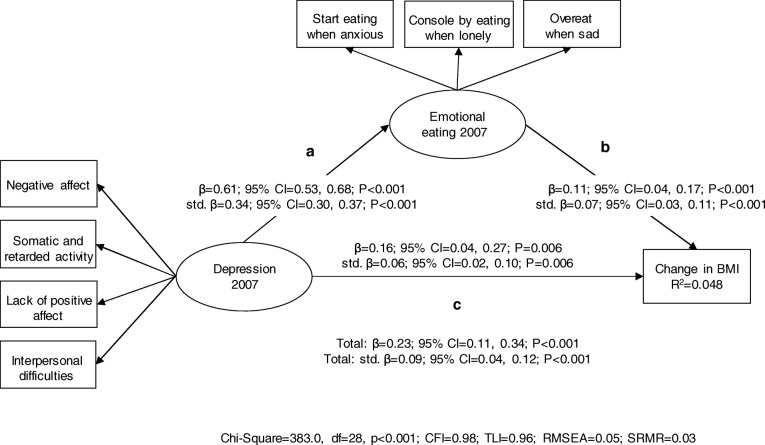
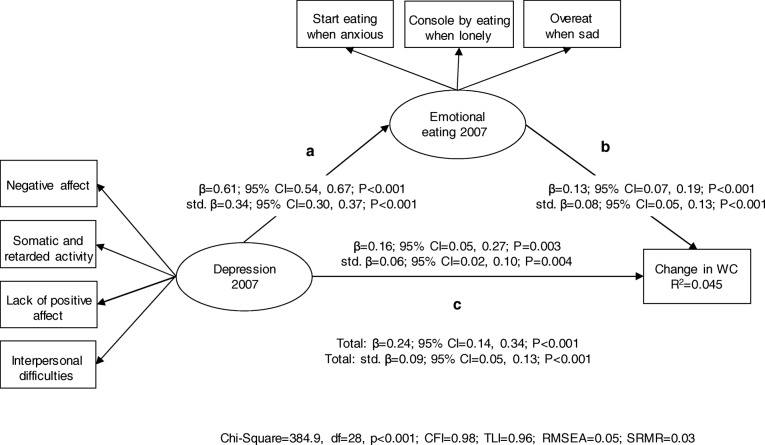
BACKGROUND: Emotional eating (i.e. eating in response to negative emotions) has been suggested to be one mechanism linking depression and subsequent development of obesity. However, studies have rarely examined this mediation effect in a prospective setting and its dependence on other factors linked to stress and its management. We used a population-based prospective cohort of adults and aimed to examine 1) whether emotional eating mediated the associations between depression and 7-year change in body mass index (BMI) and waist circumference (WC), and 2) whether gender, age, night sleep duration or physical activity moderated these associations. METHODS: Participants were Finnish 25- to 74-year-olds who attended the DILGOM study at baseline in 2007 and follow-up in 2014. At baseline (n = 5024), height, weight and WC were measured in a health examination. At follow-up (n = 3735), height, weight and WC were based on measured or self-reported information. Depression (Center for Epidemiological Studies - Depression Scale), emotional eating (Three-Factor Eating Questionnaire-R18), physical activity and night sleep duration were self-reported. Age- and gender-adjusted structural equation models with full information maximum likelihood estimator were used in the analyses. RESULTS: = 0.045). The effects of depression on change in BMI and WC were mediated by emotional eating. Night sleep duration moderated the associations of emotional eating, while age moderated the associations of depression. More specifically, emotional eating predicted higher BMI (P = 0.007 for the interaction) and WC (P = 0.026, respectively) gain in shorter sleepers (7 h or less), but not in longer sleepers (9 h or more). Depression predicted higher BMI (P < 0.001 for the interaction) and WC (P = 0.065, respectively) increase in younger participants, but not in older participants. CONCLUSIONS: Our findings offer support for the hypothesis that emotional eating is one behavioural mechanism between depression and development of obesity and abdominal obesity. Moreover, adults with a combination of shorter night sleep duration and higher emotional eating may be particularly vulnerable to weight gain. Future research should examine the clinical significance of our observations by tailoring weight management programs according to these characteristics.
Overview
The claims and statistics of this paper haven’t been checked yet.
Run the check — free, no account needed. It reads the open-access text and checks the sources it cites.
Integrity signals
Registry
Cites
Statistics
Figures
Verification
Claims the paper makes
The claims and statistics of this paper haven’t been checked yet.
Run the check — free, no account needed. It reads the open-access text and checks the sources it cites.
Claims other papers make about this one
Each is checked against this paper’s own text: does it say what the citing paper says it does?
The source backs part of the claim, not all of it — or backs it for a different population, condition or comparison.
In the citing paper
“In addition to depression, emotion-based eating is associated with many other factors, including emotion dysregulation, poor emotion regulation skills, low distress tolerance, dietary restraint, loss of control of eating, poor awareness of hunger/fullness signals, body image dissatisfaction, internalized shame, and low self-compassion (24–29).”
From Behavioral Interventions to Attenuate Driven Overeating and Weight Regain After Bariatric Surgery (2022) · cites this paper as [24]
Experimental — accuracy not yet measuredThe cited source says what the claim attributes to it.
In the citing paper
“Indeed, a recent population-based study demonstrated that emotion-based eating appears to be a plausible pathway between depression and the development of obesity (24).”
From Behavioral Interventions to Attenuate Driven Overeating and Weight Regain After Bariatric Surgery (2022) · cites this paper as [24]
The check wasn’t confident either way, so it gives no verdict — never disputed.
In the citing paper
“Evidence suggests that food consumption and weight increased during the pandemic while physical activity decreased, particularly among those with higher BMI [2, 3, 4, 5, 6].”
From Supporting Weight Management during COVID-19: A Randomized Controlled Trial of a Web-Based, ACT-Based, Guided Self-Help Intervention (2022) · cites this paper as [5]
Experimental — accuracy not yet measured
Self-check
Percentages, sums and reported differences re-computed from the paper’s own numbers.
The self-check needs the paper’s full text.
Citations
Cites
Diagnostic and Statistical Manual of Mental Disorders
American Psychiatric Association (2013) · doi:10.1176/appi.books.9780890425596 · Cited by 116,369
Diagnostic and Statistical Manual of Mental Disorders
Williams, J. B. W., & First, M. B. (2013) · Oxford University Press eBooks · doi:10.1093/acrefore/9780199975839.013.104 · Cited by 109,845
Hu, L., & Bentler, P. M. (1999) · Structural Equation Modeling A Multidisciplinary Journal · doi:10.1080/10705519909540118 · Cited by 108,788
The CES-D Scale: A Self-Report Depression Scale for Research in the General Population
Radloff, L. S. (1977) · Applied Psychological Measurement · doi:10.1177/014662167700100306 · Cited by 53,267
Statistical Analysis With Missing Data
Lahiff, M., Little, R. J. A., & Rubin, D. B. (1989) · Journal of the American Statistical Association · doi:10.2307/2289883 · Cited by 17,385
Statistical Analysis with Missing Data
Little, R. J. A., & Rubin, D. B. (2002) · Wiley Series in Probability and Statistics · doi:10.1002/9781119013563 · Cited by 8,473
Introduction to Statistical Mediation Analysis
MacKinnon, D. P. (2012) · doi:10.4324/9780203809556 · Cited by 5,618
Overweight, Obesity, and Depression: A Systematic Review and Meta-analysis of Longitudinal Studies
Luppino, F. S., de Wit, L. M., Bouvy, P. F., Stijnen, T., Cuijpers, P., Penninx, B. W. J. H., & Zitman, F. G. (2010) · Archives of General Psychiatry · doi:10.1001/archgenpsychiatry.2010.2 · Cited by 4,322
Valeri, L., & VanderWeele, T. J. (2013) · Psychological Methods · doi:10.1037/a0031034 · Cited by 2,132
Missing Data Techniques for Structural Equation Modeling.
Allison, P. D. (2003) · Journal of Abnormal Psychology · doi:10.1037/0021-843x.112.4.545 · Cited by 1,335
Cited by
Sorted by citations
Dakanalis, A., Mentzelou, M., Papadopoulou, S. K., Papandreou, D., Spanoudaki, M., Vasios, G. K., Pavlidou, E., Mantzorou, M., & Giaginis, C. (2023) · Nutrients · doi:10.3390/nu15051173 · Cited by 463
Emotional eating and obesity in adults: the role of depression, sleep and genes
Konttinen, H. M. (2020) · Proceedings of The Nutrition Society · doi:10.1017/s0029665120000166 · Cited by 339
Self-citationBemanian, M., Mæland, S., Blomhoff, R., Rabben, Å. K., Arnesen, E., Skogen, J. C., & Fadnes, L. T. (2020) · International Journal of Environmental Research and Public Health · doi:10.3390/ijerph18010130 · Cited by 137
Emotions and Food Consumption: Emotional Eating Behavior in a European Population
Ljubičić, M., Sarić, M. M., Klarin, I., Rumbak, I., Barić, I. C., Ranilović, J., Dželalija, B., Sarić, A., Nakić, D., Djekic, I. V., et al. (2023) · Foods · doi:10.3390/foods12040872 · Cited by 110
González, C. E. F., Chávez‐Servín, J. L., de la Torre‐Carbot, K., Ronquillo, D., Barreiro, M. D. L. Á. A., & Ojeda-Navarro, L. R. (2022) · Journal of Obesity · doi:10.1155/2022/4243868 · Cited by 104
Metadata
- Authors
- Konttinen, H., van Strien, T., Männistö, S., Jousilahti, P., & Haukkala, A.
- Affiliations
- University of Helsinki (FI)
- Finnish Institute for Health and Welfare (FI)
- Corresponding author
- Konttinen, Hanna
- Venue
- International Journal of Behavioral Nutrition and Physical Activity
- Published
- 2019-03-20
- Volume
- 16
- Issue
- 1
- Pages
- 28-28
- ISSN
- 1479-5868 (ISSN-L)
- PMC
- PMC6427874
- OpenAlex
- W2923007378
- Cited by
- 341
- References
- 67
- Citations by year
- 2026: 47 · 2025: 69 · 2024: 57 · 2023: 52 · 2022: 54 · 2021: 33 · 2020: 25 · 2019: 4
- FWCI
- 33.87
- Type
- journal article
- Language
- en
- Open access
- gold
- doi.org
- Licence
- Locations
- International Journal of Behavioral Nutrition and Physical Activity (publishedVersion, cc-by)
- Europe PMC (PubMed Central) (publishedVersion, cc-by)
- PubMed Central (publishedVersion, cc-by)
- VU Research Portal (publishedVersion, other-oa)
- PubMed (publishedVersion)
- DOAJ (DOAJ: Directory of Open Access Journals) (submittedVersion, cc-by-sa)
- Työväentutkimus Vuosikirja (submittedVersion)
- Radboud Repository (Radboud University) (submittedVersion)
- STM:n Hallinnonalan avoin julkaisuarkisto (Julkari) (submittedVersion)
- Radboud Repository (Radboud University) (submittedVersion, other-oa)
- Data Archiving and Networked Services (DANS) (submittedVersion, other-oa)
- Funders
- European Union (Funding of Tatjana van Strien was provided by the European Union FP7 MoodFood Project ‘Multi-country collaborative project on the role of Diet, Food-related behaviour, and Obesity in the prevention of Depression’ (grant agreement no. 613598).)
- Academy of Finland (265796 and 309157, 136895 and 263836, 118065, 118139 and 275033)
- Emil Aaltosen Säätiö (Not applicable)
- Yrjö Jahnssonin Säätiö (Not applicable)
- Juho Vainion Säätiö (Not applicable)
- Topics
- Social Sciences › Psychology › Clinical Psychology › Eating Disorders and Behaviors
- Health Sciences › Nursing › Nutrition and Dietetics › Nutrition, Health and Food Behavior
- Health Sciences › Medicine › Public Health, Environmental and Occupational Health › Obesity, Physical Activity, Diet
- Keywords
- depression, emotional eating, obesity, abdominal obesity, body mass index, waist circumference, weight gain, mediation, sleep duration, physical activity, age differences, gender differences
- MeSH terms
- Adult, Aged, Depression, Eating, Emotions, Feeding Behavior, Finland, Humans, Middle Aged, Prospective Studies, Surveys and Questionnaires, Weight Gain
About these checks
Registry, retraction, Cites and statistics results are computed, not judged, with one exception: a printed reference that no index lists is read once by a model before it counts as a citation error. Claims are extracted by a model and kept only when their quote appears verbatim in the text; each cited source is then checked, with a model’s help, for whether it says what the claim relies on. Those verdicts can be wrong — read the claim’s quote and the cited source before relying on one.
Statistics and arithmetic are recomputed, not judged.
Confidence bands are shown only for fields calibrated on our annotated test set. None is calibrated yet, so no band is shown.
What counts as a claim ›How we measure confidence ›How we check this ›
Are you an author, or do you see a problem with this page? Request a review
