

The DOI matches its Crossref record; 54 of the 54 references it cites were found in a registry or an index.
New global guidelines on sedentary behaviour and health for adults: broadening the behavioural targets
Open accessAbstract
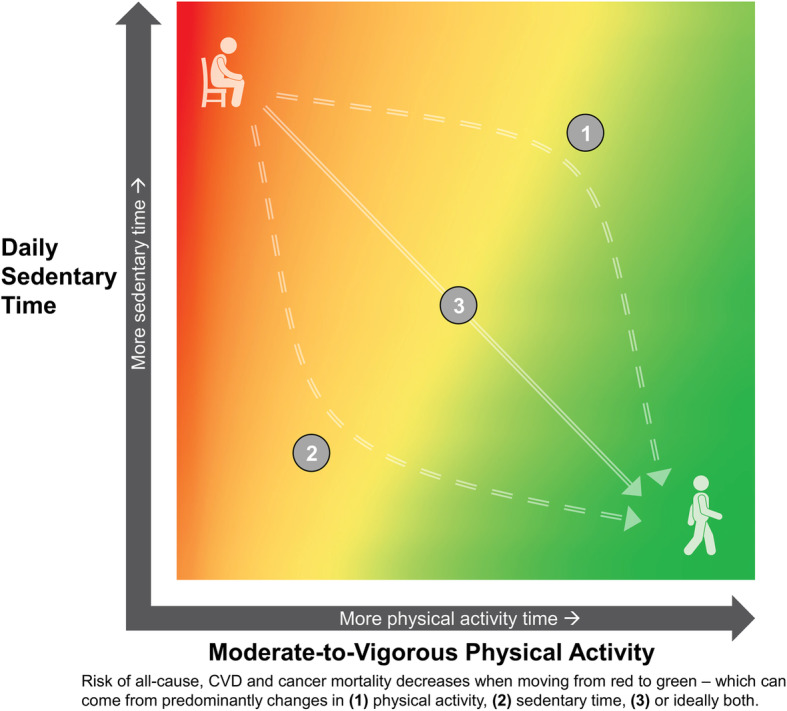
Background: In 2018, the World Health Organisation (WHO) commenced a program of work to update the 2010 Global Recommendations on Physical Activity for Health, for the first-time providing population-based guidelines on sedentary behaviour. This paper briefly summarizes and highlights the scientific evidence behind the new sedentary behaviour guidelines for all adults and discusses its strengths and limitations, including evidence gaps/research needs and potential implications for public health practice. Methods: An overview of the scope and methods used to update the evidence is provided, along with quality assessment and grading methods for the eligible new systematic reviews. The literature search update was conducted for WHO by an external team and reviewers used the AMSTAR 2 (Assessment of Multiple Systematic Reviews) tool for critical appraisal of the systematic reviews under consideration for inclusion. The Grading of Recommendations Assessment, Development and Evaluation (GRADE) method was used to rate the certainty (i.e. very low to high) of the evidence. Results: The updated systematic review identified 22 new reviews published from 2017 up to August 2019, 14 of which were incorporated into the final evidence profiles. Overall, there was moderate certainty evidence that higher amounts of sedentary behaviour increase the risk for all-cause, cardiovascular disease (CVD) and cancer mortality, as well as incidence of CVD, cancer, and type 2 diabetes. However, evidence was deemed insufficient at present to set quantified (time-based) recommendations for sedentary time. Moderate certainty evidence also showed that associations between sedentary behaviour and all-cause, CVD and cancer mortality vary by level of moderate-to-vigorous physical activity (MVPA), which underpinned additional guidance around MVPA in the context of high sedentary time. Finally, there was insufficient or low-certainty systematic review evidence on the type or domain of sedentary behaviour, or the frequency and/or duration of bouts or breaks in sedentary behaviour, to make specific recommendations for the health outcomes examined. Conclusions: The WHO 2020 guidelines are based on the latest evidence on sedentary behaviour and health, along with interactions between sedentary behaviour and MVPA, and support implementing public health programmes and policies aimed at increasing MVPA and limiting sedentary behaviour. Important evidence gaps and research opportunities are identified.
Overview
The claims and statistics of this paper haven’t been checked yet.
Run the check — free, no account needed. It reads the open-access text and checks the sources it cites.
Integrity signals
Registry
Cites
Statistics
Figures
Verification
Claims the paper makes
The claims and statistics of this paper haven’t been checked yet.
Run the check — free, no account needed. It reads the open-access text and checks the sources it cites.
Claims other papers make about this one
Each is checked against this paper’s own text: does it say what the citing paper says it does?
The source backs part of the claim, not all of it — or backs it for a different population, condition or comparison.
In the citing paper
“Sedentary behavior, characterized by wakefulness with low energy expenditure (≤ 1.5 METs), is closely associated with various adverse health outcomes [1]. It increases the risk of chronic non-communicable diseases and all-cause mortality, diminishes positive affect, and increases susceptibility to depression and anxiety [2, 3].”
From Effect of classroom physical activity breaks on learning behaviors and academic achievements in university students: a systematic review (2026) · cites this paper as [2]
Experimental — accuracy not yet measured
Self-check
Percentages, sums and reported differences re-computed from the paper’s own numbers.
The self-check needs the paper’s full text.
Citations
Cites
GRADE: an emerging consensus on rating quality of evidence and strength of recommendations
Guyatt, G. H., Oxman, A. D., Vist, G. E., Kunz, R., Falck-Ytter, Y., Alonso-Coello, P., & Schünemann, H. J. (2008) · BMJ · doi:10.1136/bmj.39489.470347.ad · Cited by 23,305 · cited 1×
“very low to high) of the evidence for each PI/ECO (see Additional File 1) [19, 20].”
BackgroundWorld Health Organization 2020 guidelines on physical activity and sedentary behaviour
Bull, F. C., Al-Ansari, S. S., Biddle, S., Borodulin, K., Buman, M. P., Cardon, G., Carty, C., Chaput, J.-P., Chastin, S., Chou, R., et al. (2020) · British Journal of Sports Medicine · doi:10.1136/bjsports-2020-102955 · Cited by 11,657 · cited 6×
“The guideline development process followed WHO protocols [15] and included establishing a guideline development group (GDG) who met in July 2019 to review and finalise the scope and agree on the methods.”
BackgroundMethodInfluentialSelf-citationShea, B. J., Reeves, B. C., Wells, G., Thuku, M., Hamel, C., Moran, J., Moher, D., Tugwell, P., Welch, V., Kristjansson, E., et al. (2017) · BMJ · doi:10.1136/bmj.j4008 · Cited by 10,636
GRADE guidelines: 3. Rating the quality of evidence
Balshem, H., Helfand, M., Schünemann, H. J., Oxman, A. D., Kunz, R., Brozek, J., Vist, G. E., Falck-Ytter, Y., Meerpohl, J., & Norris, S. (2011) · Journal of Clinical Epidemiology · doi:10.1016/j.jclinepi.2010.07.015 · Cited by 8,285
Guthold, R., Stevens, G. A., Riley, L. M., & Bull, F. C. (2018) · The Lancet Global Health · doi:10.1016/s2214-109x(18)30357-7 · Cited by 4,819
Self-citationSedentary Behavior Research Network (SBRN)—Terminology Consensus Project process and outcome
on behalf of SBRN Terminology Consensus Project Participants, Tremblay, M. S., Aubert, S., Barnes, J. D., Saunders, T. J., Carson, V., Latimer-Cheung, A. E., Chastin, S. F. M., Altenburg, T. M., & Chinapaw, M. J. M. (2017) · International Journal of Behavioral Nutrition and Physical Activity · doi:10.1186/s12966-017-0525-8 · Cited by 3,793
Self-citationBiswas, A., Oh, P. I., Faulkner, G. E., Bajaj, R. R., Silver, M. A., Mitchell, M. S., & Alter, D. A. (2015) · Annals of Internal Medicine · doi:10.7326/m14-1651 · Cited by 2,726
Ekelund, U., Steene-Johannessen, J., Brown, W. J., Fagerland, M. W., Owen, N., Powell, K. E., Bauman, A., & Lee, I.-M. (2016) · The Lancet · doi:10.1016/s0140-6736(16)30370-1 · Cited by 2,648
Self-citationEkelund, U., Tarp, J., Steene-Johannessen, J., Hansen, B. H., Jefferis, B., Fagerland, M. W., Whincup, P., Diaz, K. M., Hooker, S. P., Chernofsky, A., et al. (2019) · BMJ · doi:10.1136/bmj.l4570 · Cited by 1,769
Self-citationPatterson, R., McNamara, E., Tainio, M., de Sá, T. H., Smith, A. D., Sharp, S. J., Edwards, P., Woodcock, J., Brage, S., & Wijndaele, K. (2018) · European Journal of Epidemiology · doi:10.1007/s10654-018-0380-1 · Cited by 1,423
Chaput, J.-P., Willumsen, J., Bull, F., Chou, R., Ekelund, U., Firth, J., Jago, R., Ortega, F. B., & Katzmarzyk, P. T. (2020) · International Journal of Behavioral Nutrition and Physical Activity · doi:10.1186/s12966-020-01037-z · Cited by 1,277
Self-citationChastin, S. F. M., Palarea-Albaladejo, J., Dontje, M. L., & Skelton, D. A. (2015) · PLOS ONE · doi:10.1371/journal.pone.0139984 · Cited by 1,034
Self-citationReis, R. S., Salvo, D., Ogilvie, D., Lambert, E. V., Goenka, S., & Brownson, R. C. (2016) · The Lancet · doi:10.1016/s0140-6736(16)30728-0 · Cited by 719
Compositional data analysis for physical activity, sedentary time and sleep research
Dumuid, D., Stanford, T., Fernández, J. A. M., Pedišić, Ž., Maher, C. A., Lewis, L. K., Hron, K., Katzmarzyk, P. T., Chaput, J., Fogelholm, M., et al. (2017) · Statistical Methods in Medical Research · doi:10.1177/0962280217710835 · Cited by 548
Self-citationO’Donoghue, G., Perchoux, C., Mensah, K., Lakerveld, J., van der Ploeg, H. P., Bernaards, C. M., CHASTIN, S. F. M., Simon, C., O’Gorman, D. J., & Nazare, J. (2016) · BMC Public Health · doi:10.1186/s12889-016-2841-3 · Cited by 492
Self-citationEkelund, U., Brown, W. J., Steene‐Johannessen, J., Fagerland, M. W., Owen, N. G., Powell, K. E., Bauman, A. E., & Lee, I.-M. M. (2018) · British Journal of Sports Medicine · doi:10.1136/bjsports-2017-098963 · Cited by 478
Self-citationDiPietro, L., Al-Ansari, S. S., Biddle, S. J. H., Borodulin, K., Bull, F. C., Buman, M. P., Cardon, G., Carty, C., Chaput, J.-P., Chastin, S., et al. (2020) · International Journal of Behavioral Nutrition and Physical Activity · doi:10.1186/s12966-020-01042-2 · Cited by 387
Self-citationTelevision Viewing and Time Spent Sedentary in Relation to Cancer Risk: A Meta-Analysis
Schmid, D., & Leitzmann, M. F. (2014) · JNCI Journal of the National Cancer Institute · doi:10.1093/jnci/dju098 · Cited by 379
Self-citationMeta‐analysis of the relationship between breaks in sedentary behavior and cardiometabolic health
Chastin, S. F. M., Egerton, T., Leask, C., & Stamatakis, E. (2015) · Obesity · doi:10.1002/oby.21180 · Cited by 363 · cited 1×
“However, it should also be noted that most of the review-level evidence is based on cross-sectional [45] or acute laboratory-based [46] studies, or free-living short to medium duration intervention studies with behavioural or surrogate disease risk biomarkers as primary outcomes [47–49].”
BackgroundSelf-citationKoorts, H., Eakin, E., Estabrooks, P. A., Timperio, A. F., Salmon, J., & Bauman, A. E. (2018) · International Journal of Behavioral Nutrition and Physical Activity · doi:10.1186/s12966-018-0678-0 · Cited by 337
Loh, R., Stamatakis, E., Folkerts, D., Allgrove, J. E., & Moir, H. J. (2020) · Sports Medicine · doi:10.1007/s40279-019-01183-w · Cited by 326
Self-citationInterventions with potential to reduce sedentary time in adults: systematic review and meta-analysis
Martin, A., Fitzsimons, C., Jepson, R., Saunders, D. H., van der Ploeg, H. P., Teixeira, P. J., Gray, C. M., & Mutrie, N. (2015) · British Journal of Sports Medicine · doi:10.1136/bjsports-2014-094524 · Cited by 326
Ku, P., Steptoe, A., Liao, Y., Hsueh, M., & Chen, L. (2018) · BMC Medicine · doi:10.1186/s12916-018-1062-2 · Cited by 295
Pedišić, Ž., Dumuid, D., & Olds, T. (2017) · Victoria University Research Repository (Victoria University) · Cited by 247
Chan, D. S. M., Abar, L., Cariolou, M., Nanu, N., Greenwood, D. C., Bandera, E. V., McTiernan, A., & Norat, T. (2019) · Cancer Causes & Control · doi:10.1007/s10552-019-01223-w · Cited by 234
Nationale Empfehlungen für Bewegung und Bewegungsförderung
Pfeifer, K., & Rütten, A. (2017) · Das Gesundheitswesen · doi:10.1055/s-0042-123346 · Cited by 233
The 2017 Dutch Physical Activity Guidelines
Committee Dutch Physical Activity Guidelines 2017, Weggemans, R. M., Backx, F. J. G., Borghouts, L., Chinapaw, M., Hopman, M. T. E., Koster, A., Kremers, S., van Loon, L. J. C., May, A., et al. (2018) · International Journal of Behavioral Nutrition and Physical Activity · doi:10.1186/s12966-018-0661-9 · Cited by 227
Sitting Time and Risk of Cardiovascular Disease and Diabetes: A Systematic Review and Meta-Analysis
Bailey, D. P., Hewson, D. J., Champion, R. B., & Sayegh, S. (2019) · American Journal of Preventive Medicine · doi:10.1016/j.amepre.2019.04.015 · Cited by 219
Carty, C. I., van der Ploeg, H. P., Biddle, S., Bull, F., Willumsen, J. F., Lee, L., Kamenov, K., & Milton, K. E. (2021) · Journal of Physical Activity and Health · doi:10.1123/jpah.2020-0629 · Cited by 194
Self-citationHadgraft, N. T., WINKLER, E. A. H., Climie, R. E., Grace, M. S., Romero, L., Owen, N. G., Dunstan, D. W., Healy, G. N., & Dempsey, P. C. (2020) · British Journal of Sports Medicine · doi:10.1136/bjsports-2019-101154 · Cited by 191
Self-citationCHASTIN, S. F. M., Craemer, M. D., Lien, N., Bernaards, C. M., Buck, C., Oppert, J., Nazare, J., Lakerveld, J., O’Donoghue, G., Holdsworth, M., et al. (2016) · International Journal of Behavioral Nutrition and Physical Activity · doi:10.1186/s12966-016-0409-3 · Cited by 166
Self-citationSedentary Behavior and Chronic Disease: Mechanisms and Future Directions
Dempsey, P. C., Matthews, C. E., Dashti, S. G., Doherty, A., Bergouignan, A., van Roekel, E. H., Dunstan, D. W., Wareham, N. J., Yates, T. E., Wijndaele, K., et al. (2019) · Journal of Physical Activity and Health · doi:10.1123/jpah.2019-0377 · Cited by 150
Self-citationPhysical activity prevalence in Australian children and adolescents:
Pedišić, Ž., & Hardy, L. L. (2017) · Kinesiology · doi:10.26582/k.49.2.14 · Cited by 145
Replacing Sedentary Time: Meta-analysis of Objective-Assessment Studies
del Pozo-Cruz, J., García‐Hermoso, A., Alfonso‐Rosa, R. M., Álvarez‐Barbosa, F., Owen, N. G., CHASTIN, S. F. M., & Cruz, B. D. P. (2018) · American Journal of Preventive Medicine · doi:10.1016/j.amepre.2018.04.042 · Cited by 141
Self-citationWillumsen, J., & Bull, F. (2020) · Journal of Physical Activity and Health · doi:10.1123/jpah.2019-0457 · Cited by 131
Self-citationSedentary Behavior and Incident Cancer: A Meta-Analysis of Prospective Studies
Shen, D., Mao, W., Liu, T., Lin, Q., Lu, X., Wang, Q., Lin, F., Ekelund, U., & Wijndaele, K. (2014) · PLoS ONE · doi:10.1371/journal.pone.0105709 · Cited by 128
Self-citationJoint Prevalence of Sitting Time and Leisure-Time Physical Activity Among US Adults, 2015-2016
Ussery, E. N., Fulton, J. E., Galuska, D. A., Katzmarzyk, P. T., & Carlson, S. A. (2018) · JAMA · doi:10.1001/jama.2018.17797 · Cited by 127
Self-citationWorldwide surveillance of self-reported sitting time: a scoping review
Mclaughlin, M., Atkin, A. J., Starr, L., Hall, A., Wolfenden, L., Sutherland, R., Wiggers, J., Ramirez, A., Hallal, P., Pratt, M., et al. (2020) · International Journal of Behavioral Nutrition and Physical Activity · doi:10.1186/s12966-020-01008-4 · Cited by 117
The Descriptive Epidemiology of Sedentary Behaviour
Bauman, A. E., Petersen, C. B., Blond, K., Rangul, V., & Hardy, L. L. (2017) · Springer series on epidemiology and public health · doi:10.1007/978-3-319-61552-3_4 · Cited by 112
Dempsey, P. C., Friedenreich, C. M., Leitzmann, M. F., Buman, M. P., Lambert, E. V., Willumsen, J. F., & Bull, F. (2020) · Journal of Physical Activity and Health · doi:10.1123/jpah.2020-0525 · Cited by 109
Self-citationMañas, A., Cruz, B. D. P., García‐García, F. J., Guadalupe‐Grau, A., & Ara, I. (2017) · European Journal of Sport Science · doi:10.1080/17461391.2017.1327983 · Cited by 106
Mahmood, S., MacInnis, R. J., English, D. R., Karahalios, A., & Lynch, B. M. (2017) · International Journal of Epidemiology · doi:10.1093/ije/dyx137 · Cited by 106
Peachey, M., Richardson, J. A., Tang, A., Bello-Haas, V. P. M. D., & Gravesande, J. (2018) · British Journal of Sports Medicine · doi:10.1136/bjsports-2017-098968 · Cited by 68
Torres, A. D., Tennant, B., Ribeiro-Lucas, I., Vaux‐Bjerke, A., Piercy, K. L., & Bloodgood, B. (2018) · Journal of Physical Activity and Health · doi:10.1123/jpah.2018-0372 · Cited by 66
Buck, C., Loyen, A., Foraita, R., Cauwenberg, J. V., Craemer, M. D., MacDonncha, C., Oppert, J., Brug, J., Lien, N., Cardon, G., et al. (2019) · PLoS ONE · doi:10.1371/journal.pone.0211546 · Cited by 58
Self-citationXu, C., Furuya‐Kanamori, L., Liu, Y., Færch, K., Aadahl, M., Seguin‐Fowler, R. A., LaCroix, A. Z., Basterra-Gortari, F. J., Dunstan, D. W., Owen, N. G., et al. (2019) · Journal of the American Medical Directors Association · doi:10.1016/j.jamda.2019.05.001 · Cited by 50
Ku, P., Steptoe, A., Liao, Y., Hsueh, M., & Chen, L. (2019) · Journal of Clinical Medicine · doi:10.3390/jcm8040564 · Cited by 42
Daily sedentary time and its association with risk for colorectal cancer in adults
Ma, P., Yao, Y., Sun, W., Dai, S., & Zhou, C. (2017) · Medicine · doi:10.1097/md.0000000000007049 · Cited by 39
Berger, F. F., Leitzmann, M. F., Hillreiner, A., Sedlmeier, A. M., Prokopidi-Danisch, M. E., Burger, M., & Jochem, C. (2019) · Cancer Prevention Research · doi:10.1158/1940-6207.capr-19-0271 · Cited by 34
Self-citationAhmad, S. S., Shanmugasegaram, S., Walker, K. L., & Prince, S. A. (2017) · International Journal of Public Health · doi:10.1007/s00038-017-0947-8 · Cited by 33
Wang, J., Huang, L., Gao, Y., Wang, Y., Chen, S., Huang, J., Zheng, W., Bao, P., Gong, Y., Zhang, Y., et al. (2019) · British Journal of Sports Medicine · doi:10.1136/bjsports-2018-100350 · Cited by 20
Lee, J. (2018) · Health Care For Women International · doi:10.1080/07399332.2018.1505892 · Cited by 15
Targeting Sedentary Behaviour at the Policy Level
Okely, A. D., Tremblay, M. S., Hammersley, M. L., & Aubert, S. (2017) · Springer series on epidemiology and public health · doi:10.1007/978-3-319-61552-3_25 · Cited by 5
Physical activity in the prevention and management of bladder cancer
Shephard, R. J. (2017) · The Journal of Sports Medicine and Physical Fitness · doi:10.23736/s0022-4707.17.06830-x · Cited by 3
Research works printed but not linked: 5
- Rütten A, Pfeifer K. National recommendations for physical activity and physical activity promotion. Erlangen: FAU University Press; 2016.
- Bull F, Willumsen J. World Health Organization. Guidelines on physical activity and sedentary behaviour. Geneva: World Health Organization; 2020.
- Wang J, Huang L, Gao Y, Wang Y, Chen S, Huang J, et al. Physically active individuals have a 23% lower risk of any colorectal neoplasia and a 27% lower risk of advanced colorectal neoplasia than their non-active counterparts: systematic review and meta-analysis of observational studies. Br J Sports Med. 2020;54(10):582–91. · DOI
- Ahmad S, Shanmugasegaram S, Walker KL, Prince SA. Examining sedentary time as a risk factor for cardiometabolic diseases and their markers in south Asian adults: a systematic review. Int J Public Health. 2017;62(4):503–15. · DOI
- United Nations. Time to deliver: third UN high-level meeting on non-communicable diseases; 2018.
Cited by
Sorted by citations
Physiology of sedentary behavior
Pinto, A. J., Bergouignan, A., Dempsey, P. C., Roschel, H., Owen, N. G., Gualano, B., & Dunstan, D. W. (2023) · Physiological Reviews · doi:10.1152/physrev.00022.2022 · Cited by 442
Self-citationHoltermann, A., Schnohr, P., Nordestgaard, B. G., & Marott, J. L. (2021) · European Heart Journal · doi:10.1093/eurheartj/ehab087 · Cited by 341
Active Aging and Public Health: Evidence, Implications, and Opportunities
Dogra, S., Dunstan, D. W., Sugiyama, T., Stathi, A., Gardiner, P. A., & Owen, N. G. (2021) · Annual Review of Public Health · doi:10.1146/annurev-publhealth-052620-091107 · Cited by 389
Runacres, A., Mackintosh, K. A., Knight, R. L., Sheeran, L., Thatcher, R., Shelley, J., & McNarry, M. A. (2021) · International Journal of Environmental Research and Public Health · doi:10.3390/ijerph182111286 · Cited by 231
Digital Interventions on Healthy Lifestyle Management: Systematic Review
Chatterjee, A., Prinz, A., Gerdes, M. W., & Martínez, S. (2021) · Journal of Medical Internet Research · doi:10.2196/26931 · Cited by 229
Metadata
- Authors
- Dempsey, P. C., Biddle, S. J. H., Buman, M. P., Chastin, S., Ekelund, U., Friedenreich, C. M., Katzmarzyk, P. T., Leitzmann, M. F., Stamatakis, E., van der Ploeg, H. P., Willumsen, J., & Bull, F.
- Affiliations
- Baker Heart and Diabetes Institute (AU)
- University of Southern Queensland (AU)
- Arizona State University (US)
- Glasgow Caledonian University (GB)
- Norwegian Institute of Public Health (NO)
- Alberta Health Services (CA)
- Pennington Biomedical Research Center (US)
- University of Regensburg (DE)
- The University of Sydney (AU)
- Amsterdam Public Health (NL)
- World Health Organization (CH)
- Corresponding author
- Dempsey, Paddy C.
- ORCID
- Venue
- International Journal of Behavioral Nutrition and Physical Activity
- Published
- 2020-11-26
- Volume
- 17
- Issue
- 1
- Pages
- 151-151
- ISSN
- 1479-5868 (ISSN-L)
- PMC
- PMC7691115
- OpenAlex
- W3107337658
- Cited by
- 275
- References
- 54
- Citations by year
- 2026: 37 · 2025: 48 · 2024: 56 · 2023: 44 · 2022: 46 · 2021: 41 · 2020: 3
- FWCI
- 20.15
- Type
- journal article
- Language
- en
- Open access
- gold
- doi.org
- Locations
- International Journal of Behavioral Nutrition and Physical Activity (publishedVersion, cc-by)
- PubMed Central (publishedVersion, cc-by)
- PubMed (publishedVersion)
- Amsterdam UMC (VU Amsterdam) - Institutional Repository (publishedVersion)
- University of Southern Queensland ePrints (University of Southern Queensland) (acceptedVersion)
- UniSA Research Outputs Repository (University of South Australia) (acceptedVersion, cc-by)
- ResearchOnline (Glasgow Caledonian University) (acceptedVersion, cc-by)
- Adelaide Research & Scholarship (AR&S) (University of Adelaide) (submittedVersion, cc-by)
- Ghent University Academic Bibliography (Ghent University) (submittedVersion, cc-by)
- Civil War Book Review (submittedVersion)
- University of Regensburg Publication Server (University of Regensburg) (submittedVersion)
- NORA - Norwegian Open Research Archives (submittedVersion, other-oa)
- Figshare (submittedVersion, cc-by)
- Libraries and Cultural Resources (University of Calgary) (submittedVersion)
- Pure Amsterdam UMC (submittedVersion, other-oa)
- Apollo (University of Cambridge) (submittedVersion, cc-by)
- Data Archiving and Networked Services (DANS) (submittedVersion)
- Apollo (cc-by)
- Funders
- National Health and Medical Research Council of Australia (1110526 and 1194510, 1142685)
- PAL Technologies
- Public Health Agency of Canada
- Government of Norway
- Topics
- Health Sciences › Medicine › Public Health, Environmental and Occupational Health › Physical Activity and Health
- Social Sciences › Human Factors and Ergonomics › Ergonomics and Musculoskeletal Disorders
- Physical Sciences › Computer Science › Computer Vision and Pattern Recognition › Context-Aware Activity Recognition Systems
- Keywords
- sedentary behavior, physical activity guidelines, moderate-to-vigorous physical activity, cardiovascular mortality, cancer mortality, all-cause mortality, type 2 diabetes, evidence gaps, public health policy, AMSTAR 2, GRADE certainty of evidence
- MeSH terms
- Systematic Reviews as Topic, Adult, Cardiovascular Diseases, Diabetes Mellitus, Type 2, Humans, Neoplasms, Public Health, Risk Factors, World Health Organization, Exercise, Guidelines as Topic, Sedentary Behavior, Policy
About these checks
Registry, retraction, Cites and statistics results are computed, not judged, with one exception: a printed reference that no index lists is read once by a model before it counts as a citation error. Claims are extracted by a model and kept only when their quote appears verbatim in the text; each cited source is then checked, with a model’s help, for whether it says what the claim relies on. Those verdicts can be wrong — read the claim’s quote and the cited source before relying on one.
Statistics and arithmetic are recomputed, not judged.
Confidence bands are shown only for fields calibrated on our annotated test set. None is calibrated yet, so no band is shown.
What counts as a claim ›How we measure confidence ›How we check this ›
Are you an author, or do you see a problem with this page? Request a review
