

Barriers and facilitators to implementing community-based physical activity interventions: a qualitative systematic review
Open accessThe DOI matches its Crossref record; 55 of the 55 references it cites were found in a registry or an index.
Abstract
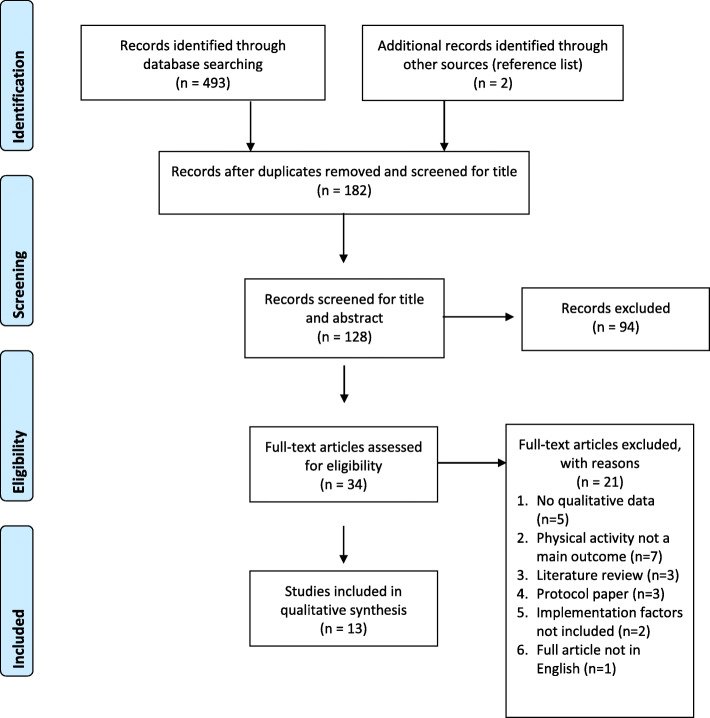
Background: Over the past decade several physical activity (PA) interventions have been shown to be efficacious in a controlled research setting, however there is a continued lack of evidence for how to successfully implement these PA interventions in real-world settings such as the community. This review aims to explore the barriers and facilitators that affect the implementation of community-based PA interventions and make recommendations to improve implementation from the included studies. Methods: A systematic literature search of EBSCOhost, Scopus, PUBMED and Web of Science was conducted to identify articles that reported qualitative data on the implementation factors of community-based interventions where PA was a primary outcome. Data were extracted using the Consolidated Framework for Implementation Research (CFIR) as a guide. Implementation factors and recommendations were then mapped onto the 5 domains of the CFIR and synthesised thematically. Results: From 495 articles, a total of 13 eligible studies were identified, with 6 studies using a mixed methods approach, and 7 reporting qualitative methods only. There were 82 implementation factors identified, including 37 barriers and 45 facilitators, and a further 26 recommendations from the papers across all 5 domains of the CFIR. More barriers than facilitators were identified within the CFIR domain inner setting, in contrast to all other domains where facilitator numbers outweighed barriers. Conclusions: This review identified many facilitators and barriers of implementing physical activity interventions in the community. A key finding of this review was the impact of implementation strategies on successful implementation of community PA interventions. From the evidence, it was clear that many barriers to implementation could have been negated or reduced by an implementation plan in which several strategies are embedded. The findings of this review also suggest more attention to individual’ skills and involvement is needed to improve self-efficacy and knowledge. The role of individuals across all organisational levels, from providers to leaders, can impact on the implementation of an intervention and its success. Trial registration: PROSPERO - CRD42020153821.
Overview
The claims and statistics of this paper haven’t been checked yet.
Free: it reads the open-access text and checks the first 5 claims that cite a source we can check. Create a free account to check every claim.
Integrity signals
Registry
Cites
Statistics
Figures
Verification
Claims the paper makes
The claims and statistics of this paper haven’t been checked yet.
Free: it reads the open-access text and checks the first 5 claims that cite a source we can check. Create a free account to check every claim.
Claims other papers make about this one
Each is checked against this paper’s own text: does it say what the citing paper says it does?
The source backs part of the claim, not all of it — or backs it for a different population, condition or comparison.
In the citing paper
“By identifying perceived facilitators and barriers across diverse interventions and consolidating patterns from participants’ experiences [21–24], strategies to promote positive behavior change, regardless of intervention framework, aims or terminology can be revealed [15].”
From Barriers and facilitators to diet, physical activity and lifestyle behavior intervention adherence: a qualitative systematic review of the literature (2023) · cites this paper as [15]
Experimental — accuracy not yet measuredThe source backs part of the claim, not all of it — or backs it for a different population, condition or comparison.
In the citing paper
“Lifestyle interventions can be rooted in a variety of frameworks and methods [14, 15], making it difficult to determine what components or ‘active ingredients’ [14–16] within interventions offer merit for behavior outcomes [17–19].”
From Barriers and facilitators to diet, physical activity and lifestyle behavior intervention adherence: a qualitative systematic review of the literature (2023) · cites this paper as [15]
Experimental — accuracy not yet measuredThe source backs part of the claim, not all of it — or backs it for a different population, condition or comparison.
In the citing paper
“One strategy to overcome this is to explore how participants within lifestyle interventions feel they are supported or hindered to change their behaviors [15].”
From Barriers and facilitators to diet, physical activity and lifestyle behavior intervention adherence: a qualitative systematic review of the literature (2023) · cites this paper as [15]
Experimental — accuracy not yet measuredThe source backs part of the claim, not all of it — or backs it for a different population, condition or comparison.
In the citing paper
“For this reason, focusing on more controllable aspects of an intervention and individual motivation can help interventionists make more actionable decisions about intervention design to improve participant adherence [15].”
From Barriers and facilitators to diet, physical activity and lifestyle behavior intervention adherence: a qualitative systematic review of the literature (2023) · cites this paper as [15]
Experimental — accuracy not yet measuredThe source backs part of the claim, not all of it — or backs it for a different population, condition or comparison.
In the citing paper
“Individualized interventions where participants have bought into an intervention [15] have been shown to be more effective [88–92].”
From Barriers and facilitators to diet, physical activity and lifestyle behavior intervention adherence: a qualitative systematic review of the literature (2023) · cites this paper as [15]
Experimental — accuracy not yet measured
6 more claims about this paper
Create a free account to see every claim other papers make about this one.
Self-check
Percentages, sums and reported differences re-computed from the paper’s own numbers.
The self-check needs the paper’s full text.
Citations
Cites
Preferred Reporting Items for Systematic Reviews and Meta-Analyses: the PRISMA statement
Moher, D., Liberati, A., Tetzlaff, J., Altman, D. G., & for the PRISMA Group (2009) · BMJ · doi:10.1136/bmj.b2535 · Cited by 83,823
Preferred Reporting Items for Systematic Reviews and Meta-Analyses: The PRISMA Statement
Moher, D., Liberati, A., Tetzlaff, J., Altman, D. G., & The PRISMA Group (2009) · PLoS Medicine · doi:10.1371/journal.pmed.1000097 · Cited by 64,042
Preferred reporting items for systematic reviews and meta-analyses: the PRISMA Statement.
(2009) · PubMed Central · Cited by 44,859
Reflecting on reflexive thematic analysis
Braun, V., & Clarke, V. (2019) · Qualitative Research in Sport, Exercise and Health · doi:10.1080/2159676x.2019.1628806 · Cited by 19,677
Damschroder, L. J., Aron, D. C., Keith, R. E., Kirsh, S. R., Alexander, J. A., & Lowery, J. C. (2009) · Implementation Science · doi:10.1186/1748-5908-4-50 · Cited by 14,496
Lee, I.-M., Shiroma, E. J., Lobelo, F., Puska, P., Blair, S. N., & Katzmarzyk, P. T. (2012) · The Lancet · doi:10.1016/s0140-6736(12)61031-9 · Cited by 8,215
Powell, B. J., Waltz, T. J., Chinman, M. J., Damschroder, L. J., Smith, J. L., Matthieu, M. M., Proctor, E. K., & Kirchner, J. E. (2015) · Implementation Science · doi:10.1186/s13012-015-0209-1 · Cited by 4,963
Guthold, R., Stevens, G. A., Riley, L. M., & Bull, F. C. (2018) · The Lancet Global Health · doi:10.1016/s2214-109x(18)30357-7 · Cited by 4,819
The Mixed Methods Appraisal Tool (MMAT) version 2018 for information professionals and researchers
Hong, Q. N., Fàbregues, S., Bartlett, G., Boardman, F., Cargo, M., Dagenais, P., Gagnon, M.-P., Griffiths, F., Nicolau, B., O’Cathain, A., et al. (2018) · Education for Information · doi:10.3233/efi-180221 · Cited by 4,737
Methods for the synthesis of qualitative research: a critical review
Barnett-Page, E., & Thomas, J. (2009) · BMC Medical Research Methodology · doi:10.1186/1471-2288-9-59 · Cited by 2,042
Research works printed but not linked: 1
- World Health Organisation. Ottawa Charter for Health Promotion: First International Conference on Health Promotion Ottawa, 21 November 1986. Retrieved from: https://www.healthpromotion.org.au/images/ottawa_charter_hp.pdf. Accessed 14 Nov 2020.
Cited by
Items 101–132 of 132
Naing, C., Htet, N. H., Tung, W. S., Aung, H. H., & Whittaker, M. A. (2023) · Figshare · doi:10.6084/m9.figshare.24257526
Murphy, J., Mansergh, F., O’Donoghue, G., van Nassau, F., Cooper, J., Grady, C., Murphy, N., Bengoechea, E. G., Murphy, M. H., Cullen, B., et al. (2023) · Figshare · doi:10.6084/m9.figshare.22603063
Self-citationSilva, C. S., Godinho, C. I. A., Encantado, J., Rodrigues, B., Carraça, E. V., Teixeira, P. J., & Silva, M. N. (2024) · Figshare · doi:10.6084/m9.figshare.26625853
Silva, C. S., Godinho, C. I. A., Encantado, J., Rodrigues, B., Carraça, E. V., Teixeira, P. J., & Silva, M. N. (2024) · Figshare · doi:10.6084/m9.figshare.26625859
Segura Martínez, P. (2023) · Repository of Digital Objects for Teaching Research and Culture (University of Valencia)
Patients with chronic diseases: physical activity level and self-perception
Triconnet, T. (2023) · HAL
Hopkins, N. (2023) · White Rose Research Online (University of Leeds, The University of Sheffield, University of York)
The Impact of Seventh-day Adventist Beliefs, Values, and Practices relative to Physical Activity
Ottey, H. (2024) · Staffordshire Online Repository (Staffordshire University)
Paulsen, L. (2025) · Publication Server of the University of Education Heidelberg (University of Education Heidelberg) · doi:10.60497/opus-1754
Laflamme, G., Trudeau, F., Lehoux, M.-C., Lemoyne, J., Brousseau‐Foley, M., & Houle, J. (2025) · BMC Family Practice · doi:10.1186/s12875-025-03138-9
B̀ouchard, D. R., Leadbetter, B., Diaz, M. F. F., Shannon, C. S., & Sibley, K. M. (2026) · Health & Social Care in the Community · doi:10.1155/hsc/5554842
Nakagawa, K., Jung, H., Okamura, H., Ishii, T., & Ishii, S. (2026) · JMA Journal · doi:10.31662/jmaj.2025-0558
Duijsens, L. J. E. (2026) · DSpace (Open University in the Netherlands) · doi:10.71583/20260625ld
Daniel, M. N., Buchholz, S. W., Schoeny, M. E., Kitsiou, S., Halloway, S., Johnson, T., Vispute, S., & Wilbur, J. (2026) · Annals of Behavioral Medicine · doi:10.1093/abm/kaag010
Community first: a systems approach to implementing integrated care
Mahesh, S., Waterman, C., Toma, M., Jackson, C., Mayrhofer, A. M., Tingle, A., & Miller, R. J. (2026) · Journal of Integrated Care · doi:10.1108/jica-06-2025-0055
Haque, N. B., Lystad, R. P., Braithwaite, J., & Mitchell, R. J. (2026) · Journal of Health Services Research & Policy · doi:10.1177/13558196261454533
O’Donnell, J., & McCann, B. (2026) · Journal of Applied Sport Psychology · doi:10.1080/10413200.2026.2678588
Fedewa, M. V., Kerch, C. J., Simmang, M. K., Grasso, K., & Aguiar, E. J. (2026) · American Journal of Lifestyle Medicine · doi:10.1177/15598276261459337
Hogg, B., Coppens, E., Gatto, D. L., Gil, C. D. C., Ayuso‐Mateos, J. L., Bakiu, K., Callanan, A., Pashoja, A. C., da Conceição, V., Dandi, Ε., et al. (2026) · PLoS ONE · doi:10.1371/journal.pone.0352598
Janssen, T. I., Vogel, O., Otto, A.-K., Klotzbier, T. J., Korbus, H., Grühn, L. A., Hildebrand, C., Jöllenbeck, T., Schoene, D., Schott, N., et al. (2026) · BMC Nursing · doi:10.1186/s12912-026-04973-6
Peels, D. A., Boekhout, J. M., Berendsen, B., Czwikla, G., van Uffelen, J. G. Z., & van Nassau, F. (2026) · Global Implementation Research and Applications · doi:10.1007/s43477-026-00242-5
PANCHAL, R. S., & Patoliya, H. (2026) · JOURNAL OF ADVANCE AND FUTURE RESEARCH · doi:10.56975/jaafr.v4i7.513016
Levinger, P., Fearn, M., Dreher, B. L., Bauman, A. E., Soh, S., Brusco, N. K., Gilbert, A. S., Muoio, R., Burton, E., & Hill, K. (2026) · Health Promotion International · doi:10.1093/heapro/daag120
Self-citationAllicock, M. A., Costa, C., McKenzie, A. H., Loomba, P., Chenier, R. S., Shegog, R., Alaniz, A., Fernández, M. E., & Savas, L. S. (2026) · JMIR Formative Research · doi:10.2196/89393
Leonhardt, C., Lauridsen, S., & Danielsen, D. (2026) · Global Implementation Research and Applications · doi:10.1007/s43477-026-00255-0
Ernawati, Haikal, M., Sumange, A., Alvia, S., Melky, E., Rifqi, A., Nuralda, Saputri, F., Mirdawati, & Haerul, H. (2026) · Humanism Jurnal Pengabdian Masyarakat · doi:10.30651/hm.v7i2.33799
Ashraf, M. N. (2026) · oURspace (University of Regina) · doi:10.82465/15
Physical activity and depression: A systematic review of clinical practice guidelines
Moreno, E. M., Poyato-Sanz, A., & Crespo, J. M. A. (2026) · Mental health and physical activity · doi:10.1016/j.mhpa.2026.100827
Kusumaningrum, N. S. D., Kaur, S., Nadal, I. P., & Winkley, K. (2026) · Health & Social Care in the Community · doi:10.1155/hsc/9932812
Yoong, S. L., Leung, G. K. W., Brown, A. D., Hillenaar, M., Bell, C., Allender, S. E., Chapman, A., Blake, M. R., Tabak, R. G., & Hayward, J. (2026) · Implementation Research and Practice · doi:10.1177/26334895261499591
Savolainen, N., Morović, M. L., Meštrić, S., Magriplis, E., Monserrat, M. J. R., Mutter, M., Sainio, T., Koivurinta, E., Kuusipalo, H., Nowak, J., et al. (2026) · Gaceta Sanitaria · doi:10.1016/j.gaceta.2026.102673
Metadata
- Authors
- Cooper, J., Murphy, J., Woods, C., Van Nassau, F., McGrath, A., Callaghan, D., Carroll, P., Kelly, P., Murphy, N., Murphy, M., Irish Physical Activity Research Collaboration (I-PARC), Bauman, A., Cullen, B., Brolly, C., Bengoechea, E. G., Mansergh, F., O’Donoghue, G., Lavelle, J., Mutrie, N., Barry, N., Smyth, P., Kielt, R., O’Brien, S., O’Shea, S., & Muppavarapu, V.
- Affiliations
- University of Limerick (IE)
- Waterford Institute of Technology (IE)
- Sport Ireland (IE)
- University of Edinburgh (GB)
- University of Ulster (GB)
- Corresponding author
- Woods, Catherine
- ORCID
- Venue
- International Journal of Behavioral Nutrition and Physical Activity
- Published
- 2021-09-07
- Volume
- 18
- Issue
- 1
- Pages
- 118-118
- ISSN
- 1479-5868 (ISSN-L)
- PMC
- PMC8422651
- OpenAlex
- W3198224841
- Cited by
- 114
- References
- 55
- Citations by year
- 2026: 24 · 2025: 24 · 2024: 39 · 2023: 22 · 2022: 5
- FWCI
- 3.40
- Type
- journal article
- Language
- en
- Open access
- gold
- doi.org
- Licence
- cc-by
- creativecommons.org/licenses/by/4.0 (tdm)
- creativecommons.org/licenses/by/4.0 (vor)
- Locations
- International Journal of Behavioral Nutrition and Physical Activity (publishedVersion, cc-by)
- PubMed Central (publishedVersion, cc-by)
- PubMed (publishedVersion)
- Arrow@dit (Dublin Institute of Technology) (acceptedVersion)
- Ulster University Research Portal (Ulster University) (submittedVersion, cc-by)
- DOAJ (DOAJ: Directory of Open Access Journals) (submittedVersion, cc-by-sa)
- Figshare (submittedVersion, cc-by-nc-sa)
- Edinburgh Research Explorer (University of Edinburgh) (submittedVersion, cc-by)
- Bristol Research (University of Bristol) (submittedVersion, cc-by)
- VU Research Portal (submittedVersion, other-oa)
- University of Limerick Institutional Repository (University of Limerick) (submittedVersion, cc-by-nc-sa)
- Data Archiving and Networked Services (DANS) (submittedVersion, other-oa)
- Funders
- Health Research Board (APA-2-17-030)
- Topics
- Health Sciences › Health Professions › General Health Professions › Health Policy Implementation Science
- Health Sciences › Medicine › Public Health, Environmental and Occupational Health › Physical Activity and Health
- Health Sciences › Health Professions › General Health Professions › Health Sciences Research and Education
- Keywords
- physical activity interventions, community-based intervention, implementation barriers, implementation facilitators, Consolidated Framework for Implementation Research, implementation strategies, self-efficacy, organizational leadership, inner setting
- MeSH terms
- Health Status, Humans, Exercise, Qualitative Research, Community-Based Participatory Research
About these checks
Registry, retraction, Cites and statistics results are computed, not judged, with one exception: a printed reference that no index lists is read once by a model before it counts as a citation error. Claims are extracted by a model and kept only when their quote appears verbatim in the text; each cited source is then checked, with a model’s help, for whether it says what the claim relies on. Those verdicts can be wrong — read the claim’s quote and the cited source before relying on one.
Statistics and arithmetic are recomputed, not judged.
Confidence bands are shown only for fields calibrated on our annotated test set. None is calibrated yet, so no band is shown.
What counts as a claim ›How we measure confidence ›How we check this ›
Are you an author, or do you see a problem with this page? Request a review
Data sources
Bibliographic data: Semantic Scholar, OpenAlex, Crossref.
Contains information from the Semantic Scholar Academic Graph Datasets, made available under the ODC Attribution License (ODC-BY 1.0).
Semantic Scholar’s data is described in: Kinney, R., et al. (2023). The Semantic Scholar Open Data Platform. arXiv:2301.10140.
