

The DOI matches its Crossref record; 2 of the 2 references it cites were found in a registry or an index.
Longitudinal changes in device-measured physical activity from childhood to young adulthood: the PANCS follow-up study
Abstract
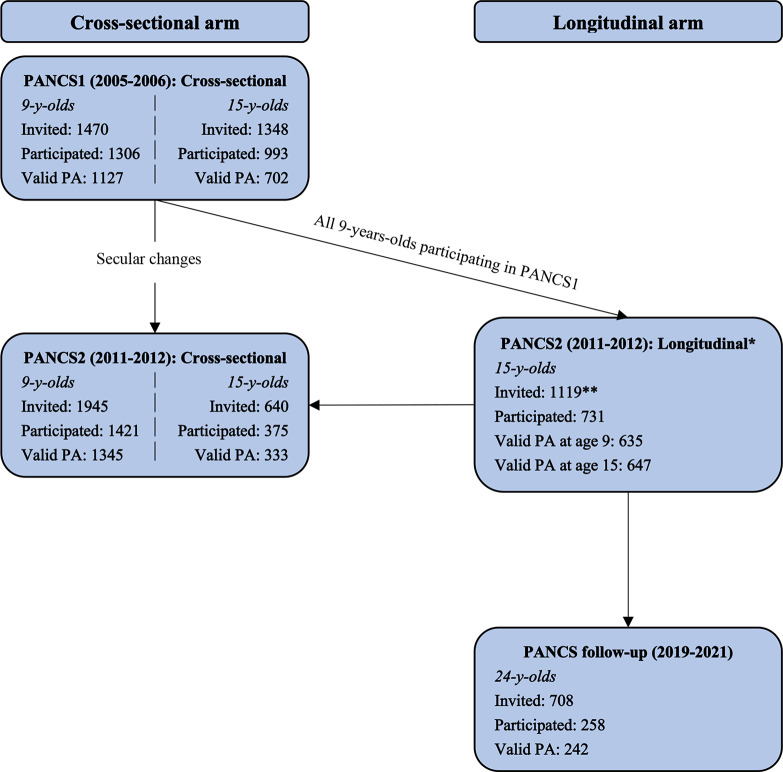
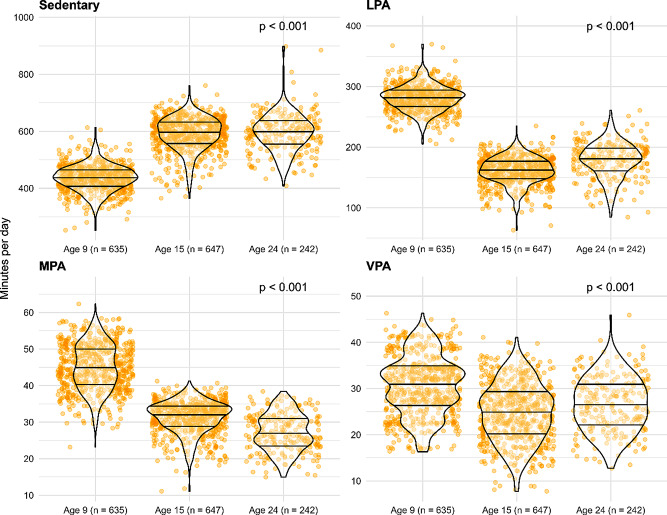
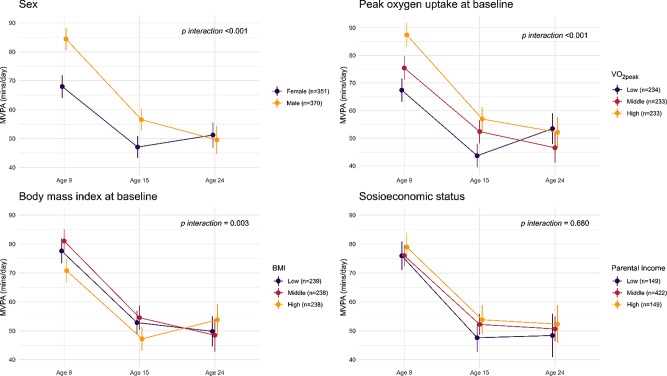
Background: There is a lack of longitudinal studies examining changes in device-measured physical activity and sedentary time from childhood to young adulthood. We aimed to assess changes in device-measured physical activity and sedentary time from childhood, through adolescence, into young adulthood in a Norwegian sample of ostensibly healthy men and women. Methods: A longitudinal cohort of 731 Norwegian boys and girls (49% girls) participated at age 9 years (2005–2006) and 15 years (2011–2012), and 258 of these participated again at age 24 years (2019–2021; including the COVID-19 pandemic period). Physical activity and sedentary time were measured using ActiGraph accelerometers. Linear mixed models were used to analyse changes in physical activity and sedentary time and whether low levels of childhood physical activity track, i.e., persist into young adulthood (n change =721; n tracking =640). Results: The most prominent change occurred between the ages of 9 to 15 years, with an increase in sedentary time (150 min/day) and less time spent in light (125 min/day), moderate (16 min/day), and vigorous physical activity (8 min/day). Only smaller changes were observed between the ages of 15 and 24 years. Changes in moderate-to-vigorous physical activity from childhood to young adulthood differed between subgroups of sex, tertiles of body mass index at baseline and tertiles of peak oxygen uptake at baseline. While the tracking models indicated low absolute stability of physical activity from childhood to young adulthood, children in the lowest quartiles of moderate-to-vigorous (OR:1.88; 95%CI: 1.23, 2.86) and total physical activity (OR: 1.87; 95%CI: 1.21, 2.87) at age 9 years were almost 90% more likely to be in these quartiles at age 24 years compared to those belonging to the upper three quartiles at baseline. Conclusions: We found a substantial reduction in physical activity and increase in time spent sedentary between age 9 and 15 years. Contrary to previous studies, using mainly self-reported physical activity, little change was observed between adolescence and young adulthood. The least active children were more likely to remain the least active adults and could be targeted for early intervention.
Overview
The claims and statistics of this paper haven’t been checked yet.
Run the check — free, no account needed. It reads the open-access text and checks the sources it cites.
Integrity signals
Registry
Cites
Statistics
Figures
Verification
Claims the paper makes
The claims and statistics of this paper haven’t been checked yet.
Run the check — free, no account needed. It reads the open-access text and checks the sources it cites.
Claims other papers make about this one
Each is checked against this paper’s own text: does it say what the citing paper says it does?
In the citing paper
“a decline in PA levels across adolescence has been consistently reported (Husøy et al., 2024).”
From Physical activity and academic performance in adolescents: a systematic review of intensity, frequency, and mediating factors (2026) · cites this paper as Husøy et al., 2024
Self-check
Percentages, sums and reported differences re-computed from the paper’s own numbers.
The self-check needs the paper’s full text.
Citations
Cites
Calibration of two objective measures of physical activity for children
Evenson, K. R., Catellier, D. J., Gill, K., Ondrak, K. S., & McMurray, R. G. (2008) · Journal of Sports Sciences · doi:10.1080/02640410802334196 · Cited by 2,677
Aerobic Capacity Reference Data in 3816 Healthy Men and Women 20–90 Years
Loe, H., Rognmo, Ø., Saltin, B., & Wisløff, U. (2013) · PLoS ONE · doi:10.1371/journal.pone.0064319 · Cited by 216
Research works printed but not linked: 39
- van Sluijs EMF, Ekelund U, Crochemore-Silva I, Guthold R, Ha A, Lubans D et al. Physical activity behaviours in adolescence: current evidence and opportunities for intervention. Lancet [Internet]. 2021;398:429–42. https://doi.org/10.1016/S0140-6736(21)01259-9. · DOI · Paper page
- Dalene KE, Anderssen SA, Andersen LB, Steene-Johannessen J, Ekelund U, Hansen BH et al. Secular and longitudinal physical activity changes in population-based samples of children and adolescents. Scand J Med Sci Sports [Internet]. 2018;28:161–71. Available from: https://onlinelibrary.wiley.com/doi/abs/https://doi.org/10.1111/sms.12876. · DOI · Paper page
- Ortega FB, Konstabel K, Pasquali E, Ruiz JR, Hurtig-Wennlöf A, Mäestu J et al. Objectively measured physical activity and sedentary time during childhood, adolescence and young adulthood: a cohort study. PLoS One [Internet]. 2013;8:e60871. https://doi.org/10.1371/journal.pone.0060871. · DOI · Paper page
- Corder K, Winpenny E, Love R, Brown HE, White M, van Sluijs E. Change in physical activity from adolescence to early adulthood: a systematic review and meta-analysis of longitudinal cohort studies. Br J Sports Med [Internet]. 2019;53:496–503. https://doi.org/10.1136/bjsports-2016-097330. · DOI
- Lee I-M, Shiroma EJ, Lobelo F, Puska P, Blair SN, Katzmarzyk PT et al. Effect of physical inactivity on major non-communicable diseases worldwide: an analysis of burden of disease and life expectancy. Lancet [Internet]. 2012;380:219–29. https://doi.org/10.1016/S0140-6736(12)61031-9. · DOI · Paper page
- Katzmarzyk PT, Friedenreich C, Shiroma EJ, Lee I-M. Physical inactivity and non-communicable disease burden in low-income, middle-income and high-income countries. Br J Sports Med [Internet]. 2022;56:101–6. https://doi.org/10.1136/bjsports-2020-103640. · DOI
- Baranowski T, Cullen KW, Basen-Engquist K, Wetter DW, Cummings S, Martineau DS et al. Transitions out of high school: time of increased cancer risk? Prev Med [Internet]. 1997;26:694–703. https://doi.org/10.1006/pmed.1997.0193. · DOI
- Caspersen CJ, Pereira MA, Curran KM. Changes in physical activity patterns in the United States, by sex and cross-sectional age. Med Sci Sports Exerc [Internet]. 2000;32:1601–9. https://doi.org/10.1097/00005768-200009000-00013. · DOI · Paper page
- Leslie E, Fotheringham MJ, Owen N, Bauman A. Age-related differences in physical activity levels of young adults. Med Sci Sports Exerc [Internet]. 2001;33:255–8. https://doi.org/10.1097/00005768-200102000-00014. · DOI
- Leslie E, Owen N, Salmon J, Bauman A, Sallis JF, Lo SK. Insufficiently active Australian college students: perceived personal, social, and environmental influences. Prev Med [Internet]. 1999;28:20–7. https://doi.org/10.1006/pmed.1998.0375. · DOI
- Hayes G, Dowd KP, MacDonncha C, Donnelly AE. Tracking of Physical Activity and Sedentary Behavior From Adolescence to Young Adulthood: A Systematic Literature Review. J Adolesc Health [Internet]. 2019;65:446–54. https://doi.org/10.1016/j.jadohealth.2019.03.013. · DOI
- Telama R. Tracking of physical activity from childhood to adulthood: a review. Obes Facts [Internet]. 2009;2:187–95. https://doi.org/10.1159/000222244. · DOI
- Aarnio M, Winter T, Peltonen J, Kujala UM, Kaprio J. Stability of leisure-time physical activity during adolescence–a longitudinal study among 16-, 17- and 18-year-old Finnish youth. Scand J Med Sci Sports [Internet]. 2002;12:179–85. https://doi.org/10.1034/j.1600-0838.2002.00250.x. · DOI
- Andersen LB, Haraldsdóttir J. Tracking of cardiovascular disease risk factors including maximal oxygen uptake and physical activity from late teenage to adulthood. An 8-year follow-up study. J Intern Med [Internet]. 1993;234:309–15. https://doi.org/10.1111/j.1365-2796.1993.tb00748.x. · DOI
- Anderssen N, Wold B, Torsheim T. Tracking of physical activity in adolescence. Res Q Exerc Sport [Internet]. 2005;76:119–29. https://doi.org/10.1080/02701367.2005.10599274. · DOI
- Azevedo MR, Menezes AM, Assunção MC, Gonçalves H, Arumi I, Horta BL et al. Tracking of physical activity during adolescence: the 1993 Pelotas Birth Cohort, Brazil. Rev Saúde Pública [Internet]. 2014 [cited 2021 Oct 4];48:925–30. Available from: https://www.scielo.br/scielo.php?script=sci_arttext&pid=S0034-89102014000600925 · DOI
- Boreham C, Robson PJ, Gallagher AM, Cran GW, Savage JM, Murray LJ. Tracking of physical activity, fitness, body composition and diet from adolescence to young adulthood: The Young Hearts Project, Northern Ireland. Int J Behav Nutr Phys Act [Internet]. 2004;1:14. https://doi.org/10.1186/1479-5868-1-14. · DOI
- Cleland V, Dwyer T, Venn A. Which domains of childhood physical activity predict physical activity in adulthood? A 20-year prospective tracking study. Br J Sports Med [Internet]. 2012;46:595–602. https://doi.org/10.1136/bjsports-2011-090508. · DOI
- Glenmark B, Hedberg G, Jansson E. Prediction of physical activity level in adulthood by physical characteristics, physical performance and physical activity in adolescence: an 11-year follow-up study. Eur J Appl Physiol Occup Physiol [Internet]. 1994;69:530–8. https://doi.org/10.1007/BF00239871. · DOI
- Rauner A, Jekauc D, Mess F, Schmidt S, Woll A. Tracking physical activity in different settings from late childhood to early adulthood in Germany: the MoMo longitudinal study. BMC Public Health [Internet]. 2015;15:391. https://doi.org/10.1186/s12889-015-1731-4. · DOI
- Raustorp A, Fröberg A. Tracking of Pedometer-Determined Physical Activity: A 16-Year Follow-Up Study. J Phys Act Health [Internet]. 2018;15:7–12. https://doi.org/10.1123/jpah.2017-0146. · DOI
- Suppli CH, Due P, Henriksen PW, Rayce SLB, Holstein BE, Rasmussen M. Low vigorous physical activity at ages 15, 19 and 27: childhood socio-economic position modifies the tracking pattern. Eur J Public Health [Internet]. 2013;23:19–24. https://doi.org/10.1093/eurpub/cks040. · DOI
- Telama R, Yang X, Viikari J, Välimäki I, Wanne O, Raitakari O. Physical activity from childhood to adulthood: a 21-year tracking study. Am J Prev Med [Internet]. 2005;28:267–73. https://doi.org/10.1016/j.amepre.2004.12.003. · DOI · Paper page
- Twisk JW, Kemper HC, van Mechelen W. Tracking of activity and fitness and the relationship with cardiovascular disease risk factors. Med Sci Sports Exerc [Internet]. 2000;32:1455–61. https://doi.org/10.1097/00005768-200008000-00014. · DOI
- Kolle E, Steene-Johannessen J, Andersen LB, Anderssen SA. Objectively assessed physical activity and aerobic fitness in a population-based sample of Norwegian 9- and 15-year-olds. Scandinavian Journal of Medicine & Science in Sports [Internet]. 2010;20:e41–7. https://doi.org/10.1111/j.1600-0838.2009.00892.x. · DOI
- Steene-Johannessen J, Anderssen SA, Kolle E, Hansen BH, Bratteteig M, Dalhaug EM et al. Temporal trends in physical activity levels across more than a decade - a national physical activity surveillance system among Norwegian children and adolescents. Int J Behav Nutr Phys Act [Internet]. 2021;18:55. https://doi.org/10.1186/s12966-021-01120-z. · DOI
- Aadland E, Andersen LB, Anderssen SA, Resaland GK. A comparison of 10 accelerometer non-wear time criteria and logbooks in children. BMC Public Health [Internet]. 2018;18. https://doi.org/10.1186/s12889-018-5212-4. · DOI
- Rich C, Geraci M, Griffiths L, Sera F, Dezateux C, Cortina-Borja M. Quality control methods in accelerometer data processing: defining minimum wear time. PLoS One [Internet]. 2013;8:e67206. https://doi.org/10.1371/journal.pone.0067206. · DOI
- Edvardsen E, Hansen BH, Holme IM, Dyrstad SM, Anderssen SA. Reference values for cardiorespiratory response and fitness on the treadmill in a 20- to 85-year-old population. Chest [Internet]. 2013;144:241–8. https://doi.org/10.1378/chest.12-1458. · DOI
- Little RJA, Rubin DB. Statistical analysis with missing data [Internet]. Hoboken, NJ, USA: John Wiley & Sons, Inc.; 2002. https://doi.org/10.1002/9781119013563. · DOI · Paper page
- Malina RM. Tracking of physical activity across the lifespan [Internet]. President’s Council on Physical Fitness and Sports, Washington DC.; 2001 Sep. Available from: https://files.eric.ed.gov/fulltext/ED470692.pdf. · DOI
- Nader PR, Bradley RH, Houts RM, McRitchie SL, O’Brien M. Moderate-to-vigorous physical activity from ages 9 to 15 years. JAMA [Internet]. 2008;300:295–305. https://doi.org/10.1001/jama.300.3.295. · DOI
- Steene-Johannessen J, Hansen BH, Dalene KE, Kolle E, Northstone K, Møller NC et al. Variations in accelerometry measured physical activity and sedentary time across Europe - harmonized analyses of 47,497 children and adolescents. Int J Behav Nutr Phys Act [Internet]. 2020;17:38. https://doi.org/10.1186/s12966-020-00930-x. · DOI
- Pedišić Ž, Bauman A. Accelerometer-based measures in physical activity surveillance: current practices and issues. Br J Sports Med [Internet]. 2015;49:219–23. https://doi.org/10.1136/bjsports-2013-093407. · DOI
- Grydeland M, Hansen BH, Ried-Larsen M, Kolle E, Anderssen SA. Comparison of three generations of ActiGraph activity monitors under free-living conditions: do they provide comparable assessments of overall physical activity in 9-year old children? BMC Sports Sci Med Rehabil [Internet]. 2014;6:26. https://doi.org/10.1186/2052-1847-6-26. · DOI
- Ried-Larsen M, Brønd JC, Brage S, Hansen BH, Grydeland M, Andersen LB et al. Mechanical and free living comparisons of four generations of the Actigraph activity monitor. Int J Behav Nutr Phys Act [Internet]. 2012;9:113. https://doi.org/10.1186/1479-5868-9-113. · DOI
- McClain JJ, Abraham TL, Brusseau TA Jr, Tudor-Locke C. Epoch length and accelerometer outputs in children: comparison to direct observation. Med Sci Sports Exerc [Internet]. 2008;40:2080–7. Available from: https://www.ncbi.nlm.nih.gov/pubmed/18981941. · DOI
- Sirard JR, Pate RR. Physical activity assessment in children and adolescents. Sports Med [Internet]. 2001;31:439–54. https://doi.org/10.2165/00007256-200131060-00004. · DOI
- Kristman V, Manno M, Côté P. Loss to follow-up in cohort studies: how much is too much? Eur J Epidemiol [Internet]. 2004;19:751–60. https://doi.org/10.1023/b:ejep.0000036568.02655.f8. · DOI · Paper page
Cited by
Sorted by citations
Jee, H. (2026) · Journal of Exercise Rehabilitation · doi:10.12965/jer.2550854.427
Metadata
- Authors
- Husøy, A., Kolle, E., Steene-Johannessen, J., Dalene, K. E., Andersen, L. B., Ekelund, U., & Anderssen, S. A.
- ORCID
- Husøy, Anders
- Venue
- International Journal of Behavioral Nutrition and Physical Activity
- Published
- 2024-03-06
- Volume
- 21
- Issue
- 1
- ISSN
- 1479-5868
- PMC
- PMC10916240
- Cited by
- 26
- References
- 2
- Language
- en
- Funders
- Norges Forskningsråd (#249932)
About these checks
Registry, retraction, Cites and statistics results are computed, not judged, with one exception: a printed reference that no index lists is read once by a model before it counts as a citation error. Claims are extracted by a model and kept only when their quote appears verbatim in the text; each cited source is then checked, with a model’s help, for whether it says what the claim relies on. Those verdicts can be wrong — read the claim’s quote and the cited source before relying on one.
Statistics and arithmetic are recomputed, not judged.
Confidence bands are shown only for fields calibrated on our annotated test set. None is calibrated yet, so no band is shown.
What counts as a claim ›How we measure confidence ›How we check this ›
Are you an author, or do you see a problem with this page? Request a review
How to cite
Cite CoChat for the checks on this page, and the paper for its own findings.
- This page
- CoChat. (2026). Citation check: Longitudinal changes in device-measured physical activity from childhood to young adulthood: the PANCS follow-up study. https://app.cochat.ai/papers/10.1186/s12966-024-01578-7
- The paper
- Husøy, A., Kolle, E., Steene-Johannessen, J., Dalene, K. E., Andersen, L. B., Ekelund, U., & Anderssen, S. A. (2024). Longitudinal changes in device-measured physical activity from childhood to young adulthood: the PANCS follow-up study. International Journal of Behavioral Nutrition and Physical Activity. https://doi.org/10.1186/s12966-024-01578-7
